Bridging the divide: axion searches and axino phenomenology at colliders
Pith reviewed 2026-05-17 23:34 UTC · model grok-4.3
The pith
LHC with 140 fb^{-1} can probe axion decay constants below 10^{11} GeV for higgsino masses below 1 TeV.
A machine-rendered reading of the paper's core claim, the machinery that carries it, and where it could break.
Core claim
In the supersymmetric DFSZ axion model with R-parity conservation, the axino possesses tree-level couplings to the Higgs sector. This enables displaced decays of mostly higgsino next-to-lightest supersymmetric particles into mostly axino lightest supersymmetric particles. Simulations produced with MadGraph and analyzed in the MadAnalysis5 framework demonstrate that for higgsino masses below 1 TeV the axion decay constant below 10^{11} GeV can be probed by the LHC with an integrated luminosity of 140 fb^{-1}.
What carries the argument
Displaced decays of mostly higgsino NLSP states into mostly axino LSP states, driven by tree-level axino couplings to the Higgs sector in the supersymmetric DFSZ model.
If this is right
- Collider experiments can set limits on axion decay constants that are complementary to those from direct detection and astrophysical observations.
- Existing LHC datasets already suffice to explore part of the parameter space in supersymmetric DFSZ axion models.
- Supersymmetric axion scenarios become accessible to study with current collider facilities rather than requiring future machines.
- The approach opens a path to broader collider searches for other supersymmetric axion realizations.
Where Pith is reading between the lines
- Non-observation in such searches would tighten bounds on the allowed range of axion decay constants in these models.
- Higher-luminosity LHC runs could extend sensitivity to larger higgsino masses or higher values of the decay constant.
- Analogous displaced-decay analyses might be applied to axino production in other supersymmetric extensions beyond the DFSZ case.
Load-bearing premise
The next-to-lightest supersymmetric particle is mostly higgsino-like and undergoes a displaced decay into a mostly axino lightest supersymmetric particle.
What would settle it
A dedicated LHC search for displaced vertices arising from neutralino decays to axinos that observes no excess events in the signal region for higgsino masses below 1 TeV and fa below 10^{11} GeV would show the claimed sensitivity does not hold.
Figures





read the original abstract
We discuss a phenomenological model that extends the minimal supersymmetric standard model to contain axions and their supersymmetric partner, the axino. In the supersymmetric DFSZ axion model, the axino has tree level couplings to the higgs sector. In the case where $R$-parity is conserved, collider experiments may be sensitive to displaced decays of heavier neutralino states into lighter, mostly axino states. We present a sensitivity analysis using a model in which mostly higgsino next-to-lightest supersymmetric particle states decay into a mostly axino lightest supersymmetric particle. The model is studied using Monte Carlo simulation produced using $\texttt{MadGraph}$ and estimates of experimental sensitivities to the model, including detector simulation and kinematic selections, are evaluated using the $\texttt{MadAnalysis5}$ framework. For a higgsino mass below 1 TeV, the axion decay constant below $f_{a} < 10^{11}$ GeV can be effectively probed by the Large Hadron Collider with an integrated luminosity of 140 fb$^{-1}$. This work demonstrates that supersymmetric DFSZ axion models can be studied with existing collider experiments, offering complementary sensitivity to direct-detection and astrophysical searches and paving the way for broader exploration of supersymmetric axion scenarios.
Editorial analysis
A structured set of objections, weighed in public.
Referee Report
Summary. The manuscript extends the MSSM with the supersymmetric DFSZ axion model, introducing an axino as a possible LSP. It focuses on R-parity conserving scenarios in which a mostly-higgsino NLSP undergoes displaced decays to a mostly-axino LSP. Monte Carlo events are generated with MadGraph and passed through MadAnalysis5 for detector simulation and kinematic selections on displaced vertices. The central claim is that, for higgsino masses below 1 TeV and 140 fb^{-1} of integrated luminosity, the LHC can probe axion decay constants fa below 10^{11} GeV, offering complementary sensitivity to direct-detection and astrophysical searches.
Significance. If the simulation chain proves reliable, the result would establish a concrete collider handle on supersymmetric axion models in a parameter region that is only weakly constrained by other methods. The emphasis on displaced vertices tied to the fa-dependent lifetime is a clear strength, as is the explicit use of tree-level DFSZ couplings. The work illustrates how existing LHC data can be repurposed for axino phenomenology.
major comments (1)
- [Sensitivity analysis] Sensitivity analysis (results section): The quoted reach fa < 10^{11} GeV for m_higgsino < 1 TeV at 140 fb^{-1} is obtained from MadGraph + MadAnalysis5 modeling of displaced-vertex efficiencies and backgrounds. No data-driven validation, comparison to alternative generators, or systematic uncertainty breakdown for low-pT displaced tracks and fake vertices is presented; an O(1) shift in either signal efficiency or background yield would directly rescale the fa limit.
minor comments (2)
- [Abstract] The abstract and model description should state the assumed NLSP-LSP mass splitting and the precise higgsino-axino mixing angles used in the event generation.
- [Introduction] A short comparison table or plot showing how the projected limit compares with existing ATLAS/CMS displaced-SUSY searches would improve context.
Simulated Author's Rebuttal
We thank the referee for their careful reading of the manuscript and for the positive assessment of its significance. The comment on the sensitivity analysis is well taken, and we agree that additional discussion of methodological limitations and uncertainties would improve the presentation. We have revised the results section accordingly while maintaining that the Monte Carlo approach provides a reasonable first estimate of the reach.
read point-by-point responses
-
Referee: Sensitivity analysis (results section): The quoted reach fa < 10^{11} GeV for m_higgsino < 1 TeV at 140 fb^{-1} is obtained from MadGraph + MadAnalysis5 modeling of displaced-vertex efficiencies and backgrounds. No data-driven validation, comparison to alternative generators, or systematic uncertainty breakdown for low-pT displaced tracks and fake vertices is presented; an O(1) shift in either signal efficiency or background yield would directly rescale the fa limit.
Authors: We acknowledge that the analysis relies on Monte Carlo simulation without data-driven validation, as the proposed signal has not been observed. MadGraph and MadAnalysis5 are standard tools for such phenomenological studies, and the displaced-vertex selections follow established techniques from existing LHC searches for long-lived particles. In the revised manuscript we have added a dedicated paragraph in the results section discussing possible systematic effects on low-pT track reconstruction and fake-vertex rates, estimating an O(1) uncertainty on signal efficiency. We also include a brief comparison note with alternative generators (e.g., Pythia) for a subset of benchmark points. While these additions do not eliminate all modeling uncertainties, they clarify the robustness of the quoted reach and show that even with a factor-of-two degradation the LHC would still probe fa values below 10^{11} GeV for higgsino masses below 1 TeV. revision: yes
Circularity Check
No circularity: sensitivity reach obtained from external Monte Carlo simulation chain
full rationale
The paper performs a Monte Carlo sensitivity study by generating events in MadGraph for a mostly-higgsino NLSP decaying to a mostly-axino LSP in the supersymmetric DFSZ model, then processing them through MadAnalysis5 for detector simulation and kinematic selections on displaced vertices. The quoted reach (fa < 10^11 GeV for m_higgsino < 1 TeV at 140 fb^{-1}) is the direct numerical output of this simulation pipeline under stated assumptions about lifetimes, efficiencies, and backgrounds; it does not reduce any prediction to a fitted parameter or prior self-citation by construction. No equations, ansatze, or uniqueness theorems are invoked that would make the result tautological with the inputs. The analysis is therefore self-contained against external benchmarks and receives the default non-circularity finding.
Axiom & Free-Parameter Ledger
free parameters (2)
- higgsino mass
- axion decay constant fa
axioms (2)
- domain assumption R-parity is conserved
- domain assumption Tree-level axino couplings to the Higgs sector in the supersymmetric DFSZ model
invented entities (1)
-
axino
no independent evidence
Lean theorems connected to this paper
-
IndisputableMonolith/Foundation/RealityFromDistinction.leanreality_from_one_distinction unclear?
unclearRelation between the paper passage and the cited Recognition theorem.
For a higgsino mass below 1 TeV, the axion decay constant below fa < 10^{11} GeV can be effectively probed by the Large Hadron Collider with an integrated luminosity of 140 fb^{-1}.
What do these tags mean?
- matches
- The paper's claim is directly supported by a theorem in the formal canon.
- supports
- The theorem supports part of the paper's argument, but the paper may add assumptions or extra steps.
- extends
- The paper goes beyond the formal theorem; the theorem is a base layer rather than the whole result.
- uses
- The paper appears to rely on the theorem as machinery.
- contradicts
- The paper's claim conflicts with a theorem or certificate in the canon.
- unclear
- Pith found a possible connection, but the passage is too broad, indirect, or ambiguous to say the theorem truly supports the claim.
Forward citations
Cited by 1 Pith paper
-
Searches for massive, long-lived particles in events with displaced vertices with ATLAS
ATLAS sets limits on long-lived particles in Higgs Portal, SUSY, and DFSZ axino models via displaced-vertex searches with new fuzzy reconstruction and muon-trigger techniques in Run 2 and Run 3 data.
Reference graph
Works this paper leans on
-
[1]
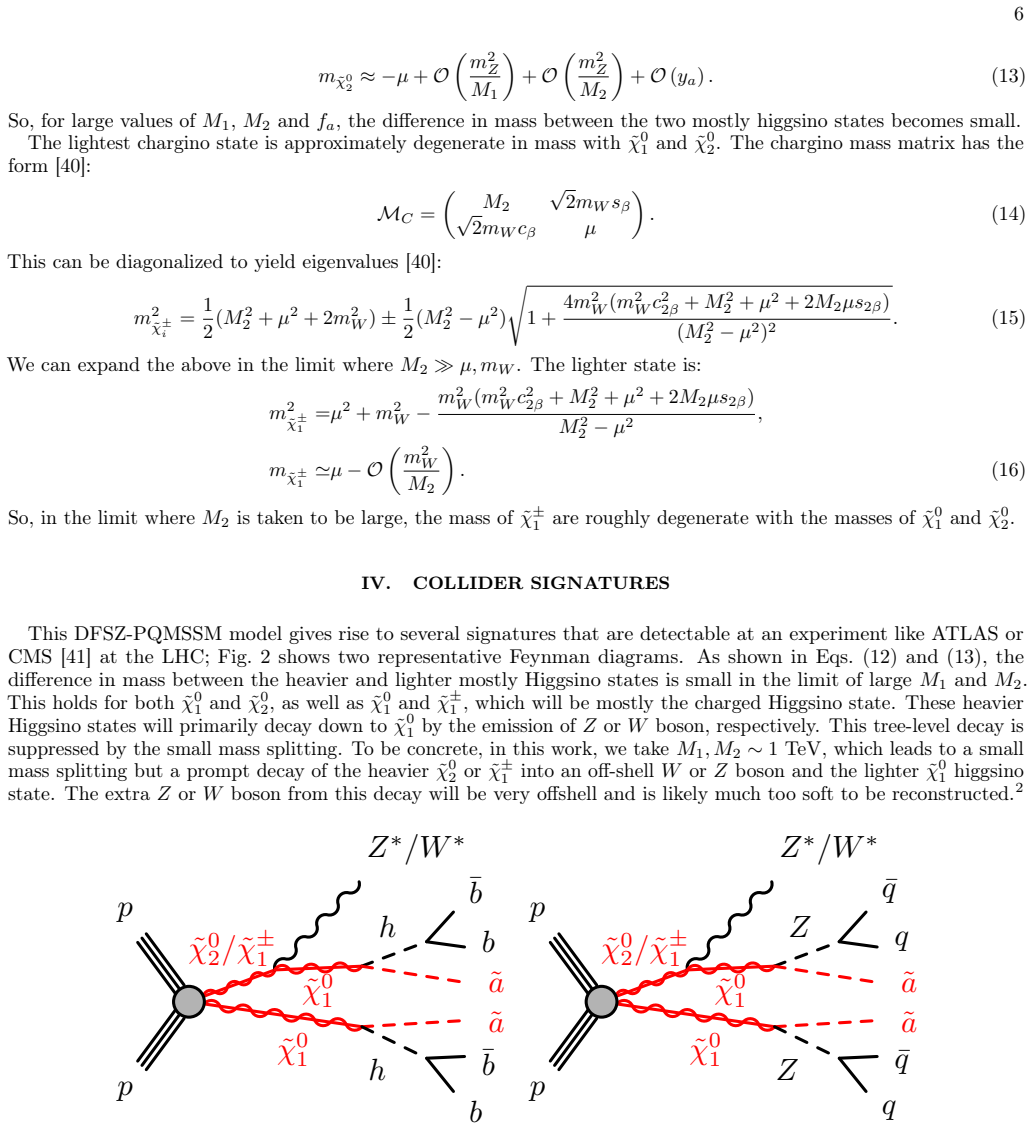
The chargino mass matrix has the form [40]: MC = M2 √ 2mW sβ√ 2mW cβ µ .(14) This can be diagonalized to yield eigenvalues [40]: m2 ˜χ± i = 1 2(M 2 2 +µ 2 + 2m2 W )± 1 2(M 2 2 −µ 2) s 1 + 4m2 W (m2 W c2 2β +M 2 2 +µ 2 + 2M2µs2β) (M 2 2 −µ 2)2 .(15) We can expand the above in the limit whereM2 ≫µ, m W. The lighter state is: m2 ˜χ± 1 =µ2 +m 2 W − m2 W (m2 W...
work page 2000
-
[2]
R. D. Peccei and H. R. Quinn, CP Conservation in the Presence of Instantons, Phys. Rev. Lett.38, 1440 (1977)
work page 1977
-
[3]
R. D. Peccei and H. R. Quinn, Constraints Imposed by CP Conservation in the Presence of Instantons, Phys. Rev. D16, 1791 (1977)
work page 1977
-
[4]
’t Hooft, Symmetry Breaking Through Bell-Jackiw Anomalies, Phys
G. ’t Hooft, Symmetry Breaking Through Bell-Jackiw Anomalies, Phys. Rev. Lett.37, 8 (1976)
work page 1976
-
[5]
R. J. Crewther, P. Di Vecchia, G. Veneziano, and E. Witten, Chiral Estimate of the Electric Dipole Moment of the Neutron in Quantum Chromodynamics, Phys. Lett. B88, 123 (1979), [Erratum: Phys. Lett. B 91, 487 (1980)]
work page 1979
- [6]
-
[7]
A. Caputo and G. Raffelt, Astrophysical Axion Bounds: The 2024 Edition, PoSCOSMICWISPers, 041 (2024), arXiv:2401.13728 [hep-ph]
-
[8]
J. Preskill, M. B. Wise, and F. Wilczek, Cosmology of the Invisible Axion, Phys. Lett. B120, 127 (1983)
work page 1983
-
[9]
L. F. Abbott and P. Sikivie, A Cosmological Bound on the Invisible Axion, Phys. Lett. B120, 133 (1983)
work page 1983
-
[10]
M. Dine and W. Fischler, The Not So Harmless Axion, Phys. Lett. B120, 137 (1983)
work page 1983
- [11]
- [12]
-
[13]
G. G. Raffelt, Astrophysical methods to constrain axions and other novel particle phenomena, Phys. Rep.198, 1 (1990)
work page 1990
-
[14]
A Search for Invisible Axion Dark Matter with the Axion Dark Matter Experiment
N. Duet al.(ADMX), A Search for Invisible Axion Dark Matter with the Axion Dark Matter Experiment, Phys. Rev. Lett. 120, 151301 (2018), arXiv:1804.05750 [hep-ex]
work page internal anchor Pith review Pith/arXiv arXiv 2018
-
[15]
Results from phase 1 of the HAYSTAC microwave cavity axion experiment
L. Zhonget al.(HAYSTAC), Results from phase 1 of the HAYSTAC microwave cavity axion experiment, Phys. Rev. D97, 092001 (2018), arXiv:1803.03690 [hep-ex]
work page internal anchor Pith review Pith/arXiv arXiv 2018
- [16]
-
[17]
Design Overview of the DM Radio Pathfinder Experiment
M. Silva-Feaver, S. Chaudhuri, H.-M. Cho, C. Dawson, P. Graham, K. Irwin, S. Kuenstner, D. Li, J. Mardon, H. Moseley, R. Mule, A. Phipps, S. Rajendran, Z. Steffen, and B. Young, Design Overview of DM Radio Pathfinder Experiment, IEEE Trans. Appl. Supercond.27, 1 (2017), arXiv:1610.09344 [astro-ph.IM]
work page internal anchor Pith review Pith/arXiv arXiv 2017
-
[18]
F. Bajjali, S. Dornbusch, M. Ekmedžić, D. Horns, C. Kasemann, A. Lobanov, L. H. Nguyen, M. Tluczykont, G. Tuccari, J. Ulrichs,et al., First results from BRASS-p broadband searches for hidden photon dark matter, JCAP08, 077 (2023), arXiv:2306.05934 [hep-ex]
- [19]
-
[20]
J. E. Kim, Weak-Interaction Singlet and StrongCPInvariance, Phys. Rev. Lett.43, 103 (1979)
work page 1979
-
[21]
M. A. Shifman, A. I. Vainshtein, and V. I. Zakharov, Can confinement ensure natural CP invariance of strong interactions?, Nucl. Phys. B166, 493 (1980)
work page 1980
-
[22]
A. R. Zhitnitsky, On Possible Suppression of the Axion Hadron Interactions., Sov. J. Nucl. Phys.31, 260 (1980)
work page 1980
-
[23]
M. Dine, W. Fischler, and M. Srednicki, A simple solution to the strong CP problem with a harmless axion, Phys. Lett. B 104, 199 (1981)
work page 1981
-
[24]
Maiani, All You Need to Know about the Higgs Boson, Conf
L. Maiani, All You Need to Know about the Higgs Boson, Conf. Proc. C7909031, 1 (1979)
work page 1979
-
[25]
M. J. G. Veltman, The Infrared - Ultraviolet Connection, Acta Phys. Polon. B12, 437 (1981)
work page 1981
-
[26]
Witten, Dynamical Breaking of Supersymmetry, Nucl
E. Witten, Dynamical Breaking of Supersymmetry, Nucl. Phys. B188, 513 (1981)
work page 1981
-
[27]
R. K. Kaul, Gauge Hierarchy in a Supersymmetric Model, Phys. Lett. B109, 19 (1982)
work page 1982
-
[28]
P. Moxhay and K. Yamamoto, Peccei-Quinn Symmetry Breaking by Radiative Corrections in Supergravity, Phys. Lett. B 151, 363 (1985)
work page 1985
-
[29]
H. Murayama, H. Suzuki, and T. Yanagida, Radiative breaking of Peccei-Quinn symmetry at the intermediate mass scale, Phys. Lett. B291, 418 (1992)
work page 1992
-
[30]
Implications of an axino LSP for naturalness
G. Barenboim, E. J. Chun, S. Jung, and W. I. Park, Implications of an axino LSP for naturalness, Phys. Rev. D90, 035020 (2014), arXiv:1407.1218 [hep-ph]
work page internal anchor Pith review Pith/arXiv arXiv 2014
-
[31]
MadAnalysis 5, a user-friendly framework for collider phenomenology
E. Conte, B. Fuks, and G. Serret, MadAnalysis 5, A User-Friendly Framework for Collider Phenomenology, Comp. Phys. Comm.184, 222 (2013), arXiv:1206.1599 [hep-ph]
work page internal anchor Pith review Pith/arXiv arXiv 2013
-
[32]
ATLAS Collaboration, The ATLAS Experiment at the CERN Large Hadron Collider, JINST3, S08003
-
[33]
K. J. Bae, H. Baer, and H. Serce, Prospects for axion detection in natural SUSY with mixed axion-higgsino dark matter: back to invisible?, JCAP2017, 024 (2017), arXiv:1705.01134 [hep-ph]
work page internal anchor Pith review Pith/arXiv arXiv 2017
-
[34]
M. Badziak and K. Harigaya, Naturally astrophobic QCD axion, JHEP06, 014 (2023), arXiv:2301.09647 [hep-ph]
-
[35]
J. E. Kim and H. Nilles, Theµ-problem and the strongCP-problem, Phys. Lett. B138, 150 (1984)
work page 1984
-
[36]
C. S. Redino and D. Wackeroth, Exploring the hadronic axion window via delayed neutralino decay to axinos at the LHC, Phys. Rev. D93, 075022 (2016)
work page 2016
-
[37]
S. Choi, J. Kalinowski, G. Moortgat-Pick, and P. Zerwas, Analysis of the neutralino system in supersymmetric theories, Eur. Phys. J. C22, 563 (2001), arXiv:hep-ph/0108117
work page internal anchor Pith review Pith/arXiv arXiv 2001
-
[38]
K. J. Bae, E. J. Chun, and S. H. Im, Cosmology of the DFSZ axino, JCAP2012, 013 (2012), arXiv:1111.5962 [hep-ph]. 16
work page internal anchor Pith review Pith/arXiv arXiv 2012
-
[39]
V. A. Beylin, V. I. Kuksa, R. S. Pasechnik, and G. M. Vereshkov, Diagonalization of the neutralino mass matrix and boson-neutralino interaction, Eur. Phys. J. C56, 395 (2008), arXiv:hep-ph/0702148
work page internal anchor Pith review Pith/arXiv arXiv 2008
-
[40]
S. P. Martin, A Supersymmetry primer, Adv. Ser. Direct. High Energy Phys.18, 1 (1998), arXiv:hep-ph/9709356
work page internal anchor Pith review Pith/arXiv arXiv 1998
-
[41]
A. Djouadi, Y. Mambrini, and M. Mühlleitner, Chargino and neutralino decays revisited, Eur. Phys. J. C20, 563 (2001)
work page 2001
-
[42]
CMS Collaboration, The CMS Experiment at the CERN LHC, JINST3, S08004
- [43]
-
[44]
A tool box for implementing supersymmetric models
F. Staub, T. Ohl, W. Porod, and C. Speckner, A Tool Box for Implementing Supersymmetric Models, Comp. Phys. Comm. 183, 2165 (2012), arXiv:1109.5147 [hep-ph]
work page internal anchor Pith review Pith/arXiv arXiv 2012
-
[45]
SARAH 4: A tool for (not only SUSY) model builders
F. Staub, SARAH 4 : A tool for (not only SUSY) model builders, Comp. Phys. Comm.185, 1773 (2014), arXiv:1309.7223 [hep-ph]
work page internal anchor Pith review Pith/arXiv arXiv 2014
-
[46]
UFO - The Universal FeynRules Output
C. Degrande, C. Duhr, B. Fuks, D. Grellscheid, O. Mattelaer, and T. Reiter, UFO - The Universal FeynRules Output, Comp. Phys. Comm.183, 1201 (2012), arXiv:1108.2040 [hep-ph]
work page internal anchor Pith review Pith/arXiv arXiv 2012
-
[47]
J. Alwall, R. Frederix, S. Frixione, V. Hirschi, F. Maltoni, O. Mattelaer, H. S. Shao, T. Stelzer, P. Torrielli, and M. Zaro, The automated computation of tree-level and next-to-leading order differential cross sections, and their matching to parton shower simulations, JHEP07, 079 (2014), arXiv:1405.0301 [hep-ph]
work page internal anchor Pith review Pith/arXiv arXiv 2014
-
[48]
The ATLAS Collaboration, ATLAS Pythia 8 tunes to 7 TeV data (2014), ATL-PHYS-PUB-2014-021
work page 2014
-
[49]
R. D. Ballet al., Parton distributions with LHC data, Nucl. Phys. B867, 244 (2013), arXiv:1207.1303 [hep-ph]
work page internal anchor Pith review Pith/arXiv arXiv 2013
-
[50]
Automatic spin-entangled decays of heavy resonances in Monte Carlo simulations
P. Artoisenet, R. Frederix, O. Mattelaer, and R. Rietkerk, Automatic spin-entangled decays of heavy resonances in Monte Carlo simulations, JHEP03, 015 (2013), arXiv:1212.3460 [hep-ph]
work page internal anchor Pith review Pith/arXiv arXiv 2013
-
[51]
A comprehensive guide to the physics and usage of PYTHIA 8.3
C. Bierlichet al., A comprehensive guide to the physics and usage of PYTHIA 8.3, SciPost Phys. Codeb.2022, 8 (2022), arXiv:2203.11601 [hep-ph]
work page internal anchor Pith review Pith/arXiv arXiv 2022
- [52]
-
[53]
M. Cacciari, G. P. Salam, and G. Soyez, FastJet User Manual, Eur. Phys. J. C72, 1896 (2012), arXiv:1111.6097 [hep-ph]
work page internal anchor Pith review Pith/arXiv arXiv 2012
-
[54]
M. Utsch and M. Goodsell, Implementation of a search for a displaced vertices with oppositely-charged leptons (32.8 fb-1; 13 TeV; ATLAS-SUSY-2017-04) (2021)
work page 2017
-
[55]
M. Aaboudet al.(ATLAS), Search for long-lived, massive particles in events with displaced vertices and missing transverse momentum in √s = 13 TeVpp collisions with the ATLAS detector, Phys. Rev. D97, 052012 (2018), arXiv:1710.04901 [hep-ex]
work page internal anchor Pith review Pith/arXiv arXiv 2018
-
[56]
Handbook of LHC Higgs Cross Sections: 4. Deciphering the Nature of the Higgs Sector
D. de Florianet al.(LHC Higgs Cross Section Working Group), Handbook of LHC Higgs Cross Sections: 4. Deciphering the Nature of the Higgs Sector (2017), arXiv:1610.07922
work page internal anchor Pith review Pith/arXiv arXiv 2017
-
[57]
B. Fuks, M. Klasen, D. R. Lamprea, and M. Rothering, Gaugino production in proton-proton collisions at a center-of-mass energy of 8 TeV, JHEP10, 081 (2012), arXiv:1207.2159 [hep-ph]
work page internal anchor Pith review Pith/arXiv arXiv 2012
-
[58]
B. Fuks, M. Klasen, D. R. Lamprea, and M. Rothering, Precision predictions for electroweak superpartner production at hadron colliders withResummino, Eur. Phys. J. C73, 2480 (2013), arXiv:1304.0790 [hep-ph]
work page internal anchor Pith review Pith/arXiv arXiv 2013
- [59]
-
[60]
O’Hare, cajohare/axionlimits: Axionlimits,https://cajohare.github.io/AxionLimits/(2020)
C. O’Hare, cajohare/axionlimits: Axionlimits,https://cajohare.github.io/AxionLimits/(2020)
work page 2020
-
[61]
G. Grilli di Cortona, E. Hardy, J. Pardo Vega, and G. Villadoro, The QCD axion, precisely, JHEP01, 034 (2016), arXiv:1511.02867 [hep-ph]
work page internal anchor Pith review Pith/arXiv arXiv 2016
-
[62]
M. Buschmann, C. Dessert, J. W. Foster, A. J. Long, and B. R. Safdi, Upper Limit on the QCD Axion Mass from Isolated Neutron Star Cooling, Phys. Rev. Lett.128, 091102 (2022), arXiv:2111.09892 [hep-ph]
-
[63]
Yu. M. Gavrilyuk, A. N. Gangapshev, A. V. Derbin, I. S. Drachnev, V. V. Kazalov, V. V. Kuzminov, M. S. Mikulich, V. N. Muratova, D. A. Tekueva, E. V. Unzhakov, and S. P. Yakimenko, New Constraints on the Axion–Electron Coupling Constant for Solar Axions, JETP Lett.116, 11 (2022), [Erratum: JETP Lett. 116, 909–911 (2022)]
work page 2022
-
[64]
K. Choi, S. H. Im, H. J. Kim, and H. Seong, Precision axion physics with running axion couplings, JHEP2021, 58 (2021)
work page 2021
- [65]
- [66]
- [67]
- [68]
-
[69]
A. Brandenburg, L. Covi, K. Hamaguchi, L. Roszkowski, and F. Steffen, Signatures of axinos and gravitinos at colliders, Phys. Lett. B617, 99 (2005)
work page 2005
-
[70]
V. Ananyev, C. Balázs, A. Beniwal, L. L. Braseth, A. Buckley, J. Butterworth, C. Chang, M. Danninger, A. Fowlie, T. E. Gonzalo, A. Kvellestad, F. Mahmoudi, G. D. Martinez, M. T. Prim, T. Procter, A. Raklev, P. Scott, P. Stöcker, J. Van Den Abeele, M. White, Y. Zhang, and GAMBIT Collaboration, Collider constraints on electroweakinos in the presence of a li...
work page 2023
-
[71]
J. L. Feng, M. Kamionkowski, and S. K. Lee, Light gravitinos at colliders and implications for cosmology, Phys. Rev. D82, 015012 (2010). 17
work page 2010
-
[72]
Out Of This World Supersymmetry Breaking
L. Randall and R. Sundrum, Out of this world supersymmetry breaking, Nucl. Phys. B557, 79 (1999), arXiv:hep-th/9810155
work page internal anchor Pith review Pith/arXiv arXiv 1999
-
[73]
G. F. Giudice, M. A. Luty, H. Murayama, and R. Rattazzi, Gaugino mass without singlets, JHEP12, 027 (1998), arXiv:hep-ph/9810442
work page internal anchor Pith review Pith/arXiv arXiv 1998
-
[74]
R. T. Co, F. D’Eramo, L. J. Hall, and D. Pappadopulo, Freeze-In Dark Matter with Displaced Signatures at Colliders, JCAP12, 024 (2015), arXiv:1506.07532 [hep-ph]
work page internal anchor Pith review Pith/arXiv arXiv 2015
-
[75]
G. F. Giudice, A. Notari, M. Raidal, A. Riotto, and A. Strumia, Towards a complete theory of thermal leptogenesis in the SM and MSSM, Nucl. Phys. B685, 89 (2004), arXiv:hep-ph/0310123
work page internal anchor Pith review Pith/arXiv arXiv 2004
-
[76]
W. Buchmuller, P. Di Bari, and M. Plumacher, Leptogenesis for pedestrians, Annals Phys. (NY)315, 305 (2005), arXiv:hep-ph/0401240
work page internal anchor Pith review Pith/arXiv arXiv 2005
-
[77]
K. J. Bae, R. Dermíšek, H. Do Kim, and I.-W. Kim, Mixed bino–wino–higgsino dark matter in gauge messenger models, JCAP2007, 014 (2007), arXiv:hep-ph/0702041
work page internal anchor Pith review Pith/arXiv arXiv 2007
discussion (0)
Sign in with ORCID, Apple, or X to comment. Anyone can read and Pith papers without signing in.