L_μ-L_τ gauge bosons in beam dumps and supernovae
Pith reviewed 2026-05-21 19:11 UTC · model grok-4.3
The pith
Reanalysis of sub-GeV Lμ-Lτ gauge bosons shows discrepancies in SHiP sensitivity and supernova cooling bounds compared to prior work.
A machine-rendered reading of the paper's core claim, the machinery that carries it, and where it could break.
Core claim
The authors establish that existing literature contains discrepancies in the projected sensitivity of the upcoming SHiP experiment to sub-GeV Lμ-Lτ gauge bosons and in the handling of supernova cooling constraints, which they address through detailed calculations of production modes in beam dumps and a fresh evaluation of SN1987A data along with additional supernova observables.
What carries the argument
Production modes of the Lμ-Lτ gauge boson in beam dumps and its contribution to supernova cooling, which determine the experimental reach and astrophysical limits.
If this is right
- Updated production calculations alter the expected event rates at beam dump facilities like SHiP.
- Re-evaluated supernova bounds change the excluded regions in the mass-coupling plane for this boson.
- Diffusive cooling provides a new way to constrain the boson's interactions in stellar environments.
- Absence of high-energy neutrinos from SN1987A imposes limits on the boson's decay or production in the supernova.
- Existence of low-energy supernovae adds further restrictions on allowed parameters.
Where Pith is reading between the lines
- The revised limits may require updating of global fits to dark sector models that include this gauge boson.
- Similar discrepancies could exist in analyses of other light vector particles, suggesting a broader review of beam dump and astrophysical constraints.
- These changes could impact the interpretation of any future signals or continued null results in related searches.
Load-bearing premise
Standard assumptions about particle production cross sections in beam dumps and energy transport mechanisms in supernova cores are accurate enough to highlight real differences from previous calculations.
What would settle it
An independent computation that reproduces the previous literature's production rates or cooling luminosities instead of this paper's values would falsify the discrepancies.
Figures




read the original abstract
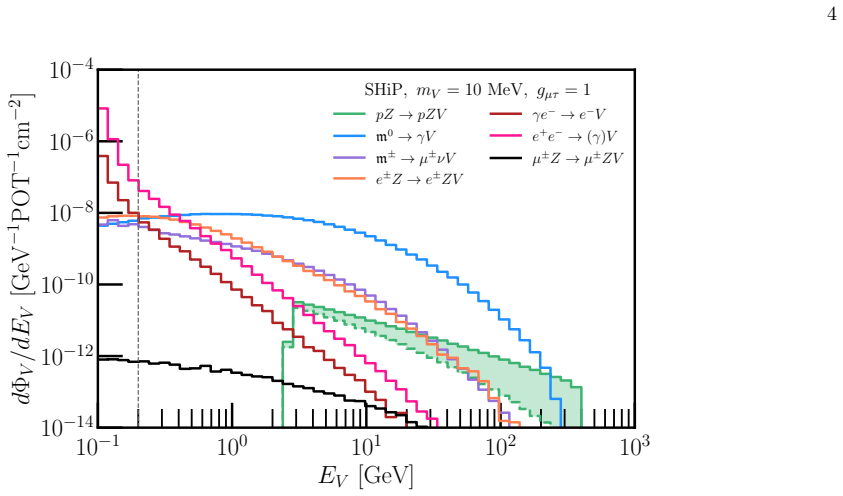
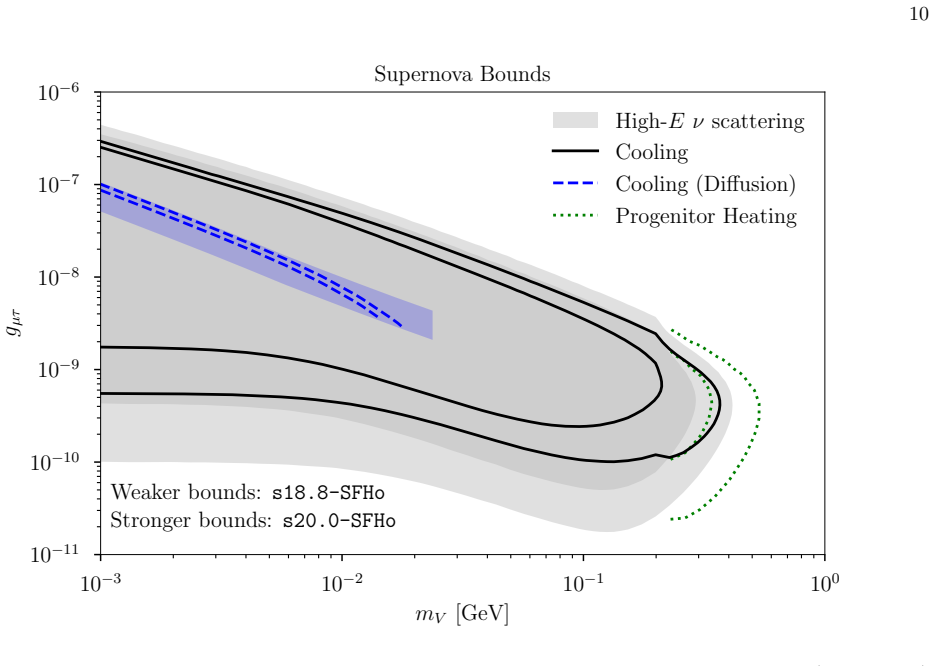
We study the phenomenology of a sub-GeV $L_\mu-L_\tau$ gauge boson. We find discrepancies with existing literature in sensitivity projections for the upcoming SHiP experiment and in the treatment of supernovae cooling constraints. We present a quantitative analysis of different production modes in beam dumps and compare our results to previous work. In the context of supernovae, we re-evaluate the standard supernova cooling bounds from SN1987A and analyze additional supernova-based probes: diffusive cooling, constraints from the existence of low-energy supernovae, and the absence of a high-energy neutrino signal from SN1987A.
Editorial analysis
A structured set of objections, weighed in public.
Referee Report
Summary. The paper studies the phenomenology of a sub-GeV L_μ-L_τ gauge boson. It identifies discrepancies with existing literature in sensitivity projections for the upcoming SHiP experiment and in the treatment of supernovae cooling constraints from SN1987A. The analysis includes quantitative treatment of production modes in beam dumps (meson decays, bremsstrahlung, etc.) and re-evaluation of supernova-based probes: diffusive cooling, constraints from low-energy supernovae, and the absence of a high-energy neutrino signal from SN1987A.
Significance. If the claimed discrepancies are substantiated by explicit numerical comparisons, the work would refine experimental reach estimates for SHiP and tighten or adjust astrophysical bounds on L_μ-L_τ models, with potential impact on model-building in the sub-GeV regime. The reliance on standard production cross-sections and cooling formulas from prior literature is a strength when accompanied by transparent cross-checks.
major comments (2)
- [Abstract and production analysis section] Abstract and production analysis section: the central claim of discrepancies in SHiP sensitivity projections rests on the quantitative modeling of beam-dump production channels. To establish these as corrections rather than modeling artifacts, the manuscript must include explicit side-by-side numerical comparisons (or tables) of cross-sections, branching ratios, and acceptance factors against the referenced prior works, specifying any differences in form factors, plasma-frequency cutoffs, or kinematic assumptions.
- [Supernova cooling re-evaluation section] Supernova cooling re-evaluation section: the re-derivation of SN1987A bounds (including diffusive cooling and neutrino-signal constraints) is load-bearing for the headline result. Direct comparison of the optical-depth integrals, temperature profiles, and energy-loss rates with the formulas in the cited literature is required to confirm that any differences arise from improved treatment rather than unstated choices in the stellar model.
minor comments (2)
- Add a dedicated comparison table (or appendix) summarizing the numerical outputs for SHiP reach and SN cooling limits versus prior results, including error budgets where applicable.
- Ensure all references to previous works are cited at the point where discrepancies are first asserted, rather than only in the abstract.
Simulated Author's Rebuttal
We thank the referee for their careful reading of our manuscript and for the constructive suggestions. We address each major comment below and agree to strengthen the presentation with additional explicit comparisons in the revised version.
read point-by-point responses
-
Referee: [Abstract and production analysis section] Abstract and production analysis section: the central claim of discrepancies in SHiP sensitivity projections rests on the quantitative modeling of beam-dump production channels. To establish these as corrections rather than modeling artifacts, the manuscript must include explicit side-by-side numerical comparisons (or tables) of cross-sections, branching ratios, and acceptance factors against the referenced prior works, specifying any differences in form factors, plasma-frequency cutoffs, or kinematic assumptions.
Authors: We agree that explicit numerical comparisons will make the origin of the discrepancies clearer. In the revised manuscript we will insert a dedicated table (or set of tables) in the production analysis section that lists side-by-side values for the dominant production channels—meson decays, bremsstrahlung, and any other relevant modes—together with the corresponding branching ratios and acceptance factors. Each entry will be accompanied by a brief note on the form factors, plasma-frequency cutoffs, and kinematic cuts employed, allowing direct comparison with the referenced prior works. This addition will demonstrate that the revised SHiP sensitivity projections arise from the updated modeling rather than from unstated differences in assumptions. revision: yes
-
Referee: [Supernova cooling re-evaluation section] Supernova cooling re-evaluation section: the re-derivation of SN1987A bounds (including diffusive cooling and neutrino-signal constraints) is load-bearing for the headline result. Direct comparison of the optical-depth integrals, temperature profiles, and energy-loss rates with the formulas in the cited literature is required to confirm that any differences arise from improved treatment rather than unstated choices in the stellar model.
Authors: We appreciate the referee’s emphasis on transparency for the supernova analysis. In the revised manuscript we will add a new subsection (or appendix) that directly compares our optical-depth integrals, adopted temperature profiles, and energy-loss rates with the corresponding expressions in the cited literature. The comparison will explicitly note the stellar-model inputs we employ and quantify how they differ from previous choices, thereby confirming that the adjusted SN1987A bounds result from the refined treatment rather than from hidden modeling differences. revision: yes
Circularity Check
Derivation is self-contained; no load-bearing reductions to self-inputs or self-citations
full rationale
The paper's central claims identify discrepancies with prior literature on SHiP sensitivity and SN1987A cooling via quantitative modeling of beam-dump production (meson decays, bremsstrahlung) and re-derivation of supernova bounds (diffusive cooling, neutrino signals). These steps rely on standard cross-sections, optical-depth integrals, and stellar-interior assumptions drawn from external references rather than reducing by the paper's own equations to a fitted parameter, self-defined quantity, or self-citation chain. No quoted step equates a prediction to its input by construction, and the analysis remains falsifiable against independent benchmarks.
Axiom & Free-Parameter Ledger
axioms (1)
- domain assumption Standard assumptions about particle production cross sections in beam dumps and energy-loss rates in supernovae are sufficiently accurate to reveal discrepancies with earlier studies.
Lean theorems connected to this paper
-
IndisputableMonolith/Cost/FunctionalEquation.leanwashburn_uniqueness_aczel unclear?
unclearRelation between the paper passage and the cited Recognition theorem.
We simulate the production of neutral and charged mesons using GEANT-4 to model the interactions of a 400 GeV beam with a cylindrical Mo target... We have improved on existing bounds by: accounting for neutrino chemical potentials... full angular averaging... gravitational time-dilation and redshift effects.
-
IndisputableMonolith/Foundation/RealityFromDistinction.leanreality_from_one_distinction unclear?
unclearRelation between the paper passage and the cited Recognition theorem.
The luminosity due to this process is LV,ballistic = <ω Γprod(r,ω) Pesc(r,ω)> ... with the Raffelt criterion LR = 4.4×10^52 erg/s.
What do these tags mean?
- matches
- The paper's claim is directly supported by a theorem in the formal canon.
- supports
- The theorem supports part of the paper's argument, but the paper may add assumptions or extra steps.
- extends
- The paper goes beyond the formal theorem; the theorem is a base layer rather than the whole result.
- uses
- The paper appears to rely on the theorem as machinery.
- contradicts
- The paper's claim conflicts with a theorem or certificate in the canon.
- unclear
- Pith found a possible connection, but the passage is too broad, indirect, or ambiguous to say the theorem truly supports the claim.
Forward citations
Cited by 2 Pith papers
-
Data-Driven Predictions for Dark Photon and Millicharged Particle Production
A data-driven framework using normalizing flows predicts the rate and kinematic distributions of dark photon and millicharged particle production directly from measured dilepton events.
-
New benchmarks for direct detection of freeze-in dark matter in vector portal models
Freeze-in at low reheating temperatures allows MeV-scale dark matter in vector portal models to be probed by future direct detection experiments in nuclear recoils for 50-500 MeV masses and via enhanced solar neutrino...
Reference graph
Works this paper leans on
-
[1]
C. Antelet al., Eur. Phys. J. C83, 1122 (2023), arXiv:2305.01715 [hep-ph]
-
[2]
Dark Sectors 2016 Workshop: Community Report
J. Alexanderet al.(2016) arXiv:1608.08632 [hep-ph]
work page internal anchor Pith review Pith/arXiv arXiv 2016
-
[3]
J. Beachamet al., J. Phys. G47, 010501 (2020), arXiv:1901.09966 [hep-ex]
-
[4]
Iltenet al., inSnowmass 2021(2022) arXiv:2206.04220 [hep-ex]
P. Iltenet al., inSnowmass 2021(2022) arXiv:2206.04220 [hep-ex]
- [5]
- [6]
-
[7]
X. G. He, G. C. Joshi, H. Lew, and R. R. Volkas, Phys. Rev. D43, 22 (1991)
work page 1991
-
[8]
X.-G. He, G. C. Joshi, H. Lew, and R. R. Volkas, Phys. Rev. D44, 2118 (1991)
work page 1991
-
[9]
Gauged L_mu - L_tau Symmetry at the Electroweak Scale
J. Heeck and W. Rodejohann, Phys. Rev. D84, 075007 (2011), arXiv:1107.5238 [hep-ph]
work page internal anchor Pith review Pith/arXiv arXiv 2011
-
[10]
Serendipity in dark photon searches
P. Ilten, Y. Soreq, M. Williams, and W. Xue, JHEP06, 004 (2018), arXiv:1801.04847 [hep-ph]
work page internal anchor Pith review Pith/arXiv arXiv 2018
-
[11]
S. Baek, N. G. Deshpande, X. G. He, and P. Ko, Phys. Rev. D64, 055006 (2001), arXiv:hep-ph/0104141
work page internal anchor Pith review Pith/arXiv arXiv 2001
-
[12]
E. Ma, D. P. Roy, and S. Roy, Phys. Lett. B525, 101 (2002), arXiv:hep-ph/0110146. 16
work page internal anchor Pith review Pith/arXiv arXiv 2002
-
[13]
Cosmology With a Very Light $L_\mu - L_\tau$ Gauge Boson
M. Escudero, D. Hooper, G. Krnjaic, and M. Pierre, JHEP03, 071 (2019), arXiv:1901.02010 [hep-ph]
work page internal anchor Pith review Pith/arXiv arXiv 2019
- [14]
- [15]
- [16]
- [17]
-
[18]
W. Altmannshofer, S. Gori, J. Mart´ ın-Albo, A. Sousa, and M. Wallbank, Phys. Rev. D100, 115029 (2019), arXiv:1902.06765 [hep-ph]
- [19]
- [20]
-
[21]
Aberleet al.(SHiP),BDF/SHiP at the ECN3 high-intensity beam facility, Tech
O. Aberleet al.(SHiP),BDF/SHiP at the ECN3 high-intensity beam facility, Tech. Rep. (CERN, Geneva, 2022)
work page 2022
-
[22]
Albaneseet al.(SHiP),BDF/SHiP at the ECN3 high-intensity beam facility, Tech
R. Albaneseet al.(SHiP),BDF/SHiP at the ECN3 high-intensity beam facility, Tech. Rep. (CERN, Geneva, 2023)
work page 2023
-
[23]
C.-Y. Chen, M. Pospelov, and Y.-M. Zhong, Phys. Rev. D95, 115005 (2017), arXiv:1701.07437 [hep-ph]
work page internal anchor Pith review Pith/arXiv arXiv 2017
- [24]
-
[25]
C. Cesarotti, Y. Kahn, G. Krnjaic, D. Rocha, and J. Spitz, Phys. Rev. D110, 055032 (2024), arXiv:2311.10829 [hep-ph]
-
[26]
C. Cesarotti and R. Gambhir, JHEP05, 283 (2024), arXiv:2310.16110 [hep-ph]
- [27]
- [28]
-
[29]
G. G. Raffelt,Stars as laboratories for fundamental physics: The astrophysics of neutrinos, axions, and other weakly interacting particles(1996)
work page 1996
- [30]
-
[31]
A. Caputo, H.-T. Janka, G. Raffelt, and E. Vitagliano, Phys. Rev. Lett.128, 221103 (2022), arXiv:2201.09890 [astro- ph.HE]
-
[32]
Coherent Propagation of PeV Neutrinos and the Dip in the Neutrino Spectrum at IceCube
A. Kamada and H.-B. Yu, Phys. Rev. D92, 113004 (2015), arXiv:1504.00711 [hep-ph]
work page internal anchor Pith review Pith/arXiv arXiv 2015
- [33]
-
[34]
E. Lopez Solaet al., Phys. Rev. Accel. Beams22, 113001 (2019), arXiv:1904.03074 [physics.ins-det]
-
[35]
Agostinelliet al.(GEANT4), Nucl
S. Agostinelliet al.(GEANT4), Nucl. Instrum. Meth. A506, 250 (2003)
work page 2003
- [36]
- [37]
- [38]
-
[39]
C. Ahdidaet al.(SHiP), Eur. Phys. J. C81, 451 (2021), arXiv:2011.05115 [hep-ex]
- [40]
-
[41]
G. Krnjaic, G. Marques-Tavares, D. Redigolo, and K. Tobioka, Phys. Rev. Lett.124, 041802 (2020), arXiv:1902.07715 [hep-ph]
-
[42]
S. Foroughi-Abari, P. Reimitz, and A. Ritz, Phys. Rev. D112, 015030 (2025), arXiv:2409.09123 [hep-ph]
-
[43]
New Exclusion Limits on Dark Gauge Forces from Proton Bremsstrahlung in Beam-Dump Data
J. Bl¨ umlein and J. Brunner, Phys. Lett. B731, 320 (2014), arXiv:1311.3870 [hep-ph]
work page internal anchor Pith review Pith/arXiv arXiv 2014
-
[44]
P. deNiverville, C.-Y. Chen, M. Pospelov, and A. Ritz, Phys. Rev. D95, 035006 (2017), arXiv:1609.01770 [hep-ph]
work page internal anchor Pith review Pith/arXiv arXiv 2017
- [45]
-
[46]
Hirataet al.(Kamiokande-II), Phys
K. Hirataet al.(Kamiokande-II), Phys. Rev. Lett.58, 1490 (1987)
work page 1987
-
[47]
R. M. Biontaet al., Phys. Rev. Lett.58, 1494 (1987)
work page 1987
-
[48]
E. N. Alekseev, L. N. Alekseeva, I. V. Krivosheina, and V. I. Volchenko, Phys. Lett. B205, 209 (1988)
work page 1988
- [49]
-
[50]
S. W. Falk and D. N. Schramm, Phys. Lett. B79, 511 (1978)
work page 1978
- [51]
-
[52]
Muonic Boson Limits: Supernova Redux
A. Caputo, G. Raffelt, and E. Vitagliano, Phys. Rev. D105, 035022 (2022), arXiv:2109.03244 [hep-ph]
work page internal anchor Pith review Pith/arXiv arXiv 2022
-
[53]
D. F. G. Fiorillo, T. Pitik, and E. Vitagliano, (2025), arXiv:2503.15630 [hep-ph]
work page internal anchor Pith review Pith/arXiv arXiv 2025
- [54]
- [55]
-
[56]
Supernova Neutrinos: Production, Oscillations and Detection
A. Mirizzi, I. Tamborra, H.-T. Janka, N. Saviano, K. Scholberg, R. Bollig, L. Hudepohl, and S. Chakraborty, Riv. Nuovo Cim.39, 1 (2016), arXiv:1508.00785 [astro-ph.HE]
work page internal anchor Pith review Pith/arXiv arXiv 2016
-
[57]
Muon Creation in Supernova Matter Facilitates Neutrino-driven Explosions
R. Bollig, H. T. Janka, A. Lohs, G. Martinez-Pinedo, C. J. Horowitz, and T. Melson, Phys. Rev. Lett.119, 242702 (2017), arXiv:1706.04630 [astro-ph.HE]
work page internal anchor Pith review Pith/arXiv arXiv 2017
- [58]
-
[59]
Syvolap, (2023), arXiv:2301.07052 [hep-ph]
V. Syvolap, (2023), arXiv:2301.07052 [hep-ph]
-
[60]
V. Syvolap and O. Ruchayskiy, Phys. Rev. D110, 115043 (2024), arXiv:2404.19191 [hep-ph]
-
[61]
NuFit-6.0: Updated global analysis of three-flavor neutrino oscillations
I. Esteban, M. C. Gonzalez-Garcia, M. Maltoni, I. Martinez-Soler, J. P. Pinheiro, and T. Schwetz, JHEP12, 216 (2024), arXiv:2410.05380 [hep-ph]
work page internal anchor Pith review Pith/arXiv arXiv 2024
-
[62]
C. B. Brattonet al.(IMB), Phys. Rev. D37, 3361 (1988)
work page 1988
- [63]
- [64]
-
[65]
S. Foroughi-Abari and A. Ritz, Phys. Rev. D105, 095045 (2022), arXiv:2108.05900 [hep-ph]
-
[66]
Dipole portal to heavy neutral leptons
G. Magill, R. Plestid, M. Pospelov, and Y.-D. Tsai, Phys. Rev. D98, 115015 (2018), arXiv:1803.03262 [hep-ph]
work page internal anchor Pith review Pith/arXiv arXiv 2018
-
[67]
H. A. Weldon, Phys. Rev. D28, 2007 (1983)
work page 2007
discussion (0)
Sign in with ORCID, Apple, or X to comment. Anyone can read and Pith papers without signing in.