DAPS++: Rethinking Diffusion Inverse Problems with Decoupled Posterior Annealing
Pith reviewed 2026-05-17 21:03 UTC · model grok-4.3
The pith
Diffusion inverse problem solvers use the prior mainly as a warm initializer near the data manifold, with reconstruction driven by measurement consistency.
A machine-rendered reading of the paper's core claim, the machinery that carries it, and where it could break.
Core claim
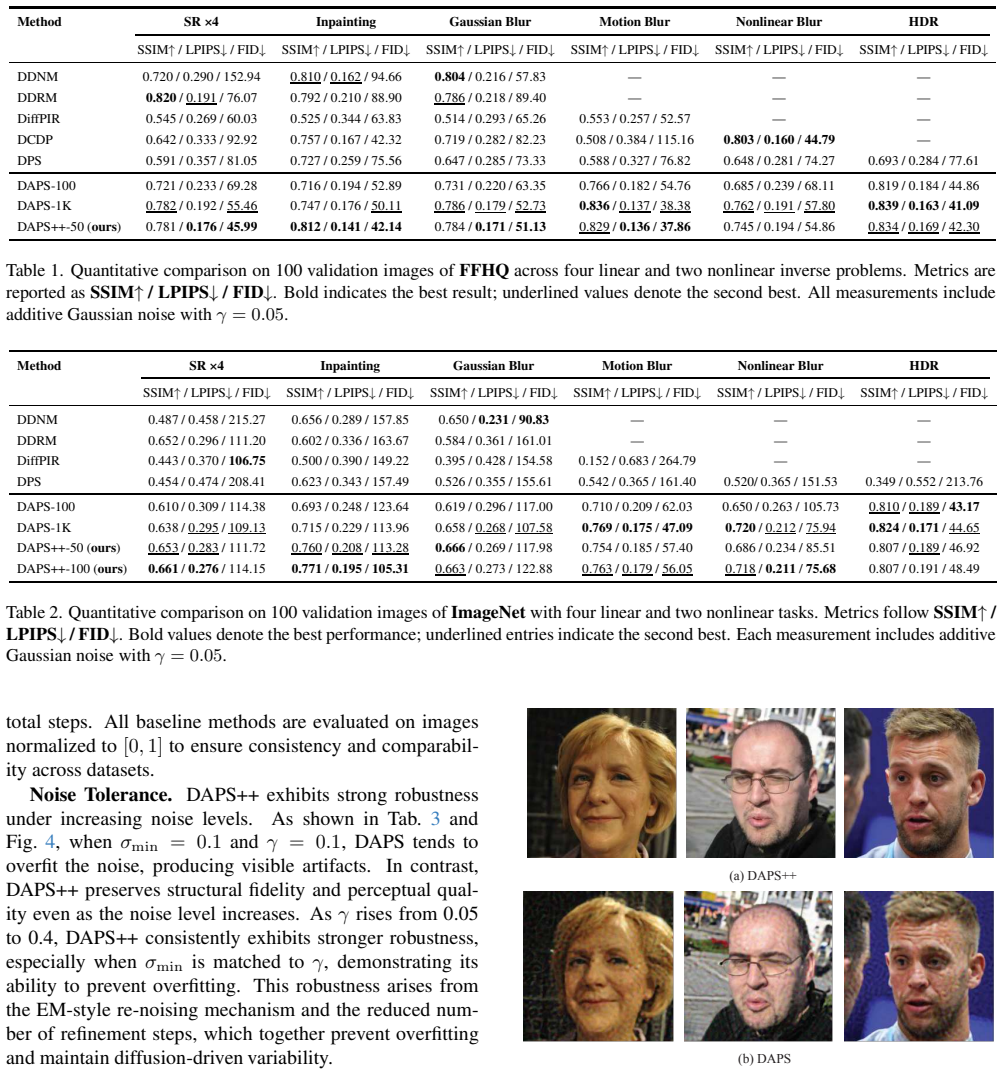
The paper establishes that the diffusion prior in inverse problem solvers serves primarily as a warm initializer placing estimates near the data manifold, with reconstruction driven almost entirely by the measurement-consistency term. This leads to the introduction of DAPS++ which decouples the diffusion initialization from the likelihood-driven refinement, allowing more direct guidance from the likelihood while maintaining numerical stability and efficiency through fewer function evaluations.
What carries the argument
DAPS++, the decoupled posterior annealing procedure that separates diffusion-based initialization from likelihood-driven refinement.
If this is right
- DAPS++ requires fewer function evaluations and measurement-optimization steps.
- It achieves high computational efficiency.
- It delivers robust reconstruction performance across diverse image restoration tasks.
- It maintains numerical stability without relying on joint diffusion trajectories.
Where Pith is reading between the lines
- The insight may extend to explain the behavior of other generative priors in inverse settings beyond diffusion.
- Practitioners could test hybrid approaches that use diffusion only for the initial placement and switch to direct optimization for refinement.
- This separation might enable applications in resource-constrained environments where full diffusion trajectories are too expensive.
- Future experiments could verify if the same decoupling benefits hold for non-image inverse problems like signal recovery.
Load-bearing premise
The assumption that fully separating diffusion initialization from likelihood-driven refinement preserves the numerical stability and reconstruction quality of the original joint process without introducing instabilities.
What would settle it
A direct comparison on standard image restoration benchmarks where the decoupled DAPS++ method shows significantly degraded reconstruction quality or numerical instability compared to the joint diffusion approach would falsify the central claim.
Figures






read the original abstract
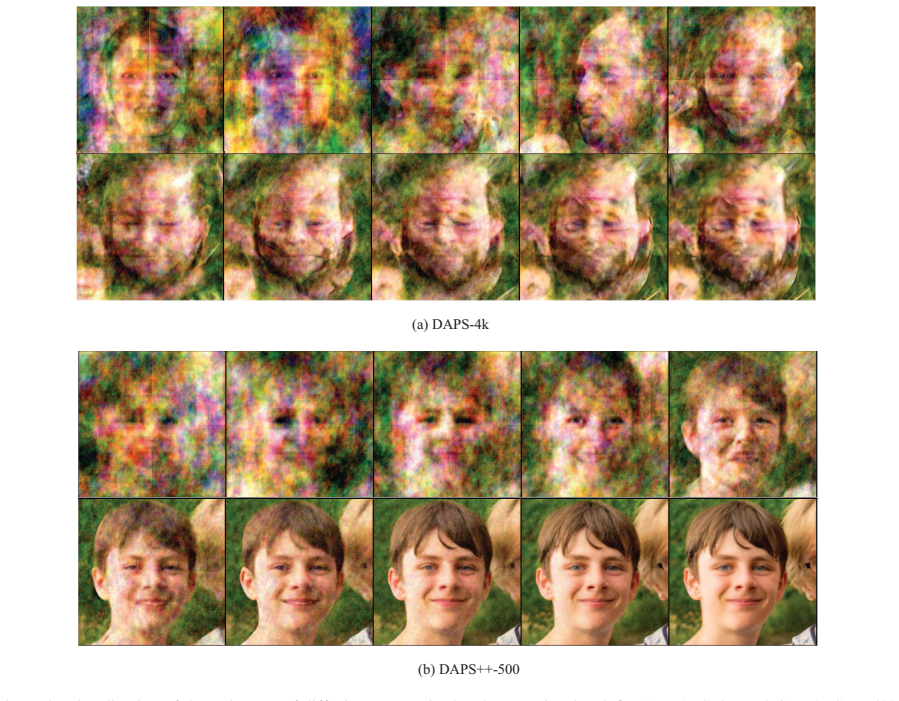
From a Bayesian perspective, score-based diffusion solves inverse problems through joint inference, embedding the likelihood with the prior to guide the sampling process. However, this formulation fails to explain its practical behavior: the prior offers limited guidance, while reconstruction is largely driven by the measurement-consistency term, leading to an inference process that is effectively decoupled from the diffusion dynamics. We show that the diffusion prior in these solvers functions primarily as a warm initializer that places estimates near the data manifold, while reconstruction is driven almost entirely by measurement consistency. Based on this observation, we introduce \textbf{DAPS++}, which fully decouples diffusion-based initialization from likelihood-driven refinement, allowing the likelihood term to guide inference more directly while maintaining numerical stability and providing insight into why unified diffusion trajectories remain effective in practice. By requiring fewer function evaluations (NFEs) and measurement-optimization steps, \textbf{DAPS++} achieves high computational efficiency and robust reconstruction performance across diverse image restoration tasks.
Editorial analysis
A structured set of objections, weighed in public.
Referee Report
Summary. The paper claims that diffusion-based solvers for inverse problems function primarily through the diffusion prior acting as a warm initializer that places estimates near the data manifold, while reconstruction is driven almost entirely by the measurement-consistency term rather than joint posterior sampling. Based on this, the authors introduce DAPS++ to fully decouple diffusion initialization from likelihood-driven refinement, claiming this yields fewer NFEs, maintained numerical stability, and robust performance on image restoration tasks.
Significance. If the central observation and decoupling hold, the work offers a useful reinterpretation of why diffusion inverse solvers succeed in practice and enables simpler, more efficient algorithms. The empirical demonstration across tasks and the efficiency gains are practical strengths; the insight into limited prior guidance could influence future solver design.
major comments (2)
- [Method / Decoupling section] The manuscript's justification for the decoupling (that plain likelihood optimization after initialization suffices without multi-scale guidance) is load-bearing for the central claim but rests on empirical observation rather than analysis showing preservation of implicit regularization; this directly engages the concern that removing annealed joint dynamics may allow drift off-manifold on ill-posed degradations.
- [Experiments] Experimental comparisons to joint diffusion trajectories do not include sufficient controls or ablations isolating the initialization phase (e.g., varying diffusion steps before switching to refinement), leaving open whether performance stems from the specific optimization schedule rather than the proposed split.
minor comments (2)
- [Method] Notation for the decoupled schedule and posterior annealing could be clarified with an explicit algorithm box or diagram to distinguish it from standard reverse SDE steps.
- [Related Work] A few citations to related work on measurement-consistent diffusion solvers appear incomplete in the related-work discussion.
Simulated Author's Rebuttal
We thank the referee for the constructive feedback and positive evaluation of the significance of our work. We address each major comment below and describe the revisions we plan to incorporate.
read point-by-point responses
-
Referee: [Method / Decoupling section] The manuscript's justification for the decoupling (that plain likelihood optimization after initialization suffices without multi-scale guidance) is load-bearing for the central claim but rests on empirical observation rather than analysis showing preservation of implicit regularization; this directly engages the concern that removing annealed joint dynamics may allow drift off-manifold on ill-posed degradations.
Authors: We acknowledge that the core justification is empirical. In the revised manuscript we will expand the Method section with a short analysis arguing that the diffusion initialization places estimates sufficiently close to the manifold (supported by distance-to-manifold measurements in the supplement) such that subsequent likelihood optimization does not induce measurable off-manifold drift on the degradations considered. We will also add a brief discussion of why the implicit regularization is largely inherited from the initializer rather than from continued annealed joint dynamics. revision: yes
-
Referee: [Experiments] Experimental comparisons to joint diffusion trajectories do not include sufficient controls or ablations isolating the initialization phase (e.g., varying diffusion steps before switching to refinement), leaving open whether performance stems from the specific optimization schedule rather than the proposed split.
Authors: We agree that additional controls would strengthen the claims. In the revised version we will include new ablation tables that vary the number of diffusion steps used for initialization (e.g., 5, 10, 20, 50 steps) before switching to pure likelihood refinement, while keeping total NFEs fixed. These results will be compared directly against joint diffusion trajectories under matched budgets to isolate the effect of the proposed split. revision: yes
Circularity Check
No significant circularity; central claim is empirical observation
full rationale
The paper's key step is the empirical claim that diffusion priors in existing inverse-problem solvers act mainly as warm initializers while reconstruction is driven by the measurement-consistency term. This is presented as an observation about practical behavior of joint diffusion trajectories, not as a first-principles derivation whose output is definitionally equivalent to its inputs. DAPS++ is then introduced by decoupling initialization from likelihood-driven refinement on the basis of that observation. No self-definitional loops appear (no quantity defined in terms of the target result), no fitted parameters are renamed as predictions, and no load-bearing self-citations or uniqueness theorems imported from prior author work are invoked to force the conclusion. The argument remains self-contained against external benchmarks of solver behavior.
Axiom & Free-Parameter Ledger
Forward citations
Cited by 1 Pith paper
-
Image Restoration via Diffusion Models with Dynamic Resolution
Dynamic resolution priors enable faster diffusion-based image restoration by operating in lower-dimensional subspaces, with adapted methods outperforming prior DM approaches on most tasks.
Reference graph
Works this paper leans on
-
[1]
Monte carlo guided diffusion for Bayesian linear inverse problems
Gabriel Cardoso, Yazid Janati El Idrissi, Sylvain Le Cor ff, and Eric Moulines. Monte carlo guided diffusion for Bayesian linear inverse problems. 2024. 1
work page 2024
-
[2]
Ilvr: Conditioning method for denoising diffusion probabilistic models
Jooyoung Choi, Sungwon Kim, Y onghyun Jeong, Y oungjune Gwon, and Sungroh Y oon. Ilvr: Conditioning method for denoising diffusion probabilistic models. In Proceedings of the IEEE/CVF International Conference on Computer Vision (ICCV), pages 14367–14376, 2021. 2
work page 2021
-
[3]
Improving diffusion models for inverse prob- lems using manifold constraints
Hyungjin Chung, Byeongsu Sim, Dohoon Ryu, and Jong Chul Ye. Improving diffusion models for inverse prob- lems using manifold constraints. Advances in Neural Infor- mation Processing Systems, 35:25683–25696, 2022. 2
work page 2022
-
[4]
Diffusion posterior sampling for general noisy inverse problems
Hyungjin Chung, Jeongsol Kim, Michael T Mccann, Marc L Klasky, and Jong Chul Ye. Diffusion posterior sampling for general noisy inverse problems. 2023. 1, 2, 4, 5
work page 2023
-
[5]
The bayesian ap- proach to inverse problems
Masoumeh Dashti and Andrew M Stuart. The bayesian ap- proach to inverse problems. In Handbook of uncertainty quantification , pages 1–118. Springer, 2015. 1
work page 2015
-
[6]
Imagenet: A large-scale hierarchical image database
Jia Deng, Wei Dong, Richard Socher, Li-Jia Li, Kai Li, and Li Fei-Fei. Imagenet: A large-scale hierarchical image database. In 2009 IEEE conference on computer vision and pattern recognition, pages 248–255. Ieee, 2009. 5
work page 2009
-
[7]
Nicolas Dey, Laure Blanc-Feraud, Christophe Zimmer, Pa s- cal Roux, Zvi Kam, Jean-Christophe Olivo-Marin, and Josiane Zerubia. Richardson–lucy algorithm with total var i- ation regularization for 3d confocal microscope deconvolu - tion. Microscopy research and technique , 69(4):260–266, 2006. 1
work page 2006
-
[8]
Diffusion mode ls beat gans on image synthesis
Prafulla Dhariwal and Alexander Nichol. Diffusion mode ls beat gans on image synthesis. Advances in neural informa- tion processing systems, 34:8780–8794, 2021. 5
work page 2021
-
[9]
Score-based diffusion models as principled priors for inverse imaging
Berthy T Feng, Jamie Smith, Michael Rubinstein, Hui- wen Chang, Katherine L Bouman, and William T Freeman. Score-based diffusion models as principled priors for inverse imaging. In Proceedings of the IEEE/CVF International Conference on Computer Vision, pages 10520–10531, 2023. 1
work page 2023
-
[10]
Blind deconvolution by means of the richardson–lucy algorithm
DA Fish, AM Brinicombe, ER Pike, and JG Walker. Blind deconvolution by means of the richardson–lucy algorithm. Journal of the Optical Society of America A , 12(1):58–65, 1995. 1
work page 1995
-
[11]
On choosing and bounding probability metrics
Alison L Gibbs and Francis Edward Su. On choosing and bounding probability metrics. International statistical re- view, 70(3):419–435, 2002. 1
work page 2002
-
[12]
Gans trained by a two time-scale update rule converge to a local nash equilib- rium
Martin Heusel, Hubert Ramsauer, Thomas Unterthiner, Bernhard Nessler, and Sepp Hochreiter. Gans trained by a two time-scale update rule converge to a local nash equilib- rium. Advances in neural information processing systems , 30, 2017. 5
work page 2017
-
[13]
Denoising di f- fusion probabilistic models
Jonathan Ho, Ajay Jain, and Pieter Abbeel. Denoising di f- fusion probabilistic models. Advances in neural information processing systems, 33:6840–6851, 2020. 1, 2
work page 2020
-
[14]
Robust compressed sensing mri with deep generative priors
Ajil Jalal, Marius Arvinte, Giannis Daras, Eric Price, Alexandros G Dimakis, and Jon Tamir. Robust compressed sensing mri with deep generative priors. Advances in neural information processing systems, 34:14938–14954, 2021. 1
work page 2021
-
[15]
A style-based generator architecture for generative adversarial networ ks
Tero Karras, Samuli Laine, and Timo Aila. A style-based generator architecture for generative adversarial networ ks. In Proceedings of the IEEE/CVF conference on computer vi- sion and pattern recognition, pages 4401–4410, 2019. 5
work page 2019
-
[16]
Elucidating the design space of diffusion-based generativ e models
Tero Karras, Miika Aittala, Timo Aila, and Samuli Laine . Elucidating the design space of diffusion-based generativ e models. Advances in neural information processing systems, 35:26565–26577, 2022. 1, 2, 5, 3, 4
work page 2022
-
[17]
Denoising diffusion restoration models
Bahjat Kawar, Michael Elad, Stefano Ermon, and Jiaming Song. Denoising diffusion restoration models. Advances in neural information processing systems , 35:23593–23606,
-
[18]
Decoupled data con- sistency with diffusion purification for image restoration
Xiang Li, Soo Min Kwon, Shijun Liang, Ismail R Alkhouri, Saiprasad Ravishankar, and Qing Qu. Decoupled data con- sistency with diffusion purification for image restoration . arXiv preprint arXiv:2403.06054, 2024. 1, 2, 5
-
[19]
Dpm-solver: A fast ode solver for diffu- sion probabilistic model sampling in around 10 steps
Cheng Lu, Y uhao Zhou, Fan Bao, Jianfei Chen, Chongxuan Li, and Jun Zhu. Dpm-solver: A fast ode solver for diffu- sion probabilistic model sampling in around 10 steps. Ad- vances in neural information processing systems , 35:5775– 5787, 2022. 1
work page 2022
-
[20]
Dpm-solver++: Fast solver for guided sam- pling of diffusion probabilistic models
Cheng Lu, Y uhao Zhou, Fan Bao, Jianfei Chen, Chongxuan Li, and Jun Zhu. Dpm-solver++: Fast solver for guided sam- pling of diffusion probabilistic models. Machine Intelligence Research, pages 1–22, 2025. 1
work page 2025
-
[21]
Optimum strategies for inverse problems in sta - tistical astronomy
LB Lucy. Optimum strategies for inverse problems in sta - tistical astronomy. Astronomy and Astrophysics (ISSN 0004- 6361), vol. 289, no. 3, p. 983-994 , 289:983–994, 1994. 1
work page 1994
-
[22]
Sparse mri: The application of compressed sensing for rapid mr imaging
Michael Lustig, David Donoho, and John M Pauly. Sparse mri: The application of compressed sensing for rapid mr imaging. Magnetic Resonance in Medicine: An Official Journal of the International Society for Magnetic Resonanc e in Medicine, 58(6):1182–1195, 2007. 1
work page 2007
-
[23]
The event horizon general relativistic magnetohydrodynamic code comparison project
Oliver Porth, Koushik Chatterjee, Ramesh Narayan, Charles F Gammie, Y osuke Mizuno, Peter Anninos, John G Baker, Matteo Bugli, Chi-kwan Chan, Jordy Davelaar, et al. The event horizon general relativistic magnetohydrodynamic code comparison project. The Astrophysical Journal Supple- ment Series, 243(2):26, 2019. 1
work page 2019
-
[24]
Solving linear inverse pr ob- lems using gan priors: An algorithm with provable guaran- tees
Viraj Shah and Chinmay Hegde. Solving linear inverse pr ob- lems using gan priors: An algorithm with provable guaran- tees. In 2018 IEEE international conference on acoustics, speech and signal processing (ICASSP) , pages 4609–4613. IEEE, 2018. 1
work page 2018
-
[25]
Solving inverse problems with latent diffusion models via hard data consistency
Bowen Song, Soo Min Kwon, Zecheng Zhang, Xinyu Hu, Qing Qu, and Liyue Shen. Solving inverse problems with latent diffusion models via hard data consistency. In The Twelfth International Conference on Learning Representa- tions, 2024. 2, 3
work page 2024
-
[26]
Denois- ing diffusion implicit models
Jiaming Song, Chenlin Meng, and Stefano Ermon. Denois- ing diffusion implicit models. 2021. 1
work page 2021
-
[27]
Generative modeling by est i- mating gradients of the data distribution
Yang Song and Stefano Ermon. Generative modeling by est i- mating gradients of the data distribution. Advances in neural information processing systems, 32, 2019. 1, 2
work page 2019
-
[28]
Improved techniques for training score-based generative models
Yang Song and Stefano Ermon. Improved techniques for training score-based generative models. Advances in neural information processing systems, 33:12438–12448, 2020. 9
work page 2020
-
[29]
Score-based generative modeling through stochastic differential equa - tions
Yang Song, Jascha Sohl-Dickstein, Diederik P Kingma, A b- hishek Kumar, Stefano Ermon, and Ben Poole. Score-based generative modeling through stochastic differential equa - tions. In ICLR, 2021. 1, 2
work page 2021
-
[30]
Solv - ing inverse problems in medical imaging with score-based generative models
Yang Song, Liyue Shen, Lei Xing, and Stefano Ermon. Solv - ing inverse problems in medical imaging with score-based generative models. 2022. 1
work page 2022
-
[31]
Inverse problems: a bayesian perspect ive
Andrew M Stuart. Inverse problems: a bayesian perspect ive. Acta numerica, 19:451–559, 2010. 1
work page 2010
-
[32]
Inverse problem theory and methods for model parameter estimation
Albert Tarantola. Inverse problem theory and methods for model parameter estimation. SIAM, 2005. 1
work page 2005
-
[33]
Zero-shot image restoration using denoising diffusion null-space model
Yinhuai Wang, Jiwen Y u, and Jian Zhang. Zero-shot image restoration using denoising diffusion null-space model. I n The Eleventh International Conference on Learning Repre- sentations, 2023. 2
work page 2023
-
[34]
Image quality assessment: from error visibility to structural similarity
Zhou Wang, Alan C Bovik, Hamid R Sheikh, and Eero P Si- moncelli. Image quality assessment: from error visibility to structural similarity. IEEE transactions on image processing, 13(4):600–612, 2004. 5
work page 2004
-
[35]
Tongda Xu, Xiyan Cai, Xinjie Zhang, Xingtong Ge, Dailan He, Ming Sun, Jingjing Liu, Ya-Qin Zhang, Jian Li, and Yan Wang. Rethinking diffusion posterior sampling: From con- ditional score estimator to maximizing a posterior. In The Thirteenth International Conference on Learning Represen - tations, 2025. 2, 4
work page 2025
-
[36]
Provably robust score-based diffusion posterior sampling for plug-and-play image reco n- struction
Xingyu Xu and Y uejie Chi. Provably robust score-based diffusion posterior sampling for plug-and-play image reco n- struction. Advances in Neural Information Processing Sys- tems, 37:36148–36184, 2024. 2
work page 2024
-
[37]
Guidance with spherical gaussian con- straint for conditional diffusion
Lingxiao Yang, Shutong Ding, Yifan Cai, Jingyi Y u, Jing ya Wang, and Ye Shi. Guidance with spherical gaussian con- straint for conditional diffusion. In Proceedings of the 41st International Conference on Machine Learning . JMLR.org, 2024. 2
work page 2024
-
[38]
Improving diffusion inverse problem solving with decoupled noise annealing
Bingliang Zhang, Wenda Chu, Julius Berner, Chenlin Men g, Anima Anandkumar, and Yang Song. Improving diffusion inverse problem solving with decoupled noise annealing. In Proceedings of the Computer Vision and Pattern Recognition Conference, pages 20895–20905, 2025. 1, 2, 5, 3
work page 2025
-
[39]
The unreasonable effectiveness of deep features as a perceptual metric
Richard Zhang, Phillip Isola, Alexei A Efros, Eli Shech t- man, and Oliver Wang. The unreasonable effectiveness of deep features as a perceptual metric. In Proceedings of the IEEE conference on computer vision and pattern recogni- tion, pages 586–595, 2018. 5
work page 2018
-
[40]
Denoising dif- fusion models for plug-and-play image restoration
Y uanzhi Zhu, Kai Zhang, Jingyun Liang, Jiezhang Cao, Bi - han Wen, Radu Timofte, and Luc V an Gool. Denoising dif- fusion models for plug-and-play image restoration. In Pro- ceedings of the IEEE/CVF conference on computer vision and pattern recognition, pages 1219–1229, 2023. 5 10 DAPS++: Rethinking Diffusion Inverse Problems with Decoup led Posterior An...
work page 2023
-
[41]
Theoretical Analysis 6.1. Lipschitz Analysis of Prior–Likelihood Inter- action To establish the negligible contribution of the prior gradi ent in high-noise regimes, we provide a Lipschitz-bound analy- sis quantifying the relative magnitudes of the likelihood and prior terms. We first introduce standard assumptions. Assumptions. A1. The score function ∇ xt...
-
[42]
Visualization of 2-step MCMC iterations for 4× down- sampling under different initialization setups
Detailed Algorithm Implementation To provide a comprehensive structural overview of the pro- posed framework, we present the complete pseudocode 1 (a) Tweddie (b) Euler-5 (c) RK4-5 (d) Noise Figure 6. Visualization of 2-step MCMC iterations for 4× down- sampling under different initialization setups. Subfigure s (a)–(c) are initialized at σ max = 100 using...
-
[43]
This outlines the heteroge- neous decomposition strategy, transitioning from the prio r- dominant generation in Stage 1 to the likelihood-dominant refinement in Stage 2
-
[44]
Discussions 8.1. Sampling Efficiency Sampling efficiency is a critical factor for diffusion-base d inverse problem solvers. The computational cost of these methods depends heavily on both the number of neural function evaluations (NFEs) and the refinement steps per- formed at each iteration. In Tab. 4, we summarize the ODE steps, annealing steps, refinement s...
-
[45]
Experimental Details We follow the forward measurement operators utilized in DAPS [ 38] and Resample [25], establishing a unified evalu- ation protocol for general linear and nonlinear inverse pro b- lems. 9.1. Final Refinement via RK4 Solver To achieve high-fidelity reconstruction, we introduce a fina l refinement stage subsequent to the initial sampling proc...
-
[46]
With this schedule, given the refinement threshold ¯σ = 0 . 5, approximately 30% of the total sam- pling steps are allocated to the refinement stage ( σt≤ ¯σ ), ensuring detailed reconstruction. 9.2. Hyperparameter Choice To evaluate the proposed method across general linear and nonlinear inverse problems, we maintain a unified hyper- parameter setting to de...
-
[47]
Re- sults across several inverse problems are summarized in Tab
More Ablation Results We present additional ablation studies on the choice of ¯σ and the polynomial exponent ρ in the noise schedule. Re- sults across several inverse problems are summarized in Tab. 6 and Tab. 7, evaluated under identical measurement noise levels. Illustrative examples are provided in Fig. 10 and Fig. 11. As shown in Tab. 6, using a large...
discussion (0)
Sign in with ORCID, Apple, or X to comment. Anyone can read and Pith papers without signing in.