REVIEW 2 major objections 4 minor 1 cited by
Generalized local complementation exactly captures LU-equivalence of graph states, with a logarithmic level bound that yields a quasi-polynomial decision algorithm and proves LU=LC up to 19 qubits.
Reviewed by Pith at T0; open to challenge. T0 means a machine referee read the full paper against a public rubric. the ladder, T0–T4 →
T0 review · deepseek-v4-flash
2026-08-03 19:51 UTC pith:27K6BFWT
load-bearing objection A strong, likely-correct thesis on LU-equivalence of graph states, but the proof of Theorem 6 has a real gap that needs fixing before the main claims can be trusted as written. the 2 major comments →
Local Equivalences of Graph States
The pith
A machine-rendered reading of the paper's core claim, the machinery that carries it, and where it could break.
Core claim
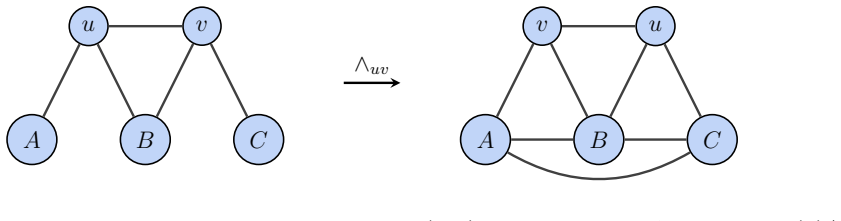
The central claim is that LU-equivalence of graph states reduces entirely to a graph-theoretic rule: if two graph states are LU-equivalent, then their graphs are related by r-local complementations for some r ≤ n, and conversely. Here 1-local complementation is the classical local complementation, so LC-equivalence is the base of the hierarchy. Sharpening the bound, for n>7 the required level satisfies r ≤ ceil(log2((n+1)/8)), which makes the LU-equivalence decision problem quasi-polynomial and implies that every graph state on at most 19 qubits has the same LU- and LC-orbits.
What carries the argument
r-local complementation G ⋆r S, defined for an r-incident independent multiset S of vertices, toggles an edge (u,v) precisely when the number of common neighbors of u and v in S is 2^{r-1} modulo 2^r. It is implemented by local X- and Z-rotations, so it is a genuine local unitary action on the graph state; level 1 is ordinary local complementation. The level r measures how far beyond Clifford operations a local equivalence must go, and the r-incidence condition is exactly what keeps the transformed object a graph state rather than a general weighted hypergraph state.
Load-bearing premise
The whole approach leans on the combinatorial lower bound that any genuinely level-r transformation forces the graph to contain at least 2^{r+2} vertices; if a smaller graph admitted such a transformation, the logarithmic bound collapses.
What would settle it
Search for a graph of order n < 2^{r+2} carrying a genuine r-incident independent multiset S whose r-local complementation cannot be simulated at level r-1; even one such pair would refute the combinatorial lower bound, undo the r = O(log n) bound, and force the decision algorithm back to exponential time.
If this is right
- Two graph states on at most 19 qubits that are locally unitarily equivalent are always locally Clifford equivalent, so no counterexample to LU=LC exists below 20 qubits.
- LU-equivalence of graph states can be decided classically in time n^{log n + O(1)}, replacing previously exponential methods.
- There is no single finite level r whose r-local complementations capture LU-equivalence for all graphs; the gap between LC- and LU-equivalence is an infinite strict hierarchy of LCr-equivalences.
- SLOCC-equivalence coincides with LU-equivalence for graph states, so the same graphical criterion also classifies entanglement under stochastic local operations and classical communication.
- Every graph is covered by minimal local sets, and such a cover can be constructed in polynomial time, anchoring the standard-form reduction used in the characterization.
Where Pith is reading between the lines
- The minimal level r needed to connect two LU-equivalent graph states could serve as a natural resource measure: a 'non-Clifford depth' of local equivalence, potentially useful in magic-state resource theories.
- The 19-qubit threshold is not claimed minimal; a computer search over graph states of 20 to 26 vertices guided by the r-local complementation rule could pinpoint the smallest order at which LU and LC orbits separate.
- The linear-constraint extension of the standard LC-equivalence algorithm may apply to other graph isomorphism problems phrased as local complementation with restrictions, not just state-equivalence questions.
- If the combinatorial lower bound at the heart of the logarithmic estimate is sharpened, the bound on r would improve accordingly, possibly yielding a polynomial-time LU-equivalence algorithm or a higher LU=LC threshold.
Editorial analysis
A structured set of objections, weighed in public.
Referee Report
Summary. The thesis develops a purely graph-theoretic characterization of local unitary (LU) equivalence for graph states. It introduces r-local complementation and LCr-equivalence, proves that LU-equivalent graph states are LCr-equivalent for some r ≤ n, shows that the LCr-equivalences form an infinite strict hierarchy, and derives a quasi-polynomial algorithm for deciding LU-equivalence. It also proves LU=LC for all graph states up to 19 qubits and studies vertex-minor universal graphs. The central claimed results are Theorem 6 (LU implies LCr for some r), Theorem 7 (strict hierarchy), Theorem 9 (logarithmic level bound), Theorem 10 (quasi-polynomial algorithm), and the 19-qubit LU=LC bound in Chapter 6.
Significance. If correct, the results would resolve the structure of local equivalence of graph states: LU-equivalence would be exactly captured by a purely graph-theoretic rule, the LC/LU gap would be an infinite strict hierarchy, and LU-equivalence would be decidable in quasi-polynomial time. The thesis is largely self-contained and contains several first-principles proofs, explicit constructions (e.g., the C_{t,k}/C'_{t,k} hierarchy), and a detailed algorithmic reduction to a constrained version of Bouchet's algorithm. The parity arguments in Lemmas 20–21 and the constructive hierarchy of Chapter 4 are substantial contributions in their own right. However, a load-bearing proof gap in Theorem 6 prevents me from endorsing the central claim as it stands.
major comments (2)
- [Chapter 4, proof of Theorem 6] The induction over K ⊆ VZ applies Lemma 12 to the set VZ\K and uses the resulting congruence modulo π/2^{|VZ|-|K|-2+δ(|VZ|-|K|-2)}. This is a strictly coarser modulus than the claimed π/2^{|VZ|-2+δ(|VZ|-2)} whenever K is nonempty. Vanishing modulo a coarser modulus does not imply vanishing modulo the finer modulus used in the induction, so the step 'by Lemma 12' is not justified. The gap is not merely cosmetic: the intermediate assertion is actually false. For |VZ|=4 and four X-vertices whose neighborhoods are the four 3-subsets of VZ, assigning α=π/2 to each X-vertex satisfies all congruences of Lemma 12 (each 2-subset sum is π, each 3-subset sum is π/2, the 4-subset sum is empty), yet the angles are not 0 modulo π/4, the modulus claimed by the induction. This does not disprove Theorem 6—the configuration is already LC1—but it shows the proof's stronger inductive claim cannot be correct
- [Chapter 4, Theorem 5 (3⇒2)] The statement 'A local complementation is, in particular, an r-local complementation' is not immediate from the definition of r-local complementation for r≥2. It is true, but only via the multiset construction S=2^{r-1}{a} (using Proposition 45), and the proof should say so explicitly. Since Theorem 5 is used repeatedly, this missing detail should be supplied.
minor comments (4)
- [Proposition 44] In the proof, the 'if and only if' condition over K⊆V is written as 'for any K⊆V' with exponent r-|K|+2-δ(|K|-2). For |K|>r+1 the exponent is negative and the condition is not meaningful. The intended statement is restricted to 2≤|K|≤r+1, matching Definition 16. Please make this restriction explicit.
- [Notation] The Kronecker delta δ used in Lemma 12 and in the proof of Theorem 6 is defined only in Definition 16. Since Chapter 4 is meant to be readable independently, re-state the convention (δ(0)=1, δ(x)=0 otherwise) where Lemma 12 is stated.
- [Abstract / front matter] The abstract writes the quasi-polynomial running time as O(nlogn); this should be O(n^{log n}) (or n^{O(log n)}). The same typo appears in the French résumé.
- [Chapter 7] The vertex-minor universality chapter is interesting but appears largely independent of the LU-equivalence results. A short paragraph in Chapter 1 or 7 connecting this notion to LCr-equivalence and LU-equivalence would help the reader understand the overall arc of the thesis.
Circularity Check
No significant circularity: the LU/LC_r characterization is derived, not assumed; self-citations are not load-bearing.
full rationale
The central derivation is self-contained. The r-local complementation is introduced as a graph operation (Definitions 16–17) and then shown, via the weighted-hypergraph phase computation (Propositions 43–44), to be exactly the action of X-rotations of angle π/2^r on graph states; the equivalence in Proposition 44 is derived as an iff condition, not assumed to force the target. The LU⇒LCr result (Theorem 6) is obtained from the standard-form machinery: Lemma 12's angle constraints are consequences of the hypergraph formula, and the induction over common neighborhoods is a proof step rather than a renaming or fitted input. The logarithmic bound (Proposition 56, Theorem 9) rests on the internally proved support-size lower bounds of Lemmas 20–21, and the quasi-polynomial algorithm inherits that bound. Known external facts—the 27-vertex counterexample, Bouchet's algorithm—are used as benchmarks, and Bouchet's LC characterization is re-proved in Section 2.5.3. The author's prior papers are cited for the MLS-cover tools and some proof details, but those proofs are either reproduced in the thesis or are independent peer-reviewed results; no load-bearing step reduces to a self-citation. The explicit limitation in Remark 9 (the open 'Class α' case) concerns completeness of the constrained LC algorithm, not circularity of the main characterization. The reviewer's proof-gap concern about Theorem 6 is a correctness issue, not an input-output tautology.
Axiom & Free-Parameter Ledger
axioms (7)
- standard math Cut-rank function satisfies symmetry, linear boundedness, and submodularity (Bouchet; Oum-Seymour [65]).
- standard math Local complementation exactly captures LC-equivalence of graph states (Van den Nest et al.; Bouchet's equations [45,56]).
- standard math Two graph states are SLOCC-equivalent iff LU-equivalent (Prop. 14, [46]).
- standard math Any local unitary relating LU-equivalent graph states decomposes as Clifford ∘ Z-rotation ∘ Clifford per qubit (Prop. 15, [47,48]).
- standard math Single-qubit unitaries in level r+1 of the Clifford hierarchy are exactly products of H and Z(π/2^r) (Prop. 41, [78,79]).
- domain assumption Existence of graphs of order n with local minimum degree ≥ 0.189n (Prop. 38, [69]).
- domain assumption Known LU-but-not-LC counterexamples of order 27 ([43,49]) are accepted as external benchmarks.
read the original abstract
Graph states form a large family of quantum states that are in one-to-one correspondence with mathematical graphs. Graph states are used in many applications, such as measurement-based quantum computation, as multipartite entangled resources. It is thus crucial to understand when two such states have the same entanglement, i.e. when they can be transformed into each other using only local operations. In this case, we say that the graph states are LU-equivalent (local unitary). If the local operations are restricted to the so-called Clifford group, we say that the graph states are LC-equivalent (local Clifford). Interestingly, a simple graph rule called local complementation fully captures LC-equivalence, in the sense that two graph states are LC-equivalent if and only if the underlying graphs are related by a sequence of local complementations. While it was once conjectured that two LU-equivalent graph states are always LC-equivalent, counterexamples do exist and local complementation fails to fully capture the entanglement of graph states. We introduce in this thesis a generalization of local complementation that does fully capture LU-equivalence. Using this characterization, we prove the existence of an infinite strict hierarchy of local equivalences between LC- and LU-equivalence. This also leads to the design of a quasi-polynomial algorithm for deciding whether two graph states are LU-equivalent, and to a proof that two LU-equivalent graph states are LC-equivalent if they are defined on at most 19 qubits. Furthermore, we study graph states that are universal in the sense that any smaller graph state, defined on any small enough set of qubits, can be induced using only local operations. We provide bounds and an optimal, probabilistic construction.
Figures






Forward citations
Cited by 1 Pith paper
-
The Structure of Circle Graph States
Circle graphs are closed under r-local complementation and bipartite circle graph states correspond one-to-one with planar code states whose MBQC is classically simulable.
Reference graph
Works this paper leans on
-
[7]
Richard P. Feynman. Simulating physics with computers.International Journal of Theoretical Physics, 21(6):467–488, Jun 1982.doi:10.1007/BF02650179
-
[8]
Peter W. Shor. Polynomial-time algorithms for prime factorization and discrete loga- rithms on a quantum computer.SIAM Journal on Computing, 26(5):1484–1509, 1997. arXiv:quant-ph/9508027,doi:10.1137/S0097539795293172
Pith/arXiv arXiv 1997
-
[9]
Robert Raussendorf and Hans J. Briegel. A one-way quantum computer.Physical Review Letters, 86(22):5188, 2001.doi:10.1103/PhysRevLett.86.5188
-
[10]
Robert Raussendorf, Daniel E. Browne, and Hans J. Briegel. Measurement-based quan- tum computation on cluster states.Physical review A, 68(2):022312, 2003.arXiv: quant-ph/0301052,doi:10.1103/PhysRevA.68.022312
Pith/arXiv arXiv 2003
-
[11]
Hans J. Briegel, David E. Browne, Wolfgang Dür, Robert Raussendorf, and Maarten Van den Nest. Measurement-based quantum computation.Nature Physics, 5(1):19–26, 2009.arXiv:0910.1116,doi:10.1038/nphys1157
Pith/arXiv arXiv 2009
-
[12]
HansJ.BriegelandRobertRaussendorf. Persistententanglementinarraysofinteracting particles.Physical Review Letters, 86:910–913, Jan 2001.arXiv:quant-ph/0004051, doi:10.1103/PhysRevLett.86.910
Pith/arXiv arXiv 2001
-
[13]
Marc Hein, Jens Eisert, and Hans J. Briegel. Multiparty entanglement in graph states.Physical Review A, 69(6), Jun 2004.arXiv:quant-ph/0307130,doi:10.1103/ physreva.69.062311
Pith/arXiv arXiv 2004
-
[14]
Resources required for preparing graph states
Peter Høyer, Mehdi Mhalla, and Simon Perdrix. Resources required for preparing graph states. InProceedings of the 17th International Symposium on Algorithms and Compu- tation (ISAAC 2006), Dec 2006. URL: https://hal.archives-ouvertes.fr/hal-01378771, doi:10.1007/11940128\_64
doi:10.1007/11940128 2006
-
[15]
Adán Cabello, Lars Eirik Danielsen, Antonio J. López-Tarrida, and José R. Portillo. Optimal preparation of graph states.Physical Review A, 83:042314, Apr 2011.arXiv: 1011.5464,doi:10.1103/PhysRevA.83.042314
Pith/arXiv arXiv 2011
-
[16]
Antonio Russo, Edwin Barnes, and Sophia E. Economou. Photonic graph state genera- tion from quantum dots and color centers for quantum communications.Physical Review B, 98(8):085303, 2018.arXiv:1801.02754,doi:10.1103/PhysRevB.98.085303. 110
Pith/arXiv arXiv 2018
-
[17]
Bikun Li, Sophia E. Economou, and Edwin Barnes. Photonic resource state generation from a minimal number of quantum emitters.npj Quantum Information, 8(1):11, Feb 2022.arXiv:2108.12466,doi:10.1038/s41534-022-00522-6
Pith/arXiv arXiv 2022
-
[18]
Sobhan Ghanbari, Jie Lin, Benjamin MacLellan, Luc Robichaud, Piotr Roztocki, and Hoi-Kwong Lo. Optimization of deterministic photonic-graph-state generation via local operations.Physical Review A, 110:052605, Nov 2024.arXiv:2401.00635,doi:10. 1103/PhysRevA.110.052605
Pith/arXiv arXiv 2024
-
[19]
Stabilizer codes and quantum error correction, 1997.arXiv: quant-ph/9705052
Daniel Gottesman. Stabilizer codes and quantum error correction, 1997.arXiv: quant-ph/9705052
Pith/arXiv arXiv 1997
-
[20]
Graphs, quadratic forms, and quantum codes
Markus Grassl, Andreas Klappenecker, and Martin Rotteler. Graphs, quadratic forms, and quantum codes. InProceedings of the 2002 IEEE International Symposium on Information Theory (ISIT 2002), pages 45–, 2002.arXiv:quant-ph/0703112,doi: 10.1109/ISIT.2002.1023317
Pith/arXiv arXiv 2002
-
[21]
Arthur Robert Calderbank and Peter W. Shor. Good quantum error-correcting codes exist.Physical Review A, 54:1098–1105, Aug 1996.arXiv:quant-ph/9512032,doi: 10.1103/PhysRevA.54.1098
Pith/arXiv arXiv 1996
-
[22]
Andrew Steane. Multiple-particle interference and quantum error correction.Proceed- ings of the Royal Society of London. Series A: Mathematical, Physical and Engineering Sciences, 452(1954):2551–2577, 1996.arXiv:quant-ph/9601029,doi:10.1098/rspa. 1996.0136
Pith/arXiv arXiv 1954
-
[23]
The Heisenberg representation of quantum computers
Daniel Gottesman. The Heisenberg representation of quantum computers. 1998.arXiv: quant-ph/9807006
Pith/arXiv arXiv 1998
-
[24]
Improved simulation of stabilizer circuits
Scott Aaronson and Daniel Gottesman. Improved simulation of stabilizer circuits. Physical Review A, 70:052328, Nov 2004.arXiv:quant-ph/0406196,doi:10.1103/ PhysRevA.70.052328
Pith/arXiv arXiv 2004
-
[25]
Dirk Schlingemann and Reinhard F. Werner. Quantum error-correcting codes associated with graphs.Physical Review A, 65(1):012308, 2001.arXiv:quant-ph/0012111,doi: 10.1103/PhysRevA.65.012308
Pith/arXiv arXiv 2001
-
[26]
Stabilizer codes can be realized as graph codes, 2001.arXiv: quant-ph/0111080
Dirk Schlingemann. Stabilizer codes can be realized as graph codes, 2001.arXiv: quant-ph/0111080
Pith/arXiv arXiv 2001
-
[27]
PhD thesis, 2025.arXiv: 2501.17959
Andrey Boris Khesin.Quantum Computing from Graphs. PhD thesis, 2025.arXiv: 2501.17959
Pith/arXiv arXiv 2025
-
[28]
Damian Markham and Barry C. Sanders. Graph states for quantum secret sharing. Physical Review A, 78(4):042309, 2008.arXiv:0808.1532,doi:10.1103/PhysRevA. 78.042309. 111
Pith/arXiv arXiv 2008
-
[29]
Adrian Keet, Ben Fortescue, Damian Markham, and Barry C. Sanders. Quantum secret sharing with qudit graph states.Physical Review A, 82:062315, Dec 2010.arXiv: 1004.4619,doi:10.1103/PhysRevA.82.062315
Pith/arXiv arXiv 2010
-
[30]
New protocols and lower bounds for quantum secret sharing with graph states
Jérôme Javelle, Mehdi Mhalla, and Simon Perdrix. New protocols and lower bounds for quantum secret sharing with graph states. InProceedings of the 7th Conference on the Theory of Quantum Computation, Communication, and Cryptography (TQC 2012), pages 1–12, 2013.arXiv:1109.1487,doi:10.1007/978-3-642-35656-8_1
Pith/arXiv arXiv 2012
-
[31]
Quantum secret sharingwithgraphstates
Sylvain Gravier, Jérôme Javelle, Mehdi Mhalla, and Simon Perdrix. Quantum secret sharingwithgraphstates. InProceedings of the 8th Mathematical and Engineering Meth- ods in Computer Science International Doctoral Workshop (MEMICS 2012), 2013. URL: https://hal.science/hal-00933722/document,doi:10.1007/978-3-642-36046-6_3
-
[32]
B. A. Bell, Damian Markham, D. A. Herrera-Martí, Anne Marin, W. J. Wadsworth, J. G. Rarity, and M. S. Tame. Experimental demonstration of graph-state quantum secret sharing.Nature Communications, 5(1):5480, Nov 2014.arXiv:1411.5827,doi: 10.1038/ncomms6480
Pith/arXiv arXiv 2014
-
[33]
All-photonic quantum repeaters
Koji Azuma, Kiyoshi Tamaki, and Hoi-Kwong Lo. All-photonic quantum repeaters. Nature communications, 6(1):1–7, 2015.arXiv:1309.7207,doi:10.1038/ncomms7787
Pith/arXiv arXiv 2015
-
[34]
Economou, David Elkouss, Paul Hilaire, Liang Jiang, Hoi- Kwong Lo, and Ilan Tzitrin
Koji Azuma, Sophia E. Economou, David Elkouss, Paul Hilaire, Liang Jiang, Hoi- Kwong Lo, and Ilan Tzitrin. Quantum repeaters: From quantum networks to the quantum internet.Reviews of Modern Physics, 95(4):045006, 2023.arXiv:2212.10820, doi:10.1103/RevModPhys.95.045006
Pith/arXiv arXiv 2023
-
[35]
Frederik Hahn, Anna Pappa, and Jens Eisert. Quantum network routing and local complementation.npj Quantum Information, 5(1):1–7, 2019.arXiv:1805.04559,doi: 10.1038/s41534-019-0191-6
Pith/arXiv arXiv 2019
-
[36]
Sergey Bravyi, Yash Sharma, Mario Szegedy, and Ronald de Wolf. Generatingkepr- pairs from ann-party resource state.Quantum, 8:1348, 2024.arXiv:2211.06497, doi:10.22331/q-2024-05-14-1348
Pith/arXiv arXiv 2024
-
[37]
Distributing graph states over arbitrary quantum networks.Physical Review A, 100:052333, Nov 2019
Clément Meignant, Damian Markham, and Frédéric Grosshans. Distributing graph states over arbitrary quantum networks.Physical Review A, 100:052333, Nov 2019. arXiv:1811.05445,doi:10.1103/PhysRevA.100.052333
Pith/arXiv arXiv 2019
-
[38]
Distributing graph states across quantum networks
Alex Fischer and Don Towsley. Distributing graph states across quantum networks. InProceedings of the 2021 IEEE International Conference on Quantum Computing and Engineering (QCE), pages 324–333, 2021.arXiv:2009.10888,doi:10.1109/ QCE52317.2021.00049
arXiv 2021
-
[39]
Vaisakh Mannalath and Anirban Pathak. Multiparty entanglement routing in quantum networks.Physical Review A, 108:062614, Dec 2023.arXiv:2211.06690,doi:10.1103/ PhysRevA.108.062614. 112
Pith/arXiv arXiv 2023
-
[40]
Vertex-minors of graphs: A survey.Discrete Ap- plied Mathematics, 351:54–73, 2024
Donggyu Kim and Sang-il Oum. Vertex-minors of graphs: A survey.Discrete Ap- plied Mathematics, 351:54–73, 2024. URL: https://dimag.ibs.re.kr/home/donggyu/ wp-content/uploads/sites/16/2023/04/2023-survey-Vertex-minors-of-graphs.pdf,doi: 10.1016/j.dam.2024.03.011
-
[41]
Axel Dahlberg, Jonas Helsen, and Stephanie Wehner. Transforming graph states to Bell-pairs is NP-Complete.Quantum, 4:348, Oct 2020.arXiv:1907.08019,doi:10. 22331/q-2020-10-22-348
Pith/arXiv arXiv 2020
-
[42]
Olaf Krueger and Reinhard F. Werner. Some open problems in quantum information theory, 2005.arXiv:quant-ph/0504166
Pith/arXiv arXiv 2005
-
[43]
Zhengfeng Ji, Jianxin Chen, Zhaohui Wei, and Mingsheng Ying. The LU-LC conjecture is false.Quantum Information and Computation, 10(1):97–108, Jan 2010.arXiv: 0709.1266,doi:QIC10.1-2-8.html
Pith/arXiv arXiv 2010
-
[44]
Marc Hein, Wolfgang Dür, Jens Eisert, Robert Raussendorf, Maarten Van den Nest, and Hans J. Briegel. Entanglement in graph states and its applications.Quantum computers, algorithms and chaos, 162, Mar 2006.arXiv:quant-ph/0602096,doi: 10.3254/978-1-61499-018-5-115
Pith/arXiv arXiv 2006
-
[45]
Maarten Van den Nest, Jeroen Dehaene, and Bart De Moor. Graphical description of the action of local Clifford transformations on graph states.Physical Review A, 69(2), Feb 2004.arXiv:quant-ph/0308151,doi:10.1103/physreva.69.022316
Pith/arXiv arXiv 2004
-
[46]
Frank Verstraete, Jeroen Dehaene, and Bart De Moor. Normal forms and entanglement measures for multipartite quantum states.Physical Review A, 68:012103, Jul 2003. arXiv:quant-ph/0105090,doi:10.1103/PhysRevA.68.012103
Pith/arXiv arXiv 2003
-
[47]
David Gross and Maarten Van den Nest. The LU-LC conjecture, diagonal local op- erations and quadratic forms over GF(2).Quantum Information and Computation, 8(3):263–281, 2008.arXiv:0707.4000,doi:10.26421/QIC8.3-4-3
Pith/arXiv arXiv 2008
-
[48]
Bei Zeng, Andrew Cross, and Isaac L. Chuang. Transversality versus universality for additive quantum codes.IEEE Transactions on Information Theory, 57(9):6272–6284, 2011.arXiv:0706.1382,doi:10.1109/TIT.2011.2161917
Pith/arXiv arXiv 2011
-
[49]
Nikoloz Tsimakuridze and Otfried Gühne. Graph states and local unitary transforma- tions beyond local Clifford operations.Journal of Physics A: Mathematical and Theoret- ical, 50(19):195302, Apr 2017.arXiv:1611.06938,doi:10.1088/1751-8121/aa67cd
Pith/arXiv arXiv 2017
-
[50]
André Bouchet. Isotropic systems.European Journal of Combinatorics, 8(3):231–244, 1987.doi:10.1016/S0195-6698(87)80027-6
-
[51]
André Bouchet. Digraph decompositions and Eulerian systems.SIAM Journal on Algebraic Discrete Methods, 8(3):323–337, 1987.doi:10.1137/0608028. 113
-
[52]
André Bouchet. Reducing prime graphs and recognizing circle graphs.Combinatorica, 7(3):243–254, Sep 1987.doi:10.1007/BF02579301
-
[53]
André Bouchet. Graphic presentations of isotropic systems.Journal of Combinatorial Theory, Series B, 45(1):58–76, 1988.doi:10.1016/0095-8956(88)90055-X
-
[54]
André Bouchet. Transforming trees by successive local complementations.Journal of Graph Theory, 12:195–207, 1988.doi:10.1002/jgt.3190120210
-
[55]
André Bouchet. Connectivity of isotropic systems.Annals of the New York Academy of Sciences, 555(1):81–93, 1989.doi:10.1111/j.1749-6632.1989.tb22439.x
arXiv 1989
-
[56]
André Bouchet. An efficient algorithm to recognize locally equivalent graphs.Combi- natorica, 11(4):315–329, Dec 1991.doi:10.1007/BF01275668
-
[57]
André Bouchet. Recognizing locally equivalent graphs.Discrete Mathematics, 114(1):75–86, 1993.doi:10.1016/0012-365X(93)90357-Y
-
[58]
André Bouchet. Circle graph obstructions.Journal of Combinatorial Theory, Series B, 60(1):107–144, 1994.doi:10.1006/jctb.1994.1008
arXiv 1994
-
[59]
André Bouchet. Multimatroids III. Tightness and fundamental graphs.European Jour- nal of Combinatorics, 22(5):657–677, 2001.doi:10.1006/eujc.2000.0486
arXiv 2001
-
[60]
Eulerian lines in finite 4-valent graphs and their transformations.Theory of Graphs, pages 219–230, 1968
Anton Kotzig. Eulerian lines in finite 4-valent graphs and their transformations.Theory of Graphs, pages 219–230, 1968
1968
-
[61]
Quelques remarques sur les transformationsκ, 1977
Anton Kotzig. Quelques remarques sur les transformationsκ, 1977
1977
-
[62]
Maarten Van den Nest, Jeroen Dehaene, and Bart De Moor. Efficient algorithm to recognize the local Clifford equivalence of graph states.Physical Review A, 70:034302, Sep 2004.arXiv:quant-ph/0405023,doi:10.1103/PhysRevA.70.034302
Pith/arXiv arXiv 2004
-
[63]
Mehdi Mhalla and Simon Perdrix. Graph states, pivot minor, and universality of (X,Z)- measurements.International Journal of Unconventional Computing, 9(1-2):153–171, 2013.arXiv:1202.6551
Pith/arXiv arXiv 2013
-
[64]
Edge-local equivalence of graphs
Maarten Van den Nest and Bart De Moor. Edge-local equivalence of graphs. 2005. arXiv:math/0510246
Pith/arXiv arXiv 2005
-
[65]
Sang-ilOumandPaulSeymour. Approximatingclique-widthandbranch-width.Journal of Combinatorial Theory, Series B, 96(4):514–528, 2006.doi:10.1016/j.jctb.2005. 10.006
-
[66]
Nielsen and Isaac L
Michael A. Nielsen and Isaac L. Chuang.Quantum Computation and Quantum Infor- mation. Cambridge University Press, 2000
2000
-
[67]
Sang-il Oum. Rank-width and vertex-minors.Journal of Combinatorial Theory, Series B, 95(1):79–100, 2005.doi:10.1016/j.jctb.2005.03.003. 114
-
[68]
D. G. Fon-Der-Flaass. Local complementations of simple and directed graphs. InDis- crete Analysis and Operations Research, 1996.doi:10.1007/978-94-009-1606-7_3
-
[69]
On the minimum degree up to local complementation: Bounds and complexity
Jérôme Javelle, Mehdi Mhalla, and Simon Perdrix. On the minimum degree up to local complementation: Bounds and complexity. InProceedings of the 38th workshop on Graph Theory (WG 2012), 2012.arXiv:1204.4564,doi:10.1007/ 978-3-642-34611-8_16
Pith/arXiv arXiv 2012
-
[70]
Minimum degree up to local complementa- tion: Bounds, parameterized complexity, and exact algorithms
David Cattanéo and Simon Perdrix. Minimum degree up to local complementa- tion: Bounds, parameterized complexity, and exact algorithms. InProceedings of the 26th International Symposium on Algorithms and Computation, (ISAAC 2015), 2015. arXiv:1503.04702,doi:10.1007/978-3-662-48971-0\_23
Pith/arXiv arXiv 2015
-
[71]
Maarten Van den Nest, Jeroen Dehaene, and Bart De Moor. Local unitary versus local Clifford equivalence of stabilizer states.Physical Review A, 71(6), Jun 2005.arXiv: quant-ph/0411115,doi:10.1103/physreva.71.062323
Pith/arXiv arXiv 2005
-
[72]
James R. Bunch and John E. Hopcroft. Triangular factorization and inversion by fast matrix multiplication.Mathematics of Computation, 28(125):231–236, Jan 1974.doi: 10.2307/2005828
-
[73]
Ibarra, Shlomo Moran, and Roger Hui
Oscar H. Ibarra, Shlomo Moran, and Roger Hui. A generalization of the fast LUP matrix decomposition algorithm and applications.Journal of Algorithms, 3(1):45–56, 1982.doi:10.1016/0196-6774(82)90007-4
-
[74]
Graph states under the action of local Clifford group in non-binary case
Mohsen Bahramgiri and Salman Beigi. Graph states under the action of local Clifford group in non-binary case. Oct 2006.arXiv:quant-ph/0610267
Pith/arXiv arXiv 2006
-
[75]
Avanti Ketkar, Andreas Klappenecker, Santosh Kumar, and Pradeep Sarvepalli. Non- binary stabilizer codes over finite fields.IEEE Transactions on Information Theory, 52:4892 – 4914, Dec 2006.arXiv:quant-ph/0508070,doi:10.1109/TIT.2006.883612
Pith/arXiv arXiv 2006
-
[76]
Access structure in graphs in high dimension and application to secret sharing
Anne Marin, Damian Markham, and Simon Perdrix. Access structure in graphs in high dimension and application to secret sharing. InProceedings of the 8th Conference on the Theory of Quantum Computation, Communication and Cryptography (TQC 2013), Apr 2013.arXiv:1304.7105,doi:10.4230/LIPIcs.TQC.2013.308
Pith/arXiv arXiv 2013
-
[77]
The rank-width of edge-coloured graphs
Mamadou Kante and Michaël Rao. The rank-width of edge-coloured graphs. Theory of Computing Systems, 52, Sep 2007.arXiv:0709.1433,doi:10.1007/ s00224-012-9399-y
Pith/arXiv arXiv 2007
-
[78]
Bei Zeng, Xie Chen, and Isaac L. Chuang. Semi-Clifford operations, structure ofCk hierarchy, and gate complexity for fault-tolerant quantum computation.Physical Review A, 77:042313, Apr 2008.arXiv:0712.2084,doi:10.1103/PhysRevA.77.042313
Pith/arXiv arXiv 2008
-
[79]
Cui, Daniel Gottesman, and Anirudh Krishna
Shawn X. Cui, Daniel Gottesman, and Anirudh Krishna. Diagonal gates in the Clifford hierarchy.Physical Review A, 95:012329, Jan 2017.arXiv:1608.06596,doi:10.1103/ PhysRevA.95.012329. 115
Pith/arXiv arXiv 2017
-
[80]
Glaudell, Shaun Kelso, William Maxwell, Samuel S
Matthew Amy, Andrew N. Glaudell, Shaun Kelso, William Maxwell, Samuel S. Mendel- son, and Neil J. Ross. Exact synthesis of multiqubit Clifford-cyclotomic circuits. InProceedings of the 16th Conference on Reversible Computation (RC 2024), 2024. arXiv:2311.07741,doi:10.1007/978-3-031-62076-8_15
Pith/arXiv arXiv 2024
-
[81]
Eric M. Rains. Quantum codes of minimum distance two.IEEE Transactions on Information Theory, 45(1):266–271, 1999.doi:10.1109/18.746807
-
[82]
Algorithm to verify local equivalence of stabilizer states, 2024.arXiv:2410.03961
Adam Burchardt, Jarn de Jong, and Lina Vandré. Algorithm to verify local equivalence of stabilizer states, 2024.arXiv:2410.03961
Pith/arXiv arXiv 2024
-
[83]
Cam- bridge university press, 1952
Godfrey Harold Hardy, John Edensor Littlewood, and George Pólya.Inequalities. Cam- bridge university press, 1952
1952
-
[84]
Matthias Englbrecht and Barbara Kraus. Symmetries and entanglement of stabilizer states.Physical Review A, 101:062302, Jun 2020.arXiv:2001.07106,doi:10.1103/ PhysRevA.101.062302
Pith/arXiv arXiv 2020
-
[85]
PhD thesis, ETH Zurich,
Arne Storjohann.Algorithms for matrix canonical forms. PhD thesis, ETH Zurich,
-
[86]
Ilan Tzitrin. Local equivalence of complete bipartite and repeater graph states.Phys- ical Review A, 98(3):032305, 2018.arXiv:1805.05968,doi:10.1103/PhysRevA.98. 032305
Pith/arXiv arXiv 2018
discussion (0)
Sign in with ORCID, Apple, or X to comment. Anyone can read and Pith papers without signing in.