Role of prompt cusps in driving the core collapse of SIDM halos
Pith reviewed 2026-05-17 03:22 UTC · model grok-4.3
The pith
Prompt cusps in SIDM halos slow early core formation by a factor of two but let later collapse track standard paths after rescaling.
A machine-rendered reading of the paper's core claim, the machinery that carries it, and where it could break.
Core claim
Halos with more prominent prompt cusps show delayed core formation by a factor of approximately 2 because of smaller velocity dispersion gradients in the inner region. During most of the core-collapse phase the evolution aligns in physical time after rescaling of densities, radii, and velocity dispersions, preserving the original virial mass at higher concentration. Late-phase deviations remain at the 5 percent level relative to the NFW reference collapse track and depend on both the increased concentration and the temperature of the outer halo regions.
What carries the argument
Prompt cusps, steep central density peaks formed by direct collapse of early overdensities and embedded in SIDM halo centers.
If this is right
- Core-collapse timing depends on the interplay between the inner prompt-cusp profile and the velocity dispersion in the outer halo.
- The scale densities and radii after collapse still reflect the original halo virial mass but at higher concentration.
- Deviations from the reference track grow at late times when outer-halo temperature either inhibits or enhances heat transfer.
Where Pith is reading between the lines
- Accounting for prompt cusps could shift the predicted mass range where core collapse becomes observable in dwarf galaxies.
- Full cosmological simulations that include prompt cusps may produce distinct signatures in central density profiles or rotation curves.
- The small late-time deviations suggest that outer-halo properties can be tuned to control the final stages of collapse.
Load-bearing premise
Isolated halos with embedded prompt cusps capture the dynamics that arise in certain SIDM models with light mediators and suppressed small-scale linear power.
What would settle it
A measurement of core-collapse timescales in low-mass halos that either matches the rescaled NFW track or shows systematic deviations larger than 5 percent when central cusp mass is accounted for would test the result.
Figures




read the original abstract
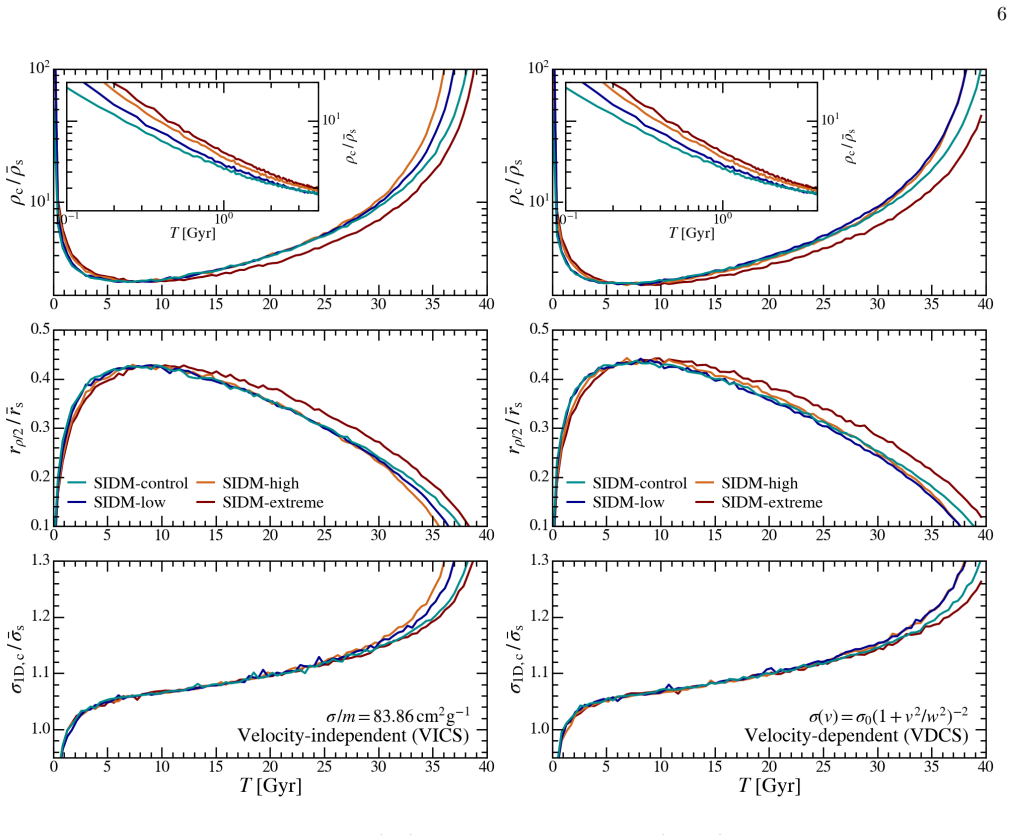
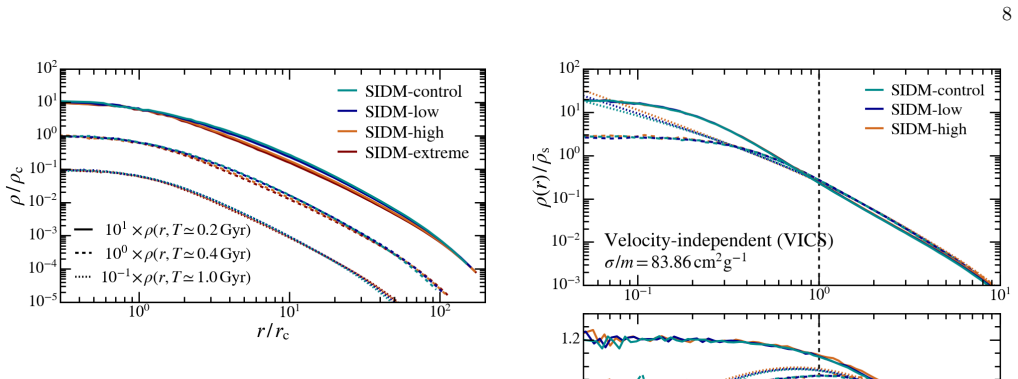
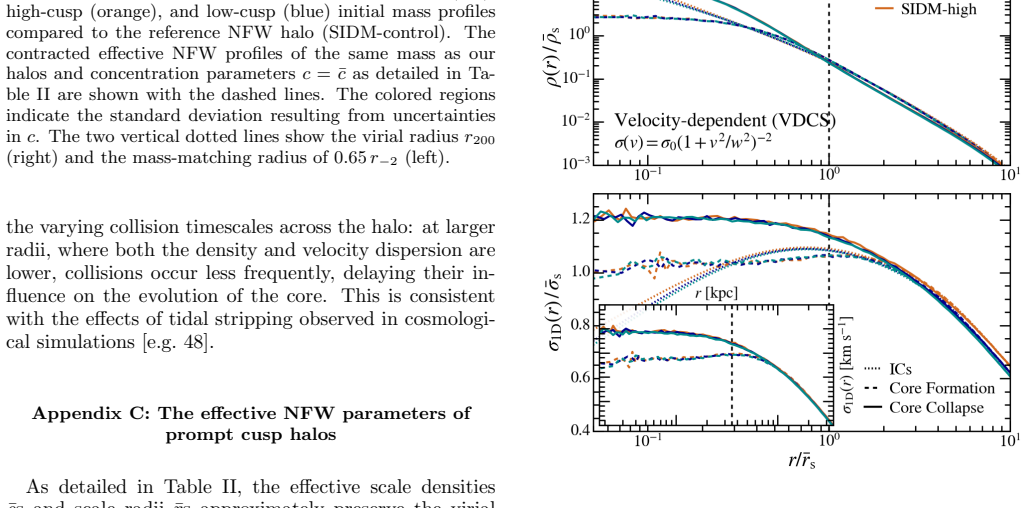
Prompt cusps (PCs) form from the direct collapse of overdensities in the early Universe, reside at the center of every dark matter halo, and have density profiles steeper than $r^{-1}$ NFW cusps. Using a suite of high-resolution N-body simulations, we study the evolution of isolated halos in self-interacting dark matter (SIDM) with massive PCs embedded at their centers, a scenario that could be realized in certain SIDM models with light mediators that predict a small-scale suppression of the linear matter power spectrum. We track the evolution of three equally concentrated $10^7\,{\rm{M}}_\odot$ halos, hosting PCs of various total masses, and quantify how the presence of a PC affects the processes of core formation and collapse. Early in the core-formation phase, halos with more prominent PCs exhibit a delayed evolution by a factor of $\sim 2$ due to smaller velocity dispersion gradients in the inner region. During most of the core-collapse phase, the halo evolution becomes closely aligned in physical time, with appropriate rescaling of densities, radii, and velocity dispersions. The scale densities and radii preserve the virial mass of the original halos, but with increased concentration. Deviations occur at the late phase of core-collapse at the level of $\sim 5\%$ relative to the reference collapse track of an NFW halo. These deviations depend non-trivially on both the increased concentration incurred by the PCs, as well as the velocity dispersion (temperature) of the outer halo regions, which can inhibit or enhance the heat transfer process. Our simulations illustrate the complex interplay between the inner and outer halo profiles in determining the onset of core collapse and motivate future studies in the full cosmological context.
Editorial analysis
A structured set of objections, weighed in public.
Referee Report
Summary. The manuscript reports results from high-resolution N-body simulations of three isolated 10^7 M_⊙ SIDM halos, each initialized with an embedded prompt cusp (PC) of varying mass. It claims that more massive PCs delay the early core-formation phase by a factor of ∼2 owing to reduced inner velocity-dispersion gradients; that the subsequent core-collapse phase aligns closely with a rescaled NFW reference track (preserving virial mass but increasing concentration); and that late-phase deviations remain at the ∼5 % level, depending non-trivially on both the PC-induced concentration increase and the outer-halo velocity dispersion.
Significance. If the reported alignment and small late-time deviations hold under the stated numerical conditions, the work supplies concrete, simulation-based evidence for the interplay between inner prompt cusps and outer halo temperature in controlling SIDM core collapse. The direct tracking of three halos with controlled PC masses constitutes a clear strength, yielding falsifiable quantitative outputs that analytic models alone cannot provide.
major comments (2)
- [Abstract and §3] Abstract and §3 (simulation setup): the central claim that late-phase deviations depend non-trivially on outer-halo velocity dispersion is derived from isolated runs in which outer density and dispersion profiles are held fixed after initialization. In the light-mediator SIDM models invoked in the introduction, continuous cosmological accretion would evolve those outer profiles and thereby alter the heat-conduction rate; this effect is not quantified and directly impacts the reported ∼5 % deviation size.
- [§4] §4 (results): no convergence tests, adopted SIDM cross-section value, or error estimation procedure for the factor-of-∼2 delay or the ∼5 % late-phase deviations are reported. Because the alignment claim rests on precise comparison of density, radius, and velocity-dispersion tracks, the absence of these diagnostics leaves the robustness of the central quantitative results unverified.
minor comments (2)
- [Figures] Figure captions and axis labels should explicitly state the SIDM cross-section and softening length used in each run.
- [Discussion] A brief comparison table to existing SIDM core-collapse tracks without PCs would help readers gauge the incremental effect of the embedded cusps.
Simulated Author's Rebuttal
We thank the referee for their constructive and detailed comments on our manuscript. We address each major comment below and have revised the manuscript to improve clarity, documentation, and qualification of our results where appropriate.
read point-by-point responses
-
Referee: [Abstract and §3] Abstract and §3 (simulation setup): the central claim that late-phase deviations depend non-trivially on outer-halo velocity dispersion is derived from isolated runs in which outer density and dispersion profiles are held fixed after initialization. In the light-mediator SIDM models invoked in the introduction, continuous cosmological accretion would evolve those outer profiles and thereby alter the heat-conduction rate; this effect is not quantified and directly impacts the reported ∼5 % deviation size.
Authors: We agree that the simulations are isolated with outer profiles held fixed after initialization. This setup was chosen to cleanly isolate the role of the prompt cusp while controlling for outer-halo properties. We have revised the abstract and §3 to explicitly qualify that the reported non-trivial dependence of the ∼5% late-phase deviations on outer velocity dispersion holds within the isolated-halo framework. We have also added a paragraph noting that continuous cosmological accretion in light-mediator models would evolve the outer profiles and could modify the heat-conduction rate and deviation amplitude. Our results therefore serve as a controlled baseline, and we explicitly motivate future cosmological simulations to quantify the accretion effect. revision: partial
-
Referee: [§4] §4 (results): no convergence tests, adopted SIDM cross-section value, or error estimation procedure for the factor-of-∼2 delay or the ∼5 % late-phase deviations are reported. Because the alignment claim rests on precise comparison of density, radius, and velocity-dispersion tracks, the absence of these diagnostics leaves the robustness of the central quantitative results unverified.
Authors: We acknowledge that the original submission did not adequately document these numerical details. In the revised manuscript we have expanded §4 with: (1) explicit convergence tests varying particle number (up to 10^7 particles) and gravitational softening, demonstrating that the core-formation delay and collapse tracks remain stable; (2) the specific SIDM cross-section value adopted in the runs; and (3) error estimation via bootstrap resampling across multiple realizations for the measured delay factor and late-time deviations. These additions confirm that the reported alignment after rescaling and the ∼5% deviations are robust under the stated numerical conditions. revision: yes
- Quantitative assessment of how continuous cosmological accretion modifies the outer profiles, heat-conduction rate, and the precise size of the ∼5% late-phase deviations in realistic light-mediator SIDM cosmologies (this requires new cosmological simulations outside the present isolated-halo study).
Circularity Check
No circularity: results are direct simulation outputs
full rationale
The paper derives its claims exclusively from high-resolution N-body simulation outputs tracking the time evolution of density, radius, and velocity dispersion profiles in three isolated 10^7 M_⊙ SIDM halos with embedded prompt cusps. The reported factor-of-~2 delay in core formation, subsequent alignment under rescaling of densities/radii/velocity dispersions, preservation of virial mass with increased concentration, and ~5% late-time deviations from the NFW reference track are all empirical measurements extracted from the simulated trajectories. No analytic derivation, fitted functional form, or equation is introduced that reduces by construction to its own inputs; the rescaling is applied post hoc as a comparative diagnostic rather than imposed to force alignment. No load-bearing self-citations, uniqueness theorems, or ansatzes are invoked to justify the central results. The study is therefore self-contained against external benchmarks and receives a circularity score of 0.
Axiom & Free-Parameter Ledger
axioms (1)
- domain assumption Isolated halos with embedded PCs represent the scenario realized in certain SIDM models with light mediators that predict a small-scale suppression of the linear matter power spectrum.
Lean theorems connected to this paper
-
IndisputableMonolith/Foundation/RealityFromDistinction.leanreality_from_one_distinction unclear?
unclearRelation between the paper passage and the cited Recognition theorem.
We perform dark-matter-only N-body simulations of idealized isolated halos using the multi-physics, massively parallel simulation code Arepo... We track the evolution of three equally concentrated 10^7 M_⊙ halos, hosting PCs of various total masses, and quantify how the presence of a PC affects the processes of core formation and collapse.
-
IndisputableMonolith/Cost/FunctionalEquation.leanwashburn_uniqueness_aczel unclear?
unclearRelation between the paper passage and the cited Recognition theorem.
When scaled by the effective scale density ρ̄_s, scale radius r̄_s, and scale velocity dispersion σ̄_s, the time evolutions of the core density, core half-density radius, and core one-dimensional velocity dispersion evolve more similarly over time... the evolutionary trajectories of the different halos appear broadly overlapping
What do these tags mean?
- matches
- The paper's claim is directly supported by a theorem in the formal canon.
- supports
- The theorem supports part of the paper's argument, but the paper may add assumptions or extra steps.
- extends
- The paper goes beyond the formal theorem; the theorem is a base layer rather than the whole result.
- uses
- The paper appears to rely on the theorem as machinery.
- contradicts
- The paper's claim conflicts with a theorem or certificate in the canon.
- unclear
- Pith found a possible connection, but the passage is too broad, indirect, or ambiguous to say the theorem truly supports the claim.
Reference graph
Works this paper leans on
-
[1]
¯ρs =ρ s min(ρPC c (T)) min(ρNFWc (T)) .(10)
¯ρs - obtained by scaling the control NFW scale density by the ratio of the minimum core density reached by the prompt-cusp halos (denotedρ PC c ) to that of the NFW control halo (denotedρ NFW c ), i.e. ¯ρs =ρ s min(ρPC c (T)) min(ρNFWc (T)) .(10)
-
[2]
¯rs =r s max(rPC ρ/2(T)) max(rNFW ρ/2 (T)) .(11)
¯rs - determined by applying the ratios of the max- imum core half-density radii to the control NFW scale radius, i.e. ¯rs =r s max(rPC ρ/2(T)) max(rNFW ρ/2 (T)) .(11)
-
[3]
¯σs - calculated from the ratios of the rates of in- crease in the core one-dimensional velocity dis- persion over the intervalT= 10–20 Gyr (∼ 0.25–0.5τ), during which the velocity dispersion evolves approximately linearly, i.e. ¯σs =σ s ⟨˙σPC 1D,c(T= 0.25–0.5τ)⟩ ⟨˙σNFW 1D,c (T= 0.25–0.5τ)⟩ (12) where ˙σdenotes a time derivative. The values are listed in ...
-
[4]
DM self-interactions rapidly thermalize the halos, erasing the signatures of the PCs in both the den- sity and velocity dispersion profiles. However, be- cause the PCs initially incur a lower temperature gradient, halos with more prominent PCs form cores more slowly
-
[5]
These values deviate at a level of∼10% among halos with PCs and the NFW reference
We find that halos with embedded PCs follow a nearly self-similar evolution once they are rescaled to characteristic densities, radii, and velocity dis- persions. These values deviate at a level of∼10% among halos with PCs and the NFW reference
-
[6]
In general, the most significant impact of the PC is the delay introduced in core formation
During the late core-collapse phase, interplay be- tween increasing central density and the elevated velocity dispersion in the outer halo exert compet- ing influences on the collapse time. In general, the most significant impact of the PC is the delay introduced in core formation. Although brief, during the first∼0.04 Gyr (approximately 1% of the collaps...
-
[7]
D. N. Spergel and P. J. Steinhardt, Observational Evi- dence for Self-Interacting Cold Dark Matter, Phys. Rev. Lett.84, 3760 (2000), arXiv:astro-ph/9909386 [astro-ph]
work page internal anchor Pith review Pith/arXiv arXiv 2000
-
[8]
Self-Interacting Dark Matter Halos and the Gravothermal Catastrophe
S. Balberg, S. L. Shapiro, and S. Inagaki, Self-Interacting Dark Matter Halos and the Gravothermal Catastrophe, ApJ568, 475 (2002), arXiv:astro-ph/0110561 [astro-ph]
work page internal anchor Pith review Pith/arXiv arXiv 2002
-
[9]
J. Koda and P. R. Shapiro, Gravothermal collapse of iso- lated self-interacting dark matter haloes: N-body simu- lation versus the fluid model, MNRAS415, 1125 (2011), arXiv:1101.3097 [astro-ph.CO]
work page internal anchor Pith review Pith/arXiv arXiv 2011
-
[11]
M. S. Delos, M. Bruff, and A. L. Erickcek, Predicting the density profiles of the first halos, Phys. Rev. D100, 023523 (2019), arXiv:1905.05766 [astro-ph.CO]
work page internal anchor Pith review Pith/arXiv arXiv 2019
- [12]
- [13]
-
[14]
L. Ondaro-Mallea, R. E. Angulo, J. St¨ ucker, O. Hahn, and S. D. M. White, Phase-space simulations of prompt cusps: simulating the formation of the first haloes with- out artificial fragmentation, MNRAS527, 10802 (2024), arXiv:2309.05707 [astro-ph.GA]
-
[15]
H. Nishikawa, K. K. Boddy, and M. Kaplinghat, Accel- erated core collapse in tidally stripped self-interacting dark matter halos, Phys. Rev. D101, 063009 (2020), arXiv:1901.00499 [astro-ph.GA]
- [16]
- [17]
- [18]
- [19]
- [20]
- [21]
-
[22]
M. Grant Roberts, L. Braff, A. Garg, S. Profumo, T. Jel- tema, and J. O’Donnell, Early formation of supermassive black holes from the collapse of strongly self-interacting dark matter, J. Cosmol. Astropart. Phys.2025, 060 (2025), arXiv:2410.17480 [astro-ph.GA]
- [23]
- [24]
- [25]
- [26]
-
[27]
J. Nibauer, A. Bonaca, A. M. Price-Whelan, D. N. Spergel, and J. E. Greene, Measurement of Dark Mat- ter Substructure from the Kinematics of the GD-1 Stel- lar Stream, arXiv e-prints , arXiv:2510.02247 (2025), arXiv:2510.02247 [astro-ph.GA]
- [28]
-
[29]
D. Gilman, Y.-M. Zhong, and J. Bovy, Constrain- ing resonant dark matter self-interactions with strong gravitational lenses, Phys. Rev. D107, 103008 (2023), arXiv:2207.13111 [astro-ph.CO]
- [30]
-
[31]
D. M. Powell, J. P. McKean, S. Vegetti, C. Sp- ingola, S. D. M. White, and C. D. Fassnacht, A million-solar-mass object detected at a cosmological dis- tance using gravitational imaging, Nature Astronomy 10.1038/s41550-025-02651-2 (2025), arXiv:2510.07382 [astro-ph.CO]
-
[32]
M. Vogelsberger, J. Zavala, F.-Y. Cyr-Racine, C. Pfrom- mer, T. Bringmann, and K. Sigurdson, ETHOS - an effective theory of structure formation: dark matter physics as a possible explanation of the small-scale CDM problems, MNRAS460, 1399 (2016), arXiv:1512.05349 [astro-ph.CO]
work page internal anchor Pith review Pith/arXiv arXiv 2016
- [33]
- [34]
- [35]
-
[36]
J. F. Navarro, C. S. Frenk, and S. D. M. White, A Uni- versal Density Profile from Hierarchical Clustering, ApJ 490, 493 (1997), arXiv:astro-ph/9611107 [astro-ph]
work page internal anchor Pith review Pith/arXiv arXiv 1997
-
[37]
D. Yang and H.-B. Yu, Gravothermal evolution of dark matter halos with differential elastic scattering, Journal of Cosmology and Astroparticle Physics2022(09), 077
- [38]
- [39]
- [40]
- [41]
-
[42]
E pur si muove: Galiliean-invariant cosmological hydrodynamical simulations on a moving mesh
V. Springel, E pur si muove: Galilean-invariant cosmolog- ical hydrodynamical simulations on a moving mesh, MN- RAS401, 791 (2010), arXiv:0901.4107 [astro-ph.CO]
work page internal anchor Pith review Pith/arXiv arXiv 2010
-
[43]
2020, ApJS, 248, 32, doi: 10.3847/1538-4365/ab908c
R. Weinberger, V. Springel, and R. Pakmor, The AREPO Public Code Release, ApJS248, 32 (2020), arXiv:1909.04667 [astro-ph.IM]
- [44]
-
[45]
Subhaloes in Self-Interacting Galactic Dark Matter Haloes
M. Vogelsberger, J. Zavala, and A. Loeb, Subhaloes in self-interacting galactic dark matter haloes, MNRAS 423, 3740 (2012), arXiv:1201.5892 [astro-ph.CO]
work page internal anchor Pith review Pith/arXiv arXiv 2012
-
[46]
Tidal tails in CDM cosmologies
V. Springel and S. D. M. White, Tidal tails in cold dark matter cosmologies, MNRAS307, 162 (1999), arXiv:astro-ph/9807320 [astro-ph]
work page internal anchor Pith review Pith/arXiv arXiv 1999
-
[47]
Generating Equilibrium Dark Matter Halos: Inadequacies of the Local Maxwellian Approximation
S. Kazantzidis, J. Magorrian, and B. Moore, Generat- ing Equilibrium Dark Matter Halos: Inadequacies of the Local Maxwellian Approximation, ApJ601, 37 (2004), arXiv:astro-ph/0309517 [astro-ph]
work page internal anchor Pith review Pith/arXiv arXiv 2004
-
[48]
D. Lynden-Bell, R. Wood, and A. Royal, The Gravo- Thermal Catastrophe in Isothermal Spheres and the On- set of Red-Giant Structure for Stellar Systems, Monthly Notices of the Royal Astronomical Society138, 495 (1968)
work page 1968
- [49]
-
[50]
Anatomy of Eddington-like inversion methods in the context of dark matter searches
T. Lacroix, M. Stref, and J. Lavalle, Anatomy of Eddington-like inversion methods in the context of dark matter searches, J. Cosmol. Astropart. Phys.2018, 040 (2018), arXiv:1805.02403 [astro-ph.GA]
work page internal anchor Pith review Pith/arXiv arXiv 2018
-
[51]
S. J. Aarseth and F. Hoyle, Dynamical evolu- tion of clusters of galaxies, i, Monthly Notices of the Royal Astronomical Society126, 223 (1963), https://academic.oup.com/mnras/article- pdf/126/3/223/8074955/mnras126-0223.pdf
work page 1963
-
[52]
V. Springel, N. Yoshida, and S. D. M. White, GADGET: a code for collisionless and gasdynamical cosmological simulations, New Astronomy6, 79 (2001), arXiv:astro- ph/0003162 [astro-ph]
-
[53]
J. J. Monaghan and J. C. Lattanzio, A refined parti- cle method for astrophysical problems, A&A149, 135 (1985)
work page 1985
-
[54]
Z. C. Zeng, A. H. G. Peter, X. Du, A. Benson, S. Kim, F. Jiang, F.-Y. Cyr-Racine, and M. Vogelsberger, Core- collapse, evaporation, and tidal effects: the life story of a self-interacting dark matter subhalo, MNRAS513, 4845 (2022), arXiv:2110.00259 [astro-ph.CO]. 12 Appendix A: Initial conditions sampling
-
[55]
We assume that the system is bounded and isotropic, thusfonly de- pends onξ, andf(<0) = 0
Eddington’s distribution function In order to achieve dynamical equilibrium in the ini- tial conditions (ICs) with respect to the CDM model, we utilize Eddington’s inversion formula [43] ρ(r) = Z √ 2ψ(r) 0 4πv2dv f(ξ).(A1) Here,ξ=ψ(r)−v 2/2 is the binding energy per unit of mass,ψis the negative gravitational potential, and f(ξ) is a phase-space distribut...
-
[56]
ICs in the context of softened gravity Typically, the Eddington distributions are constructed with the Newtonian gravitational potential. However, under the softened gravity schemes employed in simula- tions, even without DM self-interaction, halos sampled using such distributions would become unstable, leading to the formation of small cores roughly the ...
-
[57]
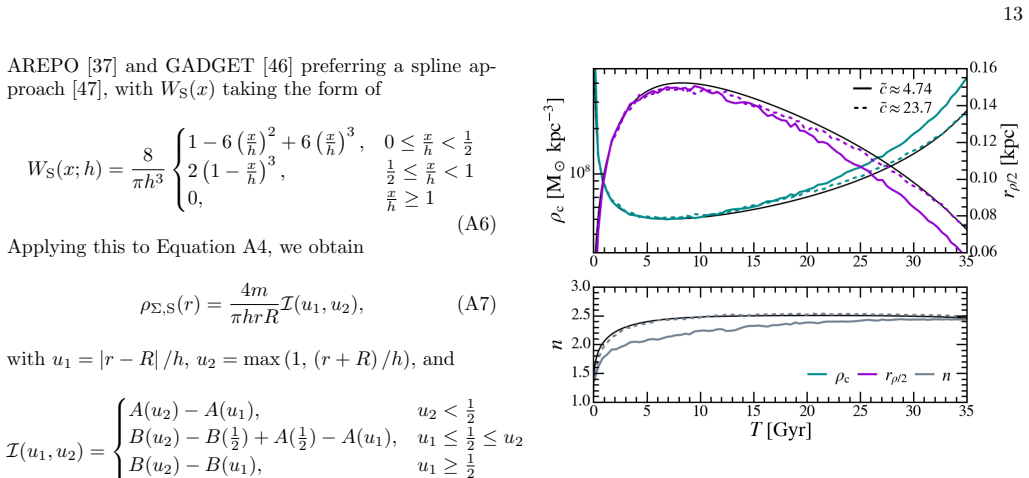
+A( 1 2)−A(u 1), u 1 ≤ 1 2 ≤u 2 B(u2)−B(u 1), u 1 ≥ 1 2 0, u 1 ≥u 2 (A8) Here, the final case occurs whenris outside of the kernel width, i.e.,|r−R| ≥h. The two auxiliary equations A(u) andB(u) are defined as A(u) = 1 2 u2 − 3 2 u4 + 6 5 u5,(A9) B(u) =u 2 −2u 3 + 3 2 u4 − 2 5 u5.(A10) In simulations that employ such a spline softening ap- proach, such as ...
discussion (0)
Sign in with ORCID, Apple, or X to comment. Anyone can read and Pith papers without signing in.