Recognition: 2 theorem links
· Lean TheoremProperties of Stable Massive Quark Stars in Holography
Pith reviewed 2026-05-17 03:01 UTC · model grok-4.3
The pith
A holographic D3/D7 model with an adjusted infrared dilaton yields a stiff equation of state for massive deconfined quarks that supports stable hybrid stars reaching two solar masses.
A machine-rendered reading of the paper's core claim, the machinery that carries it, and where it could break.
Core claim
In this adjusted holographic setup the deconfined quark phase has a sufficiently stiff equation of state to support exotic dense stars as massive as two solar masses. For stiff phenomenological baryon equations of state the transition to the quark phase is only weakly first order, permitting stable configurations with quark cores. Holographic baryons modeled as wrapped D5-branes yield unrealistic pressures in the homogeneous limit and must be discarded. Mass-radius relations and tidal deformabilities are computed for the resulting hybrid stars.
What carries the argument
The infrared-adjusted dilaton profile in the D3/D7 holographic model, which generates a mass gap and controls the stiffness of the deconfined quark-matter equation of state at finite density.
If this is right
- The transition from nuclear to quark matter remains only weakly first order when the outer baryon phase is stiff.
- Stable hybrid stars containing quark cores can reach two solar masses.
- Tidal deformabilities for these objects are directly computable and provide gravitational-wave observables.
- Holographic baryons modeled as D5-branes must be discarded because they produce unphysical pressures in the homogeneous approximation.
Where Pith is reading between the lines
- Precision radius measurements of heavy pulsars could test the presence of such quark cores.
- Gravitational-wave signals from neutron-star mergers might reveal imprints of the weak first-order transition.
- The same holographic adjustment technique could be applied to other finite-density observables such as transport coefficients.
Load-bearing premise
The dilaton profile is chosen by hand in the infrared to produce the desired massive deconfined phase, and the nuclear outer layers are supplied by external effective-field-theory calculations whose stiffness determines the strength of the transition.
What would settle it
A measured radius or tidal deformability for a two-solar-mass compact star that falls outside the range predicted by the hybrid mass-radius curves would show that this particular quark-core scenario cannot be realized.
Figures


read the original abstract
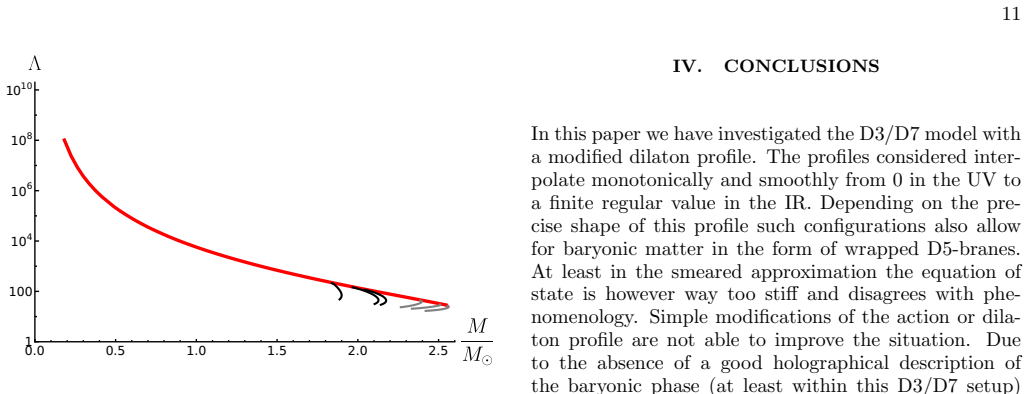
We study a holographic D3/D7 system, whose dilaton profile has been phenomenologically adjusted in the infrared. The model is used to describe a deconfined yet massive quark phase of QCD at finite density, concluding that the equation of state of such a phase can be stiff enough to support exotic dense stars as massive as 2 solar masses. Nucleons are modeled phenomenologically using the Hebeler-et.al EFT baryon phases. For the stiff phenomenological baryon phases the transition to the quark phase is weakly first order allowing for stable quark cores. We also find that holographic baryons, modeled as wrapped D5-branes, provide unrealistic pressures (in the homogeneous approximation) and have to be discarded. We compute the mass vs. radius relation and tidal deformability for these hybrid stars. Contrary to a large number of other holographic models, this holographic model indicates that quark matter could be present at the core of heavy compact stars and may be used to explore the phenomenology of such objects.
Editorial analysis
A structured set of objections, weighed in public.
Referee Report
Summary. The manuscript examines a holographic D3/D7 brane system whose infrared dilaton profile is phenomenologically adjusted to describe a deconfined yet massive quark phase of QCD at finite density. Nucleons are modeled using external phenomenological inputs from the Hebeler et al. EFT baryon phases. The authors conclude that the resulting equation of state can be stiff enough to support stable hybrid stars with masses up to 2 solar masses when the baryon phases are sufficiently stiff, yielding a weakly first-order transition that permits stable quark cores. The homogeneous holographic baryon construction (wrapped D5-branes) is discarded because it produces unrealistic pressures. Mass-radius relations and tidal deformabilities are computed, leading to the claim that quark matter could be present at the core of heavy compact stars, in contrast to many other holographic models.
Significance. If the central result holds after addressing the model choices, the work provides a concrete holographic example in which a massive quark phase can support 2-solar-mass hybrid stars with stable cores, offering a counter-example to other holographic constructions that disfavor quark cores. The explicit computation of tidal deformability supplies observable predictions that could be compared with gravitational-wave data. However, the significance is tempered by the fact that both the stiffness and the transition order are controlled by external phenomenological inputs rather than emerging directly from the holographic setup.
major comments (2)
- Abstract and model description: the infrared dilaton profile is explicitly stated to have been 'phenomenologically adjusted' to produce the desired massive deconfined quark phase. This adjustment is load-bearing for the claim that the quark EOS is stiff enough to support 2 M_⊙ stars; without an independent first-principles or data-driven justification for the specific IR form, the stiffness result is conditional on a choice made to realize the target phase rather than derived from the D3/D7 dynamics alone.
- Baryon modeling section: the transition is reported to be weakly first-order (and therefore to allow stable quark cores) only for the stiff phenomenological Hebeler et al. EFT baryon phases. The paper itself discards its own holographic baryon description (homogeneous wrapped D5-branes) for yielding unrealistic pressures. Because the order of the transition and the overall stiffness are controlled by this external selection, the existence of stable massive hybrid stars is not an unambiguous prediction of the holographic quark sector.
minor comments (3)
- Clarify the precise functional form and parameter values of the IR dilaton adjustment, including any fitting procedure or external constraints used to fix them.
- Specify the numerical method and any convergence checks employed when solving the Tolman-Oppenheimer-Volkoff equation and computing tidal deformability for the hybrid configurations.
- Add a brief comparison table or plot contrasting the present mass-radius curves with those obtained from the discarded holographic baryon construction to quantify the difference in pressures.
Simulated Author's Rebuttal
We thank the referee for the careful reading of our manuscript and the constructive comments. We address each major point below, providing clarifications on the phenomenological aspects of the model while indicating where revisions will be made to improve transparency.
read point-by-point responses
-
Referee: Abstract and model description: the infrared dilaton profile is explicitly stated to have been 'phenomenologically adjusted' to produce the desired massive deconfined quark phase. This adjustment is load-bearing for the claim that the quark EOS is stiff enough to support 2 M_⊙ stars; without an independent first-principles or data-driven justification for the specific IR form, the stiffness result is conditional on a choice made to realize the target phase rather than derived from the D3/D7 dynamics alone.
Authors: We agree that the infrared dilaton profile is adjusted phenomenologically, as explicitly noted in the manuscript, to realize a deconfined massive quark phase within the D3/D7 framework. This choice is made because the unmodified D3/D7 model does not naturally produce the desired massive quarks at finite density. Once the profile is fixed, the holographic computation yields the thermodynamic quantities and equation of state. Our central claim is that this holographic quark-matter model produces an EOS stiff enough to support 2 M_⊙ hybrid stars when matched to sufficiently stiff baryonic phases. We will revise the abstract and the model-description section to state more clearly that the result constitutes an existence demonstration within a phenomenologically tuned holographic setup rather than a first-principles derivation from the D3/D7 action alone. revision: yes
-
Referee: Baryon modeling section: the transition is reported to be weakly first-order (and therefore to allow stable quark cores) only for the stiff phenomenological Hebeler et al. EFT baryon phases. The paper itself discards its own holographic baryon description (homogeneous wrapped D5-branes) for yielding unrealistic pressures. Because the order of the transition and the overall stiffness are controlled by this external selection, the existence of stable massive hybrid stars is not an unambiguous prediction of the holographic quark sector.
Authors: We acknowledge that the weakly first-order character of the transition and the resulting stability of quark cores are obtained only when the stiff Hebeler et al. phenomenological baryon phases are employed, and that the homogeneous wrapped-D5 holographic baryon construction is discarded in the manuscript precisely because it yields unphysical pressures. The focus of the work is the holographic treatment of the quark phase; established nuclear-matter inputs are used to construct the hybrid-star sequence. We will expand the baryon-modeling section to emphasize that the result shows compatibility of the holographic quark EOS with observed massive stars under current stiff-nuclear-phase constraints, without claiming an unambiguous prediction arising solely from the holographic quark sector independent of external inputs. revision: yes
Circularity Check
No significant circularity in derivation chain
full rationale
The paper explicitly states that the dilaton profile is phenomenologically adjusted in the infrared to produce a deconfined yet massive quark phase and models nucleons using external Hebeler et al. EFT baryon phases, while discarding the homogeneous holographic baryon construction for yielding unrealistic pressures. The central claim—that the resulting EOS can be stiff enough to support 2 solar mass hybrid stars with stable quark cores—follows from explicit computations within this adjusted setup rather than reducing to a self-definitional equivalence or a fitted parameter renamed as a first-principles prediction. No load-bearing self-citations, uniqueness theorems imported from the authors' prior work, or ansatze smuggled via citation are invoked to force the result; the adjustments are presented as phenomenological inputs whose consequences are then explored. The derivation remains self-contained against these external benchmarks.
Axiom & Free-Parameter Ledger
free parameters (1)
- IR dilaton profile parameters
axioms (2)
- domain assumption AdS/CFT correspondence applies to the D3/D7 system at finite density and temperature
- domain assumption Hebeler et al. EFT baryon phases accurately represent the nucleonic matter outside the quark core
Lean theorems connected to this paper
-
IndisputableMonolith/Cost/FunctionalEquation.leanwashburn_uniqueness_aczel unclear?
unclearRelation between the paper passage and the cited Recognition theorem.
We study a holographic D3/D7 system, whose dilaton profile has been phenomenologically adjusted in the infrared... Nucleons are modeled phenomenologically using the Hebeler-et.al EFT baryon phases.
-
IndisputableMonolith/Foundation/BranchSelection.leanbranch_selection unclear?
unclearRelation between the paper passage and the cited Recognition theorem.
The reduced steepness of some of the dashed black curves allows for a smoother transition from baryonic matter to quark matter ultimately enabling stars with quark cores when using the stiff Hebeler-et.al EoS for nucleon matter.
What do these tags mean?
- matches
- The paper's claim is directly supported by a theorem in the formal canon.
- supports
- The theorem supports part of the paper's argument, but the paper may add assumptions or extra steps.
- extends
- The paper goes beyond the formal theorem; the theorem is a base layer rather than the whole result.
- uses
- The paper appears to rely on the theorem as machinery.
- contradicts
- The paper's claim conflicts with a theorem or certificate in the canon.
- unclear
- Pith found a possible connection, but the passage is too broad, indirect, or ambiguous to say the theorem truly supports the claim.
Reference graph
Works this paper leans on
-
[1]
Properties of Stable Massive Quark Stars in Holography
the authors combined information from astrophysical observations and calculations using Effective Field The- ory (EFT) and perturbative QCD to argue that in the cores of maximally massive stars, the Equation of State (EoS) is consistent with quark matter. There are also studies using perturbative QCD, which have found that dense quark stars are indeed pla...
work page internal anchor Pith review Pith/arXiv arXiv 2025
-
[2]
At largeµthis phase dominates and at asymptotically large densities reproduces the QCD EoSP(µ)∼µ 4 . In figure 2 we plot the pressure in the quark phase as a function of the chemical potential for a range of param- eters given byλ t ={1.9, ...,3},R AdS ={0.015, ...,0.02} MeV−1 (we explain our choices for the other parameters in section III A) and compare ...
-
[3]
6 Both gauge fields have been rescaled and are dimensionless here
and hence the area of the fundamental strings van- ishes and all that remains are the couplings to the world volume gauge fields in line 2 together with the boundary conditionξ(π) =χ(0). 6 Both gauge fields have been rescaled and are dimensionless here. The D7-brane coordinates are dimensionless as well. 7 Every variation of (23) has to vanish at a soluti...
-
[4]
D. D. Ivanenko and D. F. Kurdgelaidze,Hypothesis concerning quark stars, Astrophysics1(1965) 251–252
work page 1965
-
[5]
Itoh,Hydrostatic Equilibrium of Hypothetical Quark Stars, Prog
N. Itoh,Hydrostatic Equilibrium of Hypothetical Quark Stars, Prog. Theor. Phys.44(1970) 291
work page 1970
- [6]
-
[7]
Witten,Cosmic Separation of Phases, Phys
E. Witten,Cosmic Separation of Phases, Phys. Rev. D 30(1984) 272–285
work page 1984
- [8]
-
[9]
E. S. Fraga, R. D. Pisarski, and J. Schaffner-Bielich, Small, dense quark stars from perturbative QCD, Phys. Rev. D63(2001) 121702, [hep-ph/0101143]
work page internal anchor Pith review Pith/arXiv arXiv 2001
-
[10]
Looking inside neutron stars: Microscopic calculations confront observations
A. Kurkela, P. Romatschke, A. Vuorinen, and B. Wu, Looking inside neutron stars: Microscopic calculations confront observations,arXiv:1006.4062
work page internal anchor Pith review Pith/arXiv arXiv
-
[11]
GW170817: Observation of Gravitational Waves from a Binary Neutron Star Inspiral
F. K¨ opp, J. E. Horvath, D. Hadjimichef, and C. A. Z. Vasconcellos,Quark/Hybrid Stars Within Perturbative QCD in View of the GW170817 Event, Astron. Nachr. 346(2025), no. 3-4 e20240136. [9]LIGO Scientific, VirgoCollaboration, B. P. Abbott et al.,GW170817: Observation of Gravitational Waves from a Binary Neutron Star Inspiral, Phys. Rev. Lett. 119(2017), ...
work page internal anchor Pith review Pith/arXiv arXiv 2025
-
[12]
Shapiro delay measurement of a two solar mass neutron star
P. Demorest, T. Pennucci, S. Ransom, M. Roberts, and J. Hessels,Shapiro Delay Measurement of A Two Solar Mass Neutron Star, Nature467(2010) 1081–1083, [arXiv:1010.5788]
work page internal anchor Pith review Pith/arXiv arXiv 2010
-
[13]
A Massive Pulsar in a Compact Relativistic Binary
J. Antoniadis et al.,A Massive Pulsar in a Compact Relativistic Binary, Science340(2013) 6131, [arXiv:1304.6875]
work page internal anchor Pith review Pith/arXiv arXiv 2013
-
[14]
The NANOGrav Nine-year Data Set: Mass and Geometric Measurements of Binary Millisecond Pulsars
E. Fonseca et al.,The NANOGrav Nine-year Data Set: Mass and Geometric Measurements of Binary Millisecond Pulsars, Astrophys. J.832(2016), no. 2 167, [arXiv:1603.00545]. [13]NANOGravCollaboration, H. T. Cromartie et al., Relativistic Shapiro delay measurements of an extremely massive millisecond pulsar, Nature Astron.4(2019), no. 1 72–76, [arXiv:1904.06759]
work page internal anchor Pith review Pith/arXiv arXiv 2016
-
[15]
E. Fonseca et al.,Refined Mass and Geometric Measurements of the High-mass PSR J0740+6620, Astrophys. J. Lett.915(2021), no. 1 L12, [arXiv:2104.00880]
-
[16]
J. N¨ attil¨ a, M. C. Miller, A. W. Steiner, J. J. E. Kajava, V. F. Suleimanov, and J. Poutanen,Neutron star mass and radius measurements from atmospheric model fits to X-ray burst cooling tail spectra, Astron. Astrophys.608 (2017) A31, [arXiv:1709.09120]
work page internal anchor Pith review Pith/arXiv arXiv 2017
-
[17]
M. C. Miller et al.,PSR J0030+0451 Mass and Radius fromN ICERData and Implications for the Properties of Neutron Star Matter, Astrophys. J. Lett.887(2019), no. 1 L24, [arXiv:1912.05705]
work page internal anchor Pith review arXiv 2019
-
[18]
M. C. Miller et al.,The Radius of PSR J0740+6620 from NICER and XMM-Newton Data, Astrophys. J. Lett.918(2021), no. 2 L28, [arXiv:2105.06979]
work page internal anchor Pith review arXiv 2021
-
[19]
A Horizon Study for Cosmic Explorer: Science, Observatories, and Community
M. Evans et al.,A Horizon Study for Cosmic Explorer: Science, Observatories, and Community, arXiv:2109.09882. [19]ETCollaboration, A. Abac et al.,The Science of the Einstein Telescope,arXiv:2503.12263
work page internal anchor Pith review Pith/arXiv arXiv
- [20]
-
[21]
K. Yagi and N. Yunes,Approximate Universal Relations for Neutron Stars and Quark Stars, Phys. Rept.681 (2017) 1–72, [arXiv:1608.02582]
-
[22]
J. Leutgeb, J. Mager, and A. Rebhan,Hadronic light-by-light contribution to the muon g-2 from holographic QCD with solved U(1)A problem, Phys. Rev. D107(2023), no. 5 054021, [arXiv:2211.16562]
-
[23]
J. Leutgeb, J. Mager, and A. Rebhan,Superconnections 13 in AdS/QCD and the hadronic light-by-light contribution to the muon g-2, Phys. Rev. D111(2025), no. 11 114001, [arXiv:2411.10432]
-
[24]
L. Cappiello, J. Leutgeb, J. Mager, and A. Rebhan, Tensor meson transition form factors in holographic QCD and the muon g−2, JHEP07(2025) 033, [arXiv:2501.09699]
- [25]
-
[26]
Anti-de Sitter Space, Thermal Phase Transition, And Confinement In Gauge Theories
E. Witten,Anti-de Sitter space, thermal phase transition, and confinement in gauge theories, Adv. Theor. Math. Phys.2(1998) 505–532, [hep-th/9803131]
work page internal anchor Pith review Pith/arXiv arXiv 1998
-
[27]
A. Karch and E. Katz,Adding flavor to AdS / CFT, JHEP06(2002) 043, [hep-th/0205236]
work page internal anchor Pith review Pith/arXiv arXiv 2002
-
[28]
Low energy hadron physics in holographic QCD
T. Sakai and S. Sugimoto,Low energy hadron physics in holographic QCD, Prog. Theor. Phys.113(2005) 843–882, [hep-th/0412141]
work page internal anchor Pith review Pith/arXiv arXiv 2005
-
[29]
More on a holographic dual of QCD
T. Sakai and S. Sugimoto,More on a holographic dual of QCD, Prog. Theor. Phys.114(2005) 1083–1118, [hep-th/0507073]
work page internal anchor Pith review Pith/arXiv arXiv 2005
-
[30]
J. Leutgeb, J. Mager, and A. Rebhan,Divergences in the hadronic light-by-light amplitude of the holographic soft-wall model,arXiv:2511.11797
-
[31]
QCD and a Holographic Model of Hadrons
J. Erlich, E. Katz, D. T. Son, and M. A. Stephanov, QCD and a holographic model of hadrons, Phys. Rev. Lett.95(2005) 261602, [hep-ph/0501128]
work page internal anchor Pith review Pith/arXiv arXiv 2005
-
[32]
Chiral symmetry breaking from five dimensional spaces
L. Da Rold and A. Pomarol,Chiral symmetry breaking from five dimensional spaces, Nucl. Phys. B721(2005) 79–97, [hep-ph/0501218]
work page internal anchor Pith review Pith/arXiv arXiv 2005
-
[33]
Linear Confinement and AdS/QCD
A. Karch, E. Katz, D. T. Son, and M. A. Stephanov, Linear confinement and AdS/QCD, Phys. Rev. D74 (2006) 015005, [hep-ph/0602229]
work page internal anchor Pith review Pith/arXiv arXiv 2006
-
[34]
Holographic Models for QCD in the Veneziano Limit
M. Jarvinen and E. Kiritsis,Holographic Models for QCD in the Veneziano Limit, JHEP03(2012) 002, [arXiv:1112.1261]
work page internal anchor Pith review Pith/arXiv arXiv 2012
-
[35]
K. Bitaghsir Fadafan, J. Cruz Rojas, and N. Evans, Deconfined, Massive Quark Phase at High Density and Compact Stars: A Holographic Study, Phys. Rev. D101 (2020), no. 12 126005, [arXiv:1911.12705]
-
[36]
K. Bitaghsir Fadafan, J. Cruz Rojas, and N. Evans, Holographic quark matter with colour superconductivity and a stiff equation of state for compact stars, Phys. Rev. D103(2021), no. 2 026012, [arXiv:2009.14079]
-
[37]
Holographic Description of the Phase Diagram of a Chiral Symmetry Breaking Gauge Theory
N. Evans, A. Gebauer, K.-Y. Kim, and M. Magou, Holographic Description of the Phase Diagram of a Chiral Symmetry Breaking Gauge Theory, JHEP03 (2010) 132, [arXiv:1002.1885]
work page internal anchor Pith review Pith/arXiv arXiv 2010
-
[38]
S. S. Gubser,Dilaton driven confinement, hep-th/9902155
work page internal anchor Pith review Pith/arXiv arXiv
-
[39]
N. R. Constable and R. C. Myers,Exotic scalar states in the AdS / CFT correspondence, JHEP11(1999) 020, [hep-th/9905081]
work page internal anchor Pith review Pith/arXiv arXiv 1999
-
[40]
Chiral Symmetry Breaking and Pions in Non-Supersymmetric Gauge/Gravity Duals
J. Babington, J. Erdmenger, N. J. Evans, Z. Guralnik, and I. Kirsch,Chiral symmetry breaking and pions in nonsupersymmetric gauge / gravity duals, Phys. Rev. D 69(2004) 066007, [hep-th/0306018]
work page internal anchor Pith review Pith/arXiv arXiv 2004
-
[41]
M. Atashi and K. Bitaghsir Fadafan,Anomalous dimension and quasinormal modes of flavor branes, Annals Phys.469(2024) 169762
work page 2024
-
[42]
K. Bitaghsir Fadafan and M. Gholamzadeh,Chiral Symmetry Breaking and the Critical Point in QCD-like Theories, JHAP4(2024), no. 3 19–34
work page 2024
-
[43]
M. Ahmadvand, A. Ashoorioon, and K. Bitaghsir Fadafan,Confronting the magnetically-induced holographic composite inflation with observation, Phys. Rev. D104(2021), no. 6 063509, [arXiv:2103.08362]
-
[44]
O. Bergman, G. Lifschytz, and M. Lippert,Holographic Nuclear Physics, JHEP11(2007) 056, [arXiv:0708.0326]
work page internal anchor Pith review Pith/arXiv arXiv 2007
-
[45]
Cold Nuclear Matter In Holographic QCD
M. Rozali, H.-H. Shieh, M. Van Raamsdonk, and J. Wu, Cold Nuclear Matter In Holographic QCD, JHEP01 (2008) 053, [arXiv:0708.1322]
work page internal anchor Pith review Pith/arXiv arXiv 2008
-
[46]
Dense Holographic QCD in the Wigner-Seitz Approximation
K.-Y. Kim, S.-J. Sin, and I. Zahed,Dense holographic QCD in the Wigner-Seitz approximation, JHEP09 (2008) 001, [arXiv:0712.1582]
work page internal anchor Pith review Pith/arXiv arXiv 2008
-
[47]
V. Kaplunovsky, D. Melnikov, and J. Sonnenschein, Baryonic Popcorn, JHEP11(2012) 047, [arXiv:1201.1331]
work page internal anchor Pith review Pith/arXiv arXiv 2012
-
[48]
S.-w. Li, A. Schmitt, and Q. Wang,From holography towards real-world nuclear matter, Phys. Rev. D92 (2015), no. 2 026006, [arXiv:1505.04886]
work page internal anchor Pith review Pith/arXiv arXiv 2015
-
[49]
Phases of kinky holographic nuclear matter
M. Elliot-Ripley, P. Sutcliffe, and M. Zamaklar,Phases of kinky holographic nuclear matter, JHEP10(2016) 088, [arXiv:1607.04832]
work page internal anchor Pith review Pith/arXiv arXiv 2016
-
[50]
N. Kovensky and A. Schmitt,Holographic quarkyonic matter, JHEP09(2020) 112, [arXiv:2006.13739]
-
[51]
Layers of deformed instantons in holographic baryonic matter
F. Preis and A. Schmitt,Layers of deformed instantons in holographic baryonic matter, JHEP07(2016) 001, [arXiv:1606.00675]
work page internal anchor Pith review Pith/arXiv arXiv 2016
-
[52]
Towards a holographic quark-hadron continuity
K. Bitaghsir Fadafan, F. Kazemian, and A. Schmitt, Towards a holographic quark-hadron continuity, JHEP 03(2019) 183, [arXiv:1811.08698]
work page internal anchor Pith review Pith/arXiv arXiv 2019
-
[53]
N. Kovensky, A. Poole, and A. Schmitt,Building a realistic neutron star from holography, Phys. Rev. D 105(2022), no. 3 034022, [arXiv:2111.03374]
-
[54]
L. Bartolini and S. B. Gudnason,Neutron stars in the Witten-Sakai-Sugimoto model, JHEP11(2023) 209, [arXiv:2307.11886]
-
[55]
Holographic QCD in the Veneziano limit and neutron stars
N. Jokela, M. J¨ arvinen, and J. Remes,Holographic QCD in the Veneziano limit and neutron stars, JHEP 03(2019) 041, [arXiv:1809.07770]
work page internal anchor Pith review Pith/arXiv arXiv 2019
- [56]
- [57]
- [58]
-
[59]
J¨ arvinen,Holographic modeling of nuclear matter and neutron stars, Eur
M. J¨ arvinen,Holographic modeling of nuclear matter and neutron stars, Eur. Phys. J. C82(2022), no. 4 282, [arXiv:2110.08281]
-
[60]
Jarvinen,Holographic baryons, dense matter and neutron star mergers, JHAP3(2023), no
M. Jarvinen,Holographic baryons, dense matter and neutron star mergers, JHAP3(2023), no. 3 1–22, [arXiv:2307.01745]
-
[61]
L. Bartolini, S. B. Gudnason, and M. J¨ arvinen,Isospin asymmetry and neutron stars in holographic QCD in the Veneziano limit, Phys. Rev. D111(2025), no. 10 106021, [arXiv:2504.01758]. 14
-
[62]
L. Bartolini, S. B. Gudnason, J. Leutgeb, and A. Rebhan,Neutron stars and phase diagram in a hard-wall AdS/QCD model, Phys. Rev. D105(2022), no. 12 126014, [arXiv:2202.12845]
-
[63]
L. Zhang and M. Huang,Holographic cold dense matter constrained by neutron stars, Phys. Rev. D106(2022), no. 9 096028, [arXiv:2209.00766]
-
[64]
Holographic quark matter and neutron stars
C. Hoyos, D. Rodr´ ıguez Fern´ andez, N. Jokela, and A. Vuorinen,Holographic quark matter and neutron stars, Phys. Rev. Lett.117(2016), no. 3 032501, [arXiv:1603.02943]
work page internal anchor Pith review Pith/arXiv arXiv 2016
- [65]
-
[66]
Holographic Thermodynamics at Finite Baryon Density: Some Exact Results
A. Karch and A. O’Bannon,Holographic thermodynamics at finite baryon density: Some exact results, JHEP11(2007) 074, [arXiv:0709.0570]
work page internal anchor Pith review Pith/arXiv arXiv 2007
-
[67]
Gravitational-wave constraints on the neutron-star-matter Equation of State
E. Annala, T. Gorda, A. Kurkela, and A. Vuorinen, Gravitational-wave constraints on the neutron-star-matter Equation of State, Phys. Rev. Lett. 120(2018), no. 17 172703, [arXiv:1711.02644]
work page internal anchor Pith review Pith/arXiv arXiv 2018
-
[68]
Equation of state and neutron star properties constrained by nuclear physics and observation
K. Hebeler, J. M. Lattimer, C. J. Pethick, and A. Schwenk,Equation of state and neutron star properties constrained by nuclear physics and observation, Astrophys. J.773(2013) 11, [arXiv:1303.4662]
work page internal anchor Pith review Pith/arXiv arXiv 2013
-
[69]
The Baryonic Phase in Holographic Descriptions of the QCD Phase Diagram
N. Evans, K.-Y. Kim, M. Magou, Y. Seo, and S.-J. Sin, The Baryonic Phase in Holographic Descriptions of the QCD Phase Diagram, JHEP09(2012) 045, [arXiv:1204.5640]
work page internal anchor Pith review Pith/arXiv arXiv 2012
-
[70]
B. Gwak, M. Kim, B.-H. Lee, Y. Seo, and S.-J. Sin, Holographic D Instanton Liquid and chiral transition, Phys. Rev. D86(2012) 026010, [arXiv:1203.4883]
work page internal anchor Pith review Pith/arXiv arXiv 2012
-
[71]
M. Henningson and K. Skenderis,The Holographic Weyl anomaly, JHEP07(1998) 023, [hep-th/9806087]
work page internal anchor Pith review Pith/arXiv arXiv 1998
-
[72]
M. Hippert, J. Noronha, and P. Romatschke,Upper bound on the speed of sound in nuclear matter from transport, Phys. Lett. B860(2025) 139184, [arXiv:2402.14085]
- [73]
- [74]
-
[75]
P. Haensel, A. Y. Potekhin, and D. G. Yakovlev, Neutron stars 1: Equation of state and structure, vol. 326. Springer, New York, USA, 2007
work page 2007
- [76]
-
[77]
E. E. Flanagan and T. Hinderer,Constraining neutron star tidal Love numbers with gravitational wave detectors, Phys. Rev. D77(2008) 021502, [arXiv:0709.1915]
work page internal anchor Pith review Pith/arXiv arXiv 2008
-
[78]
T. Hinderer, B. D. Lackey, R. N. Lang, and J. S. Read, Tidal deformability of neutron stars with realistic equations of state and their gravitational wave signatures in binary inspiral, Phys. Rev. D81(2010) 123016, [arXiv:0911.3535]
work page internal anchor Pith review Pith/arXiv arXiv 2010
-
[79]
Tidal Love Numbers of Neutron and Self-Bound Quark Stars
S. Postnikov, M. Prakash, and J. M. Lattimer,Tidal Love Numbers of Neutron and Self-Bound Quark Stars, Phys. Rev. D82(2010) 024016, [arXiv:1004.5098]
work page internal anchor Pith review Pith/arXiv arXiv 2010
-
[80]
Tidal Deformabilities and Neutron Star Mergers
T. Zhao and J. M. Lattimer,Tidal Deformabilities and Neutron Star Mergers, Phys. Rev. D98(2018), no. 6 063020, [arXiv:1808.02858]
work page internal anchor Pith review Pith/arXiv arXiv 2018
discussion (0)
Sign in with ORCID, Apple, or X to comment. Anyone can read and Pith papers without signing in.