Interplay between Escaping Cosmic Rays and Interstellar Medium: Driving of Galactic Winds and Shaping the Local Proton Spectrum
Pith reviewed 2026-05-17 01:04 UTC · model grok-4.3
The pith
Escaping cosmic rays accelerate and heat the interstellar medium to drive galactic outflows with rates comparable to the star formation rate while offering an alternative account of the local proton spectrum.
A machine-rendered reading of the paper's core claim, the machinery that carries it, and where it could break.
Core claim
Escaping cosmic rays drive outflows in the interstellar medium with rates comparable to the star formation rate, which is consistent with the galactic wind needed to pollute the halo with metals, and a locally suppressed diffusion coefficient combined with nearby sources can account for the observed local proton spectrum.
What carries the argument
Spherically symmetric CR-hydrodynamical simulations that evolve the CR energy spectrum while including radiative cooling and thermal conduction, showing dependence on the CR diffusion coefficient.
Load-bearing premise
The model assumes a locally suppressed cosmic ray diffusion coefficient and the presence of a few nearby cosmic ray sources inside the Local Bubble to explain the observed local proton spectrum.
What would settle it
Direct measurements showing ISM outflow rates around cosmic ray sources much lower than the galactic star formation rate, or a local proton spectrum that cannot be reproduced even with nearby sources and suppressed diffusion.
Figures



read the original abstract
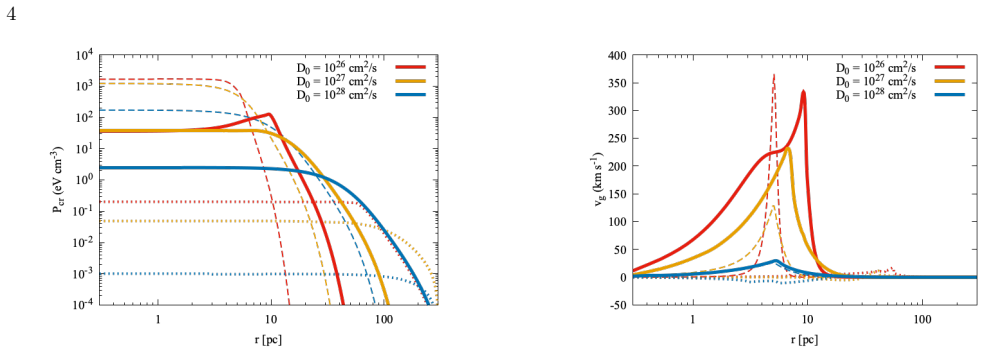
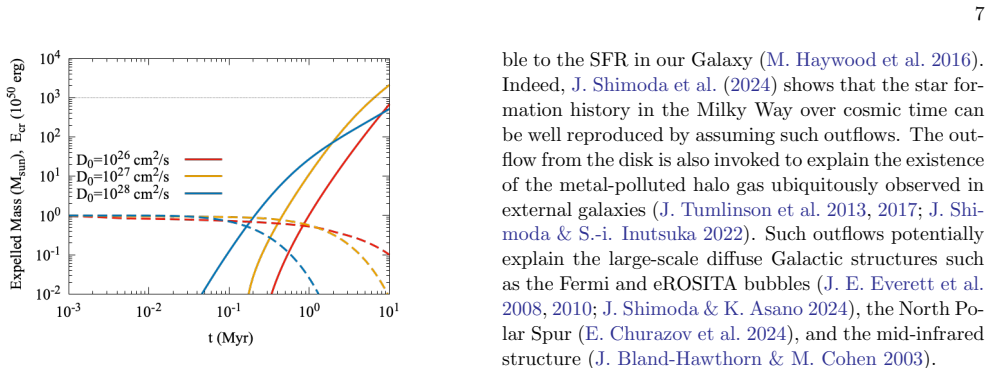
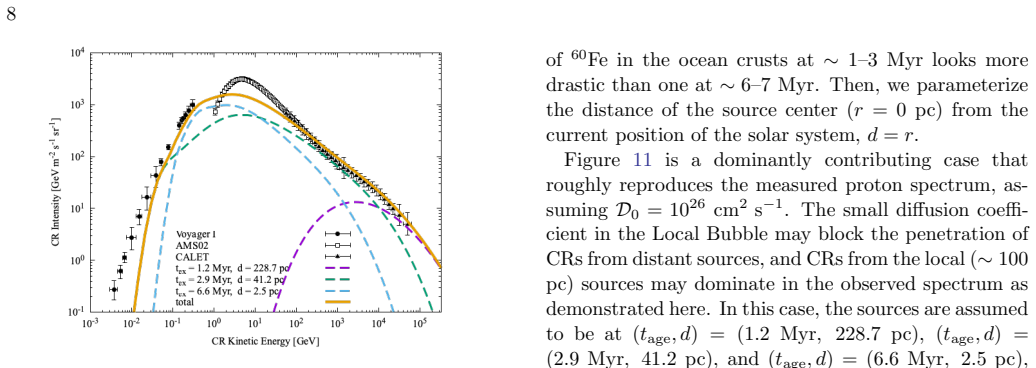
We study the effects of escaping cosmic rays (CRs) on the interstellar medium (ISM) around their source with spherically symmetric CR-hydrodynamical simulations taking into account the evolution of the CR energy spectrum, radiative cooling, and thermal conduction. We show how the escaping CRs accelerate and heat the ISM depending on the CR diffusion coefficient. The CR heating effects are potentially responsible for the recent observations of the unexpected H$\alpha$ and [OIII]$\lambda5007$ lines in old supernova remnants. The implied gas outflow rate by CRs can be comparable to the Galactic star formation rate, compatible with the Galactic wind required for polluting the halo gas with metals. Assuming a locally suppressed CR diffusion and a few nearby CR sources in the Local Bubble, we also propose alternative interpretations for the Galactic CR proton spectrum around the Earth measured with CALET, AMS02, and Voyager 1.
Editorial analysis
A structured set of objections, weighed in public.
Referee Report
Summary. The paper presents spherically symmetric CR-hydrodynamical simulations that evolve the CR energy spectrum while including radiative cooling and thermal conduction. It examines how escaping CRs accelerate and heat the ISM around sources as a function of the diffusion coefficient, links this to observed Hα and [OIII] emission in old supernova remnants, claims that the resulting gas outflow rates can reach values comparable to the Galactic star-formation rate and thereby drive winds capable of polluting the halo with metals, and offers an alternative explanation for the local proton spectrum measured by CALET, AMS02, and Voyager 1 by invoking locally suppressed diffusion together with a small number of nearby sources inside the Local Bubble.
Significance. If the local CR-ISM coupling results are robust, the work would strengthen the case for CR-driven feedback in the ISM and provide a physically motivated route to interpreting both galactic-scale winds and the local CR spectrum. The explicit inclusion of spectral evolution, cooling, and conduction is a methodological strength that goes beyond simpler steady-state treatments. The global outflow-rate claim, however, rests on an extrapolation whose quantitative support is not yet demonstrated within the manuscript.
major comments (2)
- [Discussion of implied gas outflow rates] The assertion that CR-driven outflows can reach rates comparable to the Galactic SFR (∼1–3 M⊙ yr⁻¹) is made on the basis of spherically symmetric 1D simulations around individual sources. No integration over the Galactic supernova distribution, disk scale height, or collective streaming is performed, so the Galaxy-wide mass-loss rate remains an untested extrapolation. This step is load-bearing for the galactic-wind and halo-pollution conclusion.
- [Section proposing interpretation of CALET/AMS02/Voyager 1 spectrum] The alternative interpretation of the local proton spectrum invokes a locally suppressed diffusion coefficient and a few nearby sources inside the Local Bubble. The manuscript does not quantify how these assumptions affect the predicted spectrum relative to standard propagation models or demonstrate that they are required by the data rather than chosen to fit it.
minor comments (2)
- [Methods / Simulation setup] Numerical methods, grid resolution, convergence tests, and the precise functional form and normalization of the diffusion coefficient are not described in sufficient detail for independent reproduction of the reported outflow rates and spectral shapes.
- [Results on CR heating and emission lines] The manuscript would benefit from a direct comparison of the simulated Hα and [OIII] luminosities or line ratios with the specific observational data cited for old supernova remnants.
Simulated Author's Rebuttal
We thank the referee for the constructive and detailed report. Below we respond point by point to the major comments, indicating the revisions we will incorporate to address the concerns while preserving the scope of the present study.
read point-by-point responses
-
Referee: [Discussion of implied gas outflow rates] The assertion that CR-driven outflows can reach rates comparable to the Galactic SFR (∼1–3 M⊙ yr⁻¹) is made on the basis of spherically symmetric 1D simulations around individual sources. No integration over the Galactic supernova distribution, disk scale height, or collective streaming is performed, so the Galaxy-wide mass-loss rate remains an untested extrapolation. This step is load-bearing for the galactic-wind and halo-pollution conclusion.
Authors: We agree that a complete Galaxy-wide integration lies outside the present work. Our 1D simulations quantify the local mass flux driven by escaping CRs for a range of diffusion coefficients; the statement that this flux can reach levels comparable to the Galactic SFR follows from a simple scaling with the supernova rate per unit volume and the characteristic size of the affected region. In the revised manuscript we will expand the discussion to make this scaling explicit, include an order-of-magnitude estimate that incorporates the disk scale height, and clearly state the limitations arising from the neglect of collective streaming and source clustering. We believe this addition will clarify the extrapolation without requiring a full galactic simulation. revision: partial
-
Referee: [Section proposing interpretation of CALET/AMS02/Voyager 1 spectrum] The alternative interpretation of the local proton spectrum invokes a locally suppressed diffusion coefficient and a few nearby sources inside the Local Bubble. The manuscript does not quantify how these assumptions affect the predicted spectrum relative to standard propagation models or demonstrate that they are required by the data rather than chosen to fit it.
Authors: The proposed scenario is offered as a physically motivated alternative that reproduces the observed spectral shape when diffusion is reduced inside the Local Bubble, consistent with independent evidence for suppressed transport in that region. To address the referee’s concern we will add a quantitative comparison: we will show the propagated proton spectrum obtained with our locally suppressed diffusion coefficient and a small number of nearby sources, and contrast it directly with a standard propagation model that assumes uniform diffusion throughout the Galaxy. The revised text will also clarify that the parameters are chosen to be consistent with existing constraints rather than tuned exclusively to the data, while acknowledging that other explanations remain viable. revision: yes
Circularity Check
Forward CR-hydro simulations produce outflow rates and spectral shapes from explicit input assumptions without definitional reduction
full rationale
The paper runs spherically symmetric CR-hydrodynamical simulations that evolve the CR spectrum, cooling, and conduction as functions of an input diffusion coefficient and source placement. Outflow rates emerge as simulation outputs rather than being defined to match any target observation; the local proton spectrum is interpreted by adopting (not fitting) a suppressed diffusion coefficient and a small number of nearby sources inside the Local Bubble. No equation reduces an output quantity to a fitted parameter by construction, no self-citation supplies a uniqueness theorem that forces the result, and no ansatz is smuggled in. The global extrapolation to a Galaxy-wide wind rate comparable to the SFR is an interpretive step outside the local model, but it does not create circularity within the derivation itself.
Axiom & Free-Parameter Ledger
free parameters (1)
- CR diffusion coefficient
axioms (1)
- standard math Spherically symmetric CR-hydrodynamical equations including radiative cooling and thermal conduction
Reference graph
Works this paper leans on
-
[1]
, " * write output.state after.block = add.period write newline
ENTRY address archivePrefix author booktitle chapter doi edition editor eprint howpublished institution journal key month number organization pages publisher school series title misctitle type volume year version url label extra.label sort.label short.list INTEGERS output.state before.all mid.sentence after.sentence after.block FUNCTION init.state.consts ...
-
[2]
" write newline "" before.all 'output.state := FUNCTION format.url url empty "" new.block "" url * "" * if FUNCTION format.eprint eprint empty "" archivePrefix empty "" archivePrefix "arXiv" = new.block " " eprint * " " * new.block " " eprint * " " * if if if FUNCTION format.doi doi empty "" " " doi * " " * if FUNCTION format.pid doi empty eprint empty ur...
-
[3]
First observation of PeV-energy neutrinos with IceCube
thebibliography [1] 20pt to REFERENCES 6pt =0pt \@twocolumntrue 12pt -12pt 10pt plus 3pt =0pt =0pt =1pt plus 1pt =0pt =0pt -12pt =13pt plus 1pt =20pt =13pt plus 1pt \@M =10000 =-1.0em =0pt =0pt 0pt =0pt =1.0em @enumiv\@empty 10000 10000 `\.\@m \@noitemerr \@latex@warning Empty `thebibliography' environment \@ifnextchar \@reference \@latexerr Missing key o...
work page internal anchor Pith review Pith/arXiv arXiv doi:10.1103/physrevlett.111.021103 2017
discussion (0)
Sign in with ORCID, Apple, or X to comment. Anyone can read and Pith papers without signing in.