Position: Universal Aesthetic Alignment Narrows Artistic Expression
Pith reviewed 2026-05-17 00:42 UTC · model grok-4.3
The pith
Aligning image generation models to universal aesthetic standards prevents them from producing anti-aesthetic or unconventional images when users request them.
A machine-rendered reading of the paper's core claim, the machinery that carries it, and where it could break.
Core claim
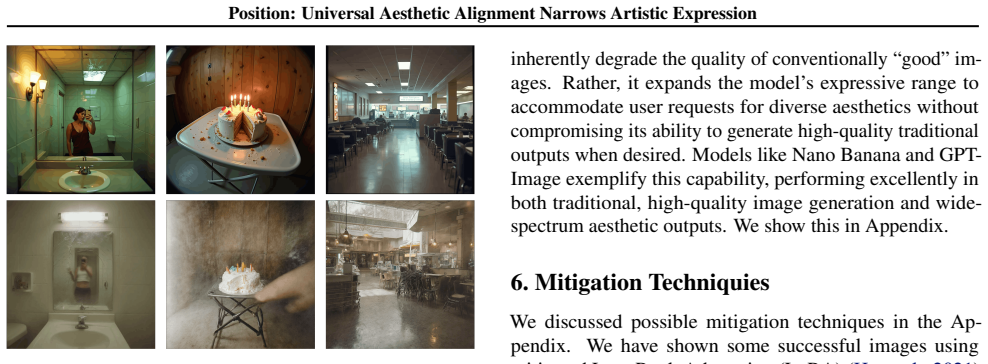
Aesthetic-aligned generation models frequently default to conventionally beautiful outputs, failing to respect instructions for low-quality or negative imagery. Reward models penalize anti-aesthetic images even when they perfectly match the explicit user prompt. The paper confirms this systemic bias through image-to-image editing and direct evaluation against real abstract artworks.
What carries the argument
A wide-spectrum aesthetics dataset paired with image-to-image editing tests that measure whether models and reward functions follow explicit prompts for non-beautiful results.
If this is right
- Models default to conventionally beautiful outputs even when users explicitly request low-quality or negative imagery.
- Reward models downgrade anti-aesthetic images despite perfect prompt match.
- This behavior embeds developer-centered values into the system at the expense of user autonomy.
- Artistic and critical uses of image generation are restricted by the absence of aesthetic pluralism.
Where Pith is reading between the lines
- Creative tools might need explicit user controls to turn aesthetic alignment on or off for different tasks.
- The same narrowing effect could appear in text, music, or video generation systems that optimize for broad appeal.
- Comparing outputs to real abstract artworks offers one practical way to test whether models preserve stylistic diversity.
Load-bearing premise
The constructed wide-spectrum aesthetics dataset and the evaluation methods of image-to-image editing and comparison to real abstract artworks isolate alignment bias from prompt ambiguity or model capability limits.
What would settle it
An aligned model that generates and assigns high reward scores to low-quality or negative images that precisely match a user prompt requesting anti-aesthetic content.
Figures




read the original abstract
Over-aligning image generation models to a generalized aesthetic preference conflicts with user intent, particularly when "anti-aesthetic" outputs are requested for artistic or critical purposes. This adherence prioritizes developer-centered values, compromising user autonomy and aesthetic pluralism. We test this bias by constructing a wide-spectrum aesthetics dataset and evaluating state-of-the-art generation and reward models. This position paper finds that aesthetic-aligned generation models frequently default to conventionally beautiful outputs, failing to respect instructions for low-quality or negative imagery. Crucially, reward models penalize anti-aesthetic images even when they perfectly match the explicit user prompt. We confirm this systemic bias through image-to-image editing and evaluation against real abstract artworks. Our code, fine-tuned models, and datasets are available on our meta-expression intentionally anti-aesthetics webpage: https://weathon.github.io/icml2026_position/.
Editorial analysis
A structured set of objections, weighed in public.
Referee Report
Summary. The paper argues that over-aligning image generation models to a generalized aesthetic preference narrows artistic expression by causing models to default to conventionally beautiful outputs even when users request anti-aesthetic or low-quality imagery for artistic or critical purposes. It supports this position by constructing a wide-spectrum aesthetics dataset and evaluating state-of-the-art generation and reward models via generation, reward scoring, image-to-image editing, and comparison to real abstract artworks, concluding that reward models penalize anti-aesthetic images despite explicit prompt matching, thereby prioritizing developer values over user autonomy and aesthetic pluralism. Code, fine-tuned models, and datasets are released.
Significance. If the central claim holds after addressing evaluation gaps, the work would usefully highlight tensions between alignment practices and creative user intent in generative AI, with implications for model design that better accommodates aesthetic pluralism. The release of code, models, and datasets is a positive contribution that enables direct replication and extension.
major comments (2)
- [Evaluation Methods (image-to-image editing and real abstract artworks comparison)] The core claim that generated images match explicit anti-aesthetic prompts yet are penalized by reward models is load-bearing, but the evaluation protocol (image-to-image editing and real-artwork comparison) does not report quantitative prompt-adherence metrics such as CLIP similarity scores or human fidelity ratings to descriptors like 'low-quality' or 'negative imagery'. Without these, the observed defaults cannot be isolated from prompt ambiguity or base-model capability limits on anti-aesthetic generation.
- [Dataset Construction] The wide-spectrum aesthetics dataset is presented as the foundation for testing alignment bias, yet no details are given on curation criteria, validation that anti-aesthetic examples are not merely underspecified, or controls such as prompt paraphrasing to distinguish alignment pressure from data scarcity in training distributions.
minor comments (1)
- [Abstract and Conclusion] The abstract and conclusion reference a webpage for code and datasets; ensure the URL is stable and the materials include full evaluation scripts and raw results to support the qualitative patterns described.
Simulated Author's Rebuttal
We thank the referee for their constructive feedback. We address each major comment below and commit to revisions that strengthen the evaluation and transparency of our position paper without altering its core argument.
read point-by-point responses
-
Referee: [Evaluation Methods (image-to-image editing and real abstract artworks comparison)] The core claim that generated images match explicit anti-aesthetic prompts yet are penalized by reward models is load-bearing, but the evaluation protocol (image-to-image editing and real-artwork comparison) does not report quantitative prompt-adherence metrics such as CLIP similarity scores or human fidelity ratings to descriptors like 'low-quality' or 'negative imagery'. Without these, the observed defaults cannot be isolated from prompt ambiguity or base-model capability limits on anti-aesthetic generation.
Authors: We agree that quantitative prompt-adherence metrics would help isolate alignment effects from prompt ambiguity or base-model limitations. As a position paper, the current evaluation emphasizes qualitative demonstration via visual examples, reward scores, and comparisons to real artworks. To address this directly, we will add CLIP similarity scores between anti-aesthetic prompts and generated outputs in the revised manuscript, along with a brief discussion of human fidelity considerations where relevant. revision: yes
-
Referee: [Dataset Construction] The wide-spectrum aesthetics dataset is presented as the foundation for testing alignment bias, yet no details are given on curation criteria, validation that anti-aesthetic examples are not merely underspecified, or controls such as prompt paraphrasing to distinguish alignment pressure from data scarcity in training distributions.
Authors: We acknowledge that additional details on dataset construction would improve reproducibility and address potential confounds. In the revised version, we will expand the methods section to specify curation criteria for the wide-spectrum aesthetics dataset, describe validation steps confirming that anti-aesthetic examples are intentionally specified rather than underspecified, and include prompt-paraphrasing controls to separate alignment pressure from training-data scarcity effects. revision: yes
Circularity Check
No significant circularity detected
full rationale
The paper advances a position through empirical evaluation: it constructs a wide-spectrum aesthetics dataset, performs image-to-image editing, and compares outputs against real abstract artworks using explicit prompt matching. These steps rely on external benchmarks and observable model behaviors rather than any fitted parameters, self-defined quantities, or self-citation chains that would reduce the central claim to the inputs by construction. No mathematical derivation, uniqueness theorem, or ansatz is invoked that loops back on the authors' own prior results or fitted values. The evaluations are therefore self-contained against independent references.
Axiom & Free-Parameter Ledger
axioms (1)
- domain assumption A generalized aesthetic preference exists that can be aligned against without loss of user autonomy
Lean theorems connected to this paper
-
IndisputableMonolith/Cost/FunctionalEquation.leanwashburn_uniqueness_aczel unclear?
unclearRelation between the paper passage and the cited Recognition theorem.
We test this bias by constructing a wide-spectrum aesthetics dataset and evaluating state-of-the-art generation and reward models... reward models penalize anti-aesthetic images even when they perfectly match the explicit user prompt.
What do these tags mean?
- matches
- The paper's claim is directly supported by a theorem in the formal canon.
- supports
- The theorem supports part of the paper's argument, but the paper may add assumptions or extra steps.
- extends
- The paper goes beyond the formal theorem; the theorem is a base layer rather than the whole result.
- uses
- The paper appears to rely on the theorem as machinery.
- contradicts
- The paper's claim conflicts with a theorem or certificate in the canon.
- unclear
- Pith found a possible connection, but the passage is too broad, indirect, or ambiguous to say the theorem truly supports the claim.
Reference graph
Works this paper leans on
-
[1]
Issue: 2 Pages: 288-289. Arvin, C. ”Check My Work?”: Measuring Sycophancy in a Simulated Educational Context, June 2025. URL http://arxiv.org/abs/2506.10297. Arzberger, A., Buijsman, S., Lupetti, M. L., Bozzon, A., and Yang, J. Nothing Comes Without Its World – Practical Challenges of Aligning LLMs to Situated Human Values through RLHF.Proceedings of the ...
-
[2]
A Neural Algorithm of Artistic Style
URL https://feelthebern.substack. com/p/introducing-over-alignment. Publi- cation Title: Ethics me THAT Type: Substack newsletter. Flux Krea Team. Releasing Open Weights for FLUX.1 Krea, July 2025. URL https://www.krea.ai/blog/ flux-krea-open-source-release. Gatys, L. A., Ecker, A. S., and Bethge, M. A Neural Algo- rithm of Artistic Style, September 2015....
work page internal anchor Pith review Pith/arXiv arXiv doi:10.1111/papa 2025
- [3]
discussion (0)
Sign in with ORCID, Apple, or X to comment. Anyone can read and Pith papers without signing in.