Recognition: no theorem link
Finding Quasars behind the Galactic Plane. IV. Candidate Selection from Chandra with Random Forest
Pith reviewed 2026-05-16 18:53 UTC · model grok-4.3
The pith
A Random Forest classifier on Chandra X-ray sources with Gaia and CatWISE data selects 7570 quasar candidates including 1060 at low Galactic latitudes.
A machine-rendered reading of the paper's core claim, the machinery that carries it, and where it could break.
Core claim
Applying this framework to previously unclassified CSC sources, we identify 7570 quasar candidates, including 1060 Galactic Plane Quasar (GPQ) candidates at |b|<20°, of which 551 are high-confidence candidates. Relative to the previously known GPQ sample, our selected GPQs reach lower optical and X-ray fluxes. Both the GPQ candidates and known GPQs display harder X-ray spectra than the all-sky quasar sample. Pilot spectroscopy confirms two high-confidence GPQ candidates as quasars at spectroscopic redshifts of z=1.2582 and z=1.1313.
What carries the argument
Random Forest classifier trained on spectroscopically confirmed quasars and stellar objects, using combined X-ray, optical, and mid-infrared photometry together with Gaia proper-motion cuts to suppress stellar contaminants.
If this is right
- The new GPQ candidates reach fainter optical and X-ray fluxes than earlier samples, extending the reach to lower-luminosity objects.
- Both candidates and known GPQs exhibit harder X-ray spectra than the all-sky quasar population, consistent with line-of-sight absorption.
- The 7570-candidate list supplies targets for spectroscopic campaigns that can refine astrometric reference frames.
- Absorption features in confirmed GPQs can be used to map Milky Way interstellar and circumgalactic gas.
- Photometric redshifts generated by the regression model allow preliminary statistical work on the population before spectra are obtained.
Where Pith is reading between the lines
- The same Random Forest pipeline could be run on larger X-ray catalogs to produce an all-sky obscured-quasar sample.
- High-confidence GPQ candidates offer a way to trace the three-dimensional distribution of dust and gas in the inner Milky Way.
- The photometric redshift estimates could support clustering or luminosity-function studies of plane quasars without waiting for complete spectroscopy.
Load-bearing premise
The training sets drawn from DESI, SDSS, and LAMOST are representative of the actual quasar and stellar populations found behind the Galactic plane despite higher extinction and crowding.
What would settle it
A spectroscopic campaign on the 551 high-confidence GPQ candidates that returns a true-quasar fraction well below 50 percent would show the classifier does not reliably isolate quasars.
Figures

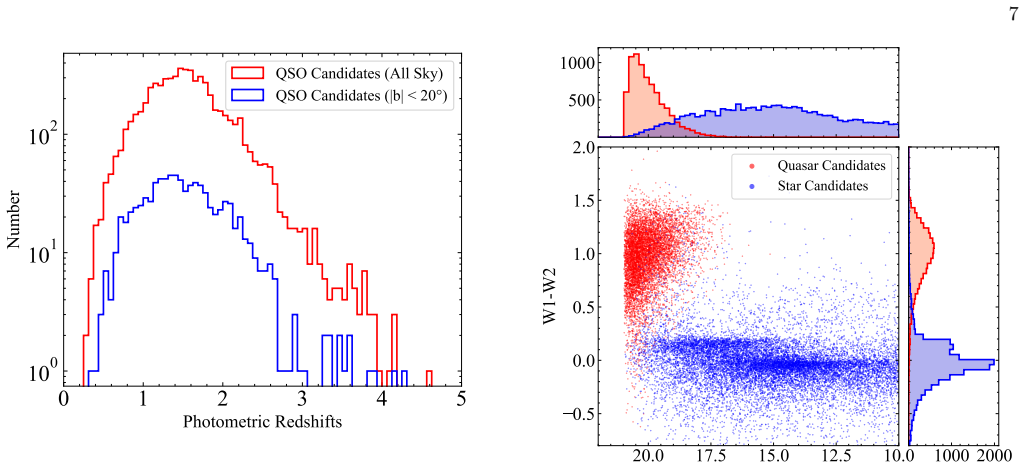


read the original abstract
Quasar samples remain severely incomplete at low Galactic latitudes because of strong extinction and source confusion. We conduct a systematic search for quasars behind the Galactic plane using X-ray sources from the Chandra Source Catalog (CSC 2.1), combined with optical data from Gaia DR3 and mid-infrared data from CatWISE2020. Using spectroscopically confirmed quasars and stellar-type objects from data sets including DESI, SDSS, and LAMOST, we apply a Random Forest classifier to identify quasar candidates, with stellar contaminants suppressed using Gaia proper-motion constraints. Photometric redshifts are estimated for the candidates using a Random Forest regression model. Applying this framework to previously unclassified CSC sources, we identify 7570 quasar candidates, including 1060 Galactic Plane Quasar (GPQ) candidates at |b|<20{\deg}, of which 551 are high-confidence candidates. Relative to the previously known GPQ sample, our selected GPQs reach lower optical and X-ray fluxes, improving sensitivity to low-flux GPQs. In addition, both the GPQ candidates and known GPQs display harder X-ray spectra than the all-sky quasar sample, consistent with increased absorption through the Galactic plane. Pilot spectroscopy confirms two high-confidence GPQ candidates as quasars at spectroscopic redshifts of z=1.2582 and z=1.1313, and further spectroscopic follow-up of the GPQ sample is underway. This work substantially improves the census of GPQs and provides a valuable target sample for future spectroscopic follow-up, enabling the use of GPQs to refine the reference frames for astrometry and probe the Milky Way interstellar and circumgalactic media with the absorption features of GPQs.
Editorial analysis
A structured set of objections, weighed in public.
Referee Report
Summary. The manuscript applies a Random Forest classifier, trained on spectroscopically confirmed quasars and stars from DESI, SDSS, and LAMOST, to Chandra Source Catalog X-ray sources combined with Gaia DR3 and CatWISE2020 photometry. Gaia proper-motion cuts are used to suppress stellar contaminants. The work reports 7570 quasar candidates overall, including 1060 Galactic Plane Quasar (GPQ) candidates at |b|<20° (551 high-confidence), with photometric redshifts estimated via Random Forest regression. Pilot spectroscopy confirms two high-confidence GPQ candidates at z=1.2582 and z=1.1313; the GPQ sample shows harder X-ray spectra than the all-sky quasar population, attributed to Galactic absorption. The method aims to improve the census of low-latitude quasars for future follow-up.
Significance. If the photometric selection proves reliable, the catalog substantially enlarges the known GPQ sample at fainter fluxes, supporting studies of Milky Way interstellar and circumgalactic media via absorption lines and improved astrometric reference frames. Strengths include the use of established multi-wavelength features, proper-motion filtering, and the two pilot redshifts; the result would be a valuable target list pending broader spectroscopic validation.
major comments (3)
- [Methods (classifier training and feature selection)] The Random Forest is trained primarily on high-latitude (|b|>20°) spectroscopic samples from DESI/SDSS/LAMOST and applied directly to |b|<20° CSC sources (abstract and methods description of classifier training). No explicit test or adjustment for differential extinction shifts in Gaia optical and CatWISE mid-IR colors is reported, which could move the target feature distributions outside the training domain and affect the reliability of the 1060 GPQ candidates and the 551 high-confidence subset.
- [Results (X-ray spectral properties)] The claim that GPQ candidates exhibit harder X-ray spectra than the all-sky sample (abstract and results section) is presented as evidence of increased absorption, but the manuscript does not quantify whether this hardness difference persists after controlling for the X-ray flux limit, the RF probability threshold, or selection biases in the CSC sample.
- [Validation and pilot spectroscopy] Only two pilot spectroscopic confirmations are provided for the high-confidence GPQ candidates. While these support the method, the absence of a quantified false-positive rate, cross-validation on a low-latitude hold-out set, or larger follow-up statistics leaves the purity of the 551 high-confidence objects untested at the scale needed to support the central claim of 1060 reliable GPQ candidates.
minor comments (2)
- [Abstract] The definition of 'high-confidence' (probability threshold or other criteria) for the 551 GPQ candidates is not stated in the abstract and should be added for clarity.
- [Figures] Feature-importance plots or color-color diagrams comparing training and target distributions would help readers assess the domain-shift concern raised above.
Simulated Author's Rebuttal
We thank the referee for the careful and constructive review of our manuscript. We address each major comment point by point below, indicating where revisions will be made to improve the analysis and presentation.
read point-by-point responses
-
Referee: [Methods (classifier training and feature selection)] The Random Forest is trained primarily on high-latitude (|b|>20°) spectroscopic samples from DESI/SDSS/LAMOST and applied directly to |b|<20° CSC sources (abstract and methods description of classifier training). No explicit test or adjustment for differential extinction shifts in Gaia optical and CatWISE mid-IR colors is reported, which could move the target feature distributions outside the training domain and affect the reliability of the 1060 GPQ candidates and the 551 high-confidence subset.
Authors: We thank the referee for highlighting this potential issue. Our feature set combines X-ray properties, Gaia proper motions, and photometry selected for robustness against moderate extinction, and the proper-motion filter already removes many stellar contaminants. Nevertheless, we acknowledge that differential extinction could induce domain shift. In the revised manuscript we will add a dedicated subsection comparing feature distributions (particularly Gaia BP-RP and CatWISE W1-W2) between the high-latitude training set and the low-latitude target sample, together with a test using synthetic catalogs that apply realistic Galactic-plane extinction. This will quantify any degradation in classifier performance and support the reliability of the reported GPQ candidates. revision: yes
-
Referee: [Results (X-ray spectral properties)] The claim that GPQ candidates exhibit harder X-ray spectra than the all-sky sample (abstract and results section) is presented as evidence of increased absorption, but the manuscript does not quantify whether this hardness difference persists after controlling for the X-ray flux limit, the RF probability threshold, or selection biases in the CSC sample.
Authors: We agree that a controlled comparison is required to isolate the absorption effect. In the revised results section we will present hardness-ratio distributions for GPQ candidates and the all-sky quasar sample in bins of matched X-ray flux and at fixed RF probability thresholds. We will also discuss possible CSC selection biases. These additions will demonstrate whether the observed hardness difference remains statistically significant after accounting for the factors raised by the referee. revision: yes
-
Referee: [Validation and pilot spectroscopy] Only two pilot spectroscopic confirmations are provided for the high-confidence GPQ candidates. While these support the method, the absence of a quantified false-positive rate, cross-validation on a low-latitude hold-out set, or larger follow-up statistics leaves the purity of the 551 high-confidence objects untested at the scale needed to support the central claim of 1060 reliable GPQ candidates.
Authors: The two pilot spectra at z=1.2582 and z=1.1313 provide direct confirmation that the classifier can identify genuine quasars at low latitude. We already report cross-validation metrics (accuracy, precision, recall) from the high-latitude training set and define the high-confidence subset via an RF probability threshold. A large independent low-latitude spectroscopic hold-out set does not currently exist. We will revise the discussion to emphasize that the 1060 objects remain candidates, to state the training-set performance metrics explicitly, and to highlight that dedicated follow-up spectroscopy is ongoing. These changes will better contextualize the current validation level. revision: partial
- Absence of a sufficiently large low-latitude spectroscopic sample for direct hold-out cross-validation or empirical false-positive rate estimation at |b|<20°.
Circularity Check
No circularity: classifier trained on independent spectroscopic catalogs and applied to new CSC sources
full rationale
The paper trains a Random Forest classifier on spectroscopically confirmed quasars and stars drawn from DESI, SDSS, and LAMOST catalogs, then applies the model to previously unclassified Chandra CSC sources. No equation or parameter is fitted to the target CSC data and then re-used as a 'prediction' on the same data. The training sets are external to the prediction set, and the reported candidates (7570 total, 1060 GPQ) are outputs of this forward application rather than re-statements of fitted inputs. Pilot spectroscopic redshifts serve as external validation, not internal closure. No self-citation chain, uniqueness theorem, or ansatz smuggling is invoked to force the result. The derivation chain is therefore self-contained against external benchmarks.
Axiom & Free-Parameter Ledger
free parameters (2)
- Random Forest hyperparameters
- Classification probability threshold
axioms (1)
- domain assumption Spectroscopic training sets from DESI, SDSS, and LAMOST accurately represent the feature distributions of quasars and stars in the target Galactic plane fields.
Reference graph
Works this paper leans on
-
[1]
L., Wu, X.-B., Yang, J., et al
Ai, Y. L., Wu, X.-B., Yang, J., et al. 2016, AJ, 151, 24, doi: 10.3847/0004-6256/151/2/24
-
[2]
F., Argudo-Fern´ andez, M., et al
Almeida, A., Anderson, S. F., Argudo-Fern´ andez, M., et al. 2023, ApJS, 267, 44, doi: 10.3847/1538-4365/acda98 13 Ba˜ nados, E., Venemans, B. P., Mazzucchelli, C., et al. 2018, Nature, 553, 473, doi: 10.1038/nature25180
-
[3]
2025, A&A, 704, A107, doi: 10.1051/0004-6361/202556747
Bao, T., Ponti, G., Haberl, F., et al. 2025, A&A, 704, A107, doi: 10.1051/0004-6361/202556747
-
[4]
Blanton, M. R., Bershady, M. A., Abolfathi, B., et al. 2017, AJ, 154, 28, doi: 10.3847/1538-3881/aa7567
-
[5]
Breiman, L. 2001, Mach. Learn., 45, 5, doi: 10.1023/A:1010933404324
-
[6]
Carrasco, D., Barrientos, L. F., Pichara, K., et al. 2015, A&A, 584, A44, doi: 10.1051/0004-6361/201525752
-
[7]
Chambers, K. C., Magnier, E. A., Metcalfe, N., et al. 2016, arXiv e-prints, arXiv:1612.05560, doi: 10.48550/arXiv.1612.05560
work page internal anchor Pith review Pith/arXiv arXiv doi:10.48550/arxiv.1612.05560 2016
-
[8]
Croom, S. M., Smith, R. J., Boyle, B. J., et al. 2004, MNRAS, 349, 1397, doi: 10.1111/j.1365-2966.2004.07619.x
-
[9]
Croom, S. M., Richards, G. T., Shanks, T., et al. 2009, MNRAS, 399, 1755, doi: 10.1111/j.1365-2966.2009.15398.x
-
[10]
2012, Research in Astronomy and Astrophysics, 12, 1197, doi: 10.1088/1674-4527/12/9/003
Cui, X.-Q., Zhao, Y.-H., Chu, Y.-Q., et al. 2012, RAA, 12, 1197, doi: 10.1088/1674-4527/12/9/003
-
[11]
Cutri, R. M., Wright, E. L., Conrow, T., et al. 2013, Explanatory Supplement to the AllWISE Data Release Products,, Explanatory Supplement to the AllWISE Data Release Products, by R. M. Cutri et al
work page 2013
-
[12]
The Baryon Oscillation Spectroscopic Survey of SDSS-III
Dawson, K. S., Schlegel, D. J., Ahn, C. P., et al. 2013, AJ, 145, 10, doi: 10.1088/0004-6256/145/1/10
work page internal anchor Pith review doi:10.1088/0004-6256/145/1/10 2013
-
[13]
Data Release 1 of the Dark Energy Spectroscopic Instrument
Delgado, A. J., Alfaro, E. J., & Yun, J. L. 2011, A&A, 531, A141, doi: 10.1051/0004-6361/201116491 DESI Collaboration, Abdul-Karim, M., Adame, A. G., et al. 2025, arXiv e-prints, arXiv:2503.14745, doi: 10.48550/arXiv.2503.14745 Di Matteo, T., Springel, V., & Hernquist, L. 2005, Nature, 433, 604, doi: 10.1038/nature03335
work page internal anchor Pith review Pith/arXiv arXiv doi:10.1051/0004-6361/201116491 2011
-
[14]
Downes, R. A., Webbink, R. F., Shara, M. M., et al. 2001, PASP, 113, 764, doi: 10.1086/320802
-
[15]
Eisenhardt, P. R. M., Marocco, F., Fowler, J. W., et al. 2020, ApJS, 247, 69, doi: 10.3847/1538-4365/ab7f2a
-
[16]
Eisenstein, D. J., Zehavi, I., Hogg, D. W., et al. 2005, ApJ, 633, 560, doi: 10.1086/466512
-
[17]
Evans, I. N., Evans, J. D., Mart´ ınez-Galarza, J. R., et al. 2024, ApJS, 274, 22, doi: 10.3847/1538-4365/ad6319
-
[18]
Fan, X., Ba˜ nados, E., & Simcoe, R. A. 2023, ARA&A, 61, 373, doi: 10.1146/annurev-astro-052920-102455
-
[19]
Flesch, E. W. 2023, Open J. Astrophys, 6, 49, doi: 10.21105/astro.2308.01505
-
[20]
2021, ApJS, 254, 6, doi: 10.3847/1538-4365/abe85e
Fu, Y., Wu, X.-B., Yang, Q., et al. 2021, ApJS, 254, 6, doi: 10.3847/1538-4365/abe85e
-
[21]
2022, ApJS, 261, 32, doi: 10.3847/1538-4365/ac7f3e
Fu, Y., Wu, X.-B., Jiang, L., et al. 2022, ApJS, 261, 32, doi: 10.3847/1538-4365/ac7f3e
-
[22]
2024, ApJS, 271, 54, doi: 10.3847/1538-4365/ad2ae6
Fu, Y., Wu, X.-B., Li, Y., et al. 2024, ApJS, 271, 54, doi: 10.3847/1538-4365/ad2ae6
-
[23]
Fu, Y., Wu, X.-B., Bouwens, R. J., et al. 2025, ApJS, 279, 54, doi: 10.3847/1538-4365/ade999 Gaia Collaboration, Mignard, F., Klioner, S. A., et al. 2018a, A&A, 616, A14, doi: 10.1051/0004-6361/201832916 Gaia Collaboration, Brown, A. G. A., Vallenari, A., et al. 2018b, A&A, 616, A1, doi: 10.1051/0004-6361/201833051 Gaia Collaboration, Klioner, S. A., Lind...
-
[24]
2007, A&A, 463, 275, doi: 10.1051/0004-6361:20066424
Winston, E. 2007, A&A, 463, 275, doi: 10.1051/0004-6361:20066424
-
[25]
Ho, T. K. 1995, in Proceedings of 3rd International Conference on Document Analysis and Recognition, Vol. 1, 278–282 vol.1, doi: 10.1109/ICDAR.1995.598994
-
[26]
Humphrey, P. J., & Buote, D. A. 2008, ApJ, 689, 983, doi: 10.1086/592590
-
[27]
2025, ApJS, 278, 6, doi: 10.3847/1538-4365/adba52
Huo, Z.-Y., Fu, Y., Huang, Y., et al. 2025, ApJS, 278, 6, doi: 10.3847/1538-4365/adba52
-
[28]
2007, ApJ, 664, 64, doi: 10.1086/518734
Im, M., Lee, I., Cho, Y., et al. 2007, ApJ, 664, 64, doi: 10.1086/518734
-
[29]
2020, ARA&A, 58, 27, doi: 10.1146/annurev-astro-120419-014455
Inayoshi, K., Visbal, E., & Haiman, Z. 2020, ARA&A, 58, 27, doi: 10.1146/annurev-astro-120419-014455
-
[30]
2018, in Society of Photo-Optical Instrumentation Engineers (SPIE) Conference Series, Vol
Jiang, H., Hu, Z., Xu, M., et al. 2018, in Society of Photo-Optical Instrumentation Engineers (SPIE) Conference Series, Vol. 10702, Ground-based and Airborne Instrumentation for Astronomy VII, ed. C. J
work page 2018
-
[31]
2018, in Society of Photo-Optical Instrumentation Engineers (SPIE) Conference Series, Vol
Evans, L. Simard, & H. Takami, 107022L, doi: 10.1117/12.2312550
-
[32]
2023, ApJS, 265, 25, doi: 10.3847/1538-4365/acaf89
Jin, J.-J., Wu, X.-B., Fu, Y., et al. 2023, ApJS, 265, 25, doi: 10.3847/1538-4365/acaf89 J¨ onsson, H., Holtzman, J. A., Allende Prieto, C., et al. 2020, AJ, 160, 120, doi: 10.3847/1538-3881/aba592
-
[33]
Kormendy, J., & Ho, L. C. 2013, ARA&A, 51, 511, doi: 10.1146/annurev-astro-082708-101811
work page internal anchor Pith review doi:10.1146/annurev-astro-082708-101811 2013
-
[34]
Kundu, A., Maccarone, T. J., & Zepf, S. E. 2007, ApJ, 662, 525, doi: 10.1086/518021
-
[35]
Liu, C., Cˆ ot´ e, P., Peng, E. W., et al. 2020, ApJS, 250, 17, doi: 10.3847/1538-4365/abad91
-
[36]
Z., van Paradijs, J., & van den Heuvel, E
Liu, Q. Z., van Paradijs, J., & van den Heuvel, E. P. J. 2006, A&A, 455, 1165, doi: 10.1051/0004-6361:20064987 14
-
[37]
Z., van Paradijs, J., & van den Heuvel, E
Liu, Q. Z., van Paradijs, J., & van den Heuvel, E. P. J. 2007, A&A, 469, 807, doi: 10.1051/0004-6361:20077303
-
[38]
L., Zhao, Y.-H., Zhao, G., et al
Luo, A.-L., Zhao, Y.-H., Zhao, G., et al. 2015, RAA, 15, 1095, doi: 10.1088/1674-4527/15/8/002
-
[39]
Lyke, B. W., Higley, A. N., McLane, J. N., et al. 2020, ApJS, 250, 8, doi: 10.3847/1538-4365/aba623
-
[40]
Lyu, B., Wu, X.-B., Jin, J.-J., et al. 2025, arXiv e-prints, arXiv:2512.02836, doi: 10.48550/arXiv.2512.02836
work page internal anchor Pith review Pith/arXiv arXiv doi:10.48550/arxiv.2512.02836 2025
-
[41]
Ma, C., Arias, E. F., Bianco, G., et al. 2009, IERS Technical Note, 35, 1
work page 2009
-
[42]
T., Gutermuth, R., Muzerolle, J., et al
Megeath, S. T., Gutermuth, R., Muzerolle, J., et al. 2012, AJ, 144, 192, doi: 10.1088/0004-6256/144/6/192
-
[43]
2011, , 414, 264, 10.1111/j.1365-2966.2011.18402.x
Mineo, S., Gilfanov, M., & Sunyaev, R. 2012, MNRAS, 419, 2095, doi: 10.1111/j.1365-2966.2011.19862.x
-
[44]
L., Dey, A., Fasbender, K., et al
Nidever, D. L., Dey, A., Fasbender, K., et al. 2021, AJ, 161, 192, doi: 10.3847/1538-3881/abd6e1
-
[45]
2005, A&A, 429, 963, doi: 10.1051/0004-6361:20040480 Pˆ aris, I., Petitjean, P., Ross, N
Ozawa, H., Grosso, N., & Montmerle, T. 2005, A&A, 429, 963, doi: 10.1051/0004-6361:20040480 Pˆ aris, I., Petitjean, P., Ross, N. P., et al. 2017, A&A, 597, A79, doi: 10.1051/0004-6361/201527999
-
[46]
Pedregosa, F., Varoquaux, G., Gramfort, A., et al. 2011, J. Mach. Learn. Res., 12, 2825 Planck Collaboration, Aghanim, N., Ashdown, M., et al. 2016, A&A, 596, A109, doi: 10.1051/0004-6361/201629022
-
[47]
Povich, M. S., Smith, N., Majewski, S. R., et al. 2011, ApJS, 194, 14, doi: 10.1088/0067-0049/194/1/14
-
[48]
Prochaska, J., Hennawi, J., Westfall, K., et al. 2020, The Journal of Open Source Software, 5, 2308, doi: 10.21105/joss.02308
-
[49]
Rebull, L. M., Koenig, X. P., Padgett, D. L., et al. 2011, ApJS, 196, 4, doi: 10.1088/0067-0049/196/1/4
-
[50]
Richards, G. T., Fan, X., Newberg, H. J., et al. 2002, AJ, 123, 2945, doi: 10.1086/340187
-
[51]
2006, Reviews in Modern Astronomy, 19, 31, doi: 10.1002/9783527619030.ch2
Richter, P. 2006, Reviews in Modern Astronomy, 19, 31, doi: 10.1002/9783527619030.ch2
-
[52]
Riello, M., De Angeli, F., Evans, D. W., et al. 2021, A&A, 649, A3, doi: 10.1051/0004-6361/202039587
-
[53]
Ritter, H., & Kolb, U. 2015, Acta Polytech. CTU Proc., 2, 21, doi: 10.14311/APP.2015.02.0021
-
[54]
Ross, N. P., Myers, A. D., Sheldon, E. S., et al. 2012, ApJS, 199, 3, doi: 10.1088/0067-0049/199/1/3
-
[55]
Savage, B. D., & Sembach, K. R. 1996, ARA&A, 34, 279, doi: 10.1146/annurev.astro.34.1.279
-
[56]
2017, MNRAS, 466, 1019, doi: 10.1093/mnras/stw3113
Sazonov, S., & Khabibullin, I. 2017, MNRAS, 466, 1019, doi: 10.1093/mnras/stw3113
-
[57]
2020, NewAR, 88, 101536, doi: 10.1016/j.newar.2020.101536
Sazonov, S., Paizis, A., Bazzano, A., et al. 2020, NewAR, 88, 101536, doi: 10.1016/j.newar.2020.101536
-
[58]
Schlegel, D. J., Finkbeiner, D. P., & Davis, M. 1998, ApJ, 500, 525, doi: 10.1086/305772
work page internal anchor Pith review doi:10.1086/305772 1998
-
[59]
Schneider, D. P., Richards, G. T., Hall, P. B., et al. 2010, AJ, 139, 2360, doi: 10.1088/0004-6256/139/6/2360
-
[60]
Soria, R., & Kong, A. K. H. 2002, ApJL, 572, L33, doi: 10.1086/341445
-
[61]
Taylor, M. B. 2005, in Astronomical Society of the Pacific Conference Series, Vol. 347, Astronomical Data Analysis Software and Systems XIV, ed. P. Shopbell, M. Britton, & R. Ebert, 29 van der Hucht, K. A. 2001, NewAR, 45, 135, doi: 10.1016/S1387-6473(00)00112-3 van der Hucht, K. A. 2006, A&A, 458, 453, doi: 10.1051/0004-6361:20065819
-
[62]
Walter, R., Lutovinov, A. A., Bozzo, E., & Tsygankov, S. S. 2015, A&A Rv, 23, 2, doi: 10.1007/s00159-015-0082-6
-
[63]
2025, ApJ, 985, 23, doi: 10.3847/1538-4357/adc7b8
Wang, H., Ai, Y., Zhang, Y., et al. 2025, ApJ, 985, 23, doi: 10.3847/1538-4357/adc7b8
-
[64]
2000, A&AS, 143, 9–22, doi: 10.1051/aas:2000332
Wenger, M., Ochsenbein, F., Egret, D., et al. 2000, A&AS, 143, 9–22, doi: 10.1051/aas:2000332
work page internal anchor Pith review doi:10.1051/aas:2000332 2000
-
[65]
2024, ApJS, 273, 21, doi: 10.3847/1538-4365/ad58df
Werk, J., Tchernyshyov, K., Bish, H., et al. 2024, ApJS, 273, 21, doi: 10.3847/1538-4365/ad58df
-
[66]
Wright, E. L., Eisenhardt, P. R. M., Mainzer, A. K., et al. 2010, AJ, 140, 1868, doi: 10.1088/0004-6256/140/6/1868
work page internal anchor Pith review doi:10.1088/0004-6256/140/6/1868 2010
-
[67]
2015, Nature, 518, 512, doi: 10.1038/nature14241
Wu, X.-B., Wang, F., Fan, X., et al. 2015, Nature, 518, 512, doi: 10.1038/nature14241
-
[68]
G., Adelman, J., Anderson, John E., J., et al
York, D. G., Adelman, J., Anderson, Jr., J. E., et al. 2000, AJ, 120, 1579, doi: 10.1086/301513
-
[69]
2011, A&A, 533, A33, doi: 10.1051/0004-6361/201116936
Zhang, Z., Gilfanov, M., Voss, R., et al. 2011, A&A, 533, A33, doi: 10.1051/0004-6361/201116936
discussion (0)
Sign in with ORCID, Apple, or X to comment. Anyone can read and Pith papers without signing in.