AgentPSO: Evolving Agent Reasoning Skill via Multi-agent Particle Swarm Optimization
Pith reviewed 2026-06-30 23:27 UTC · model grok-4.3
The pith
AgentPSO evolves multi-agent reasoning skills by applying particle-swarm updates to natural-language skill descriptions.
A machine-rendered reading of the paper's core claim, the machinery that carries it, and where it could break.
Core claim
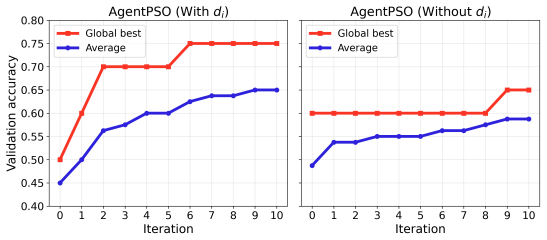
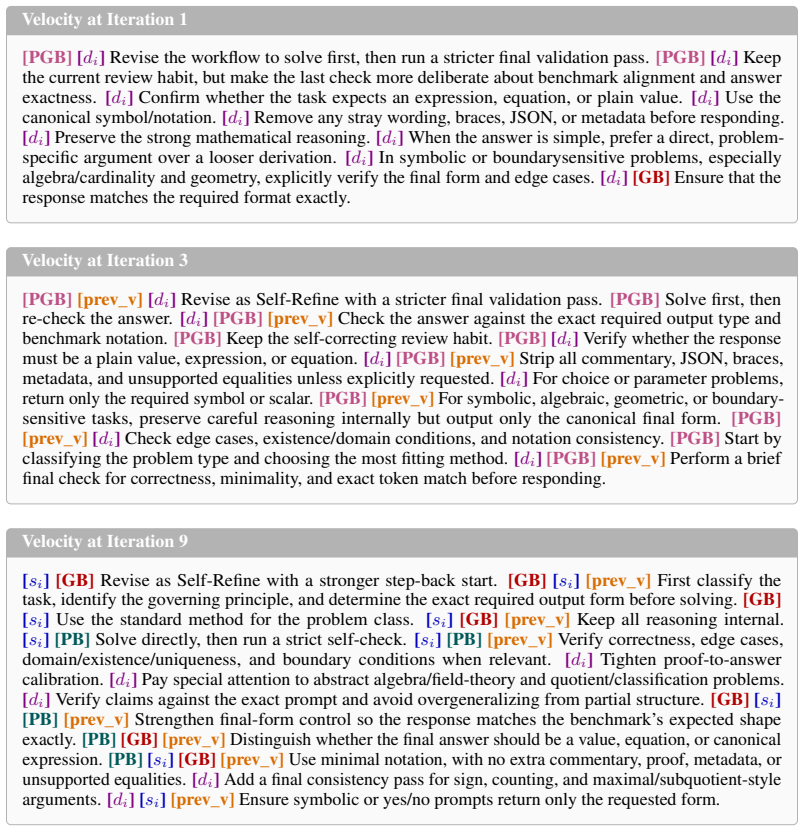
AgentPSO treats each agent as a particle-like reasoner with a natural-language skill as its state and a semantic update direction as its velocity. Each iteration, agents update their skills by combining previous velocity, personal-best skill, global-best skill, and a self-reflective direction from peer reasoning trajectories. This evolves skills that improve performance on mathematical and general reasoning benchmarks while transferring across tasks and to other models.
What carries the argument
The particle-swarm-inspired skill update that blends an agent's prior semantic velocity with its personal best skill, the population's global best skill, and reflections on peer trajectories to generate an improved natural-language reasoning skill.
If this is right
- Evolved skills outperform static single-agent skills and test-time multi-agent reasoning methods on benchmarks.
- Skills transfer successfully to new benchmarks.
- Skills transfer to a different backbone language model.
- AgentPSO captures reusable reasoning procedures instead of benchmark-specific prompts.
Where Pith is reading between the lines
- The method could be adapted to evolve skills in other domains like coding or planning by similar swarm updates.
- Population-based evolution might reduce the need for manual prompt engineering in agent systems.
- Error propagation risks suggest monitoring for divergence in skill quality over iterations.
Load-bearing premise
That combining semantic updates from personal bests, global bests and peer trajectories will lead to stable gains in reasoning quality without spreading incorrect paths through the agent population.
What would settle it
Testing the evolved skills on new benchmarks or models shows no improvement or degradation compared to baselines, or error analysis reveals increased incorrect reasoning propagated from peers.
Figures




read the original abstract
Multi-agent reasoning has shown promise for improving the problem-solving ability of large language models by allowing multiple agents to explore diverse reasoning paths. However, most existing multi-agent methods rely on inference-time debate or aggregation, which can be vulnerable to incorrect peer influence and biased consensus. Moreover, the agents themselves remain static, as their underlying reasoning skills do not evolve across tasks. In this paper, we introduce \textbf{AgentPSO}, a particle-swarm-inspired framework for evolving multi-agent reasoning skills. AgentPSO treats each agent as a particle-like reasoner whose state is a natural-language skill and whose velocity is a semantic update direction, iteratively guiding agents toward higher-performing skill configurations. Across training iterations, each agent updates its skill by combining its previous velocity, personal-best skill, global-best skill, and a self-reflective direction derived from peer reasoning trajectories. This enables agents to learn reusable reasoning behaviors by drawing on their own experience and on the strongest skills found by the population, without updating the parameters of the backbone language model. Experiments on mathematical and general reasoning benchmarks show that AgentPSO improves over static single-agent skills and test-time-only multi-agent reasoning baselines. The evolved skills further transfer across benchmarks and to another backbone model, suggesting that AgentPSO captures reusable reasoning procedures rather than merely optimizing benchmark-specific prompts. Code is publicly available at https://github.com/HYUNMIN-HWANG/AgentPSO/.
Editorial analysis
A structured set of objections, weighed in public.
Referee Report
Summary. The paper introduces AgentPSO, a multi-agent framework inspired by particle swarm optimization in which each LLM agent is treated as a particle whose state is a natural-language reasoning skill. Skills are iteratively updated by combining an agent's prior velocity with reflections on its personal-best skill, the population's global-best skill, and peer reasoning trajectories. The central claim is that this process evolves reusable reasoning procedures that improve performance on mathematical and general reasoning benchmarks relative to static single-agent and test-time multi-agent baselines, with the evolved skills transferring across benchmarks and to a different backbone model without any parameter updates to the LLM.
Significance. If the reported gains and transfer results hold under rigorous evaluation, the work would be significant for multi-agent LLM reasoning by offering a parameter-free mechanism to evolve reusable skills rather than relying on static prompts or inference-time aggregation. The public release of code at the cited GitHub repository is a clear strength that supports reproducibility and further investigation.
major comments (2)
- [§4] §4 (Experiments): No quantitative results, error bars, number of runs, or statistical significance tests are supplied for the claimed improvements over baselines or for the transfer results, which directly undermines evaluation of the central performance and transfer claims.
- [§4.3] §4.3 (Transfer experiments): The transfer results across benchmarks and to another backbone model are presented without ablations isolating the contribution of each update component (personal-best, global-best, peer-trajectory) or controls for prompt length/complexity, which is load-bearing for the interpretation that reusable procedures rather than benchmark-specific artifacts are being captured.
minor comments (2)
- [Abstract] The abstract states that experiments show improvements but supplies no benchmark names, metrics, or effect sizes.
- [§3] Notation for the velocity and skill update rules in §3 could be clarified with explicit pseudocode or a worked example of one iteration.
Simulated Author's Rebuttal
We thank the referee for the detailed and constructive review. We address each of the major comments point-by-point below and outline the revisions we will make to the manuscript.
read point-by-point responses
-
Referee: [§4] §4 (Experiments): No quantitative results, error bars, number of runs, or statistical significance tests are supplied for the claimed improvements over baselines or for the transfer results, which directly undermines evaluation of the central performance and transfer claims.
Authors: We acknowledge this limitation in the current version. The experiments section reports mean performance but lacks details on experimental repetitions and statistical analysis. In the revised manuscript, we will conduct experiments over multiple runs (at least 3-5), include error bars representing standard deviation, and apply statistical significance tests (e.g., Wilcoxon signed-rank test) to validate the improvements and transfer results. revision: yes
-
Referee: [§4.3] §4.3 (Transfer experiments): The transfer results across benchmarks and to another backbone model are presented without ablations isolating the contribution of each update component (personal-best, global-best, peer-trajectory) or controls for prompt length/complexity, which is load-bearing for the interpretation that reusable procedures rather than benchmark-specific artifacts are being captured.
Authors: We agree that isolating the contributions of each PSO-inspired update component is important for interpreting the transfer results. We will add ablation experiments in the revision that systematically disable personal-best, global-best, and peer-trajectory components individually and measure the effect on cross-benchmark and cross-model transfer. Additionally, we will include controls that match the length and complexity of the evolved skills to the baselines to ensure the gains are not due to prompt artifacts. revision: yes
Circularity Check
No significant circularity detected
full rationale
The paper defines AgentPSO via an explicit iterative update rule that combines previous velocity, personal-best skill, global-best skill, and peer-trajectory reflections in natural language; this procedure is stated independently of the target benchmark metrics and does not reduce to a fitted parameter or self-referential definition. The transfer claim across benchmarks and models is presented as an empirical observation rather than a mathematical derivation that collapses to its inputs. No self-citations, uniqueness theorems from prior author work, or smuggled ansatzes appear as load-bearing steps in the abstract or described mechanism. The derivation chain is therefore self-contained against external benchmarks.
Axiom & Free-Parameter Ledger
Forward citations
Cited by 1 Pith paper
-
"Skill issues'': data-centric optimization of lakehouse agents
Data-centric optimization of skills for agents on a branching lakehouse improves accuracy by 31.9% on 25 tasks via state-verification evaluation.
Reference graph
Works this paper leans on
-
[1]
Josh Achiam, Steven Adler, Sandhini Agarwal, Lama Ahmad, Ilge Akkaya, Florencia Leoni Aleman, Diogo Almeida, Janko Altenschmidt, Sam Altman, Shyamal Anadkat, et al. Gpt-4 technical report.arXiv preprint arXiv:2303.08774, 2023
work page internal anchor Pith review Pith/arXiv arXiv 2023
-
[2]
GEPA: Reflective prompt evolution can outperform reinforcement learning
Lakshya A Agrawal, Shangyin Tan, Dilara Soylu, Noah Ziems, Rishi Khare, Krista Opsahl-Ong, Arnav Singhvi, Herumb Shandilya, Michael J Ryan, Meng Jiang, Christopher Potts, Koushik Sen, Alex Dimakis, Ion Stoica, Dan Klein, Matei Zaharia, and Omar Khattab. GEPA: Reflective prompt evolution can outperform reinforcement learning. InThe Fourteenth International...
2026
-
[3]
Self-evolving multi-agent simulations for realistic clinical interactions
Mohammad Almansoori, Komal Kumar, and Hisham Cholakkal. Self-evolving multi-agent simulations for realistic clinical interactions. InInternational Conference on Medical Image Computing and Computer-Assisted Intervention, 2025
2025
-
[4]
A survey of self-evolving agents: On path to artificial super intelligence, 2025
Huan ang Gao, Jiayi Geng, Wenyue Hua, Mengkang Hu, Xinzhe Juan, Hongzhang Liu, Shilong Liu, Jiahao Qiu, Xuan Qi, Yiran Wu, Hongru Wang, Han Xiao, Yuhang Zhou, Shaokun Zhang, Jiayi Zhang, Jinyu Xiang, Yixiong Fang, Qiwen Zhao, Dongrui Liu, Qihan Ren, Cheng Qian, Zhenghailong Wang, Minda Hu, Huazheng Wang, Qingyun Wu, Heng Ji, and Mengdi Wang. A survey of s...
2025
-
[5]
Models overview
Anthropic. Models overview. https://platform.claude.com/docs/en/about-claude/ models/overview, 2026. Accessed: 2026-05-06
2026
-
[6]
Ismail Hossain, Fuad Rahman, Moham- mad Ruhul Amin, Shafin Rahman, and Nabeel Mohammed
Nafew Azim, Abrar Ur Alam, Hasan Bin Omar, Abdullah Mohammad Muntasir Adnan Jami, Jawad Ibn Ahad, Muhammad Rafsan Kabir, Md. Ismail Hossain, Fuad Rahman, Moham- mad Ruhul Amin, Shafin Rahman, and Nabeel Mohammed. AutoDSPy: Automating modular prompt design with reinforcement learning for small and large language models. In Saloni Pot- dar, Lina Rojas-Barah...
2025
-
[7]
Benchmarking large language models on answering and explaining challenging medical questions, 2024
Hanjie Chen, Zhouxiang Fang, Yash Singla, and Mark Dredze. Benchmarking large language models on answering and explaining challenging medical questions, 2024
2024
-
[8]
Free-MAD: Consensus-free multi-agent debate, 2026
Yu Cui, Hang Fu, Haibin Zhang, Licheng Wang, and Cong Zuo. Free-MAD: Consensus-free multi-agent debate, 2026
2026
-
[9]
Deepseek-r1: Incentivizing reasoning capability in llms via reinforcement learning, 2025
DeepSeek-AI. Deepseek-r1: Incentivizing reasoning capability in llms via reinforcement learning, 2025
2025
-
[10]
Improving Factuality and Reasoning in Language Models through Multiagent Debate
Yilun Du, Shuang Li, Antonio Torralba, Joshua B Tenenbaum, and Igor Mordatch. Improv- ing factuality and reasoning in language models through multiagent debate.arXiv preprint arXiv:2305.14325, 2023
work page internal anchor Pith review Pith/arXiv arXiv 2023
-
[11]
M-MAD: Multidimensional multi-agent debate for advanced machine transla- tion evaluation
Zhaopeng Feng, Jiayuan Su, Jiamei Zheng, Jiahan Ren, Yan Zhang, Jian Wu, Hongwei Wang, and Zuozhu Liu. M-MAD: Multidimensional multi-agent debate for advanced machine transla- tion evaluation. In Wanxiang Che, Joyce Nabende, Ekaterina Shutova, and Mohammad Taher Pilehvar, editors,Proceedings of the 63rd Annual Meeting of the Association for Computational ...
2025
-
[12]
Promptbreeder: Self-referential self-improvement via prompt evolution, 2024
Chrisantha Fernando, Dylan Sunil Banarse, Henryk Michalewski, Simon Osindero, and Tim Rocktäschel. Promptbreeder: Self-referential self-improvement via prompt evolution, 2024
2024
-
[13]
Lopes, and Fernando Morgado-Dias
Daniel Freitas, Luis G. Lopes, and Fernando Morgado-Dias. Particle swarm optimisation: A historical review up to the current developments.Entropy, 22(3):362, 2020
2020
-
[14]
CATArena: Evaluation of LLM agents through iterative tournament competitions, 2026
Lingyue Fu, Xin Ding, Yaoming Zhu, Shao Zhang, Lin Qiu, Weiwen Liu, Weinan Zhang, Xuezhi Cao, Xunliang Cai, Jiaxin Ding, and Yong Yu. CATArena: Evaluation of LLM agents through iterative tournament competitions, 2026. 11
2026
-
[15]
Ahmed G. Gad. Particle swarm optimization algorithm and its applications: A systematic review.Archives of Computational Methods in Engineering, 29:2531–2561, 2022
2022
-
[16]
Deepmath-103k: A large-scale, challenging, decontaminated, and verifiable mathematical dataset for advancing reasoning
Zhiwei He, Tian Liang, Jiahao Xu, Qiuzhi Liu, Xingyu Chen, Yue Wang, Linfeng Song, Dian Yu, Zhenwen Liang, Wenxuan Wang, Zhuosheng Zhang, Rui Wang, Zhaopeng Tu, Haitao Mi, and Dong Yu. Deepmath-103k: A large-scale, challenging, decontaminated, and verifiable mathematical dataset for advancing reasoning. 2025
2025
-
[17]
Automated Design of Agentic Systems
Shengran Hu, Cong Lu, and Jeff Clune. Automated design of agentic systems.arXiv preprint arXiv:2408.08435, 2024
work page internal anchor Pith review Pith/arXiv arXiv 2024
-
[18]
Large Language Models Cannot Self-Correct Reasoning Yet
Jie Huang, Xinyun Chen, Swaroop Mishra, Huaixiu Steven Zheng, Adams Wei Yu, Xinying Song, and Denny Zhou. Large language models cannot self-correct reasoning yet.arXiv preprint arXiv:2310.01798, 2023
work page internal anchor Pith review Pith/arXiv arXiv 2023
-
[19]
V oting or consensus? decision-making in multi-agent debate
Lars Benedikt Kaesberg, Jonas Becker, Jan Philip Wahle, Terry Ruas, and Bela Gipp. V oting or consensus? decision-making in multi-agent debate. In Wanxiang Che, Joyce Nabende, Ekaterina Shutova, and Mohammad Taher Pilehvar, editors,Findings of the Association for Computational Linguistics: ACL 2025, pages 11640–11671, Vienna, Austria, July 2025. Associati...
2025
-
[20]
Kennedy and R
J. Kennedy and R. Eberhart. Particle swarm optimization. InProceedings of ICNN’95 - International Conference on Neural Networks, volume 4, pages 1942–1948 vol.4, 1995
1942
-
[21]
Joshi, Hanna Moazam, Heather Miller, Matei Zaharia, and Christopher Potts
Omar Khattab, Arnav Singhvi, Paridhi Maheshwari, Zhiyuan Zhang, Keshav Santhanam, Sri Vardhamanan A, Saiful Haq, Ashutosh Sharma, Thomas T. Joshi, Hanna Moazam, Heather Miller, Matei Zaharia, and Christopher Potts. DSPy: Compiling declarative language model calls into state-of-the-art pipelines. InThe Twelfth International Conference on Learning Represent...
2024
-
[22]
Decomposed prompting: A modular approach for solving complex tasks
Tushar Khot, Harsh Trivedi, Matthew Finlayson, Yao Fu, Kyle Richardson, Peter Clark, and Ashish Sabharwal. Decomposed prompting: A modular approach for solving complex tasks. In International Conference on Learning Representations (ICLR), 2023
2023
-
[23]
Solving quan- titative reasoning problems with language models.Advances in neural information processing systems, 35:3843–3857, 2022
Aitor Lewkowycz, Anders Andreassen, David Dohan, Ethan Dyer, Henryk Michalewski, Vinay Ramasesh, Ambrose Slone, Cem Anil, Imanol Schlag, Theo Gutman-Solo, et al. Solving quan- titative reasoning problems with language models.Advances in neural information processing systems, 35:3843–3857, 2022
2022
-
[24]
Hunter Lightman, Vineet Kosaraju, Yura Burda, Harri Edwards, Bowen Baker, Teddy Lee, Jan Leike, John Schulman, Ilya Sutskever, and Karl Cobbe. Let’s verify step by step.arXiv preprint arXiv:2305.20050, 2023
work page internal anchor Pith review Pith/arXiv arXiv 2023
-
[25]
Enhancing multi-agent debate system performance via confidence expression
Zijie Lin and Bryan Hooi. Enhancing multi-agent debate system performance via confidence expression. In Christos Christodoulopoulos, Tanmoy Chakraborty, Carolyn Rose, and Violet Peng, editors,Findings of the Association for Computational Linguistics: EMNLP 2025, pages 6453–6471, Suzhou, China, November 2025. Association for Computational Linguistics
2025
-
[26]
MeMAD: Structured memory of debates for enhanced multi-agent reasoning
Shuai Ling, Lizi Liao, Dongmei Jiang, and Weili Guan. MeMAD: Structured memory of debates for enhanced multi-agent reasoning. InSecond Conference on Language Modeling, 2025
2025
-
[27]
Tongxuan Liu, Xingyu Wang, Weizhe Huang, Wenjiang Xu, Yuting Zeng, Lei Jiang, Hailong Yang, and Jing Li. Groupdebate: Enhancing the efficiency of multi-agent debate using group discussion.arXiv preprint arXiv:2409.14051, 2024
-
[28]
Breaking mental set to improve reasoning through diverse multi-agent debate
Yexiang Liu, Jie Cao, Zekun Li, Ran He, and Tieniu Tan. Breaking mental set to improve reasoning through diverse multi-agent debate. InICLR, 2025
2025
-
[29]
Lessons learned: A multi-agent framework for code LLMs to learn and improve
Yuanzhe Liu, Ryan Deng, Tim Kaler, Xuhao Chen, Charles E Leiserson, Yao Ma, and Jie Chen. Lessons learned: A multi-agent framework for code LLMs to learn and improve. InAdvances in Neural Information Processing Systems 38, 2025. 12
2025
-
[30]
Self-refine: Iterative refinement with self-feedback, 2023
Aman Madaan, Niket Tandon, Prakhar Gupta, Skyler Hallinan, Luyu Gao, Sarah Wiegreffe, Uri Alon, Nouha Dziri, Shrimai Prabhumoye, Yiming Yang, Sean Welleck, Bodhisattwa Prasad Majumder, Shashank Gupta, Amir Yazdanbakhsh, and Peter Clark. Self-refine: Iterative refinement with self-feedback, 2023
2023
-
[31]
Introducing gpt-5.5
OpenAI. Introducing gpt-5.5. https://openai.com/ko-KR/index/ introducing-gpt-5-5/, 2026. Accessed: 2026-05-6
2026
-
[32]
Grips: Gradient-free, edit-based instruction search for prompting large language models
Archiki Prasad, Peter Hase, Xiang Zhou, and Mohit Bansal. Grips: Gradient-free, edit-based instruction search for prompting large language models. 2022
2022
-
[33]
Reflexion: Language agents with verbal reinforcement learning.Advances in neural information processing systems, 36:8634–8652, 2023
Noah Shinn, Federico Cassano, Ashwin Gopinath, Karthik Narasimhan, and Shunyu Yao. Reflexion: Language agents with verbal reinforcement learning.Advances in neural information processing systems, 36:8634–8652, 2023
2023
-
[34]
Large language models as particle swarm optimizers
Yamato Shinohara, Jinglue Xu, Tianshui Li, and Hitoshi Iba. Large language models as particle swarm optimizers. In2025 IEEE Congress on Evolutionary Computation (CEC), pages 1–4, 2025
2025
-
[35]
Debflow: Automating agent creation via agent debate.arXiv preprint arXiv:2503.23781, 2025
Jinwei Su, Yinghui Xia, Yiqun Duan, Jun Du, Jianuo Huang, Tianyu Shi, and Lewei He. Debflow: Automating agent creation via agent debate.arXiv preprint arXiv:2503.23781, 2025
-
[36]
Doubleday, New York, 2004
James Surowiecki.The Wisdom of Crowds: Why the Many Are Smarter Than the Few and How Collective Wisdom Shapes Business, Economies, Societies, and Nations. Doubleday, New York, 2004
2004
-
[37]
Challenging BIG-Bench Tasks and Whether Chain-of-Thought Can Solve Them
Mirac Suzgun, Nathan Scales, Nathanael Schärli, Sebastian Gehrmann, Yi Tay, Hyung Won Chung, Aakanksha Chowdhery, Quoc V Le, Ed H Chi, Denny Zhou, , and Jason Wei. Challenging big-bench tasks and whether chain-of-thought can solve them.arXiv preprint arXiv:2210.09261, 2022
work page internal anchor Pith review Pith/arXiv arXiv 2022
-
[38]
Mixture-of-agents enhances large language model capabilities
Junlin Wang, Jue WANG, Ben Athiwaratkun, Ce Zhang, and James Zou. Mixture-of-agents enhances large language model capabilities. InThe Thirteenth International Conference on Learning Representations, 2025
2025
-
[39]
Chi, Sharan Narang, Aakanksha Chowdhery, and Denny Zhou
Xuezhi Wang, Jason Wei, Dale Schuurmans, Quoc V Le, Ed H. Chi, Sharan Narang, Aakanksha Chowdhery, and Denny Zhou. Self-consistency improves chain of thought reasoning in language models. InThe Eleventh International Conference on Learning Representations, 2023
2023
-
[40]
Agent workflow memory
Zora Zhiruo Wang, Jiayuan Mao, Daniel Fried, and Graham Neubig. Agent workflow memory. InForty-second International Conference on Machine Learning, 2025
2025
-
[41]
Chain-of-thought prompting elicits reasoning in large language models
Jason Wei, Xuezhi Wang, Dale Schuurmans, Maarten Bosma, Fei Xia, Ed Chi, Quoc V Le, Denny Zhou, et al. Chain-of-thought prompting elicits reasoning in large language models. Advances in neural information processing systems, 35:24824–24837, 2022
2022
-
[42]
Evo-Memory: Benchmarking LLM Agent Test-time Learning with Self-Evolving Memory
Tianxin Wei, Noveen Sachdeva, Benjamin Coleman, Zhankui He, Yuanchen Bei, Xuying Ning, Mengting Ai, Yunzhe Li, Jingrui He, Ed H. Chi, Chi Wang, Shuo Chen, Fernando Pereira, Wang- Cheng Kang, and Derek Zhiyuan Cheng. Evo-memory: Benchmarking llm agent test-time learning with self-evolving memory.arXiv preprint arXiv:2511.20857, 2025
work page internal anchor Pith review Pith/arXiv arXiv 2025
-
[43]
Zhiyuan Weng, Guikun Chen, and Wenguan Wang. Do as we do, not as you think: the conformity of large language models.arXiv preprint arXiv:2501.13381, 2025
-
[44]
Comas: Co-evolving multi-agent systems via interaction rewards.arXiv preprint arXiv:2510.08529, 2025
Xiangyuan Xue, Yifan Zhou, Guibin Zhang, Zaibin Zhang, Yijiang Li, Chen Zhang, Zhenfei Yin, Philip Torr, Wanli Ouyang, and Lei Bai. Comas: Co-evolving multi-agent systems via interaction rewards.arXiv preprint arXiv:2510.08529, 2025
-
[45]
Large language models as optimizers
Chengrun Yang, Xuezhi Wang, Yifeng Lu, Hanxiao Liu, Quoc V Le, Denny Zhou, and Xinyun Chen. Large language models as optimizers. InThe Twelfth International Conference on Learning Representations, 2024
2024
-
[46]
Tree of thoughts: Deliberate problem solving with large language models.Ad- vances in neural information processing systems, 36:11809–11822, 2023
Shunyu Yao, Dian Yu, Jeffrey Zhao, Izhak Shafran, Tom Griffiths, Yuan Cao, and Karthik Narasimhan. Tree of thoughts: Deliberate problem solving with large language models.Ad- vances in neural information processing systems, 36:11809–11822, 2023. 13
2023
-
[47]
Darwin gödel machine: Open-ended evolution of self-improving agents
Jenny Zhang, Shengran Hu, Cong Lu, Robert Tjarko Lange, and Jeff Clune. Darwin gödel machine: Open-ended evolution of self-improving agents. InThe Fourteenth International Conference on Learning Representations, 2026
2026
-
[48]
Enhancing comprehensive learning particle swarm optimization with local optima topology.Information Sciences, 471:1–18, 2019
Kai Zhang, Qiujun Huang, and Yimin Zhang. Enhancing comprehensive learning particle swarm optimization with local optima topology.Information Sciences, 471:1–18, 2019
2019
-
[49]
American invitational mathematics examination (aime) 2025, 2025
Yifan Zhang and Team Math-AI. American invitational mathematics examination (aime) 2025, 2025
2025
-
[50]
Chi, Quoc V Le, and Denny Zhou
Huaixiu Steven Zheng, Swaroop Mishra, Xinyun Chen, Heng-Tze Cheng, Ed H. Chi, Quoc V Le, and Denny Zhou. Take a step back: Evoking reasoning via abstraction in large language models. InThe Twelfth International Conference on Learning Representations, 2024
2024
-
[51]
Denny Zhou, Nathanael Schärli, Le Hou, Jason Wei, Nathan Scales, Xuezhi Wang, Dale Schuurmans, Claire Cui, Olivier Bousquet, Quoc V Le, and Ed H. Chi. Least-to-most prompting enables complex reasoning in large language models. InThe Eleventh International Conference on Learning Representations, 2023
2023
-
[52]
Memento-skills: Let agents design agents
Huichi Zhou, Siyuan Guo, Anjie Liu, Zhongwei Yu, Ziqin Gong, Bowen Zhao, Zhixun Chen, Menglong Zhang, Yihang Chen, Jinsong Li, et al. Memento-skills: Let agents design agents. arXiv preprint arXiv:2603.18743, 2026
- [53]
-
[54]
Large language models are human-level prompt engineers
Yongchao Zhou, Andrei Ioan Muresanu, Ziwen Han, Keiran Paster, Silviu Pitis, Harris Chan, and Jimmy Ba. Large language models are human-level prompt engineers. InThe Eleventh International Conference on Learning Representations, 2023
2023
-
[55]
MedXpertQA: Benchmarking Expert-Level Medical Reasoning and Understanding
Yuxin Zuo, Shang Qu, Yifei Li, Zhangren Chen, Xuekai Zhu, Ermo Hua, Kaiyan Zhang, Ning Ding, and Bowen Zhou. Medxpertqa: Benchmarking expert-level medical reasoning and understanding.arXiv preprint arXiv:2501.18362, 2025. 14 A Experimental Details Table 8:Hyperparameter settings for AgentPSO. Hyperparameter Value Number of agents 4 Number of iterations 10...
work page internal anchor Pith review Pith/arXiv arXiv 2025
discussion (0)
Sign in with ORCID, Apple, or X to comment. Anyone can read and Pith papers without signing in.