Recognition: no theorem link
Stabilizer Code-Generic Universal Fault-Tolerant Quantum Computation
Pith reviewed 2026-05-16 14:24 UTC · model grok-4.3
The pith
Novel ancilla-mediated protocols enable universal fault-tolerant quantum computation on any stabilizer code
A machine-rendered reading of the paper's core claim, the machinery that carries it, and where it could break.
Core claim
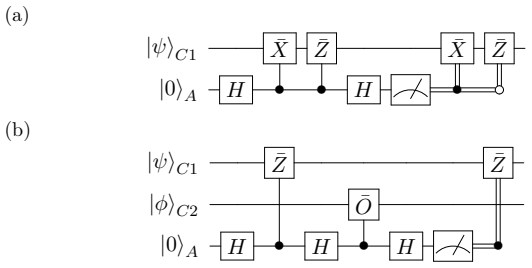
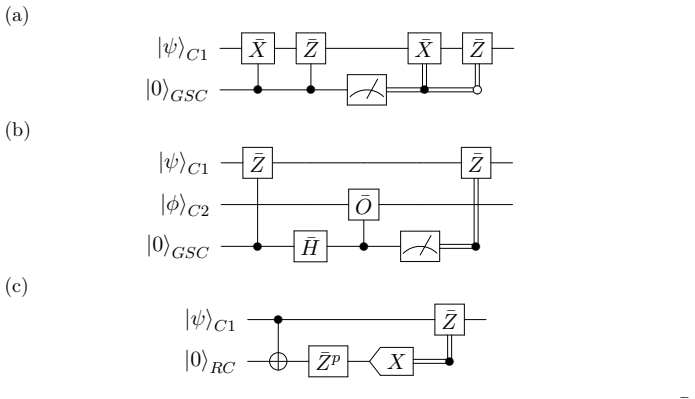
Logical Clifford and T gates can be realized through ancilla-mediated protocols that are generic to all stabilizer codes. The protocols employ helper stabilizer codes placed temporarily in ancilla registers and perform mid-circuit measurements to enact the desired logical operations without consuming the ancilla registers or modifying the underlying data code or register.
What carries the argument
Ancilla-mediated protocols that place helper stabilizer codes in ancilla registers and use mid-circuit measurements to enact logical Clifford and T gates
Load-bearing premise
The ancilla-mediated protocols implement the logical Clifford and T gates correctly and generically for every stabilizer code without hidden costs or code-specific adjustments
What would settle it
A numerical simulation or experimental run on the Steane code that fails to produce the correct logical T-gate output or introduces uncorrectable errors would disprove the claim of generic correctness
Figures



read the original abstract
Fault-tolerant quantum computation allows quantum computations to be carried out while resisting unwanted noise. Several error-correcting codes have been developed to achieve this task, but none alone are capable of universal quantum computation. This universality is highly desired and often achieved using additional techniques such as code concatenation, code switching, magic state distillation, or pieceable fault tolerance, which can be costly and only work for specific codes. This work proposes a new direction by implementing logical Clifford and T gates through novel ancilla-mediated protocols to construct a universal fault-tolerant quantum gate set. Unlike traditional techniques, our implementation is deterministic, does not consume ancilla registers, does not modify the underlying data codes or registers, and is generic over all stabilizer codes. Thus, any single code becomes capable of universal quantum computation by leveraging helper codes in ancilla registers and mid-circuit measurements. Furthermore, since these logical gates are stabilizer code-generic, these implementations enable communication between heterogeneous stabilizer codes. These features collectively open the door to countless possibilities for existing and yet undiscovered codes as well as their scalable, heterogeneous coexistence.
Editorial analysis
A structured set of objections, weighed in public.
Referee Report
Summary. The manuscript proposes novel ancilla-mediated protocols for implementing logical Clifford and T gates on stabilizer codes. These protocols are claimed to be deterministic, to avoid consuming ancilla registers or modifying the underlying data codes/registers, and to be generic across all stabilizer codes. By using helper codes in ancilla registers together with mid-circuit measurements, the approach is said to enable universal fault-tolerant quantum computation for any single stabilizer code and to permit communication between heterogeneous stabilizer codes, without relying on code concatenation, switching, magic-state distillation, or pieceable fault tolerance.
Significance. If the protocols can be shown to be uniformly generic and fault-tolerant, the result would be significant: it would remove the need for code-specific universality techniques and allow any stabilizer code to support a universal gate set while preserving the data code. The deterministic, ancilla-non-consuming character would also be advantageous for resource efficiency and for heterogeneous code architectures. The manuscript does not yet supply the derivations, explicit constructions, or error analysis needed to substantiate these advantages.
major comments (3)
- [Abstract and §3] Abstract and §3: The central genericity claim—that the same ancilla-mediated sequence of stabilizer measurements and ancilla interactions implements a logical T gate correctly for every stabilizer code without code-specific adjustments—is asserted but not derived. No general construction or uniformity proof is supplied that would apply identically to, e.g., the [[7,1,3]] Steane code and the [[5,1,3]] code; this is load-bearing for the universality and heterogeneity claims.
- [§4] §4: No fault-tolerance analysis, error propagation bounds, or threshold estimates are given for the proposed protocols. Without these, the assertion that the gates are fault-tolerant cannot be evaluated.
- [§5.1] §5.1: The statement that the protocols are “parameter-free” and do not modify the data code is not accompanied by an explicit encoding map or measurement schedule that is shown to be independent of the underlying stabilizer code’s logical operator supports.
minor comments (2)
- Notation for the ancilla registers and helper codes is introduced without a consistent table of symbols; a summary table would improve readability.
- [Abstract] The abstract lists several traditional techniques (concatenation, magic-state distillation) but does not cite the specific references used for comparison; adding those citations would clarify the novelty claim.
Simulated Author's Rebuttal
We thank the referee for their detailed and constructive comments on our manuscript. We address each major comment point by point below and indicate the revisions we will make.
read point-by-point responses
-
Referee: [Abstract and §3] The central genericity claim—that the same ancilla-mediated sequence of stabilizer measurements and ancilla interactions implements a logical T gate correctly for every stabilizer code without code-specific adjustments—is asserted but not derived. No general construction or uniformity proof is supplied that would apply identically to, e.g., the [[7,1,3]] Steane code and the [[5,1,3]] code; this is load-bearing for the universality and heterogeneity claims.
Authors: We agree that an explicit uniformity proof is required to substantiate the genericity claim. The manuscript presents the protocols using helper codes and mid-circuit measurements in a code-agnostic formalism, but does not derive that the identical sequence succeeds for arbitrary stabilizer codes. In the revised manuscript we will add a general construction: we will show that the ancilla-mediated stabilizer measurements implement the logical T gate by verifying that the induced logical operator transformations commute with all stabilizers of any underlying code and produce the required phase on the logical Pauli operators, independent of the specific generator supports. This will be illustrated with the [[7,1,3]] and [[5,1,3]] codes as examples. revision: yes
-
Referee: [§4] No fault-tolerance analysis, error propagation bounds, or threshold estimates are given for the proposed protocols. Without these, the assertion that the gates are fault-tolerant cannot be evaluated.
Authors: The present manuscript focuses on the deterministic construction and code-genericity of the protocols. A full fault-tolerance analysis, including explicit error-propagation bounds and threshold estimates, is not provided. We will add a new subsection in the revision that analyzes error propagation through the mid-circuit measurements and ancilla interactions, deriving that single-qubit errors on the data register remain correctable by the underlying stabilizer code. A preliminary threshold estimate obtained via simplified depolarizing-noise simulation will also be included; a comprehensive numerical threshold calculation will be noted as future work. revision: partial
-
Referee: [§5.1] The statement that the protocols are “parameter-free” and do not modify the data code is not accompanied by an explicit encoding map or measurement schedule that is shown to be independent of the underlying stabilizer code’s logical operator supports.
Authors: We will revise §5.1 to include an explicit general encoding map and a measurement schedule expressed solely in terms of the abstract stabilizer generators and logical operators. The schedule will be written so that it references only the commutation relations guaranteed by the stabilizer formalism, thereby demonstrating independence from any particular choice of logical-operator supports. This will confirm that the protocols remain parameter-free and leave the data code unmodified. revision: yes
Circularity Check
No circularity: claims rest on proposed novel protocols without reduction to inputs
full rationale
The paper proposes new ancilla-mediated protocols to implement logical Clifford and T gates deterministically and generically over all stabilizer codes, using helper codes in ancilla registers and mid-circuit measurements. The abstract asserts these features as properties of the construction itself, without any equations, fitted parameters, or self-citations that reduce the central claim to prior inputs by definition. No load-bearing step equates a 'prediction' to a fitted quantity or imports uniqueness via self-citation chains. The genericity is presented as an emergent capability of the uniform protocol rather than a renaming or self-definitional loop. This is a standard non-circular proposal of new methods.
Axiom & Free-Parameter Ledger
axioms (1)
- domain assumption Stabilizer codes admit logical Clifford and T gates through ancilla-mediated protocols that leave the data code unmodified
invented entities (1)
-
ancilla-mediated protocols for logical Clifford and T gates
no independent evidence
Reference graph
Works this paper leans on
-
[1]
Knill, E. & Laflamme, R. Theory of quantum error-correcting codes. Phys. Rev. A55, 900–911 (1997). URLhttps://link.aps.org/doi/ 10.1103/PhysRevA.55.900
-
[2]
Stabilizer Codes and Quantum Error Correction
Gottesman, D. Stabilizer codes and quantum error correction (1997). URLhttps://arxiv.org/abs/quant-ph/9705052.quant-ph/ 9705052
work page internal anchor Pith review Pith/arXiv arXiv 1997
-
[3]
The Heisenberg Representation of Quantum Computers
Gottesman, D. The heisenberg representation of quantum computers (1998). URLhttps://arxiv.org/abs/quant-ph/9807006.quant-ph/ 9807006
work page internal anchor Pith review Pith/arXiv arXiv 1998
-
[4]
Shannon, C. E. A mathematical theory of communication.The Bell System Technical Journal27, 379–423 (1948)
work page 1948
-
[5]
Hamming, R. W. Error detecting and error correcting codes.The Bell System Technical Journal29, 147–160 (1950)
work page 1950
-
[6]
Shor, P. W. Scheme for reducing decoherence in quantum computer memory.Phys. Rev. A52, R2493–R2496 (1995). URLhttps://link. aps.org/doi/10.1103/PhysRevA.52.R2493
-
[7]
Bacon, D. & Casaccino, A. Quantum error correcting subsystem codes from two classical linear codes. InProceedings of the 44th Annual Aller- ton Conference on Communication, Control, and Computing, 529–534 (2006)
work page 2006
-
[8]
Operator quantum error-correcting subsystems for self- correcting quantum memories.Phys
Bacon, D. Operator quantum error-correcting subsystems for self- correcting quantum memories.Phys. Rev. A73, 012340 (2006). URL https://link.aps.org/doi/10.1103/PhysRevA.73.012340
-
[9]
G., Mariantoni, M., Martinis, J
Fowler, A. G., Mariantoni, M., Martinis, J. M. & Cleland, A. N. Sur- face codes: Towards practical large-scale quantum computation.Phys. Rev. A86, 032324 (2012). URLhttps://link.aps.org/doi/10.1103/ PhysRevA.86.032324. 19
work page 2012
-
[10]
Quantum reed-muller codes.IEEE Transactions on Infor- mation Theory45, 1701–1703 (1999)
Steane, A. Quantum reed-muller codes.IEEE Transactions on Infor- mation Theory45, 1701–1703 (1999)
work page 1999
-
[11]
Bombin, H. & Martin-Delgado, M. A. Topological quantum distillation. Phys. Rev. Lett.97, 180501 (2006). URLhttps://link.aps.org/doi/ 10.1103/PhysRevLett.97.180501
-
[12]
Laflamme, R., Miquel, C., Paz, J. P. & Zurek, W. H. Perfect quantum error correcting code.Phys. Rev. Lett.77, 198–201 (1996). URLhttps: //link.aps.org/doi/10.1103/PhysRevLett.77.198
-
[13]
Córcoles, A. D.et al.Demonstration of a quantum error detection code using a square lattice of four superconducting qubits.Nature Commu- nications6, 7979 (2015). URLhttps://www.nature.com/articles/ ncomms7979
work page 2015
-
[14]
Scott, A. J. Probabilities of failure for quantum error correction.Quan- tum Information Processing4, 399–431 (2005). URLhttp://dx.doi. org/10.1007/s11128-005-0002-1
-
[15]
Fault-tolerant quantum computation
Shor, P. Fault-tolerant quantum computation. InProceedings of 37th Conference on Foundations of Computer Science, 56–65 (1996)
work page 1996
-
[16]
DiVincenzo, D. P. & Shor, P. W. Fault-tolerant error correction with efficient quantum codes.Phys. Rev. Lett.77, 3260–3263 (1996). URL https://link.aps.org/doi/10.1103/PhysRevLett.77.3260
-
[17]
Nielsen, M. A. & Chuang, I. L.10.6.1 Fault-tolerance: the big picture, 475–482 (Cambridge University Press, 2010)
work page 2010
-
[18]
Fault-tolerant quantum computing with color codes
Landahl, A. J., Anderson, J. T. & Rice, P. R. Fault-tolerant quantum computing with color codes (2011). URLhttps://arxiv.org/abs/ 1108.5738.1108.5738
work page internal anchor Pith review Pith/arXiv arXiv 2011
-
[19]
Aliferis, P. & Cross, A. W. Subsystem fault tolerance with the bacon- shor code.Phys. Rev. Lett.98, 220502 (2007). URLhttps://link. aps.org/doi/10.1103/PhysRevLett.98.220502
-
[20]
URLhttps://arxiv.org/abs/ 2503.15751.2503.15751
Davydova, M.et al.Universal fault tolerant quantum computation in 2d without getting tied in knots (2025). URLhttps://arxiv.org/abs/ 2503.15751.2503.15751
-
[21]
Paetznick, A. & Reichardt, B. W. Universal fault-tolerant quantum computation with only transversal gates and error correction.Phys. 20 Rev. Lett.111, 090505 (2013). URLhttps://link.aps.org/doi/10. 1103/PhysRevLett.111.090505
work page 2013
-
[22]
Webster, P., Vasmer, M., Scruby, T. R. & Bartlett, S. D. Univer- sal fault-tolerant quantum computing with stabilizer codes.Physi- cal Review Research4(2022). URLhttp://dx.doi.org/10.1103/ PhysRevResearch.4.013092
work page 2022
-
[23]
Yoder, T. J. Universal fault-tolerant quantum computation with bacon- shor codes (2017). URLhttps://arxiv.org/abs/1705.01686.1705. 01686
work page internal anchor Pith review Pith/arXiv arXiv 2017
-
[24]
Kubica, A. & Beverland, M. E. Universal transversal gates with color codes: A simplified approach.Phys. Rev. A91, 032330 (2015). URL https://link.aps.org/doi/10.1103/PhysRevA.91.032330
-
[25]
Jochym-O’Connor, T. & Laflamme, R. Using concatenated quan- tum codes for universal fault-tolerant quantum gates.Phys. Rev. Lett.112, 010505 (2014). URLhttps://link.aps.org/doi/10.1103/ PhysRevLett.112.010505
work page 2014
-
[26]
Heußen, S. & Hilder, J. Efficient fault-tolerant code switching via one-way transversal cnot gates (2024). URLhttps://arxiv.org/abs/ 2409.13465.2409.13465
-
[27]
Fault-Tolerant Postselected Quantum Computation: Schemes
Knill, E. Fault-tolerant postselected quantum computation: Schemes (2004). URLhttps://arxiv.org/abs/quant-ph/0402171.quant-ph/ 0402171
work page internal anchor Pith review Pith/arXiv arXiv 2004
-
[28]
Anderson, J. T., Duclos-Cianci, G. & Poulin, D. Fault-tolerant con- version between the steane and reed-muller quantum codes.Physi- cal Review Letters113(2014). URLhttp://dx.doi.org/10.1103/ PhysRevLett.113.080501
work page 2014
-
[29]
Butt, F., Heußen, S., Rispler, M. & Müller, M. Fault-tolerant code- switching protocols for near-term quantum processors.PRX Quan- tum5, 020345 (2024). URLhttps://link.aps.org/doi/10.1103/ PRXQuantum.5.020345
work page 2024
- [30]
-
[31]
URLhttps://arxiv.org/abs/2411.03202.2411.03202
Stein, S.et al.Architectures for heterogeneous quantum error correction codes (2024). URLhttps://arxiv.org/abs/2411.03202.2411.03202
-
[32]
Bravyi, S. & Kitaev, A. Universal quantum computation with ideal clifford gates and noisy ancillas.Phys. Rev. A71, 022316 (2005). URL https://link.aps.org/doi/10.1103/PhysRevA.71.022316
-
[33]
Magic state distillation: Not as costly as you think.Quantum3, 205 (2019)
Litinski, D. Magic state distillation: Not as costly as you think.Quantum3, 205 (2019). URLhttp://dx.doi.org/10.22331/ q-2019-12-02-205
work page 2019
-
[34]
Zhou, X., Leung, D. W. & Chuang, I. L. Methodology for quantum logic gate construction.Phys. Rev. A62, 052316 (2000). URLhttps: //link.aps.org/doi/10.1103/PhysRevA.62.052316
-
[35]
Eastin, B. & Knill, E. Restrictions on transversal encoded quantum gate sets.Phys. Rev. Lett.102, 110502 (2009). URLhttps://link. aps.org/doi/10.1103/PhysRevLett.102.110502
-
[36]
O., Mor, T., Pulver, M., Roychowdhury, V
Boykin, P. O., Mor, T., Pulver, M., Roychowdhury, V. & Vatan, F. On universal and fault-tolerant quantum computing: A novel basis and the quantum circuits for shor’s algorithm. InProceedings of the 40th An- nual Symposium on Foundations of Computer Science, 486–494 (IEEE, 1999)
work page 1999
-
[37]
Horsman, D., Fowler, A. G., Devitt, S. & Meter, R. V. Surface code quantum computing by lattice surgery.New Journal of Physics14, 123011 (2012). URLhttp://dx.doi.org/10.1088/1367-2630/14/12/ 123011
-
[38]
The robustness of magic state distillation against errors in Clifford gates
Jochym-O’Connor, T., Yu, Y., Helou, B. & Laflamme, R. The robust- ness of magic state distillation against errors in clifford gates (2012). URLhttps://arxiv.org/abs/1205.6715.1205.6715
work page internal anchor Pith review Pith/arXiv arXiv 2012
-
[39]
Bravyi, S. & Haah, J. Magic-state distillation with low overhead.Physi- cal Review A86(2012). URLhttp://dx.doi.org/10.1103/PhysRevA. 86.052329
-
[40]
Haah, J. & Hastings, M. B. Codes and protocols for distilling t, controlled-s, and toffoli gates.Quantum2, 71 (2018). URLhttp: //dx.doi.org/10.22331/q-2018-06-07-71. 22
-
[41]
Prabhu, P. & Reichardt, B. W. Fault-tolerant syndrome extraction and cat state preparation with fewer qubits.Quantum7, 1154 (2023). URL http://dx.doi.org/10.22331/q-2023-10-24-1154
-
[42]
Steane, A. M. Error correcting codes in quantum theory.Phys. Rev. Lett.77, 793–797 (1996). URLhttps://link.aps.org/doi/10.1103/ PhysRevLett.77.793
work page 1996
-
[43]
Threshold Accuracy for Quantum Computation
Knill, E., Laflamme, R. & Zurek, W. Threshold accuracy for quan- tum computation (1996). URLhttps://arxiv.org/abs/quant-ph/ 9610011.quant-ph/9610011
work page internal anchor Pith review Pith/arXiv arXiv 1996
-
[44]
Deutsch, D. & Jozsa, R. Rapid solution of problems by quantum computation.Proc. R. Soc. Lond. A439, 553–558 (1992). URL https://doi.org/10.1098/rspa.1992.0167
-
[45]
Cuomo, D., Caleffi, M. & Cacciapuoti, A. S. Towards a distributed quantum computing ecosystem.IET Quantum Communication1, 3–8 (2020)
work page 2020
-
[46]
Suppressing quantum errors by scaling a surface code logical qubit.Nature614, 676–681 (2023)
Google Quantum AI. Suppressing quantum errors by scaling a surface code logical qubit.Nature614, 676–681 (2023)
work page 2023
-
[47]
Pecorari, L., Jandura, S., Brennen, G. K. & Pupillo, G. High-rate quantum LDPC codes for long-range-connected neutral atom registers. Nature Communications16, 1111 (2025)
work page 2025
-
[48]
Stim: a fast stabilizer circuit simulator.Quantum5, 497 (2021)
Gidney, C. Stim: a fast stabilizer circuit simulator.Quantum5, 497 (2021)
work page 2021
-
[49]
Tansuwannont, T., Pato, B. & Brown, K. R. Adaptive syndrome mea- surements for shor-style error correction.Quantum7, 1075 (2023). URL http://dx.doi.org/10.22331/q-2023-08-08-1075. Acknowledgements This work utilized the Alpine high performance computing resource at the University of Colorado Boulder. Alpine is jointly funded by the University of Colorado ...
discussion (0)
Sign in with ORCID, Apple, or X to comment. Anyone can read and Pith papers without signing in.