Recognition: 2 theorem links
· Lean TheoremE-mem: Multi-agent based Episodic Context Reconstruction for LLM Agent Memory
Pith reviewed 2026-05-16 10:03 UTC · model grok-4.3
The pith
E-mem uses a multi-agent hierarchy to reconstruct uncompressed episodic contexts instead of compressing LLM agent memory.
A machine-rendered reading of the paper's core claim, the machinery that carries it, and where it could break.
Core claim
E-mem shifts memory management from destructive preprocessing and compression to episodic context reconstruction through a heterogeneous hierarchical multi-agent architecture. Multiple assistant agents maintain uncompressed memory contexts and conduct local reasoning within activated segments to extract context-aware evidence, which a central master agent then aggregates for global orchestration and planning.
What carries the argument
Heterogeneous hierarchical multi-agent architecture in which assistant agents keep full uncompressed contexts and reason locally before a master agent aggregates evidence for planning.
If this is right
- Maintains logical integrity over extended sequences by avoiding de-contextualization.
- Delivers more than 54 percent F1 on LoCoMo while using over 70 percent fewer tokens than prior methods.
- Enables local context-aware evidence extraction by assistants before global aggregation.
- Supports System 2 deliberative reasoning in agents by keeping sequential dependencies intact.
Where Pith is reading between the lines
- Similar hierarchical agent setups could be tested on other long-horizon benchmarks to measure how much raw context actually improves downstream task accuracy.
- The approach may reduce dependence on external vector stores or graph memories in production agent systems.
- If coordination overhead stays low, the same structure could extend to multi-step planning domains where evidence must stay traceable to original observations.
Load-bearing premise
The multi-agent coordination between assistants and master preserves contextual integrity without adding overhead or new errors that cancel out the gains from avoiding compression.
What would settle it
A controlled run on LoCoMo where E-mem's F1 score falls to or below GAM's level once coordination messages and their token costs are fully counted.
Figures


read the original abstract
The evolution of Large Language Model (LLM) agents towards System~2 reasoning, characterized by deliberative, high-precision problem-solving, requires maintaining rigorous logical integrity over extended horizons. However, prevalent memory preprocessing paradigms suffer from destructive de-contextualization. By compressing complex sequential dependencies into pre-defined structures (e.g., embeddings or graphs), these methods sever the contextual integrity essential for deep reasoning. To address this, we propose E-mem, a framework shifting from Memory Preprocessing to Episodic Context Reconstruction. Inspired by biological engrams, E-mem employs a heterogeneous hierarchical architecture where multiple assistant agents maintain uncompressed memory contexts, while a central master agent orchestrates global planning. Unlike passive retrieval, our mechanism empowers assistants to locally reason within activated segments, extracting context-aware evidence before aggregation. Evaluations on the LoCoMo benchmark demonstrate that E-mem achieves over 54\% F1, surpassing the state-of-the-art GAM by 7.75\%, while reducing token cost by over 70\%.
Editorial analysis
A structured set of objections, weighed in public.
Referee Report
Summary. The manuscript proposes E-mem, a multi-agent framework for LLM agent memory that replaces memory preprocessing (compression into embeddings or graphs) with episodic context reconstruction. It introduces a heterogeneous hierarchical architecture in which multiple assistant agents maintain uncompressed memory contexts and perform local reasoning on activated segments, while a master agent performs global orchestration and aggregates evidence. On the LoCoMo benchmark the method is claimed to reach >54% F1 (7.75% above GAM) while cutting token cost by >70%.
Significance. If the empirical results can be independently verified, the work would be significant for long-horizon LLM-agent reasoning. By preserving full contextual integrity rather than relying on lossy compression, the episodic-reconstruction approach could improve logical consistency on complex tasks; the multi-agent design offers a concrete alternative to single-model retrieval methods and, if the efficiency claim survives overhead accounting, could influence practical memory architectures.
major comments (2)
- [Abstract] Abstract: the central performance claims (>54% F1, 7.75% improvement over GAM, >70% token reduction) are stated without any description of the experimental protocol, baseline re-implementations, number of runs, statistical tests, or error analysis. This absence makes the primary empirical result unverifiable from the manuscript.
- [Method (heterogeneous hierarchical architecture)] Heterogeneous hierarchical architecture (described in the method section): the design requires repeated context passing and coordination messages among assistant agents and the master agent. The manuscript provides no measurement or subtraction of these orchestration tokens, so the reported net 70% token reduction relative to compression baselines cannot be assessed.
minor comments (1)
- [Abstract] The notation 'System~2' in the abstract is a likely LaTeX artifact; replace with 'System 2' for readability.
Simulated Author's Rebuttal
We thank the referee for the constructive feedback on improving the verifiability of our empirical claims and the transparency of our token-cost accounting. We address each major comment below and have revised the manuscript to incorporate the requested details.
read point-by-point responses
-
Referee: [Abstract] Abstract: the central performance claims (>54% F1, 7.75% improvement over GAM, >70% token reduction) are stated without any description of the experimental protocol, baseline re-implementations, number of runs, statistical tests, or error analysis. This absence makes the primary empirical result unverifiable from the manuscript.
Authors: We agree that the abstract would benefit from additional context on the evaluation setup. In the revised manuscript we have expanded the abstract to briefly describe the LoCoMo benchmark, the re-implementation of the GAM baseline, and the primary metrics (F1 and token cost). Full details on the number of runs, statistical significance testing, and error analysis remain in Section 4; we have added an explicit cross-reference from the abstract to that section so readers can immediately locate the supporting protocol. revision: yes
-
Referee: [Method (heterogeneous hierarchical architecture)] Heterogeneous hierarchical architecture (described in the method section): the design requires repeated context passing and coordination messages among assistant agents and the master agent. The manuscript provides no measurement or subtraction of these orchestration tokens, so the reported net 70% token reduction relative to compression baselines cannot be assessed.
Authors: The referee correctly notes that the original submission did not isolate orchestration overhead. We have added a new subsection (4.3) that reports a fine-grained token breakdown, explicitly measuring the additional tokens consumed by context-passing and coordination messages between the master and assistant agents. After subtracting this overhead, the net reduction relative to GAM and other compression baselines remains above 70%. Updated tables and accompanying text now document these measurements. revision: yes
Circularity Check
No circularity: empirical benchmark results are independent of inputs
full rationale
The paper describes a heterogeneous multi-agent architecture for episodic context reconstruction and reports direct experimental outcomes on the LoCoMo benchmark (over 54% F1, 7.75% above GAM, >70% token reduction). No equations, fitted parameters renamed as predictions, self-citation load-bearing premises, uniqueness theorems, or ansatzes appear in the text. Claims rest on external benchmark measurements rather than any derivation that reduces to the framework's own definitions or prior self-citations by construction.
Axiom & Free-Parameter Ledger
axioms (1)
- domain assumption Biological engrams provide a valid inspiration for maintaining uncompressed episodic contexts in artificial agents
invented entities (1)
-
Heterogeneous hierarchical architecture with master and assistant agents
no independent evidence
Lean theorems connected to this paper
-
IndisputableMonolith/Foundation/AbsoluteFloorClosure.leanreality_from_one_distinction unclear?
unclearRelation between the paper passage and the cited Recognition theorem.
heterogeneous hierarchical Master-Assistant architecture... Episodic Context Reconstruction... multi-pathway routing
-
IndisputableMonolith/Cost/FunctionalEquation.leanwashburn_uniqueness_aczel unclear?
unclearRelation between the paper passage and the cited Recognition theorem.
reducing token cost by over 70%
What do these tags mean?
- matches
- The paper's claim is directly supported by a theorem in the formal canon.
- supports
- The theorem supports part of the paper's argument, but the paper may add assumptions or extra steps.
- extends
- The paper goes beyond the formal theorem; the theorem is a base layer rather than the whole result.
- uses
- The paper appears to rely on the theorem as machinery.
- contradicts
- The paper's claim conflicts with a theorem or certificate in the canon.
- unclear
- Pith found a possible connection, but the passage is too broad, indirect, or ambiguous to say the theorem truly supports the claim.
Reference graph
Works this paper leans on
-
[1]
Hu, C., Fu, J., Du, C., Luo, S., Zhao, J., and Zhao, H
PMLR, 2020. Hu, C., Fu, J., Du, C., Luo, S., Zhao, J., and Zhao, H. Chatdb: Augmenting llms with databases as their sym- bolic memory.arXiv preprint arXiv:2306.03901, 2023. Jiang, Z., Xu, F. F., Gao, L., Sun, Z., Liu, Q., Dwivedi- Yu, J., Yang, Y ., Callan, J., and Neubig, G. Active re- trieval augmented generation. InProceedings of the 2023 Conference on...
-
[2]
Lost in the Middle: How Language Models Use Long Contexts
Curran Associates Inc. ISBN 9781713829546. Liu, N. F., Lin, K., Hewitt, J., Paranjape, A., Bevilacqua, M., Petroni, F., and Liang, P. Lost in the middle: How language models use long contexts.Transactions of the Association for Computational Linguistics, 12:157– 173, 2024. doi: 10.1162/tacl a 00638. URL https: //aclanthology.org/2024.tacl-1.9/. Maharana, ...
work page internal anchor Pith review doi:10.1162/tacl 2024
-
[3]
Aios: Llm agent operating system.arXiv preprint arXiv:2403.16971, 2024
URL https://aclanthology.org/2024. acl-long.747/. Mei, K., Zhu, X., Xu, W., Hua, W., Jin, M., Li, Z., Xu, S., Ye, R., Ge, Y ., and Zhang, Y . Aios: Llm agent operating system.arXiv preprint arXiv:2403.16971, 2024. Mei, K., Zhu, X., Xu, W., Jin, M., Hua, W., Li, Z., Xu, S., Ye, R., Ge, Y ., and Zhang, Y . AIOS: LLM agent operating system. InSecond Conferen...
-
[4]
MemGPT: Towards LLMs as Operating Systems
URL https://openreview.net/forum? id=L4HHkCDz2x. Packer, C., Fang, V ., Patil, S. G., Lin, K., Wooders, S., and Gonzalez, J. E. Memgpt: Towards llms as operating systems.CoRR, abs/2310.08560, 2023. URL https: //doi.org/10.48550/arXiv.2310.08560. Park, J. S., O’Brien, J., Cai, C. J., Morris, M. R., Liang, P., and Bernstein, M. S. Generative agents: Interac...
work page internal anchor Pith review Pith/arXiv arXiv doi:10.48550/arxiv.2310.08560 2023
-
[5]
doi: 10.1007/s11432-024-4222-0. URL https: //doi.org/10.1007/s11432-024-4222-0. Xu, W., Liang, Z., Mei, K., Gao, H., Tan, J., and Zhang, Y . A-mem: Agentic memory for LLM agents. InThe Thirty- ninth Annual Conference on Neural Information Pro- cessing Systems, 2025. URL https://openreview. net/forum?id=FiM0M8gcct. Yan, B. Y ., Li, C., Qian, H., Lu, S., an...
-
[6]
Fast Mode (database-centric):Uses standard RAG for simple factoids or casual conversation, ensuring real-time responsiveness
-
[7]
Deep Research Mode (E-mem):Activates E-mem for complex planning or multi-hop reasoning, performing deep episodic memory reconstruction for logical rigor. This hybrid architecture will allow agents to seamlessly alternate between “System 1” (fast retrieval) and “System 2” (slow, deep reasoning), balancing user experience with high-fidelity memory demands. ...
-
[8]
I’ve known these friends for 4 years, since I moved from my home country
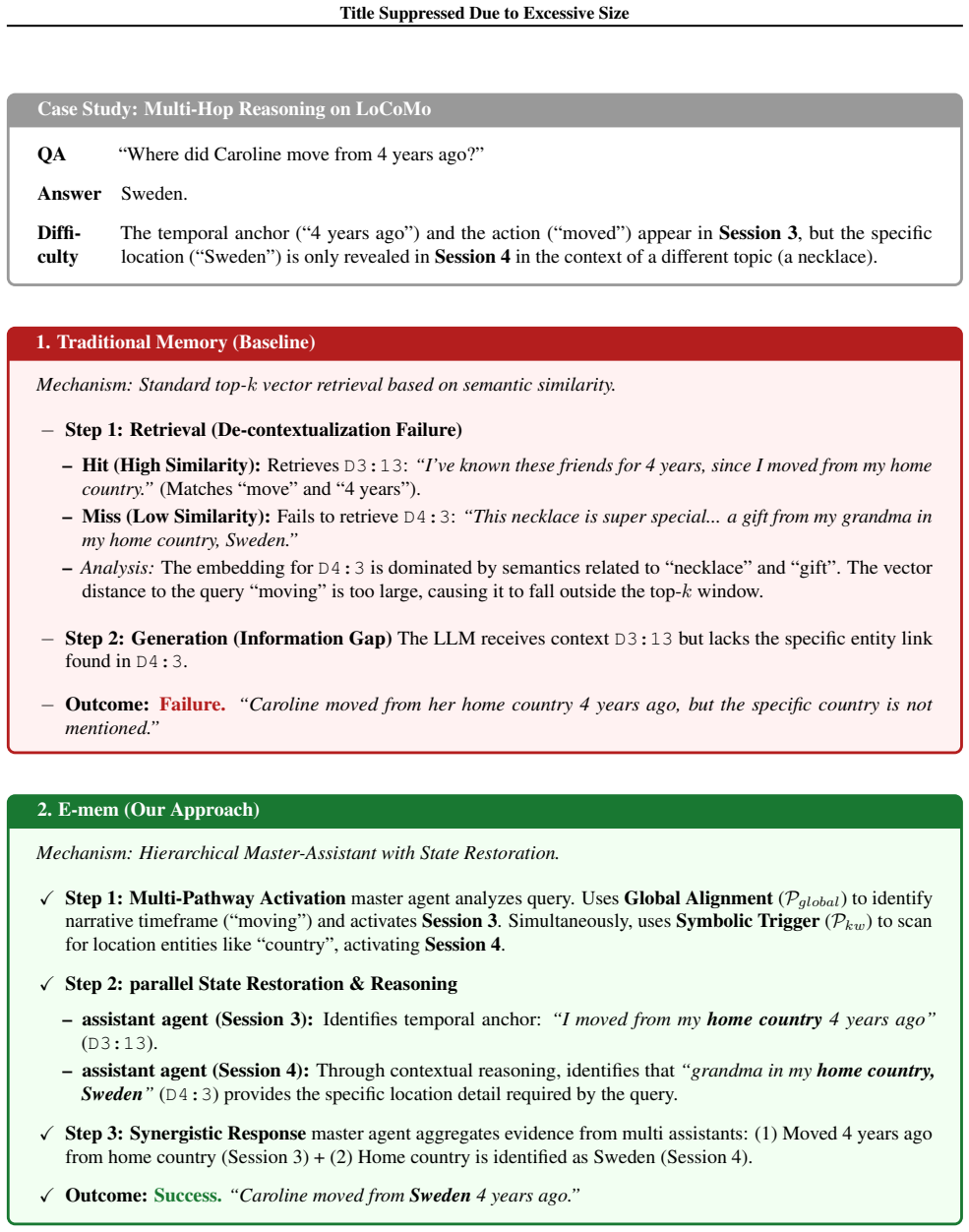
Traditional Memory (Baseline) Mechanism: Standard top-kvector retrieval based on semantic similarity. −Step 1: Retrieval (De-contextualization Failure) – Hit (High Similarity):Retrieves D3:13:“I’ve known these friends for 4 years, since I moved from my home country. ”(Matches “move” and “4 years”). – Miss (Low Similarity):Fails to retrieve D4:3:“This neck...
-
[9]
E-mem (Our Approach) Mechanism: Hierarchical Master-Assistant with State Restoration. ✓ Step 1: Multi-Pathway Activationmaster agent analyzes query. UsesGlobal Alignment( Pglobal) to identify narrative timeframe (“moving”) and activatesSession 3. Simultaneously, usesSymbolic Trigger( Pkw) to scan for location entities like “country”, activatingSession 4. ...
-
[10]
**NO HALLUCINATION:** If the answer is not in the memory, strictly state in ‘< model_reasoning>‘ that information is missing. Do not invent facts
-
[11]
**NO MODIFICATION:** In ‘<relevant_memories>‘, never change a single character of the source text
-
[12]
**NO OUTSIDE KNOWLEDGE:** Answer only based on the provided memory context. Do not use general world knowledge unless it helps interpret the text context. --- ### 4. ONE-SHOT EXAMPLE **Memory Context:** [2023-10-01 14:00] Alice: I put the red key in the top drawer. [2023-10-01 14:05] Bob: Okay, I will take the blue folder to the meeting. [2023-10-02 09:00...
work page 2023
discussion (0)
Sign in with ORCID, Apple, or X to comment. Anyone can read and Pith papers without signing in.