Recognition: no theorem link
CausalCompass: Evaluating the Robustness of Time-Series Causal Discovery in Misspecified Scenarios
Pith reviewed 2026-05-16 06:25 UTC · model grok-4.3
The pith
CausalCompass benchmark shows deep learning methods outperform others in time-series causal discovery when assumptions are violated.
A machine-rendered reading of the paper's core claim, the machinery that carries it, and where it could break.
Core claim
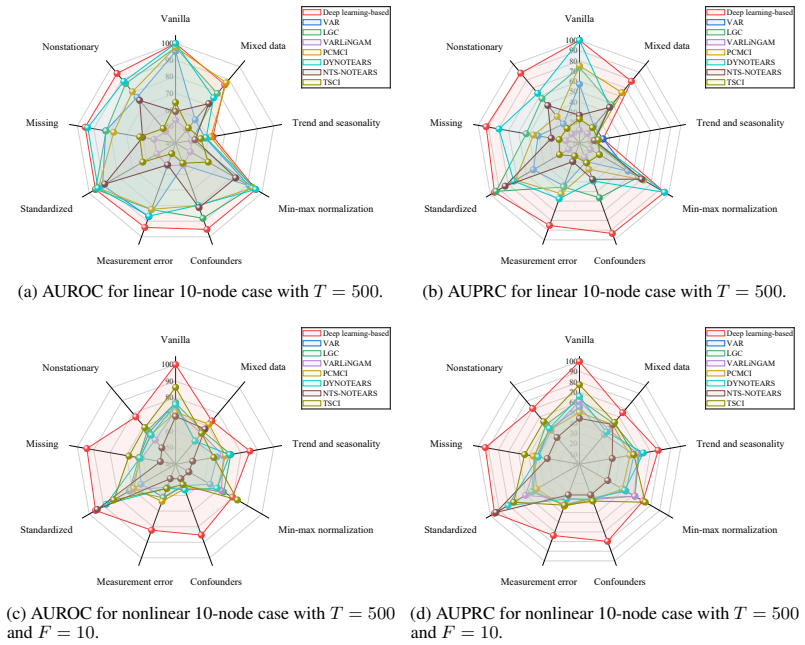
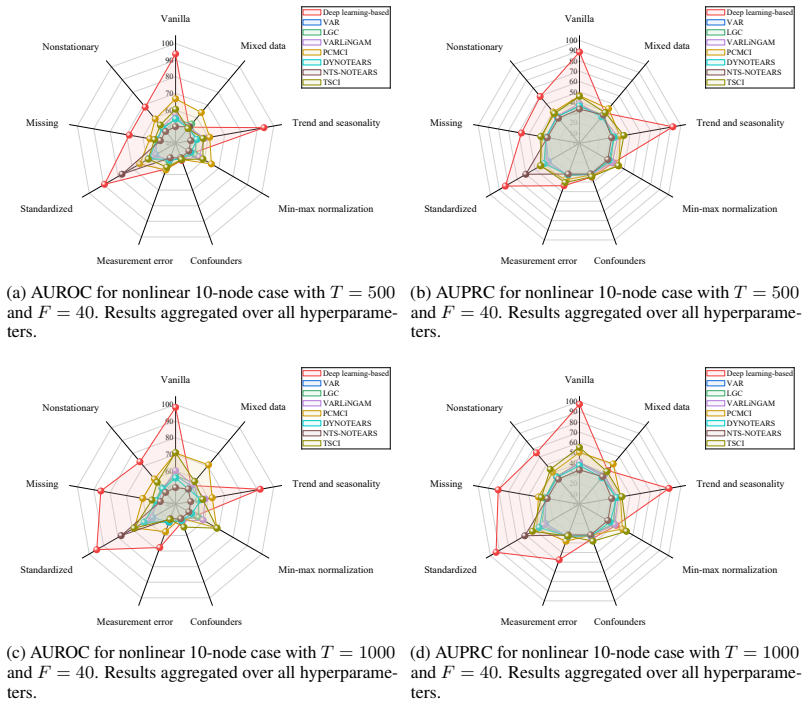
CausalCompass is a flexible benchmark framework for assessing the robustness of time-series causal discovery methods under violations of modeling assumptions. Experiments across eight scenarios show that no method attains optimal performance in all settings, yet deep learning-based approaches exhibit superior overall performance. The framework also reveals that NTS-NOTEARS depends heavily on standardized preprocessing and that ablation studies clarify the sources of deep learning strength under misspecification.
What carries the argument
CausalCompass, a benchmark that applies eight specific assumption-violation scenarios to representative time-series causal discovery algorithms and measures their performance.
If this is right
- Practitioners should favor deep learning methods when applying time-series causal discovery to data likely to violate standard assumptions.
- Hyperparameter sensitivity must be checked because performance rankings shift with different settings.
- Standardization preprocessing should be applied by default for methods like NTS-NOTEARS to avoid poor results in the unprocessed case.
- Future algorithm design should prioritize robustness mechanisms that deep learning appears to exploit under misspecification.
Where Pith is reading between the lines
- Combined violations occurring together in one dataset would be a natural next test to see whether the deep learning advantage persists.
- Adding real-world datasets with unknown violation patterns could validate whether the simulated scenarios predict actual performance.
- The flexibility of deep learning in capturing nonlinear dependencies may explain its edge and suggest targeted improvements for classical methods.
Load-bearing premise
The eight chosen assumption-violation scenarios adequately represent the range and severity of misspecifications that occur in real-world time-series data.
What would settle it
Observing that a non-deep-learning method achieves the highest average score across the eight scenarios on new or real-world datasets would challenge the claim of deep learning superiority.
Figures





read the original abstract
Causal discovery from time series is a fundamental task in machine learning. However, its widespread adoption is hindered by a reliance on untestable causal assumptions and by the lack of robustness-oriented evaluation in existing benchmarks. To address these challenges, we propose CausalCompass, a flexible and extensible benchmark framework designed to assess the robustness of time-series causal discovery (TSCD) methods under violations of modeling assumptions. To demonstrate the practical utility of CausalCompass, we conduct extensive benchmarking of representative TSCD algorithms across eight assumption-violation scenarios. Our experimental results indicate that no single method consistently attains optimal performance across all settings. Nevertheless, the methods exhibiting superior overall performance across diverse scenarios are almost invariably deep learning-based approaches. We further provide hyperparameter sensitivity analyses to deepen the understanding of these findings. We additionally conduct ablation experiments to explain the strong performance of deep learning-based methods under assumption violations. We also find, somewhat surprisingly, that NTS-NOTEARS relies heavily on standardized preprocessing in practice, performing poorly in the vanilla setting but exhibiting strong performance after standardization. Finally, our work aims to provide a comprehensive and systematic evaluation of TSCD methods under assumption violations, thereby facilitating their broader adoption in real-world applications. The user-friendly implementation, documentation and datasets are available at https://anonymous.4open.science/r/CausalCompass-anonymous-5B4F/.
Editorial analysis
A structured set of objections, weighed in public.
Referee Report
Summary. The paper introduces CausalCompass, a flexible benchmark framework for evaluating the robustness of time-series causal discovery (TSCD) methods under violations of standard modeling assumptions. Through benchmarking of representative algorithms across eight synthetic assumption-violation scenarios, the authors report that no single method is optimal in all cases, but deep learning-based approaches consistently show superior overall performance. The work includes hyperparameter sensitivity analyses, ablation studies to explain DL advantages, and a specific observation that NTS-NOTEARS performs poorly without standardization but strongly with it.
Significance. If the empirical rankings hold, CausalCompass provides a much-needed tool for systematic robustness assessment in TSCD, where untestable assumptions often limit practical adoption. The emphasis on open implementation, documentation, and datasets supports reproducibility and community use. The finding that DL methods are more resilient under misspecification could inform method selection in domains like finance and neuroscience, though this depends on the scenarios' fidelity to real data.
major comments (2)
- [Experimental Setup / Scenario Design] The headline claim that deep learning-based TSCD methods exhibit superior overall performance across diverse misspecified settings is load-bearing on the eight chosen violation scenarios being representative. The manuscript provides no quantitative validation (e.g., matching of statistical signatures such as nonlinearity strength or latent confounding levels) that these synthetic regimes align with misspecifications observed in real-world time-series from target domains.
- [Results and Discussion] The finding that NTS-NOTEARS relies heavily on standardized preprocessing (poor in vanilla setting, strong after standardization) is presented as surprising; this raises the question of whether preprocessing choices were uniformly applied across all methods, which could affect the fairness of the DL vs. non-DL ranking in § on results.
minor comments (1)
- [Abstract] The abstract states the repository link as anonymous; replace with a permanent DOI or GitHub link in the final version.
Simulated Author's Rebuttal
Thank you for the constructive feedback on our manuscript. We address each major comment below and outline the revisions we will make to strengthen the paper.
read point-by-point responses
-
Referee: [Experimental Setup / Scenario Design] The headline claim that deep learning-based TSCD methods exhibit superior overall performance across diverse misspecified settings is load-bearing on the eight chosen violation scenarios being representative. The manuscript provides no quantitative validation (e.g., matching of statistical signatures such as nonlinearity strength or latent confounding levels) that these synthetic regimes align with misspecifications observed in real-world time-series from target domains.
Authors: We thank the referee for this important observation. The eight scenarios were selected to represent common assumption violations from the TSCD literature (nonlinearity, latent confounding, non-stationarity, etc.) in a controlled manner. We did not perform quantitative statistical signature matching to specific real-world datasets, as the benchmark prioritizes synthetic control for isolating misspecification effects. In the revision we will expand the scenario design section with additional motivation and references to target domains (finance, neuroscience), explicitly acknowledge the synthetic nature of the regimes, and discuss limitations regarding real-world alignment. revision: partial
-
Referee: [Results and Discussion] The finding that NTS-NOTEARS relies heavily on standardized preprocessing (poor in vanilla setting, strong after standardization) is presented as surprising; this raises the question of whether preprocessing choices were uniformly applied across all methods, which could affect the fairness of the DL vs. non-DL ranking in § on results.
Authors: We confirm that preprocessing was applied uniformly across all methods. The vanilla setting uses raw data with no standardization, while the standardized setting applies z-score normalization consistently to every algorithm before model fitting. The NTS-NOTEARS result was obtained under these identical conditions. We will revise the results section to explicitly document the preprocessing pipeline, state that it was identical for all methods, and clarify the experimental settings to remove any ambiguity about fairness. revision: yes
Circularity Check
No circularity: purely empirical benchmarking on synthetic data
full rationale
The paper contains no mathematical derivation chain, first-principles predictions, or fitted parameters that are later renamed as outputs. It defines eight synthetic assumption-violation scenarios, generates data from them, runs existing TSCD algorithms (including DL-based ones), and reports performance metrics. All results are direct experimental measurements on the generated data; no step reduces by construction to a self-defined quantity or to a self-citation whose content is unverified. The central claim (DL methods show superior aggregate performance) is therefore an empirical observation, not a tautology. The representativeness of the eight scenarios is a separate validity question outside the scope of circularity analysis.
Axiom & Free-Parameter Ledger
axioms (1)
- domain assumption Standard causal assumptions such as no hidden confounders and correct model specification are frequently violated in practice.
Reference graph
Works this paper leans on
-
[1]
Wasim Ahmad, Maha Shadaydeh, and Joachim Denzler. Regime identification for improving causal analysis in non-stationary timeseries.arXiv preprint arXiv:2405.02315, 2024
-
[2]
Temporal causal modeling with graphical granger methods
Andrew Arnold, Yan Liu, and Naoki Abe. Temporal causal modeling with graphical granger methods. InProceedings of the 13th ACM SIGKDD international conference on Knowledge discovery and data mining, pages 66–75, 2007
work page 2007
-
[3]
Charles K Assaad, Emilie Devijver, and Eric Gaussier. Survey and evaluation of causal discovery methods for time series.Journal of Artificial Intelligence Research, 73:767–819, 2022
work page 2022
-
[4]
Andrew P Bradley. The use of the area under the roc curve in the evaluation of machine learning algorithms.Pattern recognition, 30(7):1145–1159, 1997
work page 1997
-
[5]
Kurt Butler, Daniel Waxman, and Petar Djuric. Tangent space causal inference: Leveraging vector fields for causal discovery in dynamical systems.Advances in Neural Information Processing Systems, 37:120078–120102, 2024
work page 2024
-
[6]
Triad constraints for learning causal structure of latent variables
Ruichu Cai, Feng Xie, Clark Glymour, Zhifeng Hao, and Kun Zhang. Triad constraints for learning causal structure of latent variables. InAdvances in Neural Information Processing Systems, volume 32, 2019
work page 2019
-
[7]
Causal discoveries for high dimensional mixed data.Statistics in Medicine, 41(24):4924–4940, 2022
Zhanrui Cai, Dong Xi, Xuan Zhu, and Runze Li. Causal discoveries for high dimensional mixed data.Statistics in Medicine, 41(24):4924–4940, 2022
work page 2022
-
[8]
Chris Chatfield and Haipeng Xing.The analysis of time series: an introduction with R. Chapman and hall/CRC, 2019
work page 2019
-
[9]
Jiawei Chen and Chunhui Zhao. Addressing information asymmetry: Deep temporal causal- ity discovery for mixed time series.IEEE Transactions on Pattern Analysis and Machine Intelligence, 2025
work page 2025
-
[10]
Neural ordinary differential equations.Advances in neural information processing systems, 31, 2018
Ricky TQ Chen, Yulia Rubanova, Jesse Bettencourt, and David K Duvenaud. Neural ordinary differential equations.Advances in neural information processing systems, 31, 2018
work page 2018
-
[11]
Cuts: Neural causal discovery from irregular time-series data.arXiv preprint arXiv:2302.07458, 2023
Yuxiao Cheng, Runzhao Yang, Tingxiong Xiao, Zongren Li, Jinli Suo, Kunlun He, and Qionghai Dai. Cuts: Neural causal discovery from irregular time-series data.arXiv preprint arXiv:2302.07458, 2023
-
[12]
Cuts+: High-dimensional causal discovery from irregular time-series
Yuxiao Cheng, Lianglong Li, Tingxiong Xiao, Zongren Li, Jinli Suo, Kunlun He, and Qionghai Dai. Cuts+: High-dimensional causal discovery from irregular time-series. InProceedings of the AAAI Conference on Artificial Intelligence, pages 11525–11533, 2024
work page 2024
-
[13]
Tianjiao Chu, Clark Glymour, and Greg Ridgeway. Search for additive nonlinear time series causal models.Journal of Machine Learning Research, 9(5), 2008
work page 2008
-
[14]
A seasonal-trend decomposition procedure based on loess (with discussion).J
STL Cleveland. A seasonal-trend decomposition procedure based on loess (with discussion).J. Off. Stat, 6(3), 1990
work page 1990
-
[15]
Copula pc algorithm for causal discovery from mixed data
Ruifei Cui, Perry Groot, and Tom Heskes. Copula pc algorithm for causal discovery from mixed data. InJoint European conference on machine learning and knowledge discovery in databases, pages 377–392. Springer, 2016
work page 2016
-
[16]
Haoyue Dai, Peter Spirtes, and Kun Zhang. Independence testing-based approach to causal discovery under measurement error and linear non-Gaussian models.Advances in Neural Information Processing Systems, 35:27524–27536, 2022. 10
work page 2022
-
[17]
The relationship between precision-recall and roc curves
Jesse Davis and Mark Goadrich. The relationship between precision-recall and roc curves. In Proceedings of the 23rd international conference on Machine learning, pages 233–240, 2006
work page 2006
-
[18]
On causal discovery from time series data using fci.Proba- bilistic graphical models, 16, 2010
Doris Entner and Patrik O Hoyer. On causal discovery from time series data using fci.Proba- bilistic graphical models, 16, 2010
work page 2010
-
[19]
Timegraph: Synthetic benchmark datasets for robust time-series causal discovery
Muhammad Hasan Ferdous, Emam Hossain, and Md Osman Gani. Timegraph: Synthetic benchmark datasets for robust time-series causal discovery. InProceedings of the 31st ACM SIGKDD Conference on Knowledge Discovery and Data Mining V . 2, pages 5425–5435, 2025
work page 2025
-
[20]
Ronja Foraita, Juliane Friemel, Kathrin Günther, Thomas Behrens, Jörn Bullerdiek, Rolf Nimzyk, Wolfgang Ahrens, and Vanessa Didelez. Causal discovery of gene regulation with incomplete data.Journal of the Royal Statistical Society Series A: Statistics in Society, 183(4): 1747–1775, 2020
work page 2020
-
[21]
Causal discovery for non-stationary non-linear time series data using just-in-time modeling
Daigo Fujiwara, Kazuki Koyama, Keisuke Kiritoshi, Tomomi Okawachi, Tomonori Izumitani, and Shohei Shimizu. Causal discovery for non-stationary non-linear time series data using just-in-time modeling. InConference on Causal Learning and Reasoning, pages 880–894. PMLR, 2023
work page 2023
-
[22]
MissDAG: Causal discovery in the presence of missing data with continuous additive noise models
Erdun Gao, Ignavier Ng, Mingming Gong, Li Shen, Wei Huang, Tongliang Liu, Kun Zhang, and Howard Bondell. MissDAG: Causal discovery in the presence of missing data with continuous additive noise models. InAdvances in Neural Information Processing Systems, volume 35, pages 5024–5038, 2022
work page 2022
-
[23]
Meta-d2ag: Causal graph learning with interventional dynamic data
Tian Gao, Songtao Lu, Junkyu Lee, Elliot Nelson, Debarun Bhattacharjya, Yue Yu, and Miao Liu. Meta-d2ag: Causal graph learning with interventional dynamic data. InThe Thirty-ninth Annual Conference on Neural Information Processing Systems, 2025
work page 2025
-
[24]
Andreas Gerhardus and Jakob Runge. High-recall causal discovery for autocorrelated time series with latent confounders.Advances in neural information processing systems, 33:12615–12625, 2020
work page 2020
-
[25]
Review of causal discovery methods based on graphical models.Frontiers in Genetics, 10:524, 2019
Clark Glymour, Kun Zhang, and Peter Spirtes. Review of causal discovery methods based on graphical models.Frontiers in Genetics, 10:524, 2019
work page 2019
-
[26]
Chang Gong, Chuzhe Zhang, Di Yao, Jingping Bi, Wenbin Li, and Yongjun Xu. Causal discovery from temporal data: An overview and new perspectives.ACM Computing Surveys, 57 (4):1–38, 2024
work page 2024
-
[27]
Clive WJ Granger. Investigating causal relations by econometric models and cross-spectral methods.Econometrica: journal of the Econometric Society, pages 424–438, 1969
work page 1969
-
[28]
Benjamin Herdeanu, Juan Nathaniel, Carla Roesch, Jatan Buch, Gregor Ramien, Johannes Haux, and Pierre Gentine. Causaldynamics: A large-scale benchmark for structural discovery of dynamical causal models.arXiv preprint arXiv:2505.16620, 2025
-
[29]
Identification of time-dependent causal model: A gaussian process treatment
Biwei Huang, Kun Zhang, and Bernhard Schölkopf. Identification of time-dependent causal model: A gaussian process treatment. InIJCAI, pages 3561–3568, 2015
work page 2015
-
[30]
Causal discovery and forecasting in nonstationary environments with state-space models
Biwei Huang, Kun Zhang, Mingming Gong, and Clark Glymour. Causal discovery and forecasting in nonstationary environments with state-space models. InInternational conference on machine learning, pages 2901–2910. Pmlr, 2019
work page 2019
-
[31]
Biwei Huang, Kun Zhang, Jiji Zhang, Joseph Ramsey, Ruben Sanchez-Romero, Clark Glymour, and Bernhard Schölkopf. Causal discovery from heterogeneous/nonstationary data.Journal of Machine Learning Research, 21(89):1–53, 2020
work page 2020
-
[32]
Causal discovery from subsampled time series data by constraint optimization
Antti Hyttinen, Sergey Plis, Matti Järvisalo, Frederick Eberhardt, and David Danks. Causal discovery from subsampled time series data by constraint optimization. InConference on Probabilistic Graphical Models, pages 216–227. PMLR, 2016
work page 2016
-
[33]
Aapo Hyvärinen, Kun Zhang, Shohei Shimizu, and Patrik O Hoyer. Estimation of a structural vector autoregression model using non-gaussianity.Journal of Machine Learning Research, 11 (5), 2010. 11
work page 2010
-
[34]
Efficient Causal Graph Discovery Using Large Language Models
Thomas Jiralerspong, Xiaoyin Chen, Yash More, Vedant Shah, and Yoshua Bengio. Efficient causal graph discovery using large language models.arXiv preprint arXiv:2402.01207, 2024
work page internal anchor Pith review Pith/arXiv arXiv 2024
-
[35]
Alireza Karimi and Mark R Paul. Extensive chaos in the lorenz-96 model.Chaos: An interdisciplinary journal of nonlinear science, 20(4), 2010
work page 2010
-
[36]
A logic for causal inference in time series with discrete and continuous variables
Samantha Kleinberg. A logic for causal inference in time series with discrete and continuous variables. InIJCAI Proceedings-International Joint Conference on Artificial Intelligence, volume 22, page 943, 2011
work page 2011
-
[37]
Yang Liu, Anthony C Constantinou, and Zhigao Guo. Improving bayesian network structure learning in the presence of measurement error.Journal of Machine Learning Research, 23(324): 1–28, 2022
work page 2022
-
[38]
Position: The causal revolution needs scientific pragmatism.arXiv preprint arXiv:2406.02275, 2024
Joshua Loftus. Position: The causal revolution needs scientific pragmatism.arXiv preprint arXiv:2406.02275, 2024
-
[39]
Robustness of algorithms for causal structure learning to hyperparameter choice
Damian Machlanski, Spyridon Samothrakis, and Paul S Clarke. Robustness of algorithms for causal structure learning to hyperparameter choice. InCausal Learning and Reasoning, pages 703–739. PMLR, 2024
work page 2024
-
[40]
Causal structure learning from multivariate time series in settings with unmeasured confounding
Daniel Malinsky and Peter Spirtes. Causal structure learning from multivariate time series in settings with unmeasured confounding. InProceedings of 2018 ACM SIGKDD workshop on causal discovery, pages 23–47. PMLR, 2018
work page 2018
-
[41]
Spacetime: Causal discovery from non-stationary time series
Sarah Mameche, Lénaïg Cornanguer, Urmi Ninad, and Jilles Vreeken. Spacetime: Causal discovery from non-stationary time series. InProceedings of the AAAI Conference on Artificial Intelligence, volume 39, pages 19405–19413, 2025
work page 2025
-
[42]
Riˇcards Marcinkevi ˇcs and Julia E V ogt. Interpretable models for granger causality using self-explaining neural networks.arXiv preprint arXiv:2101.07600, 2021
-
[43]
Assumption violations in causal discovery and the robustness of score matching
Francesco Montagna, Atalanti Mastakouri, Elias Eulig, Nicoletta Noceti, Lorenzo Rosasco, Dominik Janzing, Bryon Aragam, and Francesco Locatello. Assumption violations in causal discovery and the robustness of score matching. InAdvances in Neural Information Processing Systems, volume 36, 2023
work page 2023
-
[44]
Meike Nauta, Doina Bucur, and Christin Seifert. Causal discovery with attention-based convo- lutional neural networks.Machine Learning and Knowledge Extraction, 1(1):19, 2019
work page 2019
-
[45]
On the role of sparsity and DAG constraints for learning linear DAGs
Ignavier Ng, AmirEmad Ghassami, and Kun Zhang. On the role of sparsity and DAG constraints for learning linear DAGs. InAdvances in Neural Information Processing Systems, volume 33, pages 17943–17954, 2020
work page 2020
-
[46]
Structure learning with continuous optimization: A sober look and beyond
Ignavier Ng, Biwei Huang, and Kun Zhang. Structure learning with continuous optimization: A sober look and beyond. InCausal Learning and Reasoning, pages 71–105. PMLR, 2024
work page 2024
-
[47]
DYNOTEARS: Structure learning from time-series data
Roxana Pamfil, Nisara Sriwattanaworachai, Shaan Desai, Philip Pilgerstorfer, Konstantinos Georgatzis, Paul Beaumont, and Bryon Aragam. DYNOTEARS: Structure learning from time-series data. InInternational Conference on Artificial Intelligence and Statistics, pages 1595–1605. PMLR, 2020
work page 2020
-
[48]
Cambridge university press, 2009
Judea Pearl.Causality. Cambridge university press, 2009
work page 2009
-
[49]
Judea Pearl and Dana Mackenzie.The Book of Why: The New Science of Cause and Effect. Basic books, 2018
work page 2018
-
[50]
Jonas Peters, Dominik Janzing, and Bernhard Schölkopf.Elements of Causal Inference: Foundations and Learning Algorithms. The MIT Press, 2017
work page 2017
-
[51]
Audrey Poinsot, Panayiotis Panayiotou, Alessandro Leite, Nicolas Chesneau, Özgür ¸ Sim¸ sek, and Marc Schoenauer. Position: Causal machine learning requires rigorous synthetic experiments for broader adoption.arXiv preprint arXiv:2508.08883, 2025. 12
-
[52]
Vineet K Raghu, Joseph D Ramsey, Alison Morris, Dimitrios V Manatakis, Peter Sprites, Panos K Chrysanthis, Clark Glymour, and Panayiotis V Benos. Comparison of strategies for scalable causal discovery of latent variable models from mixed data.International journal of data science and analytics, 6(1):33–45, 2018
work page 2018
-
[53]
Beware of the simulated DAG! causal discovery benchmarks may be easy to game
Alexander Reisach, Christof Seiler, and Sebastian Weichwald. Beware of the simulated DAG! causal discovery benchmarks may be easy to game. InAdvances in Neural Information Processing Systems, volume 34, pages 27772–27784, 2021
work page 2021
-
[54]
Jakob Runge. Causal network reconstruction from time series: From theoretical assumptions to practical estimation.Chaos: An Interdisciplinary Journal of Nonlinear Science, 28(7), 2018
work page 2018
-
[55]
Jakob Runge. Discovering contemporaneous and lagged causal relations in autocorrelated nonlinear time series datasets. InConference on uncertainty in artificial intelligence, pages 1388–1397. Pmlr, 2020
work page 2020
-
[56]
Jakob Runge, Peer Nowack, Marlene Kretschmer, Seth Flaxman, and Dino Sejdinovic. Detecting and quantifying causal associations in large nonlinear time series datasets.Science advances, 5 (11):eaau4996, 2019
work page 2019
-
[57]
Causal inference for time series.Nature Reviews Earth & Environment, 4(7):487–505, 2023
Jakob Runge, Andreas Gerhardus, Gherardo Varando, Veronika Eyring, and Gustau Camps- Valls. Causal inference for time series.Nature Reviews Earth & Environment, 4(7):487–505, 2023
work page 2023
-
[58]
Agathe Sadeghi, Achintya Gopal, and Mohammad Fesanghary. Causal discovery from non- stationary time series.International Journal of Data Science and Analytics, 19(1):33–59, 2025
work page 2025
-
[59]
Measurement error and causal discovery
Richard Scheines and Joseph Ramsey. Measurement error and causal discovery. InCEUR workshop proceedings, volume 1792, page 1, 2017
work page 2017
-
[60]
Shohei Shimizu, Patrik O Hoyer, Aapo Hyvärinen, Antti Kerminen, and Michael Jordan. A linear non-Gaussian acyclic model for causal discovery.Journal of Machine Learning Research, 7(10), 2006
work page 2006
-
[61]
Ali Shojaie and Emily B Fox. Granger causality: A review and recent advances.Annual Review of Statistics and Its Application, 9(1):289–319, 2022
work page 2022
-
[62]
Peter Spirtes and Clark Glymour. An algorithm for fast recovery of sparse causal graphs.Social science computer review, 9(1):62–72, 1991
work page 1991
-
[63]
Peter Spirtes, Clark Glymour, and Richard Scheines.Causation, Prediction, and Search. MIT press, 2001
work page 2001
-
[64]
Gideon Stein, Maha Shadaydeh, Jan Blunk, Niklas Penzel, and Joachim Denzler. Causalrivers– scaling up benchmarking of causal discovery for real-world time-series.arXiv preprint arXiv:2503.17452, 2025
-
[65]
Gideon Stein, Niklas Penzel, Tristan Piater, and Joachim Denzler. TCD-arena: Assessing robustness of time series causal discovery methods against assumption violations. InThe Fourteenth International Conference on Learning Representations, 2026. URL https:// openreview.net/forum?id=MtdrOCLAGY
work page 2026
-
[66]
Detecting causality in complex ecosystems.science, 338(6106):496–500, 2012
George Sugihara, Robert May, Hao Ye, Chih-hao Hsieh, Ethan Deyle, Michael Fogarty, and Stephan Munch. Detecting causality in complex ecosystems.science, 338(6106):496–500, 2012
work page 2012
-
[67]
Xiangyu Sun, Oliver Schulte, Guiliang Liu, and Pascal Poupart. Nts-notears: Learning nonpara- metric dbns with prior knowledge.arXiv preprint arXiv:2109.04286, 2021
-
[68]
Detecting strange attractors in turbulence
Floris Takens. Detecting strange attractors in turbulence. InDynamical Systems and Turbulence, Warwick 1980: proceedings of a symposium held at the University of Warwick 1979/80, pages 366–381. Springer, 2006. 13
work page 1980
-
[69]
Alex Tank, Ian Covert, Nicholas Foti, Ali Shojaie, and Emily B Fox. Neural granger causality. IEEE Transactions on Pattern Analysis and Machine Intelligence, 44(8):4267–4279, 2021
work page 2021
-
[70]
Michail Tsagris, Giorgos Borboudakis, Vincenzo Lagani, and Ioannis Tsamardinos. Constraint- based causal discovery with mixed data.International journal of data science and analytics, 6 (1):19–30, 2018
work page 2018
-
[71]
Causal discovery in the presence of missing data
Ruibo Tu, Cheng Zhang, Paul Ackermann, Karthika Mohan, Hedvig Kjellström, and Kun Zhang. Causal discovery in the presence of missing data. InThe 22nd International Conference on Artificial Intelligence and Statistics, pages 1762–1770. PMLR, 2019
work page 2019
-
[72]
Yuhao Wang, Vlado Menkovski, Hao Wang, Xin Du, and Mykola Pechenizkiy. Causal discovery from incomplete data: a deep learning approach.arXiv preprint arXiv:2001.05343, 2020
-
[73]
Mixed causal structure discovery with application to prescriptive pricing
Wei Wenjuan, Feng Lu, and Liu Chunchen. Mixed causal structure discovery with application to prescriptive pricing. InProceedings of the 27th International Joint Conference on Artificial Intelligence, pages 5126–5134, 2018
work page 2018
-
[74]
Generalized independent noise condition for estimating latent variable causal graphs
Feng Xie, Ruichu Cai, Biwei Huang, Clark Glymour, Zhifeng Hao, and Kun Zhang. Generalized independent noise condition for estimating latent variable causal graphs. InAdvances in Neural Information Processing Systems, volume 33, pages 14891–14902, 2020
work page 2020
-
[75]
Causal discovery in linear latent variable models subject to measurement error
Yuqin Yang, AmirEmad Ghassami, Mohamed Nafea, Negar Kiyavash, Kun Zhang, and Ilya Shpitser. Causal discovery in linear latent variable models subject to measurement error. Advances in Neural Information Processing Systems, 35:874–886, 2022
work page 2022
-
[76]
Causal Discovery in Linear Models with Unobserved Variables and Measurement Error
Yuqin Yang, Mohamed Nafea, Negar Kiyavash, Kun Zhang, and AmirEmad Ghassami. Causal discovery in linear models with unobserved variables and measurement error.arXiv preprint arXiv:2407.19426, 2024
work page internal anchor Pith review Pith/arXiv arXiv 2024
-
[77]
The robustness of differentiable causal discovery in misspecified scenarios
Huiyang Yi, Yanyan He, Duxin Chen, Mingyu Kang, He Wang, and Wenwu Yu. The robustness of differentiable causal discovery in misspecified scenarios. InThe Thirteenth International Conference on Learning Representations, 2025
work page 2025
-
[78]
Causal discovery with missing data in a multicentric clinical study
Alessio Zanga, Alice Bernasconi, Peter JF Lucas, Hanny Pijnenborg, Casper Reijnen, Marco Scutari, and Fabio Stella. Causal discovery with missing data in a multicentric clinical study. In International Conference on Artificial Intelligence in Medicine, pages 40–44. Springer, 2023
work page 2023
-
[79]
Alessio Zanga, Alice Bernasconi, Peter JF Lucas, Hanny Pijnenborg, Casper Reijnen, Marco Scutari, and Anthony C Constantinou. Federated causal discovery with missing data in a multicentric study on endometrial cancer.Journal of biomedical informatics, page 104877, 2025
work page 2025
-
[80]
Causal discovery for linear mixed data
Yan Zeng, Shohei Shimizu, Hidetoshi Matsui, and Fuchun Sun. Causal discovery for linear mixed data. InConference on Causal Learning and Reasoning, pages 994–1009. PMLR, 2022
work page 2022
discussion (0)
Sign in with ORCID, Apple, or X to comment. Anyone can read and Pith papers without signing in.