Recognition: no theorem link
X-SYS: A Reference Architecture for Interactive Explanation Systems
Pith reviewed 2026-05-15 22:42 UTC · model grok-4.3
The pith
X-SYS is a reference architecture that connects interactive explanation user interfaces to backend system capabilities using STAR quality attributes and a five-component decomposition.
A machine-rendered reading of the paper's core claim, the machinery that carries it, and where it could break.
Core claim
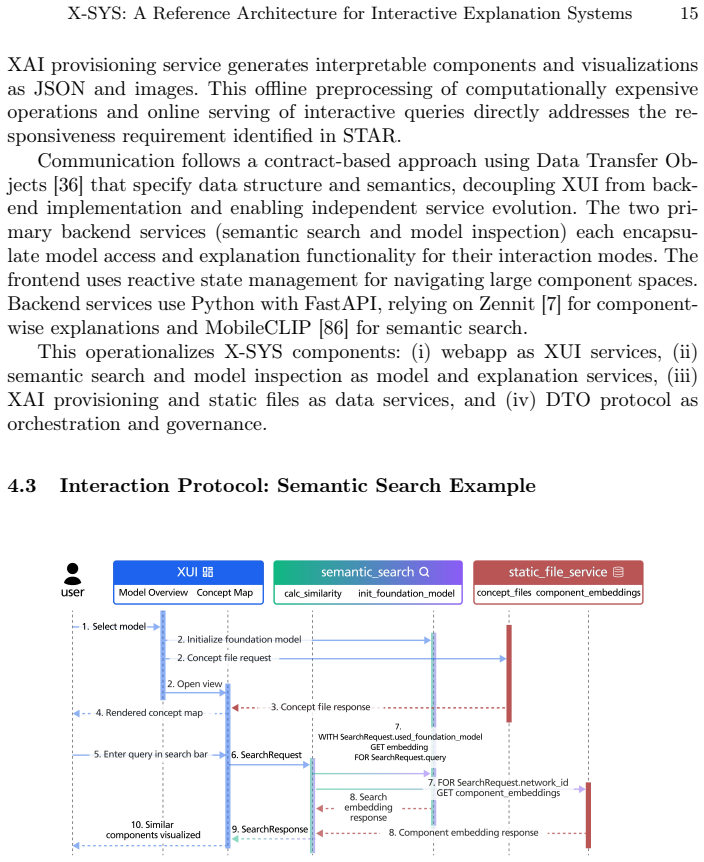
X-SYS is a reference architecture for interactive explanation systems organized around the STAR quality attributes of scalability, traceability, responsiveness, and adaptability. It specifies a five-component decomposition into XUI Services, Explanation Services, Model Services, Data Services, and Orchestration and Governance. By mapping interaction patterns to system capabilities, the architecture decouples user interface evolution from backend computation to support usability across repeated queries, evolving models and data, and governance constraints, as shown in the SemanticLens implementation for vision-language models.
What carries the argument
X-SYS reference architecture, which decomposes interactive explanation systems into five service components aligned with STAR quality attributes to map user interaction patterns to system capabilities and decouple interface evolution from backend computation.
If this is right
- Decoupling user interface evolution from backend computation enables independent updates to each part of the system.
- Contract-based service boundaries support offline and online separation to maintain responsiveness.
- Persistent state management across components ensures traceability of explanations over repeated queries.
- The architecture provides a reusable blueprint for end-to-end design of explanation systems under operational constraints.
- Systems built this way can continue to deliver usable explanations as models and data evolve.
Where Pith is reading between the lines
- The same component structure could be applied to explanation systems for other model types such as large language models to test whether the STAR attributes still suffice.
- Developers might combine X-SYS with existing monitoring tools to automatically enforce governance constraints across the five components.
- A practical test would involve measuring whether the decomposition reduces the time needed to add new interaction patterns without breaking existing services.
- The architecture suggests a path toward standardized interfaces between explanation tools and model serving platforms.
Load-bearing premise
The STAR quality attributes and five-component decomposition are sufficient to capture the system requirements induced by user interaction patterns across evolving models, data, and governance constraints.
What would settle it
An interactive explanation system that requires capabilities outside the STAR attributes or the five components to maintain usability when models or data change rapidly or when governance rules are updated.
Figures


read the original abstract
The explainable AI (XAI) research community has proposed numerous technical methods, yet deploying explainability as systems remains challenging: Interactive explanation systems require both suitable algorithms and system capabilities that maintain explanation usability across repeated queries, evolving models and data, and governance constraints. We argue that operationalizing XAI requires treating explainability as an information systems problem where user interaction demands induce specific system requirements. We introduce X-SYS, a reference architecture for interactive explanation systems, that guides (X)AI researchers, developers and practitioners in connecting interactive explanation user interfaces (XUI) with system capabilities. X-SYS organizes around four quality attributes named STAR (scalability, traceability, responsiveness, and adaptability), and specifies a five-component decomposition (XUI Services, Explanation Services, Model Services, Data Services, Orchestration and Governance). It maps interaction patterns to system capabilities to decouple user interface evolution from backend computation. We implement X-SYS through SemanticLens, a system for semantic search and activation steering in vision-language models. SemanticLens demonstrates how contract-based service boundaries enable independent evolution, offline/online separation ensures responsiveness, and persistent state management supports traceability. Together, this work provides a reusable blueprint and concrete instantiation for interactive explanation systems supporting end-to-end design under operational constraints.
Editorial analysis
A structured set of objections, weighed in public.
Referee Report
Summary. The paper claims to introduce X-SYS, a reference architecture for interactive explanation systems in XAI. It organizes the design around four STAR quality attributes (scalability, traceability, responsiveness, adaptability) and a five-component decomposition (XUI Services, Explanation Services, Model Services, Data Services, Orchestration and Governance). The architecture is said to map user interaction patterns (repeated queries, evolving models/data, governance constraints) to system capabilities in order to decouple UI evolution from backend computation, with a concrete demonstration in the SemanticLens system for semantic search and activation steering in vision-language models.
Significance. If the mapping and decoupling claims hold, the work supplies a reusable blueprint for treating explainability as an information-systems problem rather than isolated algorithms. The SemanticLens instantiation supplies concrete evidence of contract-based boundaries, offline/online separation for responsiveness, and persistent state for traceability, which strengthens the practical utility for researchers and practitioners facing operational constraints.
major comments (1)
- [X-SYS reference architecture] In the X-SYS architecture description, the STAR attributes and five-component decomposition are presented as systematically satisfying the requirements induced by the listed interaction patterns, yet no traceability matrix, bottom-up enumeration of patterns-to-components, or counter-example analysis is supplied to verify coverage and independence. This mapping is load-bearing for the central claim that the architecture decouples UI evolution from backend computation.
minor comments (2)
- [SemanticLens demonstration] In the SemanticLens implementation section, expand the description of the service contracts to include explicit interface definitions or pseudocode, which would improve reproducibility of the claimed independent evolution.
- [Introduction] The abstract states that interaction patterns 'induce' the STAR attributes; add a short paragraph clarifying whether these attributes were derived from prior literature, from the patterns themselves, or from both.
Simulated Author's Rebuttal
We thank the referee for the careful reading and for identifying a point where the central claim of X-SYS can be made more rigorous. We address the comment below and will revise the manuscript accordingly.
read point-by-point responses
-
Referee: [X-SYS reference architecture] In the X-SYS architecture description, the STAR attributes and five-component decomposition are presented as systematically satisfying the requirements induced by the listed interaction patterns, yet no traceability matrix, bottom-up enumeration of patterns-to-components, or counter-example analysis is supplied to verify coverage and independence. This mapping is load-bearing for the central claim that the architecture decouples UI evolution from backend computation.
Authors: We agree that an explicit traceability matrix would strengthen the verifiability of the mapping between interaction patterns and the STAR attributes / five-component decomposition. The current manuscript presents the mapping through narrative description and the SemanticLens instantiation, but does not supply a tabular enumeration or counter-example analysis. In the revised version we will add a dedicated subsection containing (1) a traceability matrix that lists each interaction pattern, the derived requirements, the responsible STAR attribute(s), and the primary component(s) that realize them; (2) a brief bottom-up enumeration showing how each pattern is covered; and (3) a short discussion of independence and potential edge cases. This addition will directly support the decoupling claim without altering the architecture itself. revision: yes
Circularity Check
No significant circularity detected in X-SYS reference architecture proposal
full rationale
The paper derives its X-SYS reference architecture directly from stated operational challenges (repeated queries, evolving models/data, governance constraints) and presents the STAR quality attributes plus five-component decomposition as a proposed organizing structure. No equations, fitted parameters, self-definitional reductions, or load-bearing self-citations appear in the abstract or described content. The mapping of interaction patterns to capabilities is offered as a design guideline rather than a result forced by prior inputs or author-specific uniqueness theorems. The architecture remains self-contained as an independent proposal for decoupling UI from backend services.
Axiom & Free-Parameter Ledger
axioms (1)
- domain assumption User interaction demands induce specific system requirements for explainability that can be met by a reference architecture.
invented entities (1)
-
X-SYS reference architecture
no independent evidence
Reference graph
Works this paper leans on
-
[1]
In: Proceedings ofthe2020CHIconferenceonhumanfactorsincomputingsystems.pp.1–14(2020)
Abdul, A., Von Der Weth, C., Kankanhalli, M., Lim, B.Y.: Cogam: measuring and moderating cognitive load in machine learning model explanations. In: Proceedings ofthe2020CHIconferenceonhumanfactorsincomputingsystems.pp.1–14(2020)
work page 2020
-
[2]
Nature Machine Intelligence5(9), 1006– 1019 (2023)
Achtibat, R., Dreyer, M., Eisenbraun, I., Bosse, S., Wiegand, T., Samek, W., Lapuschkin, S.: From attribution maps to human-understandable explanations through concept relevance propagation. Nature Machine Intelligence5(9), 1006– 1019 (2023)
work page 2023
-
[3]
Adhikari, A., Wenink, E., Van Der Waa, J., Bouter, C., Tolios, I., Raaijmakers, S.: Towards fair explainable ai: A standardized ontology for mapping xai solutions to use cases, explanations, and ai systems. In: Proceedings of the 15th International Conference on PErvasive Technologies Related to Assistive Environments. pp. 562– 568 (2022)
work page 2022
-
[4]
In: Proceedings of the 25th international conference on intelligent user interfaces
Alqaraawi, A., Schuessler, M., Weiß, P., Costanza, E., Berthouze, N.: Evaluating saliency map explanations for convolutional neural networks: a user study. In: Proceedings of the 25th international conference on intelligent user interfaces. pp. 275–285 (2020)
work page 2020
-
[5]
Neurocom- puting5(4), 185–196 (1993)
Amari, S.i.: Backpropagation and stochastic gradient descent method. Neurocom- puting5(4), 185–196 (1993)
work page 1993
-
[6]
In: Proceedings of the 2019 chi conference on human factors in computing systems
Amershi, S., Weld, D., Vorvoreanu, M., Fourney, A., Nushi, B., Collisson, P., Suh, J., Iqbal, S., Bennett, P.N., Inkpen, K., et al.: Guidelines for human-ai interaction. In: Proceedings of the 2019 chi conference on human factors in computing systems. pp. 1–13 (2019) X-SYS: A Reference Architecture for Interactive Explanation Systems 19
work page 2019
-
[7]
PLOS ONE21(1), e0336683 (2026)
Anders, C.J., Neumann, D., Samek, W., Müller, K.R., Lapuschkin, S.: Software for dataset-wide XAI: From local explanations to global insights with zennit, CoRe- lAy, and ViRelAy. PLOS ONE21(1), e0336683 (2026). https://doi.org/10.1371/ journal.pone.0336683, publisher: Public Library of Science
work page 2026
-
[8]
Arya, V., Bellamy, R.K., Chen, P.Y., Dhurandhar, A., Hind, M., Hoffman, S.C., Houde, S., Liao, Q.V., Luss, R., Mojsilović, A., et al.: Ai explainability 360 toolkit. In: Proceedings of the 3rd ACM India joint international conference on data science & management of data (8th ACM IKDD CODS & 26th COMAD). pp. 376–379 (2021)
work page 2021
-
[9]
Aslam, M.: A user centric approach to explainable artificial intel- ligence in industry. https://doi.org/10.26174/thesis.lboro.27967914.v1, https://repository.lboro.ac.uk/articles/thesis/A_user_centric_approach_to_ explainable_Artificial_Intelligence_in_industry/27967914/1
-
[10]
PloS one10(7), e0130140 (2015)
Bach, S., Binder, A., Montavon, G., Klauschen, F., Müller, K.R., Samek, W.: On pixel-wise explanations for non-linear classifier decisions by layer-wise relevance propagation. PloS one10(7), e0130140 (2015)
work page 2015
-
[11]
In: Proceed- ings of the AAAI conference on human computation and crowdsourcing
Bansal, G., Nushi, B., Kamar, E., Lasecki, W.S., Weld, D.S., Horvitz, E.: Beyond accuracy: The role of mental models in human-ai team performance. In: Proceed- ings of the AAAI conference on human computation and crowdsourcing. vol. 7, pp. 2–11 (2019)
work page 2019
-
[12]
RFC 6265, Internet Engineering Task Force (Apr 2011), https://www.rfc-editor.org/rfc/rfc6265
Barth, A.: HTTP state management mechanism. RFC 6265, Internet Engineering Task Force (Apr 2011), https://www.rfc-editor.org/rfc/rfc6265
work page 2011
-
[13]
Bass, L., Clements, P., Kazman, R.: Software Architecture in Practice. Addison- Wesley, 3rd edn. (2012)
work page 2012
-
[14]
In: Proceedings of the IEEE conference on computer vision and pattern recognition
Bau, D., Zhou, B., Khosla, A., Oliva, A., Torralba, A.: Network dissection: Quan- tifying interpretability of deep visual representations. In: Proceedings of the IEEE conference on computer vision and pattern recognition. pp. 6541–6549 (2017)
work page 2017
-
[15]
Frontiers in big Data4, 688969 (2021)
Belle, V., Papantonis, I.: Principles and practice of explainable machine learning. Frontiers in big Data4, 688969 (2021)
work page 2021
-
[16]
In: Proceedings of the 2020 conference on fairness, accountability, and transparency
Bhatt, U., Xiang, A., Sharma, S., Weller, A., Taly, A., Jia, Y., Ghosh, J., Puri, R., Moura, J.M., Eckersley, P.: Explainable machine learning in deployment. In: Proceedings of the 2020 conference on fairness, accountability, and transparency. pp. 648–657 (2020)
work page 2020
-
[17]
microservice archi- tecture: A performance and scalability evaluation
Blinowski, G., Ojdowska, A., Przybyłek, A.: Monolithic vs. microservice archi- tecture: A performance and scalability evaluation. IEEE access10, 20357–20374 (2022)
work page 2022
-
[18]
In: Proceedings of the 2024 CHI Conference on Human Factors in Computing Systems
Bo, J.Y., Hao, P., Lim, B.Y.: Incremental xai: Memorable understanding of ai with incremental explanations. In: Proceedings of the 2024 CHI Conference on Human Factors in Computing Systems. pp. 1–17 (2024)
work page 2024
-
[19]
In: Proceedings of the 28th International Conference on Intelligent User Interfaces
Bove, C.,Lesot,M.J., Tijus,C.A., Detyniecki,M.:Investigating theintelligibilityof plural counterfactual examples for non-expert users: an explanation user interface proposition and user study. In: Proceedings of the 28th International Conference on Intelligent User Interfaces. pp. 188–203 (2023)
work page 2023
-
[20]
Military review 82(6), 3–9 (2002)
Brewster, F.W.: Using tactical decision exercises to study tactics. Military review 82(6), 3–9 (2002)
work page 2002
-
[21]
Computers in Biology and Medicine180, 108908 (2024)
Cálem, J., Moreira, C., Jorge, J.: Intelligent systems in healthcare: A systematic survey of explainable user interfaces. Computers in Biology and Medicine180, 108908 (2024)
work page 2024
-
[22]
Computers & Security111, 102472 (2021)
Calzavara, S., Jonker, H., Krumnow, B., Rabitti, A.: Measuring web session secu- rity at scale. Computers & Security111, 102472 (2021). https://doi.org/10.1016/ j.cose.2021.102472 20 Labarta et al
-
[23]
In: IFIP Conference on Human-Computer Interaction
Chromik, M., Butz, A.: Human-xai interaction: a review and design principles for explanation user interfaces. In: IFIP Conference on Human-Computer Interaction. pp. 619–640. Springer (2021)
work page 2021
-
[24]
Systems Engineering13(1), 14–27 (2010)
Cloutier, R., Muller, G., Verma, D., Nilchiani, R., Hole, E., Bone, M.: The concept of reference architectures. Systems Engineering13(1), 14–27 (2010)
work page 2010
- [25]
-
[26]
arXiv preprint arXiv:2006.11371 (2020)
Das, A., Rad, P.: Opportunities and challenges in explainable artificial intelligence (xai): A survey. arXiv preprint arXiv:2006.11371 (2020)
-
[27]
In: Proceedings of the 2021 ACM Designing Interactive Systems Conference
Dhanorkar, S., Wolf, C.T., Qian, K., Xu, A., Popa, L., Li, Y.: Who needs to know what, when?: Broadening the explainable ai (xai) design space by looking at explanations across the ai lifecycle. In: Proceedings of the 2021 ACM Designing Interactive Systems Conference. pp. 1591–1602 (2021)
work page 2021
-
[28]
Towards A Rigorous Science of Interpretable Machine Learning
Doshi-Velez,F.,Kim,B.:Towardsarigorousscienceofinterpretablemachinelearn- ing. arXiv preprint arXiv:1702.08608 (2017)
work page internal anchor Pith review Pith/arXiv arXiv 2017
-
[29]
Nature Machine Intelligence pp
Dreyer, M., Berend, J., Labarta, T., Vielhaben, J., Wiegand, T., Lapuschkin, S., Samek, W.: Mechanistic understanding and validation of large ai models with semanticlens. Nature Machine Intelligence pp. 1–14 (2025)
work page 2025
-
[30]
Proceedings of the ACM on human-computer interaction7(CSCW1), 1–32 (2023)
Ehsan, U., Saha, K., De Choudhury, M., Riedl, M.O.: Charting the sociotechnical gap in explainable ai: A framework to address the gap in xai. Proceedings of the ACM on human-computer interaction7(CSCW1), 1–32 (2023)
work page 2023
-
[31]
Elbagoury, B.M., Vladareanu, L., Vlădăreanu, V., Salem, A.B., Travediu, A.M., Roushdy, M.I.: A hybrid stacked cnn and residual feedback gmdh-lstm deep learn- ing model for stroke prediction applied on mobile ai smart hospital platform. Sen- sors23(7), 3500 (2023)
work page 2023
-
[32]
European Parliament and Council: Regulation (EU) 2024/1689 of the European Parliament and of the Council of 13 June 2024 laying down harmonised rules on artificial intelligence and amending Regulations (EC) no 300/2008, (EU) no 167/2013, (EU) no 168/2013, (EU) 2018/858, (EU) 2018/1139 and (EU) 2019/2144 and Directive (eu) 2020/1828 (2024), http://data.eur...
work page 2024
-
[33]
Future Generation Computer Systems133, 281–296 (2022)
Evans, T., Retzlaff, C.O., Geißler, C., Kargl, M., Plass, M., Müller, H., Kiehl, T.R., Zerbe, N., Holzinger, A.: The explainability paradox: Challenges for xai in digital pathology. Future Generation Computer Systems133, 281–296 (2022)
work page 2022
-
[34]
Theory, Culture & Society38(7), 55–77 (2021-12)
Fazi, M.B.: Beyond human: Deep learning, explainability and representation. Theory, Culture & Society38(7), 55–77 (2021-12). https://doi.org/10.1177/ 0263276420966386
work page 2021
-
[35]
Fielding, R.T.: Architectural Styles and the Design of Network-based Software Architectures (2000), https://ics.uci.edu/~fielding/pubs/dissertation/top.htm
work page 2000
-
[36]
Fowler, M.: Patterns of enterprise application architecture. Addison-Wesley (2012)
work page 2012
-
[37]
In: International Conference on Advanced Information Systems Engineering
Füßl, A., Nissen, V., Heringklee, S.H.: An explanation user interface for a knowl- edge graph-based xai approach to process analysis. In: International Conference on Advanced Information Systems Engineering. pp. 72–84. Springer (2024)
work page 2024
-
[38]
In: World Conference on Explainable Artificial Intelligence
Gallée, L., Lisson, C.S., Lisson, C.G., Drees, D., Weig, F., Vogele, D., Beer, M., Götz, M.: Evaluating the explainability of attributes and prototypes for a medical classification model. In: World Conference on Explainable Artificial Intelligence. pp. 43–56. Springer (2024)
work page 2024
-
[39]
In: Joint European Conference on Machine Learning and Knowledge Discovery in Databases
Garofalo, M., Fantini, A., Pellugrini, R., Pilato, G., Villari, M., Giannotti, F.: Conversational xai: Formalizing its basic design principles. In: Joint European Conference on Machine Learning and Knowledge Discovery in Databases. pp. 295–
-
[40]
Springer (2023) X-SYS: A Reference Architecture for Interactive Explanation Systems 21
work page 2023
-
[41]
Qualitatively characterizing neural network optimization problems
Goodfellow, I.J., Vinyals, O., Saxe, A.M.: Qualitatively characterizing neural net- work optimization problems. arXiv preprint arXiv:1412.6544 (2014)
work page internal anchor Pith review Pith/arXiv arXiv 2014
-
[42]
Goodman, B., Flaxman, S.: European union regulations on algorithmic decision- making and a “right to explanation”. AI magazine38(3), 50–57 (2017)
work page 2017
-
[43]
Gregor, S., Benbasat, I.: Explanations from intelligent systems: Theoretical foun- dations and implications for practice. MIS quarterly pp. 497–530 (1999)
work page 1999
-
[44]
Data Mining and Knowledge Discovery38(5), 2770–2824 (2024)
Guidotti, R.: Counterfactual explanations and how to find them: literature re- view and benchmarking. Data Mining and Knowledge Discovery38(5), 2770–2824 (2024)
work page 2024
-
[45]
Guidotti, R., Monreale, A., Ruggieri, S., Turini, F., Giannotti, F., Pedreschi, D.: A Survey of Methods for Explaining Black Box Models. ACM Comput. Surv.51(5), 93:1–93:42 (Aug 2018). https://doi.org/10.1145/3236009
-
[46]
AI magazine40(2), 44–58 (2019)
Gunning, D., Aha, D.: Darpa’s explainable artificial intelligence (xai) program. AI magazine40(2), 44–58 (2019)
work page 2019
-
[47]
Frontiers in Artificial Intelligence7, 1471208 (2024)
Haas, S., Hegestweiler, K., Rapp, M., Muschalik, M., Hüllermeier, E.: Stakeholder- centric explanations for black-box decisions: an xai process model and its appli- cation to automotive goodwill assessments. Frontiers in Artificial Intelligence7, 1471208 (2024)
work page 2024
-
[48]
Hachi, S., Sabri, A.: Development of an explainable ai (xai) system for the in- terpretation of vit in the diagnosis of medical images. In: 2024 3rd International ConferenceonEmbeddedSystemsandArtificialIntelligence(ESAI).pp.1–8.IEEE (2024)
work page 2024
-
[49]
Journal of Machine Learning Research24(34), 1–11 (2023)
Hedström, A., Weber, L., Krakowczyk, D., Bareeva, D., Motzkus, F., Samek, W., Lapuschkin, S., Höhne, M.M.C.: Quantus: An explainable ai toolkit for respon- sible evaluation of neural network explanations and beyond. Journal of Machine Learning Research24(34), 1–11 (2023)
work page 2023
-
[50]
Digital Health11, 20552076241308298 (2025)
Jung, I.C., Schuler, K., Zerlik, M., Grummt, S., Sedlmayr, M., Sedlmayr, B.: Overview of basic design recommendations for user-centered explanation interfaces for ai-based clinical decision support systems: A scoping review. Digital Health11, 20552076241308298 (2025)
work page 2025
-
[51]
In: International conference on machine learning
Kim, B., Wattenberg, M., Gilmer, J., Cai, C., Wexler, J., Viegas, F., et al.: Inter- pretabilitybeyondfeatureattribution:Quantitativetestingwithconceptactivation vectors (tcav). In: International conference on machine learning. pp. 2668–2677. PMLR (2018)
work page 2018
-
[52]
In- ternational Journal of Human-Computer Studies181, 103160 (2024)
Kim, M., Kim, S., Kim, J., Song, T.J., Kim, Y.: Do stakeholder needs differ?- designing stakeholder-tailored explainable artificial intelligence (xai) interfaces. In- ternational Journal of Human-Computer Studies181, 103160 (2024)
work page 2024
-
[53]
Kim, S.S., Watkins, E.A., Russakovsky, O., Fong, R., Monroy-Hernández, A.: "help me help the ai": Understanding how explainability can support human-ai interac- tion. In: proceedings of the 2023 CHI conference on human factors in computing systems. pp. 1–17 (2023)
work page 2023
-
[54]
arXiv preprint arXiv:2009.07896 (2020)
Kokhlikyan, N., Miglani, V., Martin, M., Wang, E., Alsallakh, B., Reynolds, J., Melnikov, A., Kliushkina, N., Araya, C., Yan, S., et al.: Captum: A unified and generic model interpretability library for pytorch. arXiv preprint arXiv:2009.07896 (2020)
-
[55]
Kumara, I., Arts, R., Di Nucci, D., Van Den Heuvel, W.J., Tamburri, D.A.: Re- quirements and reference architecture for mlops: insights from industry. Authorea Preprints (2023)
work page 2023
-
[56]
stakeholder perspective on xai and a conceptual model guiding interdisciplinary xai research
Langer, M., Oster, D., Speith, T., Hermanns, H., Kästner, L., Schmidt, E., Sesing, A., Baum, K.: What do we want from explainable artificial intelligence (xai)?–a 22 Labarta et al. stakeholder perspective on xai and a conceptual model guiding interdisciplinary xai research. Artificial intelligence296, 103473 (2021)
work page 2021
-
[57]
Nature communications10(1), 1096 (2019)
Lapuschkin, S., Wäldchen, S., Binder, A., Montavon, G., Samek, W., Müller, K.R.: Unmasking clever hans predictors and assessing what machines really learn. Nature communications10(1), 1096 (2019)
work page 2019
-
[58]
In: International Conference on Human-Computer Interaction
Lei, D., He, Y., Zeng, J.: What is the focus of xai in ui design? prioritizing ui design principles for enhancing xai user experience. In: International Conference on Human-Computer Interaction. pp. 219–237. Springer (2024)
work page 2024
-
[59]
arXiv preprint arXiv:2202.11452 (2022)
Leventi-Peetz, A.M., Östreich, T.: Deep learning reproducibility and explainable ai (xai). arXiv preprint arXiv:2202.11452 (2022)
-
[60]
In: Proceedings of the 2020 CHI conference on human factors in computing systems
Liao, Q.V., Gruen, D., Miller, S.: Questioning the ai: informing design practices for explainable ai user experiences. In: Proceedings of the 2020 CHI conference on human factors in computing systems. pp. 1–15 (2020)
work page 2020
-
[61]
arXiv preprint arXiv:2302.01241 (2023)
Lim, B.Y., Cahaly, J.P., Sng, C.Y., Chew, A.: Diagrammatization: Rationalizing with diagrammatic ai explanations for abductive reasoning on hypotheses. arXiv preprint arXiv:2302.01241 (2023)
-
[62]
ACM computing surveys55(9), 1–35 (2023)
Liu, P., Yuan, W., Fu, J., Jiang, Z., Hayashi, H., Neubig, G.: Pre-train, prompt, and predict: A systematic survey of prompting methods in natural language processing. ACM computing surveys55(9), 1–35 (2023)
work page 2023
-
[63]
Applied Sciences12(19), 9423 (2022)
Lopes, P., Silva, E., Braga, C., Oliveira, T., Rosado, L.: Xai systems evaluation: A review of human and computer-centred methods. Applied Sciences12(19), 9423 (2022)
work page 2022
-
[64]
Advances in neural information processing systems30(2017)
Lundberg, S.M., Lee, S.I.: A unified approach to interpreting model predictions. Advances in neural information processing systems30(2017)
work page 2017
-
[65]
UMAP: Uniform Manifold Approximation and Projection for Dimension Reduction
McInnes, L., Healy, J., Melville, J.: Umap: Uniform manifold approximation and projection for dimension reduction. arXiv preprint arXiv:1802.03426 (2018)
work page internal anchor Pith review Pith/arXiv arXiv 2018
-
[66]
Information systems management39(1), 53–63 (2022)
Meske, C., Bunde, E., Schneider, J., Gersch, M.: Explainable artificial intelligence: objectives, stakeholders, and future research opportunities. Information systems management39(1), 53–63 (2022)
work page 2022
-
[67]
In: 2021 IEEE/ACM 1st Workshop on AI Engineering- Software Engineering for AI (WAIN)
Muccini, H., Vaidhyanathan, K.: Software architecture for ml-based systems: What exists and what lies ahead. In: 2021 IEEE/ACM 1st Workshop on AI Engineering- Software Engineering for AI (WAIN). pp. 121–128. IEEE (2021)
work page 2021
-
[68]
arXiv preprint arXiv:2410.19856 (2024)
Narayanan, A., Bergen, K.J.: Prototype-based methods in explainable ai and emerging opportunities in the geosciences. arXiv preprint arXiv:2410.19856 (2024)
-
[69]
Nielsen, J.: Response times: the three important limits. Usability Engineering (1993)
work page 1993
-
[70]
ICT Express11(1), 135–148 (2025)
Nikiforidis, K., Kyrtsoglou, A., Vafeiadis, T., Kotsiopoulos, T., Nizamis, A., Ioan- nidis, D., Votis, K., Tzovaras, D., Sarigiannidis, P.: Enhancing transparency and trust in AI-powered manufacturing: A survey of explainable AI (XAI) applications in smart manufacturing in the era of industry 4.0/5.0. ICT Express11(1), 135–148 (2025). https://doi.org/10.1...
-
[71]
ACM Transactions on Interactive Intelli- gent Systems12(4), 1–29 (2022)
Nourani, M., Roy, C., Block, J.E., Honeycutt, D.R., Rahman, T., Ragan, E.D., Gogate, V.: On the importance of user backgrounds and impressions: Lessons learned from interactive ai applications. ACM Transactions on Interactive Intelli- gent Systems12(4), 1–29 (2022)
work page 2022
-
[72]
Nwakanma, C.I., Ahakonye, L.A.C., Jun, T., Lee, J.M., Kim, D.S.: Explainable scada-edge network intrusion detection system: Tree-lime approach. In: 2023 IEEE International Conference on Communications, Control, and Computing Technolo- gies for Smart Grids (SmartGridComm). pp. 1–7. IEEE (2023) X-SYS: A Reference Architecture for Interactive Explanation Systems 23
work page 2023
-
[73]
Journal of Big Data 7(1), 25 (2020)
Pääkkönen, P., Pakkala, D.: Extending reference architecture of big data systems towards machine learning in edge computing environments. Journal of Big Data 7(1), 25 (2020)
work page 2020
-
[74]
Procedia CIRP115, 130–135 (2022)
Raffin, T., Reichenstein, T., Werner, J., Kühl, A., Franke, J.: A reference archi- tecture for the operationalization of machine learning models in manufacturing. Procedia CIRP115, 130–135 (2022)
work page 2022
-
[75]
In: Proceedings of the 2020 conference on fairness, accountability, and transparency
Raji, I.D., Smart, A., White, R.N., Mitchell, M., Gebru, T., Hutchinson, B., Smith- Loud, J., Theron, D., Barnes, P.: Closing the ai accountability gap: Defining an end-to-end framework for internal algorithmic auditing. In: Proceedings of the 2020 conference on fairness, accountability, and transparency. pp. 33–44 (2020)
work page 2020
-
[76]
Ribeiro, M.T., Singh, S., Guestrin, C.: " why should i trust you?" explaining the predictions of any classifier. In: Proceedings of the 22nd ACM SIGKDD interna- tional conference on knowledge discovery and data mining. pp. 1135–1144 (2016)
work page 2016
-
[77]
Proceed- ings of the IEEE109(3), 247–278 (2021)
Samek, W., Montavon, G., Lapuschkin, S., Anders, C.J., Müller, K.R.: Explaining deep neural networks and beyond: A review of methods and applications. Proceed- ings of the IEEE109(3), 247–278 (2021)
work page 2021
-
[78]
ACM Transactions on Interactive Intelligent Systems (TiiS)10(4), 1–31 (2020)
Shneiderman, B.: Bridging the gap between ethics and practice: guidelines for reliable, safe, and trustworthy human-centered ai systems. ACM Transactions on Interactive Intelligent Systems (TiiS)10(4), 1–31 (2020)
work page 2020
-
[79]
Agents, innovation, and transformation
Singla, A., Sukharevsky, A., Yee, L., Chui, M., Hall, B.: The state of ai. Agents, innovation, and transformation. Publisher: McKinsey (2025)
work page 2025
-
[80]
In: Proceedings of Mensch und Computer 2023
Sipos, L., Schäfer, U., Glinka, K., Müller-Birn, C.: Identifying explanation needs of end-users: Applying and extending the xai question bank. In: Proceedings of Mensch und Computer 2023. pp. 492–497 (2023)
work page 2023
discussion (0)
Sign in with ORCID, Apple, or X to comment. Anyone can read and Pith papers without signing in.