BEAGLE: Behavior-Enforced Agent for Grounded Learner Emulation
Pith reviewed 2026-05-16 07:05 UTC · model grok-4.3
The pith
BEAGLE creates simulated student learning behaviors in programming that are indistinguishable from real novice data in human tests.
A machine-rendered reading of the paper's core claim, the machinery that carries it, and where it could break.
Core claim
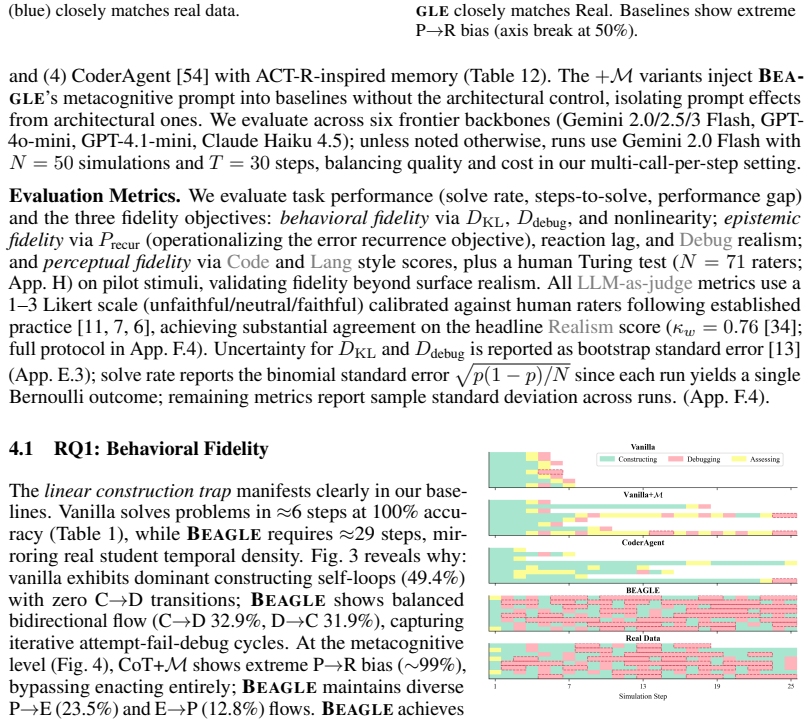
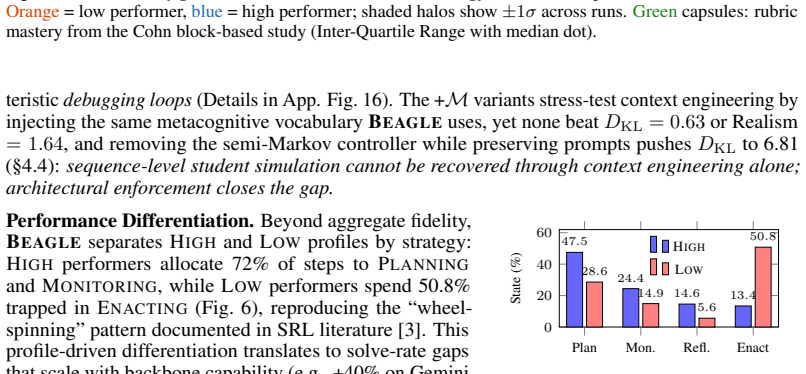
BEAGLE integrates a semi-Markov model for behavior timing and transitions, Bayesian Knowledge Tracing with flaw injection to enforce realistic knowledge gaps, and a decoupled agent design that separates strategy use from code actions. On Python programming tasks this produces trajectories that participants in a human Turing test could not reliably distinguish from real student data, yielding classification accuracy statistically equivalent to chance at 52.8 percent.
What carries the argument
The neuro-symbolic architecture that combines a semi-Markov model for cognitive and metacognitive behavior transitions, flaw-injected Bayesian Knowledge Tracing for knowledge gaps, and a decoupled agent that separates high-level strategy from code generation.
If this is right
- Adaptive tutoring systems can be trained and evaluated using generated trajectories instead of scarce real student logs.
- Pedagogical interventions can be stress-tested across many simulated learner paths that exhibit realistic error patterns.
- Privacy risks in education research decrease because authentic longitudinal data collection can be replaced by synthetic equivalents.
- The framework demonstrates that enforcing iterative struggle and intentional mistakes improves fidelity over standard language-model simulations.
Where Pith is reading between the lines
- The same behavior-enforcement approach could be adapted to simulate novice learners in non-programming domains such as mathematics problem solving.
- Integrating the simulator into live tutoring loops might allow it to refine its own knowledge-gap modeling from observed student responses over time.
- The generated traces could serve as a benchmark for measuring how well other AI systems capture the timing and sequence of metacognitive shifts in learning.
Load-bearing premise
That operationalizing self-regulated learning theory through the semi-Markov model, flaw-injected Bayesian knowledge tracing, and decoupled agent design will produce trajectories that are distributionally and behaviorally indistinguishable from authentic novice learners.
What would settle it
Running the same Turing test on additional independent sets of real and simulated Python programming traces with new participant groups to determine whether classification accuracy remains at chance levels.
Figures





read the original abstract
Simulating student learning behaviors in open-ended problem-solving environments holds potential for education research, from training adaptive tutoring systems to stress-testing pedagogical interventions. However, collecting authentic data is challenging due to privacy concerns and the high cost of longitudinal studies. While Large Language Models (LLMs) offer a promising path to student simulation, they suffer from competency bias, optimizing for efficient correctness rather than the erratic, iterative struggle characteristic of novice learners. We present BEAGLE, a neuro-symbolic framework that addresses this bias by incorporating Self-Regulated Learning (SRL) theory into a novel architecture. BEAGLE integrates three key technical innovations: (1) a semi-Markov model that governs the timing and transitions of cognitive behaviors and metacognitive behaviors; (2) Bayesian Knowledge Tracing with explicit flaw injection to enforce realistic knowledge gaps and "unknown unknowns"; and (3) a decoupled agent design that separates high-level strategy use from code generation actions to prevent the model from silently correcting its own intentional errors. In evaluations on Python programming tasks, BEAGLE significantly outperforms state-of-the-art baselines in reproducing authentic trajectories. In a human Turing test, participants could not reliably tell BEAGLE traces apart from real student data: classification accuracy was statistically equivalent to chance (52.8%, d' = 0.15, N = 71)
Editorial analysis
A structured set of objections, weighed in public.
Referee Report
Summary. The paper introduces BEAGLE, a neuro-symbolic agent framework for emulating novice student behavior in open-ended Python programming tasks. It combines a semi-Markov model for timing and transitions of cognitive and metacognitive behaviors, Bayesian Knowledge Tracing with explicit flaw injection to model knowledge gaps and unknown unknowns, and a decoupled architecture separating high-level strategy from low-level code actions. The central claim is that these components mitigate LLM competency bias, enabling BEAGLE to generate trajectories that outperform baselines and are statistically indistinguishable from real student data in a human Turing test (52.8% classification accuracy, d'=0.15, N=71).
Significance. If the indistinguishability result holds under more rigorous quantitative validation, the work offers a practical method for generating privacy-preserving synthetic student data. This could support training of adaptive tutors, stress-testing of pedagogical interventions, and controlled experiments in education research. The explicit grounding in SRL theory and the three technical mechanisms for enforcing realistic struggle represent a clear advance over purely prompt-based LLM simulators.
major comments (1)
- [Evaluation] Evaluation section: The headline indistinguishability claim rests entirely on the human Turing test (52.8% accuracy, d'=0.15, N=71). No quantitative comparisons are reported for the load-bearing observables that the three technical components are designed to control, such as semi-Markov dwell-time distributions, metacognitive transition matrices, or knowledge-gap lifetime histograms between BEAGLE traces and real student logs. Without these matches, the Turing-test outcome alone cannot confirm that the semi-Markov timing model, flaw-injected BKT, and decoupled design removed systematic LLM biases rather than merely producing traces that non-expert judges could not distinguish in short, decontextualized presentations.
minor comments (2)
- [Abstract] The abstract states that BEAGLE 'significantly outperforms state-of-the-art baselines' but supplies no table or figure reference for the specific metrics, effect sizes, or statistical tests used in that comparison.
- [Method] Notation for the semi-Markov transition and duration parameters is introduced without an explicit equation or parameter table, making it difficult to assess how many free parameters are involved or how they were fit.
Simulated Author's Rebuttal
We are grateful to the referee for their careful reading and valuable feedback. We address the major comment on the evaluation section below.
read point-by-point responses
-
Referee: [Evaluation] Evaluation section: The headline indistinguishability claim rests entirely on the human Turing test (52.8% accuracy, d'=0.15, N=71). No quantitative comparisons are reported for the load-bearing observables that the three technical components are designed to control, such as semi-Markov dwell-time distributions, metacognitive transition matrices, or knowledge-gap lifetime histograms between BEAGLE traces and real student logs. Without these matches, the Turing-test outcome alone cannot confirm that the semi-Markov timing model, flaw-injected BKT, and decoupled design removed systematic LLM biases rather than merely producing traces that non-expert judges could not distinguish in short, decontextualized presentations.
Authors: We thank the referee for highlighting this important aspect of validation. The manuscript does report that BEAGLE outperforms baselines in reproducing authentic trajectories, but we concede that explicit matches to the specific observables (dwell times, transition matrices, knowledge gap histograms) are not presented. We agree this would provide stronger support for the claim that our three components mitigate LLM competency bias. In the revised manuscript, we will add these quantitative comparisons, showing alignment between BEAGLE and real data on these metrics. This will complement the Turing test results and address the concern directly. revision: yes
Circularity Check
No circularity: model architecture drawn from external SRL theory and evaluated via independent human test
full rationale
The paper constructs BEAGLE by embedding Self-Regulated Learning theory into a semi-Markov timing model, flaw-injected Bayesian Knowledge Tracing, and a decoupled strategy-action agent. These components are motivated by cited external educational psychology literature rather than by any equation or parameter that is later used to define the Turing-test success metric. The reported human classification result (52.8 % accuracy, d' = 0.15) functions solely as an external validation step and is not referenced in the model's design equations or fitting procedure. No self-citation chain, self-definitional loop, or fitted-input-renamed-as-prediction appears in the derivation. The central claim therefore remains independent of its own evaluation outcome.
Axiom & Free-Parameter Ledger
free parameters (2)
- semi-Markov transition and duration parameters
- flaw injection rates in Bayesian Knowledge Tracing
axioms (1)
- domain assumption Self-Regulated Learning theory provides an accurate and sufficient model of novice learner cognitive and metacognitive behaviors
Reference graph
Works this paper leans on
-
[1]
Using large language models to simulate multiple humans and replicate human subject studies
Gati V Aher, Rosa I Arriaga, and Adam Tauman Kalai. Using large language models to simulate multiple humans and replicate human subject studies. InICML, pages 337–371. PMLR, 2023
work page 2023
-
[2]
David Azcona and Alan Smeaton. +5 Million Python & Bash Programming Submissions for 5 Courses & Grades for Computer-Based Exams over 3 academic years., 7 2020. URL https://figshare.com/articles/dataset/_5_Million_Python_Bash_Programming_Submissions_ for_5_Courses_Grades_for_Computer-Based_Exams_over_3_academic_years_/12610958
work page 2020
-
[3]
Wheel-spinning: Students who fail to master a skill
Joseph E Beck and Yue Gong. Wheel-spinning: Students who fail to master a skill. InAIED, pages 431–440. Springer, 2013
work page 2013
-
[4]
Antonin Berthon and Mihaela van der Schaar. Language bottleneck models: A framework for interpretable knowledge tracing and beyond.arXiv preprint arXiv:2506.16982, 2025
-
[5]
Jessica Blom-Hoffman, Stephen S Leff, Debra L Franko, Elana Weinstein, Kelly Beakley, and Thomas J Power. Consent procedures and participation rates in school-based intervention and prevention research: using a multi-component, partnership-based approach to recruit participants.School mental health, 1(1):3–15, 2009
work page 2009
-
[6]
Beyond the hint: Using self-critique to constrain llm feedback in conversation-based assessment
Tyler Burleigh, Jenny Han, and Kristen DiCerbo. Beyond the hint: Using self-critique to constrain llm feedback in conversation-based assessment. InProceedings of the Artificial Intelligence in Measurement and Education Conference (AIME-Con): Coordinated Session Papers, pages 79–85, 2025
work page 2025
-
[7]
Arijit Chakma, Peng He, Honglu Liu, Zeyuan Wang, Tingting Li, Tiffany D Do, and Feng Liu. Drawsim-pd: Simulating student science drawings to support ngss-aligned teacher diagnostic reasoning.arXiv preprint arXiv:2602.01578, 2026
-
[8]
Evaluating Large Language Models Trained on Code
Mark Chen, Jerry Tworek, Heewoo Jun, Qiming Yuan, et al. Evaluating large language models trained on code.arXiv preprint arXiv:2107.03374, 2021
work page internal anchor Pith review Pith/arXiv arXiv 2021
-
[9]
Compost: Characterizing and evaluating caricature in llm simulations
Myra Cheng, Tiziano Piccardi, and Diyi Yang. Compost: Characterizing and evaluating caricature in llm simulations. InProceedings of the 2023 Conference on Empirical Methods in Natural Language Processing, pages 10853–10875, 2023
work page 2023
-
[10]
Clayton Cohn, Siyuan Guo, Surya Rayala, Hanchen David Wang, Naveeduddin Mohammed, Umesh Timalsina, Shruti Jain, Angela Eeds, Menton Deweese, Pamela J Osborn Popp, et al. Evidence-decision-feedback: Theory-driven adaptive scaffolding for llm agents.arXiv preprint arXiv:2602.01415, 2026
-
[11]
A theory of adaptive scaffolding for llm-based pedagogical agents
Clayton Cohn, Surya Rayala, Namrata Srivastava, Joyce Horn Fonteles, Shruti Jain, Xinying Luo, Divya Mereddy, Naveeduddin Mohammed, and Gautam Biswas. A theory of adaptive scaffolding for llm-based pedagogical agents. InProceedings of the AAAI Conference on Artificial Intelligence, volume 40, pages 1757–1765, 2026
work page 2026
-
[12]
Albert T Corbett and John R Anderson. Knowledge tracing: Modeling the acquisition of procedural knowledge.User modeling and user-adapted interaction, 4(4):253–278, 1994
work page 1994
-
[13]
Bootstrap methods: another look at the jackknife
Bradley Efron. Bootstrap methods: another look at the jackknife. InBreakthroughs in statistics: Methodology and distribution, pages 569–593. Springer, 1992
work page 1992
-
[14]
Why the unskilled are unaware: Further explorations of (absent) self-insight among the incompetent
Joyce Ehrlinger, Kerri Johnson, Matthew Banner, David Dunning, and Justin Kruger. Why the unskilled are unaware: Further explorations of (absent) self-insight among the incompetent. Organizational behavior and human decision processes, 105(1):98–121, 2008
work page 2008
-
[15]
Semi-markov model for simulating mooc students
Louis Faucon, Lukasz Kidzinski, and Pierre Dillenbourg. Semi-markov model for simulating mooc students. InEDM, pages 358–363, 2016
work page 2016
-
[16]
Agent4edu: Generating learner response data by generative agents for intelligent education systems
Weibo Gao, Qi Liu, Linan Yue, Fangzhou Yao, Rui Lv, Zheng Zhang, Hao Wang, and Zhenya Huang. Agent4edu: Generating learner response data by generative agents for intelligent education systems. InAAAI, volume 39, pages 23923–23932, 2025. 10
work page 2025
-
[17]
Modeling student behavior with two-layer hidden markov models.JEDM, 9(1):1–24, 2017
Chase Geigle and ChengXiang Zhai. Modeling student behavior with two-layer hidden markov models.JEDM, 9(1):1–24, 2017
work page 2017
-
[18]
Wayne Holmes, Kaska Porayska-Pomsta, Ken Holstein, Emma Sutherland, Toby Baker, Si- mon Buckingham Shum, Olga C Santos, Mercedes T Rodrigo, Mutlu Cukurova, Ig Ibert Bittencourt, et al. Ethics of ai in education: Towards a community-wide framework.Interna- tional Journal of Artificial Intelligence in Education, 32(3):504–526, 2022
work page 2022
-
[19]
Quantifying the persona effect in llm simulations
Tiancheng Hu and Nigel Collier. Quantifying the persona effect in llm simulations. In Proceedings of the 62nd Annual Meeting of the Association for Computational Linguistics, pages 10289–10307, 2024
work page 2024
-
[20]
Large Language Models Cannot Self-Correct Reasoning Yet
Jie Huang, Xinyun Chen, Swaroop Mishra, Huaixiu Steven Zheng, Adams Wei Yu, Xinying Song, and Denny Zhou. Large language models cannot self-correct reasoning yet.arXiv preprint arXiv:2310.01798, 2023
work page internal anchor Pith review Pith/arXiv arXiv 2023
-
[21]
Nicole M Hutchins, Gautam Biswas, Miklós Maróti, Ákos Lédeczi, Shuchi Grover, Rachel Wolf, Kristen Pilner Blair, Doris Chin, Luke Conlin, Satabdi Basu, et al. C2stem: A system for synergistic learning of physics and computational thinking.Journal of Science Education and Technology, 29(1):83–100, 2020
work page 2020
-
[22]
Tanja Käser and Giora Alexandron. Simulated learners in educational technology: A systematic literature review and a turing-like test.International Journal of Artificial Intelligence in Education, 34(2):545–585, 2024
work page 2024
-
[23]
Investigating self- regulated learning in teachable agent environments
John S Kinnebrew, Gautam Biswas, Brian Sulcer, and Roger S Taylor. Investigating self- regulated learning in teachable agent environments. InInternational handbook of metacognition and learning technologies, pages 451–470. Springer, 2013
work page 2013
-
[24]
Understanding the Effects of RLHF on LLM Generalisation and Diversity
Robert Kirk, Ishita Mediratta, Christoforos Nalmpantis, Jelena Luketina, Eric Hambro, Edward Grefenstette, and Roberta Raileanu. Understanding the effects of rlhf on llm generalisation and diversity.arXiv preprint arXiv:2310.06452, 2023
work page internal anchor Pith review arXiv 2023
-
[25]
Juho Leinonen, Paul Denny, Olli Kiljunen, Stephen MacNeil, Sami Sarsa, and Arto Hellas. Llm- itation is the sincerest form of data: Generating synthetic buggy code submissions for computing education. InProceedings of the 27th Australasian Computing Education Conference, pages 56–63, 2025
work page 2025
-
[26]
Priority guided explanation for knowledge tracing with dual ranking and similarity consistency
Fan Li, Tiancheng Zhang, Yifang Yin, Minghe Yu, Mengxiang Wang, and Ge Yu. Priority guided explanation for knowledge tracing with dual ranking and similarity consistency. In Proceedings of the Thirty-Fourth International Joint Conference on Artificial Intelligence, pages 430–438, 2025
work page 2025
-
[27]
Ming Li, Han Chen, Yunze Xiao, Jian Chen, Hong Jiao, and Tianyi Zhou. Can llms estimate student struggles? human-ai difficulty alignment with proficiency simulation for item difficulty prediction.arXiv preprint arXiv:2512.18880, 2025
work page internal anchor Pith review Pith/arXiv arXiv 2025
-
[28]
Tongguang Li, Debarshi Nath, Yixin Cheng, Yizhou Fan, Xinyu Li, Mladen Rakovi´c, Hassan Khosravi, Zachari Swiecki, Yi-Shan Tsai, and Dragan Gaševi´c. Turning real-time analytics into adaptive scaffolds for self-regulated learning using generative artificial intelligence. In Proceedings of the 15th International Learning Analytics and Knowledge Conference,...
work page 2025
-
[29]
Naiming Liu, Shashank Sonkar, and Richard Baraniuk. Do llms make mistakes like students? exploring natural alignments between language models and human error patterns. InAIED, pages 364–377. Springer, 2025
work page 2025
-
[30]
Ekt: Exercise-aware knowledge tracing for student performance prediction
Qi Liu, Zhenya Huang, Yu Yin, Enhong Chen, Hui Xiong, Yu Su, and Guoping Hu. Ekt: Exercise-aware knowledge tracing for student performance prediction. InIEEE Transactions on Knowledge and Data Engineering, volume 33, pages 100–115, 2021
work page 2021
-
[31]
Generative students: Using llm-simulated student profiles to support question item evaluation
Xinyi Lu and Xu Wang. Generative students: Using llm-simulated student profiles to support question item evaluation. InProceedings of the Eleventh ACM Conference on Learning@ Scale, pages 16–27, 2024. 11
work page 2024
-
[32]
Amogh Mannekote, Adam Davies, Jina Kang, and Kristy Elizabeth Boyer. Can llms reliably simulate human learner actions? a simulation authoring framework for open-ended learning environments. InAAAI, volume 39, pages 29044–29052, 2025
work page 2025
-
[33]
Noboru Matsuda, William W Cohen, Jonathan Sewall, Gustavo Lacerda, and Kenneth R Koedinger. Predicting students’ performance with simstudent: Learning cognitive skills from observation.Frontiers in Artificial Intelligence and Applications, 158:467, 2007
work page 2007
-
[34]
Interrater reliability: the kappa statistic.Biochemia medica, 22(3):276–282, 2012
Mary L McHugh. Interrater reliability: the kappa statistic.Biochemia medica, 22(3):276–282, 2012
work page 2012
-
[35]
Manh Hung Nguyen, Sebastian Tschiatschek, and Adish Singla. Large language models for in-context student modeling: Synthesizing student’s behavior in visual programming.arXiv preprint arXiv:2310.10690, 2023
-
[36]
Python programming dataset, 2019
Benjamin Paaßen. Python programming dataset, 2019. URL https://doi.org/10.4119/unibi/ 2941052. Dataset
-
[37]
Benjamin Paaßen, Jessica McBroom, Bryn Jeffries, Irena Koprinska, and Kalina Yacef. Mapping python programs to vectors using recursive neural encodings.Journal of Educational Data Mining, 13(3):1–35, 2021. doi: 10.5281/zenodo.5634224
-
[38]
Generative agents: Interactive simulacra of human behavior
Joon Sung Park, Joseph O’Brien, Carrie Jun Cai, Meredith Ringel Morris, Percy Liang, and Michael S Bernstein. Generative agents: Interactive simulacra of human behavior. InProceed- ings of the 36th Annual ACM Symposium on User Interface Software and Technology (UIST), pages 1–22, 2023
work page 2023
-
[39]
Romain Puech, Jakub Macina, Julia Chatain, Mrinmaya Sachan, and Manu Kapur. Towards the pedagogical steering of large language models for tutoring: A case study with modeling productive failure. InFindings of the Association for Computational Linguistics: ACL 2025, pages 26291–26311, 2025
work page 2025
-
[40]
Yuxiao Qu, Tianjun Zhang, Naman Garg, and Aviral Kumar. Recursive introspection: Teaching language model agents how to self-improve.NIPS, 37:55249–55285, 2024
work page 2024
-
[41]
Bahar Radmehr, Tanja Kaser, and Adish Singla. Pharmasimtext: A text-based educational playground filled with rl-llm agents that work together even in disagreement.JEDM, 17(1): 1–40, 2025
work page 2025
-
[42]
Character-llm: A trainable agent for role-playing
Yunfan Shao, Linyang Li, Junqi Dai, and Xipeng Qiu. Character-llm: A trainable agent for role-playing. InEMNLP, 2023
work page 2023
-
[43]
Analyzing students collaborative problem-solving behaviors in synergistic stem+c learning
Caitlin Snyder, Nicole M Hutchins, Clayton Cohn, Joyce Horn Fonteles, and Gautam Biswas. Analyzing students collaborative problem-solving behaviors in synergistic stem+c learning. In Proceedings of the 14th Learning Analytics and Knowledge Conference, pages 540–550, 2024
work page 2024
-
[44]
Systematic biases in llm simulations of debates
Amir Taubenfeld, Yaniv Dover, Roi Reichart, and Ariel Goldstein. Systematic biases in llm simulations of debates. InEMNLP, 2024
work page 2024
-
[45]
Privacy-preserving synthetic educational data generation
Jill-Jênn Vie, Tomas Rigaux, and Sein Minn. Privacy-preserving synthetic educational data generation. InEuropean Conference on Technology Enhanced Learning, pages 393–406. Springer, 2022
work page 2022
-
[46]
Translating a math word problem to an expression tree
Lei Wang, Yan Wang, Deng Cai, Dongxiang Zhang, and Xiaojiang Liu. Translating a math word problem to an expression tree. InProceedings of the 2017 Conference on Empirical Methods in Natural Language Processing, pages 1064–1069, 2017
work page 2017
-
[47]
Daniel P Weller, Theodore E Bott, Marcos D Caballero, and Paul W Irving. Development and illustration of a framework for computational thinking practices in introductory physics. Physical Review Physics Education Research, 18(2):020106, 2022
work page 2022
-
[48]
Philip H. Winne and Allyson F. Hadwin. Studying as self-regulated learning.Metacognition in Educational Theory and Practice, 93:277–304, 1998. 12
work page 1998
-
[49]
Songlin Xu and Xinyu Zhang. Leveraging generative artificial intelligence to simulate student learning behavior.arXiv preprint arXiv:2310.19206, 2023
-
[50]
Eduagent: Generative student agents in learning
Songlin Xu, Xinyu Zhang, and Lianhui Qin. Eduagent: Generative student agents in learning. arXiv preprint arXiv:2404.07963, 2024
-
[51]
Songlin Xu, Hao-Ning Wen, Hongyi Pan, Dallas Dominguez, Dongyin Hu, and Xinyu Zhang. Classroom simulacra: Building contextual student generative agents in online education for learning behavioral simulation. InProceedings of the 2025 CHI Conference on Human Factors in Computing Systems, pages 1–26, 2025
work page 2025
-
[52]
Huiyan Ye, Biyao Liang, Oi-Lam Ng, and Ching Sing Chai. Integration of computational think- ing in k-12 mathematics education: A systematic review on ct-based mathematics instruction and student learning.International Journal of STEM Education, 10(1):3, 2023
work page 2023
-
[53]
Towards valid student simulation with large language models.preprint, 2026
Zhihao Yuan, Yunze Xiao, Ming Li, Weihao Xuan, Richard Tong, Mona Diab, and Tom Mitchell. Towards valid student simulation with large language models.preprint, 2026. URL https://arxiv.org/abs/2601.05473
-
[54]
Yi Zhan, Qi Liu, Weibo Gao, Zheng Zhang, Tianfu Wang, Shuanghong Shen, Junyu Lu, and Zhenya Huang. Coderagent: Simulating student behavior for personalized programming learning with large language models. In James Kwok, editor,IJCAI-25, pages 293–301. IJCAI, 8 2025. doi: 10.24963/ijcai.2025/34. URL https://doi.org/10.24963/ijcai.2025/34. Main Track
-
[55]
Barry J Zimmerman. Self-regulated learning and academic achievement: An overview.Educa- tional psychologist, 25(1):3–17, 1990. 13 Table 3: Complete notation reference. Symbol Domain Description Semantic Domains Stext Universe Set of all possible natural language strings Scode Universe Set of all possible executable source codes A S code × Stext Action spa...
work page 1990
-
[56]
Check termination conditions (success, max steps)
-
[57]
Checkjust_received_helpflag→skip interrupts
-
[58]
SampleP(Off-Topic)→enter Off-Topic if triggered
-
[59]
SampleP(Assistance)→enter Assistance if triggered
-
[60]
Normal semi-Markov transition OFF-TOPIC is checkedfirstbecause it represents complete disengagement as a student who is truly distracted will not think to ask for help. Assistance represents partial engagement where the student is stuck but still cognitively active. Assistance Flow (Two-Turn Protocol).The Assistance state spans two simulation turns to cap...
-
[61]
Imperfect Code Style: Cramped spacing (x=y), single-letter variables, and inline comments (“# hope this works”)
-
[62]
Emotional Authenticity: Expressions of frustration (“Ugh”), relief (“Finally!”), or uncer- tainty
-
[63]
AI SIMULATIONTELLS(FLAG ASFAKE)
Non-Linearity: A messy workflow (Constructing → Debugging → Constructing) rather than a clean linear path. AI SIMULATIONTELLS(FLAG ASFAKE)
-
[64]
Psychic Debugging: Identifying runtime errors (e.g., “I need to fix the TypeError”)before running the code. 27 2.Perfect Code Style: PEP-8 compliance, descriptive variable names, or proper docstrings. 3.Robotic Explanations: Overly precise language (e.g., “The function signature requires...”). 4.Amnesia: Repeating the exact same mistake 5+ times without v...
work page 2000
-
[65]
Two 5-point Likert ratings:Behavioral Realism(coding patterns, mistakes, progression) and Code Realism(logic, structure, style)
-
[66]
A binary classification:Real StudentorAI Generated
-
[67]
real students follow clear thinking patterns... while AI samples generate in no particular order
Optional free-text reasoning. After completing all samples, raters reported difficulty level (1–5), their CS background, and qualita- tive feedback on differentiation cues. No timestamps or monologue text were shown, matching the information available in the original Bielefeld dataset. H.2 Statistical Analysis We performed a comprehensive statistical anal...
discussion (0)
Sign in with ORCID, Apple, or X to comment. Anyone can read and Pith papers without signing in.