Can LLMs Estimate Student Struggles? Human-AI Difficulty Alignment with Proficiency Simulation for Item Difficulty Prediction
Pith reviewed 2026-05-16 20:13 UTC · model grok-4.3
The pith
Large language models fail to estimate how difficult questions are for human students, even when prompted to simulate lower proficiency.
A machine-rendered reading of the paper's core claim, the machinery that carries it, and where it could break.
Core claim
The central claim is that LLMs exhibit systematic human-AI difficulty misalignment. Scaling model size does not improve alignment with human ratings; models converge to a machine consensus. High task performance impedes difficulty estimation because models cannot simulate the capability limits of students even under explicit proficiency prompts, and they show no reliable introspection about their own limitations.
What carries the argument
Human-AI Difficulty Alignment measured through proficiency simulation prompts that instruct models to adopt specific student capability levels and then rate item difficulty.
If this is right
- Current LLMs cannot be used directly for automated difficulty estimation in educational tests without additional human calibration.
- Performance improvements from scaling do not transfer to tasks that require modeling human cognitive limits.
- Prompt-based simulation of student perspectives is insufficient for alignment on difficulty judgments.
- Models lack the ability to self-assess their own difficulty predictions, limiting their use in adaptive learning systems.
Where Pith is reading between the lines
- The misalignment may stem from training data that over-represents expert solutions rather than learner errors, suggesting future datasets could include struggle annotations.
- Similar gaps could appear in other domains where models must predict human behavior under capability constraints, such as accessibility or tutoring.
- Testing whether retrieval of real student response data during inference improves alignment would be a direct next experiment.
Load-bearing premise
Human-provided difficulty ratings serve as reliable ground truth and that explicit prompting to adopt proficiency levels is a sufficient test of whether an LLM can simulate student struggles.
What would settle it
Demonstrating high correlation between LLM difficulty predictions and actual student error rates or performance data on the same items after improved prompting or fine-tuning would falsify the misalignment result.
Figures




read the original abstract
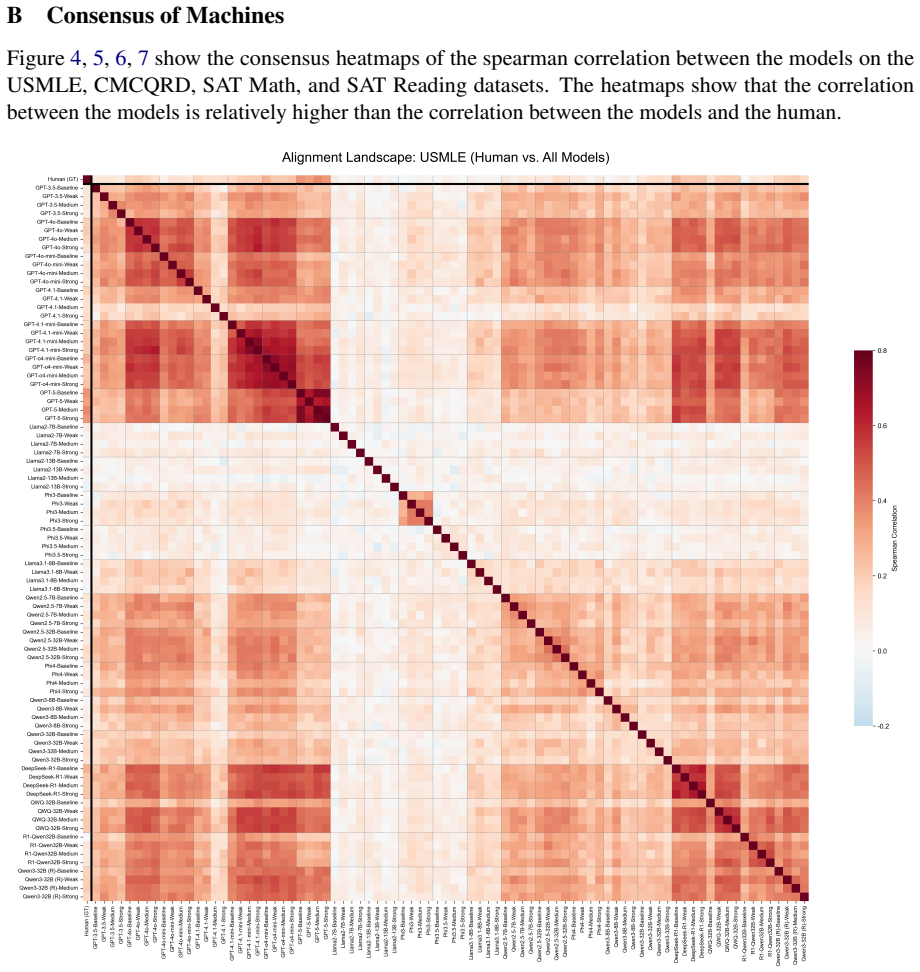
Accurate estimation of item (question or task) difficulty is critical for educational assessment but suffers from the cold start problem. While Large Language Models demonstrate superhuman problem-solving capabilities, it remains an open question whether they can perceive the cognitive struggles of human learners. In this work, we present a large-scale empirical analysis of Human-AI Difficulty Alignment for over 20 models across diverse domains such as medical knowledge and mathematical reasoning. Our findings reveal a systematic misalignment where scaling up model size is not reliably helpful; instead of aligning with humans, models converge toward a shared machine consensus. We observe that high performance often impedes accurate difficulty estimation, as models struggle to simulate the capability limitations of students even when being explicitly prompted to adopt specific proficiency levels. Furthermore, we identify a critical lack of introspection, as models fail to predict their own limitations. These results suggest that general problem-solving capability does not imply an understanding of human cognitive struggles, highlighting the challenge of using current models for automated difficulty prediction.
Editorial analysis
A structured set of objections, weighed in public.
Referee Report
Summary. The paper conducts a large-scale empirical analysis of Human-AI Difficulty Alignment across over 20 LLMs in domains including medical knowledge and mathematical reasoning. It claims systematic misalignment between model-generated difficulty estimates and human ratings, that model scaling does not reliably improve alignment (instead producing convergence to a shared machine consensus), that high problem-solving performance impedes simulation of student struggles even under explicit proficiency-level prompting, and that models exhibit a lack of introspection about their own limitations. The central conclusion is that general problem-solving capability does not imply an understanding of human cognitive struggles, limiting the use of current LLMs for automated item difficulty prediction.
Significance. If the empirical results hold after addressing methodological gaps, the work is significant for AI-assisted educational assessment. It provides concrete evidence that superhuman LLM performance on tasks does not translate to accurate modeling of human learner difficulties, which could steer research away from naive prompting-based simulation toward more targeted alignment methods or hybrid systems. The observation of machine consensus and introspection failures offers falsifiable predictions that could be tested in follow-up studies.
major comments (2)
- [Methods] Methods section: The manuscript provides no details on the number of items per domain, the number of human raters, inter-rater reliability statistics (e.g., Krippendorff’s alpha or ICC), or the exact statistical tests and effect sizes used to establish misalignment and convergence to machine consensus. These omissions are load-bearing because the central claims rest entirely on direct empirical comparisons between model outputs and human ratings.
- [Results (Proficiency Simulation)] Proficiency simulation experiments: The claim that explicit prompting to adopt specific proficiency levels fails to align models with human difficulty judgments requires quantitative before/after comparisons and controls for prompt sensitivity; without these, it is unclear whether the observed failure stems from inherent model limitations or from the particular prompting protocol employed.
minor comments (2)
- [Results] Include a summary table listing all evaluated models, their parameter counts, and baseline accuracies on the target tasks to allow readers to assess the scaling claims directly.
- [Discussion] Define 'machine consensus' operationally (e.g., via pairwise agreement or clustering of model outputs) in the text or a dedicated subsection.
Simulated Author's Rebuttal
We are grateful for the referee's insightful comments, which have helped us identify areas for improvement in our manuscript. We address each major comment below and commit to revising the paper accordingly.
read point-by-point responses
-
Referee: [Methods] Methods section: The manuscript provides no details on the number of items per domain, the number of human raters, inter-rater reliability statistics (e.g., Krippendorff’s alpha or ICC), or the exact statistical tests and effect sizes used to establish misalignment and convergence to machine consensus. These omissions are load-bearing because the central claims rest entirely on direct empirical comparisons between model outputs and human ratings.
Authors: We agree with the referee that these details should be explicitly reported. We will revise the Methods section to provide the number of items per domain, the number of human raters, inter-rater reliability statistics, and the exact statistical tests and effect sizes used. These details are available from our experimental logs and will be added to ensure the claims are fully supported. revision: yes
-
Referee: [Results (Proficiency Simulation)] Proficiency simulation experiments: The claim that explicit prompting to adopt specific proficiency levels fails to align models with human difficulty judgments requires quantitative before/after comparisons and controls for prompt sensitivity; without these, it is unclear whether the observed failure stems from inherent model limitations or from the particular prompting protocol employed.
Authors: We appreciate this suggestion for strengthening the proficiency simulation results. In the revised version, we will add quantitative comparisons of alignment metrics (e.g., correlation with human ratings) before and after applying the proficiency-level prompts. Additionally, we will include an analysis of prompt sensitivity by testing multiple prompt variations and reporting the variance in outcomes. Our data shows that the improvement is marginal across prompts, reinforcing that the misalignment is not merely due to prompting protocol but reflects deeper model limitations. We will present this in a new figure and table. revision: yes
Circularity Check
No significant circularity
full rationale
The paper conducts a large-scale empirical study comparing LLM difficulty estimates against human ratings across 20+ models and multiple domains. All load-bearing claims (misalignment, scaling not helping, failure of proficiency prompting, lack of introspection) are presented as direct observations from these comparisons rather than derived from equations, fitted parameters renamed as predictions, or self-citation chains. No self-definitional steps, ansatzes, or uniqueness theorems appear in the reported methodology or results. The work is self-contained against external human benchmarks.
Axiom & Free-Parameter Ledger
axioms (1)
- domain assumption Human difficulty ratings serve as reliable ground truth for student cognitive struggles.
Forward citations
Cited by 1 Pith paper
-
BEAGLE: Behavior-Enforced Agent for Grounded Learner Emulation
BEAGLE uses a semi-Markov model, Bayesian knowledge tracing with injected flaws, and decoupled strategy-code actions to make LLM agents produce authentic student learning trajectories that humans cannot distinguish fr...
Reference graph
Works this paper leans on
-
[1]
Wanyong Feng, Peter Tran, Stephen Sireci, and An- drew S Lan
Missing premise exacerbates overthinking: Are reasoning models losing critical thinking skill? InSecond Conference on Language Modeling. Wanyong Feng, Peter Tran, Stephen Sireci, and An- drew S Lan. 2025. Reasoning and sampling- augmented mcq difficulty prediction via llms. In International Conference on Artificial Intelligence in Education, pages 31–45. ...
work page 2025
-
[2]
Automatically predict question difficulty for reading comprehension exercises. In2021 ieee 33rd international conference on tools with artificial intel- ligence (ictai), pages 1398–1402. IEEE. Fu-Yuan Hsu, Hahn-Ming Lee, Tao-Hsing Chang, and Yao-Ting Sung. 2018. Automated estimation of item difficulty for multiple-choice tests: An application of word embe...
work page 2018
-
[3]
Question difficulty prediction for reading prob- lems in standard tests. InProceedings of the AAAI conference on artificial intelligence, volume 31. Aaron Hurst, Adam Lerer, Adam P Goucher, Adam Perelman, Aditya Ramesh, Aidan Clark, AJ Ostrow, Akila Welihinda, Alan Hayes, Alec Radford, and 1 others. 2024. Gpt-4o system card.arXiv preprint arXiv:2410.21276...
work page internal anchor Pith review Pith/arXiv arXiv 2024
-
[4]
HarmBench: A Standardized Evaluation Framework for Automated Red Teaming and Robust Refusal
Leveraging llm respondents for item evalua- tion: A psychometric analysis.British Journal of Educational Technology, 56(3):1028–1052. Frederic M Lord. 2012.Applications of item response theory to practical testing problems. Routledge. Anastassia Loukina, Su-Youn Yoon, Jennifer Sakano, Youhua Wei, and Kathy Sheehan. 2016. Textual complexity as a predictor ...
work page internal anchor Pith review Pith/arXiv arXiv 2012
-
[5]
More diverse dialogue datasets via diversity- informed data collection. InProceedings of the 58th annual meeting of the association for computational linguistics, pages 4958–4968. John Sweller. 1988. Cognitive load during problem solving: Effects on learning.Cognitive science, 12(2):257–285. John Sweller. 2011. Cognitive load theory. InPsychol- ogy of lea...
discussion (0)
Sign in with ORCID, Apple, or X to comment. Anyone can read and Pith papers without signing in.