Recognition: 2 theorem links
· Lean TheoremRotating Black Holes with Primary Scalar Hair: Shadow Signatures in Beyond Horndeski Gravity
Pith reviewed 2026-05-15 21:43 UTC · model grok-4.3
The pith
Rotating black holes with primary scalar hair produce shadows whose size and distortion depend on the sign of the hair parameter Q.
A machine-rendered reading of the paper's core claim, the machinery that carries it, and where it could break.
Core claim
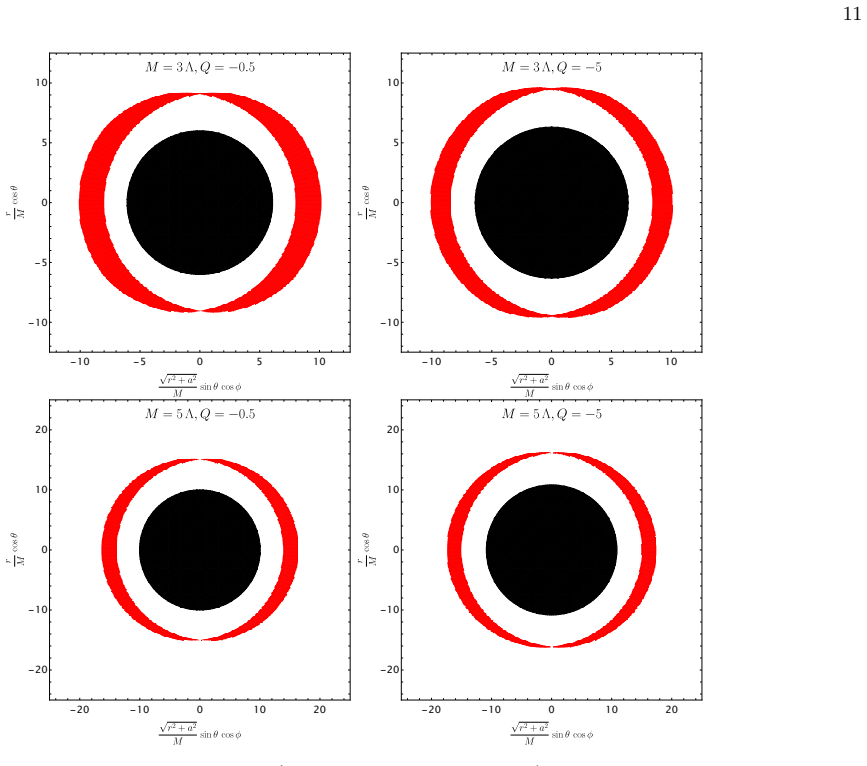
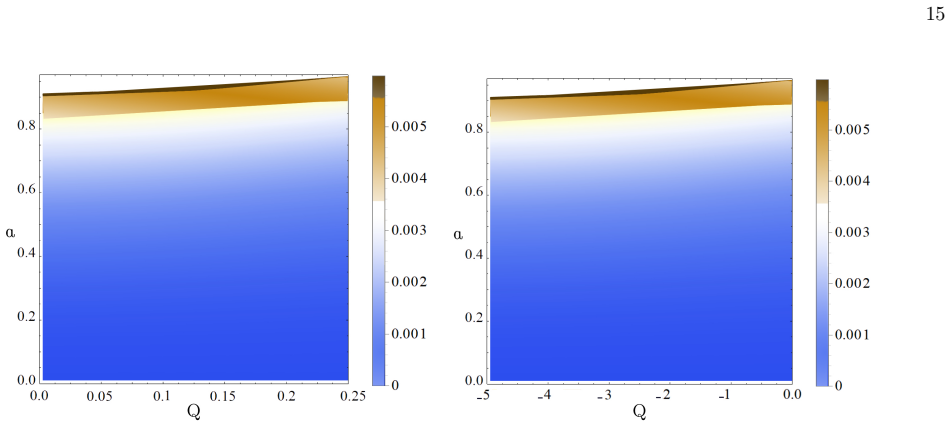
The constructed rotating metric with scalar hair parameter Q leads to photon regions whose boundaries determine shadows with characteristic modifications. Negative Q enlarges the shadow and reduces its oblateness, while positive Q shrinks the shadow and enhances its distortion. Imposing EHT bounds on the shadow diameter and circularity deviation for M87* restricts the viable (a, Q) parameter space, with stronger constraints for positive Q, yet does not rule out such black holes.
What carries the argument
The scalar hair parameter Q embedded in the rotating black hole metric derived from beyond Horndeski gravity, which alters the effective potential for photon geodesics and thus the shadow boundary.
If this is right
- Current EHT observations permit a range of negative Q values alongside various spins.
- Positive Q values are more tightly constrained by the circularity and size measurements.
- Scalar-hair effects produce shadow deviations on the order of microarcseconds.
- Next-generation horizon-scale imaging could detect or further limit these deviations.
Where Pith is reading between the lines
- Similar shadow signatures might appear in other strong-field tests such as gravitational wave ringdown or accretion disk images.
- Higher-precision measurements of Sgr A* could provide independent constraints on the same (a, Q) space.
- If the metric construction holds, it suggests a pathway to test no-hair violations without invoking secondary hair from matter fields.
Load-bearing premise
That the constructed rotating metric is a consistent solution of the beyond-Horndeski field equations and that the photon-region analysis accurately predicts the observable shadow boundary without significant higher-order corrections or frame-dragging effects omitted in the model.
What would settle it
A measurement of the M87* shadow diameter or circularity deviation that lies outside all predicted values for any combination of spin a and hair parameter Q in the model.
Figures






read the original abstract
The Event Horizon Telescope (EHT) image of M87* provides a direct test of strong-field gravity, measuring an angular shadow diameter $\theta_{d}=42\pm 3~\mu\mathrm{as}$ and a circularity deviation $\Delta C\leq 0.1$. Such observations allow quantitative tests of the Kerr paradigm and of possible deviations from the no-hair theorem. In scalar-tensor extensions of gravity, black holes may possess primary scalar hair, introducing an additional independent parameter beyond mass and spin. In this work, we construct a rotating configuration inspired by black hole solutions with primary scalar hair in beyond Horndeski gravity and analyze their photon regions and shadow formation. We show that the scalar hair parameter $Q$ induces characteristic modifications of the shadow, and in particular negative $Q$ enlarges the shadow and reduces its oblateness, while positive $Q$ shrinks and enhances its distortion. Adopting M87* as a representative case within this framework and imposing the EHT bounds on $\theta_{d}$ and $\Delta C$, we identify the viable $(a,Q)$ parameter space. We find that current observations do not exclude rotating black holes with primary scalar hair, although the allowed region is significantly restricted for $Q>0$. Finally, the scalar-hair-induced deviations are of order $\mathcal{O}(\mu\mathrm{as})$, placing them near the sensitivity threshold of present instruments and within reach of next-generation horizon-scale imaging.
Editorial analysis
A structured set of objections, weighed in public.
Referee Report
Summary. The manuscript constructs rotating black hole spacetimes with primary scalar hair in beyond Horndeski gravity by generalizing known static solutions. It computes the photon regions and resulting shadows, demonstrating that the hair parameter Q modifies the shadow diameter and circularity deviation (negative Q enlarges the shadow and reduces oblateness; positive Q shrinks it and increases distortion). Adopting M87* EHT bounds on angular diameter θ_d = 42 ± 3 μas and ΔC ≤ 0.1, the work maps the viable (a, Q) parameter space and concludes that rotating black holes with primary scalar hair remain allowed, though the region is restricted for Q > 0, with deviations of order O(μas).
Significance. If the rotating metrics satisfy the field equations, the results supply concrete, falsifiable predictions for how primary scalar hair alters strong-field observables, extending no-hair tests to beyond Horndeski theories at the sensitivity of current and next-generation horizon-scale imaging. The explicit mapping from Q to shadow observables and the derived (a, Q) constraints constitute a useful benchmark for EHT analyses.
major comments (2)
- [§2] §2 (metric construction): The rotating metric is introduced as 'inspired by' the static hairy solutions. No explicit verification is provided that the ansatz satisfies the beyond-Horndeski field equations for simultaneous nonzero a and Q. Because the photon-region and shadow calculations rest on this metric being a solution of the theory, this step is load-bearing and requires either direct substitution into the equations or a reference to a prior derivation that confirms the equations hold.
- [§4] §4, photon-orbit conditions: The effective potential for null geodesics is derived from the given metric components, but the text does not address whether frame-dragging or scalar-field stress-energy contributions introduce additional terms that could shift the unstable photon orbit radii beyond the reported O(μas) level. Clarification is needed on the completeness of the geodesic equation used.
minor comments (3)
- [Abstract] Abstract and §1: The phrase 'beyond Horndeski gravity' is used inconsistently with and without hyphen; adopt a single convention throughout.
- [Figure 4] Figure 4 (shadow contours): Axis labels and the color scale for ΔC are legible but the boundary curves corresponding to the θ_d = 42 ± 3 μas constraint could be highlighted with a distinct linestyle for immediate readability.
- [§3.2] §3.2: The definition of the circularity deviation ΔC follows the standard EHT prescription but omits an explicit formula; insert the expression used for the numerical evaluation.
Simulated Author's Rebuttal
We thank the referee for the careful reading and constructive comments on our manuscript. We address each major point below and will incorporate clarifications and revisions as needed to strengthen the presentation.
read point-by-point responses
-
Referee: [§2] §2 (metric construction): The rotating metric is introduced as 'inspired by' the static hairy solutions. No explicit verification is provided that the ansatz satisfies the beyond-Horndeski field equations for simultaneous nonzero a and Q. Because the photon-region and shadow calculations rest on this metric being a solution of the theory, this step is load-bearing and requires either direct substitution into the equations or a reference to a prior derivation that confirms the equations hold.
Authors: We agree that explicit confirmation is essential for the validity of the subsequent calculations. The rotating metric was obtained by generalizing the static hairy solutions via a Boyer-Lindquist-type ansatz that reduces correctly when a=0. In the revised manuscript we will add either a direct (albeit abbreviated) substitution of the ansatz into the beyond-Horndeski field equations for the key components or a reference to a companion derivation that establishes the solution for nonzero a and Q. revision: yes
-
Referee: [§4] §4, photon-orbit conditions: The effective potential for null geodesics is derived from the given metric components, but the text does not address whether frame-dragging or scalar-field stress-energy contributions introduce additional terms that could shift the unstable photon orbit radii beyond the reported O(μas) level. Clarification is needed on the completeness of the geodesic equation used.
Authors: Beyond Horndeski gravity is a metric theory; therefore the geodesic equation for photons is determined solely by the spacetime metric. Frame-dragging is already encoded in the g_tφ components, and the scalar-field stress-energy affects only the background metric coefficients, not the form of the geodesic equation itself. We will insert a short clarifying paragraph in the revised §4 stating this explicitly and confirming that no additional terms arise. revision: yes
Circularity Check
No significant circularity; shadow modifications computed directly from independent metric parameters
full rationale
The paper introduces the scalar hair parameter Q as an independent input in a rotating metric constructed by ansatz from known static solutions. The photon-region analysis and resulting shadow observables (diameter enlargement for Q<0, distortion enhancement for Q>0) are obtained by direct integration of the metric's null geodesics. These computed signatures are then compared against external EHT data on M87* to delineate the allowed (a,Q) region. No step reduces a reported prediction to a quantity fitted from the same data, nor does any self-citation or uniqueness theorem close a loop that makes the central claim equivalent to its inputs by construction. The derivation remains self-contained against the external observational benchmark.
Axiom & Free-Parameter Ledger
free parameters (1)
- Q
axioms (1)
- domain assumption Beyond Horndeski gravity admits black-hole solutions with primary scalar hair that can be extended to rotating cases
Lean theorems connected to this paper
-
IndisputableMonolith/Foundation/RealityFromDistinction.leanreality_from_one_distinction unclear?
unclearRelation between the paper passage and the cited Recognition theorem.
We construct a rotating configuration inspired by black hole solutions with primary scalar hair in beyond Horndeski gravity and analyze their photon regions and shadow formation.
-
IndisputableMonolith/Cost/FunctionalEquation.leanwashburn_uniqueness_aczel unclear?
unclearRelation between the paper passage and the cited Recognition theorem.
the scalar hair parameter Q induces characteristic modifications of the shadow
What do these tags mean?
- matches
- The paper's claim is directly supported by a theorem in the formal canon.
- supports
- The theorem supports part of the paper's argument, but the paper may add assumptions or extra steps.
- extends
- The paper goes beyond the formal theorem; the theorem is a base layer rather than the whole result.
- uses
- The paper appears to rely on the theorem as machinery.
- contradicts
- The paper's claim conflicts with a theorem or certificate in the canon.
- unclear
- Pith found a possible connection, but the passage is too broad, indirect, or ambiguous to say the theorem truly supports the claim.
Reference graph
Works this paper leans on
- [1]
- [2]
-
[3]
S. W. Hawking, Commun. Math. Phys.25, 152 (1972)
work page 1972
-
[4]
G. W. Gibbons, Commun. Math. Phys.45, 191 (1975)
work page 1975
-
[5]
On the charge of the Galactic centre black hole
M. Zajaˇ cek, A. Tursunov, A. Eckart, and S. Britzen, Mon. Not. Roy. Astron. Soc.480, 4408 (2018), arXiv:1808.07327 [astro-ph.GA]
work page internal anchor Pith review Pith/arXiv arXiv 2018
-
[6]
K. S. Stelle, Phys. Rev. D16, 953 (1977)
work page 1977
-
[7]
E. Di Valentinoet al.(CosmoVerse Network), Phys. Dark Univ.49, 101965 (2025), arXiv:2504.01669 [astro-ph.CO]
work page internal anchor Pith review Pith/arXiv arXiv 2025
- [8]
-
[9]
The Data Release of the Sloan Digital Sky Survey-II Supernova Survey
M. Sakoet al.(SDSS), Publ. Astron. Soc. Pac.130, 064002 (2018), arXiv:1401.3317 [astro-ph.CO]
work page internal anchor Pith review Pith/arXiv arXiv 2018
-
[10]
J. L. Sieverset al.(Atacama Cosmology Telescope), JCAP10, 060, arXiv:1301.0824 [astro-ph.CO]
work page internal anchor Pith review Pith/arXiv arXiv
-
[11]
K. S. Dawsonet al.(BOSS), Astron. J.145, 10 (2013), arXiv:1208.0022 [astro-ph.CO]
work page internal anchor Pith review Pith/arXiv arXiv 2013
- [12]
-
[13]
A. A. Starobinsky, Phys. Lett. B91, 99 (1980)
work page 1980
-
[14]
Modified Gauss-Bonnet theory as gravitational alternative for dark energy
S. Nojiri and S. D. Odintsov, Phys. Lett. B631, 1 (2005), arXiv:hep-th/0508049
work page internal anchor Pith review Pith/arXiv arXiv 2005
- [15]
-
[16]
Y.-F. Cai, S. Capozziello, M. De Laurentis, and E. N. Saridakis, Rept. Prog. Phys.79, 106901 (2016), arXiv:1511.07586 [gr-qc]
work page internal anchor Pith review Pith/arXiv arXiv 2016
-
[17]
Teleparallel equivalent of Gauss-Bonnet gravity and its modifications
G. Kofinas and E. N. Saridakis, Phys. Rev. D90, 084044 (2014), arXiv:1404.2249 [gr-qc]
work page internal anchor Pith review Pith/arXiv arXiv 2014
-
[18]
Modified teleparallel theories of gravity
S. Bahamonde, C. G. B¨ ohmer, and M. Wright, Phys. Rev. D92, 104042 (2015), arXiv:1508.05120 [gr-qc]
work page internal anchor Pith review Pith/arXiv arXiv 2015
-
[19]
L. Heisenberg, Phys. Rept.1066, 1 (2024), arXiv:2309.15958 [gr-qc]
- [20]
-
[21]
G. W. Horndeski, Int. J. Theor. Phys.10, 363 (1974)
work page 1974
-
[22]
Generalized Galileon cosmology
A. De Felice and S. Tsujikawa, Phys. Rev. D84, 124029 (2011), arXiv:1008.4236 [hep-th]
work page internal anchor Pith review Pith/arXiv arXiv 2011
-
[23]
A formal introduction to Horndeski and Galileon theories and their generalizations
C. Deffayet and D. A. Steer, Class. Quant. Grav.30, 214006 (2013), arXiv:1307.2450 [hep-th]
work page internal anchor Pith review Pith/arXiv arXiv 2013
-
[24]
A. Cisterna and C. Erices, Phys. Rev. D89, 084038 (2014), arXiv:1401.4479 [gr-qc]
work page internal anchor Pith review Pith/arXiv arXiv 2014
-
[25]
Breaking of Vainshtein screening in scalar-tensor theories beyond Horndeski
T. Kobayashi, Y. Watanabe, and D. Yamauchi, Phys. Rev. D91, 064013 (2015), arXiv:1411.4130 [gr-qc]. 21
work page internal anchor Pith review Pith/arXiv arXiv 2015
-
[26]
E. Bellini, A. J. Cuesta, R. Jimenez, and L. Verde, JCAP02, 053, [Erratum: JCAP 06, E01 (2016)], arXiv:1509.07816 [astro-ph.CO]
-
[27]
Black holes and stars in Horndeski theory
E. Babichev, C. Charmousis, and A. Leh´ ebel, Class. Quant. Grav.33, 154002 (2016), arXiv:1604.06402 [gr-qc]
work page internal anchor Pith review Pith/arXiv arXiv 2016
-
[28]
Dark energy in Horndeski theories after GW170817: A review
R. Kase and S. Tsujikawa, Int. J. Mod. Phys. D28, 1942005 (2019), arXiv:1809.08735 [gr-qc]
work page internal anchor Pith review Pith/arXiv arXiv 2019
-
[29]
S. Banerjee, Y.-F. Cai, and E. N. Saridakis, Class. Quant. Grav.36, 135009 (2019), arXiv:1808.01170 [gr-qc]
-
[30]
Horndeski theory and beyond: a review
T. Kobayashi, Rept. Prog. Phys.82, 086901 (2019), arXiv:1901.07183 [gr-qc]
work page internal anchor Pith review Pith/arXiv arXiv 2019
- [31]
-
[32]
S. Bahamonde, M. Caruana, K. F. Dialektopoulos, V. Gakis, M. Hohmann, J. Levi Said, E. N. Saridakis, and J. Sultana, Phys. Rev. D104, 084082 (2021), arXiv:2105.13243 [gr-qc]
- [33]
-
[34]
M. Petronikolou, S. Basilakos, and E. N. Saridakis, Phys. Rev. D106, 124051 (2022), arXiv:2110.01338 [gr-qc]
- [35]
- [36]
-
[37]
J. Rayimbaev, K. F. Dialektopoulos, F. Sarikulov, and A. Abdujabbarov, Eur. Phys. J. C83, 572 (2023), arXiv:2307.03019 [gr-qc]
- [38]
- [39]
-
[40]
H. Hoshimov, S. Orzuev, F. Atamurotov, and A. Abdujabbarov, Annals Phys.482, 170209 (2025)
work page 2025
- [41]
-
[42]
S. Mironov, A. Shtennikova, and M. Valencia-Villegas, Eur. Phys. J. C85, 1378 (2025), arXiv:2509.16850 [hep-th]
-
[43]
D. Totolou, T. Papanikolaou, and E. N. Saridakis, Primordial black hole dark matter from ultra-slow-roll inflation in Horndeski gravity (2025), arXiv:2512.25044 [gr-qc]
-
[44]
Healthy theories beyond Horndeski
J. Gleyzes, D. Langlois, F. Piazza, and F. Vernizzi, Phys. Rev. Lett.114, 211101 (2015), arXiv:1404.6495 [hep-th]
work page internal anchor Pith review Pith/arXiv arXiv 2015
-
[45]
M. Zumalac´ arregui and J. Garc´ ıa-Bellido, Phys. Rev. D89, 064046 (2014), arXiv:1308.4685 [gr-qc]
work page internal anchor Pith review Pith/arXiv arXiv 2014
-
[46]
Counting the degrees of freedom of generalized Galileons
C. Deffayet, G. Esposito-Farese, and D. A. Steer, Phys. Rev. D92, 084013 (2015), arXiv:1506.01974 [gr-qc]
work page internal anchor Pith review Pith/arXiv arXiv 2015
-
[47]
Relativistic Stars in Beyond Horndeski Theories
E. Babichev, K. Koyama, D. Langlois, R. Saito, and J. Sakstein, Class. Quant. Grav.33, 235014 (2016), arXiv:1606.06627 [gr-qc]
work page internal anchor Pith review Pith/arXiv arXiv 2016
-
[48]
Horndeski: beyond, or not beyond?
M. Crisostomi, M. Hull, K. Koyama, and G. Tasinato, JCAP03, 038, arXiv:1601.04658 [hep-th]
work page internal anchor Pith review Pith/arXiv arXiv
-
[49]
Testing Gravity Using Galaxy Clusters: New Constraints on Beyond Horndeski Theories
J. Sakstein, H. Wilcox, D. Bacon, K. Koyama, and R. C. Nichol, JCAP07, 019, arXiv:1603.06368 [astro-ph.CO]
work page internal anchor Pith review Pith/arXiv arXiv
-
[50]
Towards Strong Field Tests of Beyond Horndeski Gravity Theories
J. Sakstein, E. Babichev, K. Koyama, D. Langlois, and R. Saito, Phys. Rev. D95, 064013 (2017), arXiv:1612.04263 [gr-qc]
work page internal anchor Pith review Pith/arXiv arXiv 2017
-
[51]
Degenerate higher order scalar-tensor theories beyond Horndeski and disformal transformations
J. Ben Achour, D. Langlois, and K. Noui, Phys. Rev. D93, 124005 (2016), arXiv:1602.08398 [gr-qc]
work page internal anchor Pith review Pith/arXiv arXiv 2016
-
[52]
Hamiltonian analysis of higher derivative scalar-tensor theories
D. Langlois and K. Noui, JCAP07, 016, arXiv:1512.06820 [gr-qc]
work page internal anchor Pith review Pith/arXiv arXiv
-
[53]
Degenerate higher order scalar-tensor theories beyond Horndeski up to cubic order
J. Ben Achour, M. Crisostomi, K. Koyama, D. Langlois, K. Noui, and G. Tasinato, JHEP12, 100, arXiv:1608.08135 [hep-th]
work page internal anchor Pith review Pith/arXiv arXiv
-
[54]
A. Dima and F. Vernizzi, Phys. Rev. D97, 101302 (2018), arXiv:1712.04731 [gr-qc]
work page internal anchor Pith review Pith/arXiv arXiv 2018
-
[55]
Cosmological bounce and Genesis beyond Horndeski
R. Kolevatov, S. Mironov, N. Sukhov, and V. Volkova, JCAP08, 038, arXiv:1705.06626 [hep-th]
work page internal anchor Pith review Pith/arXiv arXiv
-
[56]
Dark energy scenario consistent with GW170817 in theories beyond Horndeski gravity
R. Kase and S. Tsujikawa, Phys. Rev. D97, 103501 (2018), arXiv:1802.02728 [gr-qc]
work page internal anchor Pith review Pith/arXiv arXiv 2018
- [57]
-
[58]
A. Bakopoulos, C. Charmousis, P. Kanti, N. Lecoeur, and T. Nakas, Phys. Rev. D109, 024032 (2024), arXiv:2310.11919 [gr-qc]
-
[59]
Black holes with non-minimal derivative coupling
M. Rinaldi, Phys. Rev. D86, 084048 (2012), arXiv:1208.0103 [gr-qc]
work page internal anchor Pith review Pith/arXiv arXiv 2012
-
[60]
Asymptotically locally AdS and flat black holes in Horndeski theory
A. Anabalon, A. Cisterna, and J. Oliva, Phys. Rev. D89, 084050 (2014), arXiv:1312.3597 [gr-qc]
work page internal anchor Pith review Pith/arXiv arXiv 2014
-
[61]
Solutions in the scalar-tensor theory with nonminimal derivative coupling
M. Minamitsuji, Phys. Rev. D89, 064017 (2014), arXiv:1312.3759 [gr-qc]
work page internal anchor Pith review Pith/arXiv arXiv 2014
-
[62]
T. P. Sotiriou and S.-Y. Zhou, Phys. Rev. D90, 124063 (2014), arXiv:1408.1698 [gr-qc]
work page internal anchor Pith review Pith/arXiv arXiv 2014
-
[63]
Slowly rotating black hole solutions in Horndeski gravity
A. Maselli, H. O. Silva, M. Minamitsuji, and E. Berti, Phys. Rev. D92, 104049 (2015), arXiv:1508.03044 [gr-qc]
work page internal anchor Pith review Pith/arXiv arXiv 2015
-
[64]
Horndeski theories confront the Gravity Probe B experiment
S. Mukherjee and S. Chakraborty, Phys. Rev. D97, 124007 (2018), arXiv:1712.00562 [gr-qc]
work page internal anchor Pith review Pith/arXiv arXiv 2018
-
[65]
First M87 Event Horizon Telescope Results. I. The Shadow of the Supermassive Black Hole
K. Akiyamaet al.(Event Horizon Telescope), Astrophys. J. Lett.875, L1 (2019), arXiv:1906.11238 [astro-ph.GA]
work page internal anchor Pith review Pith/arXiv arXiv 2019
-
[66]
First M87 Event Horizon Telescope Results. II. Array and Instrumentation
K. Akiyamaet al.(Event Horizon Telescope), Astrophys. J. Lett.875, L2 (2019), arXiv:1906.11239 [astro-ph.IM]
work page internal anchor Pith review Pith/arXiv arXiv 2019
- [67]
-
[68]
Regular Black Hole Metric with Three Constants of Motion
T. Johannsen, Phys. Rev. D88, 044002 (2013), arXiv:1501.02809 [gr-qc]
work page internal anchor Pith review Pith/arXiv arXiv 2013
-
[69]
R. A. Konoplya and A. Zhidenko, JCAP12, 043, arXiv:1606.00517 [gr-qc]
work page internal anchor Pith review Pith/arXiv arXiv
-
[70]
Testing the nature of dark compact objects: a status report
V. Cardoso and P. Pani, Living Rev. Rel.22, 4 (2019), arXiv:1904.05363 [gr-qc]
work page internal anchor Pith review Pith/arXiv arXiv 2019
-
[71]
Viewing the Shadow of the Black Hole at the Galactic Center
H. Falcke, F. Melia, and E. Agol, Astrophys. J. Lett.528, L13 (2000), arXiv:astro-ph/9912263
work page internal anchor Pith review Pith/arXiv arXiv 2000
-
[72]
T. Johannsen, Class. Quant. Grav.33, 113001 (2016), arXiv:1512.03818 [astro-ph.GA]
work page internal anchor Pith review Pith/arXiv arXiv 2016
-
[73]
Testing black hole candidates with electromagnetic radiation
C. Bambi, Rev. Mod. Phys.89, 025001 (2017), arXiv:1509.03884 [gr-qc]
work page internal anchor Pith review Pith/arXiv arXiv 2017
-
[74]
BlackHoleCam: fundamental physics of the Galactic center
C. Goddiet al., Int. J. Mod. Phys. D26, 1730001 (2016), arXiv:1606.08879 [astro-ph.HE]
work page internal anchor Pith review Pith/arXiv arXiv 2016
-
[75]
M. Khodadi and E. N. Saridakis, Phys. Dark Univ.32, 100835 (2021), arXiv:2012.05186 [gr-qc]
-
[76]
Psaltiset al.(Event Horizon Telescope), Phys
D. Psaltiset al.(Event Horizon Telescope), Phys. Rev. Lett.125, 141104 (2020), arXiv:2010.01055 [gr-qc]
- [77]
-
[78]
Generating rotating regular black hole solutions without complexification
M. Azreg-A¨ ınou, Phys. Rev. D90, 064041 (2014), arXiv:1405.2569 [gr-qc]. 22
work page internal anchor Pith review Pith/arXiv arXiv 2014
-
[79]
S. P. Drake and P. Szekeres, General Relativity and Gravitation32, 445 (2000), arXiv:gr-qc/9807001 [gr-qc]
work page internal anchor Pith review Pith/arXiv arXiv 2000
-
[80]
Shadow of a rotating braneworld black hole
L. Amarilla and E. F. Eiroa, Physical Review D85, 064019 (2012), arXiv:1112.6349 [gr-qc]
work page internal anchor Pith review Pith/arXiv arXiv 2012
discussion (0)
Sign in with ORCID, Apple, or X to comment. Anyone can read and Pith papers without signing in.