Revisiting the Perseus Cluster III: Role of Aspherical Explosions on its Chemical Composition and Extension to Metal-Poor Stars and Galaxies
Pith reviewed 2026-05-15 18:42 UTC · model grok-4.3
The pith
Jet-induced explosions are required to match elemental abundances in the Perseus Cluster and Milky Way trends.
A machine-rendered reading of the paper's core claim, the machinery that carries it, and where it could break.
Core claim
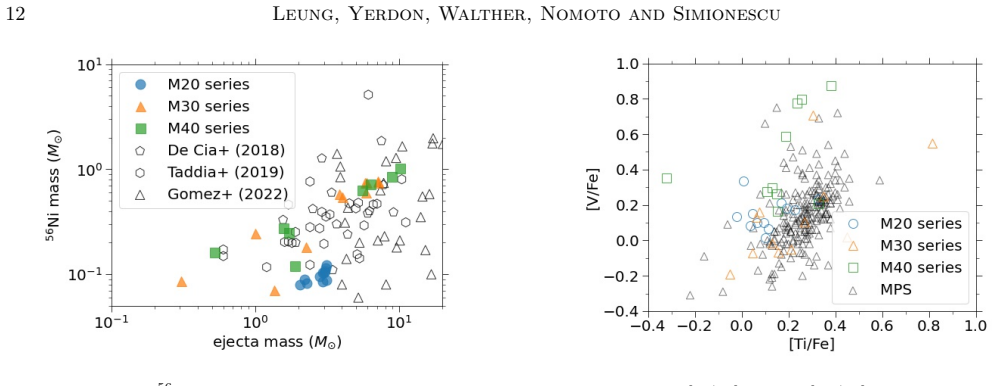
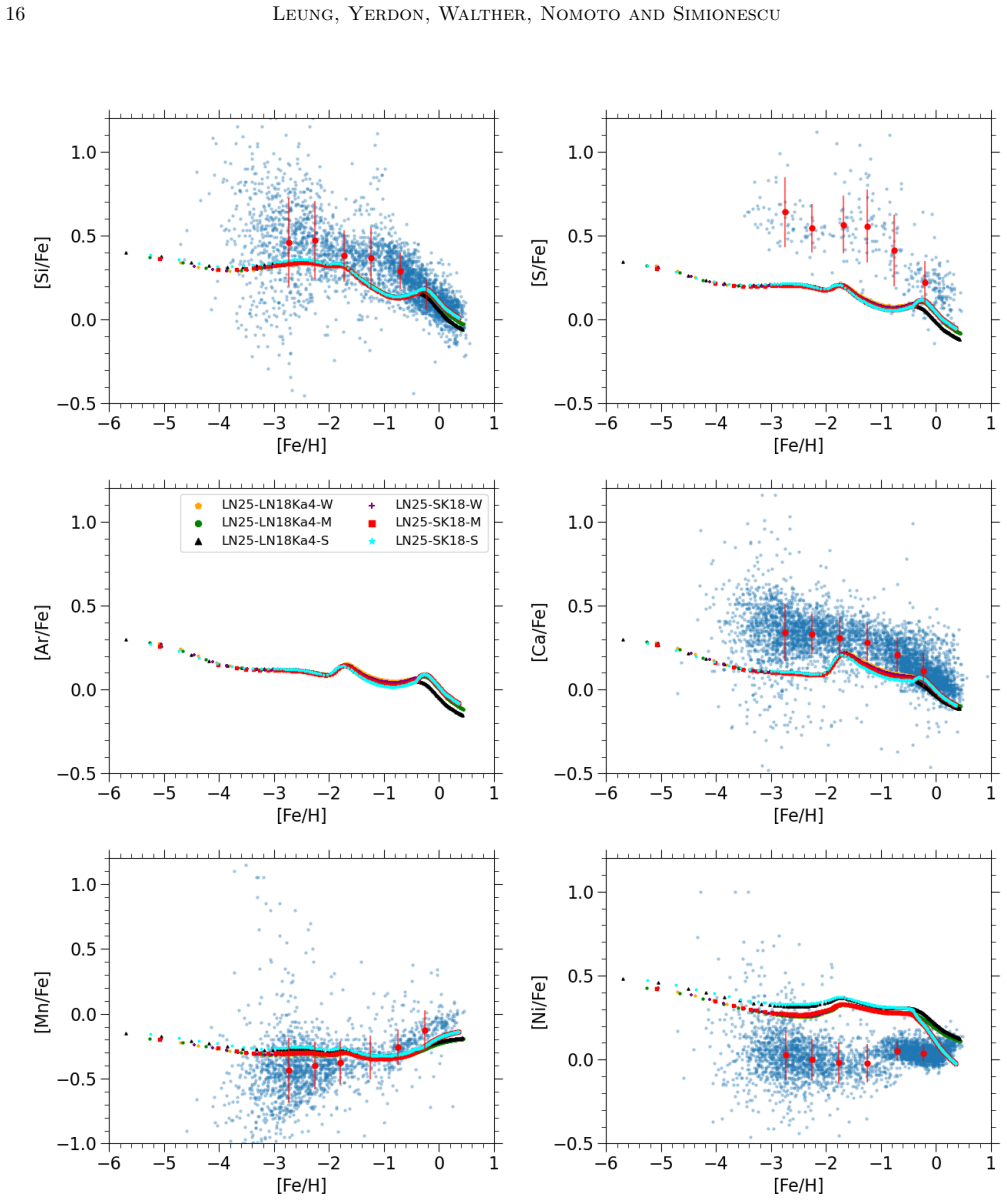
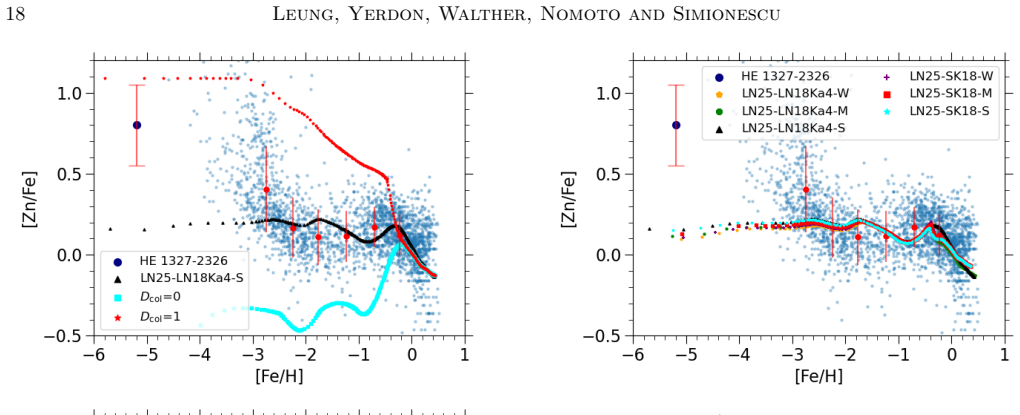
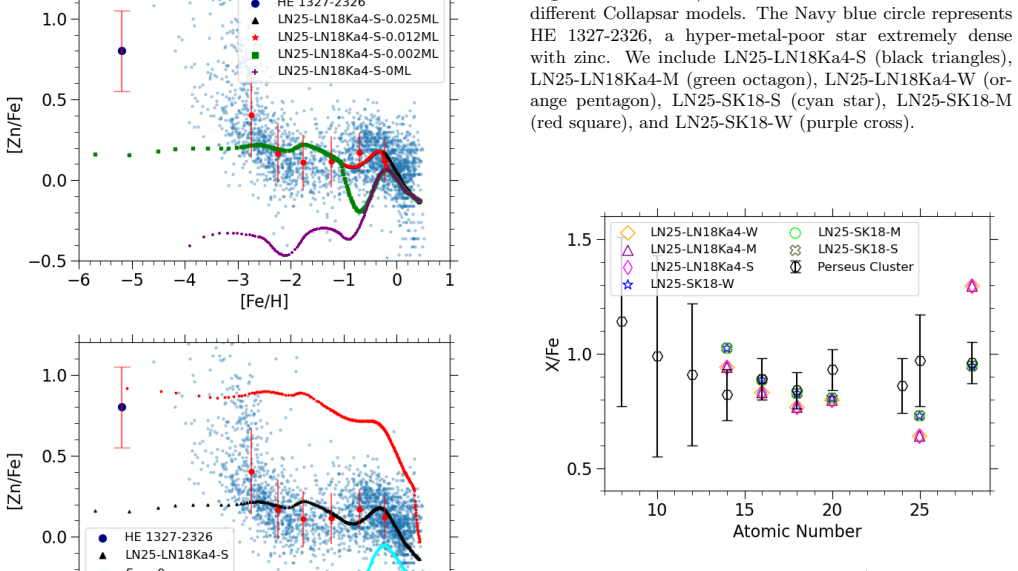
Jet-induced aspherical explosions produce chemical yields that fit the Si, S, Ar, Ca, Cr, Mn, and Ni ratios observed in the Perseus Cluster more closely than spherical models. These explosions generate a range of outcomes consistent with the observed spread in 56Ni mass versus ejecta mass and the Ti-V abundance relation. When the resulting yields are included in Milky Way chemical evolution models, collapsars prove necessary to reproduce multiple elemental trends, including the high zinc content of stars like HE 1327-2326.
What carries the argument
The jet-induced explosion mechanism, which drives aspherical outflows and enables targeted nucleosynthesis of odd-Z and iron-group elements through large post-processing networks.
If this is right
- Collapsar models reproduce the observed diversity between 56Ni mass and ejecta mass.
- The explosions account for the Ti-V relation seen in stellar abundances.
- Collapsars produce significant changes in zinc abundance during galactic chemical evolution.
- Metal-poor star observations can constrain both the rate and key parameters of collapsar events.
Where Pith is reading between the lines
- Early galactic chemical enrichment likely required a larger fraction of jet-driven events than spherical-only models assume.
- Abundance patterns in the first galaxies may need aspherical explosion effects to match current observations.
- High-redshift elemental ratio measurements could directly test the minimum collapsar contribution required.
Load-bearing premise
The jet-induced explosion models and post-processing network accurately capture production of odd-number elements and iron-group species without additional free parameters tuned to the target observations.
What would settle it
A set of elemental abundance ratios measured in a metal-poor star or galaxy cluster that cannot be reproduced by any linear combination of collapsar yields and standard spherical supernova yields would falsify the necessity of collapsars.
Figures



read the original abstract
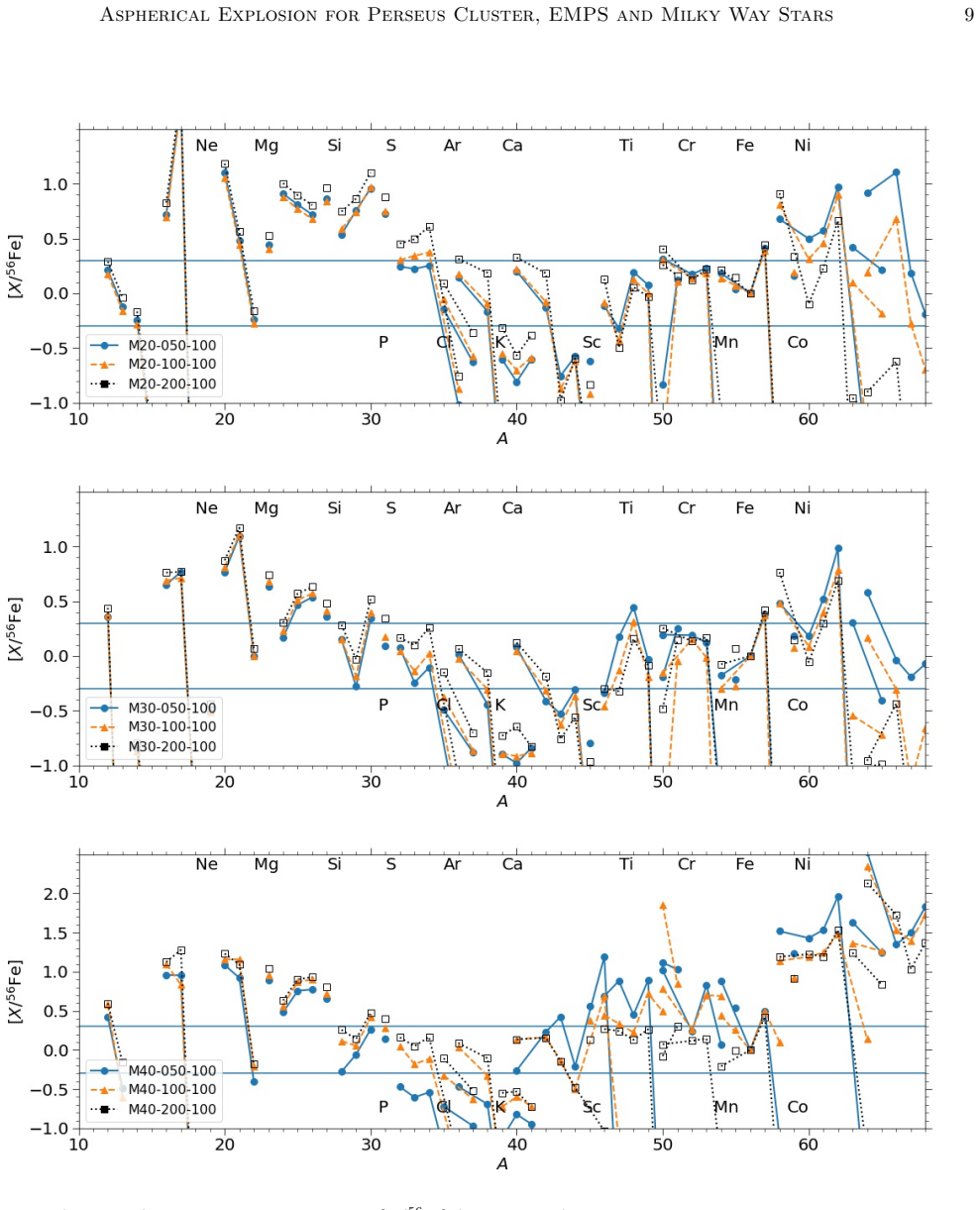
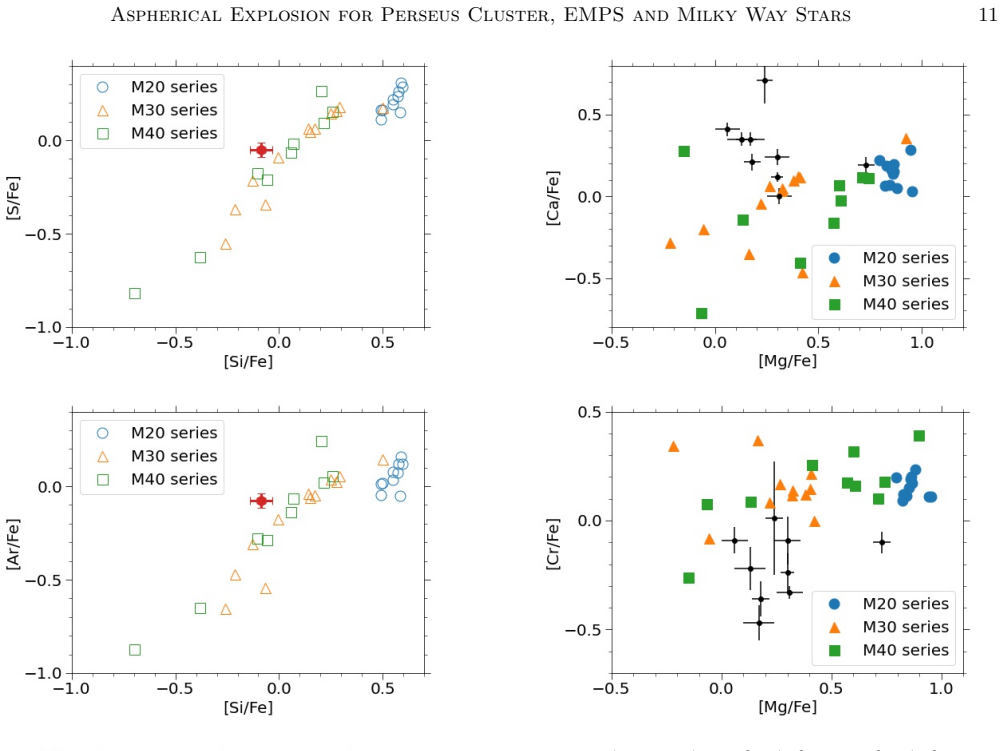
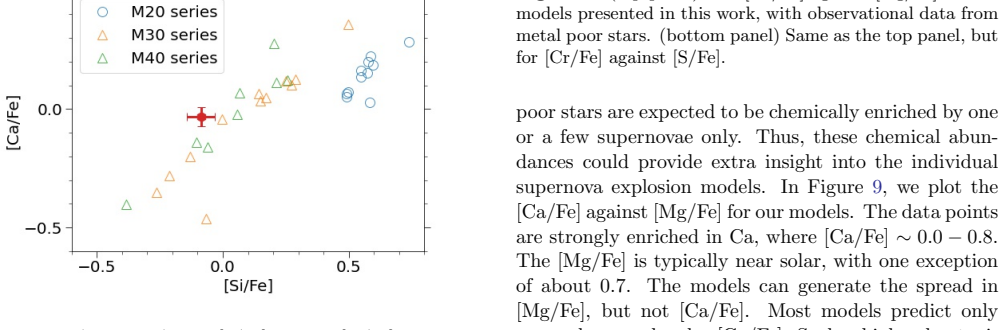
The Perseus Cluster has been precisely measured by the legacy Hitomi telescope on the Si-group (Si, S, Ar, Ca) and Fe-group elements (Cr, Mn, Ni). These element abundance ratios provide insight into the typical behaviour of supernovae. In Paper II, we presented new massive star explosion models at various metallicity, assuming spherical explosions. We show that while the fitting is improved, some features (e.g., Ni/Fe) remain to be improved. In this article, we extend our calculation to an aspherical explosion using the jet-induced explosion mechanism. The detailed pre- and post-explosion chemical profiles are calculated with a large post-processing network to capture the production of odd-number elements (V, Mn, Cu) and iron-group elements. We further explore how the jet-driven explosions create the diversity of models which could be compatible with the observed diversity in terms of $^{56}$Ni-mass vs ejecta mass, Ti-V relation, and stellar abundances. Finally, we apply the new collapsar models in the Galactic Chemical Evolution context. We study how the galactic stars, including the Zn-enriched star HE 1327-2326, can put constraints on the relative rates of collapsar and some of its model parameters. We show that collapsar could lead to significant changes in some elements, e.g., Zn. Our study shows that the collapsar is a necessary component to explain multiple elemental trends observed in the Milky Way Galaxy.
Editorial analysis
A structured set of objections, weighed in public.
Referee Report
Summary. The manuscript extends spherical supernova explosion models from Paper II to aspherical jet-induced (collapsar) explosions for massive stars at various metallicities. It computes detailed pre- and post-explosion chemical profiles with a large post-processing network to track odd-Z and iron-group elements, explores model diversity in 56Ni mass, ejecta mass, and Ti-V relations, and incorporates the yields into Galactic Chemical Evolution calculations. The central claim is that collapsars are a necessary component to reproduce multiple elemental trends in the Milky Way, including Zn enrichment in metal-poor stars such as HE 1327-2326 and abundance patterns in the Perseus Cluster.
Significance. If the necessity claim is substantiated, the work would provide a concrete mechanism linking jet-driven explosions to observed diversity in iron-group and odd-Z element ratios across metallicities, with direct implications for interpreting Hitomi Perseus data and metal-poor stellar abundances. The detailed post-processing network and extension to GCE represent a strength in connecting explosion physics to galactic trends.
major comments (3)
- [GCE application and abstract] The necessity claim for collapsars (stated in the abstract and GCE section) rests on the assertion that spherical models from Paper II cannot reproduce the same MW trends, yet no systematic parameter scan over spherical explosion energy, 56Ni mass, or mixing is reported to demonstrate that no alternative spherical combination achieves comparable fits to the Ti-V or Zn/Fe relations at the relevant metallicities.
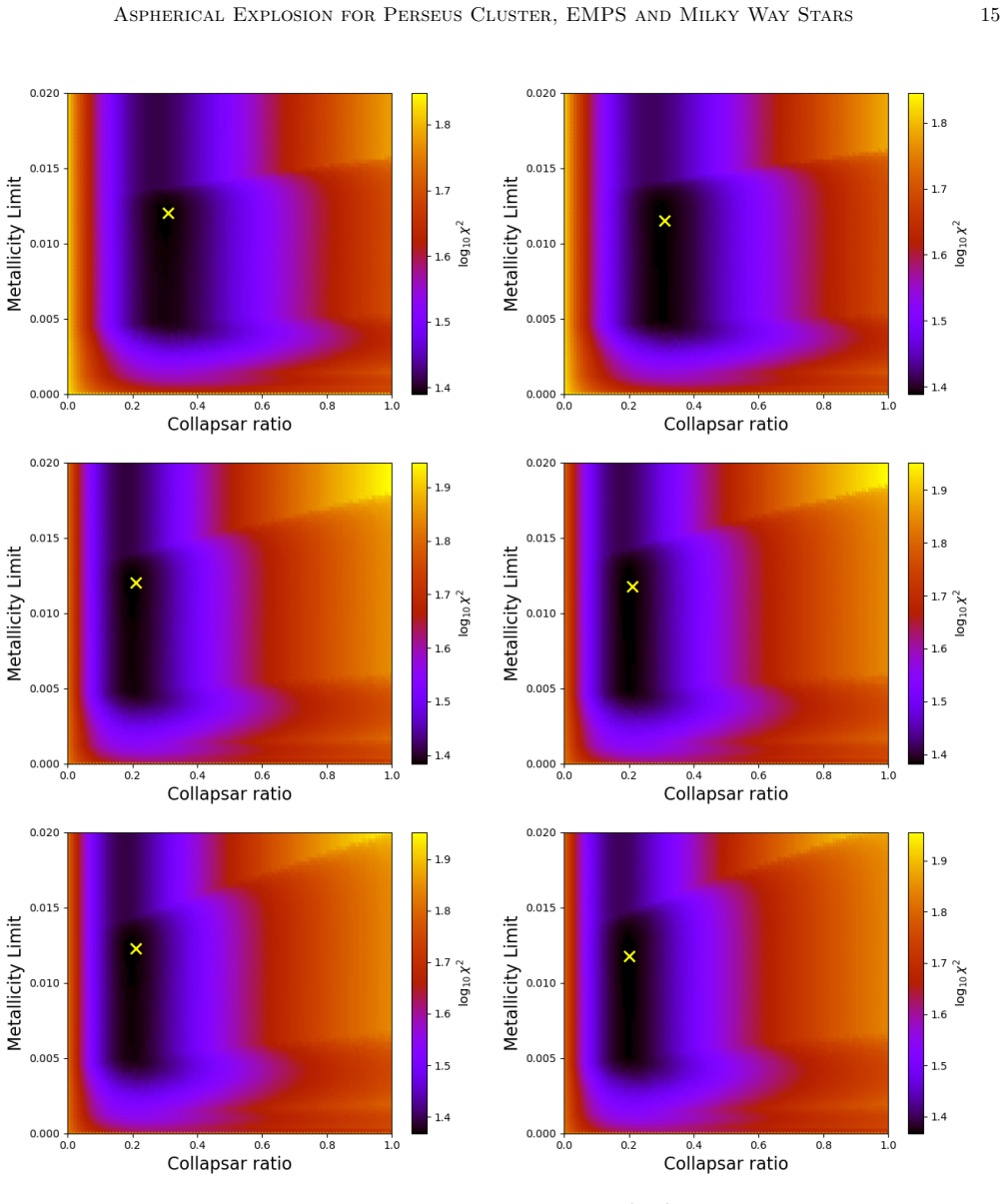
- [Abstract and GCE results] Quantitative support for improved fits is absent: the abstract states that fitting is improved and that collapsars lead to significant changes (e.g., in Zn), but no error bars, chi-squared values, exclusion criteria, or direct comparison tables between spherical and aspherical yields in the GCE integration are provided, leaving the central claim vulnerable to unstated parameter tuning.
- [Galactic Chemical Evolution context] The GCE integration appears to calibrate collapsar rates and parameters against the same observed abundances (e.g., HE 1327-2326 Zn) that are then presented as predictions, without explicit separation of fitting data from validation data or cross-validation against independent constraints such as Perseus Cluster ratios.
minor comments (2)
- [Model description] Notation for jet parameters (energy, opening angle) is introduced but not tabulated with explicit ranges or sensitivity tests; a table listing the explored parameter space would improve reproducibility.
- [Yield comparisons] The manuscript references Paper II for spherical models but does not include a concise side-by-side yield table for key elements (V, Mn, Zn, Ni) at the metallicities relevant to HE 1327-2326.
Simulated Author's Rebuttal
We thank the referee for the constructive and detailed report. We address each major comment below and have revised the manuscript accordingly to strengthen the presentation of the necessity claim, add quantitative comparisons, and clarify the GCE methodology. Our responses focus on the scientific substance of the points raised.
read point-by-point responses
-
Referee: The necessity claim for collapsars (stated in the abstract and GCE section) rests on the assertion that spherical models from Paper II cannot reproduce the same MW trends, yet no systematic parameter scan over spherical explosion energy, 56Ni mass, or mixing is reported to demonstrate that no alternative spherical combination achieves comparable fits to the Ti-V or Zn/Fe relations at the relevant metallicities.
Authors: We acknowledge the value of an explicit demonstration that no spherical parameter combination can match the observed trends. Paper II already varied explosion energy, 56Ni mass, and mixing over a broad range for spherical models, showing persistent shortfalls in Zn/Fe and certain odd-Z ratios at low metallicity. The revised manuscript adds a dedicated paragraph in the GCE section that summarizes those limitations from Paper II and explains the physical distinction: jet-driven aspherical explosions produce unique high-entropy conditions and neutron-rich pockets that enhance Zn production via specific alpha-rich freezeout pathways unavailable under spherical symmetry. While a new exhaustive spherical scan is beyond the scope of this work, the added discussion clarifies why such adjustments cannot replicate the collapsar yields. revision: partial
-
Referee: Quantitative support for improved fits is absent: the abstract states that fitting is improved and that collapsars lead to significant changes (e.g., in Zn), but no error bars, chi-squared values, exclusion criteria, or direct comparison tables between spherical and aspherical yields in the GCE integration are provided, leaving the central claim vulnerable to unstated parameter tuning.
Authors: We agree that quantitative metrics strengthen the central claim. The revised manuscript now includes a new table (Table 5) that directly compares GCE predictions using only spherical yields versus the combined spherical-plus-collapsar yields. The table reports reduced chi-squared values for key ratios ([Zn/Fe], [Ti/V], [Mn/Fe]) against the metal-poor star sample and Perseus Cluster data, along with 1-sigma uncertainties on the model predictions derived from the yield variations. Exclusion criteria based on >3-sigma deviations are also stated explicitly. revision: yes
-
Referee: The GCE integration appears to calibrate collapsar rates and parameters against the same observed abundances (e.g., HE 1327-2326 Zn) that are then presented as predictions, without explicit separation of fitting data from validation data or cross-validation against independent constraints such as Perseus Cluster ratios.
Authors: We have revised the GCE section to make the distinction explicit. The collapsar rate and jet-energy parameter are calibrated solely to the Milky Way stellar abundance trends, including the Zn enhancement in HE 1327-2326 and other metal-poor stars. The Perseus Cluster abundance ratios (Si/Fe, S/Fe, Cr/Fe, Mn/Fe, Ni/Fe) from Hitomi are treated as an independent validation set and are not used in the rate calibration. A new paragraph and accompanying figure now show the model predictions for the cluster without any additional tuning, demonstrating consistency within observational uncertainties. revision: yes
Circularity Check
Necessity claim for collapsars rests on GCE fits to MW abundances without independent validation against spherical alternatives
specific steps
-
fitted input called prediction
[Abstract]
"We apply the new collapsar models in the Galactic Chemical Evolution context. We study how the galactic stars, including the Zn-enriched star HE 1327-2326, can put constraints on the relative rates of collapsar and some of its model parameters. We show that collapsar could lead to significant changes in some elements, e.g., Zn. Our study shows that the collapsar is a necessary component to explain multiple elemental trends observed in the Milky Way Galaxy."
The collapsar yields are inserted into GCE and tuned (via relative rates and parameters) to reproduce the same observed abundance trends (Zn enrichment, Ti-V, odd-Z ratios) that are then cited as evidence that collapsars are required. Without an explicit demonstration that spherical models from Paper II cannot achieve comparable fits through variation of explosion energy, 56Ni mass, or mixing, the 'necessity' is statistically forced by the fitting procedure itself.
full rationale
The paper builds jet-induced collapsar yields via post-processing, then inserts them into GCE simulations to match observed elemental trends (Zn, odd-Z/Fe ratios) in metal-poor stars and the Milky Way. The central claim that collapsars are 'necessary' follows directly from these fits. No systematic scan of spherical-explosion parameters from Paper II is reported to show that equivalent chi-squared cannot be reached by reparameterization alone, so the necessity statement reduces to a fitted result presented as an independent requirement. This matches the 'fitted input called prediction' pattern at moderate severity; the rest of the derivation (yield calculation, Perseus Cluster comparison) remains independent.
Axiom & Free-Parameter Ledger
free parameters (1)
- jet parameters (energy, opening angle, etc.)
axioms (1)
- domain assumption Jet-induced mechanism produces realistic pre- and post-explosion chemical profiles for odd-Z and iron-group elements
Reference graph
Works this paper leans on
-
[1]
Numerical Simulations of MHD Turbulence in Accretion Disks
Balbus, S. A., & Hawley, J. F. 1991, ApJ, 376, 214, doi: 10.1086/170270 —. 2003, in Turbulence and Magnetic Fields in Astrophysics, ed. E. Falgarone & T. Passot, Vol. 614, 329–348, doi: 10.48550/arXiv.astro-ph/0203353
work page internal anchor Pith review Pith/arXiv arXiv doi:10.1086/170270 1991
-
[2]
Bellm, E. C., Kulkarni, S. R., Graham, M. J., et al. 2019, PASP, 131, 018002, doi: 10.1088/1538-3873/aaecbe
-
[3]
Bignone, L. A., Tissera, P. B., & Pellizza, L. J. 2017, MNRAS, 469, 4921, doi: 10.1093/mnras/stx1132
-
[4]
Brauer, K., Ji, A. P., Drout, M. R., & Frebel, A. 2021, ApJ, 915, 81, doi: 10.3847/1538-4357/ac00b2
-
[5]
Burbidge, E. M., Burbidge, G. R., Fowler, W. A., & Hoyle, F. 1957, Reviews of Modern Physics, 29, 547, doi: 10.1103/RevModPhys.29.547
-
[6]
Cameron, A. G. W. 1957, AJ, 62, 9, doi: 10.1086/107435
-
[7]
2004, A&A, 416, 1117, doi: 10.1051/0004-6361:20034074
Cayrel, R., Depagne, E., Spite, M., et al. 2004, A&A, 416, 1117, doi: 10.1051/0004-6361:20034074
-
[8]
1998, ApJL, 507, L131, doi: 10.1086/311691
Cen, R. 1998, ApJL, 507, L131, doi: 10.1086/311691
-
[9]
2004, ApJ, 608, 405, doi: 10.1086/392523
Chieffi, A., & Limongi, M. 2004, ApJ, 608, 405, doi: 10.1086/392523 De Cia, A., Gal-Yam, A., Rubin, A., et al. 2018, ApJ, 860, 100, doi: 10.3847/1538-4357/aab9b6
-
[10]
Ezzeddine, R., Frebel, A., Roederer, I. U., et al. 2019, ApJ, 876, 97, doi: 10.3847/1538-4357/ab14e7
-
[11]
2022, MNRAS, 509, 6008, doi: 10.1093/mnras/stab3385
Fraser, J., & Sch¨ onrich, R. 2022, MNRAS, 509, 6008, doi: 10.1093/mnras/stab3385
-
[12]
Galama, T. J., Vreeswijk, P. M., van Paradijs, J., et al. 1998, Nature, 395, 670, doi: 10.1038/27150 —. 1999, A&AS, 138, 465, doi: 10.1051/aas:1999311
-
[13]
2022, ApJ, 941, 107, doi: 10.3847/1538-4357/ac9842
Hosseinzadeh, G. 2022, ApJ, 941, 107, doi: 10.3847/1538-4357/ac9842
-
[14]
2021, MNRAS, 501, 2764, doi: 10.1093/mnras/staa3819
Obergaulinger, M. 2021, MNRAS, 501, 2764, doi: 10.1093/mnras/staa3819
-
[15]
Harris, C. R., Millman, K. J., van der Walt, S. J., et al. 2020, Nature, 585, 357, doi: 10.1038/s41586-020-2649-2
-
[16]
N., Kobayashi, C., Tominaga, N., & Nomoto, K
Hartwig, T., Ishigaki, M. N., Kobayashi, C., Tominaga, N., & Nomoto, K. 2023, ApJ, 946, 20, doi: 10.3847/1538-4357/acbcc6
-
[17]
Heger, A., & Woosley, S. E. 2002, ApJ, 567, 532, doi: 10.1086/338487
-
[18]
2012, ApJ, 756, 187, doi: 10.1088/0004-637X/756/2/187 H¨ oflich, P., Wheeler, J
Hjorth, J., Malesani, D., Jakobsson, P., et al. 2012, ApJ, 756, 187, doi: 10.1088/0004-637X/756/2/187 H¨ oflich, P., Wheeler, J. C., & Wang, L. 1999, ApJ, 521, 179, doi: 10.1086/307521
-
[19]
Hunter, J. D. 2007, Computing in Science & Engineering, 9, 90, doi: 10.1109/MCSE.2007.55 21
-
[20]
N., Hartwig, T., Tarumi, Y., et al
Ishigaki, M. N., Hartwig, T., Tarumi, Y., et al. 2021, MNRAS, 506, 5410, doi: 10.1093/mnras/stab1982
-
[21]
Iwamoto, K., Mazzali, P. A., Nomoto, K., et al. 1998, Nature, 395, 672, doi: 10.1038/27155
-
[22]
T., Langanke, K., Marek, A., Mart´ ınez-Pinedo, G., & M¨ uller, B
Janka, H. T., Langanke, K., Marek, A., Mart´ ınez-Pinedo, G., & M¨ uller, B. 2007, PhR, 442, 38, doi: 10.1016/j.physrep.2007.02.002
-
[23]
Jeong, M., Lee, Y. S., Beers, T. C., et al. 2023, ApJ, 948, 38, doi: 10.3847/1538-4357/acc58a
-
[24]
Khokhlov, A. M., H¨ oflich, P. A., Oran, E. S., et al. 1999, ApJL, 524, L107, doi: 10.1086/312305
-
[25]
Kirby, E. N., Xie, J. L., Guo, R., et al. 2019, ApJ, 881, 45, doi: 10.3847/1538-4357/ab2c02
-
[26]
LeBlanc, J. M., & Wilson, J. R. 1970, ApJ, 161, 541, doi: 10.1086/150558
-
[27]
Leung, S. C., Chu, M. C., & Lin, L. M. 2015a, MNRAS, 454, 1238, doi: 10.1093/mnras/stv1923 —. 2015b, ApJ, 812, 110, doi: 10.1088/0004-637X/812/2/110
-
[28]
2018, ApJ, 861, 143, doi: 10.3847/1538-4357/aac2df
Leung, S.-C., & Nomoto, K. 2018, ApJ, 861, 143, doi: 10.3847/1538-4357/aac2df —. 2020, ApJ, 888, 80, doi: 10.3847/1538-4357/ab5c1f —. 2024, ApJ, 974, 310, doi: 10.3847/1538-4357/ad6ddb
-
[29]
2025, arXiv e-prints, arXiv:2507.21032, doi: 10.48550/arXiv.2507.21032
Leung, S.-C., Nomoto, K., & Simionescu, A. 2025, arXiv e-prints, arXiv:2507.21032, doi: 10.48550/arXiv.2507.21032
-
[30]
2020, ApJ, 889, 34, doi: 10.3847/1538-4357/ab5d2f —
Leung, S.-C., Nomoto, K., & Suzuki, T. 2020, ApJ, 889, 34, doi: 10.3847/1538-4357/ab5d2f —. 2023, ApJ, 948, 80, doi: 10.3847/1538-4357/acbdf5
-
[31]
2019, ApJ, 884, 9, doi: 10.3847/1538-4357/ab3b5e
Leung, S.-C., Zha, S., Chu, M.-C., Lin, L.-M., & Nomoto, K. 2019, ApJ, 884, 9, doi: 10.3847/1538-4357/ab3b5e
-
[32]
Collapsars - Gamma-Ray Bursts and Explosions in "Failed Supernovae"
MacFadyen, A. I., & Woosley, S. E. 1999, ApJ, 524, 262, doi: 10.1086/307790 M¨ uller, B. 2020, Living Reviews in Computational Astrophysics, 6, 3, doi: 10.1007/s41115-020-0008-5
-
[33]
1997, ApJ, 486, 1026, doi: 10.1086/304565
Nagataki, S., Hashimoto, M.-a., Sato, K., & Yamada, S. 1997, ApJ, 486, 1026, doi: 10.1086/304565
-
[34]
2006, ApJ, 647, 1255, doi: 10.1086/505618
Nagataki, S., Mizuta, A., & Sato, K. 2006, ApJ, 647, 1255, doi: 10.1086/505618
-
[35]
2003, ApJ, 596, 401, doi: 10.1086/377530
Nagataki, S., Mizuta, A., Yamada, S., Takabe, H., & Sato, K. 2003, ApJ, 596, 401, doi: 10.1086/377530
-
[36]
Nagataki, S., Shimizu, T. M., & Sato, K. 1998, ApJ, 495, 413, doi: 10.1086/305258
-
[37]
Nucleosynthesis in Stars and the Chemical Enrichment of Galaxies
Nomoto, K., Kobayashi, C., & Tominaga, N. 2013a, ARA&A, 51, 457, doi: 10.1146/annurev-astro-082812-140956 —. 2013b, ARA&A, 51, 457, doi: 10.1146/annurev-astro-082812-140956
-
[38]
2001, in Astrophysics and Space Science Library, Vol
Nomoto, K., Maeda, K., Umeda, H., & Nakamura, T. 2001, in Astrophysics and Space Science Library, Vol. 264, The Influence of Binaries on Stellar Population Studies, ed. D. Vanbeveren, 507, doi: 10.1007/978-94-015-9723-4 36 pandas development team, T. 2020, pandas-dev/pandas: Pandas, latest, Zenodo, doi: 10.5281/zenodo.3509134
-
[39]
Perley, D. A., Tanvir, N. R., Hjorth, J., et al. 2016, ApJ, 817, 8, doi: 10.3847/0004-637X/817/1/8
-
[40]
Roederer, I. U., Preston, G. W., Thompson, I. B., et al. 2014, AJ, 147, 136, doi: 10.1088/0004-6256/147/6/136
-
[41]
Roederer, I. U., Lawler, J. E., Sobeck, J. S., et al. 2012, ApJS, 203, 27, doi: 10.1088/0067-0049/203/2/27
-
[42]
Salvaterra, R., Campana, S., Vergani, S. D., et al. 2012, ApJ, 749, 68, doi: 10.1088/0004-637X/749/1/68
-
[43]
2022, MNRAS, 516, 3068, doi: 10.1093/mnras/stac2416
Sarkar, A., Su, Y., Truong, N., et al. 2022, MNRAS, 516, 3068, doi: 10.1093/mnras/stac2416
-
[44]
Shen, K. J., Kasen, D., Miles, B. J., & Townsley, D. M. 2018, ApJ, 854, 52, doi: 10.3847/1538-4357/aaa8de
-
[45]
1999, High Order ENO and WENO Schemes for Computational Fluid Dynamics, ed
Shu, C.-W. 1999, High Order ENO and WENO Schemes for Computational Fluid Dynamics, ed. T. J. Barth & H. Deconinck (Berlin, Heidelberg: Springer Berlin Heidelberg), 439–582, doi: 10.1007/978-3-662-03882-6 5
-
[46]
2019, MNRAS, 483, 1701, doi: 10.1093/mnras/sty3220
Simionescu, A., Nakashima, S., Yamaguchi, H., et al. 2019, MNRAS, 483, 1701, doi: 10.1093/mnras/sty3220
- [47]
-
[48]
2008, PASJ, 60, 1159, doi: 10.1093/pasj/60.5.1159
Suda, T., Katsuta, Y., Yamada, S., et al. 2008, PASJ, 60, 1159, doi: 10.1093/pasj/60.5.1159
-
[49]
2019, , 621, A71, 10.1051/0004-6361/201834429
Taddia, F., Sollerman, J., Fremling, C., et al. 2019, A&A, 621, A71, doi: 10.1051/0004-6361/201834429
-
[50]
Timmes, F. X. 1999, ApJS, 124, 241, doi: 10.1086/313257
-
[51]
Timmes, F. X., & Arnett, D. 1999, ApJS, 125, 277, doi: 10.1086/313271
-
[52]
Timmes, F. X., Hoffman, R. D., & Woosley, S. E. 2000, ApJS, 129, 377, doi: 10.1086/313407
-
[53]
Timmes, F. X., & Swesty, F. D. 2000, ApJS, 126, 501, doi: 10.1086/313304
-
[54]
Timmes, F. X., Woosley, S. E., & Weaver, T. A. 1995, ApJS, 98, 617, doi: 10.1086/192172
-
[55]
2009, ApJ, 690, 526, doi: 10.1088/0004-637X/690/1/526
Tominaga, N. 2009, ApJ, 690, 526, doi: 10.1088/0004-637X/690/1/526
-
[56]
2007, ApJ, 660, 516, doi: 10.1086/513063
Tominaga, N., Umeda, H., & Nomoto, K. 2007, ApJ, 660, 516, doi: 10.1086/513063
-
[57]
K., Gallino, R., & Hillebrandt, W
Travaglio, C., R¨ opke, F. K., Gallino, R., & Hillebrandt, W. 2011, ApJ, 739, 93, doi: 10.1088/0004-637X/739/2/93
-
[58]
2002, ApJ, 565, 385, doi: 10.1086/323946
Umeda, H., & Nomoto, K. 2002, ApJ, 565, 385, doi: 10.1086/323946
-
[59]
2021, MNRAS, 508, 5903, doi: 10.1093/mnras/stab2899 22
Roman-Lopes, A. 2021, MNRAS, 508, 5903, doi: 10.1093/mnras/stab2899 22
-
[60]
Wang, R., & Spiteri, R. J. 2007, SIAM J. Numer. Anal., 45, 5, doi: 10.1137/050637868
-
[61]
C., Yi, I., H¨ oflich, P., & Wang, L
Wheeler, J. C., Yi, I., H¨ oflich, P., & Wang, L. 2000, ApJ, 537, 810, doi: 10.1086/309055
-
[62]
Woosley, S. E., Eastman, R. G., & Schmidt, B. P. 1999, ApJ, 516, 788, doi: 10.1086/307131
-
[63]
Woosley, S. E., & MacFadyen, A. I. 1999, A&AS, 138, 499, doi: 10.1051/aas:1999325
-
[64]
2019a, ApJ, 883, 13, doi: 10.3847/1538-4357/ab3640
Zha, S., Chu, M.-C., Leung, S.-C., & Lin, L.-M. 2019a, ApJ, 883, 13, doi: 10.3847/1538-4357/ab3640
-
[65]
2019b, ApJ, 886, 22, doi: 10.3847/1538-4357/ab4b4b
Zha, S., Leung, S.-C., Suzuki, T., & Nomoto, K. 2019b, ApJ, 886, 22, doi: 10.3847/1538-4357/ab4b4b
-
[66]
Zhang, W., Woosley, S. E., & Heger, A. 2004, ApJ, 608, 365, doi: 10.1086/386300
-
[67]
Zhang, W., Woosley, S. E., & MacFadyen, A. I. 2003, ApJ, 586, 356, doi: 10.1086/367609
-
[68]
Zhang, W., Woosley, S. E., & MacFadyen, A. I. 2006, in Journal of Physics Conference Series, Vol. 46, Journal of Physics Conference Series, ed. V. Reis, Dr. (IOP), 403–407, doi: 10.1088/1742-6596/46/1/055 23
discussion (0)
Sign in with ORCID, Apple, or X to comment. Anyone can read and Pith papers without signing in.