Privacy-Preserving Proof of Human Authorship via Zero-Knowledge Process Attestation
Pith reviewed 2026-05-15 18:23 UTC · model grok-4.3
The pith
Zero-knowledge proofs let verifiers confirm human authorship of writing without learning keystroke data, timings, or editing history.
A machine-rendered reading of the paper's core claim, the machinery that carries it, and where it could break.
Core claim
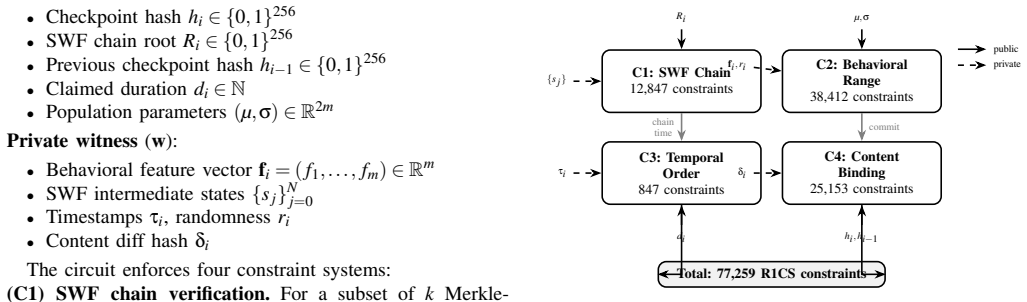
ZK-PoP allows a verifier to confirm that sequential work function chains were computed correctly, that behavioral feature vectors fall within human population distributions, and that content evolution is consistent with incremental human editing, all without learning the underlying behavioral data, exact timing, or intermediate content.
What carries the argument
ZK-PoP encodes behavioral biometrics and process constraints into arithmetic circuits, then applies Groth16 proofs with Pedersen commitments and Bulletproof range proofs to attest correctness and distributional compliance in zero knowledge.
If this is right
- Verifiers obtain cryptographic assurance of human authorship while the prover retains all raw behavioral measurements and content history.
- The system satisfies computational zero-knowledge, computational soundness, and unlinkability across independent sessions.
- Proof generation completes in under 30 seconds for a one-hour writing session, yielding 192-byte proofs that verify in 8.2 milliseconds.
- Simulation accuracy loss stays below 5 percent at privacy levels epsilon greater than or equal to 1.0.
Where Pith is reading between the lines
- The same circuit structure could support private attestation for other sequential creative processes whose intermediate states are sensitive.
- Unlinkability enables repeated authorship checks on the same author without allowing cross-session linkage or profile construction.
- Platforms could embed such proofs to distinguish human from machine-generated material while satisfying data-minimization rules.
Load-bearing premise
Behavioral biometric features can be encoded into arithmetic circuits such that range proofs and consistency checks remain both sound and sufficiently accurate when the underlying distributions are treated as public and fixed.
What would settle it
A test in which synthetic non-human inputs generate valid ZK-PoP proofs at rates matching human sessions, or in which accuracy drops more than 5 percent relative to non-private baselines at epsilon values of 1.0 or higher.
Figures

read the original abstract
Process attestation verifies human authorship by collecting behavioral biometric evidence, including keystroke dynamics, typing patterns, and editing behavior, during the creative process. However, the very data needed to prove authenticity can reveal intimate details about an author's cognitive state, health conditions, and identity, constituting sensitive biometric data under GDPR Article 9. We resolve this privacy-attestation paradox using zero-knowledge proofs. We present ZK-PoP, a construction that allows a verifier to confirm that (a) sequential work function chains were computed correctly, (b) behavioral feature vectors fall within human population distributions, and (c) content evolution is consistent with incremental human editing, all without learning the underlying behavioral data, exact timing, or intermediate content. Our construction uses Groth16 proofs over arithmetic circuits with Pedersen commitments and Bulletproof range proofs. We prove that ZK-PoP is computationally zero-knowledge, computationally sound, and achieves unlinkability across sessions. Evaluation shows proof generation in under 30 seconds for a 1-hour writing session, with 192-byte proofs verifiable in 8.2 ms, while incurring less than 5% accuracy loss in simulation at practical privacy levels (epsilon >= 1.0) compared to non-private baselines.
Editorial analysis
A structured set of objections, weighed in public.
Referee Report
Summary. The paper presents ZK-PoP, a zero-knowledge construction for privacy-preserving proof of human authorship. It allows a verifier to confirm correct computation of sequential work function chains, that behavioral feature vectors (keystroke dynamics, editing patterns) lie within fixed human population distributions, and that content evolution is consistent with incremental human editing, all via Groth16 proofs over arithmetic circuits, Pedersen commitments, and Bulletproof range proofs, without revealing the underlying biometric data, timings, or intermediate content. The manuscript claims computational zero-knowledge, computational soundness, and unlinkability across sessions, with reported performance of under 30s proof generation for 1-hour sessions, 192-byte proofs verifiable in 8.2ms, and less than 5% accuracy loss versus non-private baselines at epsilon >=1.0.
Significance. If the security reductions, circuit encodings, and accuracy claims hold under realistic conditions, the result would provide a concrete mechanism for attesting human authorship while satisfying strict privacy constraints such as GDPR Article 9, with potential applications in content authentication, academic integrity systems, and AI-detection pipelines. The reliance on standard primitives (Groth16, Bulletproofs) is a strength for deployability, though the simulation-only evaluation limits immediate practical significance.
major comments (3)
- [Abstract] Abstract and construction description: the claims of computational zero-knowledge, soundness, and unlinkability are asserted without any circuit specification, security reduction, or concrete parameter choices (e.g., curve, field size, or Bulletproof bit-lengths) for encoding behavioral features and range proofs.
- [Evaluation] Evaluation section: accuracy figures and the <5% loss claim are obtained from simulation only; no concrete parameter choices or robustness experiments against shifts in biometric distributions (demographics, devices, writing contexts) are provided, which directly undermines the soundness of the 'human population distribution' classification.
- [Construction] Construction (behavioral feature encoding): treating fixed public distributions as inputs to Bulletproof range proofs and consistency checks is load-bearing for the central human-authorship claim; the manuscript provides no argument or test showing that the resulting circuit remains sound and accurate when real population variability is present.
minor comments (1)
- The privacy parameter epsilon is referenced but its precise meaning (differential privacy, statistical distance, or other) and how it is enforced inside the arithmetic circuit are not clarified.
Simulated Author's Rebuttal
We thank the referee for their constructive comments. We address each major comment below and will revise the manuscript accordingly to provide greater detail on security claims, evaluation parameters, and construction justifications.
read point-by-point responses
-
Referee: [Abstract] Abstract and construction description: the claims of computational zero-knowledge, soundness, and unlinkability are asserted without any circuit specification, security reduction, or concrete parameter choices (e.g., curve, field size, or Bulletproof bit-lengths) for encoding behavioral features and range proofs.
Authors: We agree more explicit details are warranted. The full paper contains security definitions and a high-level reduction in Section 4, but we will expand the abstract and add a new subsection specifying the arithmetic circuit structure, the concrete security reduction sketch, and parameter choices including the BN254 curve, 256-bit prime field, and 64-bit Bulletproof ranges for all feature encodings and range proofs. revision: yes
-
Referee: [Evaluation] Evaluation section: accuracy figures and the <5% loss claim are obtained from simulation only; no concrete parameter choices or robustness experiments against shifts in biometric distributions (demographics, devices, writing contexts) are provided, which directly undermines the soundness of the 'human population distribution' classification.
Authors: The evaluation is explicitly simulation-based as stated in the abstract. We will revise the evaluation section to document the exact simulation parameters (distributions drawn from cited public keystroke and editing datasets) and add a limitations paragraph on demographic and device shifts. Comprehensive real-world robustness experiments require additional data collection and are noted as future work. revision: partial
-
Referee: [Construction] Construction (behavioral feature encoding): treating fixed public distributions as inputs to Bulletproof range proofs and consistency checks is load-bearing for the central human-authorship claim; the manuscript provides no argument or test showing that the resulting circuit remains sound and accurate when real population variability is present.
Authors: We will add a dedicated paragraph in the construction section that justifies the fixed public distributions via reference to established biometric population studies and argues that the range proofs and consistency checks preserve soundness under the modeling assumption that the public distributions are representative. We will also include a simulation-based sensitivity analysis demonstrating accuracy under moderate distribution perturbations. revision: yes
Circularity Check
Standard cryptographic primitives with no internal fitting or self-referential derivation
full rationale
The paper constructs ZK-PoP directly from established primitives (Groth16 proofs, Pedersen commitments, Bulletproof range proofs) and states standard security properties (computational zero-knowledge, soundness, unlinkability). No equations or claims reduce a 'prediction' or core result to a parameter fitted inside the same paper, nor do they rely on self-citation for uniqueness or load-bearing assumptions. Behavioral distributions are treated as fixed public inputs per the weakest assumption, but this is an explicit modeling choice rather than a circular reduction. Evaluation reports simulation accuracy loss without claiming the loss itself is derived from the protocol equations.
Axiom & Free-Parameter Ledger
free parameters (1)
- epsilon =
>=1.0
axioms (2)
- standard math Groth16 is computationally zero-knowledge and sound under standard assumptions
- domain assumption Human population distributions for behavioral features are well-defined and suitable for public range proofs
Lean theorems connected to this paper
-
IndisputableMonolith/Cost/FunctionalEquation.leanwashburn_uniqueness_aczel unclear?
unclearRelation between the paper passage and the cited Recognition theorem.
Our construction uses Groth16 proofs over arithmetic circuits with Pedersen commitments and Bulletproof range proofs... behavioral feature vectors fall within human population distributions
-
IndisputableMonolith/Foundation/ArithmeticFromLogic.leanLogicNat recovery theorem unclear?
unclearRelation between the paper passage and the cited Recognition theorem.
The circuit enforces four constraint systems: (C1) SWF chain verification... (C2) Behavioral range verification... (C3) Temporal consistency... (C4) Content binding
What do these tags mean?
- matches
- The paper's claim is directly supported by a theorem in the formal canon.
- supports
- The theorem supports part of the paper's argument, but the paper may add assumptions or extra steps.
- extends
- The paper goes beyond the formal theorem; the theorem is a base layer rather than the whole result.
- uses
- The paper appears to rely on the theorem as machinery.
- contradicts
- The paper's claim conflicts with a theorem or certificate in the canon.
- unclear
- Pith found a possible connection, but the passage is too broad, indirect, or ambiguous to say the theorem truly supports the claim.
Reference graph
Works this paper leans on
-
[1]
Can AI-Generated Text be Reliably Detected?
V . S. Sadasivan, A. Kumar, S. Balasubramanian, W. Wang, and S. Feizi, “Can AI-generated text be reliably detected?”arXiv preprint arXiv:2303.11156, 2024
work page Pith review arXiv 2024
-
[2]
W. Liang, Z. Izzo, Y . Zhang, H. Lepp, H. Cao, X. Zhao, L. Chen, H. Ye, S. Liu, Z. Huang, D. A. McFarland, and J. Y . Zou, “Monitoring AI-modified content at scale: A case study on the impact of ChatGPT on AI conference peer reviews,” inInternational Conference on Machine Learning (ICML), 2024
work page 2024
-
[3]
Uncertainty in authorship: Why perfect AI detection is mathematically impossible,
A. G. Ganie, “Uncertainty in authorship: Why perfect AI detection is mathematically impossible,”arXiv preprint arXiv:2509.11915, 2025
-
[4]
Identifying emotional states using keystroke dynamics,
C. Epp, M. Lippold, and R. L. Mandryk, “Identifying emotional states using keystroke dynamics,” inProc. ACM CHI Conf. Human Factors in Computing Systems, 2011, pp. 715–724
work page 2011
-
[5]
Using stylometry for biometric keystroke dynamics,
A. Goodman and V . Zabala, “Using stylometry for biometric keystroke dynamics,” inInternational Conference on Information Security, 2007
work page 2007
-
[6]
Keystroke dynamics as a biometric for authentication,
F. Monrose and A. D. Rubin, “Keystroke dynamics as a biometric for authentication,”Future Generation Computer Systems, vol. 16, no. 4, pp. 351–359, 2000
work page 2000
-
[7]
Regulation (EU) 2016/679 (general data protection regulation),
European Parliament and Council, “Regulation (EU) 2016/679 (general data protection regulation),”Official Journal of the European Union, vol. L 119, pp. 1–88, 2016
work page 2016
-
[8]
Privacy and data protection issues of biometric applica- tions,
E. J. Kindt, “Privacy and data protection issues of biometric applica- tions,”Law, Governance and Technology Series, vol. 12, 2013
work page 2013
-
[9]
The knowledge complexity of interactive proof systems,
S. Goldwasser, S. Micali, and C. Rackoff, “The knowledge complexity of interactive proof systems,”SIAM Journal on Computing, vol. 18, no. 1, pp. 186–208, 1989
work page 1989
-
[10]
Remote ATtestation procedures (RATS) architecture,
H. Birkholz, D. Thaler, M. Richardson, N. Smith, and W. Pan, “Remote ATtestation procedures (RATS) architecture,” IETF, RFC 9334, Jan. 2023
work page 2023
-
[11]
Argon2: New generation of memory-hard functions for password hashing and other applications,
A. Biryukov, D. Dinu, and D. Khovratovich, “Argon2: New generation of memory-hard functions for password hashing and other applications,” in IEEE European Symposium on Security and Privacy (EuroS&P), 2016, pp. 292–302
work page 2016
-
[12]
Pinocchio: Nearly practical verifiable computation,
B. Parno, J. Howell, C. Gentry, and M. Raykova, “Pinocchio: Nearly practical verifiable computation,” inIEEE Symposium on Security and Privacy (S&P), 2013, pp. 238–252
work page 2013
-
[13]
Succinct non- interactive zero knowledge for a von Neumann architecture,
E. Ben-Sasson, A. Chiesa, E. Tromer, and M. Virza, “Succinct non- interactive zero knowledge for a von Neumann architecture,” inUSENIX Security Symposium, 2014, pp. 781–796
work page 2014
-
[14]
On the size of pairing-based non-interactive arguments,
J. Groth, “On the size of pairing-based non-interactive arguments,” in Advances in Cryptology – EUROCRYPT 2016. Springer, 2016, pp. 305–326
work page 2016
-
[15]
PLONK: Permuta- tions over lagrange-bases for oecumenical noninteractive arguments of knowledge,
A. Gabizon, Z. J. Williamson, and O. Ciobotaru, “PLONK: Permuta- tions over lagrange-bases for oecumenical noninteractive arguments of knowledge,” inCryptology ePrint Archive, Report 2019/953, 2019
work page 2019
-
[16]
Bulletproofs: Short proofs for confidential transactions and more,
B. B ¨unz, J. Bootle, D. Boneh, A. Poelstra, P. Wuille, and G. Maxwell, “Bulletproofs: Short proofs for confidential transactions and more,” in IEEE Symposium on Security and Privacy (S&P), 2018, pp. 315–334
work page 2018
-
[17]
Recursive proof composition without a trusted setup,
S. Bowe, J. Grigg, and D. Hopwood, “Recursive proof composition without a trusted setup,” inAdvances in Cryptology – CRYPTO 2020. Springer, 2020, pp. 738–768
work page 2020
-
[18]
Fractal: Post-quantum and trans- parent recursive proofs from holography,
A. Chiesa, D. Ojha, and N. Spooner, “Fractal: Post-quantum and trans- parent recursive proofs from holography,” inAdvances in Cryptology – EUROCRYPT 2020. Springer, 2020, pp. 769–793. [19]Information security, cybersecurity and privacy protection — Biometric template protection, International Organization for Standardization Std. ISO/IEC 24 745:2022, 2022
work page 2020
-
[19]
Fuzzy extractors: How to generate strong keys from biometrics and other noisy data,
Y . Dodis, R. Ostrovsky, L. Reyzin, and A. Smith, “Fuzzy extractors: How to generate strong keys from biometrics and other noisy data,” SIAM Journal on Computing, vol. 38, no. 1, pp. 97–139, 2008
work page 2008
-
[20]
Biohashing: Two factor authentication featuring fingerprint data and tokenised random number,
A. T. B. Jin, D. N. C. Ling, and A. Goh, “Biohashing: Two factor authentication featuring fingerprint data and tokenised random number,” Pattern Recognition, vol. 37, no. 11, pp. 2245–2255, 2004
work page 2004
-
[21]
A survey on biometric cryptosystems and cancelable biometrics,
C. Rathgeb and A. Uhl, “A survey on biometric cryptosystems and cancelable biometrics,” inEURASIP Journal on Information Security, vol. 2011, 2011, pp. 1–25
work page 2011
-
[22]
Identification with encrypted biometric data,
J. Bringer, H. Chabanne, and B. Kindarji, “Identification with encrypted biometric data,” inInternational Conference on Security and Cryptog- raphy (SECRYPT), 2007, pp. 279–286
work page 2007
-
[23]
Privacy-preserving face recognition,
Z. Erkin, M. Franz, J. Guajardo, S. Katzenbeisser, I. Lagendijk, and T. Toft, “Privacy-preserving face recognition,” inInternational Sympo- sium on Privacy Enhancing Technologies (PETS). Springer, 2009, pp. 235–253
work page 2009
-
[24]
Biometric authentication with zero-knowledge proofs,
A. Bassit, F. Hahn, J. Joosten, R. Veldhuis, and A. Peter, “Biometric authentication with zero-knowledge proofs,” inInternational Conference of the Biometrics Special Interest Group (BIOSIG), 2022, pp. 1–6
work page 2022
-
[25]
Calibrating noise to sensitivity in private data analysis,
C. Dwork, F. McSherry, K. Nissim, and A. Smith, “Calibrating noise to sensitivity in private data analysis,” inTheory of Cryptography Conference (TCC). Springer, 2006, pp. 265–284
work page 2006
-
[26]
The algorithmic foundations of differential privacy,
C. Dwork and A. Roth, “The algorithmic foundations of differential privacy,”Foundations and Trends in Theoretical Computer Science, vol. 9, no. 3–4, pp. 211–407, 2014
work page 2014
-
[27]
KLiCKe: Keystroke logging in compositions for knowledge evaluation,
L. Tian, S. Crossley, and L. V . Waes, “KLiCKe: Keystroke logging in compositions for knowledge evaluation,”Journal of Writing Re- search, 2025, 4,992 writers, CC BY 4.0; Kaggle dataset ID: tla-lab- pii-competition-dataset
work page 2025
-
[28]
Poseidon: A new hash function for zero-knowledge proof systems,
L. Grassi, D. Khovratovich, C. Rechberger, A. Roy, and M. Schofnegger, “Poseidon: A new hash function for zero-knowledge proof systems,” in USENIX Security Symposium, 2021, pp. 519–535
work page 2021
-
[29]
Nova: Recursive zero-knowledge arguments from folding schemes,
A. Kothapalli, S. Setty, and I. Tzialla, “Nova: Recursive zero-knowledge arguments from folding schemes,” inAdvances in Cryptology – CRYPTO
-
[30]
Springer, 2022, pp. 247–277
work page 2022
-
[31]
ProtoGalaxy: Efficient ProtoStar-style fold- ing of multiple instances,
L. Eagen and A. Gabizon, “ProtoGalaxy: Efficient ProtoStar-style fold- ing of multiple instances,” Cryptology ePrint Archive, Report 2023/1106, 2023
work page 2023
-
[32]
Observa- tions on typing from 136 million keystrokes,
V . Dhakal, A. M. Feit, P. O. Kristensson, and A. Oulasvirta, “Observa- tions on typing from 136 million keystrokes,” inProc. ACM CHI Conf. Human Factors in Computing Systems, 2018, pp. 1–12
work page 2018
-
[33]
Non-interactive and information-theoretic secure ver- ifiable secret sharing,
T. P. Pedersen, “Non-interactive and information-theoretic secure ver- ifiable secret sharing,” inAdvances in Cryptology – CRYPTO ’91. Springer, 1992, pp. 129–140
work page 1992
-
[34]
A cognitive process theory of writing,
L. Flower and J. R. Hayes, “A cognitive process theory of writing,” College Composition and Communication, vol. 32, no. 4, pp. 365–387, 1981
work page 1981
-
[35]
Perceptual, cognitive, and motoric aspects of tran- scription typing,
T. A. Salthouse, “Perceptual, cognitive, and motoric aspects of tran- scription typing,”Psychological Review, vol. 93, no. 3, pp. 303–319, 1986
work page 1986
-
[36]
ScholaWrite: A dataset of end-to-end scholarly writing process,
K. C. Le, L. Wang, M. Lee, R. V olkov, L. T. Chau, and D. Kang, “ScholaWrite: A dataset of end-to-end scholarly writing process,”arXiv preprint arXiv:2502.02904, 2025
-
[37]
Universally composable security: A new paradigm for cryp- tographic protocols,
R. Canetti, “Universally composable security: A new paradigm for cryp- tographic protocols,” inIEEE Symposium on Foundations of Computer Science (FOCS), 2001, pp. 136–145
work page 2001
-
[38]
arkworks: An ecosystem for developing and programming with zkSNARKs,
arkworks contributors, “arkworks: An ecosystem for developing and programming with zkSNARKs,” https://arkworks.rs, 2022
work page 2022
-
[39]
ICICLE: A GPU acceleration library for zero-knowledge proofs,
Ingonyama, “ICICLE: A GPU acceleration library for zero-knowledge proofs,” https://github.com/ingonyama-zk/icicle, 2024
work page 2024
-
[40]
HyperPlonk: Plonk with linear-time prover and high-degree custom gates,
B. Chen, B. B ¨unz, D. Boneh, and Z. Zhang, “HyperPlonk: Plonk with linear-time prover and high-degree custom gates,” inAdvances in Cryptology – EUROCRYPT 2023. Springer, 2023
work page 2023
-
[41]
Scalable multi-party computation for zk-SNARK parameters in the random beacon model,
S. Bowe, A. Gabizon, and I. Miers, “Scalable multi-party computation for zk-SNARK parameters in the random beacon model,” inCryptology ePrint Archive, Report 2017/1050, 2018
work page 2017
-
[42]
Self-organization of cognitive performance,
G. C. V . Orden, J. G. Holden, and M. T. Turvey, “Self-organization of cognitive performance,”Journal of Experimental Psychology: General, vol. 132, no. 3, pp. 331–350, 2003
work page 2003
-
[43]
A signature scheme with efficient protocols,
J. Camenisch and A. Lysyanskaya, “A signature scheme with efficient protocols,” inInternational Conference on Security in Communication Networks (SCN). Springer, 2002, pp. 268–289
work page 2002
-
[44]
KYC without knowing your customer: Privacy-preserving identity verification,
S. Agrawal and S. Raghuraman, “KYC without knowing your customer: Privacy-preserving identity verification,” inACM Conference on Com- puter and Communications Security (CCS), 2022, pp. 295–308
work page 2022
-
[45]
Semaphore: Zero-knowledge signaling on Ethereum,
B. Whitehatet al., “Semaphore: Zero-knowledge signaling on Ethereum,” https://semaphore.pse.dev, 2022
work page 2022
-
[46]
Multi- biometric template protection: A review,
L. Gomez-Barrero, J. Galbally, C. Rathgeb, and C. Busch, “Multi- biometric template protection: A review,”Information Fusion, vol. 100, p. 101914, 2023
work page 2023
-
[47]
Keystroke dynamics against academic dishonesty in the age of LLMs,
D. Kundu, A. Mehta, R. Kumar, N. Lal, A. Anand, A. Singh, and R. R. Shah, “Keystroke dynamics against academic dishonesty in the age of LLMs,” inIEEE International Joint Conference on Biometrics (IJCB), 2024
work page 2024
-
[48]
Detecting AI-assisted writing via keystroke dynamics,
A. Mehta, R. Kumar, and R. R. Shah, “Detecting AI-assisted writing via keystroke dynamics,” inInternational Conference on Pattern Recogni- tion (ICPR), 2024
work page 2024
-
[49]
L. Fridman, S. Weber, R. Greenstadt, and M. Kam, “Active authentica- tion on mobile devices via stylometry, application usage, web browsing, and GPS location,”IEEE Access, vol. 5, pp. 21 030–21 048, 2017
work page 2017
-
[50]
Signature schemes and anonymous credentials from bilinear maps,
J. Camenisch and A. Lysyanskaya, “Signature schemes and anonymous credentials from bilinear maps,” inAdvances in Cryptology – CRYPTO
-
[51]
Springer, 2004, pp. 56–72
work page 2004
-
[52]
Brands,Rethinking Public Key Infrastructures and Digital Certifi- cates: Building in Privacy
S. Brands,Rethinking Public Key Infrastructures and Digital Certifi- cates: Building in Privacy. MIT Press, 2000
work page 2000
-
[53]
zkCNN: Zero knowledge proofs for convolutional neural networks,
T. Liu, X. Xie, and Y . Zhang, “zkCNN: Zero knowledge proofs for convolutional neural networks,” inACM Conference on Computer and Communications Security (CCS), 2021, pp. 2968–2985
work page 2021
-
[54]
Mystique: Efficient conver- sions for zero-knowledge proofs with applications to machine learning,
C. Weng, K. Yang, J. Katz, and X. Wang, “Mystique: Efficient conver- sions for zero-knowledge proofs with applications to machine learning,” inUSENIX Security Symposium, 2021
work page 2021
-
[55]
V . Costan and S. Devadas, “Intel SGX explained,” inIACR Cryptology ePrint Archive, vol. 2016/086, 2016
work page 2016
-
[56]
Efficient lifting for shorter zero-knowledge proofs and post-quantum signatures,
D. Kales and G. Zaverucha, “Efficient lifting for shorter zero-knowledge proofs and post-quantum signatures,” inCryptology ePrint Archive, Report 2020/846, 2020
work page 2020
-
[57]
Zero-knowledge from secure multiparty computation,
Y . Ishai, E. Kushilevitz, R. Ostrovsky, and A. Sahai, “Zero-knowledge from secure multiparty computation,” inACM Symposium on Theory of Computing (STOC), 2007, pp. 21–30
work page 2007
-
[58]
C2PA technical specification, version 2.3,
Coalition for Content Provenance and Authenticity, “C2PA technical specification, version 2.3,” https://c2pa.org/specifications/, 2025
work page 2025
discussion (0)
Sign in with ORCID, Apple, or X to comment. Anyone can read and Pith papers without signing in.