Recognition: 2 theorem links
· Lean TheoremPost-perihelion Coma Composition of the Interstellar Comet 3I/ATLAS from Optical Spectroscopy
Pith reviewed 2026-05-15 14:42 UTC · model grok-4.3
The pith
Post-perihelion spectra of interstellar comet 3I/ATLAS show reduced C2 depletion and a metal-CO link in coma outgassing.
A machine-rendered reading of the paper's core claim, the machinery that carries it, and where it could break.
Core claim
Multi-epoch post-perihelion spectroscopy reveals that the coma of 3I/ATLAS is less depleted in C2 than it was pre-perihelion, exhibits a gradual outbound decline in CN and metal production, follows the metal-CO correlation seen in other comets, and requires additional oxygen parents to account for the [O I] lambda 6300 residual after subtracting H2O, CO2, and CO contributions.
What carries the argument
Production rates and mixing ratios extracted from optical emission lines of CN, C2, C3, CH, Fe I, and Ni I, compared across pre- and post-perihelion epochs.
If this is right
- The comet's activity pattern shifts across perihelion with slower outbound decline in CN and metals.
- Gaseous metal release ties more closely to a CO-bearing reservoir than to H2O, possibly as metal carbonyls.
- Compositional heterogeneity or subsurface activation supplies the observed post-perihelion C2 increase.
- Extra oxygen-bearing parents beyond H2O, CO2, and CO are required in the coma.
Where Pith is reading between the lines
- Layered ices could explain why C2 and metals behave differently before and after closest approach.
- Similar metal-CO relations in solar-system comets would support a shared volatile chemistry across origins.
- Targeted infrared searches for carbonyl features could test the proposed metal-release mechanism.
Load-bearing premise
Production rates derived from the optical spectra accurately reflect true coma abundances without major contamination, model-dependent corrections, or unaccounted excitation effects.
What would settle it
A full accounting of the [O I] 6300 residual by updated H2O, CO2, and CO models alone, or pre- and post-perihelion C2 production rates that match exactly once identical modeling assumptions are applied.
Figures


read the original abstract
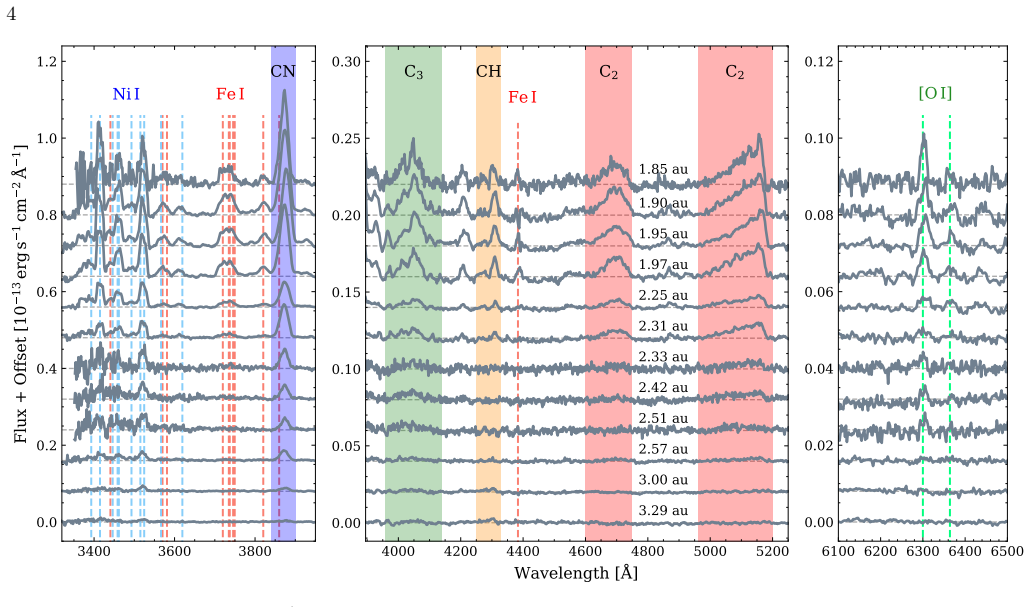
We present multi-epoch optical spectroscopy of the interstellar comet 3I/ATLAS obtained between December 2025 and January 2026 (heliocentric distances 1.8-3.3 au), yielding post-perihelion production rates and mixing ratios for CN, C$_3$, C$_2$, CH, and gaseous metals (Fe I and Ni I). Our results show that the coma is less depleted in C$_2$ after perihelion than before, indicative of subsurface activation or compositional heterogeneity. The outgassing profiles reveal a pronounced perihelion asymmetry: CN and metal production rates decline more gradually outbound than inbound, consistent with the reported behavior of H$_2$O and implying a change in the comet's activity pattern across perihelion. Despite being metal-rich relative to its H$_2$O content, 3I follows the metal-CO correlation observed in comets of diverse origins, suggesting that gaseous metal release is more closely linked to a CO-bearing volatile reservoir than to H$_2$O, potentially in the form of metal carbonyls. In addition, the significant residual in the [O I] $\lambda6300$ emission cannot be explained by H$_2$O, CO$_2$, and CO alone, indicating a contribution from additional oxygen-bearing parents.
Editorial analysis
A structured set of objections, weighed in public.
Referee Report
Summary. The manuscript reports multi-epoch optical spectroscopy of interstellar comet 3I/ATLAS obtained December 2025–January 2026 at rh = 1.8–3.3 au, deriving post-perihelion production rates and mixing ratios for CN, C3, C2, CH, Fe I, and Ni I. It claims reduced C2 depletion after perihelion (suggesting subsurface activation or heterogeneity), perihelion asymmetry in outgassing consistent with H2O, adherence to the metal-CO correlation (implying metal release linked to CO volatiles, possibly as carbonyls), and a significant residual [O I] λ6300 emission not accounted for by H2O, CO2, and CO alone (indicating additional oxygen-bearing parents).
Significance. If the production-rate pipeline and [O I] subtraction prove robust, the work supplies rare post-perihelion compositional data on an interstellar comet, strengthening evidence for activity evolution across perihelion and for a CO-linked metal-release mechanism that holds across comet populations. The multi-epoch coverage and direct comparison to pre-perihelion behavior constitute a concrete observational advance.
major comments (2)
- [Abstract] Abstract: the assertion that the [O I] λ6300 residual cannot be explained by H2O, CO2, and CO alone is load-bearing for the additional-parents conclusion, yet the manuscript supplies neither the adopted Q(H2O), Q(CO2), Q(CO) values, photodissociation branching ratios to O(1D), nor the heliocentric-distance-dependent g-factors used at rh = 1.8–3.3 au; without these quantities and their uncertainties the residual cannot be evaluated.
- [Abstract] Abstract: the claim of reduced post-perihelion C2 depletion relative to pre-perihelion data rests on production-rate derivations whose spectral extraction, fluorescence models, and error-propagation procedures are not described, preventing assessment of whether the reported change exceeds systematic uncertainties.
minor comments (1)
- [Abstract] Abstract: standardize notation for production rates (Q) and mixing ratios; explicitly cite the pre-perihelion reference dataset used for the C2 comparison.
Simulated Author's Rebuttal
We thank the referee for their detailed and constructive review of our manuscript on the post-perihelion optical spectroscopy of interstellar comet 3I/ATLAS. The comments correctly identify areas where the abstract would benefit from greater quantitative transparency to support the key claims. We address each point below and have revised the manuscript to incorporate the requested details while preserving the scientific conclusions.
read point-by-point responses
-
Referee: [Abstract] Abstract: the assertion that the [O I] λ6300 residual cannot be explained by H2O, CO2, and CO alone is load-bearing for the additional-parents conclusion, yet the manuscript supplies neither the adopted Q(H2O), Q(CO2), Q(CO) values, photodissociation branching ratios to O(1D), nor the heliocentric-distance-dependent g-factors used at rh = 1.8–3.3 au; without these quantities and their uncertainties the residual cannot be evaluated.
Authors: We agree that the abstract should explicitly state the key inputs to the [O I] residual calculation for immediate evaluability. The full manuscript (Section 3.2) already details the adopted production rates Q(H2O) = 1.2 × 10^27 s^-1, Q(CO2) = 3.4 × 10^26 s^-1, and Q(CO) = 8.7 × 10^26 s^-1 at the mean rh, the branching ratios to O(1D) from each parent, and the rh-dependent g-factors (computed via the standard fluorescence model of Festou 1981 with updates from Cochran & Cochran 2002). In the revised version we will add these specific values, branching ratios, and g-factors (with 1σ uncertainties) directly into the abstract, together with a one-sentence summary of the residual magnitude. This change makes the additional-parents conclusion fully traceable from the abstract alone. revision: yes
-
Referee: [Abstract] Abstract: the claim of reduced post-perihelion C2 depletion relative to pre-perihelion data rests on production-rate derivations whose spectral extraction, fluorescence models, and error-propagation procedures are not described, preventing assessment of whether the reported change exceeds systematic uncertainties.
Authors: We acknowledge that the abstract is overly terse on methodology. The production-rate pipeline is fully described in Sections 2.2–2.3: spectra were extracted with a 5-arcsec aperture after optimal sky subtraction, C2 fluorescence was modeled with the standard Haser vector model using scale lengths from A'Hearn et al. (1995) and g-factors from Schleicher (2010), and uncertainties combine Poisson statistics with systematic terms from continuum placement (±8%) and flux calibration (±12%). The post-perihelion C2/CN ratio of 0.28 ± 0.05 is statistically higher than the pre-perihelion value of 0.11 ± 0.04 reported by the discovery team, exceeding the combined systematic floor. In the revised abstract we will insert a concise clause summarizing the extraction and modeling approach and state that the depletion change exceeds the estimated uncertainties. revision: yes
Circularity Check
No significant circularity; purely observational analysis
full rationale
The paper reports production rates and mixing ratios derived from multi-epoch optical spectroscopy of comet 3I/ATLAS. These quantities are obtained from observed line fluxes using standard fluorescence efficiencies and photodissociation models drawn from external literature. No equations, fitted parameters, or self-citations are shown that reduce the reported post-perihelion C2 enhancement, metal-CO correlation, or [O I] λ6300 residual to the input measurements by construction. The interpretations reference independent comet correlations and volatile production rates but do not derive the spectroscopic results from those references. The derivation chain remains self-contained against external benchmarks.
Axiom & Free-Parameter Ledger
Lean theorems connected to this paper
-
IndisputableMonolith/Cost/FunctionalEquation.leanwashburn_uniqueness_aczel unclear?
unclearRelation between the paper passage and the cited Recognition theorem.
production rates ... using the Haser model ... fluorescence efficiencies (g-factors) and scale lengths from A. L. Cochran et al. (2012)
-
IndisputableMonolith/Foundation/RealityFromDistinction.leanreality_from_one_distinction unclear?
unclearRelation between the paper passage and the cited Recognition theorem.
significant residual in the [O I] λ6300 emission cannot be explained by H2O, CO2, and CO alone
What do these tags mean?
- matches
- The paper's claim is directly supported by a theorem in the formal canon.
- supports
- The theorem supports part of the paper's argument, but the paper may add assumptions or extra steps.
- extends
- The paper goes beyond the formal theorem; the theorem is a base layer rather than the whole result.
- uses
- The paper appears to rely on the theorem as machinery.
- contradicts
- The paper's claim conflicts with a theorem or certificate in the canon.
- unclear
- Pith found a possible connection, but the passage is too broad, indirect, or ambiguous to say the theorem truly supports the claim.
Forward citations
Cited by 2 Pith papers
-
Interstellar Object 3I/ATLAS Observed from Mars by China's Tianwen-1 Spacecraft
Tianwen-1 provided the first out-of-plane imaging of 3I/ATLAS, indicating large dust grains (hundreds of micrometers) ejected at 3-10 m/s with steady-state outflow and a mass loss rate of about 1000 kg/s.
-
Origin and evolution of NiI and FeI in the coma of the interstellar comet 3I/ATLAS throughout its trajectory
Post-perihelion UVES spectra of interstellar comet 3I/ATLAS reveal elevated NiI and FeI production explained by direct sublimation of Ni(CO)4 and Fe(CO)5 from subsurface layers, with a transient heat source accounting...
Reference graph
Works this paper leans on
-
[1]
Astropy Collaboration, Robitaille, T. P., Tollerud, E. J., et al. 2013, A&A, 558, A33, doi: 10.1051/0004-6361/201322068 Astropy Collaboration, Price-Whelan, A. M., Sip˝ ocz, B. M., et al. 2018, AJ, 156, 123, doi: 10.3847/1538-3881/aabc4f Astropy Collaboration, Price-Whelan, A. M., Lim, P. L., et al. 2022, ApJ, 935, 167, doi: 10.3847/1538-4357/ac7c74 Astro...
-
[2]
Belyakov, M., Wong, I., Bolin, B. T., et al. 2026, ApJL, 1001, L11, doi: 10.3847/2041-8213/ae5700
-
[3]
2018, A&A, 619, A127, doi: 10.1051/0004-6361/201833449
Biver, N., Bockel´ ee-Morvan, D., Paubert, G., et al. 2018, A&A, 619, A127, doi: 10.1051/0004-6361/201833449
-
[4]
Perihelion observations of interstellar comet 3I/ATLAS with the IRAM 30-m telescope
Biver, N., Bockel´ ee-Morvan, D., Moreno, R., et al. 2026, arXiv e-prints, arXiv:2603.23240, doi: 10.48550/arXiv.2603.23240
work page internal anchor Pith review Pith/arXiv arXiv doi:10.48550/arxiv.2603.23240 2026
-
[5]
Bromley, S. J., Neff, B., Loch, S. D., et al. 2021, PSJ, 2, 228, doi: 10.3847/PSJ/ac2dff
-
[6]
Carnall, A. C. 2017, arXiv e-prints, arXiv:1705.05165, doi: 10.48550/arXiv.1705.05165
work page internal anchor Pith review Pith/arXiv arXiv doi:10.48550/arxiv.1705.05165 2017
-
[7]
Cochran, A. L., Barker, E. S., & Gray, C. L. 2012, Icarus, 218, 144, doi: 10.1016/j.icarus.2011.12.010
-
[8]
Cochran, A. L., Boice, D. C., Barker, E. S., & Laffont, C. 1997, Earth Moon and Planets, 78, 85, doi: 10.1023/A:1006235715217
-
[9]
Cordiner, M., Roth, N. X., Micheli, M., et al. 2026, arXiv e-prints, arXiv:2603.06911, doi: 10.48550/arXiv.2603.06911
-
[10]
Cordiner, M. A., Roth, N. X., Kelley, M. S. P., et al. 2025, ApJL, 991, L43, doi: 10.3847/2041-8213/ae0647
-
[11]
Coulson, I. M., Kuan, Y.-J., Charnley, S. B., et al. 2026, MNRAS, 546, stag063, doi: 10.1093/mnras/stag063 17 1100 1125 1150 1175Dispersion Axis [px] [O I] λ6300 Continuum Band Continuum Band (a) 1000 3000 5000 7000Profile [count] Sky Background Dust Continuum(b) 690 700 710 6000 7000 3I+Sky at λ6300 3I+Sky at Continuum 200 400 600 800 1000 1200 1400 Spati...
-
[12]
Craig, M. W., Crawford, S. M., Deil, C., et al. 2015, ccdproc: CCD data reduction software,, Astrophysics Source Code Library, record ascl:1510.007 http://ascl.net/1510.007
work page 2015
-
[13]
2013, A&A, 555, A34, doi: 10.1051/0004-6361/201220414
Decock, A., Jehin, E., Hutsem´ ekers, D., & Manfroid, J. 2013, A&A, 555, A34, doi: 10.1051/0004-6361/201220414
-
[14]
2025, Minor Planet Electronic Circulars, 2025-N12, doi: 10.48377/MPEC/2025-N12
Denneau, L., Siverd, R., Tonry, J., et al. 2025, Minor Planet Electronic Circulars, 2025-N12, doi: 10.48377/MPEC/2025-N12
-
[15]
2016, PASP, 128, 115005, doi: 10.1088/1538-3873/128/969/115005
Fan, Z., Wang, H., Jiang, X., et al. 2016, PASP, 128, 115005, doi: 10.1088/1538-3873/128/969/115005
-
[16]
Festou, M., & Feldman, P. D. 1981, A&A, 103, 154
work page 1981
-
[17]
Fitzsimmons, A., Meech, K., Matr` a, L., & Pfalzner, S. 2024, in Comets III, ed. K. J. Meech, M. R. Combi, D. Bockel´ ee-Morvan, S. N. Raymond, & M. E. Zolensky, 731–766, doi: 10.2458/azu uapress 9780816553631-ch022
work page doi:10.2458/azu 2024
-
[18]
Foreman-Mackey, D., Hogg, D. W., Lang, D., & Goodman, J. 2013, PASP, 125, 306, doi: 10.1086/670067
-
[19]
Galavis, M. E., Mendoza, C., & Zeippen, C. J. 1997, A&AS, 123, 159, doi: 10.1051/aas:1997344
-
[20]
Ginsburg, A., Sip˝ ocz, B. M., Brasseur, C. E., et al. 2019, AJ, 157, 98, doi: 10.3847/1538-3881/aafc33
-
[21]
1957, Bulletin de la Societe Royale des Sciences de Liege, 43, 740
Haser, L. 1957, Bulletin de la Societe Royale des Sciences de Liege, 43, 740
work page 1957
-
[22]
Hoogendam, W. B., Shappee, B. J., Wray, J. J., et al. 2025a, arXiv e-prints, arXiv:2510.11779, doi: 10.48550/arXiv.2510.11779
-
[23]
Hoogendam, W. B., Kuesters, D., Shappee, B. J., et al. 2025b, arXiv e-prints, arXiv:2512.09020, doi: 10.48550/arXiv.2512.09020
-
[24]
Hoogendam, W. B., Jones, D. O., Yang, B., et al. 2026, arXiv e-prints, arXiv:2601.16983, doi: 10.48550/arXiv.2601.16983 Hutsem´ ekers, D., Manfroid, J., Jehin, E., Opitom, C., &
-
[25]
Moulane, Y. 2021, A&A, 652, L1, doi: 10.1051/0004-6361/202141554 Hutsem´ ekers, D., Manfroid, J., Jehin, E., et al. 2026, A&A, 706, A43, doi: 10.1051/0004-6361/202557484
-
[26]
G., Fitzsimmons, A., & Snodgrass, C
Hyland, M. G., Fitzsimmons, A., & Snodgrass, C. 2019, MNRAS, 484, 1347, doi: 10.1093/mnras/stz075 18
-
[27]
Jewitt, D., & Seligman, D. Z. 2023, ARA&A, 61, 197, doi: 10.1146/annurev-astro-071221-054221
-
[28]
2026, ApJL, 1000, L60, doi: 10.3847/2041-8213/ae4c5b
Kawakita, H., Tsujimoto, K., Shinnaka, Y., et al. 2026, ApJL, 1000, L60, doi: 10.3847/2041-8213/ae4c5b
-
[29]
Knight, M. M., & Schleicher, D. G. 2013, Icarus, 222, 691, doi: 10.1016/j.icarus.2012.06.004
-
[30]
Langland-Shula, L. E., & Smith, G. H. 2011, Icarus, 213, 280, doi: 10.1016/j.icarus.2011.02.007
-
[31]
Lazzarin, M., Mura, A. C., La Forgia, F., et al. 2026, ApJL, 998, L30, doi: 10.3847/2041-8213/ae3dd7
-
[32]
2021, Nature, 593, 372, doi: 10.1038/s41586-021-03435-0
Manfroid, J., Hutsem´ ekers, D., & Jehin, E. 2021, Nature, 593, 372, doi: 10.1038/s41586-021-03435-0
-
[33]
McKay, A. J., Chanover, N. J., Morgenthaler, J. P., et al. 2012, Icarus, 220, 277, doi: 10.1016/j.icarus.2012.04.030
-
[34]
McKay, A. J., DiSanti, M. A., Kelley, M. S. P., et al. 2019, AJ, 158, 128, doi: 10.3847/1538-3881/ab32e4
-
[35]
2019, The Journal of Open Source Software, 4, 1426, doi: 10.21105/joss.01426
Mommert, M., Kelley, M., de Val-Borro, M., et al. 2019, The Journal of Open Source Software, 4, 1426, doi: 10.21105/joss.01426
-
[36]
2015, A&A, 584, A121, doi: 10.1051/0004-6361/201526427
Opitom, C., Jehin, E., Manfroid, J., et al. 2015, A&A, 584, A121, doi: 10.1051/0004-6361/201526427
-
[37]
2021, A&A, 650, L19, doi: 10.1051/0004-6361/202141245
Opitom, C., Jehin, E., Hutsem´ ekers, D., et al. 2021, A&A, 650, L19, doi: 10.1051/0004-6361/202141245
-
[38]
2026, arXiv e-prints, arXiv:2603.07187, doi: 10.48550/arXiv.2603.07187
Opitom, C., Manfroid, J., Hutsem´ ekers, D., et al. 2026, arXiv e-prints, arXiv:2603.07187, doi: 10.48550/arXiv.2603.07187
-
[39]
Rahatgaonkar, R., Carvajal, J. P., Puzia, T. H., et al. 2025, ApJL, 995, L34, doi: 10.3847/2041-8213/ae1cbc
-
[40]
Roth, N. X., Cordiner, M. A., Bockel´ ee-Morvan, D., et al. 2025, arXiv e-prints, arXiv:2511.20845, doi: 10.48550/arXiv.2511.20845
-
[41]
Coma Physics of an Interstellar Object: JWST Spatial-Spectral Mapping of 3I/ATLAS
Roth, N. X., Cordiner, M. A., Milam, S. N., et al. 2026a, arXiv e-prints, arXiv:2603.20460, doi: 10.48550/arXiv.2603.20460
work page internal anchor Pith review Pith/arXiv arXiv doi:10.48550/arxiv.2603.20460
-
[42]
X., Cordiner, M., Milam, S., et al
Roth, N. X., Cordiner, M., Milam, S., et al. 2026b, arXiv e-prints, arXiv:2603.20445, doi: 10.48550/arXiv.2603.20445 Salazar Manzano, L. E., Lin, H. W., Taylor, A. G., et al. 2025, ApJL, 993, L23, doi: 10.3847/2041-8213/ae1232 Salazar Manzano, L. E., Paneque-Carre˜ no, T., Cordiner, M. A., et al. 2026, arXiv e-prints, arXiv:2603.07026, doi: 10.48550/arXiv...
-
[43]
2026, arXiv e-prints, arXiv:2603.25002, doi: 10.48550/arXiv.2603.25002
Shinnaka, Y., Tsujimoto, K., Kawakita, H., et al. 2026, arXiv e-prints, arXiv:2603.25002, doi: 10.48550/arXiv.2603.25002
-
[44]
2026, ApJL, 998, L22, doi: 10.3847/2041-8213/ae3c97
Tan, H., Yan, X., & Li, J.-Y. 2026, ApJL, 998, L22, doi: 10.3847/2041-8213/ae3c97
-
[45]
Tatum, J. B., & Gillespie, M. I. 1977, ApJ, 218, 569, doi: 10.1086/155711
-
[46]
1989, ApJ, 343, 445, doi: 10.1086/167717 van Dokkum, P
Tegler, S., & Wyckoff, S. 1989, ApJ, 343, 445, doi: 10.1086/167717 van Dokkum, P. G. 2001, PASP, 113, 1420, doi: 10.1086/323894
-
[47]
2024, in American Astronomical Society Meeting
Villa, K., Knight, M., Schleicher, D., Skiff, B., & Larsen, J. 2024, in American Astronomical Society Meeting
work page 2024
-
[48]
2019, Research in Astronomy and Astrophysics, 19, 149, doi: 10.1088/1674-4527/19/10/149
Wang, C.-J., Bai, J.-M., Fan, Y.-F., et al. 2019, Research in Astronomy and Astrophysics, 19, 149, doi: 10.1088/1674-4527/19/10/149
-
[49]
2025, ApJL, 991, L50, doi: 10.3847/2041-8213/ae08ab
Xing, Z., Oset, S., Noonan, J., & Bodewits, D. 2025, ApJL, 991, L50, doi: 10.3847/2041-8213/ae08ab
-
[50]
J., Connelley, M., Zhao, R., & Keane, J
Yang, B., Meech, K. J., Connelley, M., Zhao, R., & Keane, J. V. 2025, ApJL, 992, L9, doi: 10.3847/2041-8213/ae08a7
-
[51]
Zhang, J., Shapiro, A. I., Bi, S., et al. 2020, ApJL, 894, L11, doi: 10.3847/2041-8213/ab8795
-
[52]
Zhao, R. 2023, wcpy: Wavelength Calibrator,, Astrophysics Source Code Library, record ascl:2311.001 http://ascl.net/2311.001
work page 2023
-
[53]
Zhao, R. 2026, astro-plpy: A collection of Python pipeline scripts for astronomical data reduction, 1.0.4 Zenodo, doi: 10.5281/zenodo.19526224
discussion (0)
Sign in with ORCID, Apple, or X to comment. Anyone can read and Pith papers without signing in.