Recognition: 2 theorem links
· Lean TheoremTESS light curves of two new magnetic cataclysmic variables: an asynchronous polar at the period minimum, and an eclipsing system with a large spin-to-orbit ratio
Pith reviewed 2026-05-15 08:07 UTC · model grok-4.3
The pith
Two new short-period magnetic cataclysmic variables show unusually high white dwarf spin-to-orbit ratios, supporting the idea that strong fields drive synchronization at small separations.
A machine-rendered reading of the paper's core claim, the machinery that carries it, and where it could break.
Core claim
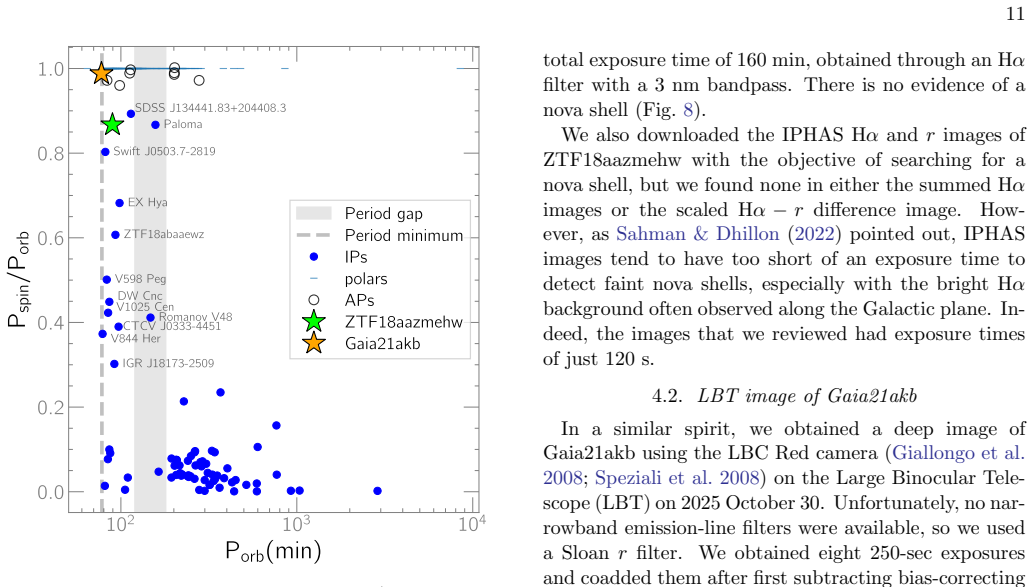
The central claim is that the growing sample of short-period asynchronous mCVs with large spin-to-orbit ratios lends credence to theoretical predictions that asynchronously rotating mCVs with sufficiently strong white dwarf magnetic fields can achieve synchronization when their orbital separations have shrunk sufficiently. Gaia21akb would be the second-shortest orbital period polar known if its 1.29-hour period is confirmed, while ZTF18aazmehw shows no discernible pole switching despite its high ratio.
What carries the argument
The white dwarf spin-to-orbit period ratio in asynchronous polars, which reaches values close to unity at short orbital periods and signals the approach to magnetic synchronization.
If this is right
- Gaia21akb would rank as the second-shortest orbital period among known polars.
- ZTF18aazmehw may require models that allow disk-like accretion structures in high-ratio asynchronous systems.
- The observed trend implies that magnetic synchronization becomes efficient once orbital periods drop below roughly 2 hours.
- Continued surveys should uncover additional short-period asynchronous mCVs with comparable ratios.
Where Pith is reading between the lines
- The period minimum appears to be a critical stage where synchronization can finalize in strongly magnetic systems.
- ZTF18aazmehw hints that some high-ratio systems may bypass classic pole-switching behavior through altered accretion geometry.
- Follow-up spectroscopy would be the most direct way to test whether the reported periods and classifications hold.
Load-bearing premise
The TESS light curve alone yields a reliable orbital period of 1.29 hours for Gaia21akb and both systems are correctly identified as asynchronous polars without multi-wavelength confirmation.
What would settle it
A radial-velocity curve or photometric eclipse timing that confirms or refutes the 1.29-hour orbital period for Gaia21akb, or clear detection of pole switching in ZTF18aazmehw, would settle the classifications.
Figures



read the original abstract
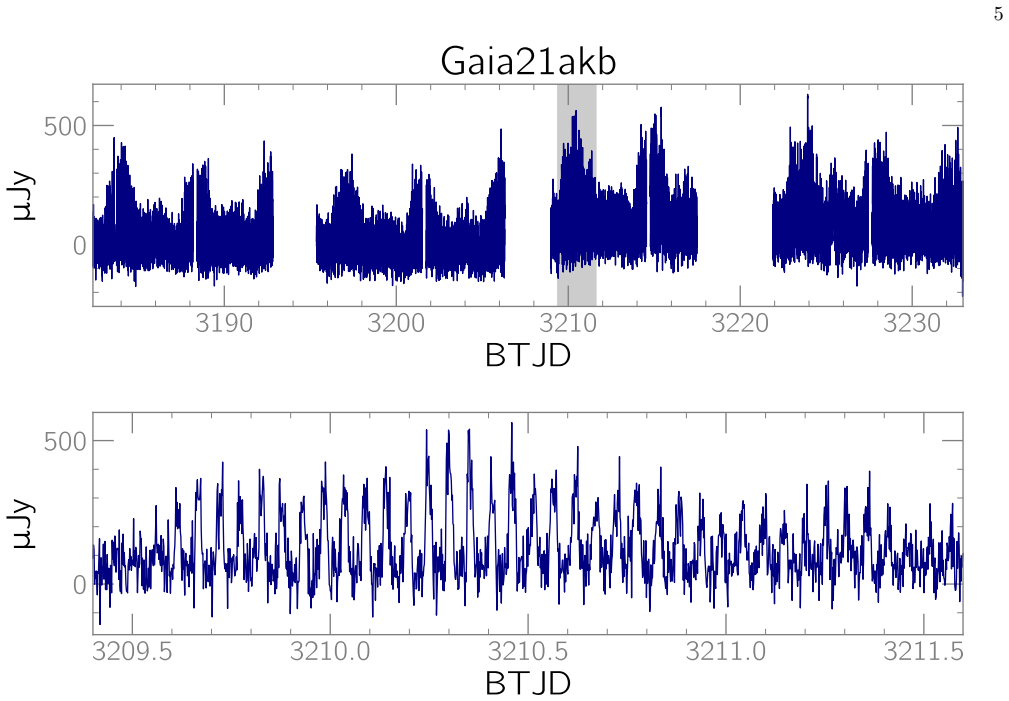
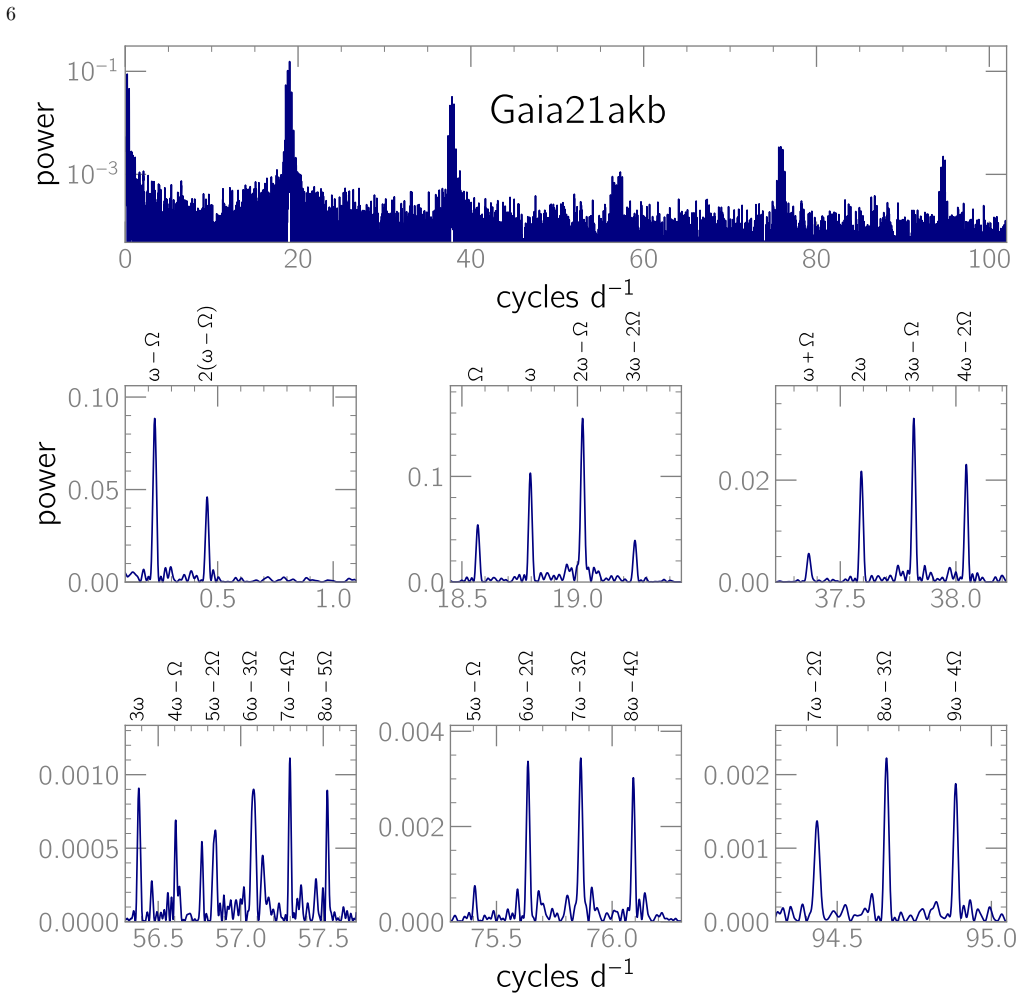
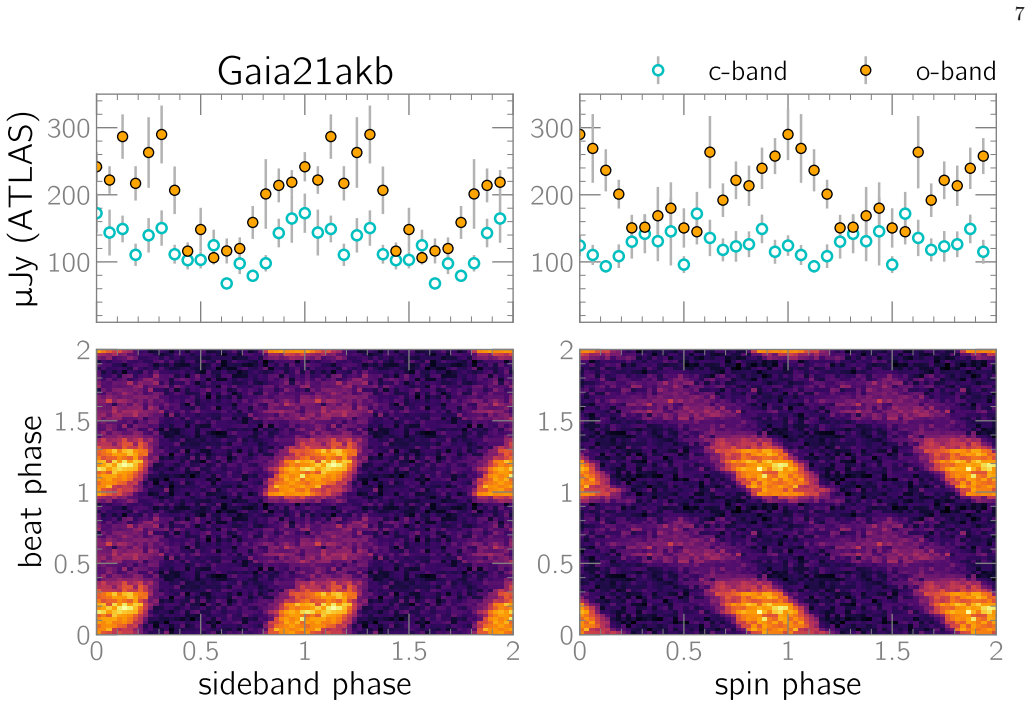
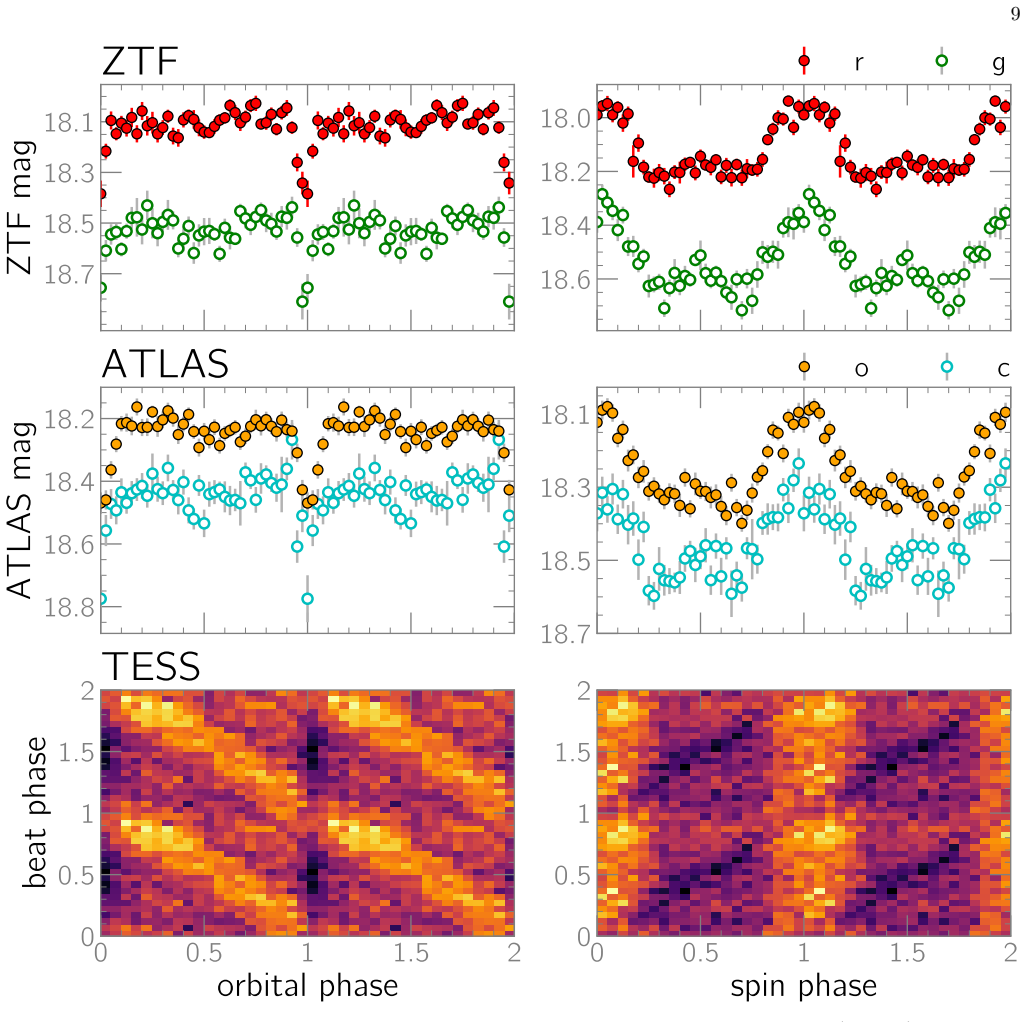
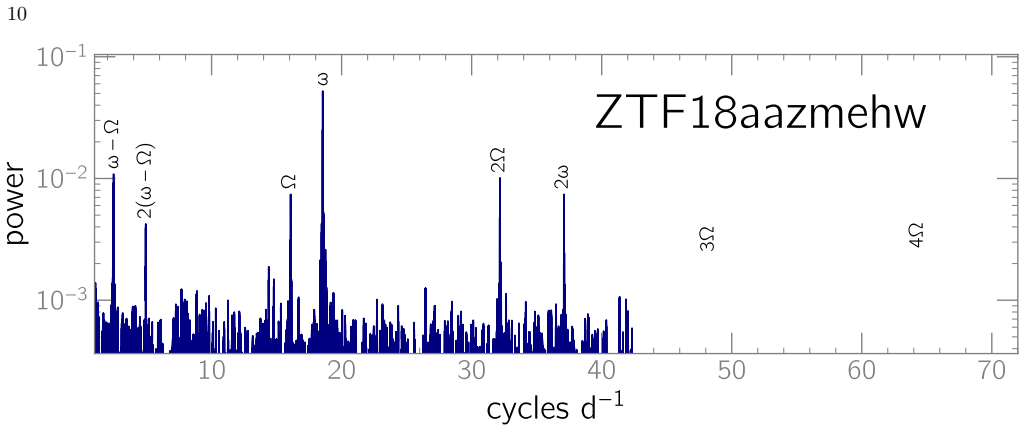
A recent development in the study of magnetic cataclysmic variable stars (mCVs) has been the identification of asynchronously spinning mCVs with orbital periods <2 h that have significantly higher white dwarf spin-to-orbital period ratios than their longer-period counterparts. We report the discovery of two additional mCVs in this class. The first, Gaia21akb, is a candidate asynchronous polar at the period minimum. While TESS photometry cannot, in isolation, lead to a conclusive identification of the orbital period, the probable orbital period of 1.29 h would be the second-shortest of any known polar and would result in a spin-to-orbit ratio of 0.9879. The second system in our study, ZTF18aazmehw, is an eclipsing mCV with a 1.50 h orbital period and a spin-to-orbit ratio of 0.867. Contrary to expectations for an asynchronous polar, ZTF18aazmehw does not show discernible evidence of pole switching and might possess a disk-like structure. The increasing number of short-period asynchronous mCVs with large spin-to-orbit ratios lends credence to theoretical predictions that asynchronously rotating mCVs with sufficiently strong white dwarf magnetic fields can achieve synchronization when their orbital separations have shrunk sufficiently.
Editorial analysis
A structured set of objections, weighed in public.
Referee Report
Summary. This paper reports the identification of two new magnetic cataclysmic variables from TESS light curves: Gaia21akb, proposed as an asynchronous polar near the period minimum with a probable orbital period of 1.29 hours yielding a spin-to-orbit ratio of 0.9879, and ZTF18aazmehw, an eclipsing system with 1.50 hour orbital period and spin-to-orbit ratio of 0.867. The authors suggest that the growing population of such short-period systems with high spin-to-orbit ratios supports theoretical models predicting synchronization in strongly magnetized white dwarfs at small orbital separations.
Significance. If the classifications and period determinations are robustly confirmed, this work would meaningfully expand the sample of short-period asynchronous polars, providing additional observational constraints on the synchronization process in mCVs at the period minimum. It demonstrates the value of high-cadence space-based photometry for detecting these rare systems and could motivate targeted follow-up observations.
major comments (2)
- [Abstract] The orbital period for Gaia21akb is described as 'probable' with the explicit caveat that TESS photometry cannot conclusively identify it; this directly impacts the central claim of it being at the period minimum with spin-to-orbit ratio 0.9879, and the manuscript should provide the detailed periodogram analysis, error estimates, and any supporting multi-band data to substantiate this identification.
- [Abstract] ZTF18aazmehw is classified as an asynchronous polar despite the noted absence of pole switching and possible disk-like structure, which are atypical for the class; the paper needs to address how these observations are reconciled with the asynchronous polar interpretation, perhaps through quantitative modeling of the light curve.
minor comments (1)
- [Abstract] The spin-to-orbit ratio for ZTF18aazmehw is given as 0.867 without specifying the number of significant figures or uncertainty; consistency with the more precise value for Gaia21akb should be checked.
Simulated Author's Rebuttal
We thank the referee for their constructive and detailed comments, which have helped us identify areas where the manuscript can be strengthened. We address each major comment below and will revise the paper accordingly.
read point-by-point responses
-
Referee: [Abstract] The orbital period for Gaia21akb is described as 'probable' with the explicit caveat that TESS photometry cannot conclusively identify it; this directly impacts the central claim of it being at the period minimum with spin-to-orbit ratio 0.9879, and the manuscript should provide the detailed periodogram analysis, error estimates, and any supporting multi-band data to substantiate this identification.
Authors: We agree that additional details on the period determination are needed to support the identification of the probable orbital period for Gaia21akb. In the revised manuscript, we will expand the relevant sections to include the full periodogram analysis (with figures or detailed descriptions of the detected peaks), quantitative error estimates on the periods, and any available supporting multi-band photometry from surveys such as ZTF or Gaia. This will allow readers to better evaluate the robustness of the 1.29 h orbital period and the resulting spin-to-orbit ratio of 0.9879 while retaining the explicit caveat regarding the limitations of TESS data alone. revision: yes
-
Referee: [Abstract] ZTF18aazmehw is classified as an asynchronous polar despite the noted absence of pole switching and possible disk-like structure, which are atypical for the class; the paper needs to address how these observations are reconciled with the asynchronous polar interpretation, perhaps through quantitative modeling of the light curve.
Authors: We thank the referee for this observation. The classification of ZTF18aazmehw rests on the detection of a coherent spin signal distinct from the orbital period in the TESS light curve, combined with the eclipsing morphology. We acknowledge that the lack of pole switching and possible disk-like features are atypical. In the revision, we will expand the discussion section to explicitly reconcile these aspects through comparison with other short-period mCVs and a qualitative interpretation tied to the high spin-to-orbit ratio. However, quantitative light-curve modeling is beyond the scope of this discovery paper and would require additional data or dedicated simulations; we will therefore limit the revision to qualitative discussion and note quantitative modeling as future work. revision: partial
Circularity Check
No circularity: direct photometric classifications support empirical trend without self-referential derivation
full rationale
The paper reports TESS photometry for Gaia21akb and ZTF18aazmehw, extracting orbital and spin periods directly from light-curve features to compute spin-to-orbit ratios. These are observational measurements, not derivations that reduce to fitted inputs by construction or self-citations. The central statement that the growing sample 'lends credence' to prior theoretical predictions is an empirical observation of a trend, not a load-bearing derivation or uniqueness theorem imported from the authors' own prior work. No equations, ansatzes, or self-definitional steps appear in the abstract or described chain.
Axiom & Free-Parameter Ledger
free parameters (3)
- Orbital period of Gaia21akb =
1.29 h
- Spin-to-orbit ratio of Gaia21akb =
0.9879
- Orbital period of ZTF18aazmehw =
1.50 h
axioms (1)
- domain assumption Light-curve morphology indicates magnetic accretion onto a white dwarf in a cataclysmic variable
Lean theorems connected to this paper
-
IndisputableMonolith/Foundation/RealityFromDistinction.leanreality_from_one_distinction unclear?
unclearRelation between the paper passage and the cited Recognition theorem.
The increasing number of short-period asynchronous mCVs with large spin-to-orbit ratios lends credence to theoretical predictions that asynchronously rotating mCVs with sufficiently strong white dwarf magnetic fields can achieve synchronization when their orbital separations have shrunk sufficiently.
-
IndisputableMonolith/Cost/FunctionalEquation.leanwashburn_uniqueness_aczel unclear?
unclearRelation between the paper passage and the cited Recognition theorem.
Pspin/Porb = 0.9879 ... 0.867 ... orbital periods 1.29 h and 1.50 h
What do these tags mean?
- matches
- The paper's claim is directly supported by a theorem in the formal canon.
- supports
- The theorem supports part of the paper's argument, but the paper may add assumptions or extra steps.
- extends
- The paper goes beyond the formal theorem; the theorem is a base layer rather than the whole result.
- uses
- The paper appears to rely on the theorem as machinery.
- contradicts
- The paper's claim conflicts with a theorem or certificate in the canon.
- unclear
- Pith found a possible connection, but the passage is too broad, indirect, or ambiguous to say the theorem truly supports the claim.
Reference graph
Works this paper leans on
-
[1]
2022, ApJ, 938, 46, doi: 10.3847/1538-4357/ac87ab
Mowlavi, N. 2022, ApJ, 938, 46, doi: 10.3847/1538-4357/ac87ab
-
[2]
Aftab, N., Zhang, X. A., Mittelman, D. R., et al. 2024, AJ, 168, 260, doi: 10.3847/1538-3881/ad7c48
-
[3]
Aftab, N., Zhang, X. A., Walker, S., et al. 2026, AJ, 171, 17, doi: 10.3847/1538-3881/ae17b4
-
[4]
2021, AJ, 161, 147, doi: 10.3847/1538-3881/abd806
Demleitner, M., & Andrae, R. 2021, AJ, 161, 147, doi: 10.3847/1538-3881/abd806
work page internal anchor Pith review doi:10.3847/1538-3881/abd806 2021
-
[5]
Bellm, E. C., Kulkarni, S. R., Graham, M. J., et al. 2019, PASP, 131, 018002, doi: 10.1088/1538-3873/aaecbe
-
[6]
1984, ApJ, 285, 252, doi: 10.1086/162499
Chanmugam, G., & Ray, A. 1984, ApJ, 285, 252, doi: 10.1086/162499
-
[7]
2022, MNRAS, 516, 3144, doi: 10.1093/mnras/stac2482 Gaia Collaboration, Brown, A
Duffy, C., Ramsay, G., Wu, K., et al. 2022, MNRAS, 516, 3144, doi: 10.1093/mnras/stac2482 Gaia Collaboration, Brown, A. G. A., Vallenari, A., et al. 2021, A&A, 649, A1, doi: 10.1051/0004-6361/202039657
-
[8]
Galiullin, I., Rodriguez, A. C., El-Badry, K., et al. 2025, ApJL, 990, L57, doi: 10.3847/2041-8213/adff82
- [9]
-
[10]
2008, A&A, 482, 349, doi: 10.1051/0004-6361:20078402
Giallongo, E., Ragazzoni, R., Grazian, A., et al. 2008, A&A, 482, 349, doi: 10.1051/0004-6361:20078402
-
[11]
2023, ApJ, 955, 150, doi: 10.3847/1538-4357/acf21b
Greiveldinger, A., Garnavich, P., Littlefield, C., et al. 2023, ApJ, 955, 150, doi: 10.3847/1538-4357/acf21b
-
[12]
Hakala, P., Ramsay, G., Potter, S. B., et al. 2019, MNRAS, 486, 2549, doi: 10.1093/mnras/stz992
-
[13]
Halpern, J. P. 2022, ApJ, 934, 123, doi: 10.3847/1538-4357/ac7d50 —. 2024, ApJ, 963, 78, doi: 10.3847/1538-4357/ad24ed
-
[14]
B., Sobeck, C., Haas, M., et al
Howell, S. B., Sobeck, C., Haas, M., et al. 2014, PASP, 126, 398, doi: 10.1086/676406 I lkiewicz, K., Scaringi, S., Veresvarska, M., et al. 2024, ApJL, 962, L34, doi: 10.3847/2041-8213/ad243c
-
[15]
2022a, arXiv e-prints, arXiv:2205.05284, doi: 10.48550/arXiv.2205.05284 —
Kato, T. 2022a, arXiv e-prints, arXiv:2205.05284, doi: 10.48550/arXiv.2205.05284 —. 2022b, arXiv e-prints, arXiv:2204.04603, doi: 10.48550/arXiv.2204.04603
-
[16]
King, A. R., & Wynn, G. A. 1999, MNRAS, 310, 203, doi: 10.1046/j.1365-8711.1999.02974.x
-
[17]
Kolbin, A. I., Suslikov, M. V., Kochkina, V. Y., et al. 2023, Astronomy Letters, 49, 475, doi: 10.1134/S1063773723080029
-
[18]
2019a, ApJ, 881, 141, doi: 10.3847/1538-4357/ab2a17 —
Littlefield, C., Garnavich, P., Mukai, K., et al. 2019a, ApJ, 881, 141, doi: 10.3847/1538-4357/ab2a17 —. 2019b, ApJ, 881, 141, doi: 10.3847/1538-4357/ab2a17
-
[19]
2015, MNRAS, 449, 3107, doi: 10.1093/mnras/stv462
Littlefield, C., Mukai, K., Mumme, R., et al. 2015, MNRAS, 449, 3107, doi: 10.1093/mnras/stv462
-
[20]
Littlefield, C., Hoard, D. W., Garnavich, P., et al. 2023a, AJ, 165, 43, doi: 10.3847/1538-3881/aca1a5
-
[21]
Littlefield, C., Mason, P. A., Garnavich, P., et al. 2023b, ApJL, 943, L24, doi: 10.3847/2041-8213/acaf04
-
[22]
Mason, P. A., Andronov, I. L., Kolesnikov, S. V., Pavlenko, E. P., & Shakovskoy, M. 1995, in Astronomical Society of the Pacific Conference Series, Vol. 85, Magnetic Cataclysmic Variables, ed. D. A. H. Buckley & B. Warner, 496
work page 1995
-
[23]
Mason, P. A., Liebert, J., & Schmidt, G. D. 1989, ApJ, 346, 941, doi: 10.1086/168074
-
[24]
A., Ramsay, G., Andronov, I., et al
Mason, P. A., Ramsay, G., Andronov, I., et al. 1998, MNRAS, 295, 511, doi: 10.1046/j.1365-8711.1998.01185.x
-
[25]
Mason, P. A., & Santana, J. B. 2015, in The Golden Age of Cataclysmic Variables and Related Objects - III (Golden2015), 16, doi: 10.22323/1.255.0016
-
[26]
Mason, P. A., Morales, J. F., Littlefield, C., et al. 2020, Advances in Space Research, 66, 1123, doi: 10.1016/j.asr.2020.03.038
-
[27]
A., Littlefield, C., Monroy, L
Mason, P. A., Littlefield, C., Monroy, L. C., et al. 2022, ApJ, 938, 142, doi: 10.3847/1538-4357/ac91cf
-
[28]
2017, PASP, 129, 044204, doi: 10.1088/1538-3873/aa54a8
Myers, G., Patterson, J., de Miguel, E., et al. 2017, PASP, 129, 044204, doi: 10.1088/1538-3873/aa54a8
-
[29]
2016, MNRAS, 458, 1833, doi: 10.1093/mnras/stw424 14
Pagnotta, A., & Zurek, D. 2016, MNRAS, 458, 1833, doi: 10.1093/mnras/stw424 14
-
[30]
1994, PASP, 106, 209, doi: 10.1086/133375
Patterson, J. 1994, PASP, 106, 209, doi: 10.1086/133375
-
[31]
Pavlenko, E. P., Mason, P. A., Sosnovskij, A. A., et al. 2018, MNRAS, 479, 341, doi: 10.1093/mnras/sty1494
-
[32]
C., Joshi, A., Scaringi, S., & Yadava, U
Rawat, N., Pandey, J. C., Joshi, A., Scaringi, S., & Yadava, U. 2022, MNRAS, doi: 10.1093/mnras/stac2723
-
[33]
Ricker, G. R., Winn, J. N., Vanderspek, R., et al. 2015, Journal of Astronomical Telescopes, Instruments, and Systems, 1, 014003, doi: 10.1117/1.JATIS.1.1.014003
work page internal anchor Pith review doi:10.1117/1.jatis.1.1.014003 2015
-
[34]
Sahman, D. I., & Dhillon, V. S. 2022, MNRAS, 510, 4180, doi: 10.1093/mnras/stab3668
-
[35]
Sahman, D. I., Dhillon, V. S., Knigge, C., & Marsh, T. R. 2015, MNRAS, 451, 2863, doi: 10.1093/mnras/stv1150
-
[36]
Sahman, D. I., Dhillon, V. S., Littlefair, S. P., & Hallinan, G. 2018, MNRAS, 477, 4483, doi: 10.1093/mnras/sty950
-
[37]
Schmidt, G. D., & Stockman, H. S. 1991, ApJ, 371, 749, doi: 10.1086/169939
-
[38]
Schwarz, R., Schwope, A. D., Staude, A., et al. 2007, A&A, 473, 511, doi: 10.1051/0004-6361:20077684
-
[39]
D., Staude, A., & Remillard, R
Schwarz, R., Schwope, A. D., Staude, A., & Remillard, R. A. 2005, A&A, 444, 213, doi: 10.1051/0004-6361:20053711
-
[40]
Remillard, R. A. 1992, ApJ, 389, 704, doi: 10.1086/171243
-
[41]
Silber, A. D., Szkody, P., Hoard, D. W., et al. 1997, MNRAS, 290, 25, doi: 10.1093/mnras/290.1.25
-
[42]
2008, in Society of Photo-Optical Instrumentation Engineers (SPIE) Conference Series, Vol
Speziali, R., Di Paola, A., Giallongo, E., et al. 2008, in Society of Photo-Optical Instrumentation Engineers (SPIE) Conference Series, Vol. 7014, Ground-based and Airborne Instrumentation for Astronomy II, ed. I. S. McLean & M. M. Casali, 70144T, doi: 10.1117/12.790132
-
[43]
Stockman, H. S., Schmidt, G. D., & Lamb, D. Q. 1988, ApJ, 332, 282, doi: 10.1086/166652
-
[44]
Szkody, P., van Roestel, J., Mason, P. A., et al. 2024, AJ, 167, 186, doi: 10.3847/1538-3881/ad2fcd
-
[45]
Takata, J., Wang, X. F., Kong, A. K. H., et al. 2022, ApJ, 936, 134, doi: 10.3847/1538-4357/ac8100
-
[46]
Tonry, J. L., Denneau, L., Heinze, A. N., et al. 2018, PASP, 130, 064505, doi: 10.1088/1538-3873/aabadf
work page internal anchor Pith review doi:10.1088/1538-3873/aabadf 2018
-
[47]
2017, A&A, 608, A36, doi: 10.1051/0004-6361/201731323
Tovmassian, G., Gonz´ alez-Buitrago, D., Thorstensen, J., et al. 2017, A&A, 608, A36, doi: 10.1051/0004-6361/201731323
-
[48]
2020, ApJ, 892, 38, doi: 10.3847/1538-4357/ab7759
Wang, Q., Qian, S., Han, Z., et al. 2020, ApJ, 892, 38, doi: 10.3847/1538-4357/ab7759
-
[49]
1995, Cataclysmic variable stars, Vol
Warner, B. 1995, Cataclysmic variable stars, Vol. 28
work page 1995
-
[50]
Watson, C. L., Henden, A. A., & Price, A. 2006, Society for Astronomical Sciences Annual Symposium, 25, 47
work page 2006
-
[51]
Witham, A. R., Knigge, C., Drew, J. E., et al. 2008, MNRAS, 384, 1277, doi: 10.1111/j.1365-2966.2007.12774.x
-
[52]
Wynn, G. A., & King, A. R. 1992, MNRAS, 255, 83, doi: 10.1093/mnras/255.1.83
-
[53]
Zucker, D. B., Raymond, J. C., Silber, A., et al. 1995, ApJ, 449, 310, doi: 10.1086/176056 15 20 40 cycles d 1 10 3 10 2 power Gaia19bxc 22.3 22.4 20 40 cycles d 1 10 4 10 3 10 2 10 1 ZTF19aasmeay 17.8 17.9 Figure 9.TESS power spectra of Gaia19bxc and ZTF19aasmeay, two understudied systems classified as very-short-period polars in the VSX catalog. The TES...
discussion (0)
Sign in with ORCID, Apple, or X to comment. Anyone can read and Pith papers without signing in.