Recognition: 2 theorem links
· Lean TheoremConstraints on the ¹²C(α, γ)¹⁶O and ¹⁶O+¹⁶O Reaction Rates from Binary Black Holes Detected via Gravitational Wave Signals
Pith reviewed 2026-05-15 07:27 UTC · model grok-4.3
The pith
Gravitational wave data from binary black holes constrains the 12C(α,γ)16O reaction rate at 300 keV to 137.6-263.4 keV barn.
A machine-rendered reading of the paper's core claim, the machinery that carries it, and where it could break.
Core claim
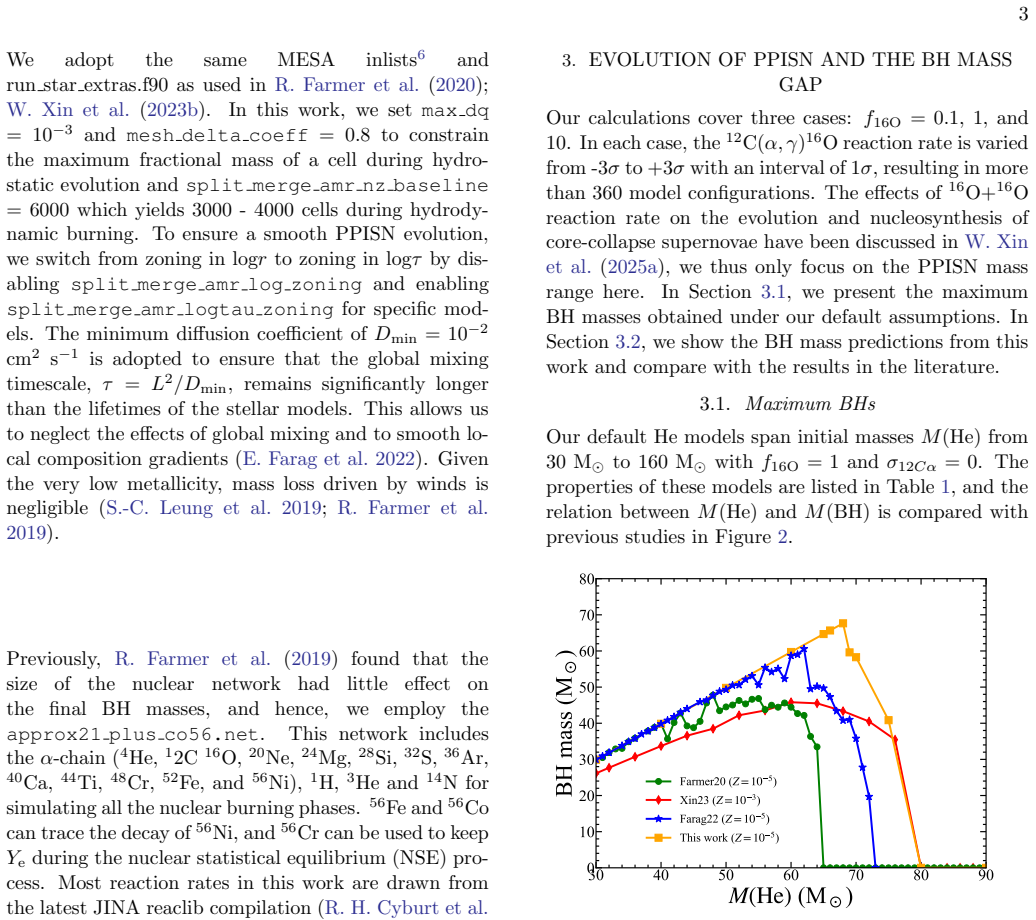
The central claim is that the astrophysical S-factor S300 for the 12C(α, γ)16O reaction is constrained to the interval 137.6–263.4 keV barn. This follows from computing the final black-hole mass distributions for helium stars with initial masses 40–150 solar masses, finding that a ±3σ variation in the carbon-alpha rate moves the lower edge of the predicted pair-instability gap from ~104 M⊙ down to ~45 M⊙, while the observed gap edge of 44–68 M⊙ selects only the portion of rate space that reproduces this location.
What carries the argument
The pair-instability supernova mechanism, whose mass threshold is set by the carbon-oxygen core mass reached at the end of helium burning, which in turn depends sensitively on the 12C(α,γ)16O reaction rate.
Load-bearing premise
The lower edge of the observed black hole mass gap arises exclusively from the pair-instability supernova process operating in single-star evolution.
What would settle it
A future gravitational-wave catalog that places the lower edge of the mass gap below 45 solar masses or above 135 solar masses, or that finds a substantial population of black holes inside the gap, would falsify the constrained range for the reaction rate.
Figures



read the original abstract
Gravitational-wave observations of binary black hole (BH) mergers provide a novel avenue for testing massive-star evolution and the resulting BH mass spectrum. Recent population analyses under the hierarchical-merger hypothesis have offered evidence for the BH mass gap and inferred its lower edge to $\sim 44 - 68$ M$_\odot$. Motivated by these findings, we compute low-metallicity ($Z=10^{-5}$) helium star models with MESA and systematically explore the effect of uncertainties in the $^{12}$C$(\alpha, \gamma)^{16}$O and $^{16}$O+$^{16}$O reaction rates on the final fate. Varying the $^{12}$C$(\alpha, \gamma)^{16}$O reaction rate by $-3 \sigma$ to $+3\sigma$, we find that the predicted BH mass gap shifts from $\sim104 - 184$ M$_\odot$ to $\sim45 - 135$ M$_\odot$. In contrast, scaling the $^{16}$O+$^{16}$O reaction rate by global factors of 0.1, 1, and 10 has only a modest effect on the lower edge of the BH mass gap (less than 5 M$_\odot$), and shifts the upper edge by more than 10 M$_\odot$. Using the predictions of our models together with the literature estimates for the lower edge of the BH mass gap, we constrain the astrophysical S factor of $^{12}$C$(\alpha, \gamma)^{16}$O reaction at 300 keV of $S_{300} \simeq$ 137.6 - 263.4 keV barn.
Editorial analysis
A structured set of objections, weighed in public.
Referee Report
Summary. The paper computes low-metallicity (Z=10^{-5}) helium-star models with MESA, systematically varying the ^{12}C(α,γ)^{16}O rate by ±3σ and the ^{16}O+^{16}O rate by factors of 0.1–10. It reports that the predicted lower edge of the black-hole mass gap shifts from ~104–184 M⊙ to ~45–135 M⊙ with the carbon-alpha rate variation, while the oxygen-oxygen rate produces only modest shifts. Combining these model predictions with literature values for the observed mass-gap lower edge (~44–68 M⊙) under the hierarchical-merger hypothesis, the authors constrain the astrophysical S-factor S_{300} of ^{12}C(α,γ)^{16}O to 137.6–263.4 keV barn.
Significance. If the central mapping and assumptions hold, the work supplies an independent astrophysical constraint on a key nuclear reaction rate that directly influences the pair-instability supernova threshold and the black-hole mass spectrum, complementing laboratory measurements. The explicit demonstration that the ^{16}O+^{16}O rate has limited impact on the lower gap edge is a useful negative result.
major comments (2)
- [Abstract and results section] The derivation of the numerical bounds S_{300} ≃ 137.6–263.4 keV barn from the reported model shifts (104–184 M⊙ to 45–135 M⊙) is not shown; no interpolation, fitting procedure, or explicit mapping between rate multiplier and gap edge is provided in the abstract or main text, yet this step is load-bearing for the central claim.
- [Introduction and discussion] The constraint assumes the observed 44–68 M⊙ lower edge arises exclusively from the pair-instability threshold in single-star He-core evolution under the hierarchical-merger hypothesis, with negligible contribution from other channels (dynamical capture, primordial BHs, or altered mass loss). No population-synthesis robustness test against these alternatives is presented, rendering the inferred window sensitive to this untested premise.
minor comments (2)
- [Methods] Define the precise criterion used to identify the lower and upper edges of the mass gap in the MESA models (e.g., the mass range with zero BH formation probability).
- [Methods] Specify the exact reaction-rate libraries and the functional form of the ±3σ variations applied to the ^{12}C(α,γ)^{16}O rate.
Simulated Author's Rebuttal
We thank the referee for their careful review and constructive comments. We address each major point below, indicating where revisions will be made to improve clarity and transparency while remaining within the scope of the present study.
read point-by-point responses
-
Referee: [Abstract and results section] The derivation of the numerical bounds S_{300} ≃ 137.6–263.4 keV barn from the reported model shifts (104–184 M⊙ to 45–135 M⊙) is not shown; no interpolation, fitting procedure, or explicit mapping between rate multiplier and gap edge is provided in the abstract or main text, yet this step is load-bearing for the central claim.
Authors: We agree that the explicit mapping from model gap edges to the S_{300} bounds was not detailed. In the revised manuscript we will add a short subsection in the Results section that describes the linear interpolation between the lower gap edges obtained at the −3σ and +3σ rate multipliers and the literature range 44–68 M⊙, thereby making the derivation of 137.6–263.4 keV barn fully transparent. revision: yes
-
Referee: [Introduction and discussion] The constraint assumes the observed 44–68 M⊙ lower edge arises exclusively from the pair-instability threshold in single-star He-core evolution under the hierarchical-merger hypothesis, with negligible contribution from other channels (dynamical capture, primordial BHs, or altered mass loss). No population-synthesis robustness test against these alternatives is presented, rendering the inferred window sensitive to this untested premise.
Authors: The work is explicitly framed under the hierarchical-merger hypothesis supported by existing population analyses. A comprehensive robustness test against all alternative channels would require a separate population-synthesis study that lies outside the scope of this paper, which focuses on nuclear-rate sensitivities within detailed stellar models. We will expand the discussion to state this assumption more clearly and to note the associated caveat with appropriate references. revision: partial
- Absence of population-synthesis robustness tests against alternative black-hole formation channels
Circularity Check
No significant circularity in derivation chain
full rationale
The paper varies the 12C(α,γ)16O rate by ±3σ as an explicit input to MESA He-star models at fixed Z=10^{-5}, computes the resulting shift in the predicted BH mass-gap lower edge (from ~104-184 M⊙ to ~45-135 M⊙), and intersects that model output with independent literature values for the observed gap edge (~44-68 M⊙) to obtain the S300 bound. This is forward modeling: nuclear-rate variation is the free parameter, gap location is the computed output, and the final constraint uses external observational data. No equation reduces to its own input by construction, no parameter is fitted to the target data and relabeled a prediction, and no load-bearing step relies on self-citation or an ansatz imported from prior work by the same authors. The chain is therefore self-contained against external benchmarks.
Axiom & Free-Parameter Ledger
free parameters (2)
- 12C(α,γ)16O rate multiplier
- 16O+16O rate scaling factor
axioms (2)
- domain assumption The black hole mass gap arises exclusively from pair-instability supernovae in massive stars.
- domain assumption The lower edge of the observed mass gap (44-68 M⊙) is correctly inferred under the hierarchical-merger hypothesis from gravitational-wave population analyses.
Lean theorems connected to this paper
-
IndisputableMonolith/Foundation/RealityFromDistinction.leanreality_from_one_distinction unclear?
unclearRelation between the paper passage and the cited Recognition theorem.
Varying the 12C(α, γ)16O reaction rate by −3σ to +3σ, we find that the predicted BH mass gap shifts from ∼104−184 M⊙ to ∼45−135 M⊙.
-
IndisputableMonolith/Cost/FunctionalEquation.leanwashburn_uniqueness_aczel unclear?
unclearRelation between the paper passage and the cited Recognition theorem.
Using the predictions of our models together with the literature estimates for the lower edge of the BH mass gap, we constrain the astrophysical S factor of 12C(α, γ)16O reaction at 300 keV of S300 ≃ 137.6 - 263.4 keV barn.
What do these tags mean?
- matches
- The paper's claim is directly supported by a theorem in the formal canon.
- supports
- The theorem supports part of the paper's argument, but the paper may add assumptions or extra steps.
- extends
- The paper goes beyond the formal theorem; the theorem is a base layer rather than the whole result.
- uses
- The paper appears to rely on the theorem as machinery.
- contradicts
- The paper's claim conflicts with a theorem or certificate in the canon.
- unclear
- Pith found a possible connection, but the passage is too broad, indirect, or ambiguous to say the theorem truly supports the claim.
Forward citations
Cited by 1 Pith paper
-
The Black Hole Mass Gap as a New Probe of Millicharged Particles
Millicharged particles weaken pulsational pair-instability in massive stars, shifting the lower edge of the black hole mass gap upward and turning gravitational wave observations into a probe for particles with masses...
Reference graph
Works this paper leans on
-
[1]
G., Abouelfettouh, I., Acernese, F., et al
Abac, A. G., Abouelfettouh, I., Acernese, F., et al. 2025, ApJL, 993, L25, doi: 10.3847/2041-8213/ae0c9c
-
[2]
Abbott, B. P., Abbott, R., Abbott, T. D., et al. 2016, PhRvL, 116, 061102, doi: 10.1103/PhysRevLett.116.061102
-
[3]
Abbott, B. P., Abbott, R., Abbott, T. D., et al. 2019, ApJL, 882, L24, doi: 10.3847/2041-8213/ab3800
-
[4]
Abbott, R., Abbott, T. D., Abraham, S., et al. 2020, The Astrophysical Journal, 900, L13, doi: 10.3847/2041-8213/aba493
-
[5]
Gravitational-wave constraints on the pair-instability mass gap and nuclear burning in massive stars
Antonini, F., Romero-Shaw, I., Callister, T., et al. 2025a, arXiv e-prints, arXiv:2509.04637, doi: 10.48550/arXiv.2509.04637
work page internal anchor Pith review Pith/arXiv arXiv doi:10.48550/arxiv.2509.04637
-
[6]
Antonini, F., Romero-Shaw, I. M., & Callister, T. 2025b, PhRvL, 134, 011401, doi: 10.1103/PhysRevLett.134.011401
-
[7]
Baraffe, I., Heger, A., & Woosley, S. E. 2001, ApJ, 550, 890, doi: 10.1086/319808
-
[8]
1967, PhRvL, 18, 379, doi: 10.1103/PhysRevLett.18.379
Barkat, Z., Rakavy, G., & Sack, N. 1967, PhRvL, 18, 379, doi: 10.1103/PhysRevLett.18.379
-
[9]
2016, A&A, 594, A97, doi: 10.1051/0004-6361/201628980
Belczynski, K., Heger, A., Gladysz, W., et al. 2016, A&A, 594, A97, doi: 10.1051/0004-6361/201628980
-
[10]
Caughlan, G. R., & Fowler, W. A. 1988, Atomic Data and Nuclear Data Tables, 40, 283 , doi: https://doi.org/10.1016/0092-640X(88)90009-5
-
[11]
2020, ApJ, 890, 43, doi: 10.3847/1538-4357/ab6739
Chieffi, A., & Limongi, M. 2020, ApJ, 890, 43, doi: 10.3847/1538-4357/ab6739
-
[12]
2021, MNRAS, 501, 4514, doi: 10.1093/mnras/staa3916
Costa, G., Bressan, A., Mapelli, M., et al. 2021, MNRAS, 501, 4514, doi: 10.1093/mnras/staa3916
-
[13]
2026, MNRAS, 546, stag073, doi: 10.1093/mnras/stag073
Croon, D., Gerosa, D., & Sakstein, J. 2026, MNRAS, 546, stag073, doi: 10.1093/mnras/stag073
-
[14]
Cyburt, R. H., Amthor, A. M., Ferguson, R., et al. 2010, ApJS, 189, 240, doi: 10.1088/0067-0049/189/1/240
-
[15]
Wieland, R. M. 1976, NuPhA, 265, 153, doi: 10.1016/0375-9474(76)90121-4 deBoer, R. J., G¨ orres, J., Wiescher, M., et al. 2017, Reviews of Modern Physics, 89, 035007, doi: 10.1103/RevModPhys.89.035007
-
[16]
Timmes, F. X. 2022, ApJ, 937, 112, doi: 10.3847/1538-4357/ac8b83
-
[17]
2020, The Astrophysical Journal, 902, L36, doi: 10.3847/2041-8213/abbadd
Justham, S. 2020, The Astrophysical Journal, 902, L36, doi: 10.3847/2041-8213/abbadd
-
[18]
2019, The Astrophysical Journal, 887, 53, doi: 10.3847/1538-4357/ab518b
Justham, S. 2019, The Astrophysical Journal, 887, 53, doi: 10.3847/1538-4357/ab518b
-
[19]
Fields, C. E., Timmes, F. X., Farmer, R., et al. 2018, ApJS, 234, 19, doi: 10.3847/1538-4365/aaa29b
-
[20]
Heger, A., & Woosley, S. E. 2002, ApJ, 567, 532, doi: 10.1086/338487
-
[21]
Kaiser, E. A., Hirschi, R., Arnett, W. D., et al. 2020, MNRAS, 496, 1967, doi: 10.1093/mnras/staa1595
-
[22]
Keszthelyi, Z., Meynet, G., Shultz, M. E., et al. 2020, Monthly Notices of the Royal Astronomical Society, 493, 518, doi: 10.1093/mnras/staa237 Kib´ edi, T., Alshahrani, B., Stuchbery, A. E., et al. 2020, PhRvL, 125, 182701, doi: 10.1103/PhysRevLett.125.182701
-
[23]
2002, ApJ, 567, 643, doi: 10.1086/338384
Kunz, R., Fey, M., Jaeger, M., et al. 2002, ApJ, 567, 643, doi: 10.1086/338384
-
[24]
2019, ApJ, 887, 72, doi: 10.3847/1538-4357/ab4fe5
Leung, S.-C., Nomoto, K., & Blinnikov, S. 2019, ApJ, 887, 72, doi: 10.3847/1538-4357/ab4fe5
-
[25]
2025, arXiv e-prints, arXiv:2507.17551, doi: 10.48550/arXiv.2507.17551
Li, Y.-J., Tang, S.-P., Xue, L.-Q., & Fan, Y.-Z. 2025, arXiv e-prints, arXiv:2507.17551, doi: 10.48550/arXiv.2507.17551
-
[26]
Marchant, P., & Moriya, T. J. 2020, A&A, 640, L18, doi: 10.1051/0004-6361/202038902
-
[27]
K., Buonanno, A., Gair, J., et al
Mehta, A. K., Buonanno, A., Gair, J., et al. 2022, ApJ, 924, 39, doi: 10.3847/1538-4357/ac3130
-
[28]
2006, ApJ, 645, 1352, doi: 10.1086/504578
Ohkubo, T., Umeda, H., Maeda, K., et al. 2006, ApJ, 645, 1352, doi: 10.1086/504578
-
[29]
2011, ApJS, 192, 3, doi: 10.1088/0067-0049/192/1/3
Paxton, B., Bildsten, L., Dotter, A., et al. 2011, ApJS, 192, 3, doi: 10.1088/0067-0049/192/1/3
-
[30]
2013, ApJS, 208, 4, doi: 10.1088/0067-0049/208/1/4 10
Paxton, B., Cantiello, M., Arras, P., et al. 2013, ApJS, 208, 4, doi: 10.1088/0067-0049/208/1/4 10
work page internal anchor Pith review doi:10.1088/0067-0049/208/1/4 2013
-
[31]
2015, ApJS, 220, 15, doi: 10.1088/0067-0049/220/1/15
Paxton, B., Marchant, P., Schwab, J., et al. 2015, ApJS, 220, 15, doi: 10.1088/0067-0049/220/1/15
work page internal anchor Pith review doi:10.1088/0067-0049/220/1/15 2015
-
[32]
Paxton, B., Schwab, J., Bauer, E. B., et al. 2018, ApJS, 234, 34, doi: 10.3847/1538-4365/aaa5a8
-
[33]
2016, MNRAS, 463, 4153, doi: 10.1093/mnras/stw2266
Rauscher, T., Nishimura, N., Hirschi, R., et al. 2016, MNRAS, 463, 4153, doi: 10.1093/mnras/stw2266
-
[34]
2025, arXiv e-prints, arXiv:2510.18867, doi: 10.48550/arXiv.2510.18867
Ray, A., & Kalogera, V. 2025, arXiv e-prints, arXiv:2510.18867, doi: 10.48550/arXiv.2510.18867
-
[35]
Renzo, M., Cantiello, M., Metzger, B. D., & Jiang, Y. F. 2020, ApJL, 904, L13, doi: 10.3847/2041-8213/abc6a6
-
[36]
P., Naab, T., Spurzem, R., et al
Rizzuto, F. P., Naab, T., Spurzem, R., et al. 2021, MNRAS, 501, 5257, doi: 10.1093/mnras/staa3634
-
[37]
L., Zevin, M., Amaro-Seoane, P., et al
Rodriguez, C. L., Zevin, M., Amaro-Seoane, P., et al. 2019, Phys. Rev. D, 100, 043027, doi: 10.1103/PhysRevD.100.043027
-
[38]
Gormaz-Matamala, A. C. 2026, arXiv e-prints, arXiv:2601.02263, doi: 10.48550/arXiv.2601.02263
-
[39]
Shen, Y. P., Guo, B., deBoer, R. J., et al. 2020, PhRvL, 124, 162701, doi: 10.1103/PhysRevLett.124.162701
-
[40]
M., Agarwal, A., Barnes, J., et al
Siegel, D. M., Agarwal, A., Barnes, J., et al. 2022, ApJ, 941, 100, doi: 10.3847/1538-4357/ac8d04
-
[41]
2025, A&A, 703, A215, doi: 10.1051/0004-6361/202555490
Simonato, F., Torniamenti, S., Mapelli, M., et al. 2025, A&A, 703, A215, doi: 10.1051/0004-6361/202555490
-
[42]
2020, ApJ, 898, 25, doi: 10.3847/1538-4357/ab9b8c
Tagawa, H., Haiman, Z., & Kocsis, B. 2020, ApJ, 898, 25, doi: 10.3847/1538-4357/ab9b8c
-
[43]
2018, ApJ, 863, 153, doi: 10.3847/1538-4357/aad2d2
Takahashi, K. 2018, ApJ, 863, 153, doi: 10.3847/1538-4357/aad2d2
-
[44]
GW231123 Formation from Population III Stars: Isolated Binary Evolution
Tanikawa, A., Liu, S., Wu, W., Fujii, M. S., & Wang, L. 2025, arXiv e-prints, arXiv:2508.01135, doi: 10.48550/arXiv.2508.01135
work page internal anchor Pith review Pith/arXiv arXiv doi:10.48550/arxiv.2508.01135 2025
-
[45]
Evidence of the pair instability gap from black hole masses
Tong, H., Fishbach, M., Thrane, E., et al. 2025, arXiv e-prints, arXiv:2509.04151, doi: 10.48550/arXiv.2509.04151
work page internal anchor Pith review Pith/arXiv arXiv doi:10.48550/arxiv.2509.04151 2025
-
[46]
2002, ApJ, 565, 385, doi: 10.1086/323946 van Son, L
Umeda, H., & Nomoto, K. 2002, ApJ, 565, 385, doi: 10.1086/323946 van Son, L. A. C., De Mink, S. E., Broekgaarden, F. S., et al. 2020, ApJ, 897, 100, doi: 10.3847/1538-4357/ab9809
-
[47]
2025, arXiv e-prints, arXiv:2510.22698, doi: 10.48550/arXiv.2510.22698
Wang, Y.-Z., Li, Y.-J., Gao, S.-J., Tang, S.-P., & Fan, Y.-Z. 2025, arXiv e-prints, arXiv:2510.22698, doi: 10.48550/arXiv.2510.22698
-
[48]
Winch, E. R. J., Vink, J. S., Higgins, E. R., & Sabhahitf, G. N. 2024, MNRAS, 529, 2980, doi: 10.1093/mnras/stae393
-
[49]
Woosley, S. E., Blinnikov, S., & Heger, A. 2007, Nature, 450, 390, doi: 10.1038/nature06333
-
[50]
Woosley, S. E., & Heger, A. 2021, ApJL, 912, L31, doi: 10.3847/2041-8213/abf2c4
-
[51]
2025a, arXiv e-prints, arXiv:2512.22963, doi: 10.48550/arXiv.2512.22963
Xin, W., Nomoto, K., Zhang, X., & Bi, S. 2025a, arXiv e-prints, arXiv:2512.22963, doi: 10.48550/arXiv.2512.22963
-
[52]
2025b, arXiv e-prints, arXiv:2502.11012, doi: 10.48550/arXiv.2502.11012
Xin, W., Nomoto, K., & Zhao, G. 2025b, arXiv e-prints, arXiv:2502.11012, doi: 10.48550/arXiv.2502.11012
-
[53]
2023a, Chinese Physics C, 47, 034107, doi: 10.1088/1674-1137/aca1ff
Xin, W., Nomoto, K., Zhao, G., & Wu, W. 2023a, Chinese Physics C, 47, 034107, doi: 10.1088/1674-1137/aca1ff
-
[54]
2023b, Research in Astronomy and Astrophysics, 23, 015014, doi: 10.1088/1674-4527/aca234
Xin, W., Nomoto, K., Zhao, G., & Zhang, X. 2023b, Research in Astronomy and Astrophysics, 23, 015014, doi: 10.1088/1674-4527/aca234
-
[55]
2025, arXiv e-prints, arXiv:2507.15701, doi: 10.48550/arXiv.2507.15701
Yuan, C., Chen, Z.-C., & Liu, L. 2025, arXiv e-prints, arXiv:2507.15701, doi: 10.48550/arXiv.2507.15701
discussion (0)
Sign in with ORCID, Apple, or X to comment. Anyone can read and Pith papers without signing in.