Recognition: 1 theorem link
· Lean TheoremQuantitative measurements of biological/chemical concentrations using smartphone cameras
Pith reviewed 2026-05-14 22:30 UTC · model grok-4.3
The pith
Smartphone cameras quantify biological and chemical concentrations comparably to lab instruments.
A machine-rendered reading of the paper's core claim, the machinery that carries it, and where it could break.
Core claim
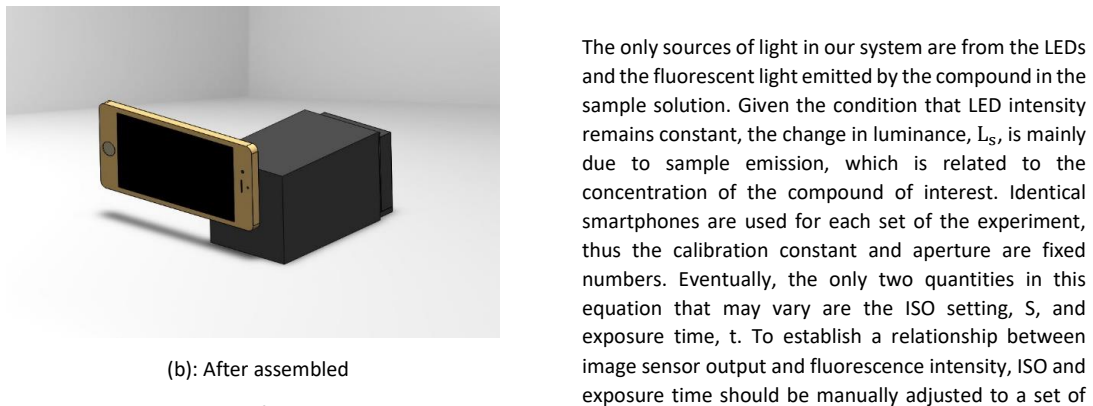
A smartphone-based imaging system with a designated optical setup combined with image processing and data analyzing techniques constructs an image database characterizing the relationship between color information and concentrations of biological/chemical assay samples. Experiments on fluorescein, RNA Mango, homogenized milk and yeast demonstrate that the proposed system estimates the concentration of fluorescent materials and colloidal mixtures comparable to currently used commercial and laboratory instruments.
What carries the argument
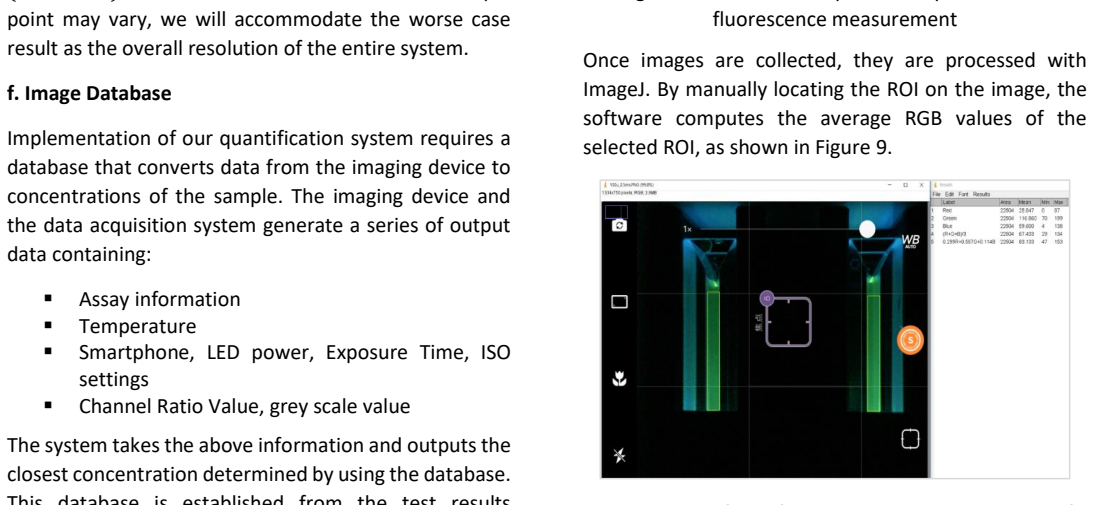
Designated optical setup combined with image processing that extracts color information from smartphone images to map onto sample concentrations.
Load-bearing premise
The color information extracted from images maintains a stable, sample-specific relationship to concentration that is not significantly affected by differences in camera sensors or ambient light conditions.
What would settle it
Repeated imaging of identical concentration samples with different smartphone models or under changed ambient lighting that produces inconsistent concentration estimates would falsify the central claim.
Figures





read the original abstract
This paper presents a smartphone-based imaging system capable of quantifying the concentration of an assortment of biological/chemical assay samples. The main objective is to construct an image database which characterizes the relationship between color information and concentrations of the biological/chemical assay sample. For this aim, a designated optical setup combined with image processing and data analyzing techniques was implemented. A series of experiments conducted on selected assays, including fluorescein, RNA Mango, homogenized milk and yeast have demonstrated that the proposed system estimates the concentration of fluorescent materials and colloidal mixtures comparable to currently used commercial and laboratory instruments. Furthermore, by utilizing the camera and computational power of smartphones, eventual development can be directed toward extremely compact, inexpensive and portable analysis and diagnostic systems which will allow experiments and tests to be conducted in remote or impoverished areas.
Editorial analysis
A structured set of objections, weighed in public.
Referee Report
Summary. The manuscript presents a smartphone-based imaging system for quantitative concentration measurements of biological and chemical assays. It constructs an empirical image database relating extracted color information to sample concentrations via a designated optical setup and image processing pipeline. Experiments on fluorescein, RNA Mango, homogenized milk, and yeast are reported to yield concentration estimates comparable to commercial and laboratory instruments, with the goal of enabling low-cost portable diagnostics.
Significance. If the central comparability claim is substantiated with proper statistical validation and cross-condition testing, the work could enable accessible, low-cost concentration assays in resource-limited settings by leveraging ubiquitous smartphone hardware. The database-driven calibration approach is pragmatic and avoids the need for specialized lab equipment.
major comments (2)
- [Abstract] Abstract: The claim that the system 'estimates the concentration of fluorescent materials and colloidal mixtures comparable to currently used commercial and laboratory instruments' is unsupported by any quantitative evidence such as error bars, sample sizes, statistical tests, or repeatability metrics. This directly undermines verification of the central claim.
- [Results/Methods] Results/Methods (implied by experimental description): No data or tests are presented on cross-device calibration curves, ambient-light variation, or inter-phone repeatability statistics, leaving the stability of the color-to-concentration mapping unverified despite its load-bearing role for generalizability.
minor comments (1)
- [Abstract] Abstract: The sentence on 'eventual development' is awkwardly phrased and could be revised for clarity regarding the intended future direction.
Simulated Author's Rebuttal
We thank the referee for the detailed and constructive review. We agree that the central comparability claim requires stronger quantitative support and that generalizability aspects need explicit treatment. We will revise the manuscript accordingly to address both points.
read point-by-point responses
-
Referee: [Abstract] Abstract: The claim that the system 'estimates the concentration of fluorescent materials and colloidal mixtures comparable to currently used commercial and laboratory instruments' is unsupported by any quantitative evidence such as error bars, sample sizes, statistical tests, or repeatability metrics. This directly undermines verification of the central claim.
Authors: We accept this criticism. The current version describes the experimental outcomes qualitatively but does not embed the requested quantitative metrics in the abstract or prominently in the results. In the revision we will (1) add specific metrics (e.g., RMSE, Pearson correlation, mean absolute percentage error) to the abstract, (2) report sample sizes and repeatability (standard deviations across replicates), and (3) include statistical comparisons against the commercial reference instruments in the Results section. revision: yes
-
Referee: [Results/Methods] Results/Methods (implied by experimental description): No data or tests are presented on cross-device calibration curves, ambient-light variation, or inter-phone repeatability statistics, leaving the stability of the color-to-concentration mapping unverified despite its load-bearing role for generalizability.
Authors: We agree that these factors are important for claiming broader applicability. The present study used a single controlled optical setup and one smartphone model. In the revised manuscript we will add a dedicated subsection discussing device-to-device variation, ambient-light sensitivity, and repeatability across phones. Where existing replicate data allow, we will report inter-phone statistics; otherwise we will explicitly state the current scope and limitations while outlining the additional experiments needed for full validation. revision: yes
Circularity Check
Empirical database construction and external instrument comparison shows no circularity
full rationale
The paper describes building an image database from smartphone captures of assays (fluorescein, RNA Mango, milk, yeast) under a designated optical setup, followed by image processing to extract color metrics and direct comparison of derived concentrations against commercial laboratory instruments. No derivation chain reduces any reported performance metric to a quantity defined solely by the paper's own fitted parameters or self-citations; the central claim rests on experimental agreement with independent external references rather than internal self-definition or prediction-by-construction.
Axiom & Free-Parameter Ledger
free parameters (1)
- color-to-concentration calibration parameters
axioms (1)
- domain assumption Smartphone camera color channels provide repeatable intensity measurements that correlate monotonically with sample concentration under controlled illumination
Lean theorems connected to this paper
-
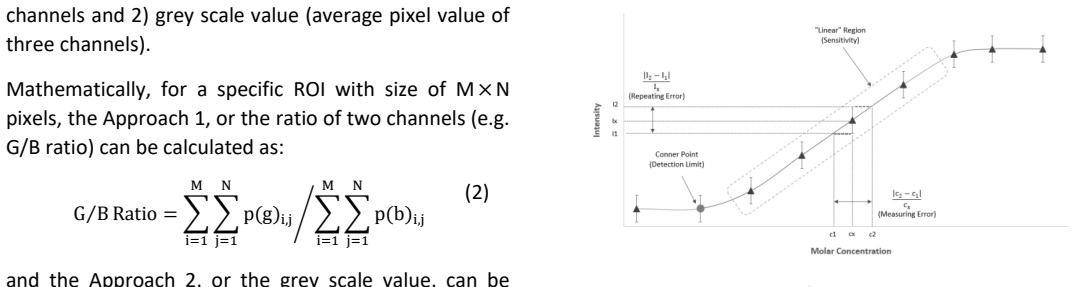
IndisputableMonolith/Foundation/RealityFromDistinction.leanreality_from_one_distinction unclearA designated optical setup combined with image processing and data analyzing techniques was implemented... G/B ratio and grey scale value... database which converts data from the imaging device to concentrations
Reference graph
Works this paper leans on
-
[1]
X. Amouretti, "Image of HTS on Multidetection Microplate Readers and Benefits For Life Science Research Laboratories," 2006
work page 2006
-
[2]
Comparison with Quartz and other Plastic Cuvettes
"Comparison with Quartz and other Plastic Cuvettes"
-
[3]
Quantitative Measurements of Biological/Chemical Concentrations using Smartphone Cameras,
Z. Cao, "Quantitative Measurements of Biological/Chemical Concentrations using Smartphone Cameras," Burnaby, British Columbia, 2018, p. 45
work page 2018
-
[4]
Measuring Luminance with a Digital Camera,
Hiscocks, Peter D., "Measuring Luminance with a Digital Camera," 14 February 2014. [Online]. Available: https://www.ee.ryerson.ca/~phiscock/astronomy/light-pollution/luminance-notes-2.pdf. [Accessed 9 April 2018]
work page 2014
-
[5]
Quantitative Measurements of Biological/chemical Concentrations using Smartphone Cameras,
Z. Cao, "Quantitative Measurements of Biological/chemical Concentrations using Smartphone Cameras," Burnaby, BC, 2018, p. 107
work page 2018
-
[6]
J. Van HOUTEN, R. J. Watts, "Temperature dependence of the photophysical and photochemical properties of the tris(2,2'-bipyridyl)ruthenium(II) ion in aqueous solution," Journal of American Chemical Society, vol. 98, no. 16, pp. 4853-4858, 1976
work page 1976
-
[7]
RNA mango aptamer-fluorophore: a bright, high-affinity complex for RNA labeling and tracking,
Dolgosheina EV, Jeng SC, Panchapakesan SS, Cojocaru R, Chen PS, Wilson PD, Hawkins N, Wiggins PA, Unrau PJ., "RNA mango aptamer-fluorophore: a bright, high-affinity complex for RNA labeling and tracking," ACS Chemical Biology, vol. 9, no. 10, pp. 2412-2420, 2014
work page 2014
-
[8]
Introduction to CMOS Image Sensors,
Renato Turchetta, Kenneth R. Spring, Michael W. Davidson, "Introduction to CMOS Image Sensors," Olympus, [Online]. Available: https://www.olympus-lifescience.com/en/microscope- resource/primer/digitalimaging/cmosimagesensors/. [Accessed 15 March 2019]
work page 2019
-
[9]
The Light-Scattering Capacity (Tyndall Effect) and Colloidal Behavior of Gelatine Sols and Gels,
E. O. Kraemer, S. T. Dexter, "The Light-Scattering Capacity (Tyndall Effect) and Colloidal Behavior of Gelatine Sols and Gels," The Journal of Physical Chemistry, vol. 31, no. 5, pp. 764-782, 1927
work page 1927
- [10]
-
[11]
A model organism for cellular aging research: Saccharomyces cerevisiae,
Zhou Jia, Kang Ya-ni, "A model organism for cellular aging research: Saccharomyces cerevisiae," Chinese Bulletin of Life Sciences, vol. 25, no. 5, pp. 511-517, 2013
work page 2013
-
[12]
Measuring Luminance with a Digital Camera,
P. D. Hiscocks, "Measuring Luminance with a Digital Camera," 2014
work page 2014
discussion (0)
Sign in with ORCID, Apple, or X to comment. Anyone can read and Pith papers without signing in.