Recognition: 2 theorem links
· Lean TheoremThe RRATalog: a Galactic census of rotating radio transients
Pith reviewed 2026-05-13 21:33 UTC · model grok-4.3
The pith
The Milky Way contains fewer than 400,000 rotating radio transients whose birth rate matches the core-collapse supernova rate.
A machine-rendered reading of the paper's core claim, the machinery that carries it, and where it could break.
Core claim
Using detailed modeling of observational biases on 335 known RRATs, the authors estimate that 34,000 plus or minus 1,600 sources beaming toward Earth are detectable above 30 mJy kpc squared, with the total Galactic population no larger than 400,000. The implied birth rate is at most 1.4 per century, which is consistent with the Galactic core-collapse supernova rate and suggests RRATs do not require a distinct progenitor population.
What carries the argument
Population synthesis that corrects for survey selection effects, combined with the Tauris and Manchester beaming model to scale from observable to total Galactic numbers.
If this is right
- RRATs at high luminosities are comparable in number to canonical pulsars.
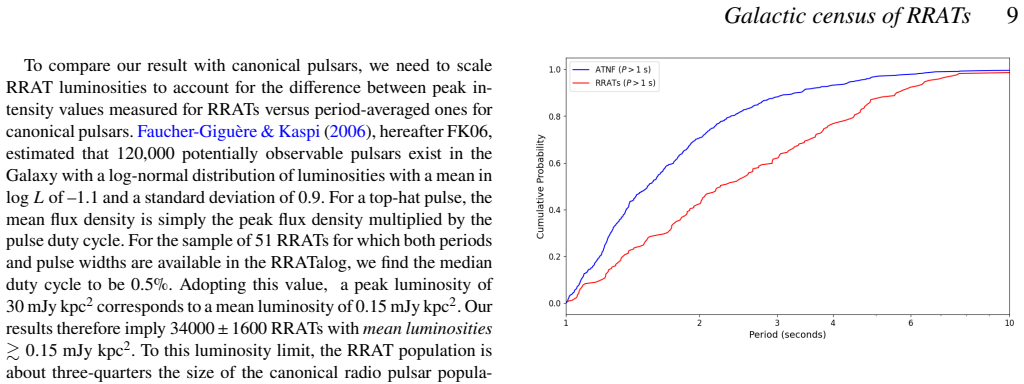
- The period distribution of RRATs is shifted to longer values, consistent with an older population.
- There is a turnover in the luminosity function below 30 mJy kpc squared.
- Future surveys can use the provided predictions for expected discovery rates.
Where Pith is reading between the lines
- RRATs may simply be an evolved stage of regular pulsars rather than a separate class.
- Improved beaming models could tighten or revise the total population estimate.
- Multi-wavelength observations might confirm the evolutionary link to pulsars.
- Undetected low-luminosity RRATs could still exist in large numbers if the turnover is real.
Load-bearing premise
The Tauris and Manchester beaming model accurately converts the number of observable RRATs into the total Galactic population.
What would settle it
A deep survey that finds a number of RRATs significantly above or below the predicted 70,000 observable sources would directly test the population estimate.
Figures




read the original abstract
Rotating radio transients (RRATs) represent a significant but poorly understood component of the Galactic neutron star population, characterized by sporadic emission first detectable only through single-pulse searches. We present the RRATalog, an up-to-date catalogue of 335 RRATs, and utilize a uniform sample of RRATs discovered in four Parkes telescope surveys to model their Galactic population. Accounting in detail for observational selection effects, we find a radial density profile similar to pulsars, but identify a significantly steeper luminosity function (power-law index $\alpha \simeq -1.3$) than previously assumed. For sources beaming towards Earth, we estimate $34000 \pm 1600$ potentially observable RRATs above a peak luminosity of 30 mJy kpc$^2$. At these high luminosities, the RRAT population is comparable in size to that of canonical pulsars. Consistent with the observed distribution, the underlying period distribution is significantly shifted toward longer periods compared to canonical pulsars, suggesting RRATs represent a more evolved population. We find evidence for a turnover in the luminosity function below 30 mJy kpc$^2$, and predict that the total number of potentially observable RRATs is $\lesssim 70,000$. Applying the Tauris \& Manchester beaming model, we estimate the total Galactic RRAT population to be $\lesssim 400,000$. The implied birth rate of $\lesssim 1.4$ RRATs per century is consistent with the Galactic core-collapse supernova rate, suggesting RRATs can be reconciled with known progenitor rates without requiring a separate evolutionary origin. We provide predictions for RRAT discoveries in ongoing and future surveys.
Editorial analysis
A structured set of objections, weighed in public.
Referee Report
Summary. The paper presents the RRATalog catalogue containing 335 rotating radio transients and analyzes a uniform subsample from four Parkes surveys. After detailed modeling of selection effects, it reports a radial density profile similar to canonical pulsars, a steeper luminosity function with power-law index α ≃ −1.3, 34 000 ± 1600 potentially observable RRATs above 30 mJy kpc², a total observable population ≲ 70 000, and a total Galactic population ≲ 400 000 after applying the Tauris & Manchester beaming fraction. The implied birth rate ≲ 1.4 per century is stated to be consistent with the Galactic core-collapse supernova rate.
Significance. If the central population numbers and birth-rate consistency hold after addressing the beaming assumption, the work supplies the first quantitative Galactic census of RRATs, demonstrates that they can be accommodated within known neutron-star birth rates without invoking a separate channel, and supplies concrete predictions for future surveys. The steeper luminosity function and longer-period distribution are also noteworthy if the selection-effect corrections are robust.
major comments (3)
- [§5] §5 (population synthesis and beaming correction): the total Galactic population ≲ 400 000 and birth rate ≲ 1.4 per century are obtained by dividing the modeled observable count by the beaming fraction taken directly from the Tauris & Manchester (1998) steady-pulsar model. No justification or test is provided for why this geometry applies to the sporadic, single-pulse emission of RRATs; any systematic difference in effective beaming solid angle scales the final numbers linearly and undermines the claimed consistency with the supernova rate.
- [§4.2] §4.2 (luminosity-function fit): the power-law index α ≃ −1.3 and the turnover below 30 mJy kpc² are derived from the same Parkes survey data used to compute the observable counts. The manuscript must demonstrate that the fitted parameters are not circularly determined by the detection threshold and must quantify the uncertainty introduced by the extrapolation to the total observable population ≲ 70 000.
- [Methods] Methods section (selection-effect modeling): the abstract states that selection effects were modeled in detail and a uniform sample was used, yet the central numbers (34 000 ± 1600 above 30 mJy kpc², radial profile) rest on modeling choices whose sensitivity is not shown. Explicit validation against independent simulations or a hold-out survey is required before the population scaling can be considered robust.
minor comments (3)
- Define the precise quantity 'peak luminosity' (mJy kpc²) at first use and ensure consistent notation between text, tables, and figures.
- [Abstract] The abstract lists 'four Parkes telescope surveys' without naming them or citing the discovery papers; this information should appear in the introduction or a dedicated table.
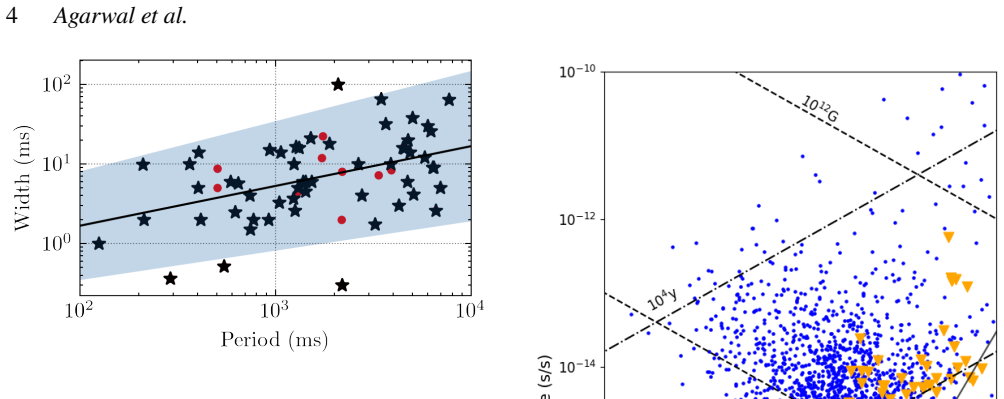
- Figure captions for the luminosity-function and period-distribution plots should state the exact sample size and any cuts applied.
Simulated Author's Rebuttal
We thank the referee for the detailed and constructive review of our manuscript. We address each major comment below and describe the revisions that will be incorporated to improve the robustness of our population estimates.
read point-by-point responses
-
Referee: [§5] §5 (population synthesis and beaming correction): the total Galactic population ≲ 400 000 and birth rate ≲ 1.4 per century are obtained by dividing the modeled observable count by the beaming fraction taken directly from the Tauris & Manchester (1998) steady-pulsar model. No justification or test is provided for why this geometry applies to the sporadic, single-pulse emission of RRATs; any systematic difference in effective beaming solid angle scales the final numbers linearly and undermines the claimed consistency with the supernova rate.
Authors: We acknowledge that the beaming correction relies on the Tauris & Manchester (1998) model derived for canonical pulsars. RRATs are widely interpreted as pulsars with the same underlying magnetic geometry but with emission that is only occasionally detectable; the beaming solid angle is therefore expected to be governed by the same dipolar geometry. Nevertheless, we agree that this is an assumption rather than a direct measurement. In the revised manuscript we will expand §5 with a dedicated paragraph justifying the choice on the basis of the overlapping period and magnetic-field distributions between RRATs and pulsars, while explicitly noting that any systematic difference in effective beaming fraction would scale the total Galactic population and birth-rate estimates linearly. We will also add a short sensitivity test showing the range of birth rates that would result from plausible variations in the beaming fraction. revision: yes
-
Referee: [§4.2] §4.2 (luminosity-function fit): the power-law index α ≃ −1.3 and the turnover below 30 mJy kpc² are derived from the same Parkes survey data used to compute the observable counts. The manuscript must demonstrate that the fitted parameters are not circularly determined by the detection threshold and must quantify the uncertainty introduced by the extrapolation to the total observable population ≲ 70 000.
Authors: The luminosity-function parameters were obtained via a maximum-likelihood fit that explicitly incorporates the survey flux limits and selection functions, rather than fitting only to detected sources. To address the referee’s concern about circularity, we will add a robustness test in the revised §4.2 in which the power-law index is refitted using only sources with peak luminosities well above the nominal threshold (L > 100 mJy kpc²). We will show that the recovered index remains consistent within the quoted uncertainties. In addition, we will report bootstrap-resampling uncertainties on the extrapolated total observable population (≲ 70 000) to quantify the effect of the extrapolation below the turnover. revision: yes
-
Referee: [Methods] Methods section (selection-effect modeling): the abstract states that selection effects were modeled in detail and a uniform sample was used, yet the central numbers (34 000 ± 1600 above 30 mJy kpc², radial profile) rest on modeling choices whose sensitivity is not shown. Explicit validation against independent simulations or a hold-out survey is required before the population scaling can be considered robust.
Authors: We will expand the Methods section with an explicit sensitivity analysis that varies the key modeling assumptions (radial scale length, luminosity-function priors, and survey completeness thresholds) and shows the resulting range in the derived observable population. We will also include a validation exercise in which the identical selection pipeline is applied to a synthetic pulsar population with known input parameters; the recovered radial profile and luminosity function will be compared to the inputs. If a suitable independent survey dataset can be obtained for a hold-out test, we will add that comparison; otherwise the limitations of the current validation will be stated clearly. revision: partial
Circularity Check
No significant circularity; population modeling uses external beaming model and data-driven fits
full rationale
The paper fits a luminosity function (α ≃ -1.3) and period distribution to the detected RRAT sample from Parkes surveys after explicit selection-effect corrections, then extrapolates the observable population (34 000 ± 1600 above 30 mJy kpc², total observable ≲ 70 000) and applies the external Tauris & Manchester beaming fraction to reach the total Galactic population ≲ 400 000. No step reduces by construction to its own inputs; the beaming correction is imported from prior independent work, the luminosity-function parameters are constrained by the observed counts rather than presupposed, and the final birth-rate comparison is an external consistency check rather than a self-referential loop. This is standard population synthesis and remains self-contained against external benchmarks.
Axiom & Free-Parameter Ledger
free parameters (2)
- luminosity function power-law index =
-1.3
- luminosity cutoff for extrapolation =
30 mJy kpc²
axioms (2)
- domain assumption Tauris & Manchester beaming model converts observable to total population
- domain assumption Radial density profile matches that of canonical pulsars
Lean theorems connected to this paper
-
IndisputableMonolith/Cost/FunctionalEquation.leanwashburn_uniqueness_aczel unclear?
unclearRelation between the paper passage and the cited Recognition theorem.
We estimate the total Galactic RRAT population to be ≲400,000. ... Applying the Tauris & Manchester beaming model...
-
IndisputableMonolith/Foundation/AlphaCoordinateFixation.leanJ_uniquely_calibrated_via_higher_derivative unclear?
unclearRelation between the paper passage and the cited Recognition theorem.
the RRAT luminosity function follows a power law with slope α ≃ −1.34 ... turnover at lower luminosities
What do these tags mean?
- matches
- The paper's claim is directly supported by a theorem in the formal canon.
- supports
- The theorem supports part of the paper's argument, but the paper may add assumptions or extra steps.
- extends
- The paper goes beyond the formal theorem; the theorem is a base layer rather than the whole result.
- uses
- The paper appears to rely on the theorem as machinery.
- contradicts
- The paper's claim conflicts with a theorem or certificate in the canon.
- unclear
- Pith found a possible connection, but the passage is too broad, indirect, or ambiguous to say the theorem truly supports the claim.
Reference graph
Works this paper leans on
-
[1]
Abhishek Malusare N., Tanushree N., Hegde G., Konar S., 2022, @doi [Journal of Astrophysics and Astronomy] 10.1007/s12036-022-09862-3 , https://ui.adsabs.harvard.edu/abs/2022JApA...43...75A 43, 75
-
[2]
Bates S. D., Lorimer D. R., Rane A., Swiggum J., 2014, @doi [MNRAS] 10.1093/mnras/stu157 , 439, 2893
-
[3]
Bezuidenhout M. C., et al., 2022, @doi [ ] 10.1093/mnras/stac579 , https://ui.adsabs.harvard.edu/abs/2022MNRAS.512.1483B 512, 1483
-
[4]
Bhattacharya D., Wijers R. A. M. J., Hartman J. W., Verbunt F., 1992, , https://ui.adsabs.harvard.edu/abs/1992A&A...254..198B 254, 198
work page 1992
-
[5]
Boyles J., et al., 2013, @doi [ ] 10.1088/0004-637X/763/2/80 , https://ui.adsabs.harvard.edu/abs/2013ApJ...763...80B 763, 80
-
[6]
291, Neutron Stars and Pulsars: Challenges and Opportunities after 80 years
Burke-Spolaor S., 2013, in van Leeuwen J., ed., IAU Symposium Vol. 291, Neutron Stars and Pulsars: Challenges and Opportunities after 80 years. pp 95--100 ( @eprint arXiv 1212.1716 ), @doi 10.1017/S1743921312023277
-
[7]
Burke-Spolaor S., Bailes M., 2010, @doi [ ] 10.1111/j.1365-2966.2009.15965.x , http://adsabs.harvard.edu/abs/2010MNRAS.402..855B 402, 855
-
[8]
Burke-Spolaor S., et al., 2011, @doi [ ] 10.1111/j.1365-2966.2011.18521.x , http://adsabs.harvard.edu/abs/2011MNRAS.416.2465B 416, 2465
-
[9]
Caleb M., et al., 2022, @doi [Nature Astronomy] 10.1038/s41550-022-01688-x , https://ui.adsabs.harvard.edu/abs/2022NatAs...6..828C 6, 828
-
[10]
Chen J. L., et al., 2022, @doi [ ] 10.3847/1538-4357/ac75d1 , https://ui.adsabs.harvard.edu/abs/2022ApJ...934...24C 934, 24
-
[11]
Cordes J. M., Lazio T. J. W., 2002, arXiv e-prints, https://ui.adsabs.harvard.edu/abs/2002astro.ph..7156C pp astro--ph/0207156
-
[12]
Cordes J. M., Shannon R. M., 2008, @doi [ ] 10.1086/589425 , http://adsabs.harvard.edu/abs/2008ApJ...682.1152C 682, 1152
-
[13]
Cordes J. M., et al., 2006, @doi [ ] 10.1086/498335 , https://ui.adsabs.harvard.edu/abs/2006ApJ...637..446C 637, 446
-
[14]
Cui B.-Y., Boyles J., McLaughlin M. A., Palliyaguru N., 2017, @doi [ ] 10.3847/1538-4357/aa6aa9 , https://ui.adsabs.harvard.edu/abs/2017ApJ...840....5C 840, 5
-
[15]
Deneva J. S., et al., 2009, @doi [ ] 10.1088/0004-637X/703/2/2259 , https://ui.adsabs.harvard.edu/abs/2009ApJ...703.2259D 703, 2259
-
[16]
Deneva J. S., Stovall K., McLaughlin M. A., Bates S. D., Freire P. C. C., Martinez J. G., Jenet F., Bagchi M., 2013, @doi [ ] 10.1088/0004-637X/775/1/51 , https://ui.adsabs.harvard.edu/abs/2013ApJ...775...51D 775, 51
-
[17]
Deneva J. S., et al., 2016, @doi [ ] 10.3847/0004-637X/821/1/10 , https://ui.adsabs.harvard.edu/abs/2016ApJ...821...10D 821, 10
-
[18]
Dewey R., Stokes G., Segelstein D., Taylor J., Weisberg J., 1984, in Reynolds S. P., Stinebring D. R., eds, Birth and Evolution of Neutron Stars: Issues Raised by Millisecond Pulsars. p. 234
work page 1984
-
[19]
Dong F. A., et al., 2023, @doi [ ] 10.1093/mnras/stad2012 , https://ui.adsabs.harvard.edu/abs/2023MNRAS.524.5132D 524, 5132
-
[20]
2010, MNRAS, 401, 1670, doi: 10.1111/j.1365-2966.2009.15794.x
Eatough R. P., Keane E. F., Lyne A. G., 2009, @doi [ ] 10.1111/j.1365-2966.2009.14524.x , https://ui.adsabs.harvard.edu/abs/2009MNRAS.395..410E 395, 410
-
[21]
2001, MNRAS, 322, 231, doi: 10.1046/j.1365-8711.2001.04022.x
Edwards R. T., Bailes M., van Straten W., Britton M. C., 2001, @doi [ ] 10.1046/j.1365-8711.2001.04637.x , http://adsabs.harvard.edu/abs/2001MNRAS.326..358E 326, 358
-
[22]
M., 2006, @doi [ ] 10.1086/501516 , https://ui.adsabs.harvard.edu/abs/2006ApJ...643..332F 643, 332
Faucher-Gigu \`e re C.-A., Kaspi V. M., 2006, @doi [ ] 10.1086/501516 , https://ui.adsabs.harvard.edu/abs/2006ApJ...643..332F 643, 332
-
[23]
Good D. C., et al., 2021, @doi [ ] 10.3847/1538-4357/ac1da6 , https://ui.adsabs.harvard.edu/abs/2021ApJ...922...43G 922, 43
-
[24]
Graber V., Ronchi M., Pardo-Araujo C., Rea N., 2024, @doi [The Astrophysical Journal] 10.3847/1538-4357/ad3e78 , 968, 16
-
[25]
Han J. L., et al., 2021, @doi [Research in Astronomy and Astrophysics] 10.1088/1674-4527/21/5/107 , https://ui.adsabs.harvard.edu/abs/2021RAA....21..107H 21, 107
-
[26]
Han J. L., et al., 2025, @doi [Research in Astronomy and Astrophysics] 10.1088/1674-4527/ada3b7 , https://ui.adsabs.harvard.edu/abs/2025RAA....25a4001H 25, 014001
-
[27]
Hessels J. W. T., Ransom S. M., Kaspi V. M., Roberts M. S. E., Champion D. J., Stappers B. W., 2008, in Bassa C., Wang Z., Cumming A., Kaspi V. M., eds, American Institute of Physics Conference Series Vol. 983, 40 Years of Pulsars: Millisecond Pulsars, Magnetars and More. pp 613--615 ( @eprint arXiv 0710.1745 ), @doi 10.1063/1.2900310
work page internal anchor Pith review Pith/arXiv arXiv doi:10.1063/1.2900310 2008
-
[28]
Jacoby B. A., Bailes M., Ord S. M., Edwards R. T., Kulkarni S. R., 2009, @doi [ ] 10.1088/0004-637X/699/2/2009 , http://adsabs.harvard.edu/abs/2009ApJ...699.2009J 699, 2009
-
[29]
Johnston S., Karastergiou A., 2019, @doi [ ] 10.1093/mnras/stz400 , https://ui.adsabs.harvard.edu/abs/2019MNRAS.485..640J 485, 640
-
[30]
Karako-Argaman C., et al., 2015, @doi [ ] 10.1088/0004-637X/809/1/67 , https://ui.adsabs.harvard.edu/abs/2015ApJ...809...67K 809, 67
-
[31]
Karuppusamy R., Stappers B. W., van Straten W., 2010, @doi [ ] 10.1051/0004-6361/200913729 , https://ui.adsabs.harvard.edu/abs/2010A&A...515A..36K 515, A36
-
[32]
Keane E. F., 2016, @doi [ ] 10.1093/mnras/stw767 , https://ui.adsabs.harvard.edu/abs/2016MNRAS.459.1360K 459, 1360
-
[33]
2008, MNRAS, 388, 1803, doi: 10.1111/j.1365-2966.2008.13522.x 30
Keane E. F., Kramer M., 2008, @doi [ ] 10.1111/j.1365-2966.2008.14045.x , https://ui.adsabs.harvard.edu/abs/2008MNRAS.391.2009K 391, 2009
-
[34]
Keane E. F., McLaughlin M. A., 2011, @doi [Bulletin of the Astronomical Society of India] 10.48550/arXiv.1109.6896 , https://ui.adsabs.harvard.edu/abs/2011BASI...39..333K 39, 333
-
[35]
2010, MNRAS, 401, 1670, doi: 10.1111/j.1365-2966.2009.15794.x
Keane E. F., Ludovici D. A., Eatough R. P., Kramer M., Lyne A. G., McLaughlin M. A., Stappers B. W., 2010, @doi [ ] 10.1111/j.1365-2966.2009.15693.x , https://ui.adsabs.harvard.edu/abs/2010MNRAS.401.1057K 401, 1057
-
[36]
W., Jin, C., Blaes, O., & Ward, M
Keane E. F., Kramer M., Lyne A. G., Stappers B. W., McLaughlin M. A., 2011, @doi [MNRAS] 10.1111/j.1365-2966.2011.18917.x , 415, 3065
-
[37]
Keane E. F., et al., 2018, @doi [ ] 10.1093/mnras/stx2126 , https://ui.adsabs.harvard.edu/abs/2018MNRAS.473..116K 473, 116
-
[38]
Keane E. F., et al., 2025, @doi [The Open Journal of Astrophysics] 10.33232/001c.154256 , https://ui.adsabs.harvard.edu/abs/2025OJAp....854256K 8, 54256
-
[39]
Keith M. J., et al., 2010, @doi [ ] 10.1111/j.1365-2966.2010.17325.x , http://adsabs.harvard.edu/abs/2010MNRAS.409..619K 409, 619
-
[40]
Kramer M., Karastergiou A., Gupta Y., Johnston S., Bhat N. D. R., Lyne A. G., 2003, @doi [ ] 10.1051/0004-6361:20030842 , https://ui.adsabs.harvard.edu/abs/2003A&A...407..655K 407, 655
-
[41]
Lazarus P., et al., 2015, @doi [ ] 10.1088/0004-637X/812/1/81 , https://ui.adsabs.harvard.edu/abs/2015ApJ...812...81L 812, 81
-
[42]
Li X.-D., 2006, @doi [ ] 10.1086/506962 , https://ui.adsabs.harvard.edu/abs/2006ApJ...646L.139L 646, L139
-
[43]
Logvinenko S. V., Tyul'bashev S. A., Malofeev V. M., 2020, @doi [Bulletin of the Lebedev Physics Institute] 10.3103/S1068335620120179 , https://ui.adsabs.harvard.edu/abs/2020BLPI...47..390L 47, 390
-
[44]
R., Kramer M., 2004, Handbook of Pulsar Astronomy
Lorimer D. R., Kramer M., 2004, Handbook of Pulsar Astronomy . Vol. 4
work page 2004
-
[45]
J., Groves, B., Kauffmann, G., & Heckman, T
Lorimer D. R., et al., 2006, @doi [MNRAS] 10.1111/j.1365-2966.2006.10887.x , 372, 777 (LFL06)
-
[46]
Lynch R. S., et al., 2018, @doi [ ] 10.3847/1538-4357/aabf8a , https://ui.adsabs.harvard.edu/abs/2018ApJ...859...93L 859, 93
-
[47]
Lyon R. J., Stappers B. W., Cooper S., Brooke J. M., Knowles J. D., 2016, @doi [ ] 10.1093/mnras/stw656 , https://ui.adsabs.harvard.edu/abs/2016MNRAS.459.1104L 459, 1104
-
[48]
Ma X., et al., 2025, @doi [ ] 10.1051/0004-6361/202452685 , https://ui.adsabs.harvard.edu/abs/2025A&A...698A.306M 698, A306
-
[49]
2001, MNRAS, 322, 231, doi: 10.1046/j.1365-8711.2001.04022.x
Manchester R. N., et al., 2001, @doi [ ] 10.1046/j.1365-8711.2001.04751.x , http://adsabs.harvard.edu/abs/2001MNRAS.328...17M 328, 17
-
[50]
McKenna D. J., Keane E. F., Gallagher P. T., McCauley J., 2024, @doi [ ] 10.1093/mnras/stad2900 , https://ui.adsabs.harvard.edu/abs/2024MNRAS.527.4397M 527, 4397
-
[51]
McLaughlin M. A., Cordes J. M., 2003, @doi [ ] 10.1086/378232 , https://ui.adsabs.harvard.edu/abs/2003ApJ...596..982M 596, 982
-
[52]
A., et al., 2006, @doi [Nature] 10.1038/nature04440 , 439, 817
McLaughlin M. A., et al., 2006, @doi [Nature] 10.1038/nature04440 , 439, 817
-
[53]
J., Moseley J., Hurley-Walker N., Grover G., Horv \'a th C., Galvin T
Mcsweeney S. J., Moseley J., Hurley-Walker N., Grover G., Horv \'a th C., Galvin T. J., Meyers B. W., Tan C. M., 2025, @doi [ ] 10.3847/1538-4357/adb27f , https://ui.adsabs.harvard.edu/abs/2025ApJ...981..143M 981, 143
-
[54]
Michilli D., et al., 2020, @doi [ ] 10.1093/mnras/stz2997 , https://ui.adsabs.harvard.edu/abs/2020MNRAS.491..725M 491, 725
-
[55]
Mickaliger M. B., McEwen A. E., McLaughlin M. A., Lorimer D. R., 2018, @doi [ ] 10.1093/mnras/sty1785 , https://ui.adsabs.harvard.edu/abs/2018MNRAS.479.5413M 479, 5413
-
[56]
Morello V., et al., 2019, @doi [ ] 10.1093/mnras/sty3328 , https://ui.adsabs.harvard.edu/abs/2019MNRAS.483.3673M 483, 3673
-
[57]
Morello V., Barr E. D., Stappers B. W., Keane E. F., Lyne A. G., 2020, @doi [ ] 10.1093/mnras/staa2291 , https://ui.adsabs.harvard.edu/abs/2020MNRAS.497.4654M 497, 4654
-
[58]
Murphy T., Kaplan D. L., 2025, @doi [arXiv e-prints] 10.48550/arXiv.2511.10785 , https://ui.adsabs.harvard.edu/abs/2025arXiv251110785M p. arXiv:2511.10785
-
[59]
Nice D. J., et al., 2013, @doi [ ] 10.1088/0004-637X/772/1/50 , https://ui.adsabs.harvard.edu/abs/2013ApJ...772...50N 772, 50
-
[60]
NE2025: An Updated Electron Density Model for the Galactic Interstellar Medium
Ocker S. K., Cordes J. M., 2026, @doi [arXiv e-prints] 10.48550/arXiv.2602.11838 , https://ui.adsabs.harvard.edu/abs/2026arXiv260211838O p. arXiv:2602.11838
work page internal anchor Pith review Pith/arXiv arXiv doi:10.48550/arxiv.2602.11838 2026
-
[61]
Padmanabh P. V., et al., 2023, @doi [ ] 10.1093/mnras/stad1900 , https://ui.adsabs.harvard.edu/abs/2023MNRAS.524.1291P 524, 1291
-
[62]
W., Jin, C., Blaes, O., & Ward, M
Palliyaguru N. T., et al., 2011, @doi [ ] 10.1111/j.1365-2966.2011.19388.x , https://ui.adsabs.harvard.edu/abs/2011MNRAS.417.1871P 417, 1871
-
[63]
Parent E., 2022, PhD thesis, McGill University
work page 2022
-
[64]
Parent E., et al., 2022, @doi [ ] 10.3847/1538-4357/ac375d , https://ui.adsabs.harvard.edu/abs/2022ApJ...924..135P 924, 135
-
[65]
Patel C., et al., 2018, @doi [The Astrophysical Journal] 10.3847/1538-4357/aaee65 , 869, 181
-
[66]
Philippov S., Kramer M., 2022, @doi [Annual Review of Astronomy and Astrophysics] 10.1146/annurev-astro-052920-112338 , 60, 495
-
[67]
Phinney E. S., Blandford R. D., 1981, @doi [ ] 10.1093/mnras/194.1.137 , https://ui.adsabs.harvard.edu/abs/1981MNRAS.194..137P 194, 137
-
[68]
Qiu H., Bannister K. W., Shannon R. M., Murphy T., Bhandari S., Agarwal D., Lorimer D. R., Bunton J. D., 2019, @doi [MNRAS] 10.1093/mnras/stz748 , 486, 166
-
[69]
Rane A., Loeb A., 2016, arXiv e-prints, https://ui.adsabs.harvard.edu/abs/2016arXiv160806952R p. arXiv:1608.06952
-
[70]
Ravi V., Hallinan G., Deep Synoptic Array Team 2021, in American Astronomical Society Meeting Abstracts \#237. p. 316.04
work page 2021
-
[71]
Rozwadowska K., Vissani F., Cappellaro E., 2021, @doi [ ] 10.1016/j.newast.2020.101498 , https://ui.adsabs.harvard.edu/abs/2021NewA...8301498R 83, 101498
- [72]
-
[73]
Samodurov V. A., Tyul'bashev S. A., Toropov M. O., Dolgushev A. V., Oreshko V. V., Logvinenko S. V., 2023, @doi [Astronomy Reports] 10.1134/S1063772923070077 , https://ui.adsabs.harvard.edu/abs/2023ARep...67..590S 67, 590
-
[74]
Schechter P., 1976, @doi [ ] 10.1086/154079 , https://ui.adsabs.harvard.edu/abs/1976ApJ...203..297S 203, 297
-
[75]
Sengar R., et al., 2023, @doi [ ] 10.1093/mnras/stad508 , https://ui.adsabs.harvard.edu/abs/2023MNRAS.522.1071S 522, 1071
-
[76]
Shapiro-Albert B. J., McLaughlin M. A., Keane E. F., 2018, @doi [ ] 10.3847/1538-4357/aae2b2 , https://ui.adsabs.harvard.edu/abs/2018ApJ...866..152S 866, 152
-
[77]
Shitov Y. P., Kuzmin A. D., Dumskii D. V., Losovsky B. Y., 2009, @doi [Astronomy Reports] 10.1134/S1063772909060080 , https://ui.adsabs.harvard.edu/abs/2009ARep...53..561S 53, 561
-
[78]
Staelin D. H., 1969, @doi [IEEE Proceedings] 10.1109/PROC.1969.7051 , https://ui.adsabs.harvard.edu/abs/1969IEEEP..57..724S 57, 724
-
[79]
A., Ramsay, G., Andronov, I., et al
Tauris T. M., Manchester R. N., 1998, @doi [ ] 10.1046/j.1365-8711.1998.01369.x , https://ui.adsabs.harvard.edu/abs/1998MNRAS.298..625T 298, 625
-
[80]
Tian J., et al., 2025, @doi [ ] 10.1093/mnras/staf1827 , https://ui.adsabs.harvard.edu/abs/2025MNRAS.544.1843T 544, 1843
discussion (0)
Sign in with ORCID, Apple, or X to comment. Anyone can read and Pith papers without signing in.