Resolving the Planck-DESI tension by nonminimally coupled quintessence
Pith reviewed 2026-05-19 01:31 UTC · model grok-4.3
The pith
Non-minimal coupling of dark matter to quintessence resolves the Planck-DESI matter density tension at over 3 sigma.
A machine-rendered reading of the paper's core claim, the machinery that carries it, and where it could break.
Core claim
By allowing dark matter to couple nonminimally to gravity through a quintessence field, the discrepancy in the present-day matter fraction between Planck and DESI is eliminated. The coupling is constrained to be nonzero at greater than 3 sigma significance. The true equation-of-state parameter of the coupled quintessence remains greater than minus one at all times, yet fitting the observations to a w0waCDM parametrization produces an apparent phantom crossing at low redshifts.
What carries the argument
The non-minimal coupling term between the quintessence scalar field and the dark matter stress-energy tensor, which modifies the effective expansion history and the evolution of perturbations to permit a single consistent value of Omega_m.
If this is right
- The combined Planck and DESI datasets prefer the coupled model over standard Lambda CDM at high significance.
- The apparent phantom crossing reported in w0waCDM fits is an artifact of misidentifying the coupled quintessence.
- Tensions in the neutrino mass sum and in the growth rate parameter S8 are simultaneously reduced.
- The background and linear perturbation equations remain stable across the relevant redshift range.
Where Pith is reading between the lines
- Similar non-minimal couplings between dark sectors could address other cosmological tensions without adding new fields.
- Direct low-redshift measurements of the dark energy equation of state from next-generation surveys would distinguish a genuine crossing from the mimicry produced by this model.
- Independent constraints on the coupling strength from galaxy clustering or weak lensing would serve as a decisive test of the mechanism.
Load-bearing premise
The specific functional form chosen for the non-minimal coupling between the quintessence field and the dark-matter stress-energy tensor is sufficient to absorb the entire Omega_m tension while leaving the background and perturbation equations stable.
What would settle it
Future BAO or weak-lensing data that continue to show an inconsistent Omega_m even after allowing for non-minimal couplings, or the absence of the model's predicted scale-dependent modifications to the matter power spectrum at the relevant redshifts.
Figures


read the original abstract
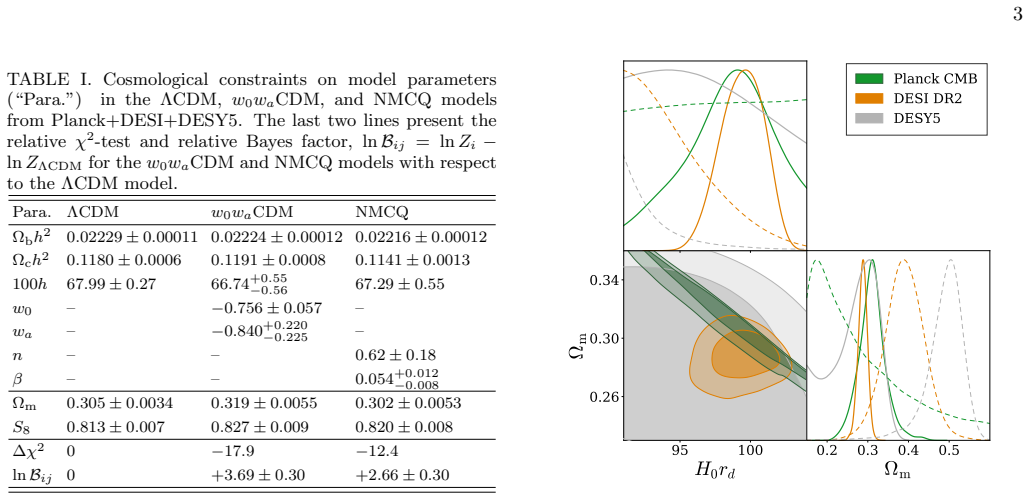
The Planck measurement of the cosmic microwave background (CMB) has established the $\Lambda$-cold-dark-matter ($\Lambda$CDM) model as the concordant model along with other observations. However, recent measurements of baryon acoustic oscillations (BAO) from the Dark Energy Spectroscopic Instrument (DESI) have renewed the matter fraction $\Omega_\mathrm{m}$ tension between Planck-$\Lambda$CDM and DESI-$\Lambda$CDM. Directly reconciling this CMB-BAO tension with a dynamical DE in Chevallier-Polarski-Linder (CPL) parametrization seems to imply a crossing of the equation-of-state (EOS) through $w=-1$ at low redshifts. In this paper, we resolve this $\Omega_\mathrm{m}$ tension by allowing for the DM nonminimally coupled to gravity via a quintessence field. This non-minimal coupling is preferred over $3\sigma$ confidence level. Consequently, even though the usual effective EOS of the coupled quintessence apart from the standard CDM part never crosses but always is above $w=-1$, a misidentification with the $w_0w_a$CDM model would exactly fake such a crossing behavior, and the tensions on neutrino mass and growth rate in the $\Lambda$CDM model are also relieved in our model as a result of the resolved $\Omega_\mathrm{m}$ tension.
Editorial analysis
A structured set of objections, weighed in public.
Referee Report
Summary. The manuscript proposes resolving the Ω_m tension between Planck CMB and DESI BAO data by introducing a non-minimal coupling between dark matter and a quintessence scalar field. It reports a >3σ statistical preference for this coupling, shows that the effective equation of state of the coupled quintessence (excluding standard CDM) remains above w=-1 without phantom crossing, and argues that misidentification with the w0waCDM parametrization produces an apparent crossing; the model is also claimed to relieve neutrino mass and growth-rate tensions as a byproduct.
Significance. If the central claims are robust, the work supplies a concrete mechanism for reconciling CMB-BAO data without phantom dark energy, by showing how a specific non-minimal coupling can absorb the tension while the apparent w0wa crossing is an artifact of model misidentification. The demonstration that multiple secondary tensions are simultaneously alleviated is a strength, as is the explicit comparison between the coupled-quintessence EOS and the w0waCDM fit.
major comments (2)
- [§2] §2 (model definition): the non-minimal coupling function between the quintessence field and the DM stress-energy tensor is introduced as a specific phenomenological form chosen to absorb the Ω_m tension. No derivation from a fundamental action, no comparison to alternative monotonic or scale-dependent couplings, and no explicit stability analysis against gradient instabilities in the perturbation equations are provided; because both the >3σ preference and the non-crossing EOS property rest on this single choice, robustness tests are required.
- [§4] §4 (results and EOS analysis): the statement that the effective quintessence EOS never crosses w=-1 is shown only for the best-fit parameters obtained by fitting the same Planck and DESI likelihoods that define the original tension. This makes the non-crossing property a direct consequence of the fitted coupling strength rather than an independent derivation; an explicit check that the result persists under varied priors on the coupling parameters or under alternative data combinations would strengthen the claim.
minor comments (2)
- [Table 1] Table 1: the reported Δχ² values lack accompanying covariance-matrix or prior-volume information, making it difficult to assess whether the >3σ preference is prior-dependent.
- [Figure 4] Figure 4 (EOS evolution): the curves for the coupled model and the w0waCDM misidentification would be clearer if the 1σ uncertainty bands were overlaid rather than shown separately.
Simulated Author's Rebuttal
We thank the referee for their constructive and detailed report. We address each major comment point by point below, providing clarifications and indicating where revisions have been made to strengthen the manuscript.
read point-by-point responses
-
Referee: [§2] §2 (model definition): the non-minimal coupling function between the quintessence field and the DM stress-energy tensor is introduced as a specific phenomenological form chosen to absorb the Ω_m tension. No derivation from a fundamental action, no comparison to alternative monotonic or scale-dependent couplings, and no explicit stability analysis against gradient instabilities in the perturbation equations are provided; because both the >3σ preference and the non-crossing EOS property rest on this single choice, robustness tests are required.
Authors: We agree that the coupling is introduced as a phenomenological form selected to resolve the Ω_m tension. No derivation from a fundamental action is provided because the model is constructed as a minimal extension focused on observational implications rather than a top-down theoretical construction. In the revised manuscript we have added an explicit check of the perturbation equations confirming the absence of gradient instabilities for the chosen coupling. We have also included a short justification for selecting this particular monotonic, scale-independent form, while noting that systematic comparisons to other couplings lie beyond the scope of the present work. revision: partial
-
Referee: [§4] §4 (results and EOS analysis): the statement that the effective quintessence EOS never crosses w=-1 is shown only for the best-fit parameters obtained by fitting the same Planck and DESI likelihoods that define the original tension. This makes the non-crossing property a direct consequence of the fitted coupling strength rather than an independent derivation; an explicit check that the result persists under varied priors on the coupling parameters or under alternative data combinations would strengthen the claim.
Authors: We accept the referee’s observation that the non-crossing result was initially shown only at the best-fit point. To address this, the revised manuscript now includes additional MCMC explorations with broadened priors on the coupling parameters and with alternative data combinations. These checks confirm that the effective equation of state of the coupled quintessence remains above w = −1 throughout the posterior volume consistent with the data. revision: yes
Circularity Check
No significant circularity; model extension fitted to external data
full rationale
The paper introduces a phenomenological non-minimal coupling between DM and a quintessence field as a new model extension, then fits its parameters directly to the Planck and DESI likelihoods. The claimed resolution of the Omega_m tension and the statement that the effective quintessence EOS stays above w=-1 follow from the model's equations and the fit results rather than from redefining inputs as outputs or from self-citation chains. The derivation remains self-contained against the external benchmarks (Planck CMB and DESI BAO), with the functional form serving as an ansatz whose consequences are computed explicitly; no load-bearing step reduces by construction to a prior result or fitted parameter renamed as a prediction.
Axiom & Free-Parameter Ledger
free parameters (2)
- non-minimal coupling strength
- quintessence potential parameters
axioms (2)
- standard math Standard FLRW background and linear perturbation equations remain valid once the non-minimal coupling is included.
- domain assumption The chosen coupling function does not introduce ghost or gradient instabilities in the perturbation sector.
invented entities (1)
-
non-minimal coupling term between quintessence and dark matter
no independent evidence
Forward citations
Cited by 16 Pith papers
-
Late-time reconstruction of non-minimally coupled gravity with a smoothness prior
Non-parametric reconstruction of non-minimally coupled gravity with a smoothness prior on CMB, DESI BAO, supernovae, and DES data yields a 2.8σ hint for coupling and a preference for phantom divide crossing stabilized...
-
Constraining interacting dark energy models with black hole superradiance
Black hole superradiance constrains the coupling strength in interacting dark energy-dark matter models through modifications to the effective mass of ultralight bosons in two scenarios.
-
Post-Newtonian Constraints on Scalar-Tensor Gravity
Unified post-Newtonian analysis reveals that Palatini scalar-tensor theories often face weaker Solar System bounds than metric versions due to stronger Yukawa suppression, with Palatini f(R) reproducing GR limits for ...
-
Non-minimally coupled quintessence with sign-switching interaction
A new quintessence model with non-minimal coupling produces an effective sign-switching interaction that fits current data better than LambdaCDM or w0waCDM and accounts for late-time dark energy weakening without phan...
-
Evidence for deviation in gravitational light deflection from general relativity at cosmological scales with KiDS-Legacy and CMB lensing
KiDS-Legacy weak lensing plus CMB data yields a 3 sigma deviation in light deflection from GR in a Lambda CDM background, with the signal driven by large-scale CMB lensing amplitudes.
-
Signatures of Modified Gravity Below $\mathcal{O}(10)$ Mpc in a Dynamical Dark Energy Background
Modified gravity below O(10) Mpc in a CPL dynamical dark energy background is required to suppress structure growth at low redshifts while satisfying CMB constraints from ISW and lensing.
-
Cosmological intercept tension
Tensions in the supernova intercept a_B at z~0.01 in PantheonPlus and z~0.1 in DES-Y5 point to data systematics or inter-survey inconsistencies rather than new physics, aligning H0 measurements and reducing support fo...
-
Is the $w_0w_a$CDM cosmological parameterization evidence for dark energy dynamics partially caused by the excess smoothing of Planck PR4 CMB anisotropy data?
Planck PR4 CMB data mildly favors dynamical dark energy, but this preference weakens when accounting for possible excess smoothing, indicating the signal may partly arise from data processing issues.
-
Dark energy, spatial curvature, and star formation efficiency from JWST photometric and spectroscopic high-redshift galaxies
Bayesian joint constraints show that elevated star formation efficiency accounts for JWST high-z galaxy excess in flat Lambda CDM, without requiring deviations in dark energy equation of state or curvature.
-
Constraints on Coupled Dark Energy in the DESI Era
New cosmological data mildly favor a small coupling between dark matter and a scalar dark energy field at |β| ≈ 0.03 while allowing an effective phantom-crossing equation of state.
-
Coupled Dark Energy and Dark Matter for DESI: An Effective Guide to the Phantom Divide
Coupled quintessence-dark matter models can produce an apparent phantom-crossing effective equation of state matching DESI preferences if the scalar field begins frozen in the radiation era.
-
Revisiting the Hubble tension problem in the framework of holographic dark energy
HDE models with future event horizon IR cutoff partially ease the Hubble tension while Hubble-scale cutoffs do not, consistent across six models and multiple BAO/SN/CMB combinations.
-
No evidence for phantom crossing: local goodness-of-fit improvements do not persist under global Bayesian model comparison
Local goodness-of-fit gains for w0wa and phantom crossing vanish under global Bayesian evidence, showing no statistically robust evidence for dynamical dark energy across datasets.
-
No evidence for phantom crossing: local goodness-of-fit improvements do not persist under global Bayesian model comparison
Global Bayesian evidence shows no statistically significant support for dynamical dark energy or phantom crossing despite limited local fit improvements in the w0wa parametrization.
-
Comparing Minimal and Non-Minimal Quintessence Models to 2025 DESI Data
Quintessence models with standard potentials give only modest improvements over Lambda to DESI data on evolving dark energy, while non-minimal couplings allow temporary phantom behavior but face tight gravity constrai...
-
The Quintom theory of dark energy after DESI DR2
This review traces the history of dynamical dark energy, presents the no-go theorem against single-field crossing of w = -1, and surveys viable Quintom constructions including multi-field models and modified gravity i...
Reference graph
Works this paper leans on
-
[1]
Planck 2018 results. VI. Cosmological parameters
N. Aghanim et al. (Planck), “Planck 2018 results. VI. Cosmological parameters,” Astron. Astrophys. 641, A6 (2020), [Erratum: Astron.Astrophys. 652, C4 (2021)], arXiv:1807.06209 [astro-ph.CO]
work page internal anchor Pith review Pith/arXiv arXiv 2018
-
[2]
Shadab Alam et al. (eBOSS), “Completed SDSS-IV ex- tended Baryon Oscillation Spectroscopic Survey: Cos- mological implications from two decades of spectro- scopic surveys at the Apache Point Observatory,” Phys. Rev. D 103, 083533 (2021), arXiv:2007.08991 [astro- ph.CO]
work page internal anchor Pith review Pith/arXiv arXiv 2021
-
[3]
The Pantheon+ Analysis: Cosmological Constraints
Dillon Brout et al., “The Pantheon+ Analysis: Cos- mological Constraints,” Astrophys. J. 938, 110 (2022), arXiv:2202.04077 [astro-ph.CO]
work page internal anchor Pith review Pith/arXiv arXiv 2022
-
[4]
DESI DR2 Results II: Measurements of Baryon Acoustic Oscillations and Cosmological Constraints
M. Abdul Karim et al. (DESI), “DESI DR2 Results II: Measurements of Baryon Acoustic Oscillations and Cosmological Constraints,” (2025), arXiv:2503.14738 [astro-ph.CO]
work page internal anchor Pith review Pith/arXiv arXiv 2025
-
[5]
T. M. C. Abbott et al. (DES), “The Dark Energy Sur- vey: Cosmology Results with ∼1500 New High-redshift Type Ia Supernovae Using the Full 5 yr Data Set,” Astrophys. J. Lett. 973, L14 (2024), arXiv:2401.02929 [astro-ph.CO]
work page internal anchor Pith review Pith/arXiv arXiv 2024
-
[6]
Accelerating Universes with Scaling Dark Matter
Michel Chevallier and David Polarski, “Accelerating universes with scaling dark matter,” Int. J. Mod. Phys. D 10, 213–224 (2001), arXiv:gr-qc/0009008
work page internal anchor Pith review Pith/arXiv arXiv 2001
-
[7]
Exploring the Expansion History of the Universe
Eric V. Linder, “Exploring the expansion history of the universe,” Phys. Rev. Lett. 90, 091301 (2003), arXiv:astro-ph/0208512
work page internal anchor Pith review Pith/arXiv arXiv 2003
-
[8]
The Cosmological Constant and Dark Energy
P. J. E. Peebles and Bharat Ratra, “The Cosmological Constant and Dark Energy,” Rev. Mod. Phys. 75, 559– 606 (2003), arXiv:astro-ph/0207347
work page internal anchor Pith review Pith/arXiv arXiv 2003
-
[9]
Ioannis D. Gialamas, Gert H¨ utsi, Kristjan Kannike, An- tonio Racioppi, Martti Raidal, Martin Vasar, and Hardi Veerm¨ ae, “Interpreting DESI 2024 BAO: Late-time dy- namical dark energy or a local effect?” Phys. Rev. D 111, 043540 (2025), arXiv:2406.07533 [astro-ph.CO]
-
[10]
Efstathiou,Evolving Dark Energy or Supernovae Systematics?, arXiv:2408.07175 (2025)
George Efstathiou, “Evolving dark energy or supernovae systematics?” Mon. Not. Roy. Astron. Soc. 538, 875– 882 (2025), arXiv:2408.07175 [astro-ph.CO]
-
[11]
The DESI DR1/DR2 evidence for dynamical dark en- ergy is biased by low-redshift supernovae,
Lu Huang, Rong-Gen Cai, and Shao-Jiang Wang, “The DESI DR1/DR2 evidence for dynamical dark en- ergy is biased by low-redshift supernovae,” Sci. China Phys. Mech. Astron. (2025), 10.1007/s11433-025-2754- 5, arXiv:2502.04212 [astro-ph.CO]
-
[12]
Shouvik Roy Choudhury and Teppei Okumura, “Up- dated Cosmological Constraints in Extended Param- eter Space with Planck PR4, DESI Baryon Acoustic Oscillations, and Supernovae: Dynamical Dark En- ergy, Neutrino Masses, Lensing Anomaly, and the Hub- ble Tension,” Astrophys. J. Lett. 976, L11 (2024), arXiv:2409.13022 [astro-ph.CO]
work page internal anchor Pith review Pith/arXiv arXiv 2024
-
[13]
Shouvik Roy Choudhury, “Cosmology in Extended Pa- rameter Space with DESI Data Release 2 Baryon Acous- tic Oscillations: A 2 σ+ Detection of Nonzero Neutrino Masses with an Update on Dynamical Dark Energy and Lensing Anomaly,” Astrophys. J. Lett. 986, L31 (2025), arXiv:2504.15340 [astro-ph.CO]
-
[14]
How much has DESI dark energy evolved since DR1?
Eoin ´O. Colg´ ain, Saeed Pourojaghi, M. M. Sheikh- Jabbari, and Lu Yin, “How much has DESI dark energy evolved since DR1?” (2025), arXiv:2504.04417 [astro- ph.CO]
-
[15]
On the tension between DESI DR2 BAO and CMB,
Gen Ye and Shi-Jie Lin, “On the tension between DESI DR2 BAO and CMB,” (2025), arXiv:2505.02207 [astro- ph.CO]
-
[16]
Jun-Qian Jiang, Davide Pedrotti, Simony Santos da Costa, and Sunny Vagnozzi, “Nonparametric late- time expansion history reconstruction and implications for the Hubble tension in light of recent DESI and type Ia supernovae data,” Phys. Rev. D 110, 123519 (2024), arXiv:2408.02365 [astro-ph.CO]
-
[17]
Gan Gu et al. (DESI), “Dynamical Dark Energy in light of the DESI DR2 Baryonic Acoustic Oscillations Mea- surements,” (2025), arXiv:2504.06118 [astro-ph.CO]
-
[18]
Chan-Gyung Park, Javier de Cruz P´ erez, and Bharat Ratra, “Using non-DESI data to confirm and strengthen the DESI 2024 spatially flat w0waCDM cosmological 6 parametrization result,” Phys. Rev. D 110, 123533 (2024), arXiv:2405.00502 [astro-ph.CO]
-
[19]
Putting flat ΛCDM in the (Redshift) bin,
Eoin ´O. Colg´ ain, M. M. Sheikh-Jabbari, Rance Solomon, Maria G. Dainotti, and Dejan Stojkovic, “Putting flat ΛCDM in the (Redshift) bin,” Phys. Dark Univ. 44, 101464 (2024), arXiv:2206.11447 [astro- ph.CO]
-
[20]
Eoin ´O. Colg´ ain, Maria Giovanna Dainotti, Salvatore Capozziello, Saeed Pourojaghi, M. M. Sheikh-Jabbari, and Dejan Stojkovic, “Does DESI 2024 confirm ΛCDM?” JHEAp 49, 100428 (2026), arXiv:2404.08633 [astro-ph.CO]
-
[21]
Eoin ´O. Colg´ ain, Saeed Pourojaghi, and M. M. Sheikh-Jabbari, “Implications of DES 5YR SNe Dataset for ΛCDM,” Eur. Phys. J. C 85, 286 (2025), arXiv:2406.06389 [astro-ph.CO]
-
[22]
DESI and SNe: Dynamical Dark Energy, Ω m Tension or System- atics?
Eoin ´O. Colg´ ain and M. M. Sheikh-Jabbari, “DESI and SNe: Dynamical Dark Energy, Ω m Tension or System- atics?” (2024), arXiv:2412.12905 [astro-ph.CO]
-
[23]
Did DESI DR2 truly re- veal dynamical dark energy?
Deng Wang and David Mota, “Did DESI DR2 truly re- veal dynamical dark energy?” (2025), arXiv:2504.15222 [astro-ph.CO]
-
[24]
Does DESI DR2 challenge ΛCDM paradigm?
Himanshu Chaudhary, Salvatore Capozziello, Vipin Ku- mar Sharma, and Ghulam Mustafa, “Does DESI DR2 challenge ΛCDM paradigm?” (2025), arXiv:2507.21607 [astro-ph.CO]
-
[25]
Can dark energy evolve to the Phantom?
Alexander Vikman, “Can dark energy evolve to the phantom?” Phys. Rev. D 71, 023515 (2005), arXiv:astro-ph/0407107
work page internal anchor Pith review Pith/arXiv arXiv 2005
-
[26]
Imperfect Dark Energy from Kinetic Gravity Braiding
Cedric Deffayet, Oriol Pujolas, Ignacy Sawicki, and Alexander Vikman, “Imperfect Dark Energy from Kinetic Gravity Braiding,” JCAP 10, 026 (2010), arXiv:1008.0048 [hep-th]
work page internal anchor Pith review Pith/arXiv arXiv 2010
-
[27]
Hints of Nonminimally Coupled Gravity in DESI 2024 Baryon Acoustic Oscillation Measurements,
Gen Ye, Matteo Martinelli, Bin Hu, and Alessandra Silvestri, “Hints of Nonminimally Coupled Gravity in DESI 2024 Baryon Acoustic Oscillation Measurements,” Phys. Rev. Lett. 134, 181002 (2025), arXiv:2407.15832 [astro-ph.CO]
-
[28]
Non-minimally coupled gravity constraints from DESI DR2 data
Jiaming Pan and Gen Ye, “Non-minimally coupled gravity constraints from DESI DR2 data,” (2025), arXiv:2503.19898 [astro-ph.CO]
work page internal anchor Pith review Pith/arXiv arXiv 2025
-
[29]
The Quintom theory of dark energy after DESI DR2
Yifu Cai, Xin Ren, Taotao Qiu, Mingzhe Li, and Xin- min Zhang, “The Quintom theory of dark energy after DESI DR2,” (2025), arXiv:2505.24732 [astro-ph.CO]
work page internal anchor Pith review Pith/arXiv arXiv 2025
-
[30]
Update on coupled dark energy and the H0 tension,
Adri` a G´ omez-Valent, Valeria Pettorino, and Luca Amendola, “Update on coupled dark energy and the H0 tension,” Phys. Rev. D 101, 123513 (2020), arXiv:2004.00610 [astro-ph.CO]
-
[31]
Chameleon dark energy can resolve the Hubble tension,
Rong-Gen Cai, Zong-Kuan Guo, Li Li, Shao-Jiang Wang, and Wang-Wei Yu, “Chameleon dark energy can resolve the Hubble tension,” Phys. Rev. D103, L121302 (2021), arXiv:2102.02020 [astro-ph.CO]
-
[32]
First de- tection of the Hubble variation correlation and its scale dependence,
Wang-Wei Yu, Li Li, and Shao-Jiang Wang, “First de- tection of the Hubble variation correlation and its scale dependence,” (2022), arXiv:2209.14732 [astro-ph.CO]
-
[33]
Chameleon early dark en- ergy and the Hubble tension,
Tanvi Karwal, Marco Raveri, Bhuvnesh Jain, Justin Khoury, and Mark Trodden, “Chameleon Early Dark Energy and the Hubble Tension,” (2021), arXiv:2106.13290 [astro-ph.CO]
-
[34]
Hubble Ten- sion as a Window on the Gravitation of the Dark Matter Sector,
Cyril Pitrou and Jean-Philippe Uzan, “Hubble Ten- sion as a Window on the Gravitation of the Dark Matter Sector,” Phys. Rev. Lett. 132, 191001 (2024), arXiv:2312.12493 [astro-ph.CO]
-
[35]
Jean-Philippe Uzan and Cyril Pitrou, “Hubble tension as a window on the gravitation of the dark matter sector: Exploration of a family of models,” Phys. Rev. D 109, 103505 (2024), arXiv:2312.12408 [astro-ph.CO]
-
[36]
Matching current observational constraints with nonminimally coupled dark energy,
William J. Wolf, Pedro G. Ferreira, and Carlos Garc´ ıa- Garc´ ıa, “Matching current observational constraints with nonminimally coupled dark energy,” Phys. Rev. D 111, L041303 (2025), arXiv:2409.17019 [astro-ph.CO]
-
[37]
Bridge the Cosmological Tensions with Thaw- ing Gravity,
Gen Ye, “Bridge the Cosmological Tensions with Thaw- ing Gravity,” (2024), arXiv:2411.11743 [astro-ph.CO]
- [38]
-
[39]
Amlan Chakraborty, Prolay K. Chanda, Subinoy Das, and Koushik Dutta, “DESI results: Hint towards coupled dark matter and dark energy,” (2025), arXiv:2503.10806 [astro-ph.CO]
-
[40]
Justin Khoury, Meng-Xiang Lin, and Mark Trod- den, “Apparent w < −1 and a Lower S8 from Dark Axion and Dark Baryons Interactions,” (2025), arXiv:2503.16415 [astro-ph.CO]
-
[41]
The Cosmologi- cal Evidence for Non-Minimal Coupling,
William J. Wolf, Carlos Garc´ ıa-Garc´ ıa, Theodore Anton, and Pedro G. Ferreira, “The Cosmologi- cal Evidence for Non-Minimal Coupling,” (2025), arXiv:2504.07679 [astro-ph.CO]
-
[42]
Alek Bedroya, Georges Obied, Cumrun Vafa, and David H. Wu, “Evolving Dark Sector and the Dark Dimension Scenario,” (2025), arXiv:2507.03090 [astro- ph.CO]
-
[43]
Weinberg’s theorem, phantom cross- ing and screening,
Philippe Brax, “Weinberg’s theorem, phantom cross- ing and screening,” (2025), arXiv:2507.16723 [astro- ph.CO]
-
[44]
Amlan Chakraborty, Tulip Ray, Subinoy Das, Arka Banerjee, and Vidhya Ganesan, “Hint of dark matter- dark energy interaction in the current cosmological data?” (2024), arXiv:2403.14247 [astro-ph.CO]
-
[45]
Wang, Constraining Cosmological Physics with DESI BAO Observations (4 2024).arXiv:2404.06796
Deng Wang, “Constraining Cosmological Physics with DESI BAO Observations,” (2024), arXiv:2404.06796 [astro-ph.CO]
-
[46]
William Giar` e, Miguel A. Sabogal, Rafael C. Nunes, and Eleonora Di Valentino, “Interacting Dark Energy after DESI Baryon Acoustic Oscillation Measurements,” Phys. Rev. Lett. 133, 251003 (2024), arXiv:2404.15232 [astro-ph.CO]
-
[47]
Tian-Nuo Li, Peng-Ju Wu, Guo-Hong Du, Shang-Jie Jin, Hai-Li Li, Jing-Fei Zhang, and Xin Zhang, “Con- straints on Interacting Dark Energy Models from the DESI Baryon Acoustic Oscillation and DES Supernovae Data,” Astrophys. J. 976, 1 (2024), arXiv:2407.14934 [astro-ph.CO]
-
[48]
Upper limits on dark energy-dark matter interaction from DESI DR2 in a field-theoretic analysis,
Amin Aboubrahim and Pran Nath, “Upper limits on dark energy-dark matter interaction from DESI DR2 in a field-theoretic analysis,” (2024), arXiv:2411.11177 [astro-ph.CO]
-
[49]
Tian-Nuo Li, Guo-Hong Du, Yun-He Li, Peng-Ju Wu, Shang-Jie Jin, Jing-Fei Zhang, and Xin Zhang, “Prob- ing the sign-changeable interaction between dark energy and dark matter with DESI baryon acoustic oscillations and DES supernovae data,” (2025), arXiv:2501.07361 [astro-ph.CO]
-
[50]
Miguel A. Sabogal, Emanuelly Silva, Rafael C. Nunes, Suresh Kumar, and Eleonora Di Valentino, “Sign 7 switching in dark sector coupling interactions as a can- didate for resolving cosmological tensions,” Phys. Rev. D 111, 043531 (2025), arXiv:2501.10323 [astro-ph.CO]
-
[51]
M. Tsedrik et al., “Interacting dark energy constraints from the full-shape analyses of BOSS DR12 and DES Year 3 measurements,” (2025), arXiv:2502.03390 [astro-ph.CO]
-
[52]
A low-redshift preference for an interacting dark energy model,
Yuejia Zhai, Marco de Cesare, Carsten van de Bruck, Eleonora Di Valentino, and Edward Wilson-Ewing, “A low-redshift preference for an interacting dark energy model,” (2025), arXiv:2503.15659 [astro-ph.CO]
-
[53]
In- teracting dark sectors in light of DESI DR2,
Rahul Shah, Purba Mukherjee, and Supratik Pal, “In- teracting dark sectors in light of DESI DR2,” (2025), arXiv:2503.21652 [astro-ph.CO]
- [54]
-
[55]
Interacting dark energy after DESI DR2: a challenge for ΛCDM paradigm?
Supriya Pan, Sivasish Paul, Emmanuel N. Saridakis, and Weiqiang Yang, “Interacting dark energy after DESI DR2: a challenge for ΛCDM paradigm?” (2025), arXiv:2504.00994 [astro-ph.CO]
-
[56]
Mai Yashiki, “Toward a simultaneous resolution of the H0 and S8 tensions: early dark energy and an inter- acting dark sector model,” (2025), arXiv:2505.23382 [astro-ph.CO]
-
[57]
Implications of DESI for Dark Matter & Cosmic Bire- fringence,
Basabendu Barman and Sudhakantha Girmohanta, “Implications of DESI for Dark Matter & Cosmic Bire- fringence,” (2025), arXiv:2506.12589 [hep-ph]
- [58]
-
[59]
Luca Amendola, “Coupled quintessence,” Phys. Rev. D 62, 043511 (2000), arXiv:astro-ph/9908023
work page internal anchor Pith review Pith/arXiv arXiv 2000
-
[60]
The cosmon model for an asymptotically vanishing time-dependent cosmological ``constant''
Christof Wetterich, “The Cosmon model for an asymp- totically vanishing time dependent cosmological ’con- stant’,” Astron. Astrophys. 301, 321–328 (1995), arXiv:hep-th/9408025
work page internal anchor Pith review Pith/arXiv arXiv 1995
-
[61]
Chameleon fields: Awaiting surprises for tests of gravity in space,
Justin Khoury and Amanda Weltman, “Chameleon fields: Awaiting surprises for tests of gravity in space,” Phys. Rev. Lett. 93, 171104 (2004), arXiv:astro- ph/0309300 [astro-ph]
-
[62]
Justin Khoury and Amanda Weltman, “Chameleon cos- mology,” Phys. Rev. D69, 044026 (2004), arXiv:astro- ph/0309411 [astro-ph]
-
[63]
Quantum Stability of Chameleon Field Theories
Amol Upadhye, Wayne Hu, and Justin Khoury, “Quan- tum Stability of Chameleon Field Theories,” Phys. Rev. Lett. 109, 041301 (2012), arXiv:1204.3906 [hep-ph]
work page internal anchor Pith review Pith/arXiv arXiv 2012
-
[64]
Cosmological Con- sequences of a Rolling Homogeneous Scalar Field,
Bharat Ratra and P. J. E. Peebles, “Cosmological Con- sequences of a Rolling Homogeneous Scalar Field,” Phys. Rev. D 37, 3406 (1988)
work page 1988
-
[65]
Cosmology with a Time Variable Cosmological Constant,
P. J. E. Peebles and Bharat Ratra, “Cosmology with a Time Variable Cosmological Constant,” Astrophys. J. Lett. 325, L17 (1988)
work page 1988
-
[66]
Cosmology and the Fate of Dilatation Symmetry
C. Wetterich, “Cosmology and the Fate of Dilata- tion Symmetry,” Nucl. Phys. B 302, 668–696 (1988), arXiv:1711.03844 [hep-th]
work page internal anchor Pith review Pith/arXiv arXiv 1988
-
[67]
The String Dilaton and a Least Coupling Principle
T. Damour and Alexander M. Polyakov, “The String dilaton and a least coupling principle,” Nucl. Phys. B 423, 532–558 (1994), arXiv:hep-th/9401069
work page internal anchor Pith review Pith/arXiv arXiv 1994
-
[68]
Peter Svrcek and Edward Witten, “Axions In String Theory,” JHEP 06, 051 (2006), arXiv:hep-th/0605206 [hep-th]
work page internal anchor Pith review Pith/arXiv arXiv 2006
-
[69]
Non-supersymmetric AdS and the Swampland
Hirosi Ooguri and Cumrun Vafa, “Non-supersymmetric AdS and the Swampland,” Adv. Theor. Math. Phys.21, 1787–1801 (2017), arXiv:1610.01533 [hep-th]
work page internal anchor Pith review Pith/arXiv arXiv 2017
-
[70]
On the Cosmological Implications of the String Swampland
Prateek Agrawal, Georges Obied, Paul J. Steinhardt, and Cumrun Vafa, “On the Cosmological Implications of the String Swampland,” Phys. Lett. B784, 271–276 (2018), arXiv:1806.09718 [hep-th]
work page internal anchor Pith review Pith/arXiv arXiv 2018
-
[71]
Distance and de Sitter Conjectures on the Swampland
Hirosi Ooguri, Eran Palti, Gary Shiu, and Cum- run Vafa, “Distance and de Sitter Conjectures on the Swampland,” (2018), arXiv:1810.05506 [hep-th]
work page internal anchor Pith review Pith/arXiv arXiv 2018
-
[72]
The impact of the Hubble tension on the evidence for dynamical dark energy,
Ye-Huang Pang, Xue Zhang, and Qing-Guo Huang, “The impact of the Hubble tension on the evidence for dynamical dark energy,” Sci. China Phys. Mech. Astron. 68, 280410 (2025), arXiv:2503.21600 [astro-ph.CO]
-
[73]
Hao Wang and Yun-Song Piao, “Dark energy in light of recent DESI BAO and Hubble tension,” (2024), arXiv:2404.18579 [astro-ph.CO]
-
[74]
The Cosmological Constant Prob- lem,
Steven Weinberg, “The Cosmological Constant Prob- lem,” Rev. Mod. Phys. 61, 1–23 (1989)
work page 1989
-
[75]
Efficient Computation of CMB anisotropies in closed FRW models
Antony Lewis, Anthony Challinor, and Anthony Lasenby, “Efficient computation of CMB anisotropies in closed FRW models,” Astrophys. J. 538, 473–476 (2000), arXiv:astro-ph/9911177
work page internal anchor Pith review Pith/arXiv arXiv 2000
-
[76]
IDECAMB: an implemen- tation of interacting dark energy cosmology in CAMB,
Yun-He Li and Xin Zhang, “IDECAMB: an implemen- tation of interacting dark energy cosmology in CAMB,” JCAP 09, 046 (2023), arXiv:2306.01593 [astro-ph.CO]
-
[77]
Parametrized Post-Friedmann Framework for Interacting Dark Energy
Yun-He Li, Jing-Fei Zhang, and Xin Zhang, “Parametrized Post-Friedmann Framework for Interact- ing Dark Energy,” Phys. Rev. D 90, 063005 (2014), arXiv:1404.5220 [astro-ph.CO]
work page internal anchor Pith review Pith/arXiv arXiv 2014
-
[78]
Effective Field Theory of Cosmic Acceleration: an implementation in CAMB
Bin Hu, Marco Raveri, Noemi Frusciante, and Alessan- dra Silvestri, “Effective Field Theory of Cosmic Accel- eration: an implementation in CAMB,” Phys. Rev. D 89, 103530 (2014), arXiv:1312.5742 [astro-ph.CO]
work page internal anchor Pith review Pith/arXiv arXiv 2014
-
[79]
Cobaya: Code for Bayesian Analysis of hierarchical physical models
Jesus Torrado and Antony Lewis, “Cobaya: Code for Bayesian Analysis of hierarchical physical models,” JCAP 05, 057 (2021), arXiv:2005.05290 [astro-ph.IM]
work page internal anchor Pith review Pith/arXiv arXiv 2021
-
[80]
Cobaya: Bayesian analysis in cosmology,
Jes´ us Torrado and Antony Lewis, “Cobaya: Bayesian analysis in cosmology,” Astrophysics Source Code Li- brary, record ascl:1910.019 (2019)
work page 1910
discussion (0)
Sign in with ORCID, Apple, or X to comment. Anyone can read and Pith papers without signing in.