Recognition: unknown
Cosmological intercept tension
Pith reviewed 2026-05-07 05:54 UTC · model grok-4.3
The pith
The intercept a_B computed from supernova magnitudes serves as a diagnostic for distinguishing local systematics from late-time new physics in cosmological models.
A machine-rendered reading of the paper's core claim, the machinery that carries it, and where it could break.
Core claim
The central claim is that the constancy of the intercept a_B across supernova datasets and redshift bins for a given late-time luminosity distance model provides a diagnostic to separate late-time new physics from local supernova systematics. Application to one dataset reveals a tension near redshift 0.01, and removing low-redshift data to eliminate it produces a Hubble constant measurement aligned with typical local determinations using both three-rung and two-rung methods. In another dataset, a tension near redshift 0.1 is found, and its elimination reduces the preference for dynamical dark energy; this tension arises from discrepancies between the supernova data and combined constraints,
What carries the argument
The intercept a_B in the magnitude-luminosity distance relation m_B = 5 lg d_L(z) - 5 a_B, which equals the combination of absolute magnitude and Hubble constant term and can be computed from observations alone for a fixed d_L model.
If this is right
- Removal of the low-redshift tension aligns the Hubble constant inference with other local measurements using both three-rung and two-rung approaches.
- Removal of the intermediate-redshift tension substantially lowers the statistical preference for dynamical dark energy.
- The intermediate-redshift tension is mainly due to inconsistencies between the supernova observations and constraints from other cosmological data.
- Dynamical dark energy acts as a compromise solution to these inter-data tensions.
- Interacting dark energy models offer a way to reconcile the supernova data with other cosmological constraints.
Where Pith is reading between the lines
- This diagnostic method could be extended to future supernova surveys to probe for similar redshift-dependent variations.
- Persistent tensions would motivate development of models that modify the expansion history in specific redshift intervals.
- Careful examination of binning choices and error modeling is needed to confirm that variations are not artifacts.
- Linking this to other probes like baryon acoustic oscillations may test the consistency of proposed interacting dark energy scenarios.
Load-bearing premise
That any variation found in the intercept a_B must reflect either local systematics or new physics, as opposed to statistical fluctuations, incomplete modeling of the luminosity distance, or effects from how the data are selected and binned.
What would settle it
Computing the intercept a_B in multiple narrow redshift bins for the intermediate-redshift supernova sample and finding it consistent with a single constant value within uncertainties would falsify the claim of a late-time tension.
Figures


read the original abstract
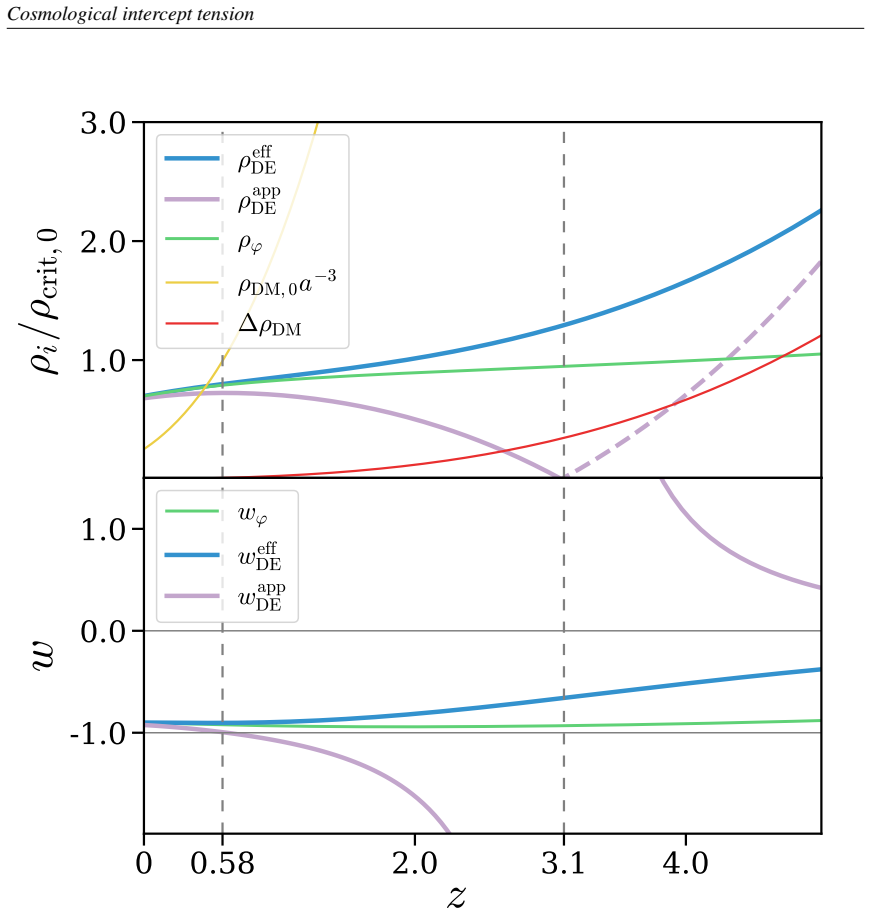
The long-standing tension in the Hubble constant $H_0$ has motivated extensive explorations of both new physics and observational systematics, for example, the late-time systematics in measuring the B-band absolute magnitude $M_B$ of type Ia supernovae, which is degenerated with $H_0$ via an intercept $-5a_B=M_B+5\lg (c/H_0/\mathrm{Mpc})+25$ in the linear relation $m_B=5\lg d_L(z)-5a_B$ between the apparent magnitude $m_B$ and logarithmic dimensionless luminosity distance $\lg d_L(z)$. Therefore, this intercept can be evaluated directly from pure observational quantities ($m_B$ and the redshift $z$) for a given model of $d_L(z)$ without knowing underlying systematics in $M_B$-$H_0$ degeneracy. Hence, the constancy of this intercept across different supernova datasets and different redshift bins within the same dataset for a given late-time model serves as a powerful diagnostic for disentangling late-time new physics from local supernova systematics. In this mini-review, we will show that: (1) there is a local $a_B$ tension in PantheonPlus around $z\sim0.01$, and the elimination of it leads to a $H_0$ measurement consistent with both SH0ES typical three-rung and first two-rung measurements; (2) there is a late-time $a_B$ tension in DES-Y5 around $z\sim0.1$, and the elimination of it largely reduces the preference for dynamical dark energy. We also update the late-time $a_B$-tension analysis for both DES-Y5 and DES-Dovekie supernovae, and find that this $a_B$ tension around $z\sim0.1$ is mainly driven by the inter-data tension between DES supernovae and DESI+Planck constraint, and the dynamical dark energy is preferred as a compromise of this tension. Finally, we briefly mention an interacting dark energy model that resolves this tension among DES, DESI, and Planck, and point out a crucial difference between the effective and apparent equations of state of dark energy.
Editorial analysis
A structured set of objections, weighed in public.
Referee Report
Summary. The manuscript proposes the constancy of the supernova intercept a_B = (5 lg d_L(z) - m_B)/5, evaluated for a fixed late-time luminosity-distance model d_L(z), as a diagnostic to distinguish late-time new physics from local systematics in Type Ia supernovae. It reports a local a_B tension in PantheonPlus near z ∼ 0.01 whose removal produces an H0 value consistent with both the standard three-rung and first two-rung SH0ES measurements, and a late-time a_B tension in DES-Y5 near z ∼ 0.1 whose removal substantially reduces the statistical preference for dynamical dark energy. Updated results for DES-Y5 and DES-Dovekie are presented, with the latter tension attributed primarily to inter-dataset inconsistency between DES supernovae and the DESI+Planck combination; an interacting dark-energy model is briefly invoked as a possible resolution that distinguishes effective from apparent equations of state.
Significance. If the reported non-constancies survive rigorous statistical validation, the a_B diagnostic could offer a practical, model-independent way to localize the source of the Hubble tension and of apparent dynamical-dark-energy signals. The approach usefully separates the intercept from the M_B–H0 degeneracy and draws attention to possible inter-dataset tensions rather than requiring new physics at every step. Credit is due for the explicit linkage between a_B constancy and the ability to recover SH0ES-like H0 values and for the qualitative discussion of an interacting dark-energy scenario.
major comments (3)
- [PantheonPlus local a_B tension analysis] In the PantheonPlus local-tension section, the identification of a_B variation near z ∼ 0.01 and the subsequent elimination of discrepant points to recover H0 consistency with SH0ES lacks any description of the precise statistical threshold, bin-boundary sensitivity tests, or multiple-comparison correction applied. Without these, it is impossible to judge whether the apparent tension exceeds the expectation from statistical fluctuations and magnitude-redshift covariances under a constant-a_B null hypothesis.
- [DES-Y5 late-time a_B tension analysis] In the DES-Y5 late-time tension section, the statement that elimination of the z ∼ 0.1 a_B tension “largely reduces the preference for dynamical dark energy” is not accompanied by quantitative measures (Δχ², Bayes factor, or posterior odds) before versus after removal. Because d_L(z) is anchored to external (Planck) constraints, the observed variation may partly reflect the joint dataset tension rather than an intrinsic supernova effect; a decomposition isolating the supernova contribution is required to support the diagnostic claim.
- [Updated DES-Y5/DES-Dovekie analysis] In the updated DES-Dovekie and inter-data tension discussion, the attribution of the a_B discrepancy primarily to tension between DES supernovae and DESI+Planck is presented without tabulated a_B values per redshift bin or per survey, nor with the associated covariance matrices. This prevents independent assessment of the size of the discrepancy relative to the reported uncertainties and weakens the claim that the tension is “mainly driven” by inter-data inconsistency.
minor comments (3)
- [Introduction] The relation −5a_B = M_B + 5 lg(c/H0/Mpc) + 25 is stated in the abstract but not written as an explicit numbered equation in the introduction; adding Eq. (1) would improve traceability.
- [Interacting dark energy model] The brief discussion of the interacting dark-energy model would benefit from a short derivation or reference showing how the effective and apparent equations of state differ, rather than a qualitative remark only.
- [Figures] Figure captions (where a_B is plotted versus z) should explicitly state the assumed d_L(z) model, the number of supernovae per bin, and the 1σ error bars used.
Simulated Author's Rebuttal
We thank the referee for their careful reading of the manuscript and for the constructive major comments, which highlight areas where additional detail will improve clarity and allow readers to better evaluate the statistical robustness of the a_B diagnostic. We respond to each point below and will incorporate revisions to address the concerns raised.
read point-by-point responses
-
Referee: In the PantheonPlus local-tension section, the identification of a_B variation near z ∼ 0.01 and the subsequent elimination of discrepant points to recover H0 consistency with SH0ES lacks any description of the precise statistical threshold, bin-boundary sensitivity tests, or multiple-comparison correction applied. Without these, it is impossible to judge whether the apparent tension exceeds the expectation from statistical fluctuations and magnitude-redshift covariances under a constant-a_B null hypothesis.
Authors: We thank the referee for this observation. The binning in the PantheonPlus analysis was chosen to align with the redshift scale of local distance-ladder calibrators, and points were flagged as discrepant when they deviated noticeably from the mean a_B across the sample. No formal multiple-comparison correction was applied because the bin boundaries were fixed by physical considerations rather than data-driven optimization. In the revised manuscript we will add an explicit description of the threshold criterion employed, report the results of sensitivity tests in which bin boundaries are shifted by small amounts, and include a short discussion of how magnitude-redshift covariances enter the a_B error budget. These additions will enable a clearer assessment of whether the observed variation exceeds expectations under the constant-a_B null hypothesis. revision: yes
-
Referee: In the DES-Y5 late-time tension section, the statement that elimination of the z ∼ 0.1 a_B tension “largely reduces the preference for dynamical dark energy” is not accompanied by quantitative measures (Δχ², Bayes factor, or posterior odds) before versus after removal. Because d_L(z) is anchored to external (Planck) constraints, the observed variation may partly reflect the joint dataset tension rather than an intrinsic supernova effect; a decomposition isolating the supernova contribution is required to support the diagnostic claim.
Authors: We agree that quantitative metrics and an explicit decomposition are needed to substantiate the claim. Because the luminosity-distance model is held fixed at the Planck best-fit values, any shift in a_B directly measures the inconsistency between the supernova magnitudes and that model; the external prior contributes a constant term to the total χ². In the revised version we will report Δχ² (and, where feasible, Bayes-factor estimates) for the w0waCDM versus ΛCDM fits before and after removal of the z ∼ 0.1 bin, together with a short paragraph that isolates the supernova-only χ² contribution. This decomposition will clarify that the reduction in dynamical-dark-energy preference is driven by the supernova data rather than by the joint tension alone. revision: yes
-
Referee: In the updated DES-Dovekie and inter-data tension discussion, the attribution of the a_B discrepancy primarily to tension between DES supernovae and DESI+Planck is presented without tabulated a_B values per redshift bin or per survey, nor with the associated covariance matrices. This prevents independent assessment of the size of the discrepancy relative to the reported uncertainties and weakens the claim that the tension is “mainly driven” by inter-data inconsistency.
Authors: We acknowledge that the absence of tabulated values limits independent verification. As the manuscript is a concise mini-review, we focused on the narrative interpretation; however, we will add a compact table listing the measured a_B and its uncertainty for each relevant redshift bin in both DES-Y5 and DES-Dovekie, together with the value expected from the DESI+Planck combination. For the covariance matrices we will describe their structure, quote the diagonal uncertainties used in the analysis, and note that the full matrices are publicly available from the supernova data releases. These additions will allow readers to confirm that the largest residuals occur when DES supernovae are combined with DESI+Planck, thereby supporting the inter-dataset origin of the tension. revision: yes
Circularity Check
No significant circularity in the a_B constancy diagnostic
full rationale
The paper defines a_B explicitly via the algebraic rearrangement a_B = (5 lg d_L(z) - m_B)/5 from the observed supernova magnitudes m_B and redshifts z, using a fixed external late-time d_L(z) model (e.g., anchored to Planck+DESI constraints independent of the supernova samples under test). It then empirically evaluates whether this computed a_B remains constant across datasets and redshift bins. This evaluation is a direct data comparison and does not reduce any reported tension, H0 consistency after point elimination, or diagnostic power to a tautology, self-fit, or self-citation chain; the variations are presented as observed discrepancies rather than predictions forced by the inputs. The derivation chain is therefore self-contained against external benchmarks, with no load-bearing step that collapses by construction.
Axiom & Free-Parameter Ledger
axioms (2)
- domain assumption The luminosity distance d_L(z) follows a specific late-time cosmological model (e.g., LambdaCDM or wCDM) that is fixed independently of the supernova data under test.
- domain assumption The intercept a_B must be constant across redshift bins and datasets under a correct late-time model unless systematics or new physics are present.
Reference graph
Works this paper leans on
-
[1]
M. Moresco et al.,Unveiling the Universe with emerging cosmological probes,Living Rev. Rel.25(2022) 6, [2201.07241]
-
[2]
L. Perivolaropoulos and F. Skara,Challenges forΛCDM: An update,New Astron. Rev.95 (2022) 101659, [2105.05208]
- [3]
-
[4]
Tensions between the Early and the Late Universe
L. Verde, T. Treu and A. G. Riess,Tensions between the Early and the Late Universe, Nature Astron.3(7, 2019) 891, [1907.10625]
work page internal anchor Pith review arXiv 2019
-
[5]
L. Knox and M. Millea,Hubble constant hunter’s guide,Phys. Rev.D101(2020) 043533, [1908.03663]
- [6]
- [7]
-
[8]
A. G. Riess et al.,A Comprehensive Measurement of the Local Value of the Hubble Constant with 1 km/s/Mpc Uncertainty from the Hubble Space Telescope and the SH0ES Team,Astrophys. J. Lett.934(2022) L7, [2112.04510]. [10]Planckcollaboration, N. Aghanim et al.,Planck 2018 results. VI. Cosmological parameters,Astron. Astrophys.641(2020) A6, [1807.06209]
work page internal anchor Pith review arXiv 2022
-
[9]
E. Di Valentino et al.,Snowmass2021 - Letter of interest cosmology intertwined II: The hubble constant tension,Astropart. Phys.131(2021) 102605, [2008.11284]
-
[10]
E. Di Valentino, O. Mena, S. Pan, L. Visinelli, W. Yang, A. Melchiorri et al.,In the realm of the Hubble tension—a review of solutions,Class. Quant. Grav.38(2021) 153001, [2103.01183]
-
[11]
N. Schöneberg, G. Franco Abellán, A. Pérez Sánchez, S. J. Witte, V. Poulin and J. Lesgourgues,The H0 Olympics: A fair ranking of proposed models,Phys. Rept.984 (2022) 1–55, [2107.10291]
- [12]
-
[13]
E. Abdalla et al.,Cosmology intertwined: A review of the particle physics, astrophysics, and cosmology associated with the cosmological tensions and anomalies,JHEAp34(2022) 49–211, [2203.06142]
work page internal anchor Pith review arXiv 2022
-
[14]
J.-P. Hu and F.-Y. Wang,Hubble Tension: The Evidence of New Physics,Universe9(2023) 94, [2302.05709]
-
[15]
S. Vagnozzi,Seven Hints That Early-Time New Physics Alone Is Not Sufficient to Solve the Hubble Tension,Universe9(2023) 393, [2308.16628]
-
[16]
R.-G. Cai, L. Li and S.-J. Wang,Hubble-constant crisis,Acta Phys. Sin.72(2023) 239801. [19]CosmoVerse Networkcollaboration, E. Di Valentino et al.,The CosmoVerse White Paper: Addressing observational tensions in cosmology with systematics and fundamental physics,Phys. Dark Univ.49(2025) 101965, [2504.01669]. 21 Cosmological intercept tension
work page internal anchor Pith review arXiv 2023
-
[17]
C. Krishnan, E. O. Colgáin, Ruchika, A. A. Sen, M. M. Sheikh-Jabbari and T. Yang,Is there an early Universe solution to Hubble tension?,Phys. Rev. D102(2020) 103525, [2002.06044]
-
[18]
K. Jedamzik, L. Pogosian and G.-B. Zhao,Why reducing the cosmic sound horizon alone can not fully resolve the Hubble tension,Commun. in Phys.4(2021) 123, [2010.04158]
- [19]
- [20]
-
[21]
S. Vagnozzi,Consistency tests ofΛCDM from the early integrated Sachs-Wolfe effect: Implications for early-time new physics and the Hubble tension,Phys. Rev. D104(2021) 063524, [2105.10425]
- [22]
-
[23]
G. Benevento, W. Hu and M. Raveri,Can Late Dark Energy Transitions Raise the Hubble constant?,Phys. Rev.D101(2020) 103517, [2002.11707]
-
[24]
D. Camarena and V. Marra,On the use of the local prior on the absolute magnitude of Type Ia supernovae in cosmological inference,Mon. Not. Roy. Astron. Soc.504(2021) 5164–5171, [2101.08641]
-
[25]
Efstathiou,To H0 or not to H0?,Mon
G. Efstathiou,To H0 or not to H0?,Mon. Not. Roy. Astron. Soc.505(2021) 3866–3872, [2103.08723]
- [26]
- [27]
- [28]
- [29]
- [30]
-
[31]
L. Huang, S.-J. Wang and W.-W. Yu,No-go guide for the Hubble tension: Late-time or local-scale new physics,Sci. China Phys. Mech. Astron.68(2025) 220413, [2401.14170]
-
[32]
L. Huang, R.-G. Cai, S.-J. Wang, J.-Q. Liu and Y.-H. Yao,Narrowing down the Hubble tension to the first two rungs of distance ladders,Sci. China Phys. Mech. Astron.68(2025) 280405, [2410.06053]
-
[33]
The DESI DR1/DR2 evidence for dynamical dark en- ergy is biased by low-redshift supernovae,
L. Huang, R.-G. Cai and S.-J. Wang,The DESI DR1/DR2 evidence for dynamical dark energy is biased by low-redshift supernovae,Sci. China Phys. Mech. Astron.(2, 2025) , [2502.04212]
- [34]
-
[35]
C. Fu and S.-J. Wang,Reconciling early dark energy with a Harrison-Zeldovich spectrum, Phys. Rev. D109(2024) L041304, [2310.12932]
-
[36]
C. Fu, D. Lu and S.-J. Wang,Harrison-Zeldovich attractor: From Planck to ACT results, Phys. Rev. D113(2026) L081304, [2510.24682]. [40]Atacama Cosmology Telescopecollaboration, T. Louis et al.,The Atacama Cosmology Telescope: DR6 power spectra, likelihoods andΛCDM parameters,JCAP11(2025) 062, [2503.14452]. [41]Atacama Cosmology Telescopecollaboration, E. ...
work page internal anchor Pith review Pith/arXiv arXiv 2026
- [37]
-
[38]
V. Poulin, T. L. Smith, R. Calderón and T. Simon,Impact of ACT DR6 and DESI DR2 for early dark energy and the Hubble tension,Phys. Rev. D113(2026) 063519, [2505.08051]. [44]SPT-3Gcollaboration, A. R. Khalife et al.,SPT-3G D1: Axion Early Dark Energy with CMB experiments and DESI,2507.23355
-
[39]
Y. Toda and O. Seto,Constraints on the varying electron mass and early dark energy in light of ACT DR6 and DESI DR2 and the implications for inflation,JCAP02(2026) 019, [2508.09025]
-
[40]
H. Wang and Y.-S. Piao,Dark energy after pre-recombination early dark energy in light of DESI DR2 and the latest ACT and SPT data,2511.16606
- [41]
- [42]
-
[43]
A. Heavens, R. Jimenez and L. Verde,Standard rulers, candles, and clocks from the low-redshift Universe,Phys. Rev. Lett.113(2014) 241302, [1409.6217]
-
[44]
Cosmological implications of baryon acoustic oscillation (BAO) measurements
E. Aubourg et al.,Cosmological implications of baryon acoustic oscillation measurements, Phys. Rev.D92(2015) 123516, [1411.1074]
work page Pith review arXiv 2015
-
[45]
L. Verde, J. L. Bernal, A. F. Heavens and R. Jimenez,The length of the low-redshift standard ruler,Mon. Not. Roy. Astron. Soc.467(2017) 731–736, [1607.05297]. [52]BOSScollaboration, S. Alam et al.,The clustering of galaxies in the completed SDSS-III Baryon Oscillation Spectroscopic Survey: cosmological analysis of the DR12 galaxy sample,Mon. Not. Roy. Ast...
-
[46]
L. Verde, E. Bellini, C. Pigozzo, A. F. Heavens and R. Jimenez,Early Cosmology Constrained,JCAP1704(2017) 023, [1611.00376]. [54]DEScollaboration, E. Macaulay et al.,First Cosmological Results using Type Ia Supernovae from the Dark Energy Survey: Measurement of the Hubble Constant,Mon. Not. Roy. Astron. Soc.486(2019) 2184–2196, [1811.02376]
-
[47]
S. M. Feeney, H. V. Peiris, A. R. Williamson, S. M. Nissanke, D. J. Mortlock, J. Alsing et al.,Prospects for resolving the Hubble constant tension with standard sirens,Phys. Rev. Lett.122(2019) 061105, [1802.03404]
work page Pith review arXiv 2019
-
[48]
P. Lemos, E. Lee, G. Efstathiou and S. Gratton,Model independent𝐻(𝑧)reconstruction using the cosmic inverse distance ladder,Mon. Not. Roy. Astron. Soc.483(2019) 4803–4810, [1806.06781]. [57]eBOSScollaboration, S. Alam et al.,Completed SDSS-IV extended Baryon Oscillation Spectroscopic Survey: Cosmological implications from two decades of spectroscopic surv...
-
[49]
J.-L. Ling, G.-H. Du, T.-N. Li, J.-F. Zhang, S.-J. Wang and X. Zhang,Model-independent cosmological inference after the DESI DR2 data with improved inverse distance ladder, Phys. Rev. D112(2025) 083528, [2505.22369]
-
[50]
The Pantheon+ Analysis: Cosmological Constraints
D. Brout et al.,The Pantheon+ Analysis: Cosmological Constraints,Astrophys. J.938 (2022) 110, [2202.04077]
work page internal anchor Pith review arXiv 2022
-
[51]
The Pantheon+ Analysis: The Full Dataset and Light-Curve Release
D. Scolnic et al.,The Pantheon+ Analysis: The Full Data Set and Light-curve Release, Astrophys. J.938(2022) 113, [2112.03863]
work page internal anchor Pith review arXiv 2022
-
[52]
2021, arXiv e-prints, arXiv:2112.03864
D. Brout et al.,The Pantheon+ Analysis: SuperCal-fragilistic Cross Calibration, Retrained SALT2 Light-curve Model, and Calibration Systematic Uncertainty,Astrophys. J.938 (2022) 111, [2112.03864]. 24 Cosmological intercept tension
- [53]
- [54]
-
[55]
B. Popovic, D. Brout, R. Kessler and D. Scolnic,The Pantheon+ Analysis: Forward Modeling the Dust and Intrinsic Color Distributions of Type Ia Supernovae, and Quantifying Their Impact on Cosmological Inferences,Astrophys. J.945(2023) 84, [2112.04456]. [65]DEScollaboration, T. M. C. Abbott et al.,The Dark Energy Survey: Cosmology Results with∼1500 New High...
-
[56]
Resolving the Planck-DESI tension by nonminimally coupled quintessence
J.-Q. Wang, R.-G. Cai, Z.-K. Guo and S.-J. Wang,Resolving the Planck-DESI tension by nonminimally coupled quintessence,Phys. Rev. D113(2026) 083534, [2508.01759]
work page internal anchor Pith review Pith/arXiv arXiv 2026
-
[57]
Huang,Supernova Magnitude Evolution and PAge Approximation,Astrophys
Z. Huang,Supernova Magnitude Evolution and PAge Approximation,Astrophys. J. Lett. 892(2020) L28, [2001.06926]
- [58]
- [59]
-
[60]
L. Huang, Z.-Q. Huang, Z. Huang, Z.-Y. Li, Z. Li and H. Zhou,A more accurate Parameterization based on cosmic Age (MAPAge),Res. Astron. Astrophys.21(2021) 277, [2108.03959]
- [61]
-
[62]
Huang,Thawing k-essence dark energy in the PAge space,Commun
Z. Huang,Thawing k-essence dark energy in the PAge space,Commun. Theor. Phys.74 (2022) 095404, [2204.09713]
- [63]
- [64]
- [65]
- [66]
- [67]
- [68]
- [69]
-
[70]
A. G. Riess et al.,JWST Validates HST Distance Measurements: Selection of Supernova Subsample Explains Differences in JWST Estimates of Local H0,Astrophys. J.977(2024) 120, [2408.11770]. [86]DESIcollaboration, M. Abdul Karim et al.,DESI DR2 results. II. Measurements of baryon acoustic oscillations and cosmological constraints,Phys. Rev. D112(2025) 083515,...
-
[71]
Accelerating Universes with Scaling Dark Matter
M. Chevallier and D. Polarski,Accelerating universes with scaling dark matter,Int. J. Mod. Phys. D10(2001) 213–224, [gr-qc/0009008]. 26 Cosmological intercept tension
work page Pith review arXiv 2001
-
[72]
E. V. Linder,Exploring the expansion history of the universe,Phys. Rev. Lett.90(2003) 091301, [astro-ph/0208512]
work page Pith review arXiv 2003
-
[73]
Evolving dark energy or supernovae systematics?
G. Efstathiou,Evolving dark energy or supernovae systematics?,Mon. Not. Roy. Astron. Soc.538(2025) 875–882, [2408.07175]
-
[74]
B. Popovic et al.,A Reassessment of the Pantheon+ and DES 5YR Calibration Uncertainties: Dovekie,2506.05471
-
[75]
D. D. Y. Ong, D. Yallup and W. Handley,A Bayesian Perspective on Evidence for Evolving Dark Energy,2511.10631
work page internal anchor Pith review arXiv
- [76]
- [77]
- [78]
-
[79]
D. Wang and D. Mota,Did DESI DR2 truly reveal dynamical dark energy?,Eur. Phys. J. C 85(2025) 1356, [2504.15222]
- [80]
discussion (0)
Sign in with ORCID, Apple, or X to comment. Anyone can read and Pith papers without signing in.