Recognition: no theorem link
Credential Leakage in LLM Agent Skills: A Large-Scale Empirical Study
Pith reviewed 2026-05-13 19:48 UTC · model grok-4.3
The pith
Third-party LLM agent skills leak credentials in over 500 cases through debug logs and prompt injections.
A machine-rendered reading of the paper's core claim, the machinery that carries it, and where it could break.
Core claim
The authors establish that 520 skills leak credentials, distributed across 10 patterns where debug logging via print and console.log causes 73.5 percent of cases, 76.3 percent of leaks require combined analysis of code and natural language, 3.1 percent arise purely from prompt injection, and 89.6 percent of leaked credentials are exploitable without privileges while persisting in forks even after upstream fixes.
What carries the argument
A taxonomy of 10 leakage patterns (4 accidental and 6 adversarial) derived from static analysis, sandbox testing, and manual inspection of skills.
If this is right
- Debug logging statements cause 73.5 percent of leaks because their output reaches the LLM through stdout.
- 76.3 percent of leaks are cross-modal and cannot be found without examining both code and natural language together.
- 89.6 percent of leaked credentials can be used directly without any special privileges.
- Credentials remain present in forks even after the original skill is updated or fixed.
- Public disclosure resulted in removal of all malicious skills and fixes to 91.6 percent of hardcoded credential cases.
Where Pith is reading between the lines
- Skill platforms could integrate automated scanning for these 10 patterns before allowing public distribution.
- Developers should receive explicit guidance to avoid any logging that writes credentials to outputs accessible by the LLM.
- Persistence across forks indicates that public repositories for skills need stronger secret-masking practices.
- Applying the same taxonomy to skills on other agent platforms would test whether the patterns are platform-specific.
Load-bearing premise
The sampled skills accurately represent the full population on the platform and the chosen detection methods reliably identify every leakage pattern present.
What would settle it
Repeating the full analysis on the unsampled skills or applying runtime execution monitoring to check whether additional leaks appear beyond those found by static and sandbox methods.
Figures


read the original abstract
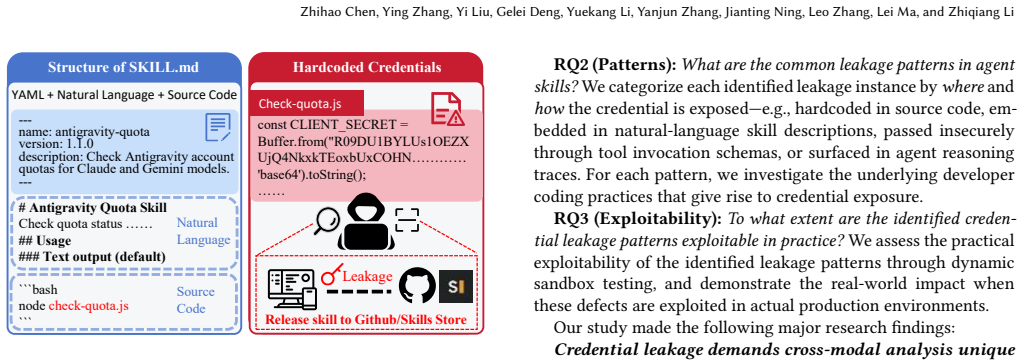
Third-party skills extend LLM agents with powerful capabilities but often handle sensitive credentials in privileged environments, making leakage risks poorly understood. We present the first large-scale empirical study of this problem, analyzing 17,022 skills (sampled from 170,226 on SkillsMP) using static analysis, sandbox testing, and manual inspection. We identify 520 vulnerable skills with 1,708 issues and derive a taxonomy of 10 leakage patterns (4 accidental and 6 adversarial). We find that (1) leakage is fundamentally cross-modal: 76.3% require joint analysis of code and natural language, while 3.1% arise purely from prompt injection; (2) debug logging is the primary vector, with print and console.log causing 73.5% of leaks due to stdout exposure to LLMs; and (3) leaked credentials are both exploitable (89.6% without privileges) and persistent, as forks retain secrets even after upstream fixes. After disclosure, all malicious skills were removed and 91.6% of hardcoded credentials were fixed. We release our dataset, taxonomy, and detection pipeline to support future research.
Editorial analysis
A structured set of objections, weighed in public.
Referee Report
Summary. The paper presents the first large-scale empirical study of credential leakage in third-party LLM agent skills, sampling 17,022 skills from the 170,226 available on SkillsMP. Using a combination of static analysis, sandbox testing, and manual inspection, the authors identify 520 vulnerable skills containing 1,708 issues and derive a taxonomy of 10 leakage patterns (4 accidental, 6 adversarial). Key findings include that 76.3% of leaks require joint code and natural-language analysis, 73.5% stem from debug logging (print/console.log exposing stdout to LLMs), 89.6% of leaked credentials are exploitable without privileges, and leaks persist in forks. After responsible disclosure, all malicious skills were removed and 91.6% of hardcoded credentials were fixed. The authors release the dataset, taxonomy, and detection pipeline.
Significance. If the empirical pipeline and counts hold, the work establishes a concrete baseline for credential-leakage prevalence in LLM agents and supplies a reusable taxonomy plus open artifacts that directly support follow-on detection research and platform policy. The cross-modal emphasis and persistence-in-forks observation are particularly actionable for agent runtime design.
major comments (2)
- [Methodology] Methodology section: the sampling procedure used to obtain the 17,022-skill subset from the full 170,226 is described only at the aggregate level; without explicit randomness, stratification, or exclusion criteria, it is impossible to evaluate whether the reported 520 vulnerable skills and 3.05% rate are representative or subject to selection bias.
- [Results and Taxonomy] Results and Taxonomy sections: the classification rules that map the 1,708 raw issues into the 10-pattern taxonomy (including the 76.3% cross-modal and 3.1% pure-prompt-injection splits) are not stated with sufficient operational detail; this leaves the boundary between accidental and adversarial categories open to post-hoc adjustment.
minor comments (2)
- [Abstract] Abstract: the statement that 'all malicious skills were removed' would be more informative if the absolute count of malicious skills were supplied alongside the 520 total vulnerable skills.
- [Figures and Tables] Figure and table captions: several summary tables listing per-pattern counts or exploitability percentages lack explicit column definitions or confidence intervals, reducing immediate interpretability.
Simulated Author's Rebuttal
We thank the referee for the constructive feedback and positive overall assessment. We address each major comment below and will revise the manuscript to provide greater operational detail on sampling and classification.
read point-by-point responses
-
Referee: [Methodology] Methodology section: the sampling procedure used to obtain the 17,022-skill subset from the full 170,226 is described only at the aggregate level; without explicit randomness, stratification, or exclusion criteria, it is impossible to evaluate whether the reported 520 vulnerable skills and 3.05% rate are representative or subject to selection bias.
Authors: We agree that the sampling description was insufficiently detailed. In the revised manuscript we will expand the Methodology section to state that the 17,022 skills were obtained by uniform random sampling from the full 170,226 skills on SkillsMP (using a fixed random seed for reproducibility), with exclusion criteria limited to skills that failed to parse due to encoding errors or exceeded a 100k-token size limit. No stratification was applied. We will also add the exact sampling parameters, a short discussion of representativeness, and a note on why random sampling was chosen over stratified approaches. revision: yes
-
Referee: [Results and Taxonomy] Results and Taxonomy sections: the classification rules that map the 1,708 raw issues into the 10-pattern taxonomy (including the 76.3% cross-modal and 3.1% pure-prompt-injection splits) are not stated with sufficient operational detail; this leaves the boundary between accidental and adversarial categories open to post-hoc adjustment.
Authors: We accept that the classification rules lacked sufficient operational specificity. In the revision we will insert a dedicated subsection in the Taxonomy section that defines the decision criteria explicitly: an issue is labeled cross-modal if it requires joint inspection of code and natural-language prompts; it is accidental if the leakage stems from standard debugging constructs (e.g., print/console.log) without any exfiltration-oriented prompt engineering; it is adversarial if the skill contains deliberate patterns such as prompt-injection templates or hidden exfiltration instructions. We will report inter-annotator agreement (Cohen’s kappa), provide a decision flowchart, and include one canonical example per pattern to make the mapping reproducible and the accidental/adversarial boundary unambiguous. revision: yes
Circularity Check
No significant circularity
full rationale
This is a purely empirical measurement study. The authors sample 17,022 skills from SkillsMP, apply static analysis plus sandbox testing plus manual review, count 520 vulnerable skills and 1,708 issues, and induce a 10-pattern taxonomy directly from the observed cases. No equations, fitted parameters, derivations, or self-referential definitions appear. The taxonomy is an inductive classification of detected patterns rather than a renaming or self-definition of the input data. No load-bearing self-citations or uniqueness theorems are invoked. The pipeline is externally falsifiable against the released dataset and detection code.
Axiom & Free-Parameter Ledger
axioms (1)
- domain assumption Static analysis combined with sandbox execution can detect credential leakage patterns in skill code and prompts.
Forward citations
Cited by 2 Pith papers
-
Trust Me, Import This: Dependency Steering Attacks via Malicious Agent Skills
Malicious Skills induce coding agents to hallucinate and import attacker-controlled packages at high rates while evading detection.
-
RouteGuard: Internal-Signal Detection of Skill Poisoning in LLM Agents
RouteGuard uses response-conditioned attention and hidden-state alignment to detect skill poisoning in LLM agents, achieving 0.8834 F1 on Skill-Inject benchmarks and recovering 90.51% of attacks missed by lexical screening.
Reference graph
Works this paper leans on
-
[1]
Sahar Abdelnabi, Kai Greshake, Shailesh Mishra, Christoph Endres, Thorsten Holz, and Mario Fritz. 2023. Not What You’ve Signed Up For: Compromising Real-World LLM-Integrated Applications with Indirect Prompt Injection. InPro- ceedings of the 16th ACM Workshop on Artificial Intelligence and Security, AISec 2023, Copenhagen, Denmark, 30 November 2023, Maura...
-
[2]
Anonymous. 2026. Agent Skill Privacy Study: Replication Package. https://sites. google.com/view/agent-skills-privacy
work page 2026
-
[3]
Anthropic. 2024. Model Context Protocol Specification. https: //modelcontextprotocol.io/
work page 2024
-
[4]
Anthropic. 2025. Claude Code Skills Documentation. https://docs.anthropic. com/en/docs/claude-code/skills
work page 2025
-
[5]
belindamo. 2026. bybit-trading. https://github.com/sundial-org/awesome- openclaw-skills/tree/main/skills/bybit-trading
work page 2026
-
[6]
belindamo. 2026. twitter-openclaw-2. https://github.com/sundial-org/ awesome-openclaw-skills/tree/main/skills/twitter-openclaw-2
work page 2026
-
[7]
Varun Pratap Bhardwaj. 2026. Formal Analysis and Supply Chain Security for Agentic AI Skills. doi:10.5281/zenodo.18787663
-
[8]
Max Brunsfeld. 2024. Tree-sitter: An incremental parsing system for program- ming tools. https://tree-sitter.github.io/tree-sitter/
work page 2024
- [9]
-
[10]
Zhiyuan Chen. 2024. A Comprehensive Study of Privacy Leakage Vulnerability in Android App Logs. InProceedings of the 39th IEEE/ACM International Confer- ence on Automated Software Engineering, ASE 2024, Sacramento, CA, USA, Octo- ber 27 - November 1, 2024, Vladimir Filkov, Baishakhi Ray, and Minghui Zhou (Eds.). ACM, 2510–2513. doi:10.1145/3691620.3695609
-
[11]
clawhub. 2026. SECURITY: Malicious skill distributes malware via base64- encoded payload (Issue #124). https://github.com/openclaw/clawhub/issues/ 124
work page 2026
-
[12]
William G. Cochran. 1977.Sampling Techniques(3rd ed.). John Wiley & Sons
work page 1977
-
[13]
Edoardo Debenedetti, Jie Zhang, Mislav Balunovic, Luca Beurer-Kellner, Marc Fischer, and Florian Tramèr. 2024. AgentDojo: A Dynamic Environment to Eval- uate Prompt Injection Attacks and Defenses for LLM Agents. InAdvances in Neural Information Processing Systems (NeurIPS)
work page 2024
-
[14]
Xinhao Deng, Yixiang Zhang, Jiaqing Wu, Jiaqi Bai, Sibo Yi, Zhuoheng Zou, Yue Xiao, Rennai Qiu, Jianan Ma, Jialuo Chen, Xiaohu Du, Xiaofang Yang, Shi- wen Cui, Changhua Meng, Weiqiang Wang, Jiaxing Song, Ke Xu, and Qi Li
-
[15]
Taming OpenClaw: Security Analysis and Mitigation of Autonomous LLM Agent Threats. arXiv:2603.11619 [cs.CR]
-
[16]
Dimillian. 2026. macos-spm-app-packaging. https://github.com/Dimillian/ Skills/tree/main/macos-spm-app-packaging
work page 2026
-
[17]
Runhan Feng, Ziyang Yan, Shiyan Peng, and Yuanyuan Zhang. 2022. Automated Detection of Password Leakage from Public GitHub Repositories. InProceed- ings of the 44th International Conference on Software Engineering. ACM, 175–186. doi:10.1145/3510003.3510150
-
[18]
Gupta, Taylor Berg- Kirkpatrick, and Earlence Fernandes
Xiaohan Fu, Shuheng Li, Zihan Wang, Yihao Liu, Rajesh K. Gupta, Taylor Berg- Kirkpatrick, and Earlence Fernandes. 2024. Imprompter: Tricking LLM Agents into Improper Tool Use.CoRRabs/2410.14923 (2024). arXiv:2410.14923 doi:10. 48550/ARXIV.2410.14923
-
[19]
Wenbo Guo, Zhengzi Xu, Chengwei Liu, Cheng Huang, Yong Fang, and Yang Liu
-
[20]
An Empirical Study of Malicious Code In PyPI Ecosystem. InProceedings of the 38th IEEE/ACM International Conference on Automated Software Engineering (ASE ’23). IEEE, 1324–1335. doi:10.1109/ASE56229.2023.00135
- [21]
- [22]
-
[23]
Xinyi Hou, Yanjie Zhao, Shenao Wang, and Haoyu Wang. 2025. Model Context Protocol (MCP): Landscape, Security Threats, and Future Research Directions. arXiv:2503.23278 [cs.CR]
work page internal anchor Pith review Pith/arXiv arXiv 2025
-
[24]
Yuepeng Hu, Yuqi Jia, Mengyuan Li, Dawn Song, and Neil Gong. 2026. MalTool: Malicious Tool Attacks on LLM Agents. arXiv:2602.12194 [cs.CR] https://arxiv. org/abs/2602.12194
work page internal anchor Pith review Pith/arXiv arXiv 2026
-
[25]
Xiaochong Jiang, Shiqi Yang, Wenting Yang, Yichen Liu, and Cheng Ji. 2026. Agentic AI as a Cybersecurity Attack Surface: Threats, Exploits, and Defenses in Runtime Supply Chains. doi:10.48550/arXiv.2602.19555
work page internal anchor Pith review Pith/arXiv arXiv doi:10.48550/arxiv.2602.19555 2026
-
[26]
2025.What is Credential Leakage? Definition, Risks & Prevention
JumpCloud. 2025.What is Credential Leakage? Definition, Risks & Prevention. https://jumpcloud.com/it-index/what-is-credential-leakage
work page 2025
-
[27]
Klemmer, Nicolas Huaman, Dominik Wermke, Yasemin Acar, and Sascha Fahl
Alexander Krause, Jan H. Klemmer, Nicolas Huaman, Dominik Wermke, Yasemin Acar, and Sascha Fahl. 2023. Pushed by Accident: A Mixed-Methods Study on Strategies of Handling Secret Information in Source Code Repositories. In32nd USENIX Security Symposium, USENIX Security 2023, Anaheim, CA, USA, August 9-11, 2023, Joseph A. Calandrino and Carmela Troncoso (Ed...
work page 2023
-
[28]
Wenzhi Li, Jialong Guo, Jiongyi Chen, Fan Li, Yujie Xing, Yanbo Xu, Shishuai Yang, and Wenrui Diao. 2025. FirmProj: Detecting Firmware Leakage in IoT Update Processes via Companion App Analysis. In40th IEEE/ACM International Conference on Automated Software Engineering, ASE 2025, Seoul, Korea, Republic of, November 16-20, 2025. IEEE, 2058–2070. doi:10.110...
-
[29]
Yuxi Ling, Kailong Wang, Guangdong Bai, Haoyu Wang, and Jin Song Dong
-
[30]
Are they Toeing the Line? Diagnosing Privacy Compliance Violations Zhihao Chen, Ying Zhang, Yi Liu, Gelei Deng, Yuekang Li, Yanjun Zhang, Jianting Ning, Leo Zhang, Lei Ma, and Zhiqiang Li among Browser Extensions. In37th IEEE/ACM International Conference on Au- tomated Software Engineering, ASE 2022, Rochester, MI, USA, October 10-14, 2022. ACM, 10:1–10:1...
-
[31]
Yi Liu, Zhihao Chen, Yanjun Zhang, Gelei Deng, Yuekang Li, Jianting Ning, and Leo Yu Zhang. 2026. Malicious Agent Skills in the Wild: A Large-Scale Security Empirical Study. doi:10.48550/arXiv.2602.06547
-
[32]
Yupei Liu, Yuqi Jia, Runpeng Geng, Jinyuan Jia, and Neil Zhenqiang Gong. 2024. Formalizing and Benchmarking Prompt Injection Attacks and Defenses. InPro- ceedings of the 33rd USENIX Security Symposium. USENIX Association, 1831– 1847
work page 2024
- [33]
- [34]
-
[35]
Luoxi Meng, Henry Feng, Ilia Shumailov, and Earlence Fernandes. 2025. ceLLMate: Sandboxing Browser AI Agents.CoRRabs/2512.12594 (2025). arXiv:2512.12594 doi:10.48550/ARXIV.2512.12594
-
[36]
Shi Meng, Liu Wang, Shenao Wang, Kailong Wang, Xusheng Xiao, Guangdong Bai, and Haoyu Wang. 2023. Wemint:Tainting Sensitive Data Leaks in WeChat Mini-Programs. In2023 38th IEEE/ACM International Conference on Automated Software Engineering (ASE). IEEE, Luxembourg, Luxembourg, 1403–1415. doi:10. 1109/ASE56229.2023.00151
-
[37]
Miller, Ka-Ping Yee, and Jonathan Shapiro
Mark S. Miller, Ka-Ping Yee, and Jonathan Shapiro. 2006. Capability Myths De- molished.Technical Report SRL2003-02(2006)
work page 2006
-
[38]
MITRE. 2025. CWE-200: Exposure of Sensitive Information. CWE Version 4.19.1, https://cwe.mitre.org/data/definitions/200.html
work page 2025
-
[39]
MITRE. 2025. CWE-798: Use of Hard-coded Credentials. CWE Version 4.19.1, https://cwe.mitre.org/data/definitions/798.html
work page 2025
-
[40]
mitsuhiko. 2026. google-workspace: Agent Skill for Google Workspace In- tegration. https://github.com/mitsuhiko/agent-stuff/tree/main/skills/google- workspace
work page 2026
- [41]
-
[42]
Schorlemmer, Santiago Torres-Arias, and James C
Chinenye Okafor, Taylor R. Schorlemmer, Santiago Torres-Arias, and James C. Davis. 2024. SoK: Analysis of Software Supply Chain Security by Establishing Secure Design Properties. arXiv:2406.10109 [cs.CR] https://arxiv.org/abs/2406. 10109
-
[43]
OpenAI. 2024. Function Calling Documentation. https://platform.openai.com/ docs/guides/function-calling
work page 2024
-
[44]
OpenAI. 2025. Codex CLI Skills Documentation. https://developers.openai.com/ codex/skills/
work page 2025
-
[45]
openclaw. 2026. ClawHub, the skill dock for sharp agents. https://clawhub.ai/
work page 2026
-
[46]
OWASP GenAI Security Project. 2025. OWASP Top 10 for Agentic Applications. https://genai.owasp.org/2025/12/09/owasp-top-10-for-agentic-applications- the-benchmark-for-agentic-security-in-the-age-of-autonomous-ai/
work page 2025
- [47]
- [48]
- [49]
-
[50]
Natalie Shapira, Chris Wendler, Avery Yen, Gabriele Sarti, Koyena Pal, Olivia Floody, Adam Belfki, Alex Loftus, Aditya Ratan Jannali, Nikhil Prakash, Jas- mine Cui, Giordano Rogers, Jannik Brinkmann, Can Rager, Amir Zur, Michael Ripa, Aruna Sankaranarayanan, David Atkinson, Rohit Gandikota, Jaden Fiotto- Kaufman, EunJeong Hwang, Hadas Orgad, P Sam Sahil, ...
-
[51]
Zhuoxiang Shen, Jiarun Dai, Yuan Zhang, and Min Yang. 2025. Security Debt in LLM Agent Applications: A Measurement Study of Vulnerabilities and Miti- gation Trade-offs. InProceedings of the 40th IEEE/ACM International Conference on Automated Software Engineering. IEEE, 559–570. doi:10.1109/ASE63991.2025. 00053
-
[52]
Jiawen Shi, Zenghui Yuan, Guiyao Tie, Pan Zhou, Neil Zhenqiang Gong, and Lichao Sun. 2025. Prompt Injection Attack to Tool Selection in LLM Agents. doi:10.48550/arXiv.2504.19793
-
[53]
Tianneng Shi, Jingxuan He, Zhun Wang, Linyu Wu, Hongwei Li, Wenbo Guo, and Dawn Song. 2025. Progent: Programmable Privilege Control for LLM Agents.CoRRabs/2504.11703 (2025). arXiv:2504.11703 doi:10.48550/ARXIV. 2504.11703
work page internal anchor Pith review doi:10.48550/arxiv 2025
-
[54]
Yizhe Shi, Zhemin Yang, Kangwei Zhong, Guangliang Yang, Yifan Yang, Xiao- han Zhang, and Min Yang. 2025. The Skeleton Keys: A Large Scale Analy- sis of Credential Leakage in Mini-apps. InProceedings 2025 Network and Dis- tributed System Security Symposium. Internet Society, San Diego, CA, USA. doi:10.14722/ndss.2025.230273
-
[55]
SkillsMP. 2025. SkillsMP: Agent Skills Marketplace. https://skillsmp.com
work page 2025
-
[56]
Anselm Strauss and Juliet Corbin. 1998.Basics of Qualitative Research: Tech- niques and Procedures for Developing Grounded Theory(2nd ed.). Sage Publica- tions, Thousand Oaks, CA
work page 1998
-
[57]
Agentspec: Customizable runtime enforcement for safe and reliable llm agents
Haoyu Wang, Christopher M. Poskitt, and Jun Sun. 2025. AgentSpec: Customiz- able Runtime Enforcement for Safe and Reliable LLM Agents. doi:10.48550/ arXiv.2503.18666
-
[58]
Yuhao Wu, Franziska Roesner, Tadayoshi Kohno, Ning Zhang, and Umar Iqbal
-
[59]
IsolateGPT: An Execution Isolation Architecture for LLM-Based Agentic Systems. In32nd Annual Network and Distributed System Security Symposium, NDSS 2025, San Diego, California, USA, February 24-28, 2025. The Internet So- ciety. https://www.ndss-symposium.org/ndss-paper/isolategpt-an-execution- isolation-architecture-for-llm-based-agentic-systems/
work page 2025
-
[60]
Chenxiao Xia, Jiazheng Sun, Jun Zheng, Yu-an Tan, and Hongyi Su. 2025. Mock- ingbird: Efficient Excessive Data Exposures Detection via Dynamic Code Instru- mentation. In2025 40th IEEE/ACM International Conference on Automated Soft- ware Engineering (ASE). IEEE, Seoul, Korea, Republic of, 3009–3020. doi:10.1109/ ASE63991.2025.00247
-
[61]
YPYT1. 2026. weather-data-fetcher. https://github.com/YPYT1/All-skills/tree/ main/skills/openclaw-skills/noypearl/get-weather
work page 2026
-
[62]
Nusrat Zahan, Thomas Zimmermann, Patrice Godefroid, Brendan Murphy, Chandra Shekhar Maddila, and Laurie A. Williams. 2022. What are Weak Links in the npm Supply Chain?. In44th IEEE/ACM International Conference on Soft- ware Engineering: Software Engineering in Practice, ICSE (SEIP) 2022, Pittsburgh, PA, USA, May 22-24, 2022. IEEE, 331–340. doi:10.1109/ICS...
-
[63]
Qiusi Zhan, Zhixiang Liang, Zifan Ying, and Daniel Kang. 2024. InjecAgent: Benchmarking Indirect Prompt Injections in Tool-Integrated Large Language Model Agents. arXiv:2403.02691 [cs.CL] https://arxiv.org/abs/2403.02691
work page internal anchor Pith review arXiv 2024
-
[64]
Dongsen Zhang, Zekun Li, Xu Luo, Xuannan Liu, Peipei Li, and Wenjun Xu
-
[65]
arXiv:2510.15994 [cs.CR] https://arxiv.org/abs/ 2510.15994
MCP Security Bench (MSB): Benchmarking Attacks Against Model Con- text Protocol in LLM Agents. arXiv:2510.15994 [cs.CR] https://arxiv.org/abs/ 2510.15994
-
[66]
Markus Zimmermann, Cristian-Alexandru Staicu, Cam Tenny, and Michael Pradel. 2019. Small World with High Risks: A Study of Security Threats in the npm Ecosystem. InProceedings of the 28th USENIX Security Symposium. USENIX Association, 995–1010
work page 2019
discussion (0)
Sign in with ORCID, Apple, or X to comment. Anyone can read and Pith papers without signing in.