Recognition: 2 theorem links
· Lean TheoremSafety-Aligned 3D Object Detection: Single-Vehicle, Cooperative, and End-to-End Perspectives
Pith reviewed 2026-05-13 21:30 UTC · model grok-4.3
The pith
Safety-aware metrics for 3D object detection in autonomous vehicles reduce collision rates by nearly 30 percent when integrated into end-to-end planning.
A machine-rendered reading of the paper's core claim, the machinery that carries it, and where it could break.
Core claim
The authors show that safety-oriented evaluation via NDS-USC and optimization via EC-IoU improve safety-critical detection performance in single-vehicle settings, demonstrate the safety advantages of cooperative models over vehicle-only baselines, and achieve a nearly 30 percent collision-rate reduction by incorporating EC-IoU into the SparseDrive end-to-end framework.
What carries the argument
EC-IoU, a safety-aware variant of the intersection-over-union loss that weights errors according to their potential collision impact, together with the NDS-USC metric that extends the nuScenes Detection Score to emphasize safety-critical mistakes.
If this is right
- Gains on standard mAP and NDS benchmarks do not reliably improve safety-oriented NDS-USC scores.
- Cooperative vehicle-infrastructure detection models deliver higher safety impact than single-vehicle models alone.
- Safety-aware fine-tuning with EC-IoU raises performance on the subset of detections that affect collision risk.
- Direct insertion of EC-IoU into an end-to-end perception-to-planning pipeline lowers system-level collision rates.
- Safety-aligned perception evaluation supplies a practical route to higher CAV safety across modular, cooperative, and end-to-end designs.
Where Pith is reading between the lines
- The same safety-loss approach could be tested on other perception modules such as lane or traffic-light detection to check for similar collision reductions.
- Industry benchmarks may shift toward requiring NDS-USC-style reporting once the collision-rate link is confirmed in more diverse conditions.
- Extending the method to multi-agent cooperative networks might address remaining edge cases that single-vehicle or simple V2I setups still miss.
Load-bearing premise
Improvements measured by NDS-USC and EC-IoU in simulation or benchmarks will reduce actual collisions in real-world driving without further physical validation.
What would settle it
A controlled on-road test in which vehicles equipped with the EC-IoU-trained detectors show no reduction in observed collision or near-miss rates compared with baseline models would disprove the claimed safety translation.
Figures


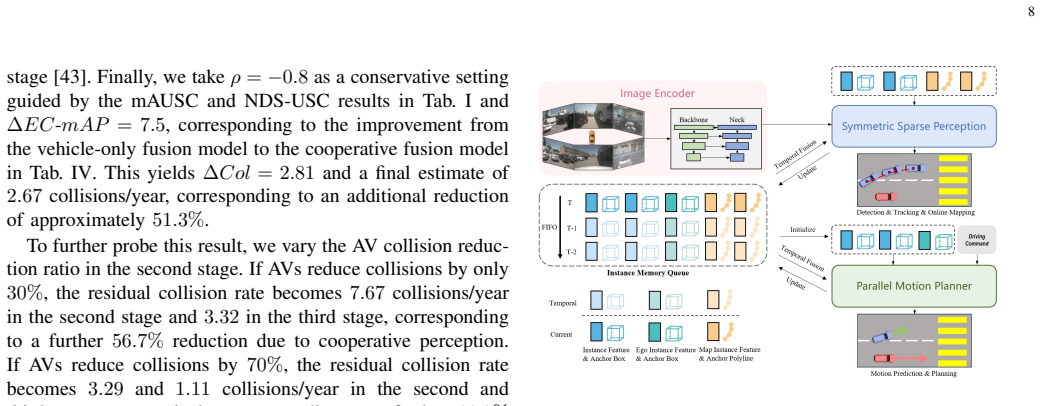

read the original abstract
Perception plays a central role in connected and autonomous vehicles (CAVs), underpinning not only conventional modular driving stacks, but also cooperative perception systems and recent end-to-end driving models. While deep learning has greatly improved perception performance, its statistical nature makes perfect predictions difficult to attain. Meanwhile, standard training objectives and evaluation benchmarks treat all perception errors equally, even though only a subset is safety-critical. In this paper, we investigate safety-aligned evaluation and optimization for 3D object detection that explicitly characterize high-impact errors. Building on our previously proposed safety-oriented metric, NDS-USC, and safety-aware loss function, EC-IoU, we make three contributions. First, we present an expanded study of single-vehicle 3D object detection models across diverse neural network architectures and sensing modalities, showing that gains under standard metrics such as mAP and NDS may not translate to safety-oriented criteria represented by NDS-USC. With EC-IoU, we reaffirm the benefit of safety-aware fine-tuning for improving safety-critical detection performance. Second, we conduct an ego-centric, safety-oriented evaluation of AV-infrastructure cooperative object detection models, underscoring its superiority over vehicle-only models and demonstrating a safety impact analysis that illustrates the potential contribution of cooperative models to "Vision Zero." Third, we integrate EC-IoU into SparseDrive and show that safety-aware perception hardening can reduce collision rate by nearly 30% and improve system-level safety directly in an end-to-end perception-to-planning framework. Overall, our results indicate that safety-aligned perception evaluation and optimization offer a practical path toward enhancing CAV safety across single-vehicle, cooperative, and end-to-end autonomy settings.
Editorial analysis
A structured set of objections, weighed in public.
Referee Report
Summary. The paper investigates safety-aligned evaluation and optimization for 3D object detection in CAVs. Building on prior NDS-USC metric and EC-IoU loss, it presents an expanded study of single-vehicle detectors across architectures and modalities showing that mAP/NDS gains may not translate to safety criteria; conducts ego-centric safety evaluation of cooperative models highlighting superiority and Vision Zero potential; and integrates EC-IoU into SparseDrive to achieve nearly 30% collision-rate reduction in an end-to-end perception-to-planning loop. Overall it argues that safety-focused perception hardening offers a practical path to improved CAV safety across single-vehicle, cooperative, and end-to-end settings.
Significance. If the central results hold, the work provides concrete evidence that prioritizing safety-critical errors via tailored metrics and losses can directly improve system-level safety metrics such as collision rate. The multi-perspective analysis (single-vehicle, cooperative, end-to-end) and the demonstration of downstream planning benefits are notable strengths. The approach reuses previously introduced metrics on new settings without introducing new free parameters, which supports reproducibility.
major comments (2)
- [§5.3] §5.3 (end-to-end integration): The claim of a nearly 30% collision-rate reduction when integrating EC-IoU into SparseDrive is shown only inside a simulator. The manuscript provides no physical validation, edge-case testing, or analysis of sim-to-real transfer for the specific detection errors penalized by EC-IoU, which is load-bearing for the system-level safety conclusion.
- [§4–§5] Experimental protocol (throughout §4–§5): Results report consistent directional improvements under NDS-USC and EC-IoU but omit error bars, full baseline implementation details, and complete hyper-parameter settings for the SparseDrive integration, making independent verification of the 30% figure difficult.
minor comments (2)
- [§2] Notation for NDS-USC and EC-IoU is introduced in the abstract and §2 but would benefit from a compact reminder table when first used in the cooperative and end-to-end sections.
- [§4] Figure captions for the cooperative perception results could explicitly state the number of infrastructure sensors and the exact scenario distribution used.
Simulated Author's Rebuttal
We appreciate the referee's detailed feedback on our manuscript. We have carefully considered each comment and provide point-by-point responses below. Where appropriate, we will revise the manuscript to address the concerns raised.
read point-by-point responses
-
Referee: [§5.3] §5.3 (end-to-end integration): The claim of a nearly 30% collision-rate reduction when integrating EC-IoU into SparseDrive is shown only inside a simulator. The manuscript provides no physical validation, edge-case testing, or analysis of sim-to-real transfer for the specific detection errors penalized by EC-IoU, which is load-bearing for the system-level safety conclusion.
Authors: We acknowledge that our end-to-end experiments are performed in a simulated environment, as is common in the field for safety-critical autonomous driving research. Physical validation on real vehicles would require extensive resources and safety protocols that are outside the scope of this academic study. However, we will add a dedicated discussion section on the limitations of simulation, including potential sim-to-real transfer challenges for the errors penalized by EC-IoU, and suggest directions for future real-world validation. We believe the simulator results still provide valuable evidence for the benefits of safety-aligned perception. revision: partial
-
Referee: [§4–§5] Experimental protocol (throughout §4–§5): Results report consistent directional improvements under NDS-USC and EC-IoU but omit error bars, full baseline implementation details, and complete hyper-parameter settings for the SparseDrive integration, making independent verification of the 30% figure difficult.
Authors: We agree that including error bars, detailed implementation information, and hyper-parameter settings is essential for reproducibility. In the revised version, we will report standard deviations or error bars from multiple experimental runs where applicable, provide full details on baseline implementations, and include complete hyper-parameter configurations for the SparseDrive integration in the supplementary material or main text. revision: yes
- Physical validation and sim-to-real transfer analysis for the end-to-end integration results
Circularity Check
Minor reliance on prior self-introduced metrics applied to new settings; no derivation reduces to fitted inputs or self-citation loops
full rationale
The paper's core contributions consist of empirical evaluations: applying the previously defined NDS-USC metric and EC-IoU loss (cited from the authors' earlier work) across single-vehicle, cooperative, and end-to-end settings, with the key result being an observed ~30% collision-rate drop when EC-IoU is integrated into SparseDrive inside a simulator. No equation or claim reduces by construction to its own inputs; the safety gains are measured outcomes rather than tautological predictions, and the self-citations serve only to reference the metric definitions rather than to justify the new experimental findings. This qualifies as a normal, low-level self-citation without circularity in the derivation chain.
Axiom & Free-Parameter Ledger
Lean theorems connected to this paper
-
IndisputableMonolith/Cost/FunctionalEquation.leanwashburn_uniqueness_aczel unclear?
unclearRelation between the paper passage and the cited Recognition theorem.
EC-IoU(P,G) := Weighted-AreaG(P∩G) / (Weighted-AreaG(G) + Area(P)−Area(P∩G)) with ωG(x,y)=[ρ(xG,yG)/ρ(x,y)]^α
-
IndisputableMonolith/Foundation/RealityFromDistinction.leanreality_from_one_distinction unclear?
unclearRelation between the paper passage and the cited Recognition theorem.
NDS-USC := ½(NDS + mAUSC) with USC = IoGT × ADR enforcing ΠPV ∧ ΠBEV
What do these tags mean?
- matches
- The paper's claim is directly supported by a theorem in the formal canon.
- supports
- The theorem supports part of the paper's argument, but the paper may add assumptions or extra steps.
- extends
- The paper goes beyond the formal theorem; the theorem is a base layer rather than the whole result.
- uses
- The paper appears to rely on the theorem as machinery.
- contradicts
- The paper's claim conflicts with a theorem or certificate in the canon.
- unclear
- Pith found a possible connection, but the passage is too broad, indirect, or ambiguous to say the theorem truly supports the claim.
Reference graph
Works this paper leans on
-
[1]
Autonomous Mobility Everywhere,
Pony.ai, “Autonomous Mobility Everywhere,” https://pony.ai/, 2025, [Online; accessed 31-May-2025]
work page 2025
-
[2]
The World’s Most Experienced Driver,
Waymo, “The World’s Most Experienced Driver,” https://waymo.com/, 2025, [Online; accessed 31-May-2025]
work page 2025
-
[3]
Standing general order on crash reporting for automated driving systems,
National Highway Traffic Safety Administration (NHTSA), “Standing general order on crash reporting for automated driving systems,” https://www.nhtsa.gov/laws-regulations/ standing-general-order-crash-reporting, 2025, [Online; accessed 31-May-2025]
work page 2025
-
[4]
Robust physical-world attacks on deep learning visual classification,
I. Evtimov, K. Eykholt, E. Fernandes, T. Kohno, B. Li, A. Prakash, A. Rahmati, F. Tramer, and D. Song, “Robust physical-world attacks on deep learning visual classification,” inIEEE/CVF Conference on Computer Vision and Pattern Recognition (CVPR), 2018
work page 2018
-
[5]
B. H.-C. Liao, C.-H. Cheng, H. Esen, and A. Knoll, “USC: Uncom- promising spatial constraints for safety-oriented 3D object detectors in autonomous driving,” inIEEE Intelligent Transportation Systems Conference (ITSC), 2024
work page 2024
-
[6]
EC-IoU: Orienting safety for object detectors via ego-centric intersection-over-union,
——, “EC-IoU: Orienting safety for object detectors via ego-centric intersection-over-union,” inIEEE/RSJ International Conference on In- telligent Robots and Systems (IROS), 2024
work page 2024
-
[7]
nuScenes: A multimodal dataset for autonomous driving,
H. Caesar, V . Bankiti, A. H. Lang, S. V ora, V . E. Liong, Q. Xu, A. Kr- ishnan, Y . Pan, G. Baldan, and O. Beijbom, “nuScenes: A multimodal dataset for autonomous driving,” inIEEE/CVF Conference on Computer Vision and Pattern Recognition (CVPR), 2020
work page 2020
-
[8]
TUMTraf V2X cooperative perception dataset,
W. Zimmer, G. A. Wardana, S. Sritharan, X. Zhou, R. Song, and A. C. Knoll, “TUMTraf V2X cooperative perception dataset,” inIEEE/CVF Conference on Computer Vision and Pattern Recognition (CVPR), 2024
work page 2024
-
[9]
Vision Zero—Implementing a policy for traffic safety,
R. Johansson, “Vision Zero—Implementing a policy for traffic safety,” Safety Science, vol. 47, no. 6, pp. 826–831, 2009
work page 2009
-
[10]
SparseDrive: End-to-end autonomous driving via sparse scene representation,
W. Sun, X. Lin, Y . Shi, C. Zhang, H. Wu, and S. Zheng, “SparseDrive: End-to-end autonomous driving via sparse scene representation,” in IEEE International Conference on Robotics and Automation (ICRA), 2025
work page 2025
-
[11]
Are we ready for autonomous driving? The KITTI vision benchmark suite,
A. Geiger, P. Lenz, and R. Urtasun, “Are we ready for autonomous driving? The KITTI vision benchmark suite,” inIEEE Conference on Computer Vision and Pattern Recognition (CVPR), 2012
work page 2012
-
[12]
Learning to evaluate perception models using planner-centric metrics,
J. Philion, A. Kar, and S. Fidler, “Learning to evaluate perception models using planner-centric metrics,” inIEEE/CVF Conference on Computer Vision and Pattern Recognition (CVPR), 2020
work page 2020
-
[13]
Revisiting 3D object detection from an egocentric perspective,
B. Deng, C. R. Qi, M. Najibi, T. Funkhouser, Y . Zhou, and D. Anguelov, “Revisiting 3D object detection from an egocentric perspective,” in Advances in Neural Information Processing Systems (NeurIPS), 2021
work page 2021
-
[14]
SHARD: Safety and human performance analysis for requirements in detection,
K. T. Mori and S. Peters, “SHARD: Safety and human performance analysis for requirements in detection,”IEEE Transactions on Intelligent Vehicles, vol. 9, no. 1, pp. 3010–3021, 2024
work page 2024
-
[15]
UnitBox: An advanced object detection network,
J. Yu, Y . Jiang, Z. Wang, Z. Cao, and T. Huang, “UnitBox: An advanced object detection network,” inACM International Conference on Multimedia (MM), 2016
work page 2016
-
[16]
Generalized Intersection over Union: A metric and a loss for bounding box regression,
H. Rezatofighi, N. Tsoi, J. Gwak, A. Sadeghian, I. Reid, and S. Savarese, “Generalized Intersection over Union: A metric and a loss for bounding box regression,” inIEEE/CVF Conference on Computer Vision and Pattern Recognition (CVPR), 2019
work page 2019
-
[17]
Focal and efficient IoU loss for accurate bounding box regression,
Y .-F. Zhang, W. Ren, Z. Zhang, Z. Jia, L. Wang, and T. Tan, “Focal and efficient IoU loss for accurate bounding box regression,”Neurocomput- ing, vol. 506, no. C, p. 146–157, 2022
work page 2022
-
[18]
Alpha- IoU: A family of power intersection over union losses for bounding box regression,
J. He, S. Erfani, X. Ma, J. Bailey, Y . Chi, and X.-S. Hua, “Alpha- IoU: A family of power intersection over union losses for bounding box regression,” inAdvances in Neural Information Processing Systems (NeurIPS), 2021
work page 2021
-
[19]
Probabilistic and geometric depth: Detecting objects in perspective,
T. Wang, X. Zhu, J. Pang, and D. Lin, “Probabilistic and geometric depth: Detecting objects in perspective,” inConference on Robot Learn- ing (CoRL), 2021
work page 2021
-
[20]
Safety-aware hardening of 3D object detection neural network systems,
C.-H. Cheng, “Safety-aware hardening of 3D object detection neural network systems,” inComputer Safety, Reliability, and Security (Safe- Comp), 2020
work page 2020
-
[21]
A safety-adapted loss for pedestrian detection in automated driving,
M. Lyssenko, P. Pimplikar, M. Bieshaar, F. Nozarian, and R. Triebel, “A safety-adapted loss for pedestrian detection in automated driving,” inIEEE International Conference on Robotics and Automation (ICRA), 2024
work page 2024
-
[22]
Vehicle-to-everything cooperative perception for autonomous driving,
T. Huang, J. Liu, X. Zhou, D. C. Nguyen, M. R. Azghadi, Y . Xia, Q.- L. Han, and S. Sun, “Vehicle-to-everything cooperative perception for autonomous driving,”Proceedings of the IEEE, 2025
work page 2025
-
[23]
R. Xu, H. Xiang, X. Xia, X. Han, J. Li, and J. Ma, “OPV2V: An open benchmark dataset and fusion pipeline for perception with vehicle- to-vehicle communication,” inProceedings of the IEEE International Conference on Robotics and Automation (ICRA), 2022, pp. 2583–2589
work page 2022
-
[24]
V2X-ViT: Vehicle-to-everything cooperative perception with vision transformer,
R. Xu, H. Xiang, Z. Tu, X. Xia, M.-H. Yang, and J. Ma, “V2X-ViT: Vehicle-to-everything cooperative perception with vision transformer,” inComputer Vision – ECCV 2022, ser. Lecture Notes in Computer Science. Springer, 2022, pp. 107–124
work page 2022
-
[25]
DAIR-V2X: A large-scale dataset for vehicle- infrastructure cooperative 3d object detection,
H. Yu, Y . Luo, M. Shu, Y . Huo, Z. Yang, Y . Shi, Z. Guo, H. Li, X. Hu, J. Yuan, and Z. Nie, “DAIR-V2X: A large-scale dataset for vehicle- infrastructure cooperative 3d object detection,” inProceedings of the IEEE/CVF Conference on Computer Vision and Pattern Recognition (CVPR), 2022, pp. 21 361–21 370
work page 2022
-
[26]
ALVINN: An autonomous land vehicle in a neu- ral network,
D. A. Pomerleau, “ALVINN: An autonomous land vehicle in a neu- ral network,” inAdvances in Neural Information Processing Systems (NeurIPS), 1988
work page 1988
-
[27]
End to End Learning for Self-Driving Cars
M. Bojarski, D. Del Testa, D. Dworakowski, B. Firner, B. Flepp, P. Goyal, L. D. Jackel, M. Monfort, U. Muller, J. Zhang, X. Zhang, J. Zhao, and K. Zieba, “End to end learning for self-driving cars,”arXiv preprint arXiv:1604.07316, 2016
work page internal anchor Pith review Pith/arXiv arXiv 2016
-
[28]
Planning- oriented autonomous driving,
Y . Hu, J. Yang, L. Chen, K. Li, C. Sima, X. Zhu, S. Chai, S. Du, T. Lin, W. Wang, L. Lu, X. Jia, Q. Liu, J. Dai, Y . Qiao, and H. Li, “Planning- oriented autonomous driving,” inIEEE/CVF Conference on Computer Vision and Pattern Recognition (CVPR), 2023
work page 2023
-
[29]
A survey on vision- language-action models for autonomous driving,
S. Jiang, Z. Huang, K. Qian, Z. Luo, T. Zhu, Y . Zhong, Y . Tang, M. Kong, Y . Wang, S. Jiao, H. Ye, Z. Sheng, X. Zhao, T. Wen, Z. Fu, S. Chen, K. Jiang, D. Yang, S. Choi, and L. Sun, “A survey on vision- language-action models for autonomous driving,” inProceedings of the IEEE/CVF International Conference on Computer Vision Workshops (ICCVW), 2025, pp. 4524–4536
work page 2025
-
[30]
FCOS3D: Fully convolutional one-stage monocular 3D object detection,
T. Wang, X. Zhu, J. Pang, and D. Lin, “FCOS3D: Fully convolutional one-stage monocular 3D object detection,” inIEEE/CVF International Conference on Computer Vision Workshops (ICCVW), 2021
work page 2021
-
[31]
DETR3D: 3D object detection from multi-view images via 3D-to-2D queries,
Y . Wang, V . Guizilini, T. Zhang, Y . Wang, H. Zhao, and J. Solomon, “DETR3D: 3D object detection from multi-view images via 3D-to-2D queries,” inConference on Robot Learning (CoRL), 2021
work page 2021
-
[32]
PETR: Position embedding transformation for multi-view 3D object detection,
Y . Liu, T. Wang, X. Zhang, and J. Sun, “PETR: Position embedding transformation for multi-view 3D object detection,” inEuropean Con- ference on Computer Vision (ECCV), 2022
work page 2022
-
[33]
PointPillars: Fast encoders for object detection from point clouds,
A. H. Lang, S. V ora, H. Caesar, L. Zhou, J. Yang, and O. Beijbom, “PointPillars: Fast encoders for object detection from point clouds,” inIEEE/CVF Conference on Computer Vision and Pattern Recognition (CVPR), 2019
work page 2019
-
[34]
SSN: Shape signature networks for multi-class object detection from point clouds,
X. Zhu, Y . Ma, T. Wang, Y . Xu, J. Shi, and D. Lin, “SSN: Shape signature networks for multi-class object detection from point clouds,” inEuropean Conference on Computer Vision (ECCV), 2020
work page 2020
-
[35]
Center-based 3D object detection and tracking,
T. Yin, X. Zhou, and P. Kr ¨ahenb¨uhl, “Center-based 3D object detection and tracking,” inIEEE/CVF Conference on Computer Vision and Pattern Recognition (CVPR), 2021
work page 2021
-
[36]
BEVFusion: Multi-task multi-sensor fusion with unified bird’s-eye view representation,
Z. Liu, H. Tang, A. Amini, X. Yang, H. Mao, D. Rus, and S. Han, “BEVFusion: Multi-task multi-sensor fusion with unified bird’s-eye view representation,” inIEEE International Conference on Robotics and Automation (ICRA), 2023
work page 2023
-
[37]
MMDetection3D: OpenMMLab next- generation platform for general 3D object detection,
MMDetection3D Contributors, “MMDetection3D: OpenMMLab next- generation platform for general 3D object detection,” https://github.com/ open-mmlab/mmdetection3d, 2020
work page 2020
-
[38]
Signalized intersection informational guide,
Federal Highway Administration, “Signalized intersection informational guide,” U.S. Department of Transportation, Washington, DC, Tech. Rep. FHW A-SA-13-027, 2013
work page 2013
-
[39]
Automatische dauerz¨ahlstellen auf autobahnen und bundesstraßen,
Bundesanstalt f ¨ur Straßenwesen (BASt), “Automatische dauerz¨ahlstellen auf autobahnen und bundesstraßen,” https://www.bast.de/DE/ Fachthemen/Verkehrstechnik/Dauerzaehlstellen/dauerzaehlstellen node.html, 2025, [Online; accessed 17-June-2025]
work page 2025
-
[40]
L. Di Lillo, T. Gode, X. Zhou, J. Scanlon, R. Chen, and T. Victor, “Do autonomous vehicles outperform latest-generation human-driven vehicles? A comparison to Waymo’s auto liability insurance claims at 25.3 M miles.” 2024
work page 2024
-
[41]
D. C. Montgomery, E. A. Peck, and G. G. Vining,Introduction to Linear Regression Analysis, 6th ed. Hoboken, NJ: Wiley, 2021
work page 2021
-
[42]
Benchmarking robustness of 3D object detection to common corruptions in autonomous driving,
Y . Dong, C. Kang, J. Zhang, Z. Zhu, Y . Wang, X. Yang, H. Su, X. Wei, and J. Zhu, “Benchmarking robustness of 3D object detection to common corruptions in autonomous driving,” inCVPR, 2023
work page 2023
-
[43]
N. Kalra and S. M. Paddock, “Driving to safety: How many miles of driving would it take to demonstrate autonomous vehicle reliability?” Transportation Research Part A: Policy and Practice, vol. 94, pp. 182– 193, 2016
work page 2016
discussion (0)
Sign in with ORCID, Apple, or X to comment. Anyone can read and Pith papers without signing in.