Recognition: no theorem link
Monte Carlo Event Generation with Continuous Normalizing Flows
Pith reviewed 2026-05-13 17:48 UTC · model grok-4.3
The pith
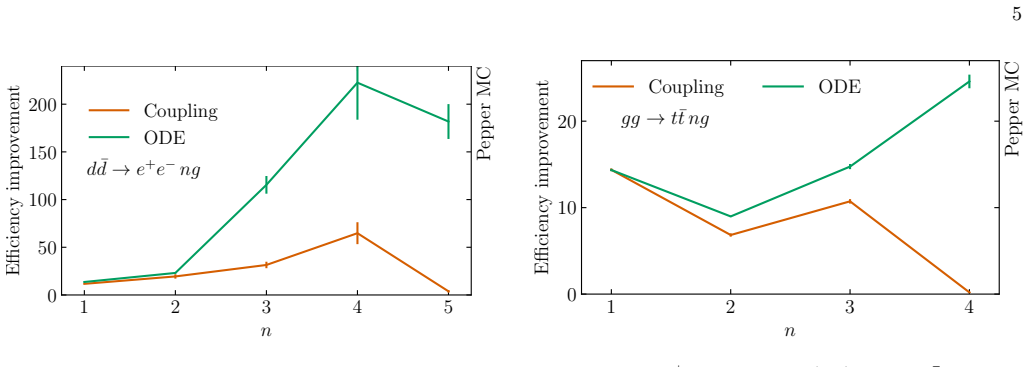
Continuous normalizing flows achieve up to 184-fold unweighting efficiency gains in Monte Carlo event generation for high-jet collider processes.
A machine-rendered reading of the paper's core claim, the machinery that carries it, and where it could break.
Core claim
Helicity-conditioned continuous normalizing flows trained via the flow matching method remap the random numbers used in matrix element evaluation for processes like lepton-pair and top-pair production with multiple jets. Compared to standard methods, unweighting efficiency improves by factors of up to 184 and 25 at the highest jet numbers for the two processes. Using a hybrid RegFlow approach that combines continuous flows with coupling layers yields parton-level unweighted event generation walltime gains of about a factor of ten at the highest jet numbers.
What carries the argument
Helicity-conditioned continuous normalizing flows trained with flow matching to remap random numbers to the target matrix-element density.
Load-bearing premise
The samples generated by the trained flows must match the target distribution closely enough to avoid introducing any bias in calculated physics observables.
What would settle it
A comparison showing statistically significant differences in predicted distributions of physical quantities such as transverse momentum spectra between events generated with the flows and those from standard methods.
Figures
read the original abstract
We apply Continuous Normalizing Flows trained with the Flow Matching method to the problem of phase-space sampling in Monte Carlo event generation for high-energy collider physics. Focusing on lepton-pair and top quark pair production with multiple jets, the two computationally most expensive processes at the Large Hadron Collider, we train helicity-conditioned Continuous Normalizing Flows to remap the random numbers used in matrix element evaluation. Compared to standard methods, we achieve unweighting efficiency improvements by factors of up to 184 and 25 for the two processes at their respective highest jet number, at the cost of an increased evaluation time. When combining the advantages of Continuous Normalizing Flows with the fast evaluation times of Coupling Layer based Flows, using the RegFlow approach, we find parton-level unweighted event generation walltime gains of about a factor of ten at the highest jet numbers. These substantial gains highlight the promise of samplers based on machine learning for next-generation collider experiments.
Editorial analysis
A structured set of objections, weighed in public.
Referee Report
Summary. The manuscript applies Continuous Normalizing Flows trained via the Flow Matching method to phase-space sampling for Monte Carlo event generation. It focuses on lepton-pair and top-quark pair production with multiple jets, training helicity-conditioned CNFs to remap random numbers, and reports unweighting efficiency gains of up to 184 and 25 for the highest jet multiplicities along with wall-time improvements of roughly a factor of ten when using the hybrid RegFlow approach that combines CNFs with coupling-layer flows.
Significance. If the central claims hold, the work offers a practical advance for addressing the computational cost of event generation for high-multiplicity processes at the LHC. The reported efficiency factors are substantial, the hybrid RegFlow strategy usefully combines the strengths of different flow architectures, and the empirical results are grounded in explicit training protocols and helicity conditioning. These elements make the approach potentially valuable for next-generation collider phenomenology.
major comments (2)
- [Results] The efficiency numbers (up to 184 and 25) and the RegFlow wall-time gain of ~10 rest on the trained flows producing samples whose density matches the target matrix-element distribution to high accuracy. Explicit quantitative validation—such as Kolmogorov-Smirnov tests, comparisons of differential distributions for key observables, or bias checks on acceptance rates—should be shown in the results section to confirm that no systematic bias is introduced into downstream physics quantities.
- [Methods] The description of how the target density is approximated during training and the precise implementation of the flow-matching loss (including any regularization or conditioning details) needs to be expanded in the methods section so that the reported efficiency factors can be reproduced independently.
minor comments (2)
- [Abstract] The abstract states an 'increased evaluation time' without quantifying the overhead; adding a brief numerical comparison of evaluation times would clarify the practical trade-off.
- [Introduction] Ensure that all acronyms (CNF, RegFlow, etc.) are defined at first use in the main text.
Circularity Check
No significant circularity detected
full rationale
The paper applies Continuous Normalizing Flows trained with Flow Matching to remap random numbers for matrix-element phase-space sampling in two collider processes. Reported unweighting efficiency gains (up to 184 and 25) and RegFlow wall-time improvements (~10) are presented as direct empirical outcomes of training and benchmarking against standard methods, with no equations or steps that reduce these metrics to fitted parameters by construction. No self-definitional mappings, fitted inputs relabeled as predictions, load-bearing self-citations, or ansatzes smuggled via prior work appear in the argument structure. The central claims rest on the standard flow-matching objective and explicit efficiency measurements, which remain independent of the target results.
Axiom & Free-Parameter Ledger
Forward citations
Cited by 1 Pith paper
-
Open LHC Monte Carlo Event Generation
A review of initiatives to make LHC Monte Carlo event generations available as open data to minimize redundant simulations and resource use.
Reference graph
Works this paper leans on
-
[1]
Aadet al.(ATLAS), The ATLAS Experiment at the CERN Large Hadron Collider, JINST3(08), S08003
G. Aadet al.(ATLAS), The ATLAS Experiment at the CERN Large Hadron Collider, JINST3(08), S08003
-
[2]
Chatrchyanet al.(CMS), The CMS Experiment at the CERN LHC, JINST3(08), S08004
S. Chatrchyanet al.(CMS), The CMS Experiment at the CERN LHC, JINST3(08), S08004
-
[3]
A. Abadaet al.(FCC), FCC Physics Opportunities: Fu- ture Circular Collider Conceptual Design Report Volume 1, Eur. Phys. J. C79, 474 (2019)
work page 2019
-
[4]
A. Abadaet al.(FCC), FCC-ee: The Lepton Collider: Future Circular Collider Conceptual Design Report Vol- ume 2, Eur. Phys. J. ST228, 261 (2019)
work page 2019
-
[5]
A. Abadaet al.(FCC), FCC-hh: The Hadron Collider: Future Circular Collider Conceptual Design Report Vol- ume 3, Eur. Phys. J. ST228, 755 (2019)
work page 2019
-
[6]
Buckleyet al., General-purpose event genera- tors for LHC physics, Phys
A. Buckleyet al., General-purpose event genera- tors for LHC physics, Phys. Rept.504, 145 (2011), arXiv:1101.2599 [hep-ph]
-
[7]
European Strategy Group,2020 Update of the European Strategy for Particle Physics(CERN Council, Geneva, 2020)
work page 2020
-
[8]
M. Narainet al., The Future of US Particle Physics - The Snowmass 2021 Energy Frontier Report (2022), arXiv:2211.11084 [hep-ex]
-
[9]
J. Albrechtet al.(HEP Software Foundation), A Roadmap for HEP Software and Computing R&D for the 2020s, Comput. Softw. Big Sci.3, 7 (2019), arXiv:1712.06982 [physics.comp-ph]
-
[10]
S. Amorosoet al.(HSF Physics Event Generator WG), Challenges in Monte Carlo Event Generator Software for High-Luminosity LHC, Comput. Softw. Big Sci.5, 12 (2021), arXiv:2004.13687 [hep-ph]
- [11]
- [12]
-
[13]
M. Aaboudet al.(ATLAS), Measurements of top-quark pair spin correlations in theeµchannel at √s= 13 TeV usingppcollisions in the ATLAS detector, Eur. Phys. J. C80, 754 (2020), arXiv:1903.07570 [hep-ex]
-
[14]
G. Aadet al.(ATLAS), Measurement of thet ¯tproduc- tion cross-section in the lepton+jets channel at √s= 13 TeV with the ATLAS experiment, Phys. Lett. B810, 135797 (2020), arXiv:2006.13076 [hep-ex]
- [15]
-
[16]
E. Bothmann, A. Buckley, I. A. Christidi, C. G¨ utschow, S. H¨ oche, M. Knobbe, T. Martin, and M. Sch¨ onherr, Accelerating LHC event generation with simplified pi- lot runs and fast PDFs, Eur. Phys. J. C82, 1128 (2022), arXiv:2209.00843 [hep-ph]
-
[17]
R. Kleiss and R. Pittau, Weight optimization in multi- channel Monte Carlo, Comput. Phys. Commun.83, 141 (1994), arXiv:hep-ph/9405257
-
[18]
G. P. Lepage, A New Algorithm for Adaptive Multidi- mensional Integration, J. Comput. Phys.27, 192 (1978)
work page 1978
-
[19]
Ohl, Vegas revisited: Adaptive Monte Carlo integra- tion beyond factorization, Comput
T. Ohl, Vegas revisited: Adaptive Monte Carlo integra- tion beyond factorization, Comput. Phys. Commun.120, 13 (1999), arXiv:hep-ph/9806432
- [20]
-
[22]
E. Tabak and E. Vanden-Eijnden, Density estimation by dual ascent of the log-likelihood, Communications in Mathematical Sciences - COMMUN MATH SCI8 (2010)
work page 2010
-
[23]
E. G. Tabak and C. V. Turner, A family of nonparametric density estimation algorithms, Communications on Pure and Applied Mathematics66, 145 (2013)
work page 2013
-
[24]
L. Dinh, D. Krueger, and Y. Bengio, NICE: non-linear independent components estimation, in3rd Interna- tional Conference on Learning Representations, Work- shop Track Proceedings(2015) arXiv:1410.8516 [cs.LG]
work page internal anchor Pith review arXiv 2015
- [25]
-
[26]
E. Bothmann, T. Janßen, M. Knobbe, T. Schmale, and S. Schumann, Exploring phase space with Neu- ral Importance Sampling, SciPost Phys.8, 069 (2020), arXiv:2001.05478 [hep-ph]
- [27]
- [28]
-
[29]
R. Verheyen, Event Generation and Density Estimation with Surjective Normalizing Flows, SciPost Phys.13, 047 (2022), arXiv:2205.01697 [hep-ph]
- [30]
- [31]
-
[32]
S. Badgeret al., Machine learning and LHC event gen- eration, SciPost Phys.14, 079 (2023), arXiv:2203.07460 [hep-ph]
-
[33]
R. T. Q. Chen, Y. Rubanova, J. Bettencourt, and D. Duvenaud, Neural ordinary differential equations, inProceedings of the 32nd International Conference on Neural Information Processing Systems(Curran Asso- ciates Inc., Red Hook, NY, USA, 2018) p. 6572–6583, arXiv:1806.07366 [cs.LG]
-
[34]
Flow Matching for Generative Modeling
Y. Lipman, R. T. Q. Chen, H. Ben-Hamu, M. Nickel, and M. Le, Flow matching for generative modeling, in 7 The Eleventh International Conference on Learning Rep- resentations(2023) arXiv:2210.02747 [cs.LG]
work page internal anchor Pith review Pith/arXiv arXiv 2023
-
[35]
M. S. Albergo and E. Vanden-Eijnden, Building normal- izing flows with stochastic interpolants, inThe Eleventh International Conference on Learning Representations (2023) arXiv:2209.15571 [cs.LG]
work page internal anchor Pith review Pith/arXiv arXiv 2023
-
[36]
M. S. Albergo, N. M. Boffi, and E. Vanden-Eijnden, Stochastic interpolants: A unifying framework for flows and diffusions (2023), arXiv:2303.08797 [cs.LG]
work page internal anchor Pith review Pith/arXiv arXiv 2023
-
[37]
X. Liu, C. Gong, and Q. Liu, Flow straight and fast: Learning to generate and transfer data with rectified flow (2022), arXiv:2209.03003 [cs.LG]
work page internal anchor Pith review Pith/arXiv arXiv 2022
-
[38]
T. M¨ uller, B. Mcwilliams, F. Rousselle, M. Gross, and J. Nov´ ak, Neural importance sampling, ACM Trans. Graph.38(2019), arXiv:1808.03856 [cs.LG]
-
[39]
C. Durkan, A. Bekasov, I. Murray, and G. Papamakar- ios, Neural spline flows, inAdvances in Neural Infor- mation Processing Systems, Vol. 32, edited by H. Wal- lach, H. Larochelle, A. Beygelzimer, F. d'Alch´ e-Buc, E. Fox, and R. Garnett (Curran Associates, Inc., 2019) arXiv:1906.04032 [stat.ML]
-
[40]
LHAPDF6: parton density access in the LHC precision era
A. Buckley, J. Ferrando, S. Lloyd, K. Nordstr¨ om, B. Page, M. R¨ ufenacht, M. Sch¨ onherr, and G. Watt, LHAPDF6: parton density access in the LHC precision era, Eur. Phys. J. C75, 132 (2015), arXiv:1412.7420 [hep- ph]
work page Pith review arXiv 2015
-
[41]
S. Kullback and R. A. Leibler, On Information and Suf- ficiency, The Annals of Mathematical Statistics22, 79 (1951)
work page 1951
-
[42]
A. Tong, K. FATRAS, N. Malkin, G. Huguet, Y. Zhang, J. Rector-Brooks, G. Wolf, and Y. Bengio, Improving and generalizing flow-based generative models with minibatch optimal transport, Trans. Mach. Learn. Res. (2024), arXiv:2302.00482 [cs.LG]
work page internal anchor Pith review Pith/arXiv arXiv 2024
-
[43]
E. Bothmann, T. Childers, W. Giele, F. Herren, S. Hoeche, J. Isaacson, M. Knobbe, and R. Wang, Efficient phase-space generation for hadron collider event simulation, SciPost Phys.15, 169 (2023), arXiv:2302.10449 [hep-ph]
-
[44]
E. Bothmann, T. Childers, W. Giele, S. H¨ oche, J. Isaac- son, and M. Knobbe, A portable parton-level event gen- erator for the high-luminosity LHC, SciPost Phys.17, 081 (2024), arXiv:2311.06198 [hep-ph]
-
[45]
E. Bothmann, W. Giele, S. Hoeche, J. Isaacson, and M. Knobbe, Many-gluon tree amplitudes on modern GPUs: A case study for novel event generators, SciPost Phys. Codeb.2022, 3 (2022), arXiv:2106.06507 [hep-ph]
-
[46]
E. Bothmann, J. Isaacson, M. Knobbe, S. H¨ oche, and W. Giele, QCD tree amplitudes on modern GPUs: A case study for novel event generators, PoSICHEP2022, 222 (2022)
work page 2022
-
[47]
T. Gleisberg, S. H¨ oche, F. Krauss, M. Sch¨ onherr, S. Schu- mann, F. Siegert, and J. Winter, Event generation with SHERPA 1.1, JHEP2009(02), 007, arXiv:0811.4622 [hep-ph]
-
[48]
E. Bothmannet al.(Sherpa), Event Generation with Sherpa 2.2, SciPost Phys.7, 034 (2019), arXiv:1905.09127 [hep-ph]
-
[49]
E. Bothmannet al.(Sherpa), Event generation with Sherpa 3, JHEP2024(12), 156, arXiv:2410.22148 [hep- ph]
-
[50]
A comprehensive guide to the physics and usage of PYTHIA 8.3
C. Bierlichet al., A comprehensive guide to the physics and usage of PYTHIA 8.3, SciPost Phys. Codeb.2022, 8 (2022), arXiv:2203.11601 [hep-ph]
work page internal anchor Pith review Pith/arXiv arXiv 2022
-
[51]
T. Sj¨ ostrand, S. Ask, J. R. Christiansen, R. Corke, N. De- sai, P. Ilten, S. Mrenna, S. Prestel, C. O. Rasmussen, and P. Z. Skands, An introduction to PYTHIA 8.2, Comput. Phys. Commun.191, 159 (2015), arXiv:1410.3012 [hep- ph]
work page internal anchor Pith review Pith/arXiv arXiv 2015
-
[52]
T. Sjostrand, S. Mrenna, and P. Z. Skands, PYTHIA 6.4 Physics and Manual, JHEP2006(05), 026, arXiv:hep- ph/0603175
-
[53]
A Brief Introduction to PYTHIA 8.1
T. Sjostrand, S. Mrenna, and P. Z. Skands, A Brief Intro- duction to PYTHIA 8.1, Comput. Phys. Commun.178, 852 (2008), arXiv:0710.3820 [hep-ph]
work page internal anchor Pith review Pith/arXiv arXiv 2008
-
[54]
Melia, Dyck words and multiquark primitive ampli- tudes, Phys
T. Melia, Dyck words and multiquark primitive ampli- tudes, Phys. Rev. D88, 014020 (2013), arXiv:1304.7809 [hep-ph]
-
[55]
Melia, Dyck words and multi-quark amplitudes, PoS RADCOR2013, 031 (2013)
T. Melia, Dyck words and multi-quark amplitudes, PoS RADCOR2013, 031 (2013)
work page 2013
-
[56]
H. Johansson and A. Ochirov, Color-Kinematics Du- ality for QCD Amplitudes, JHEP2016(01), 170, arXiv:1507.00332 [hep-ph]
-
[57]
S. H¨ oche, S. Prestel, and H. Schulz, Simulation of Vector Boson Plus Many Jet Final States at the High Luminosity LHC, Phys. Rev.D100, 014024 (2019), arXiv:1905.05120 [hep-ph]
-
[58]
E. Bothmann, T. Childers, C. G¨ utschow, S. H¨ oche, P. Hovland, J. Isaacson, M. Knobbe, and R. Latham, Efficient precision simulation of processes with many-jet final states at the LHC, Phys. Rev. D109, 014013 (2024), arXiv:2309.13154 [hep-ph]
-
[59]
R. D. Ballet al.(NNPDF), Parton distributions for the LHC Run II, JHEP2015(04), 040, arXiv:1410.8849 [hep-ph]
- [60]
-
[61]
In: Advances in Neural Information Processing Systems, vol
M. Tancik, P. P. Srinivasan, B. Mildenhall, S. Fridovich- Keil, N. Raghavan, U. Singhal, R. Ramamoorthi, J. T. Barron, and R. Ng, Fourier features let networks learn high frequency functions in low dimensional domains, inProceedings of the 34th International Conference on Neural Information Processing Systems(Curran Asso- ciates Inc., Red Hook, NY, USA, 2...
-
[62]
Decoupled Weight Decay Regularization
I. Loshchilov and F. Hutter, Decoupled weight decay reg- ularization, in7th International Conference on Learning Representations(2019) arXiv:1711.05101 [cs.LG]
work page internal anchor Pith review Pith/arXiv arXiv 2019
- [63]
discussion (0)
Sign in with ORCID, Apple, or X to comment. Anyone can read and Pith papers without signing in.