Recognition: no theorem link
Characterization of FR3 Cellular Vehicle-to-Base Station Links in HighRise Urban Scenarios
Pith reviewed 2026-05-13 17:15 UTC · model grok-4.3
The pith
FR3 delivers higher SINR than mmWave for cell-edge vehicles under full interference in high-rise cities.
A machine-rendered reading of the paper's core claim, the machinery that carries it, and where it could break.
Core claim
Ray-tracing analysis of C-V2B downlink propagation demonstrates that, with equal aperture sizes, FR3 achieves superior SNR compared to mmWave in interference-free conditions. Under full interference, FR3 yields higher SINR for cell-edge user equipment, showing that mmWave's increased array gain does not offset its greater path loss in these scenarios.
What carries the argument
Ray-tracing simulation of downlink channels to compute SNR and SINR across frequency bands with fixed-aperture antenna arrays in high-rise urban geometry.
If this is right
- FR3 provides a coverage advantage for cell-edge C-V2B users when interference is present.
- Equal-aperture antennas favor FR3 over mmWave for interference-limited urban scenarios.
- mmWave requires stronger interference mitigation or larger apertures to match FR3 edge performance.
Where Pith is reading between the lines
- Network planners may prefer FR3 allocations for reliable vehicle connectivity in dense cities.
- Hybrid FR3-mmWave systems could combine capacity from mmWave with coverage from FR3.
Load-bearing premise
The ray-tracing tool correctly reproduces real downlink propagation behavior for sub-6 GHz, FR3, and mmWave bands in high-rise urban settings with the chosen antenna configurations.
What would settle it
Direct field measurements of SINR at vehicle locations in a comparable high-rise urban area would confirm or contradict whether FR3 maintains higher cell-edge SINR than mmWave under full interference.
Figures
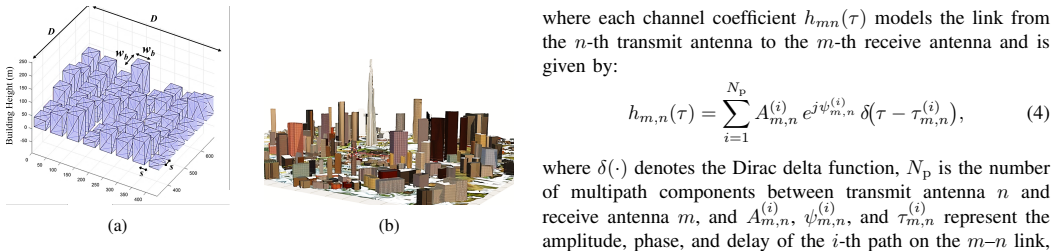



read the original abstract
Driven by the escalating demand for wireless capacity and advancements in 6G research, the new Frequency Range 3 (FR3) referred to upper mid-band (7.125-24.25 GHz) has emerged as a highly compelling spectrum candidate. This range offers a trade-off exploiting the high bandwidth capabilities of millimeter wave frequencies and the superior propagation characteristics of sub-6 GHz bands. As such, the upper mid-band presents an opportunity to enhance both coverage and capacity particularly in the context of 6G and Cellular Vehicle-to-Base Station (C-V2B). Crucially, realizing this potential requires overcoming technical challenges through accurate and realistic channel modeling, especially in dense, high-rise urban environments. To address this, we employ a ray-tracing tool to analyze downlink propagation characteristics, enabling detailed channel modeling for reliable C-V2B communication. Our analysis evaluates the signal-to-noise ratio (SNR) and signal-to-interference-plus-noise ratio (SINR) across sub-6 GHz, FR3, and mmWave bands using antenna array configurations designed for high-rise urban areas. Results show that, under equal aperture sizes across frequencies, FR3 achieves superior SNR compared to mmWave in interference-free conditions. Moreover, under the full-interference case, FR3 yields higher SINR for cell-edge User Equipment (UEs). This indicates that the increased array gain at mmWave cannot fully compensate for the severe path loss experienced by cell-edge UEs.
Editorial analysis
A structured set of objections, weighed in public.
Referee Report
Summary. The manuscript uses ray-tracing simulations to characterize downlink propagation for Cellular Vehicle-to-Base Station (C-V2B) links in high-rise urban scenarios. It compares SNR and SINR performance across sub-6 GHz, FR3 (7.125-24.25 GHz), and mmWave bands under equal-aperture antenna arrays, concluding that FR3 achieves superior SNR to mmWave in interference-free conditions and higher SINR for cell-edge UEs under full interference, because mmWave array gain cannot offset severe path loss.
Significance. If the underlying propagation model holds, the results provide concrete guidance on FR3 as a 6G spectrum candidate that trades off bandwidth and coverage for vehicular links in dense urban settings. The equal-aperture comparison and full-interference SINR ordering are directly relevant to system-level design choices.
major comments (1)
- Abstract: The claim that FR3 yields higher cell-edge SINR than mmWave under full interference (because array gain cannot compensate path loss) rests entirely on the ray-tracing tool reproducing frequency-dependent path loss, scattering, and interference. No calibration of material parameters, building models, or comparison to measurements for the FR3 band is reported, directly affecting the reliability of the reported SINR ordering.
minor comments (2)
- Abstract: No error bars, confidence intervals, or sensitivity ranges are supplied for the SNR/SINR values, making it impossible to judge whether the reported FR3 advantage is statistically distinguishable from simulation variability.
- Abstract: The phrase 'antenna array configurations designed for high-rise urban areas' is used without specifying element counts, inter-element spacing, or beamforming assumptions, which are needed to interpret the equal-aperture gain claims.
Simulated Author's Rebuttal
We thank the referee for the constructive comments and the opportunity to clarify our methodology. We address the major comment below.
read point-by-point responses
-
Referee: Abstract: The claim that FR3 yields higher cell-edge SINR than mmWave under full interference (because array gain cannot compensate path loss) rests entirely on the ray-tracing tool reproducing frequency-dependent path loss, scattering, and interference. No calibration of material parameters, building models, or comparison to measurements for the FR3 band is reported, directly affecting the reliability of the reported SINR ordering.
Authors: We agree that the absence of FR3-specific measurement calibration is a limitation that affects the strength of the claims. Our simulations use a commercial ray-tracing engine with material electromagnetic properties and scattering models taken from established ITU-R and literature sources that have been validated for sub-6 GHz and mmWave urban scenarios; frequency dependence is applied via standard scaling of permittivity, conductivity, and reflection coefficients. Because FR3 remains an emerging band, no dedicated measurement datasets were available for direct calibration at the time of the study. In revision we will (i) expand the methodology section with the exact parameter values and ray-launching settings employed, (ii) add an explicit limitations paragraph citing the relevant validation studies for the tool and noting the extrapolation to FR3, and (iii) qualify the abstract and conclusion statements to reflect that the SINR ordering is obtained under these standard physics-based assumptions rather than empirical FR3 data. These changes will not alter the reported numerical results but will improve transparency. revision: partial
Circularity Check
No circularity: results are direct ray-tracing outputs
full rationale
The paper reports SNR and SINR values obtained by applying a commercial ray-tracing engine to a fixed high-rise urban geometry with chosen antenna arrays at three frequency bands. No equations are derived, no parameters are fitted to subsets of the same data, and no self-citation chain is invoked to justify a uniqueness result or ansatz. The central claims follow immediately from the simulation outputs without reduction to any prior fitted quantity or self-referential definition.
Axiom & Free-Parameter Ledger
axioms (1)
- domain assumption Ray-tracing tool accurately models propagation in high-rise urban environments for sub-6 GHz, FR3, and mmWave frequencies
Forward citations
Cited by 1 Pith paper
-
FR3 for 6G Networks: A Comparative Study against FR1 and FR2 Across Diverse Environments
Ray-tracing comparisons show FR3 yields higher cell-edge data rates than FR2 under equal-aperture antennas in urban environments, with negligible coverage difference between vehicular and pedestrian user equipment.
Reference graph
Works this paper leans on
-
[1]
Quantifying the impact of 5G and COVID-19 on mo- bile data consumption,
Opensignal, “Quantifying the impact of 5G and COVID-19 on mo- bile data consumption,” https://www.opensignal.com/reports/2021/06/ global-state-of-the-mobile-network, accessed: April 7, 2026
work page 2021
-
[2]
Upper mid-band spectrum for 6G: Opportunities and key enablers,
Samsung Research, “Upper mid-band spectrum for 6G: Opportunities and key enablers,” https://research.samsung.com/blog/ Upper-Mid-Band-Spectrum-for-6G-Opportunities-and-Key-Enablers, accessed: April 7, 2026. Fig. 5: Coverage probability and coverage maps, (a) Coverage probability vs BS density forfull-interferencescenario across all frequencies correspondi...
work page 2026
-
[3]
M. Haiyang,et al., “A survey of new mid-band/FR3 for 6G: Channel measurement, characterization and modeling in outdoor environment,” arXiv preprint arXiv:2504.06727, 2025
-
[4]
5G 3GPP-like channel models for outdoor urban microcellular and macrocellular environments,
K. Hanedaet al., “5G 3GPP-like channel models for outdoor urban microcellular and macrocellular environments,” in2016 IEEE 83rd V ehicular Technology Conference (VTC Spring), 2016, pp. 1–7
work page 2016
-
[5]
Study on channel model for frequency spectrum from 0.5 to 100 GHz,
3GPP, “Study on channel model for frequency spectrum from 0.5 to 100 GHz,” 3rd Generation Partnership Project (3GPP), Sophia Antipolis, France, Tech. Rep. TR 38.901, 2020
work page 2020
-
[6]
Higher-Order Meta Distribution Reliability Analysis of Wireless Networks,
M. Monemiet al., “Higher-Order Meta Distribution Reliability Analysis of Wireless Networks,”arXiv preprint arXiv:2501.14289, 2025
-
[7]
A novel millimeter-wave channel simulator and applications for 5G wireless communications,
S. Sun, G. R. MacCartney, and T. S. Rappaport, “A novel millimeter-wave channel simulator and applications for 5G wireless communications,” in 2017 IEEE International Conference on Communications (ICC), 2017, pp. 1–7
work page 2017
-
[8]
A study of channel model parameters for aerial base stations at 2.4 GHz in different environments,
N. Sharma,et al., “A study of channel model parameters for aerial base stations at 2.4 GHz in different environments,” in2018 15th IEEE Annual Consumer Communications & Networking Conference (CCNC), 2018, pp. 1–6
work page 2018
-
[9]
D. Shakya,et al., “Urban outdoor propagation measurements and channel models at 6.75 GHz FR1(C) and 16.95 GHz FR3 upper mid-band spectrum for 5G and 6G,”arXiv preprint arXiv:2410.17539, 2024
-
[10]
Cellular wireless networks in the upper mid-band,
S. Kang,et al., “Cellular wireless networks in the upper mid-band,”IEEE Open Journal of the Communications Society, vol. 5, pp. 2058–2075, 2024
work page 2058
-
[11]
A comparative evaluation of propagation characteristics of vehicular VLC and MMW channels,
F. Aghaei, H. B. Eldeeb, and M. Uysal, “A comparative evaluation of propagation characteristics of vehicular VLC and MMW channels,”IEEE Transactions on V ehicular Technology, vol. 73, no. 1, pp. 4–13, 2024
work page 2024
-
[12]
Vehicular mmw communication: Channel characteriza- tion based on ray tracing study,
F. Aghaei,et al., “Vehicular mmw communication: Channel characteriza- tion based on ray tracing study,” in2024 19th International Symposium on Wireless Communication Systems (ISWCS), 2024, pp. 1–6
work page 2024
-
[13]
Wireless insite reference manual,
“Wireless insite reference manual,”Remcom, version 3.3.3, 2019
work page 2019
-
[14]
Promises and caveats of uplink IoT ultra-dense networks,
M. Ding and D. L. P ´erez, “Promises and caveats of uplink IoT ultra-dense networks,” in2018 IEEE Wireless Communications and Networking Conference (WCNC), 2018, pp. 1–6
work page 2018
-
[15]
ITU-R, “Rec. p.1410-2 propagation data and prediction methods for the design of terrestrial broadband millimetric aadio access systems,” P Series, Radiowave propagation, 2003
work page 2003
-
[16]
“Propagation data and prediction methods for the planning of short-range outdoor radiocommunication systems and radio local area networks in the frequency range 300 MHz to 100 GHz,” Aug. 2019
work page 2019
-
[17]
A. Uyrus,et al., “Recommendation ITU-R P.2040-1: Effects of building materials and structures on radio wave propagation above about 100 MHz,”Recomm. ITU-R P .2040, vol. 1, 2015
work page 2040
discussion (0)
Sign in with ORCID, Apple, or X to comment. Anyone can read and Pith papers without signing in.