Recognition: 1 theorem link
· Lean TheoremFrom Paper to Program: Accelerating Quantum Many-Body Algorithm Development via a Multi-Stage LLM-Assisted Workflow
Pith reviewed 2026-05-13 16:51 UTC · model grok-4.3
The pith
A human-reviewed intermediate specification allows LLMs to reliably generate correct code for quantum many-body algorithms such as DMRG.
A machine-rendered reading of the paper's core claim, the machinery that carries it, and where it could break.
Core claim
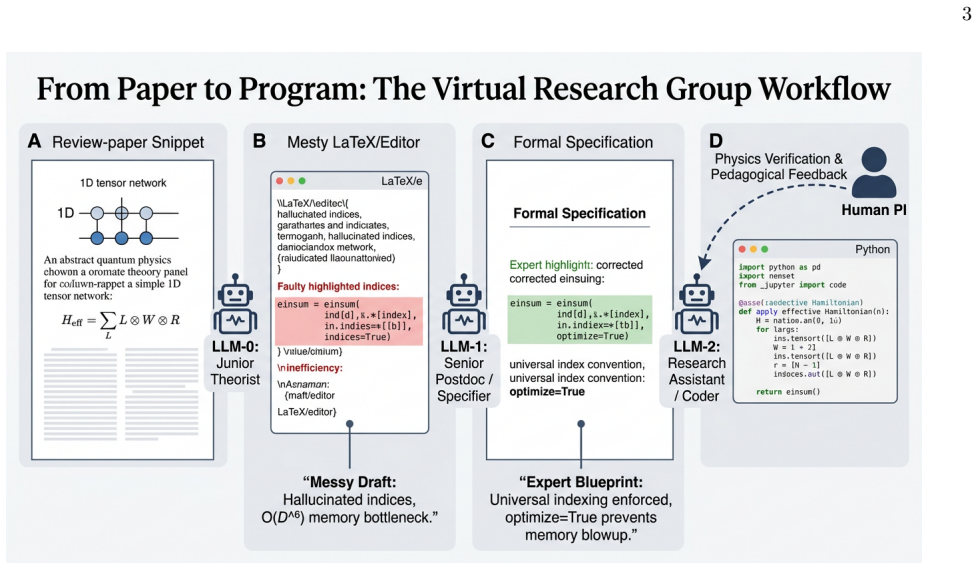
The workflow separates theory extraction, formal specification, and code implementation, with the key step being an intermediate technical specification produced by an LLM and reviewed by the human researcher that externalizes implementation-critical computational knowledge absent from the source literature, including explicit index conventions, contraction orderings, and matrix-free operational constraints. This enables reliable code generation for the DMRG algorithm, reproducing the critical entanglement scaling of the spin-1/2 Heisenberg chain and the symmetry-protected topological order of the spin-1 AKLT model. Across 16 tested combinations of leading foundation models, all workflows of
What carries the argument
The intermediate technical specification that externalizes explicit index conventions, contraction orderings, and matrix-free constraints absent from source literature.
Load-bearing premise
The human review of the intermediate technical specification reliably includes all critical implementation details without introducing new errors or omissions.
What would settle it
Finding that code produced by the workflow fails to match the known entanglement entropy scaling for the spin-1/2 Heisenberg chain would show the method does not guarantee correctness.
Figures


read the original abstract
Large language models (LLMs) can generate code rapidly but remain unreliable for scientific algorithms whose correctness depends on structural assumptions rarely explicit in the source literature. We introduce a multi-stage LLM-assisted workflow that separates theory extraction, formal specification, and code implementation. The key step is an intermediate technical specification -- produced by a dedicated LLM agent and reviewed by the human researcher -- that externalizes implementation-critical computational knowledge absent from the source literature, including explicit index conventions, contraction orderings, and matrix-free operational constraints that avoid explicit storage of large operator matrices. A controlled comparison shows that it is this externalized content, rather than the formal document structure, that enables reliable code generation. As a stringent benchmark, we apply this workflow to the Density-Matrix Renormalization Group (DMRG), a canonical quantum many-body algorithm requiring exact tensor-index logic, gauge consistency, and memory-aware contractions. The resulting code reproduces the critical entanglement scaling of the spin-$1/2$ Heisenberg chain and the symmetry-protected topological order of the spin-$1$ Affleck--Kennedy--Lieb--Tasaki model. Across 16 tested combinations of leading foundation models, all workflows satisfied the same physics-validation criteria, compared to a 46\% success rate for direct, unmediated implementation. The workflow reduced a development cycle typically requiring weeks of graduate-level effort to under 24 hours.
Editorial analysis
A structured set of objections, weighed in public.
Referee Report
Summary. The manuscript introduces a multi-stage LLM-assisted workflow for quantum many-body algorithm development. The workflow includes theory extraction, formal specification, and code implementation stages, with a key human-reviewed intermediate technical specification that externalizes details like index conventions, contraction orderings, and matrix-free constraints. Tested on DMRG for the Heisenberg chain and AKLT model, it achieves 100% success in reproducing physical signatures across 16 foundation model combinations, compared to 46% for direct implementation, reducing effort from weeks to under 24 hours.
Significance. This approach could significantly accelerate the development of complex scientific codes in quantum many-body physics by mitigating LLM limitations in handling implicit structural assumptions. The empirical validation using standard physical observables like entanglement scaling and SPT order provides a solid, falsifiable basis for the claims. The controlled comparison across multiple models strengthens the evidence for the workflow's utility.
minor comments (2)
- [Abstract] Abstract: limited detail is given on the precise failure modes of the direct baseline (the 54% unsuccessful cases); a short categorization of error types (e.g., index mismatches versus contraction ordering) would make the contribution of the specification step more transparent.
- [§4.2] §4.2: the human-review step is presented as reliable, but an explicit checklist or template for the technical specification (covering all cited implementation-critical items) would improve reproducibility of the workflow.
Simulated Author's Rebuttal
We thank the referee for their positive assessment of the manuscript, recognition of its significance for accelerating quantum many-body code development, and recommendation for minor revision. We are pleased that the controlled empirical validation and the role of the human-reviewed technical specification were viewed favorably.
Circularity Check
No significant circularity
full rationale
The paper reports an empirical success-rate comparison (46% direct LLM vs. 100% with human-reviewed intermediate specification) on DMRG code generation, validated by reproduction of pre-existing, independent physical benchmarks (entanglement scaling of the Heisenberg chain and SPT order of the AKLT model). These observables are standard, externally established results that do not depend on the workflow itself. No derivation, equation, or central claim reduces by construction to a fitted parameter, self-definition, or self-citation chain; the human-review step is explicitly acknowledged as an assumption rather than hidden. The workflow is therefore self-contained against external benchmarks.
Axiom & Free-Parameter Ledger
axioms (1)
- domain assumption LLMs can extract and formalize implicit computational knowledge (index conventions, contraction orderings, memory constraints) from scientific literature when guided by a structured workflow and human review
Lean theorems connected to this paper
-
IndisputableMonolith/Foundation/ArithmeticFromLogic.leanLogicNat recovery theorem unclearThe central innovation is the introduction of an intermediate technical specification... that externalizes implementation-critical computational knowledge... index conventions, contraction orderings, and matrix-free operational constraints
Forward citations
Cited by 1 Pith paper
-
The Agentification of Scientific Research: A Physicist's Perspective
AI will evolve from a research tool into a collaborator, fundamentally reshaping scientific collaboration, discovery, publishing, and evaluation while requiring continuous learning and idea diversity for original cont...
Reference graph
Works this paper leans on
-
[1]
Custom-defined syntax:The generated Python adoptednumpy.einsumexpressions defined within the intermediate specification, including contraction strings such as’bxy,ytY,bBst,xsX->BXY’. These strings are not standard fragments copied from common tensor- network libraries, suggesting that the models were trans- lating the local specification rather than simpl...
-
[2]
Divergent derivations of the AKLT MPO:While all tested models reproduced the standardD W = 5 Heisen- berg MPO, their treatment of the more involved spin-1 AKLT biquadratic interaction, ⃗Si · ⃗Si+1 + 1 3(⃗Si · ⃗Si+1)2, differed substantially. Gemini and GPT produced a DW = 14 expansion, Claude generated a compressed DW = 11 representation, and Kimi preferr...
-
[3]
Co-Authoring with AI: How I Wrote a Physics Paper About AI, Using AI
Correction of inconsistent specifications:The inter- mediate LATEX documents occasionally contained typo- graphical or logical inconsistencies, such as mismatched bra/ket conventions or flawed contraction strings. In multiple cases, the implementation models produced code that repaired these inconsistencies rather than fol- lowing the flawed local express...
work page internal anchor Pith review Pith/arXiv arXiv
-
[4]
F. Verstraete, V. Murg, and J. I. Cirac, Advances in Physics57, 143 (2008)
work page 2008
- [5]
-
[6]
J. I. Cirac, D. Perez-Garcia, N. Schuch, and F. Ver- straete, Reviews of Modern Physics93, 045003 (2021)
work page 2021
-
[7]
S. R. White, Physical Review Letters69, 2863 (1992)
work page 1992
-
[8]
S. R. White, Physical Review B48, 10345 (1993)
work page 1993
-
[9]
Schollw¨ ock, Annals of Physics326, 96 (2011)
U. Schollw¨ ock, Annals of Physics326, 96 (2011)
work page 2011
- [10]
- [11]
-
[12]
D. Perez-Garcia, F. Verstraete, M. M. Wolf, and J. I. Cirac, Quantum Information and Computation7, 401 (2007)
work page 2007
-
[13]
I. Affleck, T. Kennedy, E. H. Lieb, and H. Tasaki, Phys- ical Review Letters59, 799 (1987)
work page 1987
- [14]
-
[15]
T. Kennedy and H. Tasaki, Communications in Mathe- matical Physics147, 431 (1992)
work page 1992
-
[16]
M. Fishman, S. R. White, and E. M. Stoudenmire, Sci- Post Phys. Codebases , 4 (2022)
work page 2022
- [17]
-
[18]
Zhou, DMRG-LLM: Documents of llm-assisted work- flow for mps/dmrg (2026)
Y. Zhou, DMRG-LLM: Documents of llm-assisted work- flow for mps/dmrg (2026)
work page 2026
-
[19]
J. Haegeman, J. I. Cirac, T. J. Osborne, I. Piˇ zorn, H. Ver- schelde, and F. Verstraete, Phys. Rev. Lett.107, 070601 (2011)
work page 2011
-
[20]
Vidal, Physical Review Letters98, 070201 (2007)
G. Vidal, Physical Review Letters98, 070201 (2007)
work page 2007
- [21]
-
[22]
F. Verstraete and J. I. Cirac, arXiv preprint cond- mat/0407066 (2004)
- [23]
- [24]
discussion (0)
Sign in with ORCID, Apple, or X to comment. Anyone can read and Pith papers without signing in.