Recognition: 2 theorem links
· Lean TheoremOn Data Thinning for Model Validation in Small Area Estimation
Pith reviewed 2026-05-13 16:47 UTC · model grok-4.3
The pith
Data thinning splits area-level survey estimates into independent training and test components to validate small area estimation models without external data.
A machine-rendered reading of the paper's core claim, the machinery that carries it, and where it could break.
Core claim
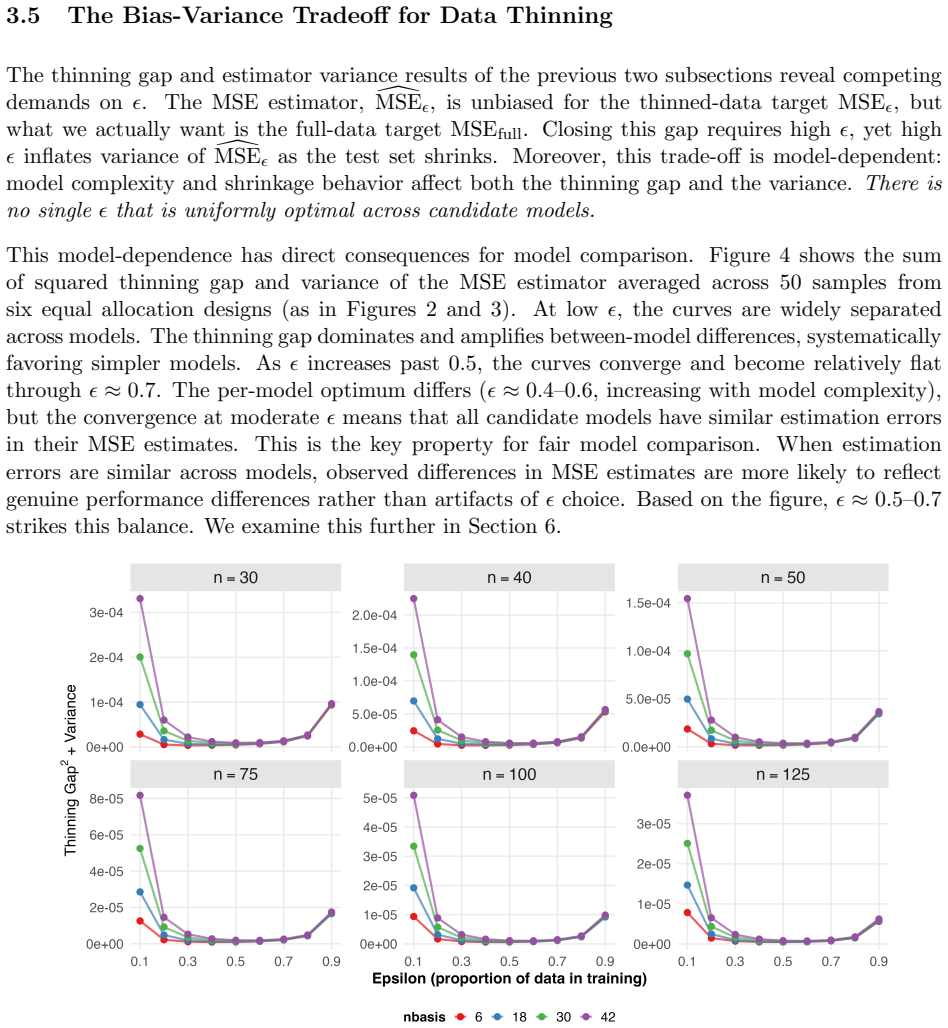
The central claim is that data thinning creates independent training and test components from area-level observations under the Fay-Herriot model, enabling principled out-of-sample validation where none existed. Theoretical analysis establishes that metrics computed on the thinned training component target a different quantity than full-data metrics, with the discrepancy scaling by model complexity. The bias-variance tradeoff is formally characterized, and specific thinning parameters are identified that balance the competing effects to support reliable model selection.
What carries the argument
Data thinning, which splits each area-level direct estimate into independent training and test components under the Fay-Herriot model to support out-of-sample validation.
If this is right
- Thinned training metrics can be used directly for model comparison once the bias-variance tradeoff is accounted for by the recommended allocation.
- Increasing the share of information retained for training narrows the gap to full-data performance but simultaneously raises the variance of the thinned estimator.
- The identified thinning parameters produce consistent and stable validation results across heterogeneous sampling designs in ACS-based simulations.
- The approach supplies a practical validation scheme that relies solely on routinely available area-level direct estimates.
Where Pith is reading between the lines
- The same thinning construction could be adapted to SAE models that extend the Fay-Herriot framework by adding random effects or spatial structure.
- Validated SAE models produced this way could feed more directly into policy allocations that depend on poverty or health estimates for small domains.
- Empirical checks on other national surveys would test whether the recommended thinning ratios generalize beyond the ACS sampling designs examined.
Load-bearing premise
The thinned training and test components remain independent and performance metrics measured on the thinned training component can be meaningfully related to full-data metrics despite targeting a different quantity whose gap varies by model complexity.
What would settle it
A design-based simulation on ACS microdata in which model rankings or performance values obtained from the recommended thinned training component diverge from full-data rankings by more than the bias amount predicted by the tradeoff analysis.
Figures




read the original abstract
Small area estimation (SAE) produces estimates of population parameters for geographic and demographic subgroups with limited sample sizes. Such estimates are critical for informing policy decisions, ranging from poverty mapping to social program funding. Despite its widespread use, principled validation of SAE models remains challenging and general guidelines are far from well-established. Unlike conventional predictive modeling settings, validation data are rarely available in the SAE context. External validation surveys or censuses often do not exist, and access to individual-level microdata is often restricted, making standard cross-validation infeasible. In this paper, we propose a novel model validation scheme using only area-level direct survey estimates under the widely used Fay-Herriot model. Our approach is based on data thinning, which splits area-level observations into independent training and test components to enable out-of-sample validation. Our theoretical analysis reveals a fundamental tension inherent in thinning-based validation: performance metrics measured on the thinned training component target a different quantity than those based on the full data, with the gap varying by model complexity. Increasing the information allocated for training reduces this gap but inflates the variance of the estimator. We formally characterize this bias-variance tradeoff and provide practical recommendations for the thinning parameters that balance these competing considerations for model comparison. We show that data thinning with these settings provides consistent and stable performance across heterogeneous sampling designs in design-based simulations using American Community Survey microdata.
Editorial analysis
A structured set of objections, weighed in public.
Referee Report
Summary. The paper proposes data thinning to split area-level direct estimates into independent training and test components for out-of-sample validation of Fay-Herriot small area estimation models. It theoretically characterizes the bias-variance tradeoff arising because thinned-training performance metrics target a different quantity than full-data metrics (with the gap depending on model complexity), derives practical recommendations for the thinning proportion, and reports consistent and stable performance across heterogeneous sampling designs in design-based simulations on American Community Survey microdata.
Significance. If the recommended thinning parameters preserve relative model rankings despite the documented gap in target quantities, the method would address a longstanding practical gap in SAE validation where external data are unavailable. The use of design-based simulations on real ACS microdata provides a stronger test of robustness than purely model-based evaluations.
major comments (2)
- [Theoretical Analysis and Simulation Results] The abstract and theoretical analysis note that the gap between thinned-training and full-data metrics varies by model complexity, yet no explicit verification is provided that relative model orderings are preserved under the recommended thinning proportion; without this, the procedure's utility for model comparison (rather than absolute performance) is not established.
- [Simulation Results] The design-based simulations claim stability across heterogeneous sampling designs, but the reported results do not include side-by-side comparison of model rankings obtained from thinned-training metrics versus full-data metrics; this comparison is required to confirm that the bias-variance tradeoff does not systematically alter selection decisions.
minor comments (2)
- [Abstract] The abstract refers to 'these settings' for the thinning parameters without stating the numerical values; these should be given explicitly in the abstract and again in the recommendations section.
- [Methods] Notation for the thinned training and test components should be introduced with a clear definition of the independence property and how the performance metric on the thinned training component relates to the full-data target.
Simulated Author's Rebuttal
We thank the referee for the constructive comments, which help clarify the scope and presentation of our results. We agree that explicit checks on model ranking preservation are valuable for demonstrating the method's utility in model selection. Below we address each major comment and outline the corresponding revisions.
read point-by-point responses
-
Referee: [Theoretical Analysis and Simulation Results] The abstract and theoretical analysis note that the gap between thinned-training and full-data metrics varies by model complexity, yet no explicit verification is provided that relative model orderings are preserved under the recommended thinning proportion; without this, the procedure's utility for model comparison (rather than absolute performance) is not established.
Authors: We appreciate this observation. Our theoretical results characterize the gap as a function of model complexity and thinning proportion, and the recommended parameters are explicitly chosen to keep the gap small enough to support stable relative comparisons. Nevertheless, we agree that a direct numerical verification of ranking preservation would strengthen the manuscript. In the revision we will add an explicit check (new table or figure in the simulation section) that compares model orderings under the recommended thinning proportions to the full-data orderings across the ACS-based designs. revision: yes
-
Referee: [Simulation Results] The design-based simulations claim stability across heterogeneous sampling designs, but the reported results do not include side-by-side comparison of model rankings obtained from thinned-training metrics versus full-data metrics; this comparison is required to confirm that the bias-variance tradeoff does not systematically alter selection decisions.
Authors: We agree that a side-by-side ranking comparison is the most direct way to confirm that the bias-variance tradeoff does not change selection decisions. The current simulations already demonstrate low variability of the thinned metrics across designs, but they stop short of tabulating the implied rankings against the full-data benchmark. We will add this comparison (new table or supplementary figure) in the revised manuscript, using the same simulation settings and model candidates already reported. revision: yes
Circularity Check
Derivation self-contained; bias-variance tradeoff derived directly from thinning construction without reduction to inputs
full rationale
The paper starts from the proposed data-thinning split of area-level Fay-Herriot observations into independent training and test components, then derives the explicit bias-variance tradeoff for the thinned-training performance metric versus the full-data target. This is a first-principles characterization of the method's own properties rather than any self-definitional loop, fitted parameter renamed as prediction, or load-bearing self-citation. Recommendations for thinning fractions follow from balancing the derived expressions, and stability is checked via external design-based simulations on ACS microdata. No step equates a claimed result to its inputs by construction, and the central validation claim rests on simulation evidence outside the analytic derivation.
Axiom & Free-Parameter Ledger
free parameters (1)
- thinning proportion
axioms (1)
- domain assumption Thinned training and test components are independent
Lean theorems connected to this paper
-
IndisputableMonolith/Cost/FunctionalEquation.leanwashburn_uniqueness_aczel unclear?
unclearRelation between the paper passage and the cited Recognition theorem.
Our approach is based on data thinning, which splits area-level observations into independent training and test components... Theorem 3.2 (Unbiased MSE estimation)... Proposition 3.3 (MSE thinning gap under known parameters) Δ_i(ε) = (1-ε)/ε · γ_i(ε)γ_i d_i
-
IndisputableMonolith/Foundation/RealityFromDistinction.leanreality_from_one_distinction unclear?
unclearRelation between the paper passage and the cited Recognition theorem.
Gaussian data thinning... y(1)_i ~ N(ε θ_i, ε d_i) and y(2)_i ~ N((1-ε) θ_i, (1-ε) d_i)
What do these tags mean?
- matches
- The paper's claim is directly supported by a theorem in the formal canon.
- supports
- The theorem supports part of the paper's argument, but the paper may add assumptions or extra steps.
- extends
- The paper goes beyond the formal theorem; the theorem is a base layer rather than the whole result.
- uses
- The paper appears to rely on the theorem as machinery.
- contradicts
- The paper's claim conflicts with a theorem or certificate in the canon.
- unclear
- Pith found a possible connection, but the passage is too broad, indirect, or ambiguous to say the theorem truly supports the claim.
Forward citations
Cited by 2 Pith papers
-
On cross-validation for small area estimators
A new cross-validation approach for small area estimators decomposes error to reveal bias and bound uncertainty, outperforming leave-one-area-out methods in simulations and Zambia literacy data.
-
On cross-validation for small area estimators
A cross-validation framework for small area estimation decomposes error to separate measurable bias from bounded unknowns, showing that leave-one-area-out methods can produce misleading model rankings while the new ap...
Reference graph
Works this paper leans on
-
[1]
Akaike, H. (1974). A new look at the statistical model identification. IEEE Transactions on Automatic Control , 19(6):716--723
work page 1974
-
[2]
Bates, S., Hastie, T., and Tibshirani, R. (2024). Cross- Validation : What Does It Estimate and How Well Does It Do It ? Journal of the American Statistical Association , 119(546):1434--1445. \_eprint: https://doi.org/10.1080/01621459.2023.2197686
-
[3]
Bradley, J. R., Holan, S. H., and Wikle, C. K. (2015). Multivariate spatio-temporal models for high-dimensional areal data with application to Longitudinal Employer - Household Dynamics . The Annals of Applied Statistics , 9(4):1761--1791
work page 2015
-
[4]
Bradley, J. R., Wikle, C. K., and Holan, S. H. (2016). Bayesian Spatial Change of Support for Count - Valued Survey Data With Application to the American Community Survey . Journal of the American Statistical Association , 111(514):472--487
work page 2016
-
[5]
Datta, G. S. and Mandal, A. (2015). Small Area Estimation With Uncertain Random Effects . Journal of the American Statistical Association , 110(512):1735--1744
work page 2015
-
[6]
Dharamshi, A., Neufeld, A., Gao, L. L., Bien, J., and Witten, D. (2025a). Decomposing Gaussians with Unknown Covariance . Biometrika , page asaf057
-
[7]
Dharamshi, A., Neufeld, A., Motwani, K., Gao, L. L., Witten, D., and Bien, J. (2025b). Generalized Data Thinning Using Sufficient Statistics . Journal of the American Statistical Association , 120(549):511--523
-
[8]
Dong, Q., Wu, W., Li, Z. R., and Wakefield, J. (2025). Toward a principled workflow for prevalence mapping using household survey data. Journal of Survey Statistics and Methodology
work page 2025
-
[9]
Duncan, E. W. and Mengersen, K. L. (2020). Comparing Bayesian spatial models: Goodness -of-smoothing criteria for assessing under- and over-smoothing. PLOS ONE , 15(5):e0233019
work page 2020
-
[10]
Fay, R. E. and Herriot, R. A. (1979). Estimates of Income for Small Places : An Application of James - Stein Procedures to Census Data . Journal of the American Statistical Association , 74(366a):269--277
work page 1979
-
[11]
Gelman, A., Hwang, J., and Vehtari, A. (2014). Understanding predictive information criteria for Bayesian models. Statistics and Computing , 24(6):997--1016
work page 2014
-
[12]
Resolution adopted by the General Assembly on 25 September 2015
General Assemby of the United Nations (2015). Resolution adopted by the General Assembly on 25 September 2015
work page 2015
-
[13]
H \'a jek, J. (1964). Asymptotic Theory of Rejective Sampling with Varying Probabilities from a Finite Population . The Annals of Mathematical Statistics , 35(4):1491--1523
work page 1964
-
[14]
Hobert, J. P. and Casella, G. (1996). The effect of improper priors on Gibbs sampling in hierarchical linear mixed models. Journal of the American Statistical Association , 91(436):1461--1473
work page 1996
-
[15]
Horvitz, D. G. and Thompson, D. J. (1952). A Generalization of Sampling Without Replacement from a Finite Universe . Journal of the American Statistical Association , 47(260):663--685
work page 1952
-
[16]
Hughes, J. and Haran, M. (2013). Dimension Reduction and Alleviation of Confounding for Spatial Generalized Linear Mixed Models . Journal of the Royal Statistical Society Series B: Statistical Methodology , 75(1):139--159
work page 2013
-
[17]
H \'a jek, J. (1960). Limiting distributions in simple random sampling from a finite population. A Magyar Tudom \'a nyos Akad \'e mia Matematikai Kutat \'o Int \'e zet \'e nek k \"o zlem \'e nyei , 5(3):361--374
work page 1960
-
[18]
Janicki, R., Raim, A. M., Holan, S. H., and Maples, J. J. (2022). Bayesian nonparametric multivariate spatial mixture mixed effects models with application to American Community Survey special tabulations. The Annals of Applied Statistics , 16(1):144--168
work page 2022
-
[19]
Jiang, J., Rao, J. S., Gu, Z., and Nguyen, T. (2008). Fence methods for mixed model selection. The Annals of Statistics , 36(4):1669--1692
work page 2008
-
[20]
Kawano, S., Parker, P. A., and Li, Z. R. (2025). Spatially selected and dependent random effects for small area estimation with application to rent burden. Journal of the Royal Statistical Society Series A: Statistics in Society , page qnaf063
work page 2025
-
[21]
Kuh, S., Kennedy, L., Chen, Q., and Gelman, A. (2024). Using leave-one-out cross validation ( LOO ) in a multilevel regression and poststratification ( MRP ) workflow: A cautionary tale. Statistics in Medicine , 43(5):953--982. \_eprint: https://onlinelibrary.wiley.com/doi/pdf/10.1002/sim.9964
-
[22]
Leiner, J., Duan, B., Wasserman, L., and Ramdas, A. (2025). Data Fission : Splitting a Single Data Point . Journal of the American Statistical Association , 120(549):135--146. \_eprint: https://doi.org/10.1080/01621459.2023.2270748
-
[23]
Lesage, \'E ., Beaumont, J.-F., and Bocci, C. (2021). Two Local Diagnostics to Evaluate the Efficiency of the Empirical Best Predictor under the Fay - Herriot Model . Survey Methodology , 47(2)
work page 2021
- [24]
-
[25]
Lohr, S. (1999). Sampling: Design and Analysis . Duxbury Press
work page 1999
-
[26]
Lumley, T. (2024). survey: analysis of complex survey samples
work page 2024
-
[27]
Marcis, L., Morales, D., Pagliarella, M. C., and Salvatore, R. (2023). Three-fold Fay -- Herriot model for small area estimation and its diagnostics. Statistical Methods & Applications , 32(5):1563--1609
work page 2023
-
[28]
Marshall, E. C. and Spiegelhalter, D. J. (2003). Approximate cross-validatory predictive checks in disease mapping models. Statistics in Medicine , 22(10):1649--1660. \_eprint: https://onlinelibrary.wiley.com/doi/pdf/10.1002/sim.1403
-
[29]
McAlinn, K. and Takanashi, K. (2025). Determining the K in K -fold cross-validation. arXiv:2511.12698 [stat]
-
[30]
M., Cavanaugh, A., Robinson, B
Michal, V., Wakefield, J., Schmidt, A. M., Cavanaugh, A., Robinson, B. E., and Baumgartner, J. (2024). Model- Based Prediction for Small Domains Using Covariates : A Comparison of Four Methods . Journal of Survey Statistics and Methodology , 12(5):1489--1514
work page 2024
-
[31]
Molina, I. and Rao, J. N. K. (2010). Small area estimation of poverty indicators. The Canadian Journal of Statistics / La Revue Canadienne de Statistique , 38(3):369--385
work page 2010
-
[32]
Moran, P. A. P. (1950). Notes on continuous stochastic phenomena. Biometrika , 37(1-2):17--23
work page 1950
-
[33]
Neufeld, A., Dharamshi, A., Gao, L. L., and Witten, D. (2024). Data Thinning for Convolution - Closed Distributions . Journal of Machine Learning Research , 25(57):1--35
work page 2024
-
[34]
L., Lei, J., and Tibshirani, R
Oliveira, N. L., Lei, J., and Tibshirani, R. J. (2024). Unbiased Risk Estimation in the Normal Means Problem via Coupled Bootstrap Techniques . arXiv:2111.09447 [math, stat]
-
[35]
Nguyen, T. and Jiang, J. (2012). Restricted fence method for covariate selection in longitudinal data analysis. Biostatistics , 13(2):303--314
work page 2012
-
[36]
Parker, P. A. (2024). Nonlinear Fay - Herriot Models for Small Area Estimation Using Random Weight Neural Networks . Journal of Official Statistics , 40(2):317--332
work page 2024
-
[37]
Porter, A. T., Holan, S. H., Wikle, C. K., and Cressie, N. (2014). Spatial Fay -- Herriot models for small area estimation with functional covariates. Spatial Statistics , 10:27--42
work page 2014
-
[38]
Prasad, N. G. N. and Rao, J. N. K. (1990). The Estimation of the Mean Squared Error of Small - Area Estimators . Journal of the American Statistical Association , 85(409):163--171
work page 1990
-
[39]
R. Bell, W., W. Basel, W., and J. Maples, J. (2016). An Overview of the U . S . Census Bureau 's Small Area Income and Poverty Estimates Program . In Pratesi, M., editor, Analysis of Poverty Data by Small Area Estimation , pages 349--378. John Wiley & Sons, Ltd, Chichester, UK
work page 2016
-
[40]
Rasines, D. G. and Young, G. A. (2023). Splitting strategies for post-selection inference. Biometrika , 110(3):597--614
work page 2023
-
[41]
R: A Language and Environment for Statistical Computing
R Core Team (2025). R: A Language and Environment for Statistical Computing . R Foundation for Statistical Computing, Vienna, Austria
work page 2025
-
[42]
Spiegelhalter, D. J., Best, N. G., Carlin, B. P., and Van Der Linde, A. (2002). Bayesian measures of model complexity and fit. Journal of the Royal Statistical Society: Series B (Statistical Methodology) , 64(4):583--639. \_eprint: https://rss.onlinelibrary.wiley.com/doi/pdf/10.1111/1467-9868.00353
-
[43]
Slud, E., Franco, C., and Hall, A. (2024). Small area estimates for V oting R ights A ct S ection 203(b) coverage determinations. Calcutta Statistical Association Bulletin , 76(1):137--159
work page 2024
-
[44]
Stern, H. S. and Cressie, N. (2000). Posterior predictive model checks for disease mapping models. Statistics in Medicine , 19(17-18):2377--2397
work page 2000
-
[45]
Vehtari, A., Gelman, A., and Gabry, J. (2017). Practical Bayesian model evaluation using leave-one-out cross-validation and WAIC . Statistics and Computing , 27(5):1413--1432
work page 2017
-
[46]
Walker, K. (2023). tigris: Load Census TIGER / Line Shapefiles
work page 2023
-
[47]
Watanabe, S. (2010). Asymptotic Equivalence of Bayes Cross Validation and Widely Applicable Information Criterion in Singular Learning Theory . Journal of Machine Learning Research , 11(116):3571--3594
work page 2010
-
[48]
Wieczorek, J., Guerin, C., and McMahon, T. (2022). K-fold cross-validation for complex sample surveys. Stat , 11(1):e454. \_eprint: https://onlinelibrary.wiley.com/doi/pdf/10.1002/sta4.454
-
[49]
Zhou, Q. M. and You, Y. (2008). Hierarchical Bayes Small Area Estimation for the Canadian Community Health Survey . Survey Methodology , 37(1):25--37
work page 2008
discussion (0)
Sign in with ORCID, Apple, or X to comment. Anyone can read and Pith papers without signing in.