Recognition: 2 theorem links
· Lean TheoremEcoAssist: Embedding Sustainability into AI-Assisted Frontend Development
Pith reviewed 2026-05-10 20:31 UTC · model grok-4.3
The pith
EcoAssist integrates energy estimates and fixes into AI coding assistants to lower frontend website energy use by 13-16 percent on average while keeping developers productive.
A machine-rendered reading of the paper's core claim, the machinery that carries it, and where it could break.
Core claim
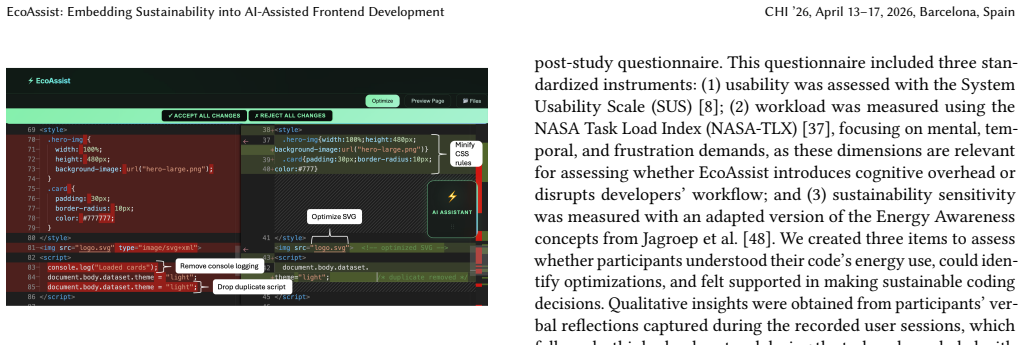
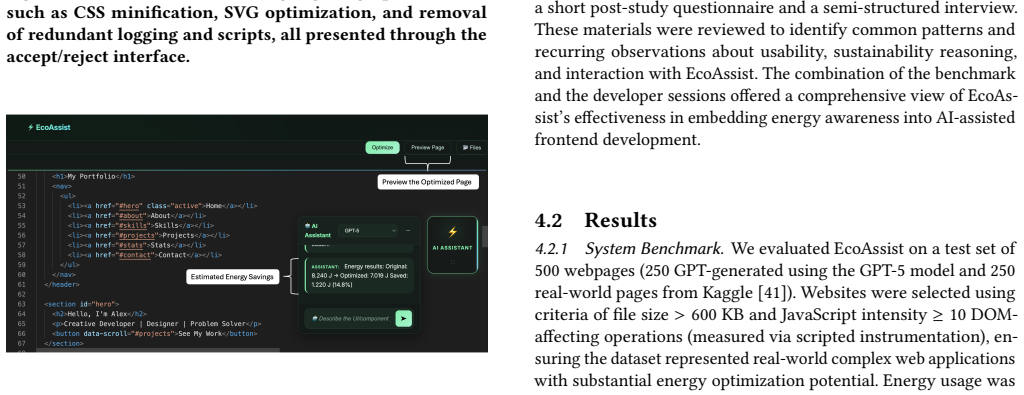
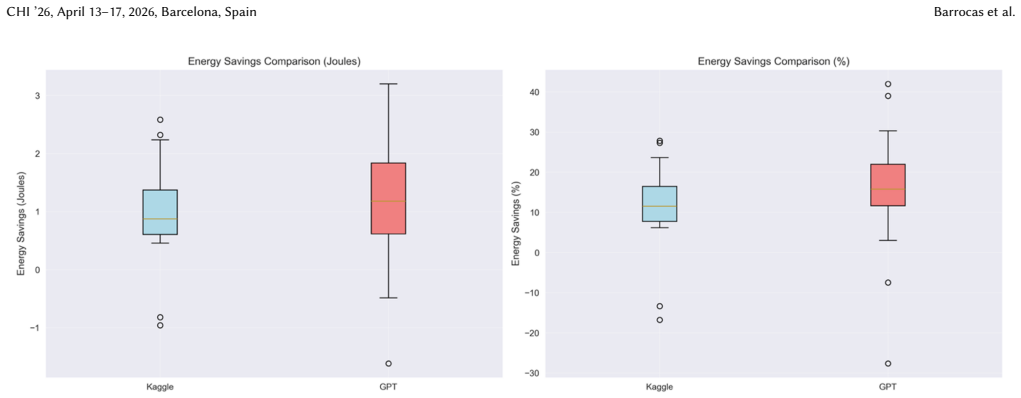
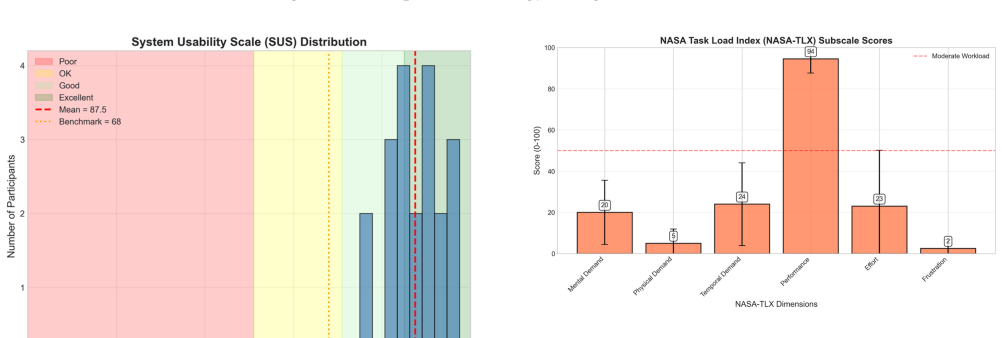
EcoAssist analyzes AI-generated frontend code for its energy footprint, supplies real-time estimates, and recommends targeted optimizations such as lighter assets or efficient rendering patterns. Benchmarks across 500 websites showed average per-site energy reductions of 13-16 percent. A user study with 20 developers found that the tool raised awareness of energy implications during coding while preserving the same levels of productivity as standard AI assistants.
What carries the argument
EcoAssist, an IDE-integrated assistant that estimates the energy footprint of AI-generated frontend code and proposes concrete optimizations to reduce it.
If this is right
- AI-generated frontend code can be systematically lowered in energy draw through embedded guidance at the point of creation.
- Developers gain ongoing awareness of energy costs without extra effort or training.
- Productivity stays level, removing a key practical barrier to adopting sustainability practices in daily coding.
- The same pattern of analysis-plus-suggestions could apply to other AI coding tasks beyond frontend web work.
Where Pith is reading between the lines
- If adopted in major AI coding platforms, the approach could lower the aggregate electricity demand from web content viewed billions of times daily.
- Similar real-time energy feedback loops might help close the gap between research guidelines and actual developer behavior in other domains such as mobile apps or backend services.
- Longer-term use could shift industry expectations so that energy metrics become a standard part of AI assistant outputs rather than an optional add-on.
Load-bearing premise
The tool's energy footprint model gives accurate estimates that hold up across real browsers, devices, and network conditions, and its suggested code changes do not introduce bugs or noticeable slowdowns.
What would settle it
Side-by-side real-world power measurements on the same websites before and after applying EcoAssist suggestions, run across multiple devices and browsers to check whether actual consumption matches the tool's predictions.
Figures




read the original abstract
Frontend code, replicated across millions of page views, consumes significant energy and contributes directly to digital emissions. Yet current AI coding assistants, such as GitHub Copilot and Amazon CodeWhisperer, emphasize developer speed and convenience, with energy impact not yet a primary focus. At the same time, existing energy-focused guidelines and metrics have seen limited adoption among practitioners, leaving a gap between research and everyday coding practice. To address this gap, we introduce EcoAssist, an energy-aware assistant integrated into an IDE that analyzes AI-generated frontend code, estimates its energy footprint, and proposes targeted optimizations. We evaluated EcoAssist through benchmarks of 500 websites and a controlled study with 20 developers. Results show that EcoAssist reduced per-website energy by 13-16% on average, increased developers' awareness of energy use, and maintained developer productivity. This work demonstrates how energy considerations can be embedded directly into AI-assisted coding workflows, supporting developers as they engage with energy implications through actionable feedback.
Editorial analysis
A structured set of objections, weighed in public.
Referee Report
Summary. The paper introduces EcoAssist, an IDE-integrated AI assistant that analyzes frontend code generated by tools like Copilot, estimates its energy footprint via an internal model based on code patterns (assets, rendering, scripting), and proposes targeted optimizations. It reports results from benchmarks on 500 websites showing 13-16% average per-website energy reduction and a controlled study with 20 developers demonstrating increased energy awareness without loss of productivity.
Significance. If the energy model proves accurate, the work has clear significance for HCI and sustainable computing by embedding energy feedback directly into AI coding workflows, addressing the adoption gap between research guidelines and practice. It provides a concrete mechanism for developers to engage with sustainability at the point of code generation.
major comments (3)
- [Evaluation] Evaluation section (500-website benchmark): The headline 13-16% energy reduction is produced entirely by EcoAssist's internal energy footprint model with no reported calibration against physical power-meter readings, no cross-browser or cross-device validation, and no sensitivity analysis for network/hardware variability. This assumption is load-bearing for the central quantitative claim.
- [User Study] User study section (20-developer controlled study): No statistical tests, baselines, error bars, or controls for selection/measurement bias are described when claiming maintained productivity and increased awareness; this prevents assessment of whether the qualitative benefits are robust.
- [Discussion] Optimizations and discussion: The manuscript does not examine whether the suggested changes introduce functional bugs, accessibility regressions, or unacceptable performance trade-offs, which directly affects the claim that productivity is maintained.
minor comments (2)
- [Abstract] Abstract and evaluation: Selection criteria and diversity characteristics of the 500 websites are not specified, limiting generalizability claims.
- Notation: The energy model components (e.g., weighting of CPU vs. network costs) should be formalized in an equation or table for reproducibility.
Simulated Author's Rebuttal
We thank the referee for their constructive feedback, which highlights important areas for improving the rigor of our evaluation and discussion. We address each major comment below, proposing revisions to enhance transparency and robustness without altering the core contributions.
read point-by-point responses
-
Referee: [Evaluation] Evaluation section (500-website benchmark): The headline 13-16% energy reduction is produced entirely by EcoAssist's internal energy footprint model with no reported calibration against physical power-meter readings, no cross-browser or cross-device validation, and no sensitivity analysis for network/hardware variability. This assumption is load-bearing for the central quantitative claim.
Authors: We acknowledge the validity of this concern. Our energy model is derived from established code pattern analyses in the sustainable web development literature rather than direct hardware measurements. To address this, we will revise the Evaluation section to explicitly describe the model's basis, include a sensitivity analysis for variables such as network conditions and hardware assumptions, and add a limitations paragraph stating the absence of physical calibration and cross-device validation. This will clarify that the reported reductions are estimates based on the model, strengthening the manuscript's transparency. revision: yes
-
Referee: [User Study] User study section (20-developer controlled study): No statistical tests, baselines, error bars, or controls for selection/measurement bias are described when claiming maintained productivity and increased awareness; this prevents assessment of whether the qualitative benefits are robust.
Authors: We agree that formal statistical analysis, baselines, error bars, and bias controls should be reported to strengthen the claims. The study collected both quantitative productivity data and qualitative awareness measures. We will revise the User Study section to include applicable statistical tests, error bars on figures, explicit baselines from the control condition, and a discussion of study controls and limitations. Given the sample size, we will also temper language on robustness. revision: yes
-
Referee: [Discussion] Optimizations and discussion: The manuscript does not examine whether the suggested changes introduce functional bugs, accessibility regressions, or unacceptable performance trade-offs, which directly affects the claim that productivity is maintained.
Authors: We concur that evaluating potential side effects of the optimizations is crucial. While the user study involved developers applying suggestions without reported major issues, we did not systematically test for bugs, accessibility, or performance trade-offs. We will expand the Discussion section to analyze common trade-offs for each optimization type (referencing relevant guidelines), note anecdotal evidence from the study, and add a limitations subsection calling for further empirical validation. This provides a more balanced view of the productivity claim. revision: yes
Circularity Check
No significant circularity detected
full rationale
The paper evaluates its claims via independent benchmarks on 500 websites and a controlled user study with 20 developers. Energy savings are computed by applying the internal footprint model to before/after code versions, but the model is not fitted to these results, nor are the results derived from the model by definition. No equations or steps reduce to self-citation chains, self-definitions, or ansatzes imported from prior author work. The derivation chain remains self-contained against the stated external benchmarks and study protocol.
Axiom & Free-Parameter Ledger
Lean theorems connected to this paper
-
IndisputableMonolith/Cost/FunctionalEquation.leanwashburn_uniqueness_aczel unclear?
unclearRelation between the paper passage and the cited Recognition theorem.
We evaluated EcoAssist through benchmarks of 500 websites and a controlled study with 20 developers. Results show that EcoAssist reduced per-website energy by 13-16% on average...
-
IndisputableMonolith/Foundation/RealityFromDistinction.leanreality_from_one_distinction unclear?
unclearRelation between the paper passage and the cited Recognition theorem.
Energy usage was recorded with Powermetrics on both the server and client sides, with Playwright automating Chrome...
What do these tags mean?
- matches
- The paper's claim is directly supported by a theorem in the formal canon.
- supports
- The theorem supports part of the paper's argument, but the paper may add assumptions or extra steps.
- extends
- The paper goes beyond the formal theorem; the theorem is a base layer rather than the whole result.
- uses
- The paper appears to rely on the theorem as machinery.
- contradicts
- The paper's claim conflicts with a theorem or certificate in the canon.
- unclear
- Pith found a possible connection, but the passage is too broad, indirect, or ambiguous to say the theorem truly supports the claim.
Reference graph
Works this paper leans on
-
[1]
Josh Achiam, Steven Adler, Sandhini Agarwal, Lama Ahmad, Ilge Akkaya, Floren- cia Leoni Aleman, Diogo Almeida, Janko Altenschmidt, Sam Altman, Shyamal Anadkat, et al. 2023. Gpt-4 technical report.arXiv preprint arXiv:2303.08774 (2023)
work page internal anchor Pith review Pith/arXiv arXiv 2023
-
[2]
Negar Alizadeh, Boris Belchev, Nishant Saurabh, Patricia Kelbert, and Fernando Castor. 2025. Language Models in Software Development Tasks: An Experi- mental Analysis of Energy and Accuracy. In2025 IEEE/ACM 22nd International Conference on Mining Software Repositories (MSR). IEEE, 725–736
2025
-
[3]
Ioannis Angelou, Vasileios Katsaras, Dimitris Kourkouridis, and Andreas Veglis
-
[4]
Social media metrics as predictors of publishers’ website traffic.Journalism and Media5, 1 (2024), 281–297
2024
-
[5]
Apple Inc. 2023. powermetrics Manual Page. https://www.unix.com/man- page/osx/1/powermetrics/. Retrieved January 21, 2026
2023
- [6]
-
[7]
Samina Azeem, Muhammad Shumail Naveed, Muhammad Sajid, and Imran Ali. 2025. AI vs. Human Programmers: Complexity and Performance in Code Generation.V A WKUM Transactions on Computer Sciences13, 1 (2025), 201–216
2025
- [8]
-
[9]
Aaron Bangor, Philip T Kortum, and James T Miller. 2008. An empirical evalua- tion of the system usability scale.Intl. Journal of Human–Computer Interaction 24, 6 (2008), 574–594
2008
-
[10]
Christian Bird, Denae Ford, Thomas Zimmermann, Nicole Forsgren, Eirini Kalliamvakou, Travis Lowdermilk, and Idan Gazit. 2022. Taking Flight with Copilot: Early insights and opportunities of AI-powered pair-programming tools.Queue20, 6 (2022), 35–57
2022
-
[11]
Eli Blevis. 2007. Sustainable interaction design: invention & disposal, renewal & reuse. InProceedings of the SIGCHI conference on Human factors in computing systems. 503–512
2007
-
[12]
Tom Brown, Benjamin Mann, Nick Ryder, Melanie Subbiah, Jared D Kaplan, Prafulla Dhariwal, Arvind Neelakantan, Pranav Shyam, Girish Sastry, Amanda Askell, et al. 2020. Language models are few-shot learners.Advances in neural information processing systems33 (2020), 1877–1901
2020
-
[13]
Tom Cappendijk, Pepijn de Reus, and Ana Oprescu. 2025. An exploration of prompting LLMs to generate energy-efficient code. In2025 IEEE/ACM 9th Inter- national Workshop on Green and Sustainable Software (GREENS). IEEE Computer Society, 31–38
2025
-
[14]
Kwame Chan-Jong-Chu, Tanjina Islam, Miguel Morales Exposito, Sanjay Sheom- bar, Christian Valladares, Olivier Philippot, Eoin Martino Grua, and Ivano Mala- volta. 2020. Investigating the correlation between performance scores and energy consumption of mobile web apps. InProceedings of the 24th International Conference on Evaluation and Assessment in Softw...
2020
-
[15]
Mark Chen. 2021. Evaluating large language models trained on code.arXiv preprint arXiv:2107.03374(2021)
work page internal anchor Pith review Pith/arXiv arXiv 2021
-
[16]
Valerie Chen, Alan Zhu, Sebastian Zhao, Hussein Mozannar, David Sontag, and Ameet Talwalkar. 2025. Need help? designing proactive ai assistants for programming. InProceedings of the 2025 CHI Conference on Human Factors in Computing Systems. 1–18
2025
-
[17]
Déaglán Connolly Bree and Mel Ó Cinnéide. 2025. How Software Design Affects Energy Performance: A Systematic Literature Review.Journal of Software: Evolution and Process37, 4 (2025), e70014
2025
-
[18]
Luis Cruz and Rui Abreu. 2017. Performance-based guidelines for energy efficient mobile applications. In2017 IEEE/ACM 4th International Conference on Mobile Software Engineering and Systems (MOBILESoft). IEEE, 46–57
2017
-
[19]
Kevin Zheyuan Cui, Mert Demirer, Sonia Jaffe, Leon Musolff, Sida Peng, and Tobias Salz. 2024. The Productivity Effects of Generative AI: Evidence from a Field Experiment with GitHub Copilot. (2024)
2024
-
[20]
Vlad-Andrei Cursaru, Laura Duits, Joel Milligan, Damla Ural, Berta Rodriguez Sanchez, Vincenzo Stoico, and Ivano Malavolta. 2024. A controlled experiment on the energy efficiency of the source code generated by code llama. InInterna- tional Conference on the Quality of Information and Communications Technology. Springer, 161–176
2024
-
[21]
Arghavan Moradi Dakhel, Vahid Majdinasab, Amin Nikanjam, Foutse Khomh, Michel C Desmarais, and Zhen Ming Jack Jiang. 2023. Github copilot ai pair programmer: Asset or liability?Journal of Systems and Software203 (2023), 111734
2023
-
[22]
Ornela Danushi, Stefano Forti, and Jacopo Soldani. 2025. Carbon-Efficient Software Design and Development: A Systematic Literature Review.ACM computing surveys57, 10 (2025), 1–35
2025
-
[23]
Felicia de Mander and Wilhelm Gren. 2023. Comparison of Energy Usage and Response Time for Web Frameworks
2023
-
[24]
Carl DiSalvo, Phoebe Sengers, and Hrönn Brynjarsdóttir. 2010. Mapping the landscape of sustainable HCI. InProceedings of the SIGCHI conference on human factors in computing systems. 1975–1984
2010
-
[25]
Benedikt Dornauer and Michael Felderer. 2023. Web image formats: Assess- ment of their real-world-usage and performance across popular web browsers. InInternational Conference on Product-Focused Software Process Improvement. Springer, 132–147
2023
-
[26]
Tasneem Muhammed Eltabakh, Nada Nabil Soudi, and Doaa Shawky. 2024. Quality of AI-Generated vs. Human-Generated Code. In2024 34th International Conference on Computer Theory and Applications (ICCTA). IEEE, 200–205
2024
-
[27]
Guillaume Fieni, Daniel Romero Acero, Pierre Rust, and Romain Rouvoy. 2024. PowerAPI: A Python framework for building software-defined power meters. Journal of Open Source Software9, 98 (2024), 6670
2024
-
[28]
Romain Fouquet, Pierre Laperdrix, and Romain Rouvoy. 2022. JSRehab: Weaning Common Web Interface Components from JavaScript Addiction. InCompanion Proceedings of the Web Conference 2022. 376–382
2022
-
[29]
Charlotte Freitag, Mike Berners-Lee, Kelly Widdicks, Bran Knowles, Gordon S Blair, and Adrian Friday. 2021. The real climate and transformative impact of ICT: A critique of estimates, trends, and regulations.Patterns2, 9 (2021)
2021
-
[30]
O’Reilly Media, Inc
Tim Frick. 2016.Designing for sustainability: a guide to building greener digital products and services. " O’Reilly Media, Inc. "
2016
- [31]
-
[32]
Ranjith Reddy Gaddam. 2025. Optimizing Core Web Vitals: A Comprehensive Framework for Enhanced Digital Performance.Journal Of Engineering And Computer Sciences4, 7 (2025), 704–711
2025
-
[33]
GitHub. 2023. GitHub Copilot. https://github.com/features/copilot. Retrieved January 21, 2026
2023
-
[34]
Google Chrome Developers. 2025. Chrome DevTools Documentation. https: //developer.chrome.com/docs/devtools. Retrieved January 21, 2026
2025
-
[35]
Google Chrome Labs. 2018. Squoosh: Image Compression Tool and CLI. https: //github.com/GoogleChromeLabs/squoosh. Retrieved January 21, 2026
2018
-
[36]
Green Software Foundation. 2024. Software Carbon Intensity (SCI) Specification Achieves ISO Standard Status. https://greensoftware.foundation/articles/sci- specification-achieves-iso-standard-status. Retrieved January 21, 2026
2024
-
[37]
Mira Hajj-Hassan, Rawad Chaker, and Anne-Marie Cederqvist. 2024. Environ- mental education: A systematic review on the use of digital tools for fostering sustainability awareness.Sustainability16, 9 (2024), 3733
2024
-
[38]
Sandra G Hart and Lowell E Staveland. 1988. Development of NASA-TLX (Task Load Index): Results of empirical and theoretical research. InAdvances in psychology. Vol. 52. Elsevier, 139–183
1988
-
[39]
HTML-Minifier-Terser Contributors. 2020. HTML-Minifier-Terser: Highly Con- figurable, Well-Tested, JavaScript-based HTML Minifier. https://github.com/ terser/html-minifier-terser. Retrieved January 21, 2026. EcoAssist: Embedding Sustainability into AI-Assisted Frontend Development CHI ’26, April 13–17, 2026, Barcelona, Spain
2020
-
[40]
Dong Huang, Jianbo Dai, Han Weng, Puzhen Wu, Yuhao Qing, Heming Cui, Zhijiang Guo, and Jie Zhang. 2024. Effilearner: Enhancing efficiency of generated code via self-optimization.Advances in Neural Information Processing Systems 37 (2024), 84482–84522
2024
-
[41]
Ola Hulleberg, Henrik Landgraff Granum, Sivert Gullberg Hansen, Magnus Moen, Carlos Vicient Monllaó, and Yavuz Inal. 2023. The awareness and practices of web developers toward sustainable web design. InInternational Conference on Human-Computer Interaction. Springer, 134–145
2023
-
[42]
huntingdata11. 2023. Phishing Website HTML Classification. https://www. kaggle.com/datasets/huntingdata11/phishing-website-html-classification. Re- trieved January 21, 2026
2023
-
[43]
Shashikant Ilager, Lukas Florian Briem, and Ivona Brandic. 2025. Green-Code: Learning to Optimize Energy Efficiency in Llm-Based Code Generation. In2025 IEEE 25th International Symposium on Cluster, Cloud and Internet Computing (CCGrid). IEEE, 559–569
2025
-
[44]
Imagemin Contributors. 2013. Imagemin: Image Minifier for Node. https: //github.com/imagemin/imagemin. Retrieved January 21, 2026
2013
-
[45]
Saki Imai. 2022. Is github copilot a substitute for human pair-programming? an empirical study. InProceedings of the ACM/IEEE 44th International Conference on Software Engineering: Companion Proceedings. 319–321
2022
- [46]
-
[47]
ISO/IEC JTC 1. 2024. Information Technology — Software Carbon Intensity (SCI) Specification. https://www.iso.org/standard/86612.html. Retrieved January 21, 2026
2024
-
[48]
2022.Sustainable design: HCI, usability and environmental concerns
Tomayess Issa and Pedro Isaias. 2022.Sustainable design: HCI, usability and environmental concerns. Springer Nature
2022
-
[49]
Erik Jagroep, Jordy Broekman, Jan Martijn EM Van Der Werf, Patricia Lago, Sjaak Brinkkemper, Leen Blom, and Rob Van Vliet. 2017. Awakening awareness on energy consumption in software engineering. In2017 IEEE/ACM 39th Inter- national Conference on Software Engineering: Software Engineering in Society Track (ICSE-SEIS). IEEE, 76–85
2017
-
[50]
Bashira Jaradat. 2024. Integrating Sustainability Cases in Higher Computing Education. InProceedings of the 2024 on Innovation and Technology in Computer Science Education V. 2. 836–837
2024
- [51]
-
[52]
Janne Kalliola and Juho Vepsäläinen. 2025. Challenges related to approximating the energy consumption of a website.IEEE Access(2025)
2025
-
[53]
Louay Khrouf, Anas Shatnawi, Boubou Thiam Niang, and Benoit Verhaeghe
-
[54]
In2025 IEEE/ACM 9th International Workshop on Green and Sustainable Software (GREENS)
On the Energy Consumption of Web Applications: An Empirical Study of their Design Solutions. In2025 IEEE/ACM 9th International Workshop on Green and Sustainable Software (GREENS). IEEE, 47–54
- [55]
-
[56]
Stéphane Lecorney, Robin Zweifel, and James Taylor. 2024. Review of Web Analytic tools for sustainable design. In2024 11th IEEE Swiss Conference on Data Science (SDS). IEEE, 237–240
2024
-
[57]
Yujia Li, David Choi, Junyoung Chung, Nate Kushman, Julian Schrittwieser, Rémi Leblond, Tom Eccles, James Keeling, Felix Gimeno, Agustin Dal Lago, et al
-
[58]
Competition-level code generation with alphacode.Science378, 6624 (2022), 1092–1097
2022
-
[59]
Jenny T Liang, Chenyang Yang, and Brad A Myers. 2024. A large-scale survey on the usability of ai programming assistants: Successes and challenges. In Proceedings of the 46th IEEE/ACM international conference on software engineering. 1–13
2024
-
[60]
Ivano Malavolta, Kishan Nirghin, Gian Luca Scoccia, Simone Romano, Salvatore Lombardi, Giuseppe Scanniello, and Patricia Lago. 2023. Javascript dead code identification, elimination, and empirical assessment.IEEE Transactions on Software Engineering49, 7 (2023), 3692–3714
2023
-
[61]
Hugo Matalonga, Bruno Cabral, Fernando Castor, Marco Couto, Rui Pereira, Simao Melo De Sousa, and João Paulo Fernandes. 2019. Greenhub farmer: real- world data for android energy mining. In2019 IEEE/ACM 16th International Conference on Mining Software Repositories (MSR). IEEE, 171–175
2019
-
[62]
Microsoft. 2025. Playwright Documentation. https://playwright.dev. Retrieved January 21, 2026
2025
-
[63]
Antti P Miettinen and Jukka K Nurminen. 2010. Analysis of the energy consump- tion of javascript based mobile web applications. InInternational Conference on Mobile Lightweight Wireless Systems. Springer, 124–135
2010
-
[64]
Mozilla. 2025. Firefox Profiler. https://profiler.firefox.com. Retrieved January 21, 2026
2025
-
[65]
Peter Müller and Contributors. 2017. Subfont: Command Line Tool to Optimize Webfont Loading. https://github.com/Munter/subfont. Retrieved January 21, 2026
2017
-
[66]
Jitesh Nayak and Apurva Chandwadkar. 2021. Green patterns of user interface design: A guideline for sustainable design practices. InInternational Conference on Human-Computer Interaction. Springer, 51–57
2021
-
[67]
2019.Digital minimalism: Choosing a focused life in a noisy world
Cal Newport. 2019.Digital minimalism: Choosing a focused life in a noisy world. Penguin
2019
-
[68]
Hira Noman, Naeem Ahmed Mahoto, Sania Bhatti, Hamad Ali Abosaq, Mana Saleh Al Reshan, and Asadullah Shaikh. 2022. An exploratory study of software sustainability at early stages of software development.Sustainabil- ity14, 14 (2022), 8596
2022
-
[69]
Addy Osmani and Contributors. 2015. Critical: Extract and Inline Critical-path CSS in HTML Pages. https://github.com/addyosmani/critical. Retrieved January 21, 2026
2015
-
[70]
Shola Oyedeji, Ruzanna Chitchyan, Mikhail Ola Adisa, and Hatef Shamshiri
- [71]
-
[72]
Parcel Contributors. 2023. LightningCSS: An Extremely Fast CSS Parser, Trans- former, and Minifier. https://lightningcss.dev/. Retrieved January 21, 2026
2023
-
[73]
Parcel Contributors. 2025. Parcel: Blazing Fast, Zero Configuration Web Appli- cation Bundler. https://github.com/parcel-bundler/parcel. Retrieved January 21, 2026
2025
-
[74]
Priyavanshi Pathania, Nikhil Bamby, Rohit Mehra, Samarth Sikand, Vibhu Sau- janya Sharma, Vikrant Kaulgud, Sanjay Podder, and Adam P Burden. 2025. Calculating Software’s Energy Use and Carbon Emissions: A Survey of the State of Art, Challenges, and the Way Ahead.arXiv preprint arXiv:2506.09683(2025)
-
[75]
Huiyun Peng, Arjun Gupte, Ryan Hasler, Nicholas John Eliopoulos, Chien-Chou Ho, Rishi Mantri, Leo Deng, Konstantin Läufer, George K Thiruvathukal, and James C Davis. 2025. SysLLMatic: Large Language Models are Software System Optimizers.arXiv preprint arXiv:2506.01249(2025)
work page internal anchor Pith review Pith/arXiv arXiv 2025
-
[76]
Sida Peng, Eirini Kalliamvakou, Peter Cihon, and Mert Demirer. 2023. The impact of ai on developer productivity: Evidence from github copilot.arXiv preprint arXiv:2302.06590(2023)
work page internal anchor Pith review Pith/arXiv arXiv 2023
-
[77]
Radhakrishnan Arikrishna Perumal. 2025. The role of AI tools like ChatGPT and Copilot in revolutionizing software development and user experiences. International Journal of Advance Research, Ideas and Innovations in Technology 11, 1 (2025), 125–131
2025
-
[78]
Olivier Philippot, Alain Anglade, and Thierry Leboucq. 2014. Characterization of the energy consumption of websites: Impact of website implementation on resource consumption. InICT for Sustainability 2014 (ICT4S-14). Atlantis Press, 171–178
2014
-
[79]
Bhagyajit Pingua, Adyakanta Sahoo, Meenakshi Kandpal, Deepak Murmu, Jyotir- mayee Rautaray, Rabindra Kumar Barik, and Manob Jyoti Saikia. 2025. Medical LLMs: Fine-Tuning vs. Retrieval-Augmented Generation.Bioengineering12, 7 (2025), 687
2025
-
[80]
Dennis Pockstaller, Stefan Huber, and Lukas Demetz. 2023. Comparing the Energy Consumption of WebAssembly and JavaScript in Mobile Browsers.. In WEBIST. 121–127
2023
discussion (0)
Sign in with ORCID, Apple, or X to comment. Anyone can read and Pith papers without signing in.