Recognition: 2 theorem links
· Lean TheoremDiffusion of PeV Cosmic Rays in the Turbulent and Multiphase Interstellar Medium
Pith reviewed 2026-05-10 19:56 UTC · model grok-4.3
The pith
PeV cosmic rays cross magnetic fields two orders of magnitude faster in a multiphase interstellar medium than in uniform models.
A machine-rendered reading of the paper's core claim, the machinery that carries it, and where it could break.
Core claim
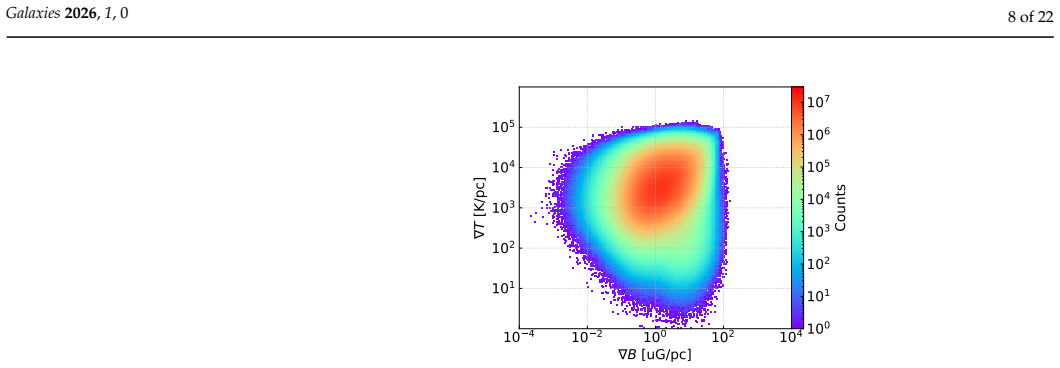
In 3D MHD simulations of a multiphase ISM containing warm neutral medium, unstable neutral medium, and cold neutral medium, 1.5-15 PeV test particles experience enhanced cross-field transport at thermal phase interfaces due to magnetic-field gradients and localized fluctuations. Because particles reside primarily in the trans-Alfvénic WNM and UNM, global parallel and perpendicular diffusion coefficients both reach approximately 10^30 cm² s⁻¹ at 1.5 PeV, with the perpendicular value exceeding the isothermal case by two orders of magnitude. A phase-phase diffusion matrix decomposition shows that transport is governed by stochastic field-line wandering in the volume-filling phases, with all off
What carries the argument
Phase-phase diffusion matrix decomposition that isolates transport contributions and cross-phase displacement correlations from each thermal component.
If this is right
- Global CR transport follows the stochastic wandering of field lines in the volume-filling WNM and UNM rather than being set by the cold phase.
- Cross-phase displacement correlations remain positive, so transport between thermal phases is cooperative.
- The super-Alfvénic CNM locally confines particles and suppresses diffusion within cold clouds.
- Perpendicular diffusion coefficients reach 10^30 cm² s⁻¹ while the global pitch-angle scattering rate stays lower than in an equivalent isothermal medium.
Where Pith is reading between the lines
- The elevated perpendicular transport could allow PeV particles to sample a larger fraction of the Galactic volume before interacting or escaping.
- Gamma-ray emission maps from different ISM phases may display less contrast than trapping in cold gas alone would predict.
- Similar phase-dependent transport may operate at lower energies once self-consistent CR feedback is included in the simulations.
Load-bearing premise
The test-particle approximation in MHD-generated turbulence accurately reproduces the magnetic-field geometry and fluctuation spectrum that real PeV particles would encounter.
What would settle it
A measured perpendicular diffusion coefficient for Galactic PeV particles substantially below 10^30 cm² s⁻¹, for instance from the spatial extent of gamma-ray halos around identified PeVatrons or from anisotropy patterns in arrival directions.
Figures




read the original abstract
Galactic cosmic rays (CRs) are a fundamental non-thermal component of the interstellar medium (ISM). Understanding the transport of super-high-energy particles is essential for interpreting observations of Galactic PeVatrons. Classical diffusion models assuming a homogeneous and isothermal medium oversimplify the multiphase ISM. We utilize high-resolution 3D MHD simulations to self-consistently generate a multiphase ISM, comprising the warm (WNM), unstable (UNM), and cold neutral medium (CNM), and investigate 1.5-15 PeV particle transport using a test-particle approach. We find that thermal phase transitions induce steep magnetic field strength gradients at phase boundaries, creating localized magnetic fluctuations that act as efficient sites for adiabatic mirror reflections and non-adiabatic pitch-angle scattering, strongly enhancing cross-field transport at these interfaces. However, because phase boundaries occupy only a small volume fraction and particles spend most of their trajectory in the weakly scattering WNM and UNM, the global pitch-angle scattering coefficient in the multiphase ISM is smaller than in an equivalent isothermal medium. This locally strong scattering nevertheless drives both parallel and perpendicular spatial diffusion coefficients to $\sim10^{30} {\rm cm^2 s^{-1}$ at 1.5~PeV, with the perpendicular component exceeding its isothermal counterpart ($\sim 10^{28}{\rm cm^2 s^{-1}$) by two orders of magnitude. Using a phase--phase diffusion matrix decomposition, we show that global CR transport is governed by the volume-filling, trans-Alfv\'enic WNM and UNM, where particles stream along stochastically wandering field lines. Cross-phase displacement correlations are universally positive, indicating cooperative transport between thermal phases. In contrast, the super-Alfv\'enic CNM acts as an efficient confinement that substantially suppresses local diffusion.
Editorial analysis
A structured set of objections, weighed in public.
Referee Report
Summary. The paper uses high-resolution 3D MHD simulations to self-consistently generate a multiphase ISM (WNM, UNM, CNM) and a test-particle approach to track 1.5-15 PeV cosmic rays. It reports that global CR transport is dominated by the volume-filling trans-Alfvénic WNM and UNM, where particles stream along stochastically wandering field lines with universally positive cross-phase displacement correlations; the super-Alfvénic CNM confines particles and suppresses local diffusion. Phase boundaries induce localized scattering that enhances perpendicular diffusion by two orders of magnitude relative to isothermal media, yielding D ~ 10^30 cm^2 s^{-1} at 1.5 PeV, while the global pitch-angle scattering coefficient is smaller than in equivalent isothermal runs.
Significance. If robust, the results offer a physically grounded alternative to homogeneous diffusion models for PeV CRs, with direct implications for interpreting Galactic PeVatron observations and for CR propagation codes that incorporate multiphase structure. The phase-phase diffusion matrix decomposition and the finding of cooperative transport between thermal phases constitute a concrete, falsifiable framework that could be tested against gamma-ray or neutrino data.
major comments (2)
- [Abstract] Abstract: the reported diffusion coefficients (~10^30 cm^2 s^{-1} at 1.5 PeV, perpendicular component two orders of magnitude above the isothermal value) are presented without error bars, resolution studies, or convergence tests. Because PeV particles have Larmor radii ~0.1-1 pc, it is essential to demonstrate that these values and the conclusion that WNM/UNM govern global transport remain unchanged when grid scale or box size is varied.
- [Abstract] Abstract (test-particle section): the central claim that global transport is controlled by volume-filling trans-Alfvénic WNM/UNM with positive cross-phase correlations rests on the assumption that the MHD grid fully captures the magnetic geometry and fluctuation spectrum experienced by 1.5-15 PeV particles. Unresolved sub-grid power or current-sheet structure at thermal interfaces could alter the parallel scattering rate and the perpendicular enhancement; a quantitative test of this assumption (e.g., varying numerical diffusivity or adding sub-grid scattering) is required to confirm that the CNM-confinement and WNM/UNM-dominance results are not numerical artifacts.
minor comments (1)
- [Abstract] The abstract would be clearer if it stated the simulation resolution, box size, and number of test particles used to obtain the quoted diffusion coefficients.
Simulated Author's Rebuttal
We thank the referee for the constructive and detailed report. The two major comments correctly identify the need for explicit numerical validation of our diffusion results and transport conclusions. We address each point below and will revise the manuscript to include the requested tests.
read point-by-point responses
-
Referee: [Abstract] Abstract: the reported diffusion coefficients (~10^30 cm^2 s^{-1} at 1.5 PeV, perpendicular component two orders of magnitude above the isothermal value) are presented without error bars, resolution studies, or convergence tests. Because PeV particles have Larmor radii ~0.1-1 pc, it is essential to demonstrate that these values and the conclusion that WNM/UNM govern global transport remain unchanged when grid scale or box size is varied.
Authors: We agree that the absence of explicit resolution studies and error bars is a limitation in the current version. Our simulations were performed at a grid scale chosen to resolve the Larmor radii of 1.5-15 PeV particles, but we did not present systematic comparisons. In the revised manuscript we will add a new subsection with resolution and box-size convergence tests, ensemble-based error bars on the diffusion coefficients, and explicit verification that the WNM/UNM dominance and D ~ 10^30 cm^2 s^{-1} values are unchanged under refinement. revision: yes
-
Referee: [Abstract] Abstract (test-particle section): the central claim that global transport is controlled by volume-filling trans-Alfvénic WNM/UNM with positive cross-phase correlations rests on the assumption that the MHD grid fully captures the magnetic geometry and fluctuation spectrum experienced by 1.5-15 PeV particles. Unresolved sub-grid power or current-sheet structure at thermal interfaces could alter the parallel scattering rate and the perpendicular enhancement; a quantitative test of this assumption (e.g., varying numerical diffusivity or adding sub-grid scattering) is required to confirm that the CNM-confinement and WNM/UNM-dominance results are not numerical artifacts.
Authors: This concern is well-founded. While our grid resolves the dominant magnetic gradients at phase boundaries, sub-grid effects could in principle modify scattering rates. We will add quantitative tests in the revision: (i) runs with deliberately increased numerical diffusivity and (ii) test-particle integrations that include an explicit sub-grid pitch-angle scattering term at unresolved scales. These will be used to show that the CNM confinement, positive cross-phase correlations, and overall WNM/UNM control of global transport persist, thereby confirming the results are not artifacts. revision: yes
Circularity Check
No circularity: results are direct numerical outputs from MHD+test-particle runs
full rationale
The paper's central claims (global transport governed by volume-filling trans-Alfvénic WNM/UNM, positive cross-phase correlations, CNM confinement, diffusion coefficients ~10^30 cm² s⁻¹) are obtained by computing statistical moments of particle trajectories integrated in self-consistently generated 3D MHD fields. No parameter is fitted to a target observable and then re-used as a 'prediction'; no equation reduces to its own input by definition; no load-bearing uniqueness theorem or ansatz is imported via self-citation. The derivation chain is therefore self-contained against external benchmarks.
Axiom & Free-Parameter Ledger
axioms (2)
- standard math Ideal MHD equations govern the evolution of the multiphase ISM
- domain assumption Test particles do not back-react on the magnetic field
Lean theorems connected to this paper
-
IndisputableMonolith/Foundation/AlexanderDuality.leanalexander_duality_circle_linking unclear?
unclearRelation between the paper passage and the cited Recognition theorem.
We utilize high-resolution 3D MHD simulations... test-particle approach... phase–phase diffusion matrix decomposition
-
IndisputableMonolith/Cost/FunctionalEquation.leanwashburn_uniqueness_aczel unclear?
unclearRelation between the paper passage and the cited Recognition theorem.
global pitch-angle scattering coefficient... D∥ and D⊥
What do these tags mean?
- matches
- The paper's claim is directly supported by a theorem in the formal canon.
- supports
- The theorem supports part of the paper's argument, but the paper may add assumptions or extra steps.
- extends
- The paper goes beyond the formal theorem; the theorem is a base layer rather than the whole result.
- uses
- The paper appears to rely on the theorem as machinery.
- contradicts
- The paper's claim conflicts with a theorem or certificate in the canon.
- unclear
- Pith found a possible connection, but the passage is too broad, indirect, or ambiguous to say the theorem truly supports the claim.
Reference graph
Works this paper leans on
-
[1]
Strong, A.W.; Moskalenko, I.V .; Ptuskin, V .S. Cosmic-Ray Propagation and Interactions in the Galaxy.Annual Review of Nuclear and Particle Science2007,57, 285–327, [arXiv:astro-ph/astro-ph/0701517]. https://doi.org/10.1146/annurev.nucl.57.090506.123011
-
[2]
Everett, J.E.; Zweibel, E.G.; Benjamin, R.A.; McCammon, D.; Rocks, L.; Gallagher, III, J.S. The Milky Way’s Kiloparsec- Scale Wind: A Hybrid Cosmic-Ray and Thermally Driven Outflow.ApJ2008,674, 258–270, [arXiv:astro-ph/0710.3712]. https://doi.org/10.1086/524766
-
[3]
Cosmic ray feedback in hydrodynamical simulations of galaxy formation
Jubelgas, M.; Springel, V .; Enßlin, T.; Pfrommer, C. Cosmic ray feedback in hydrodynamical simulations of galaxy formation. A&A2008,481, 33–63, [arXiv:astro-ph/astro-ph/0603485]. https://doi.org/10.1051/0004-6361:20065295
-
[4]
Van Rossum, G.; Drake, F.L.Python 3 Reference Manual; CreateSpace: Scotts Valley, CA, 2009
2009
-
[5]
VERITAS Collaboration.; Acciari, V .A.; Aliu, E.; Arlen, T.; Aune, T.; Bautista, M.; Beilicke, M.; Benbow, W.; Boltuch, D.; Bradbury, S.M.; et al. A connection between star formation activity and cosmic rays in the starburst galaxy M82.NATURE2009,462, 770–772, [arXiv:astro-ph.CO/0911.0873]. https://doi.org/10.1038/nature08557
-
[6]
Girichidis, P .; Naab, T.; Walch, S.; Hanasz, M.; Mac Low, M.M.; Ostriker, J.P .; Gatto, A.; Peters, T.; Wünsch, R.; Glover, S.C.O.; et al. Launching Cosmic-Ray-driven Outflows from the Magnetized Interstellar Medium.ApJL2016,816, L19, [arXiv:astro- ph.GA/1509.07247]. https://doi.org/10.3847/2041-8205/816/2/L19
-
[7]
Ruszkowski, M.; Yang, H.Y.K.; Zweibel, E. Global Simulations of Galactic Winds Including Cosmic-ray Streaming.ApJ2017, 834, 208, [arXiv:astro-ph.GA/1602.04856]. https://doi.org/10.3847/1538-4357/834/2/208
-
[8]
The origin of the formalism intrinsic degeneracies and their influence on H 0
Hopkins, P .F.; Chan, T.K.; Ji, S.; Hummels, C.B.; Kereš, D.; Quataert, E.; Faucher-Giguère, C.A. Cosmic ray driven outflows to Mpc scales from L∗ galaxies.MNRAS2021,501, 3640–3662, [arXiv:astro-ph.GA/2002.02462]. https://doi.org/10.1093/mnras/ staa3690
-
[9]
Liu, M.; Hu, Y.; Lazarian, A. Velocity gradients: magnetic field tomography towards the supernova remnant W44.MNRAS2022, 510, 4952–4961, [arXiv:astro-ph.GA/2109.13670]. https://doi.org/10.1093/mnras/stab3783
-
[10]
Krumholz, M.R.; Crocker, R.M.; Offner, S.S.R. The cosmic ray ionization and γ-ray budgets of star-forming galaxies.MNRAS 2023,520, 5126–5143, [arXiv:astro-ph.GA/2211.03488]. https://doi.org/10.1093/mnras/stad459. https://doi.org/10.3390/galaxies1010000 Galaxies2026,1, 0 20 of 22
-
[11]
Hopkins, P .F.; Quataert, E.; Ponnada, S.B.; Silich, E. Cosmic Rays Masquerading as Hot CGM Gas: An Inverse-Compton Origin for Diffuse X-ray Emission in the Circumgalactic Medium.arXiv e-prints2025, p. arXiv:2501.18696, [arXiv:astro-ph.HE/2501.18696]. https://doi.org/10.48550/arXiv.2501.18696
-
[12]
Gaisser, T.K.Cosmic rays and particle physics.; 1990
1990
-
[13]
Gaisser, T.K.; Stanev, T.; Tilav, S. Cosmic ray energy spectrum from measurements of air showers.Frontiers of Physics2013, 8, 748–758, [arXiv:astro-ph.HE/1303.3565]. https://doi.org/10.1007/s11467-013-0319-7
-
[14]
Extended gamma-ray sources around pulsars constrain the origin of the positron flux at Earth
Abeysekara, A.U.; Albert, A.; Alfaro, R.; Alvarez, C.; Álvarez, J.D.; Arceo, R.; Arteaga-Velázquez, J.C.; Avila Rojas, D.; Ayala Solares, H.A.; Barber, A.S.; et al. Extended gamma-ray sources around pulsars constrain the origin of the positron flux at Earth. Science2017,358, 911–914, [arXiv:astro-ph.HE/1711.06223]. https://doi.org/10.1126/science.aan4880
-
[15]
Cao, Z.; Aharonian, F.; Axikegu.; Bai, Y.X.; Bao, Y.W.; Bastieri, D.; Bi, X.J.; Bi, Y.J.; Bian, W.; Bukevich, A.V .; et al. Measurements of All-Particle Energy Spectrum and Mean Logarithmic Mass of Cosmic Rays from 0.3 to 30 PeV with LHAASO-KM2A.PRL2024, 132, 131002, [arXiv:astro-ph.HE/2403.10010]. https://doi.org/10.1103/PhysRevLett.132.131002
-
[16]
The origin of galactic cosmic rays.AAPR2013,21, 70, [arXiv:astro-ph.HE/1311.7346]
Blasi, P . The origin of galactic cosmic rays.AAPR2013,21, 70, [arXiv:astro-ph.HE/1311.7346]. https://doi.org/10.1007/s00159-0 13-0070-7
-
[17]
International Journal of Modern Physics D , keywords =
Gabici, S.; Evoli, C.; Gaggero, D.; Lipari, P .; Mertsch, P .; Orlando, E.; Strong, A.; Vittino, A. The origin of Galactic cosmic rays: Challenges to the standard paradigm.International Journal of Modern Physics D2019,28, 1930022–339, [arXiv:astro- ph.HE/1903.11584]. https://doi.org/10.1142/S0218271819300222
-
[18]
Cosmic rays escape from their sources.Frontiers in Astronomy and Space Sciences2025,11, 1411076
Marcowith, A. Cosmic rays escape from their sources.Frontiers in Astronomy and Space Sciences2025,11, 1411076. https: //doi.org/10.3389/fspas.2024.1411076
-
[19]
Di Mauro, M.; Manconi, S.; Donato, F. Detection of a γ -ray halo around Geminga with the Fermi-LAT data and implications for the positron flux.PRD2019,100, 123015, [arXiv:astro-ph.HE/1903.05647]. https://doi.org/10.1103/PhysRevD.100.123015
-
[20]
Cao, Z.; Aharonian, F.A.; An, Q.; Axikegu, L. X., B.; Bai, Y.X.; Bao, Y.W.; Bastieri, D.; Bi, X.J.; Bi, Y.J.; Cai, H.; et al. Ultrahigh-energy photons up to 1.4 petaelectronvolts from 12 γ-ray Galactic sources.NATURE2021,594, 33–36. https://doi.org/10.1038/s41586-0 21-03498-z
-
[21]
Lhaaso Collaboration.; Cao, Z.; Aharonian, F.; An, Q.; Axikegu.; Bai, L.X.; Bai, Y.X.; Bao, Y.W.; Bastieri, D.; Bi, X.J.; et al. Peta-electron volt gamma-ray emission from the Crab Nebula.Science2021,373, 425–430, [arXiv:astro-ph.HE/2111.06545]. https://doi.org/10.1126/science.abg5137
-
[22]
Cosmic-Ray Propagation
Jokipii, J.R. Cosmic-Ray Propagation. I. Charged Particles in a Random Magnetic Field.ApJ1966,146, 480. https://doi.org/10.1 086/148912
-
[23]
Jokipii, J.R.; Parker, E.N. Stochastic Aspects of Magnetic Lines of Force with Application to Cosmic-Ray Propagation.ApJ1969, 155, 777. https://doi.org/10.1086/149909
-
[24]
Yan, H.; Lazarian, A. Scattering of Cosmic Rays by Magnetohydrodynamic Interstellar Turbulence.PRL2002,89, 281102, [arXiv:astro-ph/astro-ph/0205285]. https://doi.org/10.1103/PhysRevLett.89.281102
-
[25]
Qin, G.; Matthaeus, W.H.; Bieber, J.W. Perpendicular Transport of Charged Particles in Composite Model Turbulence: Recovery of Diffusion.ApJL2002,578, L117–L120. https://doi.org/10.1086/344687
-
[26]
Yan, H.; Lazarian, A. Cosmic-Ray Propagation: Nonlinear Diffusion Parallel and Perpendicular to Mean Magnetic Field.ApJ 2008,673, 942–953, [arXiv:astro-ph/0710.2617]. https://doi.org/10.1086/524771
-
[27]
Lazarian, A.; Xu, S. Diffusion of Cosmic Rays in MHD Turbulence with Magnetic Mirrors.ApJ2021,923, 53, [arXiv:astro- ph.HE/2106.08362]. https://doi.org/10.3847/1538-4357/ac2de9
-
[28]
Kempski, P .; Fielding, D.B.; Quataert, E.; Galishnikova, A.K.; Kunz, M.W.; Philippov, A.A.; Ripperda, B. Cosmic ray transport in large-amplitude turbulence with small-scale field reversals.MNRAS2023,525, 4985–4998, [arXiv:astro-ph.HE/2304.12335]. https://doi.org/10.1093/mnras/stad2609
-
[29]
Lemoine, M. Particle transport through localized interactions with sharp magnetic field bends in MHD turbulence.Journal of Plasma Physics2023,89, 175890501, [arXiv:physics.plasm-ph/2304.03023]. https://doi.org/10.1017/S0022377823000946
-
[30]
Cosmic-ray transport in inhomogeneous media.MNRAS2026,545, staf2108, [arXiv:astro-ph.HE/2507.19044]
Ewart, R.J.; Reichherzer, P .; Ren, S.; Majeski, S.; Mori, F.; Nastac, M.L.; Bott, A.F.A.; Kunz, M.W.; Schekochihin, A.A. Cosmic-ray transport in inhomogeneous media.MNRAS2026,545, staf2108, [arXiv:astro-ph.HE/2507.19044]. https://doi.org/10.1093/ mnras/staf2108
-
[31]
Xu, S.; Yan, H. Cosmic-Ray Parallel and Perpendicular Transport in Turbulent Magnetic Fields.ApJ2013,779, 140, [arXiv:astro- ph.HE/1307.1346]. https://doi.org/10.1088/0004-637X/779/2/140
-
[32]
Hu, Y.; Lazarian, A.; Xu, S. Superdiffusion of cosmic rays in compressible magnetized turbulence.MNRAS2022,512, 2111–2124, [arXiv:astro-ph.GA/2111.15066]. https://doi.org/10.1093/mnras/stac319
-
[33]
Lazarian, A.; Xu, S.; Hu, Y. Cosmic ray propagation in turbulent magnetic fields.Frontiers in Astronomy and Space Sciences2023, 10, 1154760, [arXiv:astro-ph.GA/2304.02684]. https://doi.org/10.3389/fspas.2023.1154760. https://doi.org/10.3390/galaxies1010000 Galaxies2026,1, 0 21 of 22
-
[34]
Hu, Y.; Xu, S.; Lazarian, A.; Stone, J.M.; Hopkins, P .F. Cosmic-ray Perpendicular Superdiffusion and Parallel Mirror Diffusion in a Partially Ionized and Turbulent Medium.ApJ2025,994, 142, [arXiv:astro-ph.GA/2505.07421]. https://doi.org/10.3847/1538-435 7/ae1127
-
[35]
Cosmic-ray propagation in the bi-stable interstellar medium
Commerçon, B.; Marcowith, A.; Dubois, Y. Cosmic-ray propagation in the bi-stable interstellar medium. I. Conditions for cosmic-ray trapping.A&A2019,622, A143, [arXiv:astro-ph.GA/1811.11509]. https://doi.org/10.1051/0004-6361/201833809
-
[36]
Habegger, R.; Ho, K.W.; Yuen, K.H.; Zweibel, E.G. Cosmic-Ray Feedback on Bistable Interstellar Medium Turbulence.ApJ2024, 974, 17, [arXiv:astro-ph.HE/2403.07976]. https://doi.org/10.3847/1538-4357/ad67da
-
[37]
Giacinti, G.; Kachelrieß, M.; Semikoz, D.V .; Sigl, G. Cosmic ray anisotropy as signature for the transition from galactic to extragalactic cosmic rays.JCAP2012,2012, 031, [arXiv:astro-ph.HE/1112.5599]. https://doi.org/10.1088/1475-7516/2012/07/03 1
-
[38]
Snodin, A.P .; Shukurov, A.; Sarson, G.R.; Bushby, P .J.; Rodrigues, L.F.S. Global diffusion of cosmic rays in random magnetic fields.MNRAS2016,457, 3975–3987, [arXiv:astro-ph.HE/1509.03766]. https://doi.org/10.1093/mnras/stw217
-
[39]
Diffusion of Relativistic Charged Particles and Field Lines in Isotropic Turbulence
Kuhlen, M.; Mertsch, P .; Phan, V .H.M. Diffusion of Relativistic Charged Particles and Field Lines in Isotropic Turbulence. I. Numerical Simulations.ApJ2025,992, 10, [arXiv:astro-ph.HE/2211.05881]. https://doi.org/10.3847/1538-4357/adee9a
-
[40]
Stanimirovic, S.; Staveley-Smith, L.; Dickey, J.M.; Sault, R.J.; Snowden, S.L. The large-scale HI structure of the Small Magellanic Cloud.MNRAS1999,302, 417–436. https://doi.org/10.1046/j.1365-8711.1999.02013.x
-
[41]
Vázquez-Semadeni, E.; Gazol, A.; Scalo, J. Is Thermal Instability Significant in Turbulent Galactic Gas?ApJ2000,540, 271–285, [arXiv:astro-ph/astro-ph/0001027]. https://doi.org/10.1086/309318
-
[42]
Wolfire, M.G.; McKee, C.F.; Hollenbach, D.; Tielens, A.G.G.M. Neutral Atomic Phases of the Interstellar Medium in the Galaxy. ApJ2003,587, 278–311, [arXiv:astro-ph/astro-ph/0207098]. https://doi.org/10.1086/368016
-
[43]
The Hi Distribution of the Milky Way.ARAA2009,47, 27–61
Kalberla, P .M.W.; Kerp, J. The Hi Distribution of the Milky Way.ARAA2009,47, 27–61. https://doi.org/10.1146/annurev-astro- 082708-101823
-
[44]
Draine, B.T.Physics of the Interstellar and Intergalactic Medium; 2011
2011
-
[45]
Boulanger, F.; Enßlin, T.; Fletcher, A.; Girichides, P .; Hackstein, S.; Haverkorn, M.; Hörandel, J.R.; Jaffe, T.; Jasche, J.; Kachelrieß, M.; et al. IMAGINE: a comprehensive view of the interstellar medium, Galactic magnetic fields and cosmic rays.JCAP2018, 2018, 049, [arXiv:astro-ph.GA/1805.02496]. https://doi.org/10.1088/1475-7516/2018/08/049
-
[46]
Hu, Y.; Yuen, K.H.; Lazarian, V .; Ho, K.W.; Benjamin, R.A.; Hill, A.S.; Lockman, F.J.; Goldsmith, P .F.; Lazarian, A. Magnetic field morphology in interstellar clouds with the velocity gradient technique.Nature Astronomy2019,3, 776–782, [arXiv:astro- ph.GA/2002.09948]. https://doi.org/10.1038/s41550-019-0769-0
-
[47]
Ho, K.W.; Yuen, K.H.; Lazarian, A. The stable “Unstable Natural Media” due to the presence of turbulence.arXiv e-prints2024, p. arXiv:2407.14199, [arXiv:astro-ph.GA/2407.14199]. https://doi.org/10.48550/arXiv.2407.14199
-
[48]
Hu, Y. Origin of the Multiphase Interstellar Medium: The Effects of Turbulence and Magnetic Field.ApJ2025,986, 62, [arXiv:astro-ph.GA/2505.07423]. https://doi.org/10.3847/1538-4357/add731
-
[49]
Interstellar Flow and Star Formation2025
Vázquez-Semadeni, E. Interstellar Flow and Star Formation2025
-
[50]
Hu, Y.; Truong, B.; Hoang, T.; Tram, L.N. Galactic Dust Polarization in Turbulent Multiphase ISM: On the Origin of theEE/BB Asymmetry.arXiv e-prints2026, p. arXiv:2601.17255, [arXiv:astro-ph.GA/2601.17255]. https://doi.org/10.48550/arXiv.2601.172 55
-
[51]
Effective cosmic ray diffusion in multiphase galactic environments.arXiv e-prints2025, p
Thomas, T.; Pfrommer, C.; Pakmor, R.; Lemmerz, R.; Shalaby, M. Effective cosmic ray diffusion in multiphase galactic environments.arXiv e-prints2025, p. arXiv:2510.16125, [arXiv:astro-ph.GA/2510.16125]. https://doi.org/10.48550/arXiv.2510.1 6125
-
[52]
Stone, J.M.; Mullen, P .D.; Fielding, D.; Grete, P .; Guo, M.; Kempski, P .; Most, E.R.; White, C.J.; Wong, G.N. AthenaK: A Performance- Portable Version of the Athena++ AMR Framework.arXiv e-prints2024, p. arXiv:2409.16053, [arXiv:astro-ph.IM/2409.16053]. https://doi.org/10.48550/arXiv.2409.16053
-
[53]
Koyama, H.; Inutsuka, S.i. An Origin of Supersonic Motions in Interstellar Clouds.ApJL2002,564, L97–L100, [arXiv:astro- ph/astro-ph/0112420]. https://doi.org/10.1086/338978
-
[54]
Magnetic Fields in Molecular Clouds.ARAA2012,50, 29–63
Crutcher, R.M. Magnetic Fields in Molecular Clouds.ARAA2012,50, 29–63. https://doi.org/10.1146/annurev-astro-081811-125 514
-
[55]
Turbulence and star formation in molecular clouds.MNRAS1981,194, 809–826
Larson, R.B. Turbulence and star formation in molecular clouds.MNRAS1981,194, 809–826. https://doi.org/10.1093/mnras/19 4.4.809
-
[56]
Ha, T.; Li, Y.; Kounkel, M.; Xu, S.; Li, H.; Zheng, Y. Turbulence in Milky Way Star-forming Regions Traced by Young Stars and Gas.ApJ2022,934, 7, [arXiv:astro-ph.GA/2205.00012]. https://doi.org/10.3847/1538-4357/ac76bf
-
[57]
Hu, Y.; Xu, S.; Arzamasskiy, L.; Stone, J.M.; Lazarian, A. Damping of MHD turbulence in a partially ionized medium.MNRAS 2024,527, 3945–3961, [arXiv:astro-ph.GA/2306.10010]. https://doi.org/10.1093/mnras/stad3493
-
[58]
Lazarian, A.; Yan, H. Superdiffusion of Cosmic Rays: Implications for Cosmic Ray Acceleration.ApJ2014,784, 38, [arXiv:astro- ph.HE/1308.3244]. https://doi.org/10.1088/0004-637X/784/1/38. https://doi.org/10.3390/galaxies1010000 Galaxies2026,1, 0 22 of 22
-
[59]
Aartsen, M.G.; Abbasi, R.; Abdou, Y.; Ackermann, M.; Adams, J.; Aguilar, J.A.; Ahlers, M.; Altmann, D.; Andeen, K.; Auffenberg, J.; et al. Observation of Cosmic-Ray Anisotropy with the IceTop Air Shower Array.ApJ2013,765, 55, [arXiv:astro-ph.HE/1210.5278]. https://doi.org/10.1088/0004-637X/765/1/55
-
[60]
Aartsen, M.G.; Abraham, K.; Ackermann, M.; Adams, J.; Aguilar, J.A.; Ahlers, M.; Ahrens, M.; Altmann, D.; Anderson, T.; Ansseau, I.; et al. Anisotropy in Cosmic-Ray Arrival Directions in the Southern Hemisphere Based on Six Years of Data from the IceCube Detector.ApJ2016,826, 220, [arXiv:astro-ph.HE/1603.01227]. https://doi.org/10.3847/0004-637X/826/2/220
-
[61]
Amenomori, M.; Ayabe, S.; Bi, X.J.; Chen, D.; Cui, S.W.; Danzengluobu.; Ding, L.K.; Ding, X.H.; Feng, C.F.; Feng, Z.; et al. Anisotropy and Corotation of Galactic Cosmic Rays.Science2006,314, 439–443, [arXiv:astro-ph/astro-ph/0610671]. https: //doi.org/10.1126/science.1131702
-
[62]
Liu, R.Y.; Yan, H.; Zhang, H. Understanding the Multiwavelength Observation of Geminga’s Tev Halo: The Role of Anisotropic Diffusion of Particles.PRL2019,123, 221103, [arXiv:astro-ph.HE/1904.11536]. https://doi.org/10.1103/PhysRevLett.123.221103
-
[63]
De La Torre Luque, P .; Fornieri, O.; Linden, T. Anisotropic diffusion cannot explain TeV halo observations.PRD2022,106, 123033, [arXiv:astro-ph.HE/2205.08544]. https://doi.org/10.1103/PhysRevD.106.123033
-
[64]
The Effectiveness of Instabilities for the Confinement of High Energy Cosmic Rays in the Galactic Disk.ApJL1971,8, 189
Kulsrud, R.M.; Cesarsky, C.J. The Effectiveness of Instabilities for the Confinement of High Energy Cosmic Rays in the Galactic Disk.ApJL1971,8, 189
-
[65]
Xu, S.; Yan, H.; Lazarian, A. Damping of Magnetohydrodynamic Turbulence in Partially Ionized Plasma: Implications for Cosmic Ray Propagation.ApJ2016,826, 166, [arXiv:astro-ph.HE/1506.05585]. https://doi.org/10.3847/0004-637X/826/2/166
-
[66]
Plotnikov, I.; Ostriker, E.C.; Bai, X.N. Influence of Ion-Neutral Damping on the Cosmic-Ray Streaming Instability: Magnetohydro- dynamic Particle-in-cell Simulations.ApJ2021,914, 3, [arXiv:astro-ph.HE/2102.11878]. https://doi.org/10.3847/1538-4357/abf7 b3
-
[67]
Lazarian, A.; Xu, S. Damping of Alfvén Waves in MHD Turbulence and Implications for Cosmic Ray Streaming Instability and Galactic Winds.Frontiers in Physics2022,10, 702799, [arXiv:astro-ph.GA/2201.05168]. https://doi.org/10.3389/fphy.2022.702799. Disclaimer/Publisher’s Note:The statements, opinions and data contained in all publications are solely those o...
discussion (0)
Sign in with ORCID, Apple, or X to comment. Anyone can read and Pith papers without signing in.