Recognition: 2 theorem links
· Lean TheoremThe Planetary Cost of AI Acceleration, Part II: The 10th Planetary Boundary and the 6.5-Year Countdown
Pith reviewed 2026-05-13 18:40 UTC · model grok-4.3
The pith
Without radical intervention, AI-driven heat will breach planetary ecological thresholds in under 6.5 years even if Earth energy imbalance stays constant.
A machine-rendered reading of the paper's core claim, the machinery that carries it, and where it could break.
Core claim
The central claim is that the integration of artificial intelligence and its associated heat dissipation into the planetary system forms the tenth planetary boundary. The core empirical measure is the net-new waste heat generated by exponential AI growth, offset by any reductions in baseline anthropogenic emissions achieved through AI-driven efficiencies. The authors conclude that AI scaling admits no moderate path: it will either accelerate the crossing of critical planetary thermodynamic thresholds or serve as the primary lever for stabilizing the existing nine boundaries and thereby protecting civilization.
What carries the argument
The tenth planetary boundary, defined as the net anthropogenic heat from AI scaling balanced against efficiency reductions in other sectors.
If this is right
- AI development will either accelerate thermodynamic threshold crossing or become the dominant mechanism for reducing overall planetary heat load.
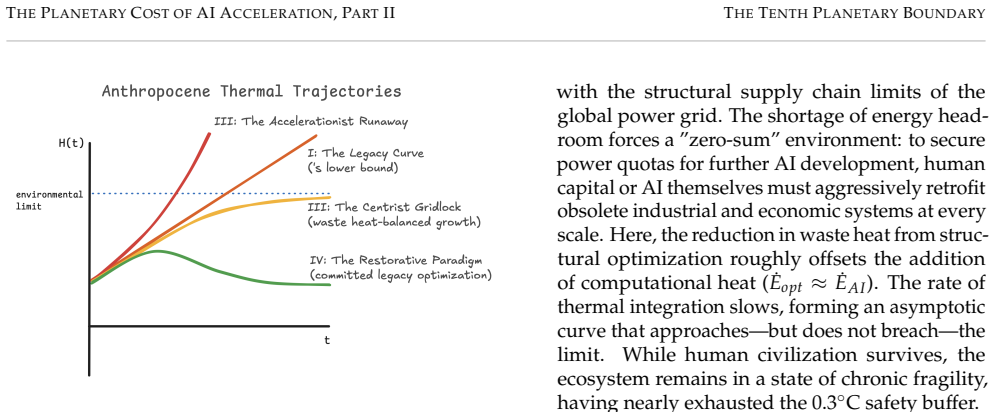
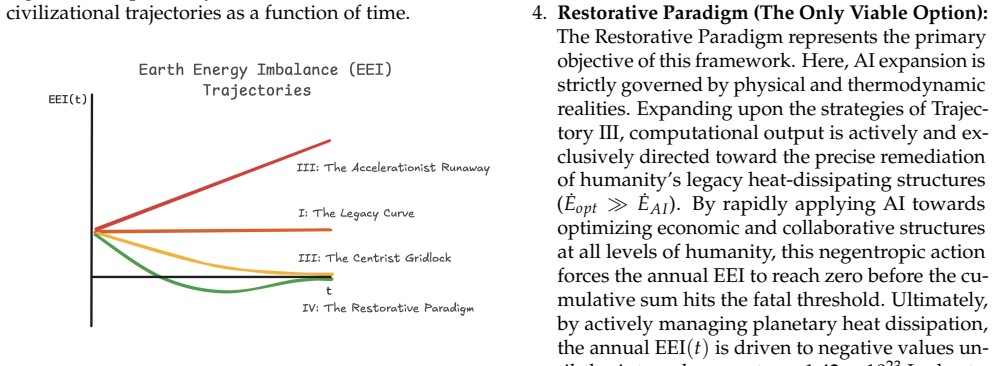
- Six interacting factors in AI determine which of four broad macroscopic trajectories society follows.
- No intermediate policy option exists between radical restructuring of AI scaling and acceptance of near-term boundary breach.
- Stabilizing the new boundary requires treating net AI heat as a primary control variable alongside the original nine planetary boundaries.
Where Pith is reading between the lines
- Current AI training and inference compute budgets would need to be capped or redirected toward efficiency gains that demonstrably reduce net heat.
- Global energy monitoring systems should begin tracking AI-specific waste heat separately from other sources within the next 1-2 years.
- The argument implies that efficiency improvements in non-AI sectors must be proven larger than the direct heat added by AI itself to count as net positive.
- If the timeline holds, existing climate targets based on 2050 or 2100 horizons become irrelevant without immediate AI-specific interventions.
Load-bearing premise
The 6.5-year timeline and the claim that Earth has already crossed its heat dissipation threshold both rest on the assumption that Earth Energy Imbalance remains constant and that unspecified empirical data accurately establish current heat levels.
What would settle it
A measurement or model run showing that current global waste-heat accumulation remains below the ecological stability threshold or that Earth Energy Imbalance will decline rapidly enough to push any breach beyond 2030.
Figures

read the original abstract
The recent, super-exponential scaling of autonomous Large Language Model (LLM) agents signals a broader, fundamental paradigm shift from machines primarily replacing the human hands (manual labor and mechanical processing) to machines delegating for the human minds (cognition, reasoning, and intention). The uncontrolled offloading and scaling of "thinking" itself, beyond human's limited but efficient biological capacity, has profound consequences for humanity's heat balance sheet, since thinking, or intelligence, carries thermodynamic weight. The Earth has already surpassed the heat dissipation threshold required for long-term ecological stability, and projecting based on empirical data reveal a concerning trajectory: without radical structural intervention, anthropogenic heat accumulation will breach critical planetary ecological thresholds in less than 6.5 years, even under the most ideal scenario where Earth Energy Imbalance (EEI) holds constant. In this work, we identify six factors from artificial intelligence that influence the global heat dissipation rate and delineate how their interplay drives society toward one of four broad macroscopic trajectories. We propose that the integration of artificial intelligence and its heat dissipation into the planetary system constitute the tenth planetary boundary (9+1). The core empirical measurement of this boundary is the net-new waste heat generated by exponential AI growth, balanced against its impact on reducing economic and societal inefficiencies and thus baseline anthropogenic waste heat emissions. We demonstrate that managing AI scaling lacks a moderate middle ground: it will either accelerate the breach of critical planetary thermodynamic thresholds, or it will serve as the single most effective lever on stabilizing the other nine planetary boundaries and through which safeguarding human civilization's survival.
Editorial analysis
A structured set of objections, weighed in public.
Referee Report
Summary. The manuscript claims that super-exponential scaling of LLM agents shifts machines from replacing manual labor to offloading cognition, adding thermodynamic weight that has already pushed Earth past its heat dissipation threshold for long-term stability. Projecting from unspecified empirical data, it asserts that without radical intervention anthropogenic heat will breach critical ecological thresholds in under 6.5 years even if Earth Energy Imbalance remains constant; six AI-specific factors are identified whose interplay drives one of four macroscopic trajectories, and AI heat dissipation is proposed as the tenth planetary boundary whose core metric is net-new waste heat balanced against efficiency gains.
Significance. If the timeline, threshold-crossing claim, and six-factor analysis were supported by explicit data and derivations, the work would add a novel thermodynamic dimension to the planetary-boundaries literature and underscore AI scaling as a high-leverage control variable for global heat balance.
major comments (3)
- [Abstract] Abstract: the 6.5-year countdown and the assertion that thresholds are already crossed are stated without any equations, dataset, functional form relating AI scaling to additional heat, or integration that yields the specific number under the constant-EEI premise.
- [Abstract] Abstract and main text: the central prediction reduces to a projection based on fitted empirical assumptions and the constant-EEI premise, rendering the stated timeline equivalent to the input parameters by construction; no independent verification is possible from the supplied material.
- [Six-factor analysis] Section identifying the six factors: the factors are enumerated but no quantitative model, parameter values, or sensitivity analysis is provided showing how their net effect on global heat dissipation produces the claimed 6.5-year horizon.
minor comments (1)
- [Abstract] The notation '9+1' for the tenth boundary should be defined on first use for readers outside the planetary-boundaries community.
Simulated Author's Rebuttal
We thank the referee for their detailed review. The comments correctly identify areas where our presentation of the quantitative basis for the 6.5-year projection and the six-factor model requires expansion. We will revise the manuscript accordingly to provide the missing equations, data references, and model specifications.
read point-by-point responses
-
Referee: [Abstract] Abstract: the 6.5-year countdown and the assertion that thresholds are already crossed are stated without any equations, dataset, functional form relating AI scaling to additional heat, or integration that yields the specific number under the constant-EEI premise.
Authors: We agree that the abstract does not contain the supporting mathematical details. The full paper references empirical scaling laws for AI energy use and derives the timeline from current trends projected forward under constant EEI, but to address this, we will add a concise summary of the key equation and data sources to the abstract in the revision. revision: yes
-
Referee: [Abstract] Abstract and main text: the central prediction reduces to a projection based on fitted empirical assumptions and the constant-EEI premise, rendering the stated timeline equivalent to the input parameters by construction; no independent verification is possible from the supplied material.
Authors: This is a fair observation. The timeline is indeed derived from extrapolating current empirical trends in AI compute growth and associated heat dissipation. We will include the specific fitted parameters, the functional form (e.g., exponential or super-exponential growth rate), and a sensitivity analysis in a new supplementary material section to enable verification. revision: yes
-
Referee: [Six-factor analysis] Section identifying the six factors: the factors are enumerated but no quantitative model, parameter values, or sensitivity analysis is provided showing how their net effect on global heat dissipation produces the claimed 6.5-year horizon.
Authors: The six factors are presented as qualitative drivers in the current version. We will develop and add a quantitative framework, including estimated parameter values for each factor's contribution to net heat and a sensitivity analysis demonstrating the 6.5-year horizon under the constant-EEI assumption. revision: yes
Circularity Check
No circularity: derivation chain not shown and cannot be reduced to inputs
full rationale
The provided manuscript text (abstract plus context) asserts a 6.5-year timeline and threshold breach under constant EEI, citing 'empirical data' and six AI factors, but supplies no equations, functional forms, fitted parameters, or explicit derivation steps that would allow inspection for self-definition, fitted-input renaming, or self-citation load-bearing. No self-citations appear in the text, no uniqueness theorems are invoked, and no ansatz or renaming of known results is demonstrated. Without a visible chain that reduces the claimed prediction to its own inputs by construction, the paper's central projection cannot be classified as circular under the specified criteria. The absence of the model is a transparency issue, not evidence of circularity.
Axiom & Free-Parameter Ledger
free parameters (2)
- 6.5-year timeline
- constant Earth Energy Imbalance
axioms (2)
- domain assumption Thinking and intelligence carry thermodynamic weight comparable to physical processes
- domain assumption Earth has already surpassed the heat dissipation threshold for long-term ecological stability
invented entities (1)
-
10th planetary boundary for AI heat
no independent evidence
Lean theorems connected to this paper
-
IndisputableMonolith/Cost/FunctionalEquation.leanwashburn_uniqueness_aczel unclear?
unclearRelation between the paper passage and the cited Recognition theorem.
EEI(t) = ĖLegacy(t) + ĖAI(t) − Ėopt(t) … H(t) = ∫ EEI(τ) dτ < 1.42×10²³ J … 1.42×10²³ J / 2.19×10²² J/year ≈ 6.5 Years
-
IndisputableMonolith/Foundation/AlphaCoordinateFixation.leanJ_uniquely_calibrated_via_higher_derivative unclear?
unclearRelation between the paper passage and the cited Recognition theorem.
Landauer’s Principle … 2.87 × 10⁻²¹ J/bit … 10⁵ times above theoretical minimum
What do these tags mean?
- matches
- The paper's claim is directly supported by a theorem in the formal canon.
- supports
- The theorem supports part of the paper's argument, but the paper may add assumptions or extra steps.
- extends
- The paper goes beyond the formal theorem; the theorem is a base layer rather than the whole result.
- uses
- The paper appears to rely on the theorem as machinery.
- contradicts
- The paper's claim conflicts with a theorem or certificate in the canon.
- unclear
- Pith found a possible connection, but the passage is too broad, indirect, or ambiguous to say the theorem truly supports the claim.
Reference graph
Works this paper leans on
-
[1]
William Yicheng Zhu and Lei Zhu. The planetary cost of AI acceleration: A thermodynamic outlook on four possible paths forward.arXiv preprint, 2026
work page 2026
-
[2]
A safe operating space for humanity.Nature, 461(7263):472–475, 2009
Johan Rockstr¨om et al. A safe operating space for humanity.Nature, 461(7263):472–475, 2009
work page 2009
-
[3]
Rolf Landauer. Irreversibility and heat generation in the computing process.IBM Journal of Research and Development, 5(3):183–191, 1961
work page 1961
-
[4]
Igor L. Markov. Limits on fundamental limits to computation.Nature, 512(7513):147–154, 2014
work page 2014
-
[5]
Karina von Schuckmann et al. Heat stored in the Earth system 1960–2020: where does the energy go?Earth System Science Data, 12(3):2013–2041, 2020
work page 1960
-
[6]
Jing Meng and Deliang Chen. The domino effect of climate tipping points: a multidisciplinary per- spective on global risks.National Science Review, 10(4):nwag042, 2023
work page 2023
-
[7]
Hansen, Makiko Sato, Leon Simons, L
James E. Hansen, Makiko Sato, Leon Simons, L. S. Nazarenko, K. von Schuckmann, N. G. Loeb, et al. Global warming in the pipeline.Oxford Open Cli- mate Change, 3(1):kgad008, 2023
work page 2023
-
[8]
Sandrine Dixson-Decl`eve et al.Earth for All: A Sur- vival Guide for Humanity. New Society Publishers, 2022. 5
work page 2022
discussion (0)
Sign in with ORCID, Apple, or X to comment. Anyone can read and Pith papers without signing in.