Recognition: unknown
Double Neutron Star Delay Times Across Cosmic Metallicities: The Role of Helium Star Progenitors
Pith reviewed 2026-05-08 17:25 UTC · model grok-4.3
The pith
Helium main-sequence radii set a minimum orbital size that pushes most double neutron star mergers to occur 80-250 million years after star formation.
A machine-rendered reading of the paper's core claim, the machinery that carries it, and where it could break.
Core claim
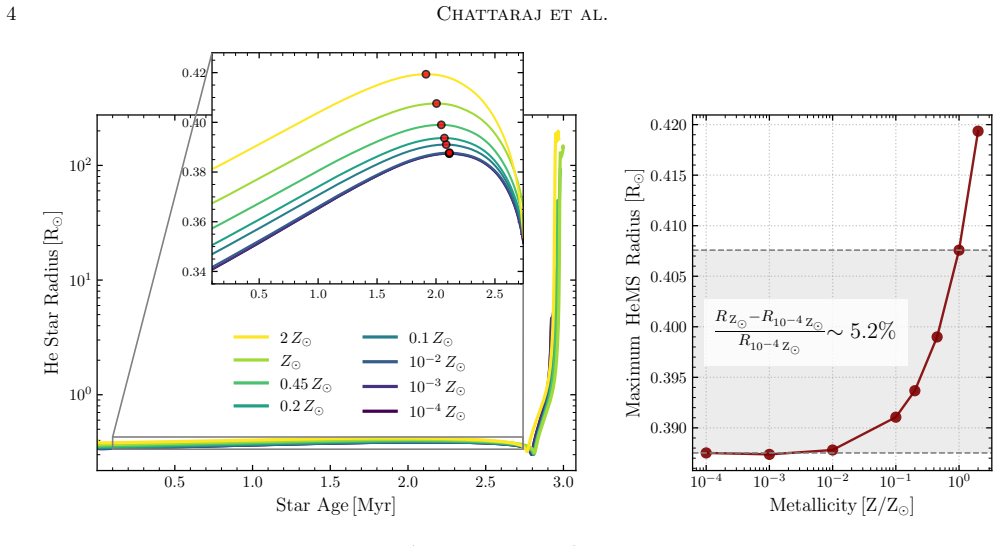
At a given metallicity the stellar radius during the helium main sequence sets a lower limit on the size of the DNS orbit at birth. Population synthesis then shows that the resulting delay time distribution is independent of other binary assumptions, with the majority of mergers occurring no earlier than about 40 Myr after star formation and peaking strongly between 80 and 250 Myr. Roughly 15 percent merge within 80 Myr while at least 20 percent take longer than 1 Gyr, and the distribution can develop a metallicity-dependent double-peaked shape when different formation channels dominate.
What carries the argument
The helium main-sequence radius at each metallicity, which imposes a firm lower bound on the initial orbital separation of the double neutron star binary and therefore on its gravitational-wave merger time.
If this is right
- Roughly 15 percent of mergers within 80 Myr can supply r-process material in galaxies whose star formation lasts only a few tens of millions of years.
- More than 20 percent of mergers after 1 Gyr can produce short gamma-ray bursts inside old, metal-poor galaxies.
- The delay time distribution develops a double-peaked shape at some metallicities because the dominant formation channel shifts with metallicity.
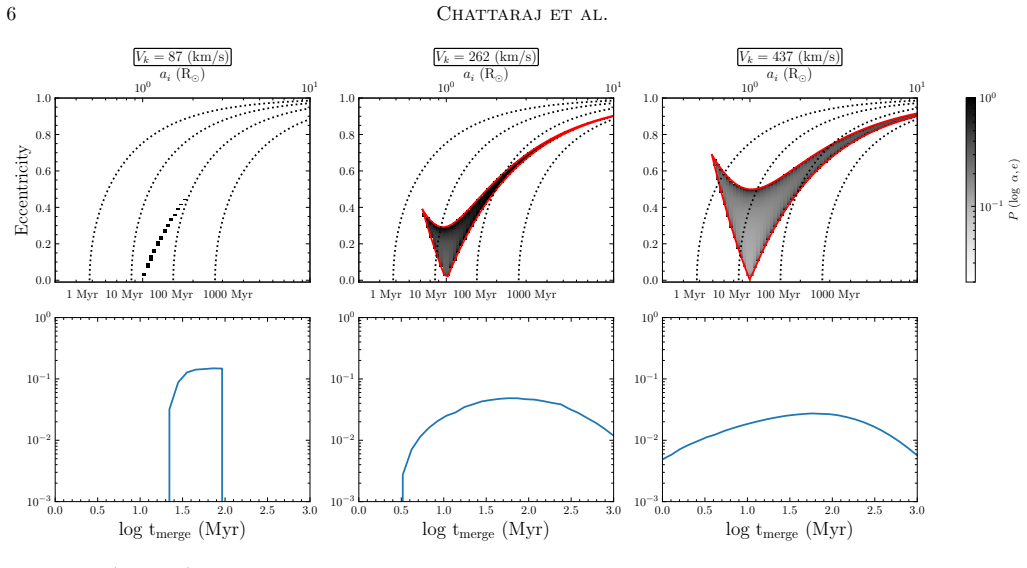
- Natal kicks large enough to produce very short delays require magnitudes and directions that are inconsistent with observed double neutron star systems.
Where Pith is reading between the lines
- The same helium-radius limit could be checked by comparing predicted merger ages against the star-formation histories of host galaxies for known double neutron star systems.
- Very short-delay events would demand kick orientations that are statistically rare, offering a way to test kick models without assuming the radius limit itself.
- The framework may apply to other compact-object binaries in which a helium star phase sets the final separation before the second compact object forms.
Load-bearing premise
The helium star radius on the main sequence supplies a hard lower limit on the initial separation of the two neutron stars at every metallicity.
What would settle it
A statistically significant population of double neutron star mergers with delay times well below 40 million years after star formation, or the absence of any double-peaked structure in the observed delay distribution at varying metallicities.
Figures




read the original abstract
Metallicity can play a significant role in massive binary evolution through its impact on the opacity within stellar interiors and wind-driven mass loss. In this work, we investigate how the double neutron star (DNS) delay time distribution (DTD) is shaped by the metallicity-dependent evolution of the helium star$-$NS progenitor system. Drawing from insights rooted in single and binary star physics, we argue that at a given metallicity, the stellar radius during the helium main-sequence sets a lower limit on the size of the DNS orbit at birth. We then perform population synthesis with the detailed binary evolution code POSYDON to illustrate the resulting DTD across a range of metallicities. Our results indicate that, independent of binary physics assumptions, the majority of DNS mergers across metallicities occur typically no earlier than $\simeq 40\,\rm{Myr}$ after star formation and peaks strongly between $80-250\,\rm{Myr}$. Roughly $15\%$ of DNSs merge within 80 Myr, which may explain $r$-process enrichment in environments with brief star formation histories, while $\gtrsim 20\%$ merge on delay times $>1$Gyr, providing an explanation for short gamma-ray bursts in old, metal-poor galaxies. The shape of the DTD can be complex, with a metallicity-dependent split in the dominant formation channel imprinting a characteristic double-peaked structure. Although ideally oriented natal kicks can produce very short merging DNS, we find that the required kick magnitudes are inconsistent with observations. Our work has implications for assessing the contribution of DNS mergers to $r$-process enrichment and gamma-ray bursts/kilonovae transients across cosmic time.
Editorial analysis
A structured set of objections, weighed in public.
Referee Report
Summary. The manuscript uses population synthesis with the POSYDON binary evolution code to compute delay-time distributions (DTDs) for double neutron star (DNS) mergers across a range of metallicities. Drawing on single- and binary-star radius and Roche-lobe arguments, it posits that the helium main-sequence radius at fixed metallicity imposes a hard lower bound on the pre-second-supernova separation, yielding a minimum merger delay of ≃40 Myr, a strong peak between 80–250 Myr, ~15% of systems merging within 80 Myr, and ≳20% with delays >1 Gyr. The DTD shape is reported to be metallicity-dependent and potentially double-peaked due to shifts in dominant formation channels; the work discusses implications for r-process enrichment and short gamma-ray bursts.
Significance. If the claimed minimum delay and channel independence hold, the results would provide a physically motivated prior for DNS contributions to r-process sites and kilonova transients across cosmic time, particularly in short star-formation bursts and old metal-poor galaxies. The adoption of detailed, metallicity-dependent binary evolution via POSYDON is a clear methodological strength, moving beyond parameterized prescriptions.
major comments (2)
- [Abstract and §3] Abstract and §3 (population synthesis setup): the central claim that the DTD minimum of ≃40 Myr and overall shape are 'independent of binary physics assumptions' is load-bearing yet rests on the assertion that He-MS radius sets a universal lower bound on post-second-SN separation. The manuscript must explicitly demonstrate (via channel-by-channel fractions or an additional run) that common-envelope evolution prior to the helium-star phase contributes negligibly to the short-delay tail; otherwise the independence statement does not follow from the POSYDON grid.
- [§4] §4 (results on DTD): the reported fractions (15% within 80 Myr, ≳20% >1 Gyr) and the double-peaked structure are presented without error bars, convergence tests against initial binary parameter distributions, or sensitivity to natal-kick prescriptions. These omissions directly affect the quantitative statements used to link DNSs to r-process enrichment and GRB hosts.
minor comments (2)
- [Figures] Figure 3 (or equivalent DTD plots): axis labels and legend entries should explicitly state the metallicity grid values and whether the curves are normalized per unit star formation or per DNS formed.
- [§2] §2 (theoretical lower-limit argument): the transition from single-star He-MS radius to binary Roche-lobe constraint is sketched but would benefit from an explicit inequality relating radius, orbital period, and mass ratio at the onset of the second supernova.
Simulated Author's Rebuttal
We thank the referee for their detailed and constructive comments on our manuscript. We have carefully considered each point and provide point-by-point responses below, along with indications of revisions to be made.
read point-by-point responses
-
Referee: [Abstract and §3] the central claim that the DTD minimum of ≃40 Myr and overall shape are 'independent of binary physics assumptions' is load-bearing yet rests on the assertion that He-MS radius sets a universal lower bound on post-second-SN separation. The manuscript must explicitly demonstrate (via channel-by-channel fractions or an additional run) that common-envelope evolution prior to the helium-star phase contributes negligibly to the short-delay tail; otherwise the independence statement does not follow from the POSYDON grid.
Authors: We agree that an explicit demonstration strengthens the independence claim. The physical argument is that the helium main-sequence radius at a given metallicity provides a hard lower limit on the orbital separation immediately prior to the second supernova, independent of prior evolutionary history. Common-envelope evolution before the helium-star phase typically leads to tighter orbits initially, but subsequent evolution and mass transfer adjust the separation such that the helium star's radius still enforces the minimum post-SN separation. To address the referee's request, we have added channel-by-channel fractions in a revised §3, showing that pre-helium CE channels contribute negligibly to the short-delay population (<80 Myr), as these systems often merge or disrupt earlier or result in longer delays. This supports that the DTD shape is robust. revision: yes
-
Referee: [§4] the reported fractions (15% within 80 Myr, ≳20% >1 Gyr) and the double-peaked structure are presented without error bars, convergence tests against initial binary parameter distributions, or sensitivity to natal-kick prescriptions. These omissions directly affect the quantitative statements used to link DNSs to r-process enrichment and GRB hosts.
Authors: We acknowledge these omissions in the original manuscript. In the revised version, we have incorporated error bars on the fractions using bootstrap resampling of the simulated populations to account for statistical uncertainties. We have also added convergence tests by varying the initial mass function, binary mass ratios, and orbital separations within observational ranges, confirming that the reported fractions and double-peaked structure are robust. For natal kicks, we performed additional runs with different kick velocity distributions, showing that the overall DTD features remain consistent. These results are now presented in §4 with a new figure and discussed in the text. revision: yes
Circularity Check
No significant circularity; DTD obtained via forward modeling
full rationale
The central result (DNS DTD shape and minimum delay time) is produced by running the POSYDON population-synthesis code on metallicity-dependent binary tracks. The helium-main-sequence radius argument is introduced as an independent physical lower bound drawn from single/binary stellar structure, not as a fitted parameter or self-referential definition. No load-bearing self-citation chain, ansatz smuggling, or renaming of known results is present in the provided text; the simulation outputs are not forced by construction to match any input data or prior claim.
Axiom & Free-Parameter Ledger
axioms (1)
- domain assumption At a given metallicity, the stellar radius during the helium main-sequence sets a lower limit on the size of the DNS orbit at birth.
Reference graph
Works this paper leans on
-
[1]
2017, PhRvL, 119, 161101, doi: 10.1103/PhysRevLett.119.161101
Abbott, B. P., et al. 2017a, Phys. Rev. Lett., 119, 161101, doi: 10.1103/PhysRevLett.119.161101
-
[2]
Abbott, B. P., et al. 2017b, Astrophys. J. Lett., 848, L12, doi: 10.3847/2041-8213/aa91c9
-
[3]
Abbott, B. P., et al. 2020, Astrophys. J. Lett., 892, L3, doi: 10.3847/2041-8213/ab75f5
-
[4]
2018, MNRAS, 481, 4332, doi: 10.1093/mnras/sty2530
Anand, N., Shahid, M., & Resmi, L. 2018, MNRAS, 481, 4332, doi: 10.1093/mnras/sty2530
-
[5]
Andrews, J. J., & Mandel, I. 2019, ApJL, 880, L8, doi: 10.3847/2041-8213/ab2ed1
-
[6]
Andrews, J. J., & Zezas, A. 2019, MNRAS, 486, 3213, doi: 10.1093/mnras/stz1066 14Chattaraj et al
-
[7]
Andrews, J. J., Bavera, S. S., Briel, M., et al. 2025, ApJS, 281, 3, doi: 10.3847/1538-4365/adfb78 Astropy Collaboration, Robitaille, T. P., Tollerud, E. J., et al. 2013, A&A, 558, A33, doi: 10.1051/0004-6361/201322068 Astropy Collaboration, Price-Whelan, A. M., Sip˝ ocz, B. M., et al. 2018, AJ, 156, 123, doi: 10.3847/1538-3881/aabc4f Astropy Collaboratio...
-
[8]
Bandyopadhyay, A., Ezzeddine, R., Allende Prieto, C., et al. 2024, ApJS, 274, 39, doi: 10.3847/1538-4365/ad6f0f
-
[9]
S., Ramirez-Ruiz, E., & Fryer, C
Behroozi, P. S., Ramirez-Ruiz, E., & Fryer, C. L. 2014, ApJ, 792, 123, doi: 10.1088/0004-637X/792/2/123
-
[10]
Belczynski, K., Kalogera, V., & Bulik, T. 2002, ApJ, 572, 407, doi: 10.1086/340304
-
[11]
2006, ApJ, 648, 1110, doi: 10.1086/505169
Belczynski, K., Perna, R., Bulik, T., et al. 2006, ApJ, 648, 1110, doi: 10.1086/505169
-
[12]
2018a, A&A, 615, A91, doi: 10.1051/0004-6361/201732428
Belczynski, K., Askar, A., Arca-Sedda, M., et al. 2018a, A&A, 615, A91, doi: 10.1051/0004-6361/201732428
-
[13]
2018b, arXiv e-prints, arXiv:1812.10065, doi: 10.48550/arXiv.1812.10065
Belczynski, K., Bulik, T., Olejak, A., et al. 2018b, arXiv e-prints, arXiv:1812.10065, doi: 10.48550/arXiv.1812.10065
-
[14]
2016, ApJL, 829, L13, doi: 10.3847/2041-8205/829/1/L13
Beniamini, P., Hotokezaka, K., & Piran, T. 2016, ApJL, 829, L13, doi: 10.3847/2041-8205/829/1/L13
-
[15]
2016, MNRAS, 456, 4089, doi: 10.1093/mnras/stv2903
Beniamini, P., & Piran, T. 2016, MNRAS, 456, 4089, doi: 10.1093/mnras/stv2903
-
[16]
2019, MNRAS, 487, 4847, doi: 10.1093/mnras/stz1589
Beniamini, P., & Piran, T. 2019, MNRAS, 487, 4847, doi: 10.1093/mnras/stz1589
-
[17]
2024, ApJ, 966, 17, doi: 10.3847/1538-4357/ad32cd
Beniamini, P., & Piran, T. 2024, ApJ, 966, 17, doi: 10.3847/1538-4357/ad32cd
-
[18]
Berger, E., Fox, D. B., Price, P. A., et al. 2007, ApJ, 664, 1000, doi: 10.1086/518762
-
[19]
2019, MNRAS, 490, 296, doi: 10.1093/mnras/stz2554
Bonetti, M., Perego, A., Dotti, M., & Cescutti, G. 2019, MNRAS, 490, 296, doi: 10.1093/mnras/stz2554
-
[20]
S., Berger, E., Stevenson, S., et al
Broekgaarden, F. S., Berger, E., Stevenson, S., et al. 2022, MNRAS, 516, 5737, doi: 10.1093/mnras/stac1677
-
[21]
Cantiello, M., Langer, N., Brott, I., et al. 2009, A&A, 499, 279, doi: 10.1051/0004-6361/200911643
-
[22]
Castor, J. I., Abbott, D. C., & Klein, R. I. 1975, ApJ, 195, 157, doi: 10.1086/153315
-
[23]
2023, MNRAS, 524, 471, doi: 10.1093/mnras/stad1862
Cehula, J., & Pejcha, O. 2023, MNRAS, 524, 471, doi: 10.1093/mnras/stad1862
-
[24]
Chattaraj, A., Andrews, J. J., Bavera, S. S., et al. 2026, ApJ, 997, 52, doi: 10.3847/1538-4357/ae1f93
-
[25]
Chen, H.-Y., Landry, P., Read, J. S., & Siegel, D. M. 2025, ApJ, 985, 154, doi: 10.3847/1538-4357/add0af
-
[26]
2018, MNRAS, 474, 2937, doi: 10.1093/mnras/stx2923
Chruslinska, M., Belczynski, K., Klencki, J., & Benacquista, M. 2018, MNRAS, 474, 2937, doi: 10.1093/mnras/stx2923
-
[27]
2022, MNRAS, 509, 1557, doi: 10.1093/mnras/stab2882 Cˆ ot´ e, B., Eichler, M., Arcones, A., et al
Chu, Q., Yu, S., & Lu, Y. 2022, MNRAS, 509, 1557, doi: 10.1093/mnras/stab2882 Cˆ ot´ e, B., Eichler, M., Arcones, A., et al. 2019, ApJ, 875, 106, doi: 10.3847/1538-4357/ab10db
-
[28]
Cox, A. N., & Tabor, J. E. 1976, ApJS, 31, 271, doi: 10.1086/190383 De Santis, A. L., Ronchini, S., Santoliquido, F., &
-
[29]
2026, arXiv e-prints, arXiv:2602.13391
Branchesi, M. 2026, arXiv e-prints, arXiv:2602.13391, doi: 10.48550/arXiv.2602.13391
-
[30]
J., & Thomas, H
Delgado, A. J., & Thomas, H. C. 1981, A&A, 96, 142
1981
-
[31]
Dewi, J. D. M., & Pols, O. R. 2003, MNRAS, 344, 629, doi: 10.1046/j.1365-8711.2003.06844.x
-
[32]
Heuvel, E. P. J. 2002, MNRAS, 331, 1027, doi: 10.1046/j.1365-8711.2002.05257.x
-
[33]
Disberg, P., Gaspari, N., & Levan, A. J. 2024, A&A, 689, A348, doi: 10.1051/0004-6361/202450790
-
[34]
Disberg, P., & Mandel, I. 2025, arXiv e-prints, arXiv:2505.22102, doi: 10.48550/arXiv.2505.22102
-
[35]
2012, ApJ, 759, 52, doi: 10.1088/0004-637X/759/1/52
Dominik, M., Belczynski, K., Fryer, C., et al. 2012, ApJ, 759, 52, doi: 10.1088/0004-637X/759/1/52
-
[36]
Eggleton, P. P. 1983, ApJ, 268, 368, doi: 10.1086/160960
-
[37]
Fishbach, M., Ji, A. P., Fong, W.-f., et al. 2026, arXiv e-prints, arXiv:2604.05059. https://arxiv.org/abs/2604.05059
work page internal anchor Pith review Pith/arXiv arXiv 2026
-
[38]
P., & van den Heuvel, E
Flannery, B. P., & van den Heuvel, E. P. J. 1975, A&A, 39, 61
1975
-
[39]
2013, ApJ, 769, 56, doi: 10.1088/0004-637X/769/1/56
Fong, W., Berger, E., Chornock, R., et al. 2013, ApJ, 769, 56, doi: 10.1088/0004-637X/769/1/56
-
[40]
Fragos, T., Andrews, J. J., Bavera, S. S., et al. 2023, ApJS, 264, 45, doi: 10.3847/1538-4365/ac90c1
-
[41]
Gallegos-Garcia, M., Berry, C. P. L., & Kalogera, V. 2023, ApJ, 955, 133, doi: 10.3847/1538-4357/ace434 G¨ otberg, Y., de Mink, S. E., & Groh, J. H. 2017, A&A, 608, A11, doi: 10.1051/0004-6361/201730472 G¨ otberg, Y., Drout, M. R., Ji, A. P., et al. 2023, ApJ, 959, 125, doi: 10.3847/1538-4357/ace5a3
-
[42]
2024, MNRAS, 530, 4461, doi: 10.1093/mnras/stae1112
Guo, Y.-L., Wang, B., Chen, W.-C., et al. 2024, MNRAS, 530, 4461, doi: 10.1093/mnras/stae1112
-
[43]
Hansen, T. T., Simon, J. D., Marshall, J. L., et al. 2017, ApJ, 838, 44, doi: 10.3847/1538-4357/aa634a
-
[44]
2013, A&A, 558, A22, doi: 10.1051/0004-6361/201321471
Hao, J.-M., & Yuan, Y.-F. 2013, A&A, 558, A22, doi: 10.1051/0004-6361/201321471
-
[45]
Harris, C. R., Millman, K. J., van der Walt, S. J., et al. 2020, Nature, 585, 357–362, doi: 10.1038/s41586-020-2649-2
-
[46]
Henderson, L. E., Gerasimov, R., & Kirby, E. N. 2025a, ApJL, 992, L14, doi: 10.3847/2041-8213/ae0a4a Double Neutron Star Delay Times Across Metallicities15
-
[47]
2025, ApJ, 983, 117, doi: 10.3847/1538-4357/adbe7d Hern´ andez-Mart´ ınez, L., & Pe˜ na, M
Gerasimov, R., & Manwadkar, V. 2025b, ApJ, 983, 117, doi: 10.3847/1538-4357/adbe7d
-
[48]
doi:10.1051/0004-6361:20020434
Hill, V., Plez, B., Cayrel, R., et al. 2002, A&A, 387, 560, doi: 10.1051/0004-6361:20020434
-
[49]
Hobbs, G., Lorimer, D. R., Lyne, A. G., & Kramer, M. 2005, MNRAS, 360, 974, doi: 10.1111/j.1365-2966.2005.09087.x
-
[50]
Holmbeck, E. M., & Andrews, J. J. 2024, ApJ, 963, 110, doi: 10.3847/1538-4357/ad1e52
-
[51]
2018, International Journal of Modern Physics D, 27, 1842005, doi: 10.1142/S0218271818420051
Hotokezaka, K., Beniamini, P., & Piran, T. 2018, International Journal of Modern Physics D, 27, 1842005, doi: 10.1142/S0218271818420051
-
[52]
Hunter, J. D. 2007, Computing in Science & Engineering, 9, 90, doi: 10.1109/MCSE.2007.55
-
[53]
Iglesias, C. A., & Rogers, F. J. 1991, ApJ, 371, 408, doi: 10.1086/169902
-
[54]
Iglesias, C. A., Rogers, F. J., & Wilson, B. G. 1992, ApJ, 397, 717, doi: 10.1086/171827
-
[55]
Im, M., Yoon, Y., Lee, S.-K. J., et al. 2017, ApJL, 849, L16, doi: 10.3847/2041-8213/aa9367
-
[56]
Taam, R. E. 2003, ApJ, 592, 475, doi: 10.1086/375578
-
[57]
Janka, H.-T. 2017, ApJ, 837, 84, doi: 10.3847/1538-4357/aa618e
-
[58]
Jermyn, A. S., Bauer, E. B., Schwab, J., et al. 2023, ApJS, 265, 15, doi: 10.3847/1538-4365/acae8d
-
[59]
P., Frebel, A., Chiti, A., et al.\ 2016, , 531, 610
Ji, A. P., Frebel, A., Chiti, A., & Simon, J. D. 2016a, Nature, 531, 610, doi: 10.1038/nature17425
-
[60]
Ji, A. P., Frebel, A., Simon, J. D., & Chiti, A. 2016b, ApJ, 830, 93, doi: 10.3847/0004-637X/830/2/93
-
[61]
Ji, A. P., Simon, J. D., Roederer, I. U., et al. 2023, AJ, 165, 100, doi: 10.3847/1538-3881/acad84
-
[62]
2024, Research in Astronomy and Astrophysics, 24, 115022, doi: 10.1088/1674-4527/ad8d1b
Jiang, L., Xu, K., Zha, S., et al. 2024, Research in Astronomy and Astrophysics, 24, 115022, doi: 10.1088/1674-4527/ad8d1b
-
[63]
Kalogera, V. 1996, ApJ, 471, 352, doi: 10.1086/177974
-
[64]
2017, Nature, 551, 80, doi: 10.1038/nature24453
Ramirez-Ruiz, E. 2017, Nature, 551, 80, doi: 10.1038/nature24453
-
[65]
1994, Stellar Structure and Evolution
Kippenhahn, R., & Weigert, A. 1994, Stellar Structure and Evolution
1994
-
[66]
Kirby, E. N., Ji, A. P., & Kovalev, M. 2023, ApJ, 958, 45, doi: 10.3847/1538-4357/acf309
-
[67]
2023, The Astrophysical Journal Letters, 943, L12, doi: 10.3847/2041-8213/acad82
Kobayashi, C., Mandel, I., Belczynski, K., et al. 2023, ApJL, 943, L12, doi: 10.3847/2041-8213/acad82
-
[68]
Wide Jets or Low Rates: Reconciling Short GRB and Gravitational-Wave Neutron Star Merger Rates
Kunnumkai, K., Palmese, A., O’Connor, B., Farah, A., & Magana Hernandez, I. 2026, arXiv e-prints, arXiv:2604.05046. https://arxiv.org/abs/2604.05046
work page internal anchor Pith review Pith/arXiv arXiv 2026
-
[69]
Lattimer, J. M., & Schramm, D. N. 1974, ApJL, 192, L145, doi: 10.1086/181612
-
[70]
Limberg, G., Ji, A. P., Naidu, R. P., et al. 2024, MNRAS, 530, 2512, doi: 10.1093/mnras/stae969
-
[71]
, year = 1994, month = may, volume =
Lyne, A. G., & Lorimer, D. R. 1994, Nature, 369, 127, doi: 10.1038/369127a0
-
[72]
2024, arXiv e-prints, arXiv:2406.08630, doi: 10.48550/arXiv.2406.08630
Maoz, D., & Nakar, E. 2024, arXiv e-prints, arXiv:2406.08630, doi: 10.48550/arXiv.2406.08630
-
[73]
2021, A&A, 650, A110, doi: 10.1051/0004-6361/202040227
Matsuno, T., Hirai, Y., Tarumi, Y., et al. 2021, A&A, 650, A110, doi: 10.1051/0004-6361/202040227
-
[74]
S., Zheng, Z., & Ramirez-Ruiz, E
McCarthy, K. S., Zheng, Z., & Ramirez-Ruiz, E. 2020, MNRAS, 499, 5220, doi: 10.1093/mnras/staa3206
-
[75]
McWilliam, A., Preston, G. W., Sneden, C., & Searle, L. 1995, AJ, 109, 2757, doi: 10.1086/117486
-
[76]
Metzger, B. D. 2017, arXiv e-prints, arXiv:1710.05931, doi: 10.48550/arXiv.1710.05931
-
[77]
Metzger, B. D., Mart´ ınez-Pinedo, G., Darbha, S., et al. 2010, MNRAS, 406, 2650, doi: 10.1111/j.1365-2966.2010.16864.x
-
[78]
Naidu, R. P., Ji, A. P., Conroy, C., et al. 2022, ApJL, 926, L36, doi: 10.3847/2041-8213/ac5589
-
[79]
2025, MNRAS, 543, 233, doi: 10.1093/mnras/staf1397
Nair, A., & Stevenson, S. 2025, MNRAS, 543, 233, doi: 10.1093/mnras/staf1397
-
[80]
Nakar, E., Gal-Yam, A., & Fox, D. B. 2006, ApJ, 650, 281, doi: 10.1086/505855
discussion (0)
Sign in with ORCID, Apple, or X to comment. Anyone can read and Pith papers without signing in.