Recognition: 2 theorem links
· Lean TheoremPart-Level 3D Gaussian Vehicle Generation with Joint and Hinge Axis Estimation
Pith reviewed 2026-05-10 19:48 UTC · model grok-4.3
The pith
A new generative approach creates 3D Gaussian vehicle models that support realistic animation of parts like doors and wheels from a single image.
A machine-rendered reading of the paper's core claim, the machinery that carries it, and where it could break.
Core claim
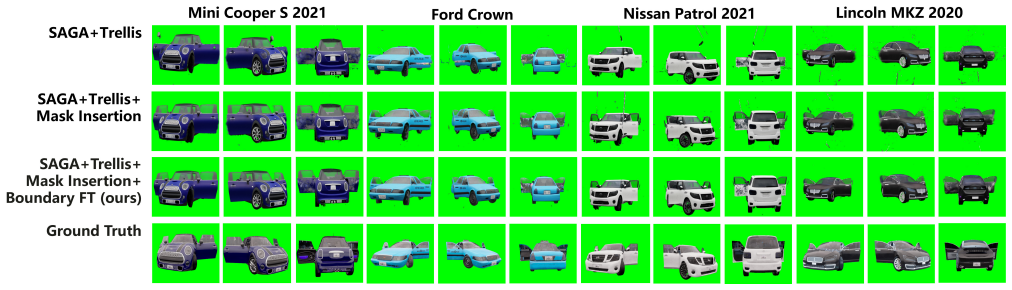
The central claim is that a 3D Gaussian generator equipped with a part-edge refinement module and a kinematic reasoning head can synthesize animatable vehicle models from one image or sparse views. The refinement module enforces exclusive ownership of Gaussians by each part to avoid boundary artifacts during motion. The reasoning head outputs the 3D positions of joints and the directions of hinge axes for movable components such as doors and steering wheels. Together these elements close the gap between high-quality static generation and part-aware dynamic simulation.
What carries the argument
The part-edge refinement module that assigns Gaussians exclusively to one part and the kinematic reasoning head that predicts joint positions and hinge axes.
Load-bearing premise
The refinement module and reasoning head can be trained to remove boundary distortions and recover accurate kinematic parameters from image input without the base generator creating new artifacts once animation begins.
What would settle it
Animate the generated models using the predicted joints and axes and check whether part boundaries show visible stretching or incorrect motion paths compared with real vehicle movements captured on video.
Figures


read the original abstract
Simulation is essential for autonomous driving, yet current frameworks often model vehicles as rigid assets and fail to capture part-level articulation. With perception algorithms increasingly leveraging dynamics such as wheel steering or door opening, realistic simulation requires animatable vehicle representations. Existing CAD-based pipelines are limited by library coverage and fixed templates, preventing faithful reconstruction of in-the-wild instances. We propose a generative framework that, from a single image or sparse multi-view input, synthesizes an animatable 3D Gaussian vehicle. Our method addresses two challenges: (i) large 3D asset generators are optimized for static quality but not articulation, leading to distortions at part boundaries when animated; and (ii) segmentation alone cannot provide the kinematic parameters required for motion. To overcome this, we introduce a part-edge refinement module that enforces exclusive Gaussian ownership and a kinematic reasoning head that predicts joint positions and hinge axes of movable parts. Together, these components enable faithful part-aware simulation, bridging the gap between static generation and animatable vehicle models.
Editorial analysis
A structured set of objections, weighed in public.
Referee Report
Summary. The paper proposes a generative framework for synthesizing animatable 3D Gaussian vehicle models from single-image or sparse multi-view inputs. It identifies two limitations of existing static generators—distortions at part boundaries during animation and the absence of kinematic parameters—and introduces a part-edge refinement module to enforce exclusive Gaussian ownership together with a kinematic reasoning head to predict joint positions and hinge axes of movable parts, thereby enabling faithful part-aware simulation.
Significance. If the modules perform as described, the work would meaningfully advance vehicle modeling for autonomous-driving simulation by producing animatable, part-level 3D Gaussian assets directly from in-the-wild imagery rather than relying on limited CAD templates. The combination of boundary-aware Gaussian assignment with explicit kinematic prediction addresses a practical gap between high-fidelity static generation and dynamic, controllable vehicle representations.
major comments (1)
- [Abstract] The abstract states the problems and proposed modules but supplies no equations, training details, quantitative results, or ablation studies. Without evidence that the modules actually prevent distortions or produce accurate kinematics, the central claim cannot be evaluated.
Simulated Author's Rebuttal
We thank the referee for the positive assessment of our work's significance in advancing animatable vehicle representations for autonomous-driving simulation. We respond to the major comment below.
read point-by-point responses
-
Referee: [Abstract] The abstract states the problems and proposed modules but supplies no equations, training details, quantitative results, or ablation studies. Without evidence that the modules actually prevent distortions or produce accurate kinematics, the central claim cannot be evaluated.
Authors: We agree that the provided abstract functions as a high-level summary and therefore omits equations, training specifics, quantitative metrics, and ablation results. These elements are fully detailed in the manuscript body: the part-edge refinement module and its exclusive-ownership losses appear in Section 3.2, the kinematic reasoning head for joint/axis prediction in Section 3.3, the training protocol in Section 4.1, and all quantitative evaluations plus ablations demonstrating reduced boundary distortions and accurate kinematics in Sections 4.2–4.3 (including Tables 1–3 and Figures 5–8). To address the concern and allow quicker assessment of the central claims, we will revise the abstract to incorporate a concise statement highlighting the empirical improvements. revision: yes
Circularity Check
No significant circularity; method presented as additive modules without self-referential derivations
full rationale
The paper describes a generative 3D Gaussian framework augmented by a part-edge refinement module and a kinematic reasoning head. These are introduced as independent components to address boundary distortions and missing kinematic parameters, respectively. No equations, derivations, or predictions are shown that reduce by construction to fitted inputs or self-citations. The abstract and description frame the approach as an additive pipeline bridging static generation to animation, with no load-bearing steps that equate outputs to inputs via definition or renaming. The derivation chain remains self-contained against external benchmarks, as the modules are presented as trained extensions rather than closed loops.
Axiom & Free-Parameter Ledger
invented entities (2)
-
part-edge refinement module
no independent evidence
-
kinematic reasoning head
no independent evidence
Lean theorems connected to this paper
-
IndisputableMonolith/Foundation/RealityFromDistinction.leanreality_from_one_distinction unclearpart-edge refinement module that enforces exclusive Gaussian ownership and a kinematic reasoning head that predicts joint positions and hinge axes
-
IndisputableMonolith/Cost/FunctionalEquation.leanwashburn_uniqueness_aczel unclearLoptimization = (1−λoutside)Lphoto + λoutside Loutside
Reference graph
Works this paper leans on
-
[1]
ShapeNet: An Information-Rich 3D Model Repository
A. X. Chang, T. Funkhouser, L. Guibas, P. Hanrahan, Q. Huang, Z. Li, S. Savarese, M. Savva, S. Song, H. Su, J. Xiao, L. Yi, and F. Yu, “Shapenet: An information-rich 3d model repository,”arXiv preprint arXiv:1512.03012, 2015
work page internal anchor Pith review arXiv 2015
-
[2]
Partnet: A large-scale benchmark for fine-grained and hierarchical part-level 3d object understanding,
K. Mo, S. Zhu, A. X. Chang, L. Yi, S. Tripathi, L. J. Guibas, and H. Su, “Partnet: A large-scale benchmark for fine-grained and hierarchical part-level 3d object understanding,” inProceedings of the IEEE/CVF Conference on Computer Vision and Pattern Recognition (CVPR), June 2019
2019
-
[3]
Pointnet: Deep learning on point sets for 3d classification and segmentation,
C. R. Qi, H. Su, K. Mo, and L. J. Guibas, “Pointnet: Deep learning on point sets for 3d classification and segmentation,” inProceedings of the IEEE Conference on Computer Vision and Pattern Recognition (CVPR), July 2017
2017
-
[4]
Pointnet++: Deep hierar- chical feature learning on point sets in a metric space,
C. R. Qi, L. Yi, H. Su, and L. J. Guibas, “Pointnet++: Deep hierar- chical feature learning on point sets in a metric space,” inAdvances in Neural Information Processing Systems, vol. 30, 2017
2017
-
[5]
Pointcnn: Con- volution on x-transformed points,
Y . Li, R. Bu, M. Sun, W. Wu, X. Di, and B. Chen, “Pointcnn: Con- volution on x-transformed points,” inAdvances in Neural Information Processing Systems, vol. 31, 2018
2018
-
[6]
Dgcnn: A convolutional neural network over large-scale labeled graphs,
A. V . Phan, M. Le Nguyen, Y . L. H. Nguyen, and L. T. Bui, “Dgcnn: A convolutional neural network over large-scale labeled graphs,”Neural Networks, vol. 108, pp. 533–543, 2018
2018
-
[7]
Kpconv: Flexible and deformable convolution for point clouds,
H. Thomas, C. R. Qi, J.-E. Deschaud, B. Marcotegui, F. Goulette, and L. J. Guibas, “Kpconv: Flexible and deformable convolution for point clouds,” inProceedings of the IEEE/CVF International Conference on Computer Vision, pp. 6411–6420, 2019
2019
-
[8]
Learning transferable visual models from natural language supervi- sion,
A. Radford, J. W. Kim, C. Hallacy, A. Ramesh, G. Goh, S. Agarwal, G. Sastry, A. Askell, P. Mishkin, J. Clark, G. Krueger, and I. Sutskever, “Learning transferable visual models from natural language supervi- sion,” inInternational Conference on Machine Learning, pp. 8748– 8763, PMLR, 2021
2021
-
[10]
DINOv2: Learning Robust Visual Features without Supervision
M. Oquab, T. Darcet, T. Moutakanni, H. V o, M. Szafraniec, V . Khali- dov, P. Fernandez, D. Haziza, F. Massa, A. El-Nouby,et al., “Dinov2: Learning robust visual features without supervision,”arXiv preprint arXiv:2304.07193, 2023
work page internal anchor Pith review Pith/arXiv arXiv 2023
-
[11]
Segment anything,
A. Kirillov, E. Mintun, N. Ravi, H. Mao, C. Rolland, L. Gustafson, T. Xiao, S. Whitehead, A. C. Berg, W.-Y . Lo,et al., “Segment anything,” inProceedings of the IEEE/CVF international conference on computer vision, pp. 4015–4026, 2023
2023
-
[12]
Z. Ma, Y . Yue, and G. Gkioxari, “Find any part in 3d,”arXiv preprint arXiv:2411.13550, 2025
-
[13]
Geosam2: Unleashing the power of sam2 for 3d part segmentation,
K. Deng, Y . Yang, J. Sun, X. Liu, Y . Liu, D. Liang, and Y .-P. Cao, “Geosam2: Unleashing the power of sam2 for 3d part segmentation,” arXiv preprint arXiv:2508.14036, 2025
-
[14]
Y . Zhou, J. Gu, X. Li, M. Liu, Y . Fang, and H. Su, “Partslip++: Enhancing low-shot 3d part segmentation via multi-view instance segmentation and maximum likelihood estimation,”arXiv preprint arXiv:2312.03015, 2023
-
[15]
G. Tang, W. Zhao, L. Ford, D. Benhaim, and P. Zhang, “Segment any mesh,”arXiv preprint arXiv:2408.13679, 2025
-
[16]
Sampart3d: Segment any part in 3d objects.arXiv preprint arXiv:2411.07184, 2024
Y . Yang, Y . Huang, Y .-C. Guo, L. Lu, X. Wu, E. Y . Lam, Y .-P. Cao, and X. Liu, “Sampart3d: Segment any part in 3d objects,”arXiv preprint arXiv:2411.07184, 2024
-
[17]
Gaussian grouping: Segment and edit anything in 3d scenes,
M. Ye, M. Danelljan, F. Yu, and L. Ke, “Gaussian grouping: Segment and edit anything in 3d scenes,” inEuropean conference on computer vision, pp. 162–179, Springer, 2024
2024
-
[18]
Semantic gaussians: Open- vocabulary scene understanding with 3d gaussian splatting,
J. Guo, X. Ma, Y . Fan, H. Liu, and Q. Li, “Semantic gaussians: Open- vocabulary scene understanding with 3d gaussian splatting,”arXiv preprint arXiv:2403.15624, 2024
-
[19]
Opensplat3d: Open-vocabulary 3d instance segmen- tation using gaussian splatting,
J. Piekenbrinck, C. Schmidt, A. Hermans, N. Vaskevicius, T. Linder, and B. Leibe, “Opensplat3d: Open-vocabulary 3d instance segmen- tation using gaussian splatting,” inProceedings of the IEEE/CVF Conference on Computer Vision and Pattern Recognition, pp. 5246– 5255, 2025
2025
-
[20]
Segment any 3d gaussians,
J. Cen, J. Fang, C. Yang, L. Xie, X. Zhang, W. Shen, and Q. Tian, “Segment any 3d gaussians,” inProceedings of the AAAI Conference on Artificial Intelligence, vol. 39, pp. 1971–1979, 2025
1971
-
[21]
Sigmoid loss for language image pre-training,
X. Zhai, B. Mustafa, A. Kolesnikov, and L. Beyer, “Sigmoid loss for language image pre-training,” inProceedings of the IEEE/CVF international conference on computer vision, pp. 11975–11986, 2023
2023
-
[22]
Gemini 1.5: Unlocking multimodal understanding across millions of tokens of context
G. Team, P. Georgiev, V . I. Lei, R. Burnell, L. Bai, A. Gulati, G. Tanzer, D. Vincent, Z. Pan, S. Wang,et al., “Gemini 1.5: Unlocking multimodal understanding across millions of tokens of context,”arXiv preprint arXiv:2403.05530, 2024
work page internal anchor Pith review Pith/arXiv arXiv 2024
-
[23]
Grounded language-image pre-training,
L. H. Li, P. Zhang, H. Zhang, J. Yang, C. Li, Y . Zhong, L. Wang, L. Yuan, L. Zhang, J.-N. Hwang, K.-W. Chang, and J. Gao, “Grounded language-image pre-training,” inProceedings of the IEEE/CVF Conference on Computer Vision and Pattern Recognition (CVPR), pp. 10965–10975, June 2022
2022
-
[24]
Masqclip for open-vocabulary universal image segmentation,
X. Xu, T. Xiong, Z. Ding, and Z. Tu, “Masqclip for open-vocabulary universal image segmentation,” inProceedings of the IEEE/CVF International Conference on Computer Vision, pp. 887–898, 2023
2023
-
[25]
Carla: An open urban driving simulator,
A. Dosovitskiy, G. Ros, F. Codevilla, A. Lopez, and V . Koltun, “Carla: An open urban driving simulator,” inProceedings of the 1st Annual Conference on Robot Learning, pp. 1–16, 2017
2017
-
[26]
Virtual worlds as proxy for multi-object tracking analysis,
A. Gaidon, Q. Wang, Y . Cabon, and E. Vig, “Virtual worlds as proxy for multi-object tracking analysis,” inProceedings of the IEEE Conference on Computer Vision and Pattern Recognition (CVPR), June 2016
2016
-
[27]
Airsim: High-fidelity visual and physical simulation for autonomous vehicles,
S. Shah, D. Dey, C. Lovett, and A. Kapoor, “Airsim: High-fidelity visual and physical simulation for autonomous vehicles,” inField and Service Robotics: Results of the 11th International Conference, pp. 621–635, Springer, 2017
2017
-
[28]
Nerf in the wild: Neural radiance fields for unconstrained photo collections,
R. Martin-Brualla, N. Radwan, M. S. M. Sajjadi, J. T. Barron, A. Dosovitskiy, and D. Duckworth, “Nerf in the wild: Neural radiance fields for unconstrained photo collections,” inProceedings of the IEEE/CVF Conference on Computer Vision and Pattern Recognition (CVPR), pp. 7210–7219, June 2021
2021
-
[29]
Unisurf: Unifying neural implicit surfaces and radiance fields for multi-view reconstruction,
M. Oechsle, S. Peng, and A. Geiger, “Unisurf: Unifying neural implicit surfaces and radiance fields for multi-view reconstruction,” in Proceedings of the IEEE/CVF International Conference on Computer Vision, pp. 5589–5599, 2021
2021
-
[30]
Regnerf: Regularizing neural radiance fields for view synthesis from sparse inputs,
M. Niemeyer, J. T. Barron, B. Mildenhall, M. S. Sajjadi, A. Geiger, and N. Radwan, “Regnerf: Regularizing neural radiance fields for view synthesis from sparse inputs,” inProceedings of the IEEE/CVF Conference on Computer Vision and Pattern Recognition, pp. 5480– 5490, 2022
2022
-
[31]
Ners: Neural reflectance surfaces for sparse-view 3d reconstruction in the wild,
J. Zhang, G. Yang, S. Tulsiani, and D. Ramanan, “Ners: Neural reflectance surfaces for sparse-view 3d reconstruction in the wild,” inAdvances in Neural Information Processing Systems, vol. 34, pp. 29835–29847, 2021
2021
-
[32]
Lidarsim: Realistic lidar simulation by leveraging the real world,
S. Manivasagam, S. Wang, K. Wong, W. Zeng, M. Sazanovich, S. Tan, B. Yang, W.-C. Ma, and R. Urtasun, “Lidarsim: Realistic lidar simulation by leveraging the real world,” inProceedings of the IEEE/CVF Conference on Computer Vision and Pattern Recognition, pp. 11167–11176, 2020
2020
-
[33]
arXiv preprint arXiv:2012.08503 , year=
M. Guo, A. Fathi, J. Wu, and T. Funkhouser, “Object-centric neural scene rendering,”arXiv preprint arXiv:2012.08503, 2020
-
[34]
Cadsim: Robust and scalable in-the- wild 3d reconstruction for controllable sensor simulation
J. Wang, S. Manivasagam, Y . Chen, Z. Yang, I. A. B ˆarsan, A. J. Yang, W.-C. Ma, and R. Urtasun, “Cadsim: Robust and scalable in-the-wild 3d reconstruction for controllable sensor simulation,”arXiv preprint arXiv:2311.01447, 2023
-
[35]
Urbancad: Towards highly controllable and photorealistic 3d vehicles for urban scene simulation,
Y . Lu, Y . Cai, S. Zhang, H. Zhou, H. Hu, H. Yu, A. Geiger, and Y . Liao, “Urbancad: Towards highly controllable and photorealistic 3d vehicles for urban scene simulation,” inProceedings of the Computer Vision and Pattern Recognition Conference, pp. 27519–27530, 2025
2025
-
[36]
Structured 3d latents for scalable and versatile 3d generation,
J. Xiang, Z. Lv, S. Xu, Y . Deng, R. Wang, B. Zhang, D. Chen, X. Tong, and J. Yang, “Structured 3d latents for scalable and versatile 3d generation,” inProceedings of the Computer Vision and Pattern Recognition Conference, pp. 21469–21480, 2025
2025
-
[37]
Hdbscan: Hierarchical density based clustering,
L. McInnes, J. Healy, S. Astels,et al., “Hdbscan: Hierarchical density based clustering,”Journal of Open Source Software, vol. 2, no. 11, p. 205, 2017
2017
-
[38]
Dynamic graph cnn for learning on point clouds,
Y . Wang, Y . Sun, Z. Liu, S. E. Sarma, M. M. Bronstein, and J. M. Solomon, “Dynamic graph cnn for learning on point clouds,”ACM Transactions on Graphics (tog), vol. 38, no. 5, pp. 1–12, 2019
2019
-
[39]
Pointconv: Deep convolutional networks on 3d point clouds,
W. Wu, Z. Qi, and L. Fuxin, “Pointconv: Deep convolutional networks on 3d point clouds,” inProceedings of the IEEE/CVF Conference on computer vision and pattern recognition, pp. 9621–9630, 2019
2019
-
[40]
SAM 2: Segment Anything in Images and Videos
N. Ravi, V . Gabeur, Y .-T. Hu, R. Hu, C. Ryali, T. Ma, H. Khedr, R. R ¨adle, C. Rolland, L. Gustafson, E. Mintun, J. Pan, K. V . Alwala, N. Carion, C.-Y . Wu, R. Girshick, P. Doll ´ar, and C. Feichtenhofer, “Sam 2: Segment anything in images and videos,”arXiv preprint arXiv:2408.00714, 2024
work page internal anchor Pith review Pith/arXiv arXiv 2024
-
[41]
You only look once: Unified, real-time object detection,
J. Redmon, S. Divvala, R. Girshick, and A. Farhadi, “You only look once: Unified, real-time object detection,” inProceedings of the IEEE Conference on Computer Vision and Pattern Recognition, pp. 779– 788, 2016
2016
-
[42]
3d gaussian splatting for real-time radiance field rendering.,
B. Kerbl, G. Kopanas, T. Leimk ¨uhler, and G. Drettakis, “3d gaussian splatting for real-time radiance field rendering.,”ACM Trans. Graph., vol. 42, no. 4, pp. 139–1, 2023
2023
-
[43]
Evaluation of deep learning algorithms for semantic segmentation of car parts,
K. Pasupa, P. Kittiworapanya, N. Hongngern, and K. Woraratpanya, “Evaluation of deep learning algorithms for semantic segmentation of car parts,”Complex & Intelligent Systems, pp. 1–13, May 2021
2021
-
[44]
3drealcar: An in-the-wild rgb-d car dataset with 360-degree views,
X. Du, Y . Wang, H. Sun, Z. Wu, H. Sheng, S. Wang, J. Ying, M. Lu, T. Zhu, K. Zhan, and X. Yu, “3drealcar: An in-the-wild rgb-d car dataset with 360-degree views,”arXiv preprint arXiv:2406.04875, 2025
-
[45]
X. Hu, Y . Wang, L. Fan, C. Luo, J. Fan, Z. Lei, Q. Li, J. Peng, and Z. Zhang, “Sagd: Boundary-enhanced segment anything in 3d gaussian via gaussian decomposition,”arXiv preprint arXiv:2401.17857, 2025
-
[46]
Gamma: Generalizable articulation modeling and manipulation for articulated objects,
Q. Yu, J. Wang, W. Liu, C. Hao, L. Liu, L. Shao, W. Wang, and C. Lu, “Gamma: Generalizable articulation modeling and manipulation for articulated objects,” in2024 IEEE International Conference on Robotics and Automation (ICRA), pp. 5419–5426, IEEE, 2024
2024
-
[47]
Sapien: A simulated part-based interac- tive environment,
F. Xiang, Y . Qin, K. Mo, Y . Xia, H. Zhu, F. Liu, M. Liu, H. Jiang, Y . Yuan, H. Wang,et al., “Sapien: A simulated part-based interac- tive environment,” inProceedings of the IEEE/CVF Conference on Computer Vision and Pattern Recognition, pp. 11097–11107, 2020
2020
-
[48]
Shape2motion: Joint analysis of motion parts and attributes from 3d shapes,
X. Wang, B. Zhou, Y . Shi, X. Chen, Q. Zhao, and K. Xu, “Shape2motion: Joint analysis of motion parts and attributes from 3d shapes,” inProceedings of the IEEE/CVF Conference on Computer Vision and Pattern Recognition, pp. 8876–8884, 2019
2019
-
[49]
The unreasonable effectiveness of deep features as a perceptual metric,
R. Zhang, P. Isola, A. A. Efros, E. Shechtman, and O. Wang, “The unreasonable effectiveness of deep features as a perceptual metric,” in Proceedings of the IEEE conference on computer vision and pattern recognition, pp. 586–595, 2018
2018
-
[50]
K-nearest neighbor,
L. E. Peterson, “K-nearest neighbor,”Scholarpedia, vol. 4, no. 2, p. 1883, 2009
2009
discussion (0)
Sign in with ORCID, Apple, or X to comment. Anyone can read and Pith papers without signing in.