Recognition: no theorem link
Formal specification and behavioral simulation of the holiday gift exchange game
Pith reviewed 2026-05-10 18:39 UTC · model grok-4.3
The pith
Social costs reduce stealing in holiday gift exchanges by 27-48% and dominate uncertainty or strategy.
A machine-rendered reading of the paper's core claim, the machinery that carries it, and where it could break.
Core claim
A full factorial simulation of 240,000 games in the decorated model shows that implicit social costs are the dominant regulator of aggression, reducing stealing by 27-48% and outweighing both uncertainty and strategic sophistication; partial information slightly increases stealing through asymmetric uncertainty; correlated valuations amplify every behavioral effect so that consensus about gift quality intensifies competition; and the first-player advantage is robust across all conditions.
What carries the argument
The decorated behavioral model that augments the formally specified game states and stealing chains with partial information, social costs, and adaptive strategies grounded in discrete choice theory and the frustration-aggression literature.
Load-bearing premise
The decorated behavioral model accurately captures how partial information, social costs, and adaptive strategies influence real player decisions in the game.
What would settle it
Running controlled real-world gift exchanges that vary the presence of social-norm reminders and the amount of gift information provided, then measuring whether stealing drops by the simulated 27-48% when social costs are emphasized.
Figures



read the original abstract
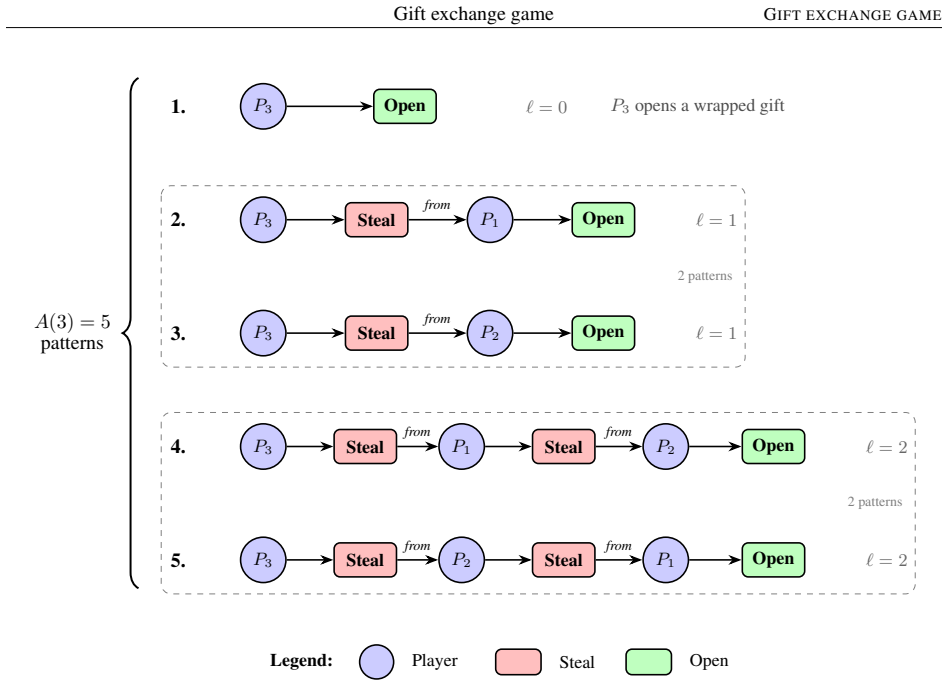
The holiday gift exchange game is a familiar social institution with nontrivial strategic structure. We provide a formal treatment of the game's mechanics, defining the state space, action sets, and the recursive structure of stealing chains; we prove termination and derive an algorithm for counting distinct game trajectories, which grow far faster than the space of possible final allocations. Beyond the base mechanics, we introduce a decorated model incorporating partial information, social costs, and adaptive strategies grounded in discrete choice theory and the frustration-aggression literature. A full factorial simulation of 240,000 games yields three findings of note: implicit social costs are the dominant regulator of aggression, reducing stealing by 27--48\% and outweighing both uncertainty and strategic sophistication; partial information, contrary to expectation, slightly increases stealing through asymmetric uncertainty; correlated valuations amplify every behavioral effect, so that consensus about gift quality, rather than the features themselves, is what intensifies competition. The first-player advantage is robust across all conditions.
Editorial analysis
A structured set of objections, weighed in public.
Referee Report
Summary. The manuscript formally specifies the holiday gift exchange game by defining its state space, action sets, and the recursive structure of stealing chains; it proves termination and derives an algorithm for counting distinct game trajectories. It then introduces a decorated behavioral model incorporating partial information, social costs, and adaptive strategies grounded in discrete choice theory and the frustration-aggression literature. A full-factorial simulation of 240,000 games is used to examine behavioral effects, yielding the claims that implicit social costs reduce stealing by 27--48% and dominate other factors, that partial information slightly increases stealing, that correlated valuations amplify all effects, and that first-player advantage is robust.
Significance. If the behavioral model is shown to be robust, the work would supply a useful formal framework for analyzing social institutions with stealing chains and would quantify how social costs, information, and valuation correlation shape aggression in such games. The termination proof and trajectory-counting algorithm are clear technical contributions to the modeling of complex turn-based social games.
major comments (2)
- [Abstract and §4] Abstract and §4 (Simulation Results): the central quantitative claims (27--48% reduction in stealing attributable to social costs, dominance over uncertainty and strategic sophistication) are generated by the decorated behavioral model. No calibration to human play data, no out-of-sample validation, and no sensitivity analysis over the social-cost functional form or discrete-choice parameters are reported; therefore the reported effect sizes and factor ranking rest on unvalidated modeling choices.
- [§3] §3 (Decorated Behavioral Model): the assumption that the chosen social-cost and frustration-aggression mappings accurately capture real-player responses is load-bearing for all simulation conclusions, yet the manuscript provides no empirical grounding or alternative-specification checks for these mappings.
minor comments (1)
- [§2] The notation for state components and stealing-chain recursion would benefit from an early concrete example (e.g., a 3-player, 4-gift instance) to improve readability for readers unfamiliar with the game.
Simulated Author's Rebuttal
We thank the referee for the constructive comments. The points raised correctly identify that the quantitative claims rest on specific modeling choices without direct empirical calibration. We respond point by point below and outline revisions that increase transparency while preserving the exploratory nature of the simulation study.
read point-by-point responses
-
Referee: [Abstract and §4] Abstract and §4 (Simulation Results): the central quantitative claims (27--48% reduction in stealing attributable to social costs, dominance over uncertainty and strategic sophistication) are generated by the decorated behavioral model. No calibration to human play data, no out-of-sample validation, and no sensitivity analysis over the social-cost functional form or discrete-choice parameters are reported; therefore the reported effect sizes and factor ranking rest on unvalidated modeling choices.
Authors: We agree that the reported effect sizes are conditional on the chosen parameter values and functional forms. The study is a formal specification plus simulation exercise intended to explore implications of theoretically motivated behavioral rules rather than to deliver calibrated predictions of human behavior. In revision we will (i) qualify the abstract and §4 to state that all percentages and dominance claims hold 'under the proposed behavioral decoration,' (ii) add a sensitivity subsection in §4 that re-runs the factorial design for social-cost coefficients in [0.5, 2.0] and for two alternative discrete-choice temperature values, confirming that social costs remain the dominant factor across this range, and (iii) insert an explicit 'Limitations' paragraph acknowledging the absence of human-data calibration and out-of-sample validation. revision: partial
-
Referee: [§3] §3 (Decorated Behavioral Model): the assumption that the chosen social-cost and frustration-aggression mappings accurately capture real-player responses is load-bearing for all simulation conclusions, yet the manuscript provides no empirical grounding or alternative-specification checks for these mappings.
Authors: The mappings are taken from the cited discrete-choice and frustration-aggression literatures; however, we accept that no direct empirical tests or alternative functional forms are examined. We will expand §3 with a short paragraph justifying the linear social-cost and threshold-based frustration rules by reference to the source papers. We will also add a robustness appendix that repeats a 20 % subsample of the 240 000 games under a quadratic social-cost function and under a shifted frustration threshold, reporting that the qualitative ordering of effects is unchanged. These checks will be presented as internal consistency tests rather than empirical validation. revision: partial
- Direct calibration to human play data or out-of-sample validation, which would require new behavioral experiments outside the scope of the present theoretical and simulation manuscript.
Circularity Check
No circularity: simulation outputs generated from explicitly defined model
full rationale
The paper formally specifies game mechanics, proves termination, derives a trajectory-counting algorithm, then defines a decorated behavioral model drawing on discrete choice theory and frustration-aggression literature before running a full-factorial simulation. None of the reported findings (e.g., 27-48% stealing reduction) reduce by construction to the inputs; the quantitative results are produced by executing the model rather than by algebraic identity or parameter renaming. No self-citations, uniqueness theorems, or ansatzes imported from prior author work appear in the derivation chain. The simulation is self-contained against its own stated assumptions and parameter choices.
Axiom & Free-Parameter Ledger
Reference graph
Works this paper leans on
-
[1]
Sloane, and Doron Zeilberger
Moa Apagodu, David Applegate, N. Sloane, and Doron Zeilberger. Analysis of the gift exchange problem.The Electronic Journal of Combinatorics, 24, 07 2017
2017
-
[2]
David Applegate and N. J. A. Sloane. The gift exchange problem, 2009
2009
-
[3]
Pareto-optimal algorithms for learning in games
Eshwar Ram Arunachaleswaran, Natalie Collina, and Jon Schneider. Pareto-optimal algorithms for learning in games. InProceedings of the 25th ACM Conference on Economics and Computation, pages 490–510, 2024
2024
-
[4]
Bad is stronger than good.Review of general psychology, 5(4):323–370, 2001
Roy F Baumeister, Ellen Bratslavsky, Catrin Finkenauer, and Kathleen D V ohs. Bad is stronger than good.Review of general psychology, 5(4):323–370, 2001
2001
-
[5]
Rational hedging and valuation of integrated risks under constant absolute risk aversion.Insurance: Mathematics and economics, 33(1):1–28, 2003
Dirk Becherer. Rational hedging and valuation of integrated risks under constant absolute risk aversion.Insurance: Mathematics and economics, 33(1):1–28, 2003
2003
-
[6]
Frustration-aggression hypothesis: examination and reformulation.Psychological bulletin, 106(1):59, 1989
Leonard Berkowitz. Frustration-aggression hypothesis: examination and reformulation.Psychological bulletin, 106(1):59, 1989
1989
-
[7]
Reputation for quality.Econometrica, 81(6):2381–2462, 2013
Simon Board and Moritz Meyer-ter Vehn. Reputation for quality.Econometrica, 81(6):2381–2462, 2013
2013
-
[8]
Trust, risk and betrayal.Journal of Economic Behavior & Organization, 55(4):467–484, 2004
Iris Bohnet and Richard Zeckhauser. Trust, risk and betrayal.Journal of Economic Behavior & Organization, 55(4):467–484, 2004
2004
-
[9]
An exploration of reputation formation in experimental games.Journal of Economic Behavior & Organization, 50(1):89–115, 2003
Jordi Brandts and Neus Figueras. An exploration of reputation formation in experimental games.Journal of Economic Behavior & Organization, 50(1):89–115, 2003
2003
-
[10]
Reference points and negative reciprocity in simple sequential games.Games and Economic Behavior, 36(2):138–157, 2001
Jordi Brandts and Carles Solà. Reference points and negative reciprocity in simple sequential games.Games and Economic Behavior, 36(2):138–157, 2001
2001
-
[11]
Peter Jensen Brown. Two-and-a-half idioms - the history and etymology of white elephants: elephant in a raffle, white elephant, and the gift of the white elephant – a history and etymology of two-and-a-half idioms. Online, June 2014. Published June 28, 2014
2014
-
[12]
Two-and-a-half more idioms - white elephants and yankee swaps: The history and etymology of white elephant gift exchanges, white elephant sales and yankee swaps
Peter Jensen Brown. Two-and-a-half more idioms - white elephants and yankee swaps: The history and etymology of white elephant gift exchanges, white elephant sales and yankee swaps. Online, June 2014. Published June 28, 2014
2014
-
[13]
The mean and variance of the mean-variance decision rule.American Journal of Agricultural Economics, 72(4):966–974, 1990
James A Chalfant, Robert N Collender, and Shankar Subramanian. The mean and variance of the mean-variance decision rule.American Journal of Agricultural Economics, 72(4):966–974, 1990
1990
-
[14]
Understanding social preferences with simple tests.The quarterly journal of economics, 117(3):817–869, 2002
Gary Charness and Matthew Rabin. Understanding social preferences with simple tests.The quarterly journal of economics, 117(3):817–869, 2002
2002
-
[15]
Exploiting moral wiggle room: experiments demonstrating an illusory preference for fairness.Economic Theory, 33(1):67–80, 2007
Jason Dana, Roberto A Weber, and Jason Xi Kuang. Exploiting moral wiggle room: experiments demonstrating an illusory preference for fairness.Economic Theory, 33(1):67–80, 2007
2007
-
[16]
The economics of strong reciprocity.Moral sentiments and material interests
Ernst Fehr and Urs Fischbacher. The economics of strong reciprocity.Moral sentiments and material interests. The foundations for cooperation in economic life, pages 151–193, 2005
2005
-
[17]
Social preferences and the brain
Ernst Fehr and Ian Krajbich. Social preferences and the brain. InNeuroeconomics, pages 193–218. Elsevier, 2014
2014
-
[18]
Theories of fairness and reciprocity-evidence and economic applications.Working paper/Institute for Empirical Research in Economics, 75, 2001
Ernst Fehr and Klaus Schmidt. Theories of fairness and reciprocity-evidence and economic applications.Working paper/Institute for Empirical Research in Economics, 75, 2001
2001
-
[19]
Breaking the envy cycle: Best-of-both- worlds guarantees for subadditive valuations
Michal Feldman, Simon Mauras, Vishnu V Narayan, and Tomasz Ponitka. Breaking the envy cycle: Best-of-both- worlds guarantees for subadditive valuations. InProceedings of the 25th ACM Conference on Economics and Computation, pages 1236–1266, 2024
2024
-
[20]
To steal or not to steal: Self-discrepancies as a way to promote pro-social behavior: The moderating role of self-interest.Frontiers in Psychology, 13:748298, 2022
Alin Gavreliuc, Dana Gavreliuc, and Alin Semenescu. To steal or not to steal: Self-discrepancies as a way to promote pro-social behavior: The moderating role of self-interest.Frontiers in Psychology, 13:748298, 2022
2022
-
[21]
Axiomatic rationality and ecological rationality.Synthese, 198(4):3547–3564, 2021
Gerd Gigerenzer. Axiomatic rationality and ecological rationality.Synthese, 198(4):3547–3564, 2021
2021
-
[22]
Bargaining under a deadline: Evidence from the reverse ultimatum game.Games and Economic Behavior, 45(2):347–368, 2003
Uri Gneezy, Ernan Haruvy, and Alvin E Roth. Bargaining under a deadline: Evidence from the reverse ultimatum game.Games and Economic Behavior, 45(2):347–368, 2003
2003
-
[23]
Gomes, David P
Hugo S. Gomes, David P. Farrington, Ivy N. Defoe, and Ângela Maia. Field experiments on dishonesty and stealing: what have we learned in the last 40 years?Journal of Experimental Criminology, 18(3):607–637, 09 2022
2022
-
[24]
Frustration–aggression hypothesis reconsidered: The role of significance quest.Aggressive behavior, 49(5):445–468, 2023
Arie W Kruglanski, Molly Ellenberg, Ewa Szumowska, Erica Molinario, Anne Speckhard, N Pontus Leander, Antonio Pierro, Gabriele Di Cicco, and Brad J Bushman. Frustration–aggression hypothesis reconsidered: The role of significance quest.Aggressive behavior, 49(5):445–468, 2023. 38 Gift exchange gameGIFT EXCHANGE GAME
2023
-
[25]
Emotional inertia and psychological maladjustment
Peter Kuppens, Nicholas B Allen, and Lisa B Sheeber. Emotional inertia and psychological maladjustment. Psychological science, 21(7):984–991, 2010
2010
-
[26]
Emotion and decision making.Annual review of psychology, 66(1):799–823, 2015
Jennifer S Lerner, Ye Li, Piercarlo Valdesolo, and Karim S Kassam. Emotion and decision making.Annual review of psychology, 66(1):799–823, 2015
2015
-
[27]
Absolute and relative risk aversion: An experimental study.Journal of Risk and uncertainty, 8(3):289–307, 1994
Haim Levy. Absolute and relative risk aversion: An experimental study.Journal of Risk and uncertainty, 8(3):289–307, 1994
1994
-
[28]
N-player trust game with second-order reputation evaluation in the networked population.IEEE Systems Journal, 17(2):2982–2992, 2022
Xuezhu Li, Meiling Feng, Weiwei Han, and Chengyi Xia. N-player trust game with second-order reputation evaluation in the networked population.IEEE Systems Journal, 17(2):2982–2992, 2022
2022
-
[29]
Emotions in economic theory and economic behavior.American economic review, 90(2):426– 432, 2000
George Loewenstein. Emotions in economic theory and economic behavior.American economic review, 90(2):426– 432, 2000
2000
-
[30]
Daniel mcfadden and the econometric analysis of discrete choice.The Scandinavian Journal of Economics, 103(2):217–229, 2001
Charles F Manski. Daniel mcfadden and the econometric analysis of discrete choice.The Scandinavian Journal of Economics, 103(2):217–229, 2001
2001
-
[31]
John Wiley & Sons, 2000
Harry M Markowitz and G Peter Todd.Mean-variance analysis in portfolio choice and capital markets. John Wiley & Sons, 2000
2000
-
[32]
Economic choices.American economic review, 91(3):351–378, 2001
Daniel McFadden. Economic choices.American economic review, 91(3):351–378, 2001
2001
-
[33]
Characteristics analysis of behavioural portfolio theory in the markowitz portfolio theory framework.Managerial finance, 48(2):277–288, 2022
Saksham Mittal, Sujoy Bhattacharya, and Satrajit Mandal. Characteristics analysis of behavioural portfolio theory in the markowitz portfolio theory framework.Managerial finance, 48(2):277–288, 2022
2022
-
[34]
Late and multiple bidding in second price internet auctions: Theory and evidence concerning different rules for ending an auction.Games and Economic behavior, 55(2):297–320, 2006
Axel Ockenfels and Alvin E Roth. Late and multiple bidding in second price internet auctions: Theory and evidence concerning different rules for ending an auction.Games and Economic behavior, 55(2):297–320, 2006
2006
-
[35]
Trust and betrayals: Reputational payoffs and behaviors without commitment.Theoretical Economics, 16(2):449–475, 2021
Harry Pei. Trust and betrayals: Reputational payoffs and behaviors without commitment.Theoretical Economics, 16(2):449–475, 2021
2021
-
[36]
The multiplicity of emotions: A framework of emotional functions in decision making.Judgment and decision making, 3(1):5–17, 2008
Hans-Rüdiger Pfister and Gisela Böhm. The multiplicity of emotions: A framework of emotional functions in decision making.Judgment and decision making, 3(1):5–17, 2008
2008
-
[37]
The deadline effect in bargaining: Some experi- mental evidence.The American Economic Review, 78(4):806–823, 1988
Alvin E Roth, J Keith Murnighan, and Francoise Schoumaker. The deadline effect in bargaining: Some experi- mental evidence.The American Economic Review, 78(4):806–823, 1988
1988
-
[38]
Status quo bias in decision making.Journal of risk and uncertainty, 1(1):7–59, 1988
William Samuelson and Richard Zeckhauser. Status quo bias in decision making.Journal of risk and uncertainty, 1(1):7–59, 1988
1988
-
[39]
Promises and lies: Restoring violated trust
Maurice E Schweitzer, John C Hershey, and Eric T Bradlow. Promises and lies: Restoring violated trust. Organizational behavior and human decision processes, 101(1):1–19, 2006
2006
-
[40]
Children’s dynamic use of face-and behavior-based cues in an economic trust game.Developmental Psychology, 58(12):2275, 2022
Saba Siddique, Linda Jeffery, Romina Palermo, Jemma R Collova, and Clare AM Sutherland. Children’s dynamic use of face-and behavior-based cues in an economic trust game.Developmental Psychology, 58(12):2275, 2022
2022
-
[41]
Satisficing games.Information Sciences, 114(1-4):255–280, 1999
Wynn C Stirling and Michael A Goodrich. Satisficing games.Information Sciences, 114(1-4):255–280, 1999
1999
-
[42]
OUP USA, 2012
Peter M Todd and Gerd Gigerenzer.Ecological rationality: Intelligence in the world. OUP USA, 2012
2012
-
[43]
Cambridge University Press, 01 2009
Kenneth Train.Discrete Choice Methods With Simulation, volume 2009. Cambridge University Press, 01 2009
2009
-
[44]
Tricked, backstabbed and bamboozled: A conceptual model of betrayal for multiplayer games
Pedro Valério. Tricked, backstabbed and bamboozled: A conceptual model of betrayal for multiplayer games. Master’s thesis, Universidade de Aveiro (Portugal), 2024
2024
-
[45]
Mean-variance portfolio selection under partial information.SIAM Journal on Control and Optimization, 46(1):156–175, 2007
Jie Xiong and Xun Yu Zhou. Mean-variance portfolio selection under partial information.SIAM Journal on Control and Optimization, 46(1):156–175, 2007. A Notation reference Here we tabulate the notation and parameters used throughout our work here. 39 Gift exchange gameGIFT EXCHANGE GAME Table 10: Summary of notation used throughout Symbol Meaning P={P 1, ....
2007
discussion (0)
Sign in with ORCID, Apple, or X to comment. Anyone can read and Pith papers without signing in.