Recognition: no theorem link
Beyond Accuracy: Unveiling Inefficiency Patterns in Tool-Integrated Reasoning
Pith reviewed 2026-05-10 19:19 UTC · model grok-4.3
The pith
PTE metric predicts LLM tool-use latency better than token counts
A machine-rendered reading of the paper's core claim, the machinery that carries it, and where it could break.
Core claim
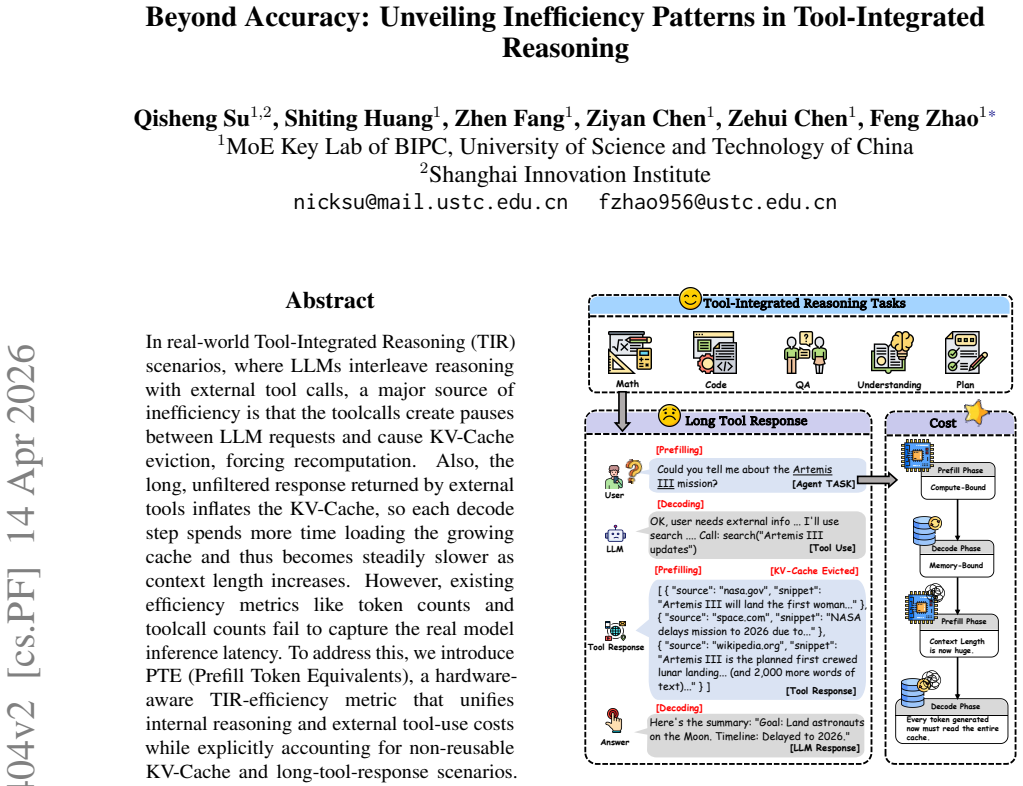
The central discovery is that Prefill Token Equivalents (PTE) provides a hardware-aware way to quantify the total computational cost in tool-integrated reasoning by unifying internal model computations with external tool interactions, specifically adjusting for the recomputation costs from KV-Cache evictions during tool calls and the increased per-step latency from lengthy tool outputs. This metric aligns more closely with measured wall-clock latency in high-concurrency environments than conventional token counts, maintains consistent model efficiency orderings across varied hardware, and reveals that reasoning trajectories with elevated PTE expenditures are associated with reduced correct
What carries the argument
Prefill Token Equivalents (PTE), a metric that estimates the equivalent amount of prefill token processing required, including penalties for non-reusable cache segments caused by tool call interruptions and the decode overhead from extended tool responses.
Load-bearing premise
The five chosen benchmarks together with the industrial high-concurrency tests sufficiently represent the range of typical tool-integrated reasoning applications.
What would settle it
A controlled experiment on additional TIR tasks or different model families where standard token counts show stronger correlation with measured latency than PTE, or where no negative relationship appears between PTE cost and answer correctness.
Figures




read the original abstract
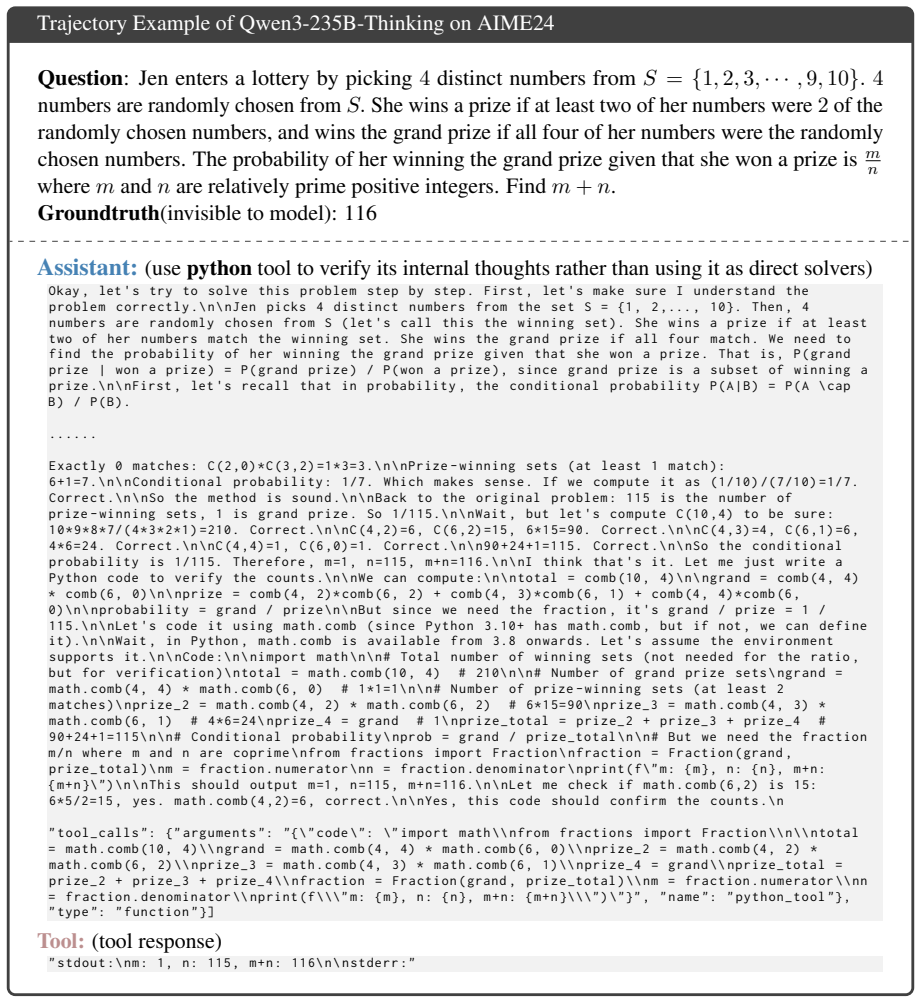
In real-world Tool-Integrated Reasoning (TIR) scenarios, where LLMs interleave reasoning with external tool calls, a major source of inefficiency is that the toolcalls create pauses between LLM requests and cause KV-Cache eviction, forcing recomputation. Also, the long, unfiltered response returned by external tools inflates the KV-Cache, so each decode step spends more time loading the growing cache and thus becomes steadily slower as context length increases. However, existing efficiency metrics like token counts and toolcall counts fail to capture the real model inference latency. To address this, we introduce PTE (Prefill Token Equivalents), a hardware-aware TIR-efficiency metric that unifies internal reasoning and external tool-use costs while explicitly accounting for non-reusable KV-Cache and long-tool-response scenarios. Validation in a high-concurrency industrial setting indicates that PTE aligns significantly better with wall-clock latency than standard token counts, while maintaining consistent efficiency rankings across diverse hardware profiles. We conduct extensive experiments across five TIR benchmarks, quantify their PTE costs, and identify four inefficiency patterns that appear in TIR. We also discover that trajectories with higher PTE costs tend to have lower reasoning correctness, indicating that simply using more tools does not improve the quality of the answer.
Editorial analysis
A structured set of objections, weighed in public.
Referee Report
Summary. The paper argues that standard metrics such as token counts and tool-call counts fail to capture real inference latency in Tool-Integrated Reasoning (TIR) because tool calls trigger KV-cache evictions and long tool responses inflate the cache, slowing decode steps. It introduces PTE (Prefill Token Equivalents), a hardware-aware metric that unifies reasoning and tool-use costs while accounting for non-reusable KV-cache. Industrial high-concurrency validation shows PTE aligns better with wall-clock latency than token counts and yields consistent efficiency rankings across hardware; experiments on five TIR benchmarks identify four inefficiency patterns and report that higher-PTE trajectories exhibit lower reasoning correctness.
Significance. If the empirical claims hold after proper statistical controls and generalizability checks, PTE could serve as a practical replacement for token-based efficiency measures in TIR system design and benchmarking, directly linking efficiency to latency and correctness. The negative correlation finding would highlight a previously under-quantified trade-off in tool usage. The industrial validation and cross-hardware consistency are strengths, but the absence of derivation details, statistical tests, and ablation studies limits the immediate adoption potential.
major comments (3)
- [PTE definition (abstract and §3)] The definition and derivation of PTE are presented without explicit equations or parameter-free claims in the abstract and methods; it is therefore impossible to verify how the metric converts tool-response lengths and KV-cache eviction events into prefill equivalents or why it is hardware-aware rather than fitted to the specific industrial traces.
- [Industrial validation (§4)] The central claim that PTE 'aligns significantly better' with wall-clock latency than token counts rests on industrial validation but reports no correlation coefficients, p-values, confidence intervals, or error bars; without these, the strength of the alignment and the cross-hardware ranking consistency cannot be assessed.
- [Benchmark experiments and correlation analysis (§5)] The reported negative correlation between PTE cost and reasoning correctness, as well as the four inefficiency patterns, are derived from five unspecified benchmarks without controls for task difficulty, statistical significance tests, or cross-benchmark ablation; this leaves open whether the patterns and correlation are general properties of TIR or artifacts of the chosen task distributions and tool-response lengths.
minor comments (2)
- [Abstract] The abstract would benefit from a one-sentence mathematical sketch of how PTE is computed from KV-cache state and tool-response length.
- [Experiments] No mention is made of whether the five benchmarks and industrial traces are publicly available or whether code for PTE computation will be released, which affects reproducibility.
Simulated Author's Rebuttal
We are grateful to the referee for their constructive comments, which have helped us identify areas for improvement in clarity and rigor. We address each major comment below, indicating the revisions we will make to the manuscript.
read point-by-point responses
-
Referee: [PTE definition (abstract and §3)] The definition and derivation of PTE are presented without explicit equations or parameter-free claims in the abstract and methods; it is therefore impossible to verify how the metric converts tool-response lengths and KV-cache eviction events into prefill equivalents or why it is hardware-aware rather than fitted to the specific industrial traces.
Authors: We thank the referee for pointing this out. In the revised manuscript, we will include the explicit mathematical definition of PTE in the abstract and provide a detailed derivation in §3, including the formulas that map tool-response lengths and KV-cache eviction events to prefill token equivalents. The hardware-awareness stems from incorporating hardware-specific factors such as memory bandwidth and cache eviction costs, which are not fitted to traces but derived from first principles of transformer inference. We will also clarify that PTE is parameter-free in its core formulation. revision: yes
-
Referee: [Industrial validation (§4)] The central claim that PTE 'aligns significantly better' with wall-clock latency than token counts rests on industrial validation but reports no correlation coefficients, p-values, confidence intervals, or error bars; without these, the strength of the alignment and the cross-hardware ranking consistency cannot be assessed.
Authors: We agree that additional statistical details are necessary. In the revision, we will add Pearson and Spearman correlation coefficients, associated p-values, 95% confidence intervals, and error bars for the comparisons between PTE and token counts against wall-clock latency. We will also include statistical tests confirming the consistency of efficiency rankings across hardware profiles. revision: yes
-
Referee: [Benchmark experiments and correlation analysis (§5)] The reported negative correlation between PTE cost and reasoning correctness, as well as the four inefficiency patterns, are derived from five unspecified benchmarks without controls for task difficulty, statistical significance tests, or cross-benchmark ablation; this leaves open whether the patterns and correlation are general properties of TIR or artifacts of the chosen task distributions and tool-response lengths.
Authors: We will specify the five TIR benchmarks explicitly in the revised text. We will perform and report statistical significance tests (e.g., t-tests or Wilcoxon tests) for the negative correlation and for differences in correctness across PTE levels. For controls, we will add an analysis stratifying by task difficulty where possible. However, a full cross-benchmark ablation may require additional experiments; we will include partial ablations on benchmark subsets and discuss generalizability limitations. The patterns were observed consistently across the benchmarks, supporting their generality. revision: partial
Circularity Check
No circularity: PTE is a new definition validated empirically against external latency measurements.
full rationale
The paper defines PTE as a hardware-aware metric that accounts for KV-Cache eviction and long tool responses in TIR scenarios. It then reports empirical validation showing better alignment with wall-clock latency than token counts, plus observed patterns from five benchmarks. No equations, fitted parameters, or self-citations are presented that reduce the metric or the inefficiency patterns to tautological inputs by construction. The alignment and correlation findings are data-driven observations, not self-referential derivations. The derivation chain is self-contained as an empirical metric proposal plus measurement.
Axiom & Free-Parameter Ledger
invented entities (1)
-
PTE (Prefill Token Equivalents)
no independent evidence
Forward citations
Cited by 2 Pith papers
-
SkillFlow:Benchmarking Lifelong Skill Discovery and Evolution for Autonomous Agents
SkillFlow benchmark shows lifelong skill evolution yields modest gains for some models like Claude Opus 4.6 but limited or negative utility for others despite high skill usage.
-
LLM-Oriented Information Retrieval: A Denoising-First Perspective
Denoising to maximize usable evidence density and verifiability is becoming the primary bottleneck in LLM-oriented information retrieval, conceptualized via a four-stage framework and addressed through a pipeline taxo...
Reference graph
Works this paper leans on
-
[1]
T-eval: Evaluating the tool utilization capabil- ity step by step.CoRR. Karl Cobbe, Vineet Kosaraju, Mohammad Bavarian, Mark Chen, Heewoo Jun, Lukasz Kaiser, Matthias Plappert, Jerry Tworek, Jacob Hilton, Reiichiro Nakano, Christopher Hesse, and John Schulman
-
[2]
Training Verifiers to Solve Math Word Problems
Training verifiers to solve math word prob- lems.Preprint, arXiv:2110.14168. Lu Dai, Yijie Xu, Jinhui Ye, Hao Liu, and Hui Xiong
work page internal anchor Pith review Pith/arXiv arXiv
-
[3]
Seper: Measure retrieval utility through the lens of semantic perplexity reduction.arXiv preprint arXiv:2503.01478. Guanting Dong, Yifei Chen, Xiaoxi Li, Jiajie Jin, Hongjin Qian, Yutao Zhu, Hangyu Mao, Guorui Zhou, Zhicheng Dou, and Ji-Rong Wen. 2025a. Tool- star: Empowering llm-brained multi-tool reasoner via reinforcement learning.Preprint, arXiv:2505....
-
[4]
Critictool: Evaluating self-critique capabil- ities of large language models in tool-calling error scenarios.arXiv preprint arXiv:2506.13977. Carlos E. Jimenez, John Yang, Alexander Wettig, Shunyu Yao, Kexin Pei, Ofir Press, and Karthik Narasimhan. 2024. Swe-bench: Can language mod- els resolve real-world github issues?Preprint, arXiv:2310.06770. Jared Ka...
-
[5]
GAIA: a benchmark for General AI Assistants
Gaia: a benchmark for general ai assistants. Preprint, arXiv:2311.12983. Zaifeng Pan, Ajjkumar Patel, Zhengding Hu, Yipeng Shen, Yue Guan, Wan-Lu Li, Lianhui Qin, Yida Wang, and Yufei Ding. 2025. Kvflow: Efficient pre- fix caching for accelerating llm-based multi-agent workflows.Preprint, arXiv:2507.07400. Shishir G Patil, Huanzhi Mao, Fanjia Yan, Charlie...
work page internal anchor Pith review arXiv 2025
-
[6]
arXiv preprint arXiv:2508.15754 , year=
Dissecting tool-integrated reasoning: An empirical study and analysis.arXiv preprint arXiv:2508.15754. Yinmin Zhong, Shengyu Liu, Junda Chen, Jianbo Hu, Yibo Zhu, Xuanzhe Liu, Xin Jin, and Hao Zhang
-
[7]
Toolqa: A dataset for llm question answering with external tools,
{DistServe}: Disaggregating prefill and de- coding for goodput-optimized large language model serving. In18th USENIX Symposium on Operat- ing Systems Design and Implementation (OSDI 24), pages 193–210. Yuchen Zhuang, Yue Yu, Kuan Wang, Haotian Sun, and Chao Zhang. 2023. Toolqa: A dataset for llm question answering with external tools.Preprint, arXiv:2306....
-
[8]
m : { m } , n : { n } , m + n : { m + n }\
\ n \ nprobability = grand / prize \ n \ nBut since we need the fraction , it's grand / prize = 1 / 115.\ n \ nLet's code it using math . comb ( since Python 3.10+ has math . comb , but if not , we can define it ) .\ n \ nWait , in Python , math . comb is available from 3.8 onwards . Let's assume the environment supports it .\ n \ nCode :\ n \ nimport mat...
-
[9]
edengreen
[5 Reasons Why Organic Farming Is Not Sustainable ] ( https :// www . edengreen . com / blog - collection / organic - farming - sustainability ) Organic produce is grown without synthetic pesticides , fertilizers , or GMOs . It must meet strict USDA certification standards . These standards include using ... See more
-
[10]
[ What Organic Farming ( and Processing ) Doesn't Allow ] ( https :// www . usda . gov / about - usda / news / blog / organic -101 - what - organic - farming - and - processing ...) Methods like irradiation , sewage sludge , and genetic engineering are all expressly prohibited from being used when growing or processing organic foods . See more
-
[11]
Assistant:(usevisittool) Now let me visit the most relevant USDA page to get detailed information about what organic agriculture excludes :
[ Organic vs . Conventional Farming ]..." Assistant:(usevisittool) Now let me visit the most relevant USDA page to get detailed information about what organic agriculture excludes : " tool_calls ": {" arguments ": "{\" url \": \" https :// www . usda . gov / about - usda / news / blog / organic -101 - what - organic - farming - and - processing ...\" , \"...
1986
discussion (0)
Sign in with ORCID, Apple, or X to comment. Anyone can read and Pith papers without signing in.