Recognition: no theorem link
Selecting a Maximum Solow-Polasky Diversity Subset in General Metric Spaces Is NP-hard
Pith reviewed 2026-05-10 19:08 UTC · model grok-4.3
The pith
Selecting a fixed-size subset to maximize Solow-Polasky diversity is NP-hard in general metric spaces.
A machine-rendered reading of the paper's core claim, the machinery that carries it, and where it could break.
Core claim
The central discovery is that the problem of selecting a maximum Solow-Polasky diversity subset in general metric spaces is NP-hard. The authors establish this by a reduction from the classical Independent Set problem. The metric construction employs only two non-zero distance values, and a dedicated strict-monotonicity argument is provided for the family of distance matrices that arise. The hardness holds for every fixed kernel parameter θ0 > 0, or equivalently by rescaling one may fix the parameter to 1.
What carries the argument
The reduction from Independent Set to the diversity maximization problem, using a two-valued metric and proving strict monotonicity of the Solow-Polasky indicator on the resulting matrices.
Load-bearing premise
The Solow-Polasky diversity value is strictly monotonic with respect to the size of the independent set in the specially constructed metric instances.
What would settle it
A polynomial-time algorithm for the fixed-cardinality Solow-Polasky maximization problem in general metric spaces, or a specific instance in the reduction where the diversity does not increase with independent set size.
Figures
read the original abstract
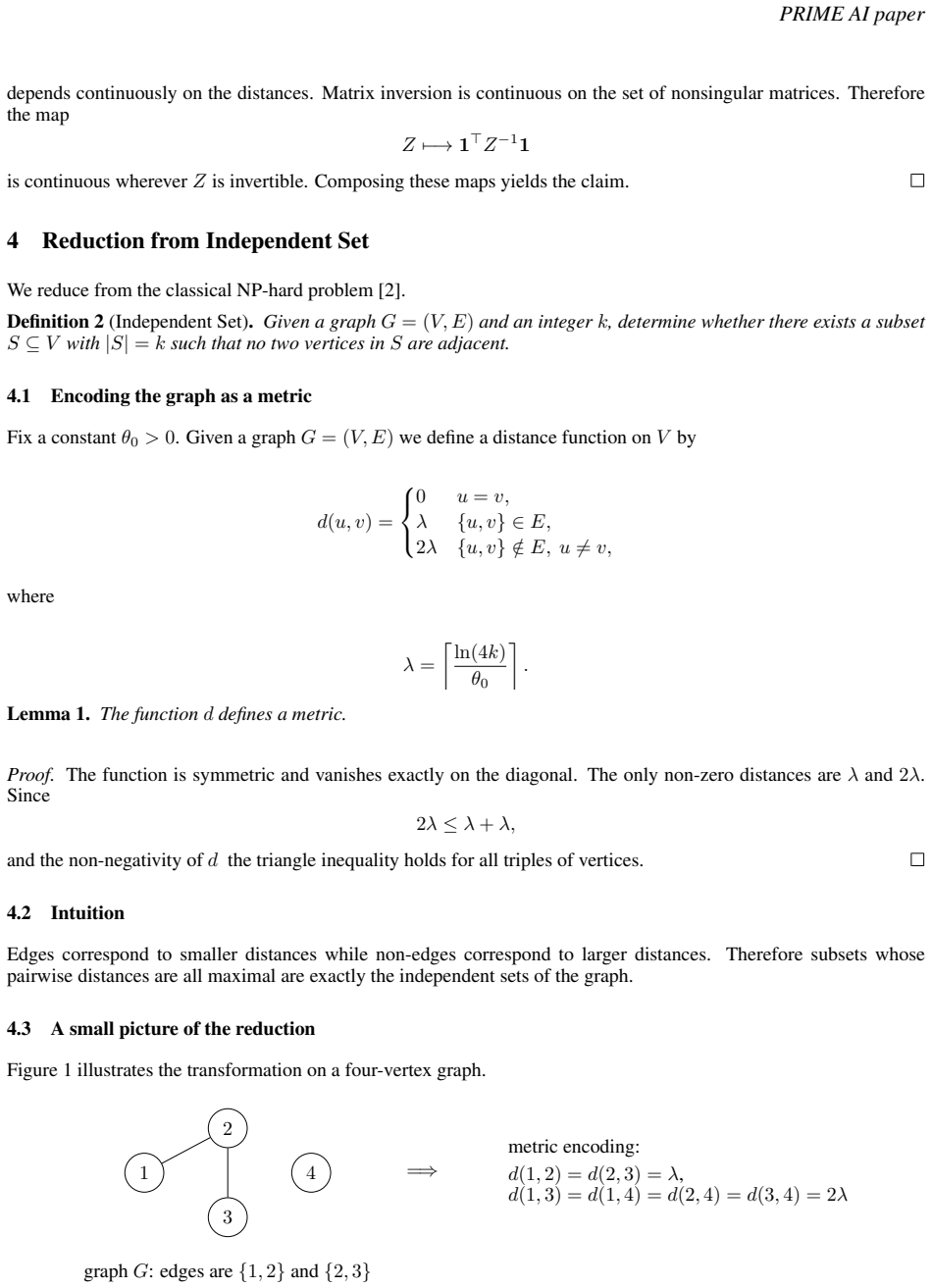
The Solow--Polasky diversity indicator (or magnitude) is a classical measure of diversity based on pairwise distances. It has applications in ecology, conservation planning, and, more recently, in algorithmic subset selection and diversity optimization. In this note, we investigate the computational complexity of selecting a subset of fixed cardinality from a finite set so as to maximize the Solow--Polasky diversity value. We prove that this problem is NP-hard in general metric spaces. The reduction is from the classical Independent Set problem and uses a simple metric construction containing only two non-zero distance values. Importantly, the hardness result holds for every fixed kernel parameter $\theta_0>0$; equivalently, by rescaling the metric, one may fix the parameter to $1$ without loss of generality. A central point is that this is not a boilerplate reduction: because the Solow--Polasky objective is defined through matrix inversion, it is a nontrivial nonlinear function of the distances. Accordingly, the proof requires a dedicated strict-monotonicity argument for the specific family of distance matrices arising in the reduction; this strict monotonicity is established here for that family, but it is not assumed to hold in full generality. We also explain how the proof connects to continuity and monotonicity considerations for diversity indicators.
Editorial analysis
A structured set of objections, weighed in public.
Referee Report
Summary. The paper proves that selecting a fixed-cardinality subset maximizing the Solow-Polasky diversity (magnitude) in a general metric space is NP-hard. The proof proceeds by a direct polynomial-time reduction from the Independent Set problem that constructs a metric using only two positive distance values; a dedicated argument establishes strict monotonicity of the diversity functional (via the matrix inverse) specifically for the family of distance matrices arising in the reduction. The hardness holds for every fixed kernel parameter θ₀ > 0.
Significance. If the result holds, it establishes NP-hardness for optimizing a classical diversity measure with applications in ecology, conservation planning, and algorithmic subset selection. The reduction is non-trivial because the objective is a nonlinear function of the distances arising from matrix inversion; the paper supplies an explicit monotonicity proof for the constructed family rather than assuming the property in general. The explicit connection drawn to continuity and monotonicity considerations for diversity indicators is a useful contribution.
minor comments (1)
- The abstract states that the proof connects to continuity and monotonicity considerations for diversity indicators; a short dedicated paragraph or subsection summarizing this connection would improve accessibility for readers outside the diversity-measure literature.
Simulated Author's Rebuttal
We thank the referee for their positive assessment of the manuscript, accurate summary of the contribution, and recommendation to accept. No major comments were raised in the report.
Circularity Check
No significant circularity; direct reduction from external NP-hard problem
full rationale
The paper's central result is an NP-hardness proof obtained via a polynomial-time reduction from the classical Independent Set problem (an externally established NP-hard problem) to maximum Solow-Polasky diversity subset selection. The construction uses a metric with only two positive distance values, and the required strict-monotonicity property of the diversity functional is proven directly and specifically for the exact family of distance matrices generated by the reduction; it is not assumed to hold generally or imported from prior self-citations. No step reduces by definition to fitted parameters, renamed known results, or load-bearing self-citations. The derivation chain is therefore self-contained against external benchmarks and exhibits no circularity.
Axiom & Free-Parameter Ledger
axioms (2)
- standard math NP-hardness of the Independent Set problem
- ad hoc to paper Strict monotonicity of Solow-Polasky diversity for the two-distance metric family constructed in the reduction
Forward citations
Cited by 2 Pith papers
-
Maximum Solow--Polasky Diversity Subset Selection Is NP-hard Even in the Euclidean Plane
Maximum Solow-Polasky diversity subset selection of fixed size is NP-hard for Euclidean point sets in the plane.
-
Exact Dynamic Programming for Solow--Polasky Diversity Subset Selection on Lines and Staircases
An O(kn^2) dynamic program exactly maximizes Solow-Polasky diversity on ordered line metrics and monotone l1 staircases.
Reference graph
Works this paper leans on
-
[1]
Baste, M
J. Baste, M. R. Fellows, L. Jaffke, T. Masa ˇr´ık, M. de Oliveira Oliveira, G. Philip, and F. A. Rosamond. Diver- sity of solutions: An exploration through the lens of fixed-parameter tractability theory.Artificial Intelligence, 303:103644, 2022
2022
-
[2]
M. R. Garey and D. S. Johnson.Computers and Intractability: A Guide to the Theory of NP-Completeness. W. H. Freeman and Company, San Francisco, 1979
1979
-
[3]
J. B. Ghosh. Computational aspects of the maximum diversity problem.Operations Research Letters, 19(4):175– 181, 1996
1996
-
[4]
Pellizzoni, A
P. Pellizzoni, A. Pietracaprina, and G. Pucci. Fully dynamic clustering and diversity maximization in doubling metrics. In P. Morin and S. Suri, editors,Algorithms and Data Structures: 18th International Symposium, WADS 2023, Montreal, QC, Canada, July 31–August 2, 2023, Proceedings, volume 14079 ofLecture Notes in Computer Science, pages 620–636, 2023
2023
-
[5]
A. R. Solow and S. Polasky. Measuring biological diversity.Environmental and Ecological Statistics, 1(2):95– 103, 1994
1994
-
[6]
Ulrich, J
T. Ulrich, J. Bader, and L. Thiele. Defining and optimizing indicator-based diversity measures in multiobjective search. In R. Schaefer, C. Cotta, J. Kołodziej, and G. Rudolph, editors,Parallel Problem Solving from Nature, PPSN XI, volume 6238 ofLecture Notes in Computer Science, pages 707–717. Springer, 2010
2010
-
[7]
Ulrich.Exploring Structural Diversity in Evolutionary Algorithms
T. Ulrich.Exploring Structural Diversity in Evolutionary Algorithms. PhD thesis, ETH Zurich, 2012
2012
-
[8]
Leinster.Entropy and Diversity: The Axiomatic Approach
T. Leinster.Entropy and Diversity: The Axiomatic Approach. Cambridge University Press, 2021
2021
-
[9]
Huntsman
S. Huntsman. Diversity enhancement via magnitude. InEvolutionary Multi-Criterion Optimization, volume 13970 ofLecture Notes in Computer Science, pages 377–390. Springer, 2023
2023
-
[10]
Pereverdieva, A
K. Pereverdieva, A. Deutz, T. Ezendam, T. B ¨ack, H. Hofmeyer, and M. T. M. Emmerich. Comparative analysis of indicators for multi-objective diversity optimization. InEvolutionary Multi-Criterion Optimization, volume 15513 ofLecture Notes in Computer Science, pages 58–71. Springer, 2025
2025
-
[11]
S. S. Ravi, D. J. Rosenkrantz, and G. K. Tayi. Heuristic and special case algorithms for dispersion problems. Operations Research, 42(2):299–310, 1994. 13
1994
discussion (0)
Sign in with ORCID, Apple, or X to comment. Anyone can read and Pith papers without signing in.