Recognition: 3 theorem links
· Lean TheoremMathematical Models of Evolution and Replicator Systems Dynamics. Chapter 1: Introduction to Replicator Systems
Pith reviewed 2026-05-10 18:59 UTC · model grok-4.3
The pith
Replicator equations unify evolutionary dynamics for any system with heredity, variability, and selection.
A machine-rendered reading of the paper's core claim, the machinery that carries it, and where it could break.
Core claim
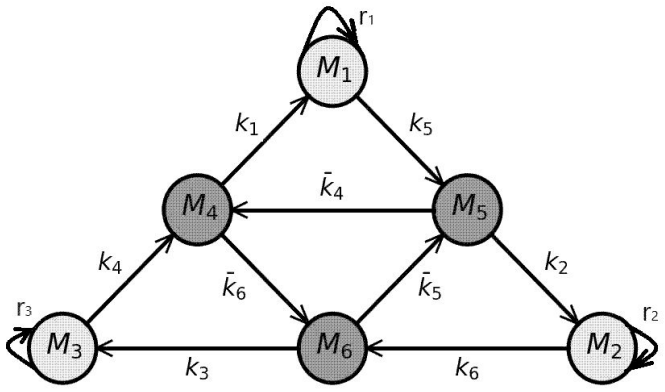
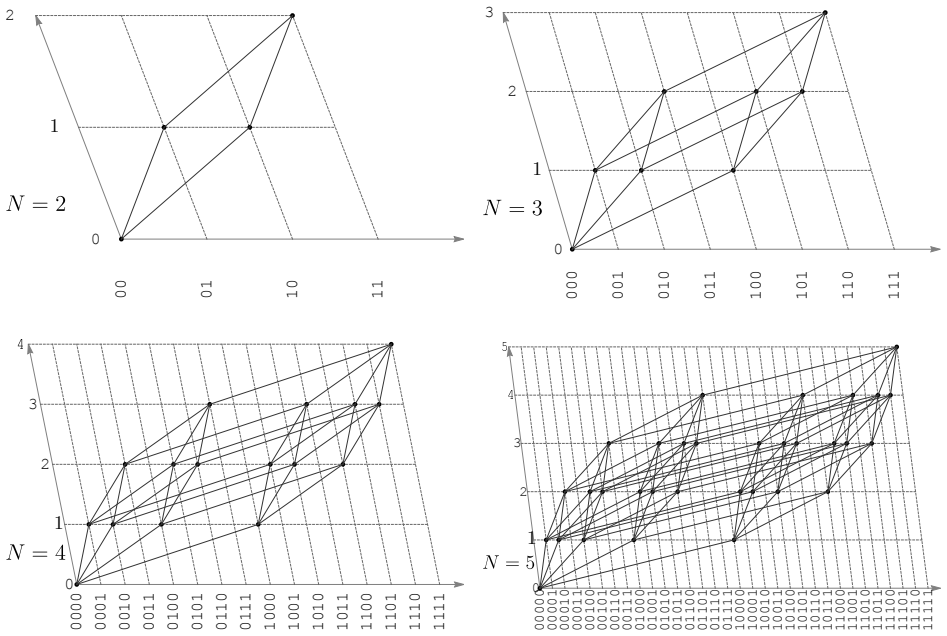
Starting from Kolmogorov equations for interacting populations, the replicator equation formalizes frequency changes among types according to relative fitness. In the hypercyclic regime, the system is permanent and carries evolutionary variability intrinsically. The quasispecies models exhibit globally stable equilibria, with sequence space structure revealing an error-threshold phenomenon that limits faithful replication.
What carries the argument
The replicator equation, which governs the time evolution of type frequencies based on their relative fitness in interacting populations.
If this is right
- Evolutionary processes in non-biological systems can be modeled by the same replicator dynamics if the three processes are definable.
- Hypercyclic organization guarantees long-term coexistence and ongoing variation without external intervention.
- The error threshold in quasispecies models sets a quantitative limit on mutation rates for stable inheritance.
Where Pith is reading between the lines
- The framework could extend to cultural or technological evolution by redefining types as memes or designs and fitness as adoption rates.
- Permanence of hypercycles suggests a mechanism for sustaining diversity in engineered systems like synthetic biology circuits.
- Sequence space structure implies that high-dimensional type spaces naturally produce error thresholds, testable in digital evolution experiments.
Load-bearing premise
Heredity, variability, and selection can be meaningfully defined for any system regardless of the specific biological substrate.
What would settle it
An observed evolutionary system where frequency dynamics deviate from replicator predictions even after fitness differences are measured, or a hypercycle simulation that fails to remain permanent under standard assumptions.
Figures





read the original abstract
This chapter is an overview of foundational results in the mathematical theory of replicator systems. Its primary aim is to provide a unified framework for the mathematical formalisation of evolutionary processes in the spirit of generalised Darwinism -- that is, for any system in which heredity, variability, and selection can be meaningfully defined, regardless of the specific biological substrate. Starting from the Kolmogorov equations for interacting populations, we derive the replicator equation and examine three canonical regimes: independent, autocatalytic, and hypercyclic replication. The hypercycle is shown to be permanent and to carry evolutionary variability intrinsically. We then survey the quasispecies framework -- the Eigen and Crow--Kimura models -- covering global stability of equilibria, sequence space structure, and the error-threshold phenomenon. Throughout, the emphasis is on the mathematical structures that underlie these models rather than on biological detail, with the goal of making the framework applicable to abstract evolutionary dynamics beyond its original molecular biology context.
Editorial analysis
A structured set of objections, weighed in public.
Referee Report
Summary. This chapter is an overview of foundational results in the mathematical theory of replicator systems. It derives the replicator equation from the Kolmogorov equations for interacting populations, examines three canonical regimes (independent, autocatalytic, and hypercyclic replication), demonstrates the permanence of the hypercycle along with its intrinsic evolutionary variability, and surveys the quasispecies framework (Eigen and Crow-Kimura models) with attention to global stability of equilibria, sequence space structure, and the error-threshold phenomenon. The emphasis is on mathematical structures to support a unified framework for generalized Darwinism applicable beyond specific biological substrates.
Significance. If the standard derivations and referenced properties hold as presented, the chapter provides a clear, unified introduction to replicator dynamics that facilitates application to abstract evolutionary systems. It earns credit for explicitly grounding all core results (hypercycle permanence, quasispecies equilibria, error threshold) in prior literature rather than introducing new unverified claims, and for prioritizing mathematical structures over biological detail to enable broader use in generalized Darwinism.
minor comments (2)
- [Derivation of the replicator equation] The transition from Kolmogorov population dynamics to the replicator equation in the independent replication regime would benefit from an explicit intermediate step showing how the frequency variables are introduced, to improve accessibility for readers outside mathematical biology.
- [Quasispecies framework] The survey of sequence space structure in the quasispecies section assumes familiarity with Hamming distance metrics; a brief reminder of the metric and its role in the error threshold would strengthen the presentation without adding length.
Simulated Author's Rebuttal
We thank the referee for the positive assessment of the chapter, the accurate summary of its content, and the recommendation to accept. We are pleased that the emphasis on mathematical structures supporting a unified framework for generalized Darwinism was recognized.
Circularity Check
No significant circularity; standard overview of prior results
full rationale
This chapter is presented as an introductory survey deriving the replicator equation from Kolmogorov dynamics and summarizing established permanence results for hypercycles plus Eigen/Crow-Kimura quasispecies properties. All load-bearing statements explicitly reference classical literature rather than introducing new fitted parameters, self-definitions, or uniqueness theorems that reduce to the authors' own prior work. No equations or claims within the provided text reduce by construction to inputs supplied by the same manuscript; the derivation chain remains externally anchored.
Axiom & Free-Parameter Ledger
axioms (2)
- standard math Kolmogorov equations for interacting populations form the starting point
- domain assumption Heredity, variability, and selection can be defined for any system
Lean theorems connected to this paper
-
IndisputableMonolith/Cost/FunctionalEquation.leanwashburn_uniqueness_aczel unclear?
unclearRelation between the paper passage and the cited Recognition theorem.
Starting from the Kolmogorov equations... one obtains the replicator equation dui/dt = ui[(Au)i − f(u)]
-
IndisputableMonolith/Foundation/RealityFromDistinction.leanreality_from_one_distinction unclear?
unclearRelation between the paper passage and the cited Recognition theorem.
A replicator system is permanent iff there exists p ∈ int Sn such that (p, A ū) > (ū, A ū) for all boundary equilibria ū
-
IndisputableMonolith/Foundation/AlphaCoordinateFixation.leanalpha_pin_under_high_calibration unclear?
unclearRelation between the paper passage and the cited Recognition theorem.
lim μ→∞ m̄(μ) = 2−N Σ CkN mk (limiting stabilisation of leading eigenvalue)
What do these tags mean?
- matches
- The paper's claim is directly supported by a theorem in the formal canon.
- supports
- The theorem supports part of the paper's argument, but the paper may add assumptions or extra steps.
- extends
- The paper goes beyond the formal theorem; the theorem is a base layer rather than the whole result.
- uses
- The paper appears to rely on the theorem as machinery.
- contradicts
- The paper's claim conflicts with a theorem or certificate in the canon.
- unclear
- Pith found a possible connection, but the passage is too broad, indirect, or ambiguous to say the theorem truly supports the claim.
Forward citations
Cited by 1 Pith paper
-
Chapter 2: Geometry of the Fitness Surface and Trajectory Dynamics of Replicator Systems
Replicator trajectories generally fail to reach the global maximum of the mean fitness surface unless the fitness matrix satisfies specific structural conditions such as being circulant, in which case the unique stabl...
Reference graph
Works this paper leans on
-
[1]
Allen Lane, London, 1997
Deutsch, D.The Fabric of Reality: The Science of Parallel Universes—and Its Implica- tions. Allen Lane, London, 1997
1997
-
[2]
Oxford University Press, Oxford, 1976
Dawkins, R.The Selfish Gene. Oxford University Press, Oxford, 1976
1976
-
[3]
I.Ordinary Differential Equations
Arnold, V. I.Ordinary Differential Equations. MIT Press, Cambridge, MA, 1978
1978
-
[4]
Naturwissenschaften 1971, 58(10), 465–523
Eigen, M. Selforganization of matter and the evolution of biological macromolecules. Naturwissenschaften, 58(10):465–523, 1971. doi:10.1007/BF00623322
-
[5]
A principle of natural self -organization
Eigen, M., & Schuster, P. The hypercycle. A principle of natural self-organization. Part A: Emergence of the hypercycle.Naturwissenschaften, 64(11):541–565, 1977. doi:10.1007/BF00450633
-
[6]
Stages of emerging life—five principles of early organization
Eigen, M., & Schuster, P. Stages of emerging life—five principles of early organization. Journal of Molecular Evolution, 19(1):47–61, 1982. doi:10.1007/BF02100223
-
[7]
A., Ginzburg, L
Gimel’farb, A. A., Ginzburg, L. R., Poluektov, R. A., et al.Dinamicheskaya teoriya bi- ologicheskikh populyatsii[Dynamic Theory of Biological Populations]. Nauka, Moscow,
-
[8]
M., & Logofet, D
Svirezhev, Yu. M., & Logofet, D. O.Ustoychivost’ biologicheskikh soobshchestv[Stability of Biological Communities]. Nauka, Moscow, 1978. [in Russian]
1978
-
[9]
Maynard Smith, J., & Price, G. R. The logic of animal conflict.Nature, 246:15–18, 1973. doi:10.1038/246015a0
-
[10]
Taylor, P. D., & Jonker, L. B. Evolutionary stable strategies and game dynamics.Math- ematical Biosciences, 40(1–2):145–156, 1978. doi:10.1016/0025-5564(78)90077-9
-
[11]
Lincoln, T. A., & Joyce, G. F. Self-sustained replication of an RNA enzyme.Science, 323(5918):1229–1232, 2009. doi:10.1126/science.1167856
-
[12]
L., Chen, I
Vaidya, N., Manapat, M. L., Chen, I. A., Xulvi-Brunet, R., Hayden, E. J., & Lehman, N. Spontaneous network formation among cooperative RNA replicators.Nature, 491:72–77,
-
[13]
doi:10.1038/nature11549
-
[14]
Cambridge University Press, Cambridge, 1998
Hofbauer, J., & Sigmund, K.Evolutionary Games and Population Dynamics. Cambridge University Press, Cambridge, 1998
1998
-
[15]
Evolutionary game dynamics.Bulletin of the American Mathematical Society, 40(4):479–519, 2003
Hofbauer, J., & Sigmund, K. Evolutionary game dynamics.Bulletin of the American Mathematical Society, 40(4):479–519, 2003. doi:10.1090/S0273-0979-03-00988-1
-
[16]
Drozhzhin, S., Yakushkina, T., & Bratus, A. S. Fitness optimization and evolution of permanent replicator systems.Journal of Mathematical Biology, 82(3):15, 2021. doi:10.1007/s00285-021-01548-8
-
[17]
Princeton University Press, Princeton, NJ, 2009
Sigmund, K.The Calculus of Selfishness. Princeton University Press, Princeton, NJ, 2009
2009
-
[18]
A.The Genetical Theory of Natural Selection
Fisher, R. A.The Genetical Theory of Natural Selection. Clarendon Press, Oxford, 1930
1930
-
[19]
Universal classe s of hash functions
Hofbauer, J., Schuster, P., & Sigmund, K. A note on evolutionarily stable strategies and game dynamics.Journal of Theoretical Biology, 81(3):609–612, 1979. doi:10.1016/0022- 5193(79)90058-4
-
[20]
McGraw-Hill, New York, 1960
Bellman, R.Introduction to Matrix Analysis, 2nd ed. McGraw-Hill, New York, 1960
1960
-
[21]
P., & Lefschetz, S.Stability by Liapunov’s Direct Method with Applications
LaSalle, J. P., & Lefschetz, S.Stability by Liapunov’s Direct Method with Applications. Academic Press, New York, 1961
1961
-
[22]
E.Linear Algebra
Shilov, G. E.Linear Algebra. Dover Publications, New York, 1977
1977
-
[23]
John Murray, Lon- don, 1859
Darwin, C.On the Origin of Species by Means of Natural Selection. John Murray, Lon- don, 1859
-
[24]
Mallet-Paret, J., & Smith, H. L. The Poincar´ e–Bendixson theorem for monotone cyclic feedback systems.Journal of Dynamics and Differential Equations, 2(4):367–421, 1990. doi:10.1007/BF01054041 33
-
[25]
Competitive exclusion of disjoint hypercycles.Journal of Physical Chem- istry, 216:35–39, 2002
Hofbauer, J. Competitive exclusion of disjoint hypercycles.Journal of Physical Chem- istry, 216:35–39, 2002
2002
-
[26]
S., Drozhzhin, S., & Yakushkina, T
Bratus, A. S., Drozhzhin, S., & Yakushkina, T. On the evolution of hypercycles.Math- ematical Biosciences, 306:119–125, 2018. doi:10.1016/j.mbs.2018.09.001
-
[27]
Hofbauer, J., Mallet-Paret, J., & Smith, H. L. Stable periodic solutions for the hy- percycle system.Journal of Dynamics and Differential Equations, 3(3):423–436, 1991. doi:10.1007/BF01049740
-
[28]
Tikhonov, A. N., Vasil’eva, A. B., & Sveshnikov, A. G.Differential Equations. Springer, Berlin, 1985. doi:10.1007/978-3-642-82175-2
-
[29]
F., & Kimura, M.An Introduction to Population Genetics Theory
Crow, J. F., & Kimura, M.An Introduction to Population Genetics Theory. Harper & Row, New York, 1970
1970
-
[30]
The selection mutation equation.Journal of Mathematical Biology, 23(1):41–53, 1985
Hofbauer, J. The selection mutation equation.Journal of Mathematical Biology, 23(1):41–53, 1985. doi:10.1007/BF00276557
-
[31]
Semenov, Y. S., Bratus, A. S., & Novozhilov, A. S. On the behavior of the leading eigen- value of Eigen’s evolutionary matrices.Mathematical Biosciences, 258:134–147, 2014. doi:10.1016/j.mbs.2014.10.004
-
[32]
Swetina, J., & Schuster, P. Self-replication with errors: a model for polynucleotide repli- cation.Biophysical Chemistry, 16(4):329–345, 1982. doi:10.1016/0301-4622(82)87037-3
-
[33]
Saakian, D. B., & Hu, C.-K. Eigen model as a quantum spin chain: exact dynamics. Physical Review E, 69:021913, 2004. doi:10.1103/PhysRevE.69.021913
-
[34]
Saakian, D. B., & Hu, C.-K. Exact solution of the Eigen model with general fitness functions and degradation rates.Proceedings of the National Academy of Sciences USA, 103(13):4935–4939, 2006. doi:10.1073/pnas.0504924103
-
[35]
Bratus, A. S., Novozhilov, A. S., & Semenov, Y. S. Linear algebra of the permutation invariant Crow–Kimura model of prebiotic evolution.Mathematical Biosciences, 256:42– 57, 2014. doi:10.1016/j.mbs.2014.08.006
-
[36]
Springer, Berlin, 1976
Kato, T.Perturbation Theory for Linear Operators, 2nd ed. Springer, Berlin, 1976
1976
-
[37]
Nowak, M., & Schuster, P. Error thresholds of replication in finite populations: mutation frequencies and the onset of Muller’s ratchet.Journal of Theoretical Biology, 137(4):375– 395, 1989. doi:10.1016/S0022-5193(89)80087-8
-
[38]
Eigen, M. Error catastrophe and antiviral strategy.Proceedings of the National Academy of Sciences USA, 99(21):13374–13376, 2002. doi:10.1073/pnas.212514699
-
[39]
Takeuchi, N., & Hogeweg, P. Error-thresholds exist in fitness landscapes with lethal mutations.BMC Evolutionary Biology, 7:15, 2007. doi:10.1186/1471-2148-7-15
-
[40]
Mathematical modeling of evolution
Schuster, P. Mathematical modeling of evolution. Solved and open problems.Theory in Biosciences, 130(1):71–89, 2011. doi:10.1007/s12064-010-0110-z 34
discussion (0)
Sign in with ORCID, Apple, or X to comment. Anyone can read and Pith papers without signing in.