Recognition: no theorem link
Neutrino transport and flavor instabilities in a post-merger disk
Pith reviewed 2026-05-10 18:31 UTC · model grok-4.3
The pith
Neutrino lepton-number crossings arise naturally in post-merger disks, triggering fast flavor instabilities.
A machine-rendered reading of the paper's core claim, the machinery that carries it, and where it could break.
Core claim
In the accretion disk, the neutrino radiation field naturally develops electron-lepton-number crossings through the interplay between the more isotropic electron neutrino field and the more anisotropic electron antineutrino field. The neutrino field in the disk is also unstable to fast flavor instabilities, although collisional flavor instabilities occur on longer timescales. Local multi-energy quantum-kinetic calculations show that unstable-mode growth matches fully anisotropic linear stability analysis, flavor transformation increases heavy-lepton neutrino fluxes, and collisional instabilities break heavy-flavor symmetry by raising antineutrino average energy. In global simulations with an
What carries the argument
Electron-lepton-number crossings in the neutrino angular distributions, formed by the differing isotropy of electron neutrinos and antineutrinos, which seed fast flavor instabilities via linear mode growth.
If this is right
- Flavor conversion increases heavy-lepton neutrino fluxes throughout the disk.
- Collisional instabilities raise the average energy of heavy-flavor antineutrinos above that of neutrinos and break heavy-flavor symmetry.
- The fast flavor instability remains dominant over the collisional one in most of the disk volume.
- Coherence and conversion appear primarily in polar regions because advection outruns growth under the attenuated Hamiltonian.
Where Pith is reading between the lines
- Accurate modeling of these instabilities will be required to predict nucleosynthesis yields in merger ejecta.
- Higher-resolution or unattenuated global simulations could reveal stronger flavor conversion inside the disk itself.
- The same angular-distribution mechanism may operate in other neutrino-rich environments such as core-collapse supernovae.
Load-bearing premise
The attenuation applied to the Hamiltonian in global quantum-kinetic simulations causes advection to outpace instability growth and artificially suppresses coherence inside the disk.
What would settle it
A global quantum-kinetic simulation without Hamiltonian attenuation that develops significant flavor coherence and conversion inside the disk rather than only in the polar regions.
Figures






read the original abstract
Neutron star mergers are multimessenger sources whose dynamics and signals depend critically on neutrinos and their flavor transformations. We investigate whether fast and collisional neutrino flavor instabilities (FFIs and CFIs) arise in a GW170817-like post-merger accretion disk, and how they develop and relax, by performing global and local classical and quantum-kinetic simulations that resolve anisotropies and inhomogeneities in the full six-dimensional phase space. In the accretion disk, the neutrino radiation field naturally develops electron-lepton-number crossings through the interplay between the more isotropic electron neutrino field and the more anisotropic electron antineutrino field. The neutrino field in the disk is also unstable to CFI, although on longer timescales than the FFI. Using local, multi-energy quantum-kinetic calculations at selected points, we find that the growth of unstable modes is well-predicted by a fully anisotropic linear stability analysis and the flavor transformation increases the heavy lepton neutrino fluxes. CFI likewise enhances heavy-flavor fluxes, shows significant impacts from the growth of multi-energy anisotropic modes, and breaks the symmetry of the heavy-flavor sector by raising the average energy of heavy-flavor antineutrinos above that of heavy-flavor neutrinos. However, the CFI remains subdominant to the FFI in most of the disk. In our global quantum-kinetic simulations with an attenuated Hamiltonian, flavor coherence develops primarily in the polar regions. Because the attenuation causes advection to outpace the growth of the instabilities, coherence and flavor conversion remain artificially suppressed within the disk. These results emphasize the resolution and scaling requirements for future global simulations that capture instability growth, saturation, and advection simultaneously.
Editorial analysis
A structured set of objections, weighed in public.
Referee Report
Summary. The manuscript claims that in a GW170817-like post-merger accretion disk, the neutrino radiation field develops electron-lepton-number (ELN) crossings through the interplay of isotropic electron neutrinos and anisotropic antineutrinos, rendering it unstable to collisional flavor instabilities (CFI) on longer timescales than fast flavor instabilities (FFI). Local multi-energy quantum-kinetic simulations and fully anisotropic linear stability analysis at selected points predict mode growth and show that flavor transformations increase heavy-lepton neutrino fluxes, with CFI enhancing heavy-flavor fluxes and breaking symmetry by raising average energies of heavy-flavor antineutrinos. Global quantum-kinetic simulations with an attenuated Hamiltonian, however, exhibit flavor coherence primarily in polar regions, as advection outpaces instability growth and artificially suppresses coherence and conversion in the disk. The work highlights resolution and scaling needs for future global simulations.
Significance. This research is significant for multimessenger astrophysics, as neutrino flavor transformations in merger disks can influence observable signals and nucleosynthesis yields. The integration of global classical/quantum-kinetic simulations with local detailed calculations and linear analysis offers a comprehensive approach to studying instabilities in six-dimensional phase space. Strengths include the use of fully anisotropic linear stability analysis to predict growth rates and the identification of multi-energy effects in CFI. If the limitations from the attenuated Hamiltonian are addressed, the findings could guide future simulations of flavor evolution in realistic environments.
major comments (2)
- [Abstract] Abstract: The assertion that the neutrino field in the disk 'naturally develops electron-lepton-number crossings' and 'is also unstable to CFI' is not supported by the global quantum-kinetic simulations, which use an attenuated Hamiltonian leading to advection outpacing growth and suppressing coherence within the disk. This renders the disk-wide claims dependent on local calculations whose validity under global transport is untested, as explicitly noted in the abstract.
- [Local multi-energy quantum-kinetic calculations] Local multi-energy quantum-kinetic calculations section: The reported growth rates, flux changes, and mode predictions lack quantitative error bars, convergence tests, or full datasets. This weakens validation of the linear stability analysis predictions and the claimed CFI impacts on heavy-flavor fluxes and symmetry breaking.
minor comments (1)
- [Abstract] The abstract is information-dense; clearer separation of local versus global results and explicit caveats on the attenuated Hamiltonian would improve readability.
Simulated Author's Rebuttal
We thank the referee for their detailed and constructive report. We address each major comment below and outline revisions that strengthen the manuscript while preserving the accuracy of our findings. The global simulations with an attenuated Hamiltonian are presented with their limitations explicitly noted, and the local analyses provide supporting evidence at representative points.
read point-by-point responses
-
Referee: [Abstract] Abstract: The assertion that the neutrino field in the disk 'naturally develops electron-lepton-number crossings' and 'is also unstable to CFI' is not supported by the global quantum-kinetic simulations, which use an attenuated Hamiltonian leading to advection outpacing growth and suppressing coherence within the disk. This renders the disk-wide claims dependent on local calculations whose validity under global transport is untested, as explicitly noted in the abstract.
Authors: We agree that the abstract must carefully distinguish between the local and global results. The manuscript already states that the global runs employ an attenuated Hamiltonian, causing advection to outpace instability growth and suppressing coherence inside the disk. The statements regarding natural development of ELN crossings and CFI instability are grounded in the local multi-energy quantum-kinetic calculations and fully anisotropic linear stability analysis performed at selected disk points. These local results are presented as representative of conditions within the disk. To address the referee's concern, we will revise the abstract to explicitly qualify the disk-wide claims as informed by the local analyses while reiterating the advection-limited nature of the global simulations. This revision clarifies the scope without altering the scientific content. revision: partial
-
Referee: [Local multi-energy quantum-kinetic calculations] Local multi-energy quantum-kinetic calculations section: The reported growth rates, flux changes, and mode predictions lack quantitative error bars, convergence tests, or full datasets. This weakens validation of the linear stability analysis predictions and the claimed CFI impacts on heavy-flavor fluxes and symmetry breaking.
Authors: We acknowledge that additional quantitative validation would improve the presentation. In the revised manuscript we will add error estimates derived from ensembles of runs with perturbed initial conditions and varied energy resolutions, together with explicit convergence tests for the reported growth rates and flux modifications. We will also deposit the simulation data and analysis scripts in a public repository to enable independent verification of the mode predictions and CFI effects on heavy-flavor fluxes and symmetry breaking. These additions directly strengthen the validation of the linear stability analysis. revision: yes
Circularity Check
No significant circularity; claims rest on forward simulations
full rationale
The paper's central claims—that ELN crossings develop naturally from isotropy differences between electron neutrinos and antineutrinos, and that the disk is unstable to CFI (subdominant to FFI)—are obtained by solving the neutrino transport and quantum-kinetic equations numerically in both global and local setups. No equations reduce to fitted inputs by construction, no parameters are tuned to reproduce the target instabilities, and no self-citations import uniqueness theorems or ansatzes that would make the result tautological. The abstract explicitly flags the artificial suppression of coherence inside the disk due to Hamiltonian attenuation, but this is a stated limitation of the method rather than a hidden circularity. The derivation chain is therefore self-contained against external benchmarks (the simulations themselves), yielding an honest non-finding of circularity.
Axiom & Free-Parameter Ledger
axioms (2)
- domain assumption Neutrino flavor evolution can be modeled with classical and quantum-kinetic transport equations in six-dimensional phase space
- domain assumption Fully anisotropic linear stability analysis accurately predicts growth rates of unstable modes
Forward citations
Cited by 3 Pith papers
-
Collective neutrino-antineutrino pair oscillations
In anisotropic neutrino gases, νν-bar pairing instabilities emerge when the excessive pair-occupation number distribution changes sign, producing pair conversions at growth rates comparable to fast flavor instabilities.
-
Fast Neutrino-Flavor Conversion with Attenuation and Global Lepton Gradient
Steep radial lepton gradients suppress fast neutrino-flavor conversion in global spherical simulations; the suppression depends strongly on the attenuation parameter and is explained by an adiabatic condition on flavo...
-
Dynamic Competition of Fast and Collisional Neutrino Flavor Instabilities with Collisional Damping in Spatially Inhomogeneous Systems
Numerical quantum-kinetic simulations demonstrate that collisional damping alters intermediate dynamics of coexisting fast and collisional neutrino flavor instabilities yet drives all unstable cases to the identical f...
Reference graph
Works this paper leans on
-
[1]
class” and quantum kinetics, “QKE
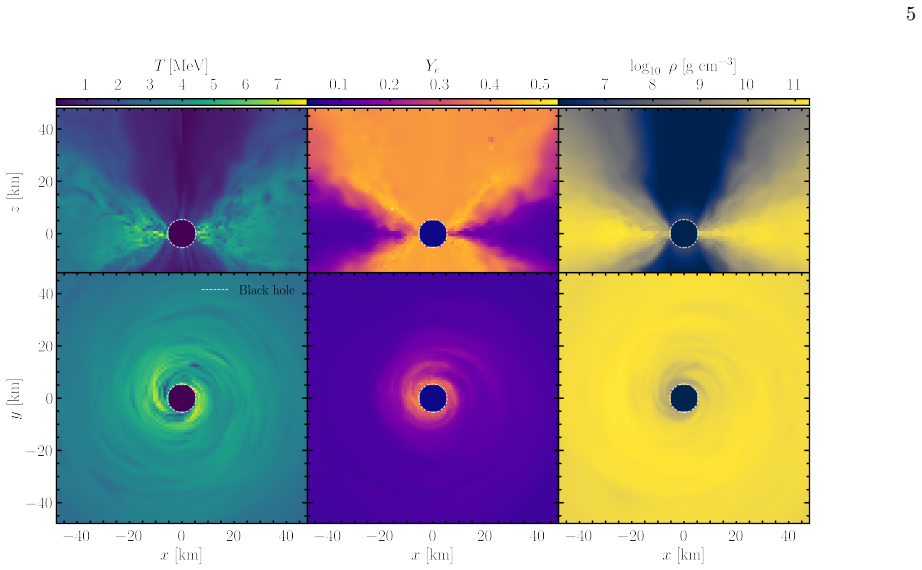
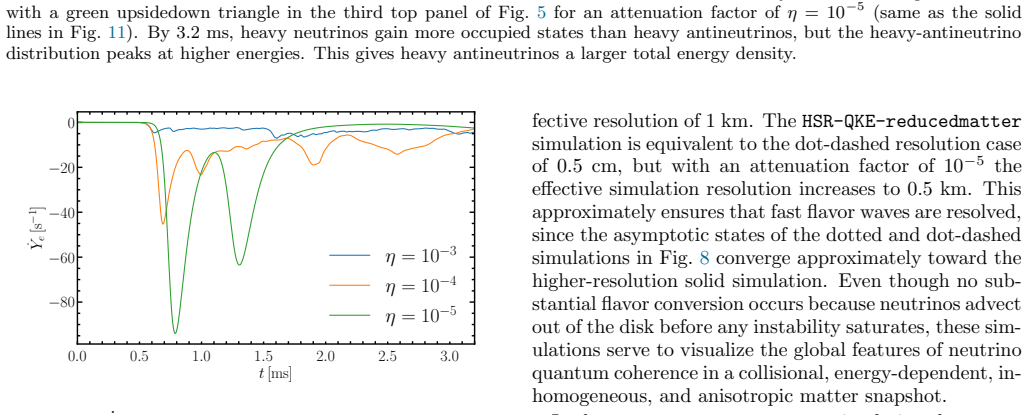
using theSFHoequation of state and a Monte- Carlo neutrino transport scheme with neutrino emission, absorption, and scattering. The setup involves a Kerr black hole spacetime with a mass ofM BH = 2.58M⊙ and spina= 0.69, along with a torus initially in hydrostatic equilibrium, entropys= 4k B/baryon, electron fraction Ye = 0.1, and disk massM d = 0.12M⊙ [9,...
-
[2]
Before FFC
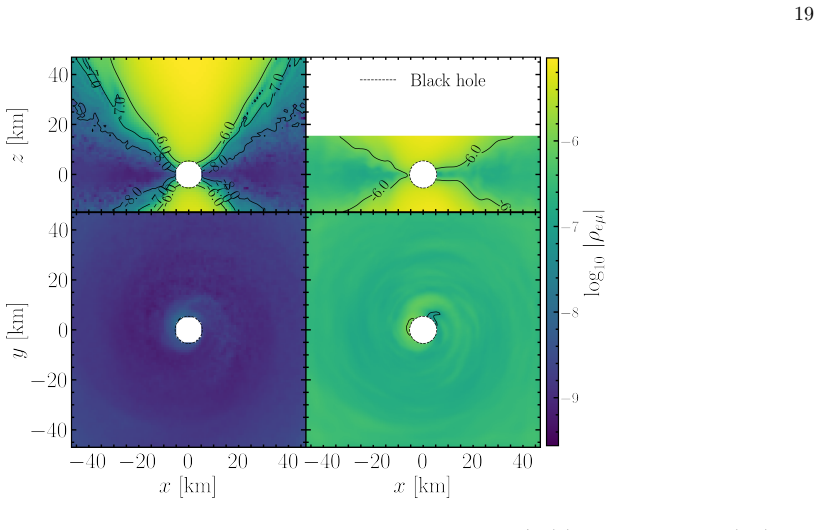
Global analysis on the classical radiation field Following Ref. [107], we define the electron lepton num- ber (ELN) – heavy lepton number (XLN) angular distri- bution as ∆G= (G νe −G ¯νe)−(G νx −G ¯νx),(11) where the angular distribution of neutrinos of flavoriis Gνi(Ω) = √ 2GF 4π Z E2 dE (hc)3 fνi(E,Ω).(12) 7 FIG. 2. Number densities of electron neutrino...
-
[3]
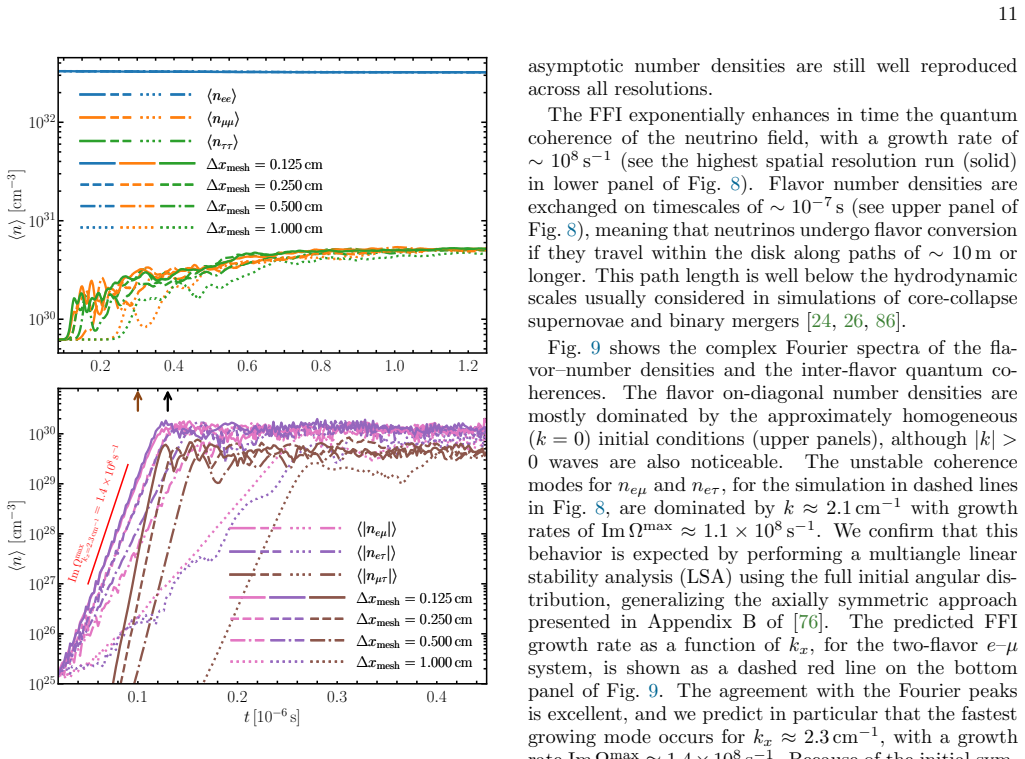
Local study of the FFI To investigate the small-scale behavior of the FFI in our post-merger disk, we perform a local neutrino quan- tum kinetics simulation at the location identified with a black circular marker in the left panels of Fig. 5. Specif- ically, the full angular data at this location, shown in the top row of Fig. 7, is used as initial conditi...
-
[4]
Global analysis on the classical radiation field To get some intuition regarding the origin of the CFI, we perform both a monochromatic and a multi-energy LSA in the steady state solution of the neutrino radi- ation field for theHAR-classsimulation in Figs. 2 and
-
[5]
Method B
The monochromatic case enables an analytic descrip- tion of the CFI and helps with building intuition, while the multi-energy calculations are needed for accurate re- sults (although we note that the discrepancy between these approaches was suggested to be much larger in CCSN environments [57] than in NSM ones [77]). We consider charged-current interactio...
-
[6]
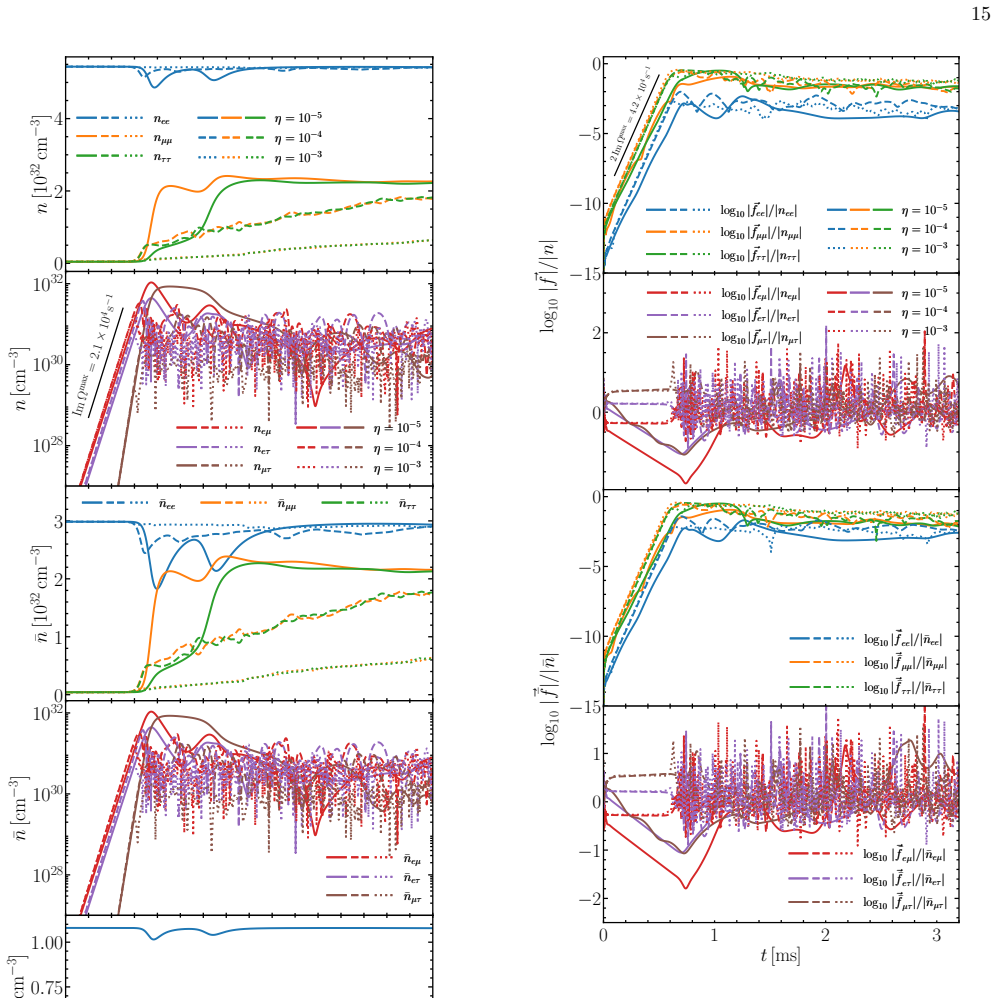
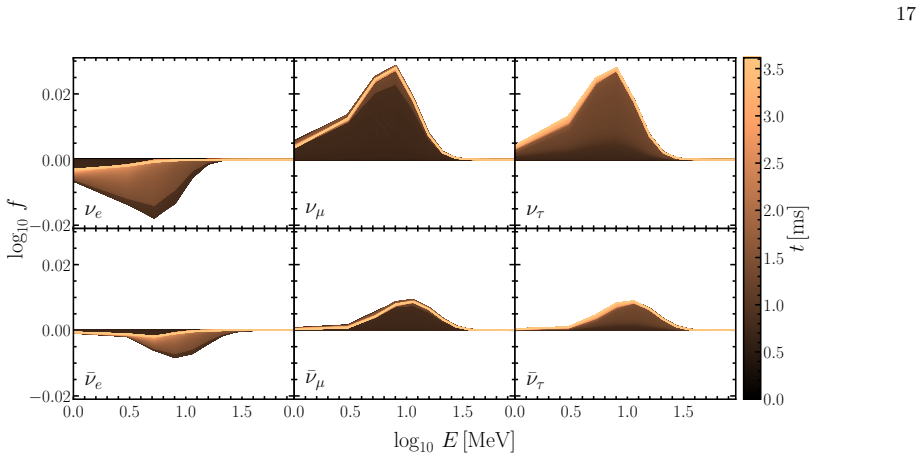
Local study of the CFI a. Simulation setupTo assess the potential effect of the CFI in our post-merger disk, we perform a multi- energy collisional neutrino flavor transformation simu- lation in a small domain inside the post-merger disk. We extracted the neutrino configuration from the point marked with a green upsidedown triangle in the third top panel ...
-
[7]
Burns,Neutron Star Mergers and How to Study Them,Living Rev
E. Burns, Living Rev. Rel.23, 4 (2020), arXiv:1909.06085 [astro-ph.HE]
-
[8]
R. Fern´ andez and B. D. Metzger, Ann. Rev. Nucl. Part. Sci.66, 23 (2016), arXiv:1512.05435 [astro-ph.HE]
-
[9]
R. Margutti and R. Chornock, Ann. Rev. Astron. Astro- phys.59, 155 (2021), arXiv:2012.04810 [astro-ph.HE]
- [11]
-
[12]
Margalit and B
B. Margalit and B. D. Metzger, The Astrophysical Jour- nal Letters880, L15 (2019)
2019
-
[13]
Foucart, P
F. Foucart, P. M¨ osta, T. Ramirez, A. J. Wright, S. Darbha, and D. Kasen, Phys. Rev. D104, 123010 (2021)
2021
-
[14]
M¨ osta, D
P. M¨ osta, D. Radice, R. Haas, E. Schnetter, and S. Bernuzzi, The Astrophysical Journal Letters901, L37 (2020)
2020
- [15]
-
[16]
Nedora, F
V. Nedora, F. Schianchi, S. Bernuzzi, D. Radice, B. Daszuta, A. Endrizzi, A. Perego, A. Prakash, and F. Zappa, Classical and Quantum Gravity39, 015008 (2021)
2021
-
[17]
Zhu and L
Z. Zhu and L. Rezzolla, Phys. Rev. D104, 083004 (2021)
2021
- [18]
-
[19]
O. Just, S. Goriely, H.-T. Janka, S. Nagataki, and A. Bauswein, Monthly Notices of the Royal Astronom- ical Society509, 1377 (2022)
2022
-
[20]
B. P. Abbottet al.(LIGO Scientific, Virgo), Phys. Rev. Lett.119, 161101 (2017), arXiv:1710.05832 [gr-qc]
work page internal anchor Pith review arXiv 2017
-
[21]
B. P. Abbottet al., Astrophys. J. Lett.848, L12 (2017), arXiv:1710.05833 [astro-ph.HE]
work page Pith review arXiv 2017
- [22]
- [23]
-
[24]
Barnes, Front
J. Barnes, Front. in Phys.8, 355 (2020)
2020
-
[25]
Foucart, inReference Module in Materials Science and Materials Engineering(Elsevier, 2025)
F. Foucart, inReference Module in Materials Science and Materials Engineering(Elsevier, 2025)
2025
- [26]
-
[27]
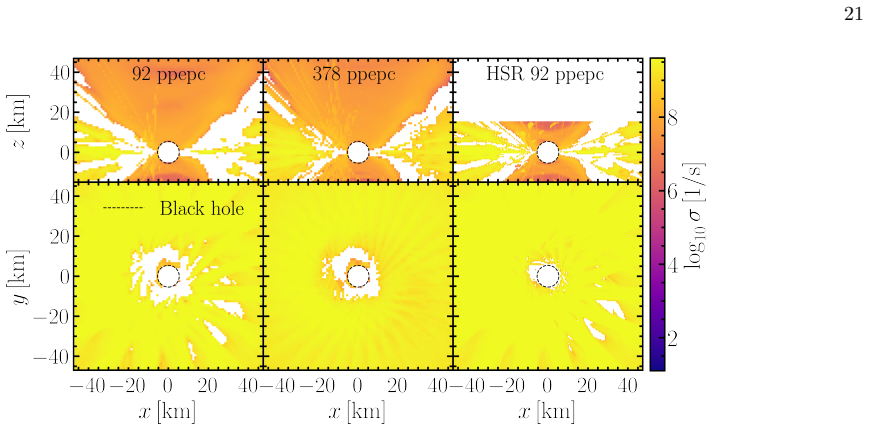
S. Curtis, J. M. Miller, C. Frohlich, T. Sprouse, 21 FIG. 16. Fast flavor instability growth rates in the GW170817 post-merger disk simulations with angular resolutions of 92 (left), 378 (center). All other parameters match those of theHAR-classsimulation (Table I). The right panels show the FFI growth rate for the high spatial resolution (HSR) simulation...
- [28]
-
[29]
J. Lippuner, R. Fern´ andez, L. F. Roberts, F. Foucart, D. Kasen, B. D. Metzger, and C. D. Ott, Mon. Not. Roy. Astron. Soc.472, 904 (2017), arXiv:1703.06216 [astro- ph.HE]
-
[30]
K. A. Lund, P. Mukhopadhyay, J. M. Miller, and G. C. McLaughlin, Astrophys. J. Lett.985, L9 (2025)
2025
-
[31]
O. Just, S. Abbar, M.-R. Wu, I. Tamborra, H.-T. Janka, and F. Capozzi, Phys. Rev. D105, 083024 (2022)
2022
- [32]
-
[33]
Kajita, Nuclear Physics B - Proceedings Supplements 77, 123 (1999)
T. Kajita, Nuclear Physics B - Proceedings Supplements 77, 123 (1999)
1999
-
[34]
Q. R. Ahmad, R. C. Allen, T. C. Andersen,et al.(SNO Collaboration), Phys. Rev. Lett.87, 071301 (2001)
2001
-
[35]
Wolfenstein, Phys
L. Wolfenstein, Phys. Rev. D17, 2369 (1978)
1978
-
[36]
Mikheev and A
S. Mikheev and A. Y. Smirnov, inSolar Neutrinos (CRC Press, 2018) pp. 305–309
2018
-
[37]
S. P. Mikheyev and A. Y. Smirnov, Il Nuovo Cimento C9, 10.1007/BF02508049 (1986)
-
[38]
J. T. Pantaleone, Phys. Lett. B287, 128 (1992)
1992
-
[39]
Sigl and G
G. Sigl and G. Raffelt, Nucl. Phys. B406, 423 (1993)
1993
-
[40]
Qian and G
Y.-Z. Qian and G. M. Fuller, Phys. Rev. D51, 1479 (1995)
1995
-
[41]
Richers, D
S. Richers, D. Willcox, and N. Ford, Physical Review D 104, 103023 (2021)
2021
-
[42]
Richers, H
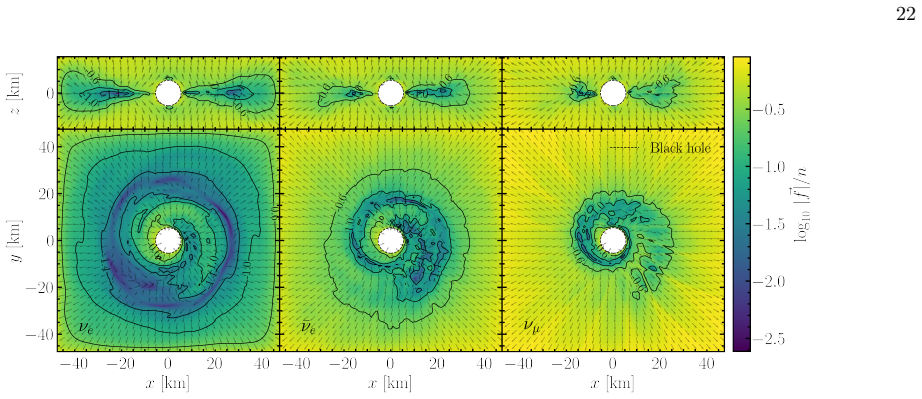
S. Richers, H. Duan, M.-R. Wu, S. Bhattacharyya, M. Zaizen, M. George, C.-Y. Lin, and Z. Xiong, Physical Review D106, 043011 (2022). 22 FIG. 18. Flux factors of electron (left), electron antineutrino (center), and muon neutrinos (right) for theHSR-classsimulation. Other heavy-flavor neutrinos and antineutrinos follow the same trend as the muon-neutrino pa...
2022
-
[43]
R. F. Sawyer, Phys. Rev. D72, 045003 (2005)
2005
-
[44]
Wu and I
M.-R. Wu and I. Tamborra, Phys. Rev. D95, 103007 (2017)
2017
-
[46]
George, M.-R
M. George, M.-R. Wu, I. Tamborra, R. Ardevol- Pulpillo, and H.-T. Janka, Phys. Rev. D102, 103015 (2020)
2020
-
[47]
Nagakura, A
H. Nagakura, A. Burrows, L. Johns, and G. M. Fuller, Phys. Rev. D104, 083025 (2021)
2021
-
[48]
I. Tamborra and S. Shalgar, Ann. Rev. Nucl. Part. Sci. 71, 165 (2021), arXiv:2011.01948 [astro-ph.HE]
- [49]
- [50]
-
[51]
Mukhopadhyay, J
P. Mukhopadhyay, J. Miller, and G. C. McLaughlin, The Astrophysical Journal974, 110 (2024)
2024
-
[52]
L. Johns, Phys. Rev. Lett.130, 191001 (2023), arXiv:2104.11369 [hep-ph]
-
[53]
Johns and Z
L. Johns and Z. Xiong, Phys. Rev. D106, 103029 (2022)
2022
-
[54]
Z. Xiong, M.-R. Wu, G. Mart´ ınez-Pinedo, T. Fischer, M. George, C.-Y. Lin, and L. Johns, Phys. Rev. D107, 083016 (2023), arXiv:2210.08254 [astro-ph.HE]
- [55]
- [57]
-
[59]
S. Shalgar and I. Tamborra, Phys. Rev. D109, 103011 (2024), arXiv:2307.10366 [astro-ph.HE]
- [60]
-
[61]
Zaizen, Phys
M. Zaizen, Phys. Rev. D111, 103029 (2025)
2025
-
[62]
J. Froustey, Phys. Rev. D112, 023029 (2025), arXiv:2505.16961 [hep-ph]
- [63]
-
[64]
V¨ a¨ an¨ anen and G
D. V¨ a¨ an¨ anen and G. McLaughlin, Physical Review D 93, 105044 (2016)
2016
-
[65]
Y.-L. Zhu, A. Perego, and G. C. McLaughlin, Physical Review D94, 105006 (2016)
2016
-
[66]
Vlasenko and G
A. Vlasenko and G. C. McLaughlin, Physical Review D 97, 083011 (2018)
2018
- [67]
-
[68]
Malkus, G
A. Malkus, G. McLaughlin, and R. Surman, Physical Review D93, 045021 (2016)
2016
-
[69]
M.-R. Wu, H. Duan, and Y.-Z. Qian, Physics Letters B 752, 89 (2016)
2016
-
[70]
Padilla-Gay, S
I. Padilla-Gay, S. Shalgar, and I. Tamborra, Journal of Cosmology and Astroparticle Physics2024(05), 037
- [71]
-
[72]
D. F. G. Fiorillo, H.-T. Janka, and G. G. Raffelt, Phys. Rev. Lett.135, 231003 (2025)
2025
-
[73]
D. F. G. Fiorillo and G. G. Raffelt, J. High Energy Phys. 2025(4), 146
2025
-
[74]
D. F. G. Fiorillo and G. G. Raffelt, J. High Energy Phys. 2025(6), 146
2025
-
[75]
S. Shalgar and I. Tamborra, J. Cosmol. Astropart. Phys. 09, 021, arXiv:2406.09504 [astro-ph.HE]
- [76]
- [77]
-
[78]
Dasgupta and A
B. Dasgupta and A. Mirizzi, Phys. Rev. D92, 125030 (2015)
2015
-
[79]
Chakraborty, R
S. Chakraborty, R. Hansen, I. Izaguirre, and G. Raffelt, Nucl. Phys. B908, 366 (2016)
2016
-
[80]
I. Padilla-Gay, H.-H. Chen, S. Abbar, M.-R. Wu, 23 and Z. Xiong, Phys. Rev. D112, 043039 (2025), arXiv:2505.11588 [astro-ph.HE]
-
[81]
H. Nagakura, K. Sumiyoshi, S. Fujibayashi, Y. Sekiguchi, and M. Shibata, Phys. Rev. D112, 043029 (2025), arXiv:2504.20143 [astro-ph.HE]
-
[82]
J. Froustey, S. Richers, E. Grohs, S. D. Flynn, F. Fou- cart, J. P. Kneller, and G. C. McLaughlin, Phys. Rev. D109, 043046 (2024), arXiv:2311.11968 [astro-ph.HE]
-
[83]
J. Froustey, F. Foucart, C. Hall, J. P. Kneller, D. Kundu, Z. Lin, G. C. McLaughlin, and S. Rich- ers, Phys. Rev. D113, 063050 (2026), arXiv:2601.02461 [astro-ph.HE]
-
[84]
Foucart, E
F. Foucart, E. O’Connor, L. Roberts, L. E. Kidder, H. P. Pfeiffer, and M. A. Scheel, Phys. Rev. D94, 123016 (2016)
2016
discussion (0)
Sign in with ORCID, Apple, or X to comment. Anyone can read and Pith papers without signing in.