Recognition: unknown
Fast Neutrino-Flavor Conversion with Attenuation and Global Lepton Gradient
Pith reviewed 2026-05-10 13:12 UTC · model grok-4.3
The pith
Steep radial lepton gradients suppress fast neutrino-flavor conversion when flavor waves cannot remain on the unstable branch long enough.
A machine-rendered reading of the paper's core claim, the machinery that carries it, and where it could break.
Core claim
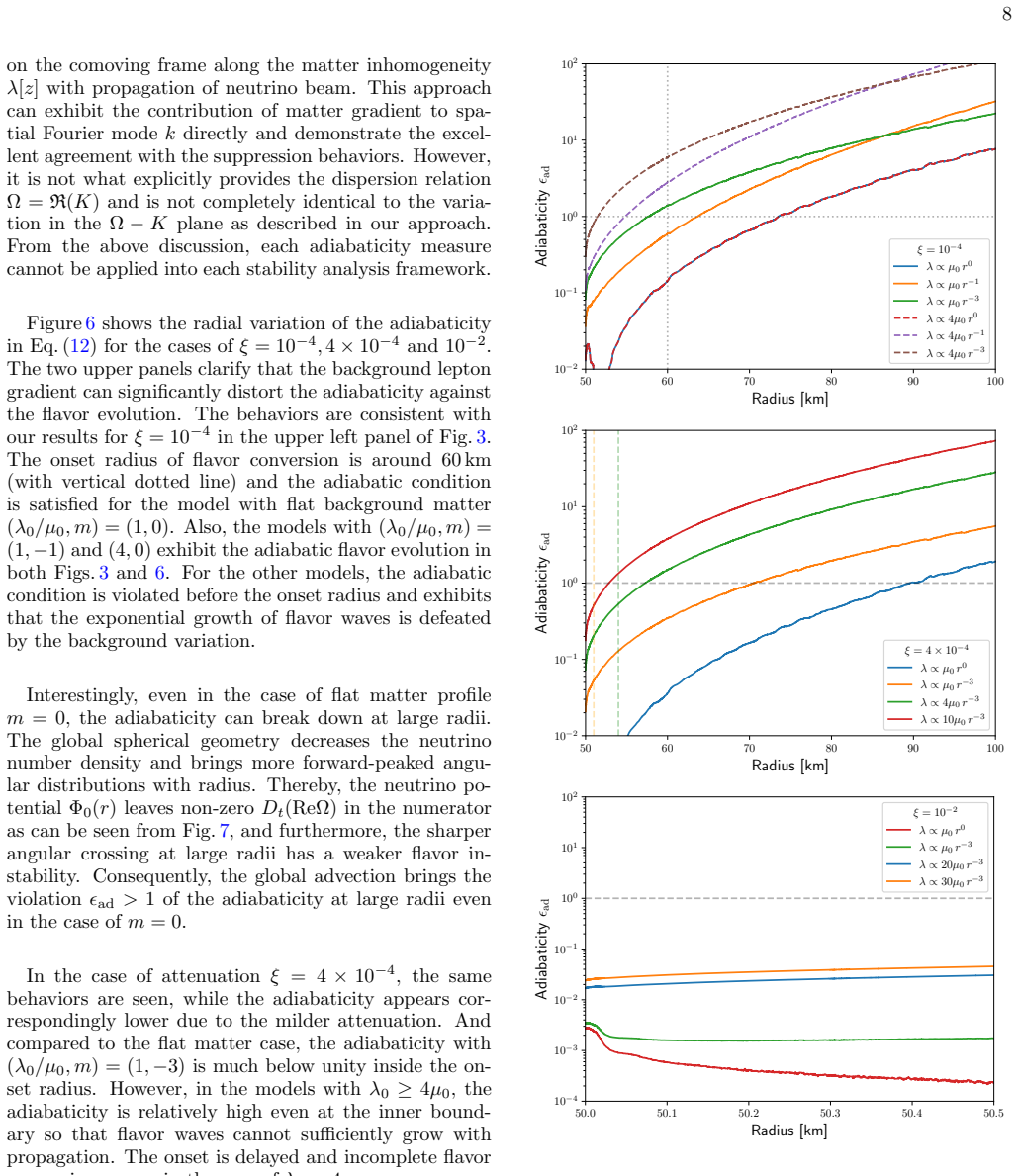
In spherical-geometry quantum-kinetic simulations, steep radial lepton gradients suppress fast neutrino-flavor conversion because flavor waves leave the unstable branch of the local dispersion relation before sufficient coherence grows. Attenuation lengthens the required growth time, making it harder for waves to follow the shifting unstable region. An adiabatic condition quantifies when conversion can still occur, and an approximate formula is supplied for use in classical neutrino-transport models.
What carries the argument
The adiabatic condition on flavor-wave propagation, which requires the wave to remain on the unstable branch of the local dispersion relation long enough for coherence to grow despite background shifts and attenuation.
If this is right
- Steep radial lepton gradients in CCSN and BNSM environments can locally suppress FFC.
- Suppression strength depends sensitively on the value chosen for the attenuation parameter.
- An approximate adiabaticity formula can be inserted directly into classical neutrino transport codes.
- Attenuation in global simulations tends to overestimate the quenching effect of background variations.
Where Pith is reading between the lines
- In full three-dimensional models the same adiabatic criterion would predict patchy regions of conversion where gradients are shallow enough.
- Classical transport schemes could use the supplied formula as a sub-grid check to decide where full quantum-kinetic treatment is required.
- If physical damping mechanisms produce effective attenuation, the same mechanism might suppress FFC even more strongly than the simulations indicate.
Load-bearing premise
The attenuated oscillation Hamiltonian together with spherical symmetry and a static background sufficiently captures the essential global quantum-kinetic behavior without introducing artifacts that dominate the reported sensitivity to attenuation.
What would settle it
A controlled simulation or analytic calculation that tracks flavor coherence growth for a known radial lepton gradient while varying the attenuation length, checking whether coherence saturates only when the wave stays on the unstable branch for a time exceeding the inverse growth rate.
Figures




read the original abstract
Fast neutrino-flavor conversion (FFC) can nontrivially alter neutrino radiation field in core-collapase supernovae (CCSN) and binary neutron-star merger (BNSM) remnants. However, its interplay with global geometry remains poorly understood because microscopic flavor conversion scales are much shorter than global transport scales. We perform global quantum kinetic neutrino transport simulations in spherical geometry with neutrino and matter backgrounds, using an attenuated oscillation Hamiltonian. We find that steep radial lepton gradients can suppress FFC, whereas the suppression is highly sensitive to the adopted attenuation parameter. This behavior is explained by an adiabatic condition: flavor coherence can grow sufficiently only while the flavor wave remains on the unstable branch in the local dispersion relation during propagation. Background variation shifts the unstable branch, while attenuation lengthens the growth timescale, making the flavor coherence following more difficult. We provide an approximate formula for the adiabaticity that can be used directly in CCSN and BNSM models developed by classical neutrino transport simulations. Our results show that attenuation artificially leads to an overestimation of the impact of background variation and should therefore be applied with caution in global simulations of neutrino flavor conversion.
Editorial analysis
A structured set of objections, weighed in public.
Referee Report
Summary. The manuscript reports global quantum kinetic simulations of fast neutrino-flavor conversion (FFC) in spherical geometry employing an attenuated oscillation Hamiltonian with static neutrino and matter backgrounds. It claims that steep radial lepton gradients suppress FFC, with the suppression highly sensitive to the attenuation parameter. This is interpreted through an adiabatic condition: flavor coherence grows only while the wave remains on the unstable branch of the local dispersion relation as it propagates. An approximate formula for the adiabaticity is derived and offered for direct use in classical neutrino transport models for CCSN and BNSM. The authors note that attenuation artificially overestimates the impact of background variations.
Significance. If the central result holds beyond the attenuated and static approximations, the work provides a concrete link between global lepton gradients and microscopic FFC, together with a practical approximate formula that could be adopted in existing classical transport codes. The explicit caution regarding overestimation by attenuation is a strength. However, the reported sensitivity to the artificial parameter and the static spherical setup limit the immediate physical robustness of the suppression claim and the formula.
major comments (2)
- [Abstract] Abstract: the reported suppression of FFC by steep radial lepton gradients is stated to be 'highly sensitive to the adopted attenuation parameter,' and attenuation is explicitly said to 'artificially lead to an overestimation of the impact of background variation.' Because the adiabatic condition and the approximate formula are both extracted from the same attenuated dynamics, this sensitivity is load-bearing for the central claim and its applicability to the unattenuated physical regime.
- [Methods / Simulation Setup] The simulations adopt spherical symmetry and static backgrounds. These choices isolate the propagation test but remove possible self-consistent back-reaction of flavor evolution on the lepton gradient itself. The adiabaticity argument relies on the local dispersion relation remaining well-defined under these approximations; any quantitative test of how back-reaction or non-spherical geometry alters the unstable branch would directly affect the reported suppression.
minor comments (2)
- [Abstract and Results] The abstract and results sections would benefit from explicit numerical values or ranges for the attenuation parameter in the sensitivity tests, together with a brief statement of resolution and convergence checks.
- [Throughout] Notation for the local dispersion relation and the adiabaticity criterion should be cross-referenced to the defining equations when first introduced in the text.
Simulated Author's Rebuttal
We thank the referee for the careful and constructive review of our manuscript. The comments highlight important aspects of the approximations used and their implications for the central claims. We address each major comment point by point below, with proposed revisions to strengthen the presentation of limitations while preserving the integrity of the reported results.
read point-by-point responses
-
Referee: [Abstract] Abstract: the reported suppression of FFC by steep radial lepton gradients is stated to be 'highly sensitive to the adopted attenuation parameter,' and attenuation is explicitly said to 'artificially lead to an overestimation of the impact of background variation.' Because the adiabatic condition and the approximate formula are both extracted from the same attenuated dynamics, this sensitivity is load-bearing for the central claim and its applicability to the unattenuated physical regime.
Authors: We agree that the sensitivity to the attenuation parameter is central and directly affects the applicability of the adiabatic condition and formula. The manuscript already states this sensitivity explicitly and cautions that attenuation overestimates the impact of background variations. To address the concern, we will revise the abstract to more prominently note that both the adiabatic condition and the approximate formula are derived within the attenuated framework, serving as a practical but cautious tool for classical transport codes rather than a direct extrapolation to the unattenuated regime. This revision reinforces the load-bearing nature of the sensitivity without altering the core findings. revision: yes
-
Referee: [Methods / Simulation Setup] The simulations adopt spherical symmetry and static backgrounds. These choices isolate the propagation test but remove possible self-consistent back-reaction of flavor evolution on the lepton gradient itself. The adiabaticity argument relies on the local dispersion relation remaining well-defined under these approximations; any quantitative test of how back-reaction or non-spherical geometry alters the unstable branch would directly affect the reported suppression.
Authors: Spherical symmetry and static backgrounds were chosen specifically to isolate the effect of radial lepton gradients on flavor-wave propagation and to enable a clean derivation of the adiabatic condition from the local dispersion relation. Including self-consistent back-reaction would introduce dynamical evolution of the backgrounds, which is computationally demanding and beyond the scope of this work focused on the propagation mechanism. The local dispersion relation remains well-defined under the static approximation, supporting the adiabatic analysis. We will expand the discussion section to explicitly acknowledge these limitations, discuss their potential influence on the unstable branch, and outline how non-spherical or dynamic extensions could modify the suppression. revision: partial
Circularity Check
No significant circularity in the derivation chain
full rationale
The paper reports results from global quantum-kinetic simulations that employ an attenuated oscillation Hamiltonian in spherical static backgrounds, observes suppression of FFC by steep lepton gradients, and attributes the outcome to an adiabatic condition based on the local dispersion relation. An approximate formula for adiabaticity is supplied for use in classical transport models. Although the abstract explicitly notes sensitivity to the attenuation parameter and its artificial overestimation of background effects, the central explanatory step (adiabatic condition from dispersion analysis) is a standard theoretical construct applied to the simulation outputs rather than a quantity defined by or fitted directly to those outputs. No load-bearing step reduces by construction to the inputs, self-citation chains, or ansatz smuggling; the derivation remains self-contained against the stated approximations and external benchmarks.
Axiom & Free-Parameter Ledger
free parameters (1)
- attenuation parameter
axioms (2)
- domain assumption Spherical symmetry and static neutrino/matter backgrounds are adequate for capturing the global interplay between flavor conversion and lepton gradients.
- domain assumption The attenuated oscillation Hamiltonian approximates the essential quantum-kinetic evolution sufficiently to study the global suppression effect.
Forward citations
Cited by 3 Pith papers
-
Collective neutrino-antineutrino pair oscillations
In anisotropic neutrino gases, νν-bar pairing instabilities emerge when the excessive pair-occupation number distribution changes sign, producing pair conversions at growth rates comparable to fast flavor instabilities.
-
Flavomon ray tracing in matter gradients
Matter gradients slow but do not suppress neutrino-mass-induced flavor instabilities, so flavomon ray tracing is required instead of local stability analysis alone.
-
Dynamic Competition of Fast and Collisional Neutrino Flavor Instabilities with Collisional Damping in Spatially Inhomogeneous Systems
Numerical quantum-kinetic simulations demonstrate that collisional damping alters intermediate dynamics of coexisting fast and collisional neutrino flavor instabilities yet drives all unstable cases to the identical f...
Reference graph
Works this paper leans on
-
[1]
H. Duan, G. M. Fuller, and Y.-Z. Qian, Collective Neu- trino Oscillations, Annual Review of Nuclear and Particle Science60, 569 (2010)
2010
-
[2]
Richers and M
S. Richers and M. Sen, Fast Flavor Transformations, inHandbook of Nuclear Physics, edited by I. Tanihata, H. Toki, and T. Kajino (Springer Nature, Singapore,
-
[3]
I. Tamborra and S. Shalgar, New Developments in Fla- vor Evolution of a Dense Neutrino Gas, Annual Review of Nuclear and Particle Science 10.1146/annurev-nucl- 102920-050505 (2021)
-
[4]
M. C. Volpe, Neutrinos from dense environments: Flavor mechanisms, theoretical approaches, observations, and new directions, Reviews of Modern Physics96, 025004 (2024)
2024
-
[5]
Yamada, H
S. Yamada, H. Nagakura, R. Akaho, A. Harada, S. Fu- rusawa, W. Iwakami, H. Okawa, H. Matsufuru, and K. Sumiyoshi, Physical mechanism of core-collapse su- pernovae that neutrinos drive, Proceedings of the Japan Academy, Series B100, 190 (2024)
2024
- [6]
- [7]
-
[8]
M.-R. Wu, I. Tamborra, O. Just, and H.-T. Janka, Im- prints of neutrino-pair flavor conversions on nucleosyn- thesis in ejecta from neutron-star merger remnants, Phys- ical Review D96, 123015 (2017)
2017
-
[9]
Li and D
X. Li and D. M. Siegel, Neutrino Fast Flavor Conver- sions in Neutron-Star Postmerger Accretion Disks, Phys- ical Review Letters126, 251101 (2021)
2021
-
[10]
Fern´ andez, S
R. Fern´ andez, S. Richers, N. Mulyk, and S. Fahlman, Fast flavor instability in hypermassive neutron star disk outflows, Physical Review D106, 103003 (2022)
2022
-
[11]
O. Just, S. Abbar, M.-R. Wu, I. Tamborra, H.-T. Janka, and F. Capozzi, Fast neutrino conversion in hydrody- namic simulations of neutrino-cooled accretion disks, Physical Review D105, 083024 (2022)
2022
-
[12]
Ehring, S
J. Ehring, S. Abbar, H.-T. Janka, G. Raffelt, and I. Tam- borra, Fast neutrino flavor conversion in core-collapse su- pernovae: A parametric study in 1D models, Physical Review D107, 103034 (2023)
2023
-
[13]
Ehring, S
J. Ehring, S. Abbar, H.-T. Janka, G. Raffelt, and I. Tamborra, Fast Neutrino Flavor Conversions Can Help and Hinder Neutrino-Driven Explosions, Physical Review Letters131, 061401 (2023)
2023
-
[14]
Ehring, S
J. Ehring, S. Abbar, H.-T. Janka, G. Raffelt, K. Naka- mura, and K. Kotake, Gravitational-Wave Signatures of Nonstandard Neutrino Properties in Collapsing Stellar Cores, Physical Review Letters136, 021201 (2026)
2026
-
[15]
H. Nagakura and K. Sumiyoshi, Neutron star kick driven by asymmetric fast-neutrino flavor conversion, Physical Review D109, 103017 (2024), arXiv:2401.15180 [astro- ph, physics:gr-qc, physics:hep-ph]
-
[16]
K. Mori, T. Takiwaki, K. Kotake, and S. Horiuchi, Three- dimensional core-collapse supernova models with phe- nomenological treatment of neutrino flavor conversions, Publications of the Astronomical Society of Japan77, L9 (2025)
2025
-
[17]
T. Wang and A. Burrows, The Effect of the Fast-Flavor Instability on Core-Collapse Supernova Models (2025), arXiv:2503.04896 [astro-ph]
- [18]
-
[19]
K. A. Lund, P. Mukhopadhyay, J. M. Miller, and G. C. McLaughlin, Angle-dependent in Situ Fast Flavor Trans- formations in Post-neutron-star-merger Disks, The As- trophysical Journal Letters985, L9 (2025)
2025
-
[20]
Y. Qiu, D. Radice, S. Richers, and M. Bhattacharyya, Neutrino Flavor Transformation in Neutron Star Merg- ers, Physical Review Letters135, 091401 (2025)
2025
- [21]
-
[22]
Akaho, H
R. Akaho, H. Nagakura, and S. Yamada, Comparative testing of subgrid models for fast neutrino flavor con- versions in core-collapse supernova simulations, Physical Review D112, 043015 (2025)
2025
-
[23]
R. Akaho, H. Nagakura, W. Iwakami, S. Furusawa, A. Harada, H. Okawa, H. Matsufuru, K. Sumiyoshi, and S. Yamada, Bifurcated Impact of Neutrino Fast Fla- vor Conversion on Core-collapse Supernovae Informed by Multi-angle Neutrino Radiation Hydrodynamics (2026), arXiv:2601.08269 [astro-ph]
work page internal anchor Pith review arXiv 2026
-
[24]
R. F. Sawyer, Speed-up of neutrino transformations in a supernova environment, Physical Review D72, 045003 (2005)
2005
-
[25]
R. F. Sawyer, Neutrino Cloud Instabilities Just above the Neutrino Sphere of a Supernova, Physical Review Letters 116, 081101 (2016)
2016
-
[26]
Morinaga, Fast neutrino flavor instability and neutrino flavor lepton number crossings, Physical Review D105, L101301 (2022)
T. Morinaga, Fast neutrino flavor instability and neutrino flavor lepton number crossings, Physical Review D105, L101301 (2022)
2022
-
[27]
Dasgupta and D
B. Dasgupta and D. Mukherjee, Sufficient and necessary conditions for collective neutrino instability: Fast, slow, and mixed, Physical Review D112, 123049 (2025)
2025
-
[28]
Nagakura, T
H. Nagakura, T. Morinaga, C. Kato, and S. Yamada, Fast-pairwise Collective Neutrino Oscillations Associated with Asymmetric Neutrino Emissions in Core-collapse Supernovae, The Astrophysical Journal886, 139 (2019)
2019
-
[29]
Nagakura, A
H. Nagakura, A. Burrows, L. Johns, and G. M. Fuller, Where, when, and why: Occurrence of fast-pairwise collective neutrino oscillation in three-dimensional core- collapse supernova models, Physical Review D104, 083025 (2021)
2021
-
[30]
Morinaga, H
T. Morinaga, H. Nagakura, C. Kato, and S. Yamada, Fast neutrino-flavor conversion in the preshock region of core- collapse supernovae, Physical Review Research2, 012046 (2020)
2020
-
[31]
Delfan Azari, S
M. Delfan Azari, S. Yamada, T. Morinaga, H. Nagakura, S. Furusawa, A. Harada, H. Okawa, W. Iwakami, and K. Sumiyoshi, Fast collective neutrino oscillations inside the neutrino sphere in core-collapse supernovae, Physical Review D101, 023018 (2020)
2020
-
[32]
Abbar, H
S. Abbar, H. Duan, K. Sumiyoshi, T. Takiwaki, and M. C. Volpe, Fast neutrino flavor conversion modes in multidimensional core-collapse supernova models: The role of the asymmetric neutrino distributions, Physical Review D101, 043016 (2020)
2020
-
[33]
Glas, H.-T
R. Glas, H.-T. Janka, F. Capozzi, M. Sen, B. Das- gupta, A. Mirizzi, and G. Sigl, Fast neutrino flavor in- stability in the neutron-star convection layer of three- dimensional supernova models, Physical Review D101, 063001 (2020)
2020
-
[34]
Harada and H
A. Harada and H. Nagakura, Prospects of Fast Flavor Neutrino Conversion in Rotating Core-collapse Super- novae, The Astrophysical Journal924, 109 (2022)
2022
-
[35]
Akaho, J
R. Akaho, J. Liu, H. Nagakura, M. Zaizen, and S. Ya- mada, Collisional and fast neutrino flavor instabilities in two-dimensional core-collapse supernova simulation with Boltzmann neutrino transport, Physical Review D109, 023012 (2024)
2024
-
[36]
Cornelius, I
M. Cornelius, I. Tamborra, M. Heinlein, S. Shalgar, and H.-T. Janka, Electron-neutrino lepton number crossings: Variations with the supernova core physics, Physical Re- view D112, 063006 (2025)
2025
-
[37]
Wu and I
M.-R. Wu and I. Tamborra, Fast neutrino conversions: Ubiquitous in compact binary merger remnants, Physical Review D95, 103007 (2017)
2017
-
[38]
George, M.-R
M. George, M.-R. Wu, I. Tamborra, R. Ardevol-Pulpillo, and H.-T. Janka, Fast neutrino flavor conversion, ejecta properties, and nucleosynthesis in newly-formed hyper- massive remnants of neutron-star mergers, Physical Re- view D102, 103015 (2020)
2020
-
[39]
Richers, Evaluating approximate flavor instability metrics in neutron star mergers, Physical Review D106, 083005 (2022)
S. Richers, Evaluating approximate flavor instability metrics in neutron star mergers, Physical Review D106, 083005 (2022). 13
2022
-
[40]
Kawaguchi, S
K. Kawaguchi, S. Fujibayashi, and M. Shibata, Long- term Monte Carlo-based neutrino-radiation hydrody- namics simulations for a black hole-torus system, Physi- cal Review D111, 023015 (2025)
2025
-
[41]
Nagakura, K
H. Nagakura, K. Sumiyoshi, S. Fujibayashi, Y. Sekiguchi, and M. Shibata, Neutrino flavor instabilities in a binary neutron star merger remnant: Roles of a long-lived hy- permassive neutron star, Physical Review D112, 043029 (2025)
2025
-
[42]
J. Froustey, F. Foucart, C. Hall, J. P. Kneller, D. Kundu, Z. Lin, G. C. McLaughlin, and S. Richers, Neutrino flavor instabilities in neutron star mergers with mo- ment transport: Slow, fast, and collisional modes (2026), arXiv:2601.02461 [astro-ph]
-
[43]
Bhattacharyya and B
S. Bhattacharyya and B. Dasgupta, Fast Flavor Depolar- ization of Supernova Neutrinos, Physical Review Letters 126, 061302 (2021)
2021
-
[44]
Bhattacharyya and B
S. Bhattacharyya and B. Dasgupta, Elaborating the ul- timate fate of fast collective neutrino flavor oscillations, Physical Review D106, 103039 (2022)
2022
-
[45]
M.-R. Wu, M. George, C.-Y. Lin, and Z. Xiong, Collec- tive fast neutrino flavor conversions in a 1D box: Initial conditions and long-term evolution, Physical Review D 104, 103003 (2021)
2021
-
[46]
Zaizen and H
M. Zaizen and H. Nagakura, Simple method for deter- mining asymptotic states of fast neutrino-flavor conver- sion, Physical Review D107, 103022 (2023)
2023
-
[47]
Zaizen and H
M. Zaizen and H. Nagakura, Characterizing quasis- teady states of fast neutrino-flavor conversion by stability and conservation laws, Physical Review D107, 123021 (2023)
2023
-
[48]
Xiong, M.-R
Z. Xiong, M.-R. Wu, S. Abbar, S. Bhattacharyya, M. George, and C.-Y. Lin, Evaluating approximate asymptotic distributions for fast neutrino flavor conver- sions in a periodic 1D box, Physical Review D108, 063003 (2023)
2023
-
[49]
George, Z
M. George, Z. Xiong, M.-R. Wu, and C.-Y. Lin, Evolution and the quasistationary state of collective fast neutrino flavor conversion in three dimensions without axisymme- try, Physical Review D110, 123018 (2024)
2024
-
[50]
Nagakura, M
H. Nagakura, M. Zaizen, J. Liu, and L. Johns, Resolution requirements for numerical modeling of neutrino quan- tum kinetics, Physical Review D111, 043028 (2025)
2025
- [51]
-
[52]
Nagakura and M
H. Nagakura and M. Zaizen, Time-Dependent and Qua- sisteady Features of Fast Neutrino-Flavor Conversion, Physical Review Letters129, 261101 (2022)
2022
-
[53]
Nagakura, Roles of Fast Neutrino-Flavor Conversion on the Neutrino-Heating Mechanism of Core-Collapse Su- pernova, Physical Review Letters130, 211401 (2023)
H. Nagakura, Roles of Fast Neutrino-Flavor Conversion on the Neutrino-Heating Mechanism of Core-Collapse Su- pernova, Physical Review Letters130, 211401 (2023)
2023
-
[54]
Nagakura and M
H. Nagakura and M. Zaizen, Connecting small-scale to large-scale structures of fast neutrino-flavor conversion, Physical Review D107, 063033 (2023)
2023
-
[55]
Nagakura, Global features of fast neutrino-flavor con- version in binary neutron star mergers, Physical Review D108, 103014 (2023)
H. Nagakura, Global features of fast neutrino-flavor con- version in binary neutron star mergers, Physical Review D108, 103014 (2023)
2023
-
[56]
Nagakura and M
H. Nagakura and M. Zaizen, Basic characteristics of neutrino flavor conversions in the postshock regions of core-collapse supernova, Physical Review D108, 123003 (2023)
2023
-
[57]
Shalgar and I
S. Shalgar and I. Tamborra, Neutrino flavor conversion, advection, and collisions: Toward the full solution, Phys- ical Review D107, 063025 (2023)
2023
-
[58]
Shalgar and I
S. Shalgar and I. Tamborra, Neutrino quantum kinetics in a core-collapse supernova, Journal of Cosmology and Astroparticle Physics2024(09), 021
-
[59]
Xiong, M.-R
Z. Xiong, M.-R. Wu, G. Mart´ ınez-Pinedo, T. Fischer, M. George, C.-Y. Lin, and L. Johns, Evolution of colli- sional neutrino flavor instabilities in spherically symmet- ric supernova models, Physical Review D107, 083016 (2023)
2023
-
[60]
Xiong, M.-R
Z. Xiong, M.-R. Wu, M. George, C.-Y. Lin, N. K. Largani, T. Fischer, and G. Mart´ ınez-Pinedo, Fast neu- trino flavor conversions in a supernova: Emergence, evolution, and effects, Physical Review D109, 123008 (2024)
2024
-
[61]
Neutrino transport and flavor instabilities in a post-merger disk
E. Urquilla, S. Shankar, D. Kundu, J. Froustey, S. Rich- ers, J. M. Miller, G. C. McLaughlin, J. P. Kneller, and F. Foucart, Neutrino transport and flavor instabilities in a post-merger disk (2026), arXiv:2604.06404 [astro-ph]
work page internal anchor Pith review Pith/arXiv arXiv 2026
-
[62]
S. Bhattacharyya, M.-R. Wu, and Z. Xiong, Role of Mat- ter Inhomogeneity on Fast Flavor Conversion of Super- nova Neutrinos (2025), arXiv:2504.11316 [astro-ph]
-
[63]
Sigl and G
G. Sigl and G. Raffelt, General kinetic description of rel- ativistic mixed neutrinos, Nuclear Physics B406, 423 (1993)
1993
-
[64]
Izaguirre, G
I. Izaguirre, G. Raffelt, and I. Tamborra, Fast Pairwise Conversion of Supernova Neutrinos: A Dispersion Re- lation Approach, Physical Review Letters118, 021101 (2017)
2017
-
[65]
Zaizen, Movie for Fig.2 of Fast Neutrino-Flavor Con- version with Attenuation and Global Lepton Gradient, https://mzizn.github.io/movie/global matter/global matter.html (2026)
M. Zaizen, Movie for Fig.2 of Fast Neutrino-Flavor Con- version with Attenuation and Global Lepton Gradient, https://mzizn.github.io/movie/global matter/global matter.html (2026)
2026
-
[66]
Nagakura, L
H. Nagakura, L. Johns, and M. Zaizen, Bhatnagar-Gross- Krook subgrid model for neutrino quantum kinetics, Physical Review D109, 083013 (2024)
2024
-
[67]
D. F. G. Fiorillo and G. G. Raffelt, Theory of neutrino slow flavor evolution. Part II. Space-time evolution of linear instabilities, Journal of High Energy Physics2025, 146 (2025)
2025
-
[68]
Ruuth, Global optimization of explicit strong-stability- preserving Runge-Kutta methods, Mathematics of Com- putation75, 183 (2006)
S. Ruuth, Global optimization of explicit strong-stability- preserving Runge-Kutta methods, Mathematics of Com- putation75, 183 (2006)
2006
-
[69]
Gottlieb, D
S. Gottlieb, D. I. Ketcheson, and C.-W. Shu, High Order Strong Stability Preserving Time Discretizations, Jour- nal of Scientific Computing38, 251 (2009)
2009
-
[70]
Johns, H
L. Johns, H. Nagakura, G. M. Fuller, and A. Burrows, Fast oscillations, collisionless relaxation, and spurious evolution of supernova neutrino flavor, Physical Review D102, 103017 (2020)
2020
-
[71]
Richers, D
S. Richers, D. E. Willcox, N. M. Ford, and A. Myers, Particle-in-cell simulation of the neutrino fast flavor in- stability, Physical Review D103, 083013 (2021)
2021
-
[72]
Zaizen and T
M. Zaizen and T. Morinaga, Nonlinear evolution of fast neutrino flavor conversion in the preshock region of core- collapse supernovae, Physical Review D104, 083035 (2021)
2021
-
[73]
Jiang and C.-W
G.-S. Jiang and C.-W. Shu, Efficient Implementation of Weighted ENO Schemes, Journal of Computational Physics126, 202 (1996)
1996
-
[74]
Huang, Y.-X
W.-F. Huang, Y.-X. Ren, and X. Jiang, A simple algo- rithm to improve the performance of the WENO scheme on non-uniform grids, Acta Mechanica Sinica34, 37 (2018)
2018
-
[75]
Nagakura, General-relativistic quantum-kinetics neu- 14 trino transport, Physical Review D106, 063011 (2022)
H. Nagakura, General-relativistic quantum-kinetics neu- 14 trino transport, Physical Review D106, 063011 (2022)
2022
discussion (0)
Sign in with ORCID, Apple, or X to comment. Anyone can read and Pith papers without signing in.