Recognition: unknown
HQF-Net: A Hybrid Quantum-Classical Multi-Scale Fusion Network for Remote Sensing Image Segmentation
Pith reviewed 2026-05-10 17:39 UTC · model grok-4.3
The pith
A hybrid quantum-classical network improves remote sensing semantic segmentation by fusing a frozen vision transformer with quantum skip connections.
A machine-rendered reading of the paper's core claim, the machinery that carries it, and where it could break.
Core claim
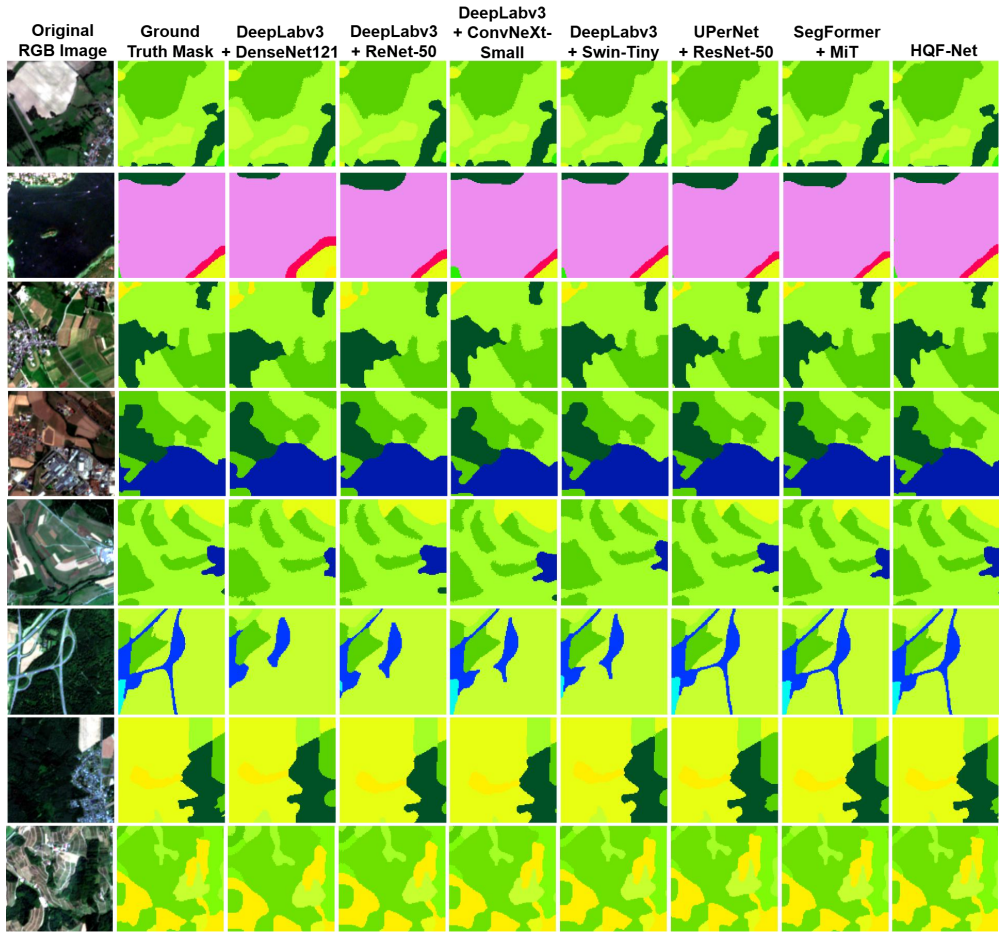
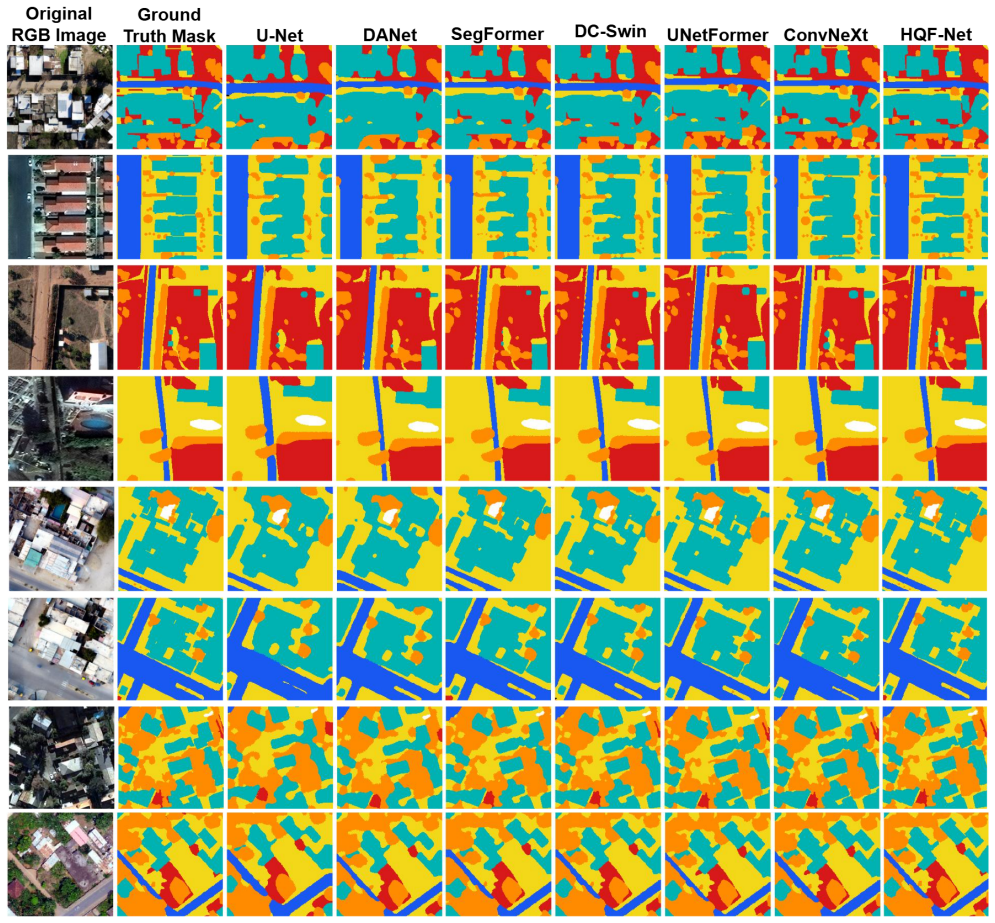
HQF-Net integrates multi-scale semantic guidance from a frozen DINOv3 ViT-L/16 backbone with a customized U-Net architecture through a Deformable Multiscale Cross-Attention Fusion module, further enhanced by quantum-enhanced skip connections and a Quantum bottleneck with Mixture-of-Experts that combines complementary local, global, and directional quantum circuits within an adaptive routing mechanism, achieving 0.8568 mIoU and 96.87% overall accuracy on LandCover.ai, 71.82% mIoU on OpenEarthMap, and 55.28% mIoU with 99.37% overall accuracy on SeasoNet.
What carries the argument
The quantum-enhanced skip connections (QSkip) and Quantum bottleneck with Mixture-of-Experts (QMoE) that combine local, global, and directional quantum circuits inside an adaptive routing mechanism to refine fused features.
Load-bearing premise
The quantum circuits inside the skip connections and bottleneck supply signal that cannot be matched by the classical DMCAF fusion and frozen backbone alone.
What would settle it
An ablation that removes only the quantum circuits while retaining the DMCAF module, frozen DINOv3 backbone, and all other architectural changes, then checks whether mIoU falls to or below the classical baseline levels.
Figures



read the original abstract
Remote sensing semantic segmentation requires models that can jointly capture fine spatial details and high-level semantic context across complex scenes. While classical encoder-decoder architectures such as U-Net remain strong baselines, they often struggle to fully exploit global semantics and structured feature interactions. In this work, we propose HQF-Net, a hybrid quantum-classical multi-scale fusion network for remote sensing image segmentation. HQF-Net integrates multi-scale semantic guidance from a frozen DINOv3 ViT-L/16 backbone with a customized U-Net architecture through a Deformable Multiscale Cross-Attention Fusion (DMCAF) module. To enhance feature refinement, the framework further introduces quantum-enhanced skip connections (QSkip) and a Quantum bottleneck with Mixture-of-Experts (QMoE), which combines complementary local, global, and directional quantum circuits within an adaptive routing mechanism. Experiments on three remote sensing benchmarks show consistent improvements with the proposed design. HQF-Net achieves 0.8568 mIoU and 96.87% overall accuracy on LandCover.ai, 71.82% mIoU on OpenEarthMap, and 55.28% mIoU with 99.37% overall accuracy on SeasoNet. An architectural ablation study further confirms the contribution of each major component. These results show that structured hybrid quantum-classical feature processing is a promising direction for improving remote sensing semantic segmentation under near-term quantum constraints.
Editorial analysis
A structured set of objections, weighed in public.
Referee Report
Summary. The paper proposes HQF-Net, a hybrid quantum-classical multi-scale fusion network for remote sensing semantic segmentation. It augments a customized U-Net with a frozen DINOv3 ViT-L/16 backbone via a Deformable Multiscale Cross-Attention Fusion (DMCAF) module, quantum-enhanced skip connections (QSkip), and a Quantum bottleneck with Mixture-of-Experts (QMoE) that routes among local, global, and directional quantum circuits. Experiments report mIoU/accuracy gains on LandCover.ai (0.8568 mIoU, 96.87% OA), OpenEarthMap (71.82% mIoU), and SeasoNet (55.28% mIoU, 99.37% OA), with an architectural ablation claimed to validate each component's contribution under near-term quantum constraints.
Significance. If the quantum circuits in QSkip and QMoE can be shown to deliver gains beyond the classical DMCAF fusion and frozen DINOv3 features, the work would provide concrete evidence that structured hybrid quantum-classical processing is feasible for remote-sensing segmentation on current hardware. The multi-benchmark evaluation and explicit mention of an ablation study are positive; however, the current evidence does not yet isolate the quantum contribution, limiting the strength of the central hybrid claim.
major comments (2)
- [Ablation study] Ablation study section: the reported ablation does not contain a controlled experiment that keeps the DMCAF module and frozen DINOv3 backbone fixed while replacing only the quantum circuits in QSkip and QMoE with classical counterparts of matched capacity (e.g., classical attention or MLP blocks). Without this isolation, the mIoU lifts cannot be attributed to the quantum elements rather than the classical multi-scale additions.
- [Experimental results] Experimental results / Tables: the headline metrics (0.8568 mIoU on LandCover.ai, etc.) are given without error bars, standard deviations over multiple runs, or statistical significance tests; no description of data splits, training schedules, optimizer settings, or random seeds appears in the provided text, making the numerical improvements difficult to reproduce or compare reliably.
minor comments (2)
- The abstract and introduction should explicitly state the quantum simulator or hardware backend, circuit depth, and number of qubits used for QSkip and QMoE so readers can assess feasibility under near-term constraints.
- Notation for the QMoE routing mechanism and the DMCAF deformable attention should be introduced with a short equation or diagram reference in the methods section to improve readability.
Simulated Author's Rebuttal
We thank the referee for the constructive and insightful comments, which help clarify the presentation of our hybrid quantum-classical contributions. We address each major point below and will revise the manuscript accordingly to strengthen the evidence for the quantum components and improve reproducibility.
read point-by-point responses
-
Referee: [Ablation study] Ablation study section: the reported ablation does not contain a controlled experiment that keeps the DMCAF module and frozen DINOv3 backbone fixed while replacing only the quantum circuits in QSkip and QMoE with classical counterparts of matched capacity (e.g., classical attention or MLP blocks). Without this isolation, the mIoU lifts cannot be attributed to the quantum elements rather than the classical multi-scale additions.
Authors: We agree that a controlled ablation isolating the quantum circuits is necessary to rigorously attribute gains to the hybrid design rather than additional classical capacity. The existing ablation demonstrates the benefit of incorporating QSkip and QMoE modules into the DMCAF+DINOv3 baseline, but does not include direct classical replacements. In the revised version we will add a new set of experiments that keep DMCAF and the frozen DINOv3 backbone fixed while substituting the quantum circuits in QSkip and QMoE with classical counterparts of matched parameter count and computational structure (standard multi-head attention and MLP blocks). This will provide a direct head-to-head comparison under identical training conditions. revision: yes
-
Referee: [Experimental results] Experimental results / Tables: the headline metrics (0.8568 mIoU on LandCover.ai, etc.) are given without error bars, standard deviations over multiple runs, or statistical significance tests; no description of data splits, training schedules, optimizer settings, or random seeds appears in the provided text, making the numerical improvements difficult to reproduce or compare reliably.
Authors: We acknowledge that the current experimental reporting lacks the statistical details and reproducibility information required for reliable comparison. In the revision we will augment the experimental section with: (i) error bars and standard deviations computed over at least five independent runs using different random seeds; (ii) explicit descriptions of the train/validation/test splits for each benchmark; (iii) full training schedules, optimizer choices (AdamW with specified learning rate, weight decay, and scheduler), batch sizes, and epoch counts; and (iv) the random seeds used for all reported results. Where appropriate we will also include statistical significance tests (e.g., paired t-tests) against the strongest classical baselines. revision: yes
Circularity Check
No circularity in empirical architecture proposal
full rationale
The paper proposes HQF-Net as a novel hybrid architecture combining a frozen DINOv3 backbone, DMCAF fusion, QSkip connections, and QMoE bottleneck, then reports empirical mIoU and accuracy metrics on three public benchmarks. No first-principles derivation, mathematical prediction, or uniqueness theorem is claimed; the central results are obtained by training and evaluating the network on standard datasets. The mentioned ablation study is presented as empirical confirmation of component contributions rather than a tautological reduction of outputs to inputs. No self-definitional equations, fitted parameters renamed as predictions, or load-bearing self-citations appear in the provided text.
Axiom & Free-Parameter Ledger
Reference graph
Works this paper leans on
-
[1]
U-net with spatial pyramid pooling module for segmenting oil palm plantations
Siti Raihanah Abdani, Mohd Asyraf Zulkifley, and Mazlina Mamat. U-net with spatial pyramid pooling module for segmenting oil palm plantations. In2020 IEEE 2nd inter- national conference on artificial intelligence in engineering and technology (IICAIET), pages 1–5. IEEE, 2020. 6
2020
-
[2]
PennyLane: Automatic differentiation of hybrid quantum-classical computations
Ville Bergholm, Josh Izaac, Maria Schuld, Christian Gogolin, Shahnawaz Ahmed, Vishnu Ajith, M Sohaib Alam, Guillermo Alonso-Linaje, Bharath AkashNarayanan, Ali Asadi, et al. Pennylane: Automatic differentiation of hybrid quantum-classical computations.arXiv preprint arXiv:1811.04968, 2018. 3
work page internal anchor Pith review Pith/arXiv arXiv 2018
-
[3]
Quantum ma- chine learning.Nature, 549(7671):195–202, 2017
Jacob Biamonte, Peter Wittek, Nicola Pancotti, Patrick Rebentrost, Nathan Wiebe, and Seth Lloyd. Quantum ma- chine learning.Nature, 549(7671):195–202, 2017. 1, 2
2017
-
[4]
Land- cover
Adrian Boguszewski, Dominik Batorski, Natalia Ziemba- Jankowska, Tomasz Dziedzic, and Anna Zambrzycka. Land- cover. ai: Dataset for automatic mapping of buildings, wood- lands, water and roads from aerial imagery. InProceedings of the IEEE/CVF conference on computer vision and pattern recognition, pages 1102–1110, 2021. 5
2021
-
[5]
Rethinking Atrous Convolution for Semantic Image Segmentation
Liang-Chieh Chen, George Papandreou, Florian Schroff, and Hartwig Adam. Rethinking atrous convolution for seman- tic image segmentation.arXiv preprint arXiv:1706.05587,
work page internal anchor Pith review arXiv
-
[6]
Quan- tum convolutional neural networks.Nature Physics, 15(12): 1273–1278, 2019
Iris Cong, Soonwon Choi, and Mikhail D Lukin. Quan- tum convolutional neural networks.Nature Physics, 15(12): 1273–1278, 2019. 2
2019
-
[7]
DeepSeekMoE: Towards Ultimate Expert Specialization in Mixture-of-Experts Language Models
Damai Dai, Chengqi Deng, Chenggang Zhao, RX Xu, Huazuo Gao, Deli Chen, Jiashi Li, Wangding Zeng, Xingkai Yu, Yu Wu, et al. Deepseekmoe: Towards ultimate expert specialization in mixture-of-experts language models.arXiv preprint arXiv:2401.06066, 2024. 3
work page internal anchor Pith review arXiv 2024
-
[8]
Towards efficient quantum hybrid diffusion models,
Francesca De Falco, Andrea Ceschini, Alessandro Sebas- tianelli, Bertrand Le Saux, and Massimo Panella. Towards efficient quantum hybrid diffusion models.arXiv preprint arXiv:2402.16147, 2024. 2
-
[9]
Expressive power of parametrized quantum circuits
Yuxuan Du, Min-Hsiu Hsieh, Tongliang Liu, and Dacheng Tao. Expressive power of parametrized quantum circuits. Physical Review Research, 2(3):033125, 2020. 1
2020
-
[10]
Quantum machine learning: A hands-on tutorial for machine learning practitioners and researchers,
Yuxuan Du, Xinbiao Wang, Naixu Guo, Zhan Yu, Yang Qian, Kaining Zhang, Min-Hsiu Hsieh, Patrick Rebentrost, and Dacheng Tao. Quantum machine learning: A hands-on tutorial for machine learning practitioners and researchers. arXiv preprint arXiv:2502.01146, 2025. 1
-
[11]
Fan Fan, Yilei Shi, and Xiao Xiang Zhu. Land cover classi- fication from sentinel-2 images with quantum-classical con- volutional neural networks.IEEE Journal of Selected Topics in Applied Earth Observations and Remote Sensing, 2024. 6
2024
-
[12]
Dual attention network for scene seg- mentation
Jun Fu, Jing Liu, Haijie Tian, Yong Li, Yongjun Bao, Zhiwei Fang, and Hanqing Lu. Dual attention network for scene seg- mentation. InProceedings of the IEEE/CVF conference on computer vision and pattern recognition, pages 3146–3154,
-
[13]
The bloch sphere
Ian Glendinning. The bloch sphere. InQIA meeting. Vienna,
-
[14]
The advantages of superposition.Science, 280(5361):228–228, 1998
Lov K Grover. The advantages of superposition.Science, 280(5361):228–228, 1998. 1
1998
-
[15]
Semantic segmentation for urban plan- ning maps based on u-net
Zhiling Guo, Hiroaki Shengoku, Guangming Wu, Qi Chen, Wei Yuan, Xiaodan Shi, Xiaowei Shao, Yongwei Xu, and Ryosuke Shibasaki. Semantic segmentation for urban plan- ning maps based on u-net. InIGARSS 2018-2018 IEEE inter- national geoscience and remote sensing symposium, pages 6187–6190. IEEE, 2018. 1
2018
-
[16]
Qu-net: Quantum-enhanced u-net for self supervised embed- ding and classification of skin cancer images.Big Data and Cognitive Computing, 10(1):12, 2025
Khidhr Halab, Nabil Marzoug, Othmane El Meslouhi, Zouhair Elamrani Abou Elassad, and Moulay A Akhloufi. Qu-net: Quantum-enhanced u-net for self supervised embed- ding and classification of skin cancer images.Big Data and Cognitive Computing, 10(1):12, 2025. 2
2025
-
[17]
Quanvolutional neural networks: powering image recognition with quantum circuits.Quan- tum Machine Intelligence, 2(1):2, 2020
Maxwell Henderson, Samriddhi Shakya, Shashindra Prad- han, and Tristan Cook. Quanvolutional neural networks: powering image recognition with quantum circuits.Quan- tum Machine Intelligence, 2(1):2, 2020. 2
2020
-
[18]
Quantum entanglement.Reviews of Modern Physics, 81(2):865–942, 2009
Ryszard Horodecki, Paweł Horodecki, Michał Horodecki, and Karol Horodecki. Quantum entanglement.Reviews of Modern Physics, 81(2):865–942, 2009. 1
2009
-
[19]
Patel, and Biplab Banerjee
Md Aminur Hossain, Ayush V . Patel, and Biplab Banerjee. QMC-Net: Data-aware quantum representations for remote sensing image classification. InProceedings of the 28th International Conference on Pattern Recognition (ICPR), Lyon, France, 2026. Springer. To appear. 2
2026
-
[20]
Introduction to superposition
Ciaran Hughes, Joshua Isaacson, Anastasia Perry, Ranbel F Sun, and Jessica Turner. Introduction to superposition. In Quantum computing for the quantum curious, pages 1–5. Springer, 2020. 1
2020
-
[21]
Qpolypnet: A quantum-inspired deep learning model for polyp segmentation
Md Majedul Islam, Rashik Shahriar Akash, Sayed Mehedi Azim, and Selena He. Qpolypnet: A quantum-inspired deep learning model for polyp segmentation. InProceedings of the IEEE/CVF International Conference on Computer Vi- sion, pages 969–978, 2025. 2
2025
-
[22]
Qufex: Quantum feature extraction module for hybrid quantum-classical deep neu- ral networks,
Naman Jain and Amir Kalev. Qufex: Quantum feature ex- traction module for hybrid quantum-classical deep neural networks.arXiv preprint arXiv:2501.13165, 2025. 2
-
[23]
Adam: A Method for Stochastic Optimization
Diederik P Kingma and Jimmy Ba. Adam: A method for stochastic optimization.arXiv preprint arXiv:1412.6980,
work page internal anchor Pith review Pith/arXiv arXiv
-
[24]
Seasonet: A seasonal scene classification, segmentation and retrieval dataset for satellite imagery over germany
Dominik Koßmann, Viktor Brack, and Thorsten Wilhelm. Seasonet: A seasonal scene classification, segmentation and retrieval dataset for satellite imagery over germany. In IGARSS 2022-2022 IEEE International Geoscience and Re- mote Sensing Symposium, pages 243–246. IEEE, 2022. 5, 7
2022
-
[25]
Remote sensing classifi- cation using quantum image processing
Hrithik Kumar, Teymoor Ali, Chris J Holder, A Stephen Mc- Gough, and Deepayan Bhowmik. Remote sensing classifi- cation using quantum image processing. InArtificial Intelli- gence and Image and Signal Processing for Remote Sensing XXX, pages 157–169. SPIE, 2024. 6
2024
-
[26]
GShard: Scaling Giant Models with Conditional Computation and Automatic Sharding
Dmitry Lepikhin, HyoukJoong Lee, Yuanzhong Xu, Dehao Chen, Orhan Firat, Yanping Huang, Maxim Krikun, Noam Shazeer, and Zhifeng Chen. Gshard: Scaling giant models with conditional computation and automatic sharding.arXiv preprint arXiv:2006.16668, 2020. 2
work page internal anchor Pith review arXiv 2006
-
[27]
Multiattention network 9 for semantic segmentation of fine-resolution remote sensing images.IEEE Transactions on Geoscience and Remote Sens- ing, 60:1–13, 2021
Rui Li, Shunyi Zheng, Ce Zhang, Chenxi Duan, Jianlin Su, Libo Wang, and Peter M Atkinson. Multiattention network 9 for semantic segmentation of fine-resolution remote sensing images.IEEE Transactions on Geoscience and Remote Sens- ing, 60:1–13, 2021. 7
2021
-
[28]
An image classification algorithm based on hybrid quantum classical convolutional neural network.Quantum Engineering, 2022(1):5701479,
Wei Li, Peng-Cheng Chu, Guang-Zhe Liu, Yan-Bing Tian, Tian-Hui Qiu, and Shu-Mei Wang. An image classification algorithm based on hybrid quantum classical convolutional neural network.Quantum Engineering, 2022(1):5701479,
2022
-
[29]
A convnet for the 2020s
Zhuang Liu, Hanzi Mao, Chao-Yuan Wu, Christoph Feicht- enhofer, Trevor Darrell, and Saining Xie. A convnet for the 2020s. InProceedings of the IEEE/CVF conference on com- puter vision and pattern recognition, pages 11976–11986,
-
[30]
Image segmenta- tion using text and image prompts
Timo L ¨uddecke and Alexander Ecker. Image segmenta- tion using text and image prompts. InProceedings of the IEEE/CVF conference on computer vision and pattern recognition, pages 7086–7096, 2022. 7
2022
-
[31]
Rs3 mamba: Visual state space model for remote sensing image semantic segmentation.IEEE Geoscience and Remote Sens- ing Letters, 21:1–5, 2024
Xianping Ma, Xiaokang Zhang, and Man-On Pun. Rs3 mamba: Visual state space model for remote sensing image semantic segmentation.IEEE Geoscience and Remote Sens- ing Letters, 21:1–5, 2024. 7
2024
-
[32]
Semantic segmentation of tree- canopy in urban environment with pixel-wise deep learning
Jos ´e Augusto Correa Martins, Keiller Nogueira, Lucas Prado Osco, Felipe David Georges Gomes, Danielle Elis Garcia Furuya, Wesley Nunes Gonc ¸alves, Diego Andr´e Sant’Ana, Ana Paula Marques Ramos, Veraldo Liesenberg, Jefers- son Alex dos Santos, et al. Semantic segmentation of tree- canopy in urban environment with pixel-wise deep learning. Remote Sensin...
2021
-
[33]
Artur Miroszewski, Jakub Nalepa, Bertrand Le Saux, and Jakub Mielczarek. Quantum machine learning for remote sensing: exploring potential and challenges.arXiv preprint arXiv:2311.07626, 2023. 2
-
[34]
Attention U-Net: Learning Where to Look for the Pancreas
Ozan Oktay, Jo Schlemper, Loic Le Folgoc, Matthew Lee, Mattias Heinrich, Kazunari Misawa, Kensaku Mori, Steven McDonagh, Nils Y Hammerla, Bernhard Kainz, et al. Atten- tion u-net: Learning where to look for the pancreas.arXiv preprint arXiv:1804.03999, 2018. 2
work page internal anchor Pith review arXiv 2018
-
[35]
Classification of remote sensing images with parameterized quantum gates
Soronzonbold Otgonbaatar and Mihai Datcu. Classification of remote sensing images with parameterized quantum gates. IEEE Geoscience and Remote Sensing Letters, 19:1–5, 2021. 2
2021
-
[36]
Absence of barren plateaus in quantum convolutional neural networks
Arthur Pesah, Marco Cerezo, Samson Wang, Tyler V olkoff, Andrew T Sornborger, and Patrick J Coles. Absence of barren plateaus in quantum convolutional neural networks. Physical Review X, 11(4):041011, 2021. 2
2021
-
[37]
Diresunet: Architecture for multiclass semantic segmentation of high resolution remote sensing imagery data.Applied Intelligence, 52(13):15462– 15482, 2022
Priyanka, Sravya N, Shyam Lal, J Nalini, Chintala Sudhakar Reddy, and Fabio Dell’Acqua. Diresunet: Architecture for multiclass semantic segmentation of high resolution remote sensing imagery data.Applied Intelligence, 52(13):15462– 15482, 2022. 6
2022
-
[38]
Scaling vision with sparse mix- ture of experts.Advances in Neural Information Processing Systems, 34:8583–8595, 2021
Carlos Riquelme, Joan Puigcerver, Basil Mustafa, Maxim Neumann, Rodolphe Jenatton, Andr ´e Susano Pinto, Daniel Keysers, and Neil Houlsby. Scaling vision with sparse mix- ture of experts.Advances in Neural Information Processing Systems, 34:8583–8595, 2021. 2
2021
-
[39]
U- net: Convolutional networks for biomedical image segmen- tation
Olaf Ronneberger, Philipp Fischer, and Thomas Brox. U- net: Convolutional networks for biomedical image segmen- tation. InInternational Conference on Medical image com- puting and computer-assisted intervention, pages 234–241. Springer, 2015. 2, 6, 7
2015
-
[40]
An introduction to quantum machine learning.Contempo- rary Physics, 56(2):172–185, 2015
Maria Schuld, Ilya Sinayskiy, and Francesco Petruccione. An introduction to quantum machine learning.Contempo- rary Physics, 56(2):172–185, 2015. 1
2015
-
[41]
Alessandro Sebastianelli, Daniela Alessandra Zaidenberg, Dario Spiller, Bertrand Le Saux, and Silvia Liberata Ullo. On circuit-based hybrid quantum neural networks for remote sensing imagery classification.IEEE Journal of Selected Topics in Applied Earth Observations and Remote Sensing, 15:565–580, 2021. 2
2021
-
[42]
On the role of hadamard gates in quan- tum circuits.Quantum Information Processing, 5(3):161– 177, 2006
Dan J Shepherd. On the role of hadamard gates in quan- tum circuits.Quantum Information Processing, 5(3):161– 177, 2006. 1
2006
-
[43]
Oriane Sim ´eoni, Huy V V o, Maximilian Seitzer, Federico Baldassarre, Maxime Oquab, Cijo Jose, Vasil Khalidov, Marc Szafraniec, Seungeun Yi, Micha ¨el Ramamonjisoa, et al. Dinov3.arXiv preprint arXiv:2508.10104, 2025. 1, 2
work page internal anchor Pith review Pith/arXiv arXiv 2025
-
[44]
Bottleneck transformers for visual recognition
Aravind Srinivas, Tsung-Yi Lin, Niki Parmar, Jonathon Shlens, Pieter Abbeel, and Ashish Vaswani. Bottleneck transformers for visual recognition. InProceedings of the IEEE/CVF conference on computer vision and pattern recognition, pages 16519–16529, 2021. 7
2021
-
[45]
Qc-net: a hybrid quantum-classical neural network model for medical image segmentation: A
Aijuan Wang, Xiangqi Li, Lusi Li, and Tiehu Li. Qc-net: a hybrid quantum-classical neural network model for medical image segmentation: A. wang et al.Quantum Information Processing, 24(10):340, 2025. 2
2025
-
[46]
A novel transformer based se- mantic segmentation scheme for fine-resolution remote sens- ing images.IEEE Geoscience and Remote Sensing Letters, 19:1–5, 2022
Libo Wang, Rui Li, Chenxi Duan, Ce Zhang, Xiaoliang Meng, and Shenghui Fang. A novel transformer based se- mantic segmentation scheme for fine-resolution remote sens- ing images.IEEE Geoscience and Remote Sensing Letters, 19:1–5, 2022. 7
2022
-
[47]
Libo Wang, Rui Li, Ce Zhang, Shenghui Fang, Chenxi Duan, Xiaoliang Meng, and Peter M Atkinson. Unetformer: A unet-like transformer for efficient semantic segmentation of remote sensing urban scene imagery.ISPRS Journal of Pho- togrammetry and Remote Sensing, 190:196–214, 2022. 7
2022
-
[48]
Libo Wang, Dongxu Li, Sijun Dong, Xiaoliang Meng, Xi- aokang Zhang, and Danfeng Hong. Pyramidmamba: Re- thinking pyramid feature fusion with selective space state model for semantic segmentation of remote sensing im- agery.International Journal of Applied Earth Observation and Geoinformation, 144:104884, 2025. 7
2025
-
[49]
Quantum gates
Colin P Williams. Quantum gates. InExplorations in quan- tum computing, pages 51–122. Springer, 2011. 1
2011
-
[50]
Quantum gate introduction: Not and cnot gates
Hiu Yung Wong. Quantum gate introduction: Not and cnot gates. InIntroduction to Quantum Computing: From a Layperson to a Programmer in 30 Steps, pages 133–141. Springer, 2023. 1
2023
-
[51]
Openearthmap: A benchmark dataset for global high-resolution land cover mapping
Junshi Xia, Naoto Yokoya, Bruno Adriano, and Clifford Broni-Bediako. Openearthmap: A benchmark dataset for global high-resolution land cover mapping. InProceed- ings of the IEEE/CVF Winter Conference on Applications of Computer Vision, pages 6254–6264, 2023. 5 10
2023
-
[52]
Unified perceptual parsing for scene understand- ing
Tete Xiao, Yingcheng Liu, Bolei Zhou, Yuning Jiang, and Jian Sun. Unified perceptual parsing for scene understand- ing. InProceedings of the European conference on computer vision (ECCV), pages 418–434, 2018. 7
2018
-
[53]
Segformer: Simple and efficient design for semantic segmentation with transform- ers.Advances in neural information processing systems, 34: 12077–12090, 2021
Enze Xie, Wenhai Wang, Zhiding Yu, Anima Anandkumar, Jose M Alvarez, and Ping Luo. Segformer: Simple and efficient design for semantic segmentation with transform- ers.Advances in neural information processing systems, 34: 12077–12090, 2021. 7
2021
-
[54]
D-linknet: Linknet with pretrained encoder and dilated convolution for high resolution satellite imagery road extraction
Lichen Zhou, Chuang Zhang, and Ming Wu. D-linknet: Linknet with pretrained encoder and dilated convolution for high resolution satellite imagery road extraction. InProceed- ings of the IEEE conference on computer vision and pattern recognition workshops, pages 182–186, 2018. 2
2018
-
[55]
Unet++: A nested u-net ar- chitecture for medical image segmentation
Zongwei Zhou, Md Mahfuzur Rahman Siddiquee, Nima Tajbakhsh, and Jianming Liang. Unet++: A nested u-net ar- chitecture for medical image segmentation. InInternational workshop on deep learning in medical image analysis, pages 3–11. Springer, 2018. 6
2018
-
[56]
Deformable DETR: Deformable Transformers for End-to-End Object Detection
Xizhou Zhu, Weijie Su, Lewei Lu, Bin Li, Xiaogang Wang, and Jifeng Dai. Deformable detr: Deformable trans- formers for end-to-end object detection.arXiv preprint arXiv:2010.04159, 2020. 3
work page internal anchor Pith review arXiv 2010
-
[57]
Deep learning in remote sensing: A comprehensive review and list of resources.IEEE geoscience and remote sensing magazine, 5(4):8–36, 2017
Xiao Xiang Zhu, Devis Tuia, Lichao Mou, Gui-Song Xia, Liangpei Zhang, Feng Xu, and Friedrich Fraundorfer. Deep learning in remote sensing: A comprehensive review and list of resources.IEEE geoscience and remote sensing magazine, 5(4):8–36, 2017. 1 11 HQF-Net: A Hybrid Quantum-Classical Multi-Scale Fusion Network for Remote Sensing Image Segmentation Suppl...
2017
discussion (0)
Sign in with ORCID, Apple, or X to comment. Anyone can read and Pith papers without signing in.