Recognition: 2 theorem links
· Lean TheoremProjector, Neural, and Tensor-Network Representations of mathbb{Z}_N Cluster and Dipolar-cluster SPT States
Pith reviewed 2026-05-10 17:43 UTC · model grok-4.3
The pith
The P-representation efficiently encodes Z_N cluster and dipolar-cluster SPT wavefunctions and yields closed-form neural weights plus a three-index tensor product form.
A machine-rendered reading of the paper's core claim, the machinery that carries it, and where it could break.
Core claim
The Z_N cluster-state wavefunction is expressed in the projector-based P-representation, identified as the efficient scheme. The interaction matrix in this representation is rewritten via the restricted Boltzmann machine scheme in terms of neural weight matrices to obtain neural quantum state and matrix product state forms of the identical state. Closed-form weight functions W(s,h) coupling physical spins s to hidden variables h are derived for both the ordinary Z_N cluster state and the dipolar-cluster state. The dipolar case directly produces a tensor product state representation in which each local tensor carries three virtual indices. The resulting tensor product construction is compared
What carries the argument
The P-representation, a projector-based scheme that encodes the cluster wavefunction through local constraints between physical spins s and auxiliary hidden variables h, which is then recast into neural weights W(s,h) and grouped into tensor networks.
If this is right
- The same weight matrices can be grouped either as a neural network or as a matrix product state, giving two numerically distinct but mathematically equivalent representations of one wavefunction.
- The tensor product state for the dipolar cluster state connects each site to two nearest neighbors plus one further neighbor through three virtual indices.
- The generalized Z_N Kramers-Wannier operator is non-invertible because it functions as a dipolar discrete Fourier transform on the Z_N variables.
- Density-matrix renormalization group comparisons suggest the tensor product state can be computationally lighter than standard matrix product states for some modulated SPT phases.
Where Pith is reading between the lines
- The same projector-to-weight-function route may supply explicit tensor representations for other symmetry-protected phases that involve dipole or higher multipole symmetries.
- The three-index local tensors could reduce the effective bond dimension needed along certain directions when the SPT pattern is spatially modulated.
- Because the construction is exact and parameter-free, it supplies a controlled testbed for studying how neural-network and tensor-network ansatzes capture topological entanglement.
Load-bearing premise
Rewriting the interaction matrix of the P-representation through the restricted Boltzmann machine scheme produces an exact representation that preserves the topological properties without introducing approximations or parameter adjustments that would alter the symmetries.
What would settle it
Exact computation of the overlap between the constructed TPS wavefunction and the known analytic cluster or dipolar-cluster state on a finite open chain; any systematic drop below unity as system size or N increases would show the representation is not faithful.
Figures



read the original abstract
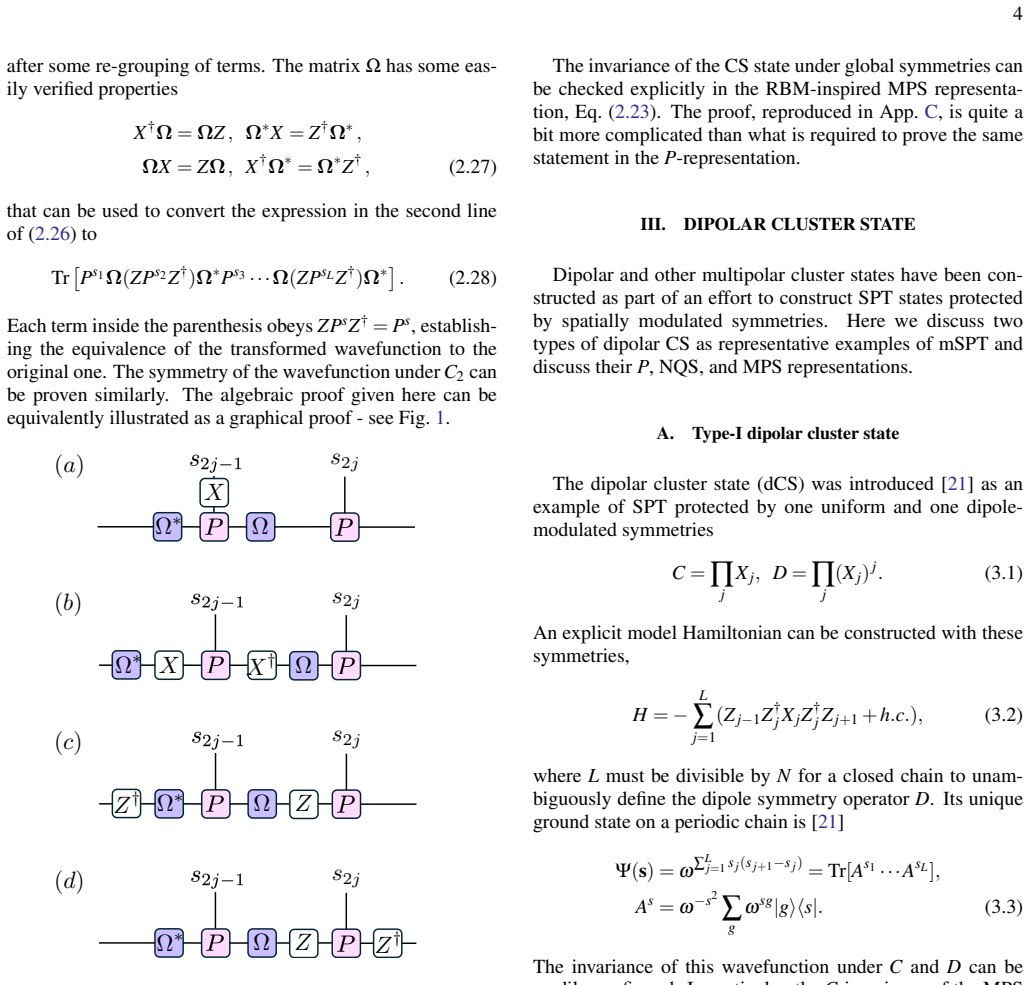
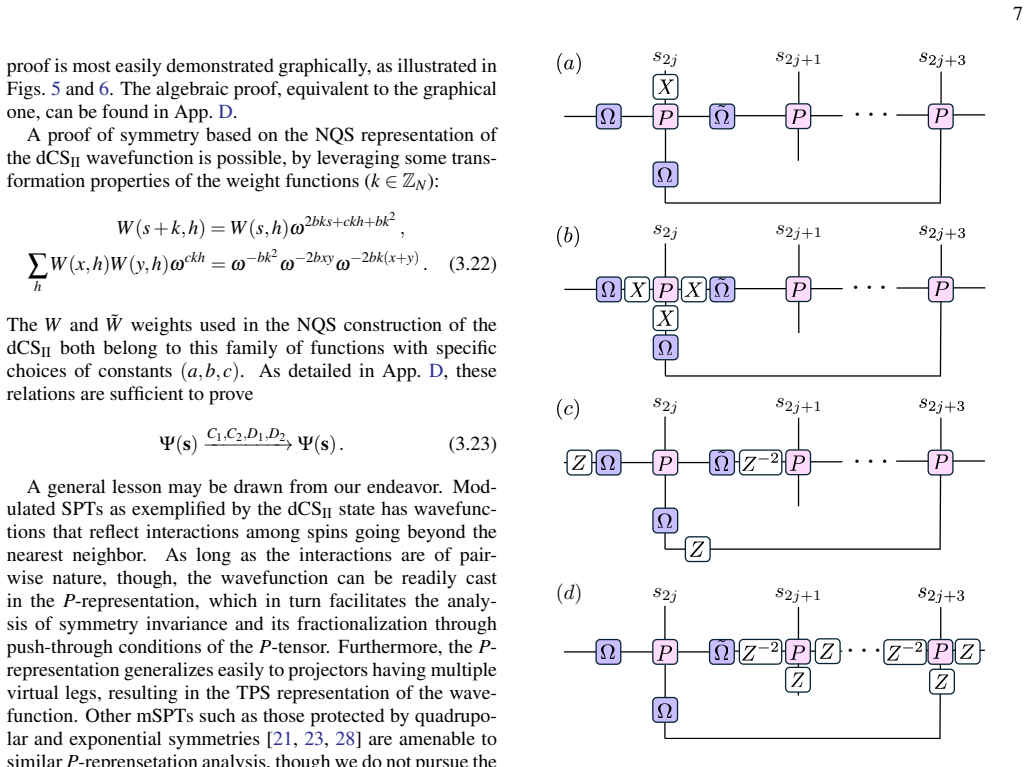
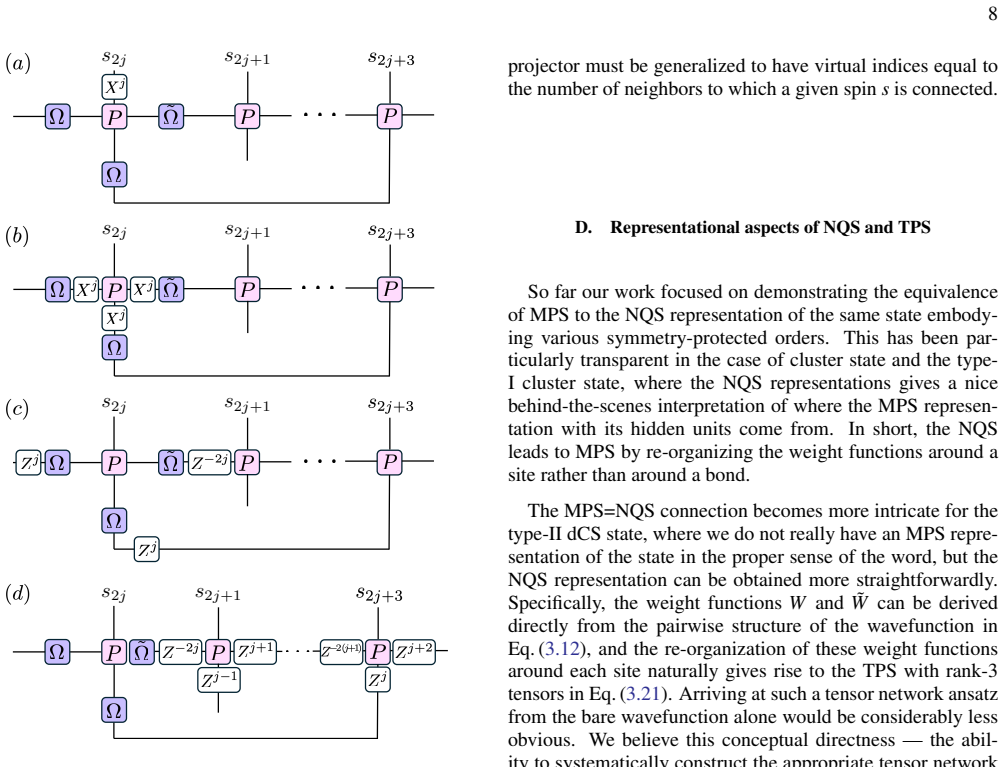
The $\mathbb{Z}_N$ cluster-state wavefunction, a paradigmatic example of symmetry-protected topological (SPT) order with $\mathbb{Z}_N \times \mathbb{Z}_N$ symmetry, is expressed in various equivalent ways. We identify the projector-based scheme called the $P$-representation as the efficient way to express cluster and dipolar cluster state's wavefunctions. Employing the restricted Boltzmann machine scheme to re-write the interaction matrix in the $P$-representation in terms of neural weight matrices allows us to develop the neural quantum state (NQS) and the matrix product state (MPS) representations of the same state. The NQS and MPS representations differ only in the way the weight matrices are split and grouped together in a matrix product. For both $\mathbb{Z}_N$ cluster and dipolar cluster states, we derive in closed form the weight function $W(s,h)$ that couples physical spins $s$ to hidden variables $h$, generalizing the previous construction for $Z_2$ cluster states to $\mathbb{Z}_N$. For the dipolar cluster state protected by two charge and two dipole symmetries, the procedure we have developed leads to the tensor product state (TPS) representation of the wavefunction where each local tensor carries three virtual indices connecting a given site to two nearest neighbors and one further neighbor. We benchmark the resulting TPS construction against conventional MPS representation using density-matrix renormalization group simulations and argue that the TPS could offer a more efficient representation for some modulated SPT states. As a by-product of the investigation, we generalize the previous $Z_2$ matrix product operator construction of the Kramers-Wannier (KW) operator to $\mathbb{Z}_N$ and interprets it as the dipolar generalization of the discrete Fourier transform on $\mathbb{Z}_N$ variables. The new interpretation naturally explains why the KW map is non-invertible.
Editorial analysis
A structured set of objections, weighed in public.
Referee Report
Summary. The manuscript derives exact closed-form expressions for the weight function W(s,h) in the P-representation of Z_N cluster and dipolar-cluster SPT states, generalizing prior Z_2 constructions. These yield equivalent neural quantum state (NQS), matrix product state (MPS), and tensor product state (TPS) representations via algebraic regrouping of weight matrices, with the TPS for the dipolar case using three virtual indices to encode the two charge and two dipole symmetries. The work benchmarks the TPS against conventional MPS using DMRG simulations to argue for efficiency advantages in modulated SPT states and generalizes the Kramers-Wannier operator to Z_N, reinterpreting it as a dipolar discrete Fourier transform that explains its non-invertibility.
Significance. If the closed-form derivations hold as stated, the paper provides parameter-free, exact representations that unify projector, neural, and tensor-network descriptions of these SPT states. The explicit algebraic constructions and DMRG benchmarks constitute reproducible strengths that could aid numerical studies of modulated topological phases. The KW-operator generalization adds interpretive value by linking it to symmetry structure.
minor comments (2)
- [Benchmarking and efficiency discussion] The DMRG benchmarking section should include explicit quantitative metrics (e.g., bond-dimension scaling or CPU-time comparisons) to support the efficiency claim for the TPS representation over MPS.
- [TPS construction for dipolar cluster state] Clarify the precise range of N for which the closed-form W(s,h) remains valid without additional constraints, and confirm that the TPS virtual indices exactly capture the full symmetry group without truncation.
Simulated Author's Rebuttal
We thank the referee for their careful reading of the manuscript and for the positive evaluation. We appreciate the recognition of the closed-form derivations for the Z_N cluster and dipolar-cluster SPT states, the unification of projector, neural, and tensor-network representations, the DMRG benchmarks, and the reinterpretation of the generalized Kramers-Wannier operator. Since the referee recommends minor revision but does not specify particular issues in the major comments section, we will review the manuscript for any typographical or minor clarifications in the revised version.
Circularity Check
No significant circularity: exact algebraic generalizations from projector form
full rationale
The paper begins with the known projector-based P-representation of the Z_N cluster and dipolar-cluster states. It then applies the standard restricted Boltzmann machine scheme to rewrite the interaction matrix, yielding closed-form weight functions W(s,h) via direct algebraic generalization of the Z_2 case. NQS, MPS, and TPS representations are obtained by exact regrouping and splitting of weight matrices into matrix products or tensors with the required virtual indices; no parameters are fitted to data or optimized variationally. DMRG benchmarks serve as independent numerical checks. The KW-operator extension is likewise a direct algebraic generalization reinterpreted as a dipolar discrete Fourier transform. No derivation step reduces to a self-definition, a fitted input renamed as prediction, or a load-bearing self-citation whose validity depends on the present work. The constructions remain self-contained against external benchmarks.
Axiom & Free-Parameter Ledger
axioms (2)
- domain assumption The Z_N cluster state is exactly representable by a local projector onto the symmetric subspace defined by the Z_N x Z_N symmetry.
- domain assumption The restricted Boltzmann machine can exactly reproduce the interaction matrix of the cluster state when weights are chosen appropriately.
Lean theorems connected to this paper
-
IndisputableMonolith/Cost/FunctionalEquation.lean; Foundation/AbsoluteFloorClosure.lean; Foundation/AlexanderDuality.leanwashburn_uniqueness_aczel; reality_from_one_distinction; alexander_duality_circle_linking unclearWe identify the projector-based scheme called the P-representation... derive in closed form the weight function W(s,h)... Ω=WW^t... TPS representation... KW operator as dipolar discrete Fourier transform
-
IndisputableMonolith/Cost.leanJcost definition; costAlphaLog echoesW(s,h)=κ^{-1/2} ω^{a h^2 + b s^2 + c s h} with a=N^{-1}/4, b=N^{-1}/2, c=-1 (App. B)
Reference graph
Works this paper leans on
-
[1]
kqv86ZV8yFHoK0jDgxMvsw3mgnA=
with the Hamiltonian H=− ∑ j Z2j−1 X2j Z−2 2j+1 Z2j+3 −∑ j Z2j−2 Z−2 2j X2j+1 Z2j+2 +h.c., (3.10) which is is symmetric under two sets of charge and dipole symmetries C1 = ∏ j X2j−1 ,C 2 = ∏ j X2j D1 = ∏ j (X2j−1 ) j,D 2 = ∏ j (X2j ) j.(3.11) To distinguish this from the previous dipolar CS, we refer to the new model as dCS II. The ground-state wavefuncti...
2024
-
[2]
Carleo and M
G. Carleo and M. Troyer, Solving the Quantum Many-Body Problem with Artificial Neural Networks, Science355, 602 (2017)
2017
-
[3]
L. L. Viteritti, R. Rende, and F. Becca, Transformer Variational Wave Functions for Frustrated Quantum Spin Systems, Phys. Rev. Lett.130, 236401 (2023)
2023
-
[4]
D.-L. Deng, X. Li, and S. Das Sarma, Machine learning topo- logical states, Phys. Rev. B96, 195145 (2017)
2017
-
[5]
D.-L. Deng, X. Li, and S. Das Sarma, Quantum Entanglement in Neural Network States, Phys. Rev. X7, 021021 (2017), arXiv:1701.04844 [cond-mat.dis-nn]
work page Pith review arXiv 2017
-
[6]
Gao and L.-M
X. Gao and L.-M. Duan, Efficient representation of quantum many-body states with deep neural networks, Nature Commu- nications8, 662 (2017)
2017
-
[7]
Glasser, N
I. Glasser, N. Pancotti, M. August, I. D. Rodr´ıguez, and I. Cirac, Neural-network quantum states, string-bond states, and chiral topological states, Phys. Rev. X8, 011006 (2018)
2018
-
[8]
S. R. Clark, Unifying neural-network quantum states and cor- relator product states via tensor networks, J. Phys. A: Math. Theor.51, 135301 (2018)
2018
-
[9]
J. Chen, S. Cheng, H. Xie, L. Wang, and T. Xiang, Equivalence of restricted Boltzmann machines and tensor network states, Phys. Rev. B97, 085104 (2018)
2018
-
[10]
Jia, Y .-H
Z.-A. Jia, Y .-H. Zhang, Y .-C. Wu, L. Kong, G.-C. Guo, and G.- P. Guo, Efficient machine-learning representations of a surface code with boundaries, defects, domain walls, and twists, Phys. Rev. A99, 012307 (2019)
2019
-
[11]
Z.-A. Jia, L. Wei, Y .-C. Wu, G.-C. Guo, and G.-P. Guo, Entan- glement area law for shallow and deep quantum neural network states, New Journal of Physics22, 053022 (2020)
2020
-
[12]
Sharir, A
O. Sharir, A. Shashua, and G. Carleo, Deep autoregressive mod- els for the efficient variational simulation of many-body quan- tum systems, Phys. Rev. Lett.124, 020503 (2020)
2020
-
[13]
Hibat-Allah, M
M. Hibat-Allah, M. Ganahl, R. Melko, and J. Carrasquilla, Re- current neural network wave functions, Phys. Rev. Research2, 023358 (2020)
2020
-
[14]
Carrasquilla, Machine learning for quantum matter, Ad- vances in Physics: X5, 1797528 (2020)
J. Carrasquilla, Machine learning for quantum matter, Ad- vances in Physics: X5, 1797528 (2020)
2020
-
[15]
C. Vivas and J. Madro˜nero, Neural-Network Quantum States: A Systematic Review, arXiv preprint (2022), arXiv:2204.12966 [quant-ph]
-
[16]
Lange, A
H. Lange, A. Van de Walle, A. Abedinnia, and A. Bohrdt, From architectures to applications: a review of neural quantum states, Quantum Science and Technology9, 040501 (2024)
2024
-
[17]
P. Chen, B. Yan, and S. X. Cui, Representing arbitrary ground states of the toric code by a restricted Boltzmann machine, Phys. Rev. B111, 045101 (2025)
2025
-
[18]
Paul, Bound on entanglement in neural quantum states (2025), arXiv:2510.11797 [quant-ph]
N. Paul, Bound on entanglement in neural quantum states (2025), arXiv:2510.11797 [quant-ph]
-
[19]
Chen, Z.-C
X. Chen, Z.-C. Gu, and X.-G. Wen, Complete classification of one-dimensional gapped quantum phases in interacting spin systems, Phys. Rev. B84, 235128 (2011)
2011
-
[20]
Schuch, D
N. Schuch, D. P ´erez-Garc´ıa, and I. Cirac, Classifying quantum phases using matrix product states and projected entangled pair states, Phys. Rev. B84, 165139 (2011)
2011
-
[21]
Pollmann, A
F. Pollmann, A. M. Turner, E. Berg, and M. Oshikawa, Symme- try protection of topological phases in one-dimensional quan- tum spin systems, Phys. Rev. B85, 075125 (2012)
2012
-
[22]
J. H. Han, E. Lake, H. T. Lam, R. Verresen, and Y . You, Topo- logical quantum chains protected by dipolar and other modu- lated symmetries, Phys. Rev. B109, 125121 (2024)
2024
- [23]
-
[24]
J. Kim, Y . You, and J. H. Han, Noninvertible symmetry and topological holography for modulated SPT in one dimension, SciPost Phys.19, 110 (2025)
2025
-
[25]
Sun, J.-H
S. Sun, J.-H. Zhang, Z. Bi, and Y . You, Holographic View of Mixed-State Symmetry-Protected Topological Phases in Open Quantum Systems, PRX Quantum6, 020333 (2025)
2025
-
[26]
S. D. Pace, G. Delfino, H. T. Lam, and ¨Omer M. Aksoy, Gaug- ing modulated symmetries: Kramers-Wannier dualities and non-invertible reflections, SciPost Phys.18, 021 (2025)
2025
-
[27]
T. Saito, W. Cao, B. Han, and H. Ebisu, Matrix product state classification of one-dimensional multipole symmetry- protected topological phases, Physical Review B112, 10.1103/6txg-7hy7 (2025)
-
[28]
D. Bulmash, Defect Networks for Topological Phases Protected By Modulated Symmetries (2025), arXiv:2508.06604 [cond- mat.str-el]
-
[29]
S. D. Pace, ¨Omer M. Aksoy, and H. T. Lam, Spacetime symmetry-enriched SymTFT: From LSM anomalies to modu- lated symmetries and beyond, SciPost Phys.20, 007 (2026). 18
2026
-
[30]
2026.arXiv e-prints:arXiv:2603.19189
A. Anakru, S. Srinivasan, L. Li, and Z. Bi, Matrix Product States for Modulated Symmetries: SPT, LSM, and Beyond (2026), arXiv:2603.19189 [cond-mat.str-el]
-
[31]
S.-Q. Ning, H. Ebisu, and H. T. Lam, Matrix Product States for Modulated Topological Phases: Crystalline Equiv- alence Principle and Lieb-Schultz-Mattis Constraints (2026), arXiv:2603.19381 [cond-mat.str-el]
work page internal anchor Pith review Pith/arXiv arXiv 2026
-
[32]
Raussendorf and H
R. Raussendorf and H. J. Briegel, A One-Way Quantum Com- puter, Phys. Rev. Lett.86, 5188 (2001)
2001
-
[33]
Maeda and T
J. Maeda and T. Oishi, N-ality symmetry and SPT phases in (1+1)d, Journal of High Energy Physics2025, 63 (2025)
2025
-
[34]
Yao, Lattice Translation Modulated Symmetries and TFTs (2025), arXiv:2510.03889 [cond-mat.str-el]
C.-Y . Yao, Lattice Translation Modulated Symmetries and TFTs (2025), arXiv:2510.03889 [cond-mat.str-el]
-
[35]
Seiberg, S
N. Seiberg, S. Seifnashri, and S.-H. Shao, Non-invertible sym- metries and LSM-type constraints on a tensor product Hilbert space, SciPost Phys.16, 154 (2024)
2024
-
[36]
Seifnashri and S.-H
S. Seifnashri and S.-H. Shao, Cluster State as a Noninvertible Symmetry-Protected Topological Phase, Phys. Rev. Lett.133, 116601 (2024)
2024
-
[37]
W. Cao, L. Li, and M. Yamazaki, Generating lattice non- invertible symmetries, SciPost Phys.17, 104 (2024)
2024
-
[38]
Aasen, R
D. Aasen, R. S. K. Mong, and P. Fendley, Topological defects on the lattice: I. The Ising model, Journal of Physics A: Mathe- matical and Theoretical49, 354001 (2016)
2016
-
[39]
S.-H. Shao, What’s done cannot be undone: TASI lectures on non-invertible symmetries (2024), arXiv:2308.00747 [hep-th]
-
[40]
Bhardwaj, S
L. Bhardwaj, S. Schafer-Nameki, and J. Yan, Generalized global symmetries and non-invertible symmetries, Communi- cations in Mathematical Physics393, 119 (2022)
2022
-
[41]
More precisely, the total dipole moment must be zero modulus N, assuming that the length of the chainLis divisible byN
-
[42]
J. Kim, M. Kim, N. Kawashima, J. H. Han, and H.-Y . Lee, Con- struction of variational matrix product states for the Heisenberg spin-1 chain, Phys. Rev. B102, 085117 (2020)
2020
-
[43]
T. Zaklama, M. Geier, and L. Fu, Large Electron Model: A Uni- versal Ground State Predictor (2026), arXiv:2603.02346 [cond- mat.str-el]
-
[44]
J. Kim, J. Y . Lee, and J. H. Han, Gauging modulated symme- tries via multiple gauge symmetry operators and adaptive quan- tum circuits, Phys. Rev. B113, 085139 (2026)
2026
discussion (0)
Sign in with ORCID, Apple, or X to comment. Anyone can read and Pith papers without signing in.