Recognition: no theorem link
Differentiable Environment-Trajectory Co-Optimization for Safe Multi-Agent Navigation
Pith reviewed 2026-05-10 18:48 UTC · model grok-4.3
The pith
Jointly optimizing environment configurations and agent trajectories enables safer multi-agent navigation in constrained spaces.
A machine-rendered reading of the paper's core claim, the machinery that carries it, and where it could break.
Core claim
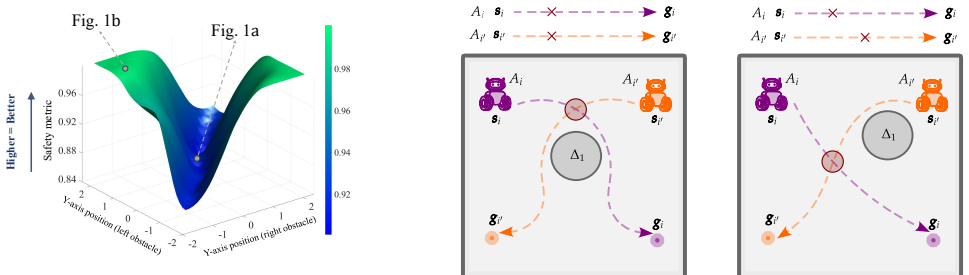
The central discovery is a differentiable co-optimization framework for environments and trajectories in multi-agent navigation. The lower-level problem optimizes agent trajectories to minimize navigation costs using interior point methods, while the upper-level problem optimizes environment parameters to maximize a novel measure-theoretic safety metric using gradient ascent. Gradients are obtained analytically by applying the KKT conditions and the Implicit Function Theorem to couple the levels. This allows the system to find environment configurations that provide navigation guidance, improving safety and efficiency in scenarios from warehouse logistics to urban transportation.
What carries the argument
Bi-level optimization structure where lower-level trajectory optimization is solved with interior point methods and upper-level environment optimization uses gradient ascent, coupled differentiably via KKT conditions and the Implicit Function Theorem, with a measure-theoretic safety metric as the objective.
Load-bearing premise
Environment configurations can be modeled as continuous variables with reliable gradients computed through optimization conditions, and the safety metric based on measure theory truly captures collision risks in practice.
What would settle it
Running the method on a physical multi-robot system in a warehouse and measuring if actual collision rates decrease compared to fixed environment baselines under identical agent control policies.
Figures




read the original abstract
The environment plays a critical role in multi-agent navigation by imposing spatial constraints, rules, and limitations that agents must navigate around. Traditional approaches treat the environment as fixed, without exploring its impact on agents' performance. This work considers environment configurations as decision variables, alongside agent actions, to jointly achieve safe navigation. We formulate a bi-level problem, where the lower-level sub-problem optimizes agent trajectories that minimize navigation cost and the upper-level sub-problem optimizes environment configurations that maximize navigation safety. We develop a differentiable optimization method that iteratively solves the lower-level sub-problem with interior point methods and the upper-level sub-problem with gradient ascent. A key challenge lies in analytically coupling these two levels. We address this by leveraging KKT conditions and the Implicit Function Theorem to compute gradients of agent trajectories w.r.t. environment parameters, enabling differentiation throughout the bi-level structure. Moreover, we propose a novel metric that quantifies navigation safety as a criterion for the upper-level environment optimization, and prove its validity through measure theory. Our experiments validate the effectiveness of the proposed framework in a variety of safety-critical navigation scenarios, inspired from warehouse logistics to urban transportation. The results demonstrate that optimized environments provide navigation guidance, improving both agents' safety and efficiency.
Editorial analysis
A structured set of objections, weighed in public.
Referee Report
Summary. The manuscript formulates a bi-level optimization problem for safe multi-agent navigation in which the lower level optimizes agent trajectories (minimizing navigation cost subject to dynamics and collision-avoidance constraints) via interior-point methods while the upper level optimizes continuous environment parameters to maximize a novel measure-theoretic safety metric via gradient ascent. Gradients of the lower-level solution with respect to environment variables are obtained by implicit differentiation through the KKT system using the Implicit Function Theorem. Experiments in simulated warehouse-logistics and urban-transportation scenarios are reported to show that the co-optimized environments improve both safety and efficiency.
Significance. If the gradient computations are reliable, the work offers a principled way to treat environment geometry as a decision variable rather than a fixed constraint, which could influence environment design for autonomous systems. The measure-theoretic safety metric and its proof constitute a clear theoretical contribution; the bi-level differentiable framework is a natural extension of recent differentiable-optimization literature to multi-agent settings.
major comments (2)
- [§3 and §4] §3 (Bi-level formulation) and §4 (Differentiable optimization): the central claim that environment parameters can be optimized by gradient ascent on the safety metric rests on the ability to compute d(trajectory*)/d(env) via the Implicit Function Theorem applied to the KKT system of the lower-level non-convex trajectory problem. For problems with active collision constraints whose active-set structure changes with environment geometry, the KKT Jacobian is not guaranteed to be invertible (LICQ, strict complementarity, and SOSC may fail at interior-point solutions). The manuscript provides no verification, regularization, or conditioning analysis that these conditions hold in the reported scenarios.
- [§5] §5 (Experiments): the reported improvements in safety and efficiency are presented without ablation on the gradient-computation step itself (e.g., comparison against finite-difference gradients, Jacobian condition-number statistics, or failure cases where the IFT step is ill-conditioned). Because the co-optimization loop depends on these gradients, the absence of such diagnostics leaves the empirical support for the method incomplete.
minor comments (2)
- [Abstract and §5] The abstract states that experiments validate the framework but supplies no quantitative metrics, error bars, or baseline comparisons; the full manuscript should ensure these appear in the main text and tables with clear statistical reporting.
- [§2 and §4] Notation for the safety metric (measure-theoretic construction) and its relation to the KKT stationarity conditions should be cross-referenced explicitly so readers can trace how the upper-level objective depends on the lower-level solution.
Simulated Author's Rebuttal
We thank the referee for the detailed and constructive feedback. We address the concerns regarding the applicability of the Implicit Function Theorem to the non-convex lower-level problem and the need for additional empirical diagnostics on the gradient computations. We outline revisions that will strengthen the manuscript while clarifying the scope of our contributions.
read point-by-point responses
-
Referee: [§3 and §4] §3 (Bi-level formulation) and §4 (Differentiable optimization): the central claim that environment parameters can be optimized by gradient ascent on the safety metric rests on the ability to compute d(trajectory*)/d(env) via the Implicit Function Theorem applied to the KKT system of the lower-level non-convex trajectory problem. For problems with active collision constraints whose active-set structure changes with environment geometry, the KKT Jacobian is not guaranteed to be invertible (LICQ, strict complementarity, and SOSC may fail at interior-point solutions). The manuscript provides no verification, regularization, or conditioning analysis that these conditions hold in the reported scenarios.
Authors: We acknowledge that the lower-level trajectory optimization is non-convex and that active-set changes can violate LICQ, strict complementarity, or SOSC, potentially rendering the KKT Jacobian singular. Our framework applies the Implicit Function Theorem under the standard local regularity assumption that holds at converged interior-point solutions, which is common in differentiable optimization work. In our experiments the co-optimization converged reliably without singular Jacobians. To address the referee's point we will add a dedicated paragraph in §4 discussing these regularity conditions, together with empirical condition-number statistics collected from the KKT systems in both warehouse and urban scenarios. We will also describe a simple regularization heuristic (small diagonal perturbation) used when the Jacobian is near-singular. A general theoretical guarantee for arbitrary environment geometries remains outside the paper's scope and would require stronger problem assumptions; we will explicitly state this limitation. revision: partial
-
Referee: [§5] §5 (Experiments): the reported improvements in safety and efficiency are presented without ablation on the gradient-computation step itself (e.g., comparison against finite-difference gradients, Jacobian condition-number statistics, or failure cases where the IFT step is ill-conditioned). Because the co-optimization loop depends on these gradients, the absence of such diagnostics leaves the empirical support for the method incomplete.
Authors: We agree that direct validation of the implicit gradients would improve the empirical grounding of the method. In the revised manuscript we will extend §5 with an ablation that compares IFT-derived gradients against central finite-difference approximations on a representative subset of environment parameters. We will also tabulate the condition numbers of the KKT Jacobians observed across all optimization iterations and report any ill-conditioned cases together with the regularization steps taken. These additions will quantify the reliability of the gradient step and directly respond to the referee's concern. revision: yes
Circularity Check
No significant circularity in the derivation chain
full rationale
The paper's bi-level formulation separates the lower-level trajectory optimization (solved via interior-point methods) from the upper-level environment optimization (via gradient ascent). Gradients are obtained by applying the standard KKT conditions and Implicit Function Theorem to couple the levels, which are external mathematical tools rather than quantities derived from the paper's own fitted results or definitions. The proposed safety metric is defined and justified independently via measure theory with an explicit proof of validity. No load-bearing step reduces by construction to a self-citation, a fitted input renamed as a prediction, or an ansatz smuggled through prior work; the central claims rest on these independent derivations plus experimental validation in the reported scenarios.
Axiom & Free-Parameter Ledger
axioms (2)
- domain assumption Environment configurations can be represented as continuous decision variables.
- standard math KKT conditions and the implicit function theorem apply to the lower-level trajectory optimization.
invented entities (1)
-
Novel navigation safety metric
no independent evidence
Reference graph
Works this paper leans on
-
[1]
Advances in multi-robot systems,
T. Arai, E. Pagello, L. E. Parker, et al., “Advances in multi-robot systems,”IEEE Transactions on Robotics and Automation, vol. 18, no. 5, pp. 655–661, 2002
2002
-
[2]
A survey and analysis of cooperative multi-agent robot systems: Challenges and directions,
Z. H. Ismail, N. Sariff, and E. G. Hurtado, “A survey and analysis of cooperative multi-agent robot systems: Challenges and directions,” Applications of Mobile Robots, vol. 5, pp. 8–14, 2018
2018
-
[3]
Online control barrier functions for decentralized multi-agent navigation,
Z. Gao, G. Yang, and A. Prorok, “Online control barrier functions for decentralized multi-agent navigation,” inIEEE International Sympo- sium on Multi-Robot and Multi-Agent Systems (MRS), 2023
2023
-
[4]
Formation control for a coop- erative multi-agent system using decentralized navigation functions,
M. C. De Gennaro and A. Jadbabaie, “Formation control for a coop- erative multi-agent system using decentralized navigation functions,” inIEEE American Control Conference (ACC), 2006
2006
-
[5]
Reciprocal velocity obstacles for real-time multi-agent navigation,
J. Van den Berg, M. Lin, and D. Manocha, “Reciprocal velocity obstacles for real-time multi-agent navigation,” inIEEE International Conference on Robotics and Automation (ICRA), 2008
2008
-
[6]
Decentralized path planning for multi- agent teams with complex constraints,
V . R. Desaraju and J. P. How, “Decentralized path planning for multi- agent teams with complex constraints,”Autonomous Robots, vol. 32, no. 4, pp. 385–403, 2012
2012
-
[7]
Primal: Pathfinding via reinforcement and imi- tation multi-agent learning,
G. Sartoretti et al., “Primal: Pathfinding via reinforcement and imi- tation multi-agent learning,”IEEE Robotics and Automation Letters, vol. 4, no. 3, pp. 2378–2385, 2019
2019
-
[8]
Provably safe online multi-agent navigation in unknown environments,
Z. Gao, G. Yang, J. Bayrooti, and A. Prorok, “Provably safe online multi-agent navigation in unknown environments,” inConference on Robot Learning (CoRL), 2024
2024
-
[9]
Search-based testing of multi-agent manufacturing systems for deadlocks based on models,
N. Mani, V . Garousi, and B. H. Far, “Search-based testing of multi-agent manufacturing systems for deadlocks based on models,” International Journal on Artificial Intelligence Tools, vol. 19, no. 04, pp. 417–437, 2010
2010
-
[10]
Uncovering surprising behaviors in reinforce- ment learning via worst-case analysis,
A. Ruderman et al., “Uncovering surprising behaviors in reinforce- ment learning via worst-case analysis,” 2019
2019
-
[11]
A new-generation auto- mated warehousing capability,
Q. Wang, R. McIntosh, and M. Brain, “A new-generation auto- mated warehousing capability,”International Journal of Computer Integrated Manufacturing, vol. 23, no. 6, pp. 565–573, 2010
2010
-
[12]
Robotic building (s),
H. Bier, “Robotic building (s),”Next Generation Building, vol. 1, no. 1, 2014
2014
-
[13]
Flexible automated warehouse: A literature review and an innovative framework,
L. Custodio and R. Machado, “Flexible automated warehouse: A literature review and an innovative framework,”The International Journal of Advanced Manufacturing Technology, vol. 106, no. 1, pp. 533–558, 2020
2020
-
[14]
Prioritized planning algorithms for trajectory coordination of multiple mobile robots,
M. ˇC´ap, P. Nov´ak, A. Kleiner, and M. Seleck `y, “Prioritized planning algorithms for trajectory coordination of multiple mobile robots,” IEEE Transactions on Automation Science and Engineering, vol. 12, no. 3, pp. 835–849, 2015
2015
-
[15]
Coordinating hundreds of cooperative, autonomous vehicles in warehouses,
P. R. Wurman, R. D’Andrea, and M. Mountz, “Coordinating hundreds of cooperative, autonomous vehicles in warehouses,”AI Magazine, vol. 29, no. 1, pp. 9–9, 2008
2008
-
[16]
Selecting an optimum configura- tion of one-way and two-way routes,
Z. Drezner and G. O. Wesolowsky, “Selecting an optimum configura- tion of one-way and two-way routes,”Transportation Science, vol. 31, no. 4, pp. 386–394, 1997
1997
-
[17]
Use of unmanned vehicles in search and rescue operations in forest fires: Advantages and limitations observed in a field trial,
S. Karma et al., “Use of unmanned vehicles in search and rescue operations in forest fires: Advantages and limitations observed in a field trial,”International Journal of Disaster Risk Reduction, vol. 13, pp. 307–312, 2015
2015
-
[18]
Computer games with intelligence,
D. Johnson and J. Wiles, “Computer games with intelligence,” in IEEE International Conference on Fuzzy Systems (FUZZ-IEEE), 2001
2001
-
[19]
Clark,Being there: Putting brain, body, and world together again
A. Clark,Being there: Putting brain, body, and world together again. MIT press, 1998
1998
-
[20]
Control under communication con- straints,
S. Tatikonda and S. Mitter, “Control under communication con- straints,”IEEE Transactions on Automatic Control, vol. 49, no. 7, pp. 1056–1068, 2004
2004
-
[21]
Sdp-based joint sensor and controller design for information-regularized optimal lqg control,
T. Tanaka and H. Sandberg, “Sdp-based joint sensor and controller design for information-regularized optimal lqg control,” inIEEE Conference on Decision and Control (CDC), 2015
2015
-
[22]
Lqg control and sensing co-design,
V . Tzoumas, L. Carlone, G. J. Pappas, and A. Jadbabaie, “Lqg control and sensing co-design,”IEEE Transactions on Automatic Control, vol. 66, no. 4, pp. 1468–1483, 2020
2020
-
[23]
Automatic design and manufacture of robotic lifeforms,
H. Lipson and J. B. Pollack, “Automatic design and manufacture of robotic lifeforms,”Nature, vol. 406, no. 6799, pp. 974–978, 2000
2000
-
[24]
Scalable co- optimization of morphology and control in embodied machines,
N. Cheney, J. Bongard, V . SunSpiral, and H. Lipson, “Scalable co- optimization of morphology and control in embodied machines,” Journal of The Royal Society Interface, vol. 15, no. 143, p. 20 170 937, 2018
2018
-
[25]
Co-designing versatile quadruped robots for dynamic and energy-efficient motions,
G. Fadini et al., “Co-designing versatile quadruped robots for dynamic and energy-efficient motions,”Robotica, vol. 42, no. 6, pp. 2004– 2025, 2024
2004
-
[26]
Computational design of energy-efficient legged robots: Optimizing for size and actuators,
G. Fadini, T. Flayols, A. Del Prete, N. Mansard, and P. Sou `eres, “Computational design of energy-efficient legged robots: Optimizing for size and actuators,” inIEEE International Conference on Robotics and Automation (ICRA), 2021
2021
-
[27]
Simulation aided co-design for robust robot optimization,
G. Fadini, T. Flayols, A. Del Prete, and P. Sou `eres, “Simulation aided co-design for robust robot optimization,”IEEE Robotics and Automation Letters, vol. 7, no. 4, pp. 11 306–11 313, 2022
2022
-
[28]
Control-aware design optimization for bio-inspired quadruped robots,
F. De Vincenti, D. Kang, and S. Coros, “Control-aware design optimization for bio-inspired quadruped robots,” inIEEE/RSJ Inter- national Conference on Intelligent Robots and Systems (IROS), 2021
2021
-
[29]
Computational co-optimization of design parameters and motion trajectories for robotic systems,
S. Ha, S. Coros, A. Alspach, J. Kim, and K. Yamane, “Computational co-optimization of design parameters and motion trajectories for robotic systems,”The International Journal of Robotics Research, vol. 37, no. 13-14, pp. 1521–1536, 2018
2018
-
[30]
Joint optimization of robot design and motion parameters using the implicit function theorem.,
S. Ha, S. Coros, A. Alspach, J. Kim, and K. Yamane, “Joint optimization of robot design and motion parameters using the implicit function theorem.,” inRobotics: Science and systems (RSS), 2017
2017
-
[31]
Concurrent optimization of mechanical design and locomotion control of a legged robot,
K. M. Digumarti, C. Gehring, S. Coros, J. Hwangbo, and R. Sieg- wart, “Concurrent optimization of mechanical design and locomotion control of a legged robot,”Mobile Service Robotics, pp. 315–323, 2014
2014
-
[32]
Joint equilibrium policy search for multi-agent scheduling problems,
T. Gabel and M. Riedmiller, “Joint equilibrium policy search for multi-agent scheduling problems,” inGerman Conference on Mul- tiagent System Technologies (MATES), 2008
2008
-
[33]
Co-optimizating multi-agent placement with task assignment and scheduling,
C. Zhang and J. A. Shah, “Co-optimizating multi-agent placement with task assignment and scheduling,” inInternational Joint Confer- ences on Artificial Intelligence (IJCAI), 2016
2016
-
[34]
Decentralized energy aware co- optimization of mobility and communication in multiagent systems,
H. Jaleel and J. S. Shamma, “Decentralized energy aware co- optimization of mobility and communication in multiagent systems,” inIEEE Conference on Decision and Control (CDC), 2016
2016
-
[35]
Motion-communication co-optimization with cooperative load transfer in mobile robotics: An optimal control perspective,
U. Ali, H. Cai, Y . Mostofi, and Y . Wardi, “Motion-communication co-optimization with cooperative load transfer in mobile robotics: An optimal control perspective,”IEEE Transactions on Control of Network Systems, vol. 6, no. 2, pp. 621–632, 2018
2018
-
[36]
Environment optimization for multi-agent navigation,
Z. Gao and A. Prorok, “Environment optimization for multi-agent navigation,” inIEEE International Conference on Robotics and Au- tomation (ICRA), 2023
2023
-
[37]
Constrained environment optimization for prioritized multi-agent navigation,
Z. Gao and A. Prorok, “Constrained environment optimization for prioritized multi-agent navigation,”IEEE Open Journal of Control Systems, vol. 2, pp. 337–355, 2023
2023
-
[38]
Co-optimizing reconfigurable environments and policies for decentralized multiagent navigation,
Z. Gao, G. Yang, and A. Prorok, “Co-optimizing reconfigurable environments and policies for decentralized multiagent navigation,” IEEE Transactions on Robotics, vol. 41, pp. 4741–4760, 2025
2025
-
[39]
Decentralized collision avoidance, deadlock detection, and deadlock resolution for multiple mobile robots,
M. Jager and B. Nebel, “Decentralized collision avoidance, deadlock detection, and deadlock resolution for multiple mobile robots,” in IEEE/RSJ International Conference on Intelligent Robots and Systems (IROS), 2001
2001
-
[40]
Finding and optimizing solvable priority schemes for decoupled path planning techniques for teams of mobile robots,
M. Bennewitz, W. Burgard, and S. Thrun, “Finding and optimizing solvable priority schemes for decoupled path planning techniques for teams of mobile robots,”Robotics and Autonomous Systems, vol. 41, no. 2-3, pp. 89–99, 2002
2002
-
[41]
Complete decentralized method for on-line multi-robot trajectory planning in well-formed infras- tructures,
M. ˇC´ap, J. V okˇr´ınek, and A. Kleiner, “Complete decentralized method for on-line multi-robot trajectory planning in well-formed infras- tructures,” inInternational Conference on Automated Planning and Scheduling (ICAPS), 2015
2015
-
[42]
Multi-robot path deconflic- tion through prioritization by path prospects,
W. Wu, S. Bhattacharya, and A. Prorok, “Multi-robot path deconflic- tion through prioritization by path prospects,” inIEEE International Conference on Robotics and Automation (ICRA), 2020
2020
-
[43]
arXiv preprint arXiv:2103.01991 , year=
I. Gur, N. Jaques, K. Malta, M. Tiwari, H. Lee, and A. Faust, “Adversarial environment generation for learning to navigate the web,”arXiv preprint arXiv:2103.01991, 2021
-
[44]
Minimum constraint displacement motion planning.,
K. K. Hauser, “Minimum constraint displacement motion planning.,” inRobotics: Science and Systems (RSS), 2013
2013
-
[45]
The minimum constraint removal problem with three robotics applications,
K. Hauser, “The minimum constraint removal problem with three robotics applications,”The International Journal of Robotics Re- search, vol. 33, no. 1, pp. 5–17, 2014
2014
-
[46]
Multi-agent path finding in configurable environments,
M. Bellusci, N. Basilico, F. Amigoni, et al., “Multi-agent path finding in configurable environments,” inInternational Joint Conference on Autonomous Agents and Multiagent Systems (AAMAS), 2020
2020
-
[47]
Rudin,Principles of mathematical analysis, 3rd edition
W. Rudin,Principles of mathematical analysis, 3rd edition. McGraw- Hill, 2008
2008
-
[48]
On Evaluation of Embodied Navigation Agents
P. Anderson et al., “On evaluation of embodied navigation agents,” arXiv preprint arXiv:1807.06757, 2018
work page internal anchor Pith review arXiv 2018
-
[49]
Navigating to objects in the real world,
T. Gervet, S. Chintala, D. Batra, J. Malik, and D. S. Chaplot, “Navigating to objects in the real world,”Science Robotics, vol. 8, no. 79, eadf6991, 2023
2023
-
[50]
Reinforced cross-modal matching and self-supervised imitation learning for vision-language navigation,
X. Wang et al., “Reinforced cross-modal matching and self-supervised imitation learning for vision-language navigation,” inIEEE/CVF Conference on Computer Vision and Pattern Recognition (CVPR), 2019
2019
discussion (0)
Sign in with ORCID, Apple, or X to comment. Anyone can read and Pith papers without signing in.