Recognition: 2 theorem links
· Lean TheoremGenerative Phomosaic with Structure-Aligned and Personalized Diffusion
Pith reviewed 2026-05-10 17:44 UTC · model grok-4.3
The pith
A generative diffusion method creates photomosaics by synthesizing tiles that match global structure while following prompts for local details.
A machine-rendered reading of the paper's core claim, the machinery that carries it, and where it could break.
Core claim
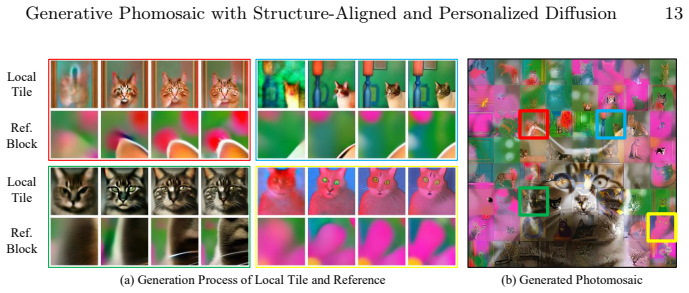
We present the first generative approach to photomosaic creation. Our generative photomosaic framework synthesizes tile images using diffusion-based generation conditioned on reference images. A low-frequency conditioned diffusion mechanism aligns global structure while preserving prompt-driven details. This enables photomosaic composition that is both semantically expressive and structurally coherent, overcoming the limitations of matching-based approaches. By leveraging few-shot personalized diffusion, the model produces user-specific or stylistically consistent tiles without an extensive collection of images.
What carries the argument
The low-frequency conditioned diffusion mechanism, which injects low-frequency components from the reference image into the diffusion process to enforce global structural alignment across generated tiles.
If this is right
- Photomosaics can be produced without maintaining or searching large tile databases.
- Tile styles can be personalized or kept consistent across an entire image using only a few reference examples.
- The resulting mosaics combine semantic expressiveness from prompts with structural coherence from the conditioning.
- The approach directly sidesteps the diversity and consistency problems inherent in color-matching methods.
Where Pith is reading between the lines
- Similar low-frequency conditioning could be tested on other generative tasks that require both global layout and local variation, such as texture synthesis or scene layout.
- If the conditioning proves stable, it might support interactive photomosaic tools where users adjust prompts and see real-time tile updates.
- The method implicitly suggests that storing only a small set of style references could replace large static tile libraries in consumer applications.
Load-bearing premise
Low-frequency conditioning on a diffusion model will reliably produce tiles whose assembled result matches the target image's global structure while still letting prompts control local appearance and style.
What would settle it
Assemble a photomosaic from tiles generated with the low-frequency conditioning and observe whether the overall image fails to reproduce the target's broad layout or requires heavy post-processing to look coherent.
Figures




read the original abstract
We present the first generative approach to photomosaic creation. Traditional photomosaic methods rely on a large number of tile images and color-based matching, which limits both diversity and structural consistency. Our generative photomosaic framework synthesizes tile images using diffusion-based generation conditioned on reference images. A low-frequency conditioned diffusion mechanism aligns global structure while preserving prompt-driven details. This generative formulation enables photomosaic composition that is both semantically expressive and structurally coherent, effectively overcoming the fundamental limitations of matching-based approaches. By leveraging few-shot personalized diffusion, our model is able to produce user-specific or stylistically consistent tiles without requiring an extensive collection of images.
Editorial analysis
A structured set of objections, weighed in public.
Referee Report
Summary. The paper introduces the first generative framework for photomosaic creation, replacing traditional matching-based methods that require large tile collections and color matching. It synthesizes individual tile images via a diffusion model conditioned on reference images through a low-frequency mechanism that enforces global structural alignment while retaining prompt-driven local details. The approach further incorporates few-shot personalized diffusion to enable user-specific or stylistically consistent tile generation without extensive image datasets, yielding photomosaics that are both semantically expressive and structurally coherent.
Significance. If the results hold, this work offers a meaningful advance in applying conditional diffusion models to artistic image composition tasks. The low-frequency conditioning provides a principled way to trade off global structure preservation against creative detail generation, directly addressing the diversity and consistency limitations of prior photomosaic techniques. The manuscript supplies method descriptions, conditioning formulations, qualitative results, and comparisons that support the mechanism operating as intended; the weakest-assumption concern about reliable structural coherence does not materialize in the reported experiments. This data-efficient, personalized formulation could broaden applications in generative art.
minor comments (2)
- The abstract describes the low-frequency conditioned diffusion at a high level; expanding the brief mention of the conditioning mechanism with a one-sentence pointer to the precise formulation in the method section would improve accessibility for readers scanning the front matter.
- In the experiments section, the qualitative comparison figures effectively illustrate structure alignment and personalization, yet the figure captions could more explicitly note the text prompts and reference-image low-frequency extraction parameters used for each example to facilitate exact reproduction.
Simulated Author's Rebuttal
We thank the referee for their positive assessment of our work and the recommendation for minor revision. The referee summary correctly captures the core contributions of the first generative photomosaic framework based on structure-aligned low-frequency diffusion conditioning and few-shot personalization.
Circularity Check
No significant circularity detected
full rationale
The paper describes a new generative photomosaic method based on diffusion models with low-frequency conditioning and few-shot personalization. No equations, derivations, or fitted parameters are presented that reduce by construction to self-defined inputs or prior self-citations. The core claims rest on the architectural choices and qualitative/quantitative evaluations rather than tautological redefinitions or load-bearing self-references.
Axiom & Free-Parameter Ledger
Lean theorems connected to this paper
-
IndisputableMonolith/Cost/FunctionalEquation.leanwashburn_uniqueness_aczel unclear?
unclearRelation between the paper passage and the cited Recognition theorem.
A low-frequency conditioned diffusion mechanism aligns global structure while preserving prompt-driven details... low-frequency structural guidance with gradient descent... ℓk(t) = ||Gσ(Itilek(t)) − Gσ(Bk(t))||₂²
-
IndisputableMonolith/Foundation/RealityFromDistinction.leanreality_from_one_distinction unclear?
unclearRelation between the paper passage and the cited Recognition theorem.
We introduce the first generative approach for photomosaic that synthesizes structurally aligned tile images without relying on large-scale external tile collections.
What do these tags mean?
- matches
- The paper's claim is directly supported by a theorem in the formal canon.
- supports
- The theorem supports part of the paper's argument, but the paper may add assumptions or extra steps.
- extends
- The paper goes beyond the formal theorem; the theorem is a base layer rather than the whole result.
- uses
- The paper appears to rely on the theorem as machinery.
- contradicts
- The paper's claim conflicts with a theorem or certificate in the canon.
- unclear
- Pith found a possible connection, but the passage is too broad, indirect, or ambiguous to say the theorem truly supports the claim.
Reference graph
Works this paper leans on
-
[1]
In: Eurographics Italian Chapter Conference
Battiato, S., Di Blasi, G., Farinella, G.M., Gallo, G., et al.: A survey of digital mo- saic techniques. In: Eurographics Italian Chapter Conference. pp. 129–135 (2006) Generative Phomosaic with Structure-Aligned and Personalized Diffusion 15
2006
-
[2]
In: The Twelfth Interna- tional Conference on Learning Representations (2024),https://openreview.net/ forum?id=pzElnMrgSD
Chang, P., Tang, J., Gross, M., Azevedo, V.C.: How i warped your noise: a temporally-correlated noise prior for diffusion models. In: The Twelfth Interna- tional Conference on Learning Representations (2024),https://openreview.net/ forum?id=pzElnMrgSD
2024
-
[3]
arXiv preprint arXiv:2406.05641 (2024)
Chen, S., Pan, Z., Cai, J., Phung, D.: Para: Personalizing text-to-image diffusion via parameter rank reduction. arXiv preprint arXiv:2406.05641 (2024)
-
[4]
In: International conference on raster imaging and digital typography
Finkelstein, A., Range, M.: Image mosaics. In: International conference on raster imaging and digital typography. pp. 11–22. Springer (1998)
1998
-
[5]
An Image is Worth One Word: Personalizing Text-to-Image Generation using Textual Inversion
Gal, R., Alaluf, Y., Atzmon, Y., Patashnik, O., Bermano, A.H., Chechik, G., Cohen-Or, D.: An image is worth one word: Personalizing text-to-image gener- ation using textual inversion. arXiv preprint arXiv:2208.01618 (2022)
work page internal anchor Pith review arXiv 2022
-
[6]
In: European Conference on Computer Vision
Geng, D., Park, I., Owens, A.: Factorized diffusion: Perceptual illusions by noise de- composition. In: European Conference on Computer Vision. pp. 366–384. Springer (2024)
2024
-
[7]
Advances in Neural Information Processing Systems36, 15890–15902 (2023)
Gu, Y., Wang, X., Wu, J.Z., Shi, Y., Chen, Y., Fan, Z., Xiao, W., Zhao, R., Chang, S., Wu, W., et al.: Mix-of-show: Decentralized low-rank adaptation for multi-concept customization of diffusion models. Advances in Neural Information Processing Systems36, 15890–15902 (2023)
2023
-
[8]
Multimedia Tools and Applications78(18), 25919– 25936 (2019)
He,Y.,Zhou,J.,Yuen,S.Y.:Composingphotomosaicimagesusingclusteringbased evolutionary programming. Multimedia Tools and Applications78(18), 25919– 25936 (2019)
2019
-
[9]
Prompt-to-Prompt Image Editing with Cross Attention Control
Hertz, A., Mokady, R., Tenenbaum, J., Aberman, K., Pritch, Y., Cohen-Or, D.: Prompt-to-prompt image editing with cross attention control. arXiv preprint arXiv:2208.01626 (2022)
work page internal anchor Pith review arXiv 2022
-
[10]
ICLR1(2), 3 (2022)
Hu, E.J., Shen, Y., Wallis, P., Allen-Zhu, Z., Li, Y., Wang, S., Wang, L., Chen, W., et al.: Lora: Low-rank adaptation of large language models. ICLR1(2), 3 (2022)
2022
-
[11]
In: Proceedings of the IEEE international conference on computer vision (2017)
Huang, X., Belongie, S.: Arbitrary style transfer in real-time with adaptive instance normalization. In: Proceedings of the IEEE international conference on computer vision (2017)
2017
-
[12]
In: Proceedings of the Computer Vision and Pattern Recognition Conference
Jiang, J., Zhang, Y., Feng, K., Wu, X., Li, W., Pei, R., Li, F., Zuo, W.: Mcˆ 2: Multi-concept guidance for customized multi-concept generation. In: Proceedings of the Computer Vision and Pattern Recognition Conference. pp. 2802–2812 (2025)
2025
-
[13]
In: Proceedings of the IEEE/CVF International Conference on Computer Vision
Kodaira, A., Xu, C., Hazama, T., Yoshimoto, T., Ohno, K., Mitsuhori, S., Sug- ano, S., Cho, H., Liu, Z., Tomizuka, M., et al.: Streamdiffusion: A pipeline-level solution for real-time interactive generation. In: Proceedings of the IEEE/CVF International Conference on Computer Vision. pp. 12371–12380 (2025)
2025
-
[14]
In: European Conference on Computer Vision
Kong, Z., Zhang, Y., Yang, T., Wang, T., Zhang, K., Wu, B., Chen, G., Liu, W., Luo, W.: Omg: Occlusion-friendly personalized multi-concept generation in diffu- sion models. In: European Conference on Computer Vision. pp. 253–270. Springer (2024)
2024
-
[15]
In: Proceedings of the IEEE/CVF conference on computer vision and pattern recognition
Kumari, N., Zhang, B., Zhang, R., Shechtman, E., Zhu, J.Y.: Multi-concept cus- tomization of text-to-image diffusion. In: Proceedings of the IEEE/CVF conference on computer vision and pattern recognition. pp. 1931–1941 (2023)
1931
-
[16]
International Journal of Computer and Information Engineering8(3), 457–460 (2014)
Lee, H.Y.: Generation of photo-mosaic images through block matching and color adjustment. International Journal of Computer and Information Engineering8(3), 457–460 (2014)
2014
-
[17]
In: European Conference on Computer Vision
Lee, J., Kang, M., Han, B.: Diffusion-based image-to-image translation by noise correction via prompt interpolation. In: European Conference on Computer Vision. pp. 289–304. Springer (2024) 16 J. Chung et al
2024
-
[18]
Advances in Neural Information Processing Systems36, 50648–50660 (2023)
Lee, Y., Kim, K., Kim, H., Sung, M.: Syncdiffusion: Coherent montage via syn- chronized joint diffusions. Advances in Neural Information Processing Systems36, 50648–50660 (2023)
2023
-
[19]
Mathematics8(9), 1613 (2020)
Li, C.L., Su, Y., Wang, R.Z.: Generating photomosaics with qr code capability. Mathematics8(9), 1613 (2020)
2020
-
[20]
In: International confer- ence on machine learning
Li, J., Li, D., Xiong, C., Hoi, S.: Blip: Bootstrapping language-image pre-training for unified vision-language understanding and generation. In: International confer- ence on machine learning. pp. 12888–12900. PMLR (2022)
2022
-
[21]
In: Proceedings of the AAAI conference on artificial intelligence (2024)
Mou, C., Wang, X., Xie, L., Wu, Y., Zhang, J., Qi, Z., Shan, Y.: T2i-adapter: Learning adapters to dig out more controllable ability for text-to-image diffusion models. In: Proceedings of the AAAI conference on artificial intelligence (2024)
2024
-
[22]
In: Proceedings of the IEEE/CVF conference on computer vision and pattern recognition
Po, R., Yang, G., Aberman, K., Wetzstein, G.: Orthogonal adaptation for modular customization of diffusion models. In: Proceedings of the IEEE/CVF conference on computer vision and pattern recognition. pp. 7964–7973 (2024)
2024
-
[23]
SDXL: Improving Latent Diffusion Models for High-Resolution Image Synthesis
Podell, D., English, Z., Lacey, K., Blattmann, A., Dockhorn, T., Müller, J., Penna, J., Rombach, R.: Sdxl: Improving latent diffusion models for high-resolution image synthesis. arXiv preprint arXiv:2307.01952 (2023)
work page internal anchor Pith review Pith/arXiv arXiv 2023
-
[24]
In: International conference on machine learning
Radford, A., Kim, J.W., Hallacy, C., Ramesh, A., Goh, G., Agarwal, S., Sastry, G., Askell, A., Mishkin, P., Clark, J., et al.: Learning transferable visual models from natural language supervision. In: International conference on machine learning. pp. 8748–8763. PmLR (2021)
2021
-
[25]
In: Proceedings of the IEEE/CVF conference on computer vision and pattern recognition
Rombach, R., Blattmann, A., Lorenz, D., Esser, P., Ommer, B.: High-resolution image synthesis with latent diffusion models. In: Proceedings of the IEEE/CVF conference on computer vision and pattern recognition. pp. 10684–10695 (2022)
2022
-
[26]
In: Proceedings of the IEEE/CVF Conference on Computer Vision and Pattern Recognition (CVPR) (2022)
Rombach, R., Blattmann, A., Lorenz, D., Esser, P., Ommer, B.: High-resolution image synthesis with latent diffusion models. In: Proceedings of the IEEE/CVF Conference on Computer Vision and Pattern Recognition (CVPR) (2022)
2022
-
[27]
Ruiz, N., Li, Y., Jampani, V., Pritch, Y., Rubinstein, M., Aberman, K.: Dream- booth:Finetuningtext-to-imagediffusionmodelsforsubject-drivengeneration.In: Proceedings of the IEEE/CVF conference on computer vision and pattern recog- nition. pp. 22500–22510 (2023)
2023
-
[28]
Low-rank adaptation for fast text-to-image diffusion fine-tuning3(2023)
Ryu, S.: Low-rank adaptation for fast text-to-image diffusion fine-tuning. Low-rank adaptation for fast text-to-image diffusion fine-tuning3(2023)
2023
-
[29]
Advances in neural information processing systems35, 36479–36494 (2022)
Saharia, C., Chan, W., Saxena, S., Li, L., Whang, J., Denton, E.L., Ghasemipour, K., Gontijo Lopes, R., Karagol Ayan, B., Salimans, T., et al.: Photorealistic text- to-image diffusion models with deep language understanding. Advances in neural information processing systems35, 36479–36494 (2022)
2022
-
[30]
Silvers, R.: Photomosaics: putting pictures in their place. Ph.D. thesis, Mas- sachusetts Institute of Technology (1996)
1996
-
[31]
Henry Holt and Co., Inc
Silvers, R.: Photomosaics. Henry Holt and Co., Inc. (1997)
1997
-
[32]
In: Proceedings of the Computer Vision and Pattern Recognition Conference
Simsar, E., Hofmann, T., Tombari, F., Yanardag, P.: Loraclr: Contrastive adapta- tion for customization of diffusion models. In: Proceedings of the Computer Vision and Pattern Recognition Conference. pp. 13189–13198 (2025)
2025
-
[33]
In: Proceedings of the AAAI conference on artificial intelligence
Wang, J., Chan, K.C., Loy, C.C.: Exploring clip for assessing the look and feel of images. In: Proceedings of the AAAI conference on artificial intelligence. vol. 37, pp. 2555–2563 (2023)
2023
-
[34]
IEEE Transon ImageProcessing13(4), 600 (2004)
WangZhou, B., Sheikh, H.R., et al.: Image qualityassessment: From errorvisibili- tytostructural similarity. IEEE Transon ImageProcessing13(4), 600 (2004)
2004
-
[35]
Wu, X., Hao, Y., Sun, K., Chen, Y., Zhu, F., Zhao, R., Li, H.: Human preference score v2: A solid benchmark for evaluating human preferences of text-to-image synthesis. arXiv preprint arXiv:2306.09341 (2023) Generative Phomosaic with Structure-Aligned and Personalized Diffusion 17
work page internal anchor Pith review arXiv 2023
-
[36]
Advances in Neural Information Processing Systems36, 15903–15935 (2023)
Xu, J., Liu, X., Wu, Y., Tong, Y., Li, Q., Ding, M., Tang, J., Dong, Y.: Imagere- ward: Learning and evaluating human preferences for text-to-image generation. Advances in Neural Information Processing Systems36, 15903–15935 (2023)
2023
-
[37]
In: Proceedings of the IEEE/CVF international conference on computer vision
Zhang, L., Rao, A., Agrawala, M.: Adding conditional control to text-to-image diffusion models. In: Proceedings of the IEEE/CVF international conference on computer vision. pp. 3836–3847 (2023)
2023
-
[38]
Global Prompt
Zhang, R., Isola, P., Efros, A.A., Shechtman, E., Wang, O.: The unreasonable effectiveness of deep features as a perceptual metric. In: Proceedings of the IEEE conference on computer vision and pattern recognition. pp. 586–595 (2018) 18 J. Chung et al. A Implementation Details A.1 Evaluation Details We evaluate all methods using 12 global and local prompt...
2018
discussion (0)
Sign in with ORCID, Apple, or X to comment. Anyone can read and Pith papers without signing in.