Recognition: unknown
Gravitational wave signal and noise response of an optically levitated sensor in a Fabry-P\'erot cavity
Pith reviewed 2026-05-10 17:36 UTC · model grok-4.3
The pith
Levitated sensor in Fabry-Pérot cavity shows asymmetric gravitational wave response that suppresses input-mirror noise.
A machine-rendered reading of the paper's core claim, the machinery that carries it, and where it could break.
Core claim
The authors derive the gravitational wave response of a levitated object in an optical cavity in a gauge-independent manner and establish that the strain signal is strongly asymmetric with respect to trap position. This asymmetry implies that input-mirror displacements couple to the signal with much lower strength than end-mirror displacements and common-mode mirror motion. These results clarify the physical origin of the interaction and provide essential design principles for high-frequency gravitational wave detectors based on optical levitation.
What carries the argument
The position-dependent strain response arising from the general-relativistic interaction between the gravitational wave and the levitated object in the cavity.
If this is right
- The gravitational wave strain signal is maximized when the levitated sensor is placed near the input mirror.
- Input-mirror displacement noise is highly suppressed in the strain signal relative to end-mirror noise.
- Common-mode mirror motion couples more strongly to the signal than isolated input-mirror motion.
- These asymmetries establish key design principles for high-frequency GW detectors using levitated sensors.
Where Pith is reading between the lines
- The same asymmetry could be exploited in other cavity-based interferometric sensors to reduce specific noise sources.
- Laboratory tests with controlled mirror displacements could directly measure the predicted suppression factor as a function of trap position.
- The gauge-independent derivation suggests the result holds beyond specific coordinate choices used in prior work.
Load-bearing premise
The analysis assumes an idealized point-like levitated object inside a perfect Fabry-Pérot cavity without scattering, absorption, or finite-size effects.
What would settle it
Direct measurement of the strain signal amplitude and noise coupling strengths at varying trap positions in a prototype cavity would confirm the asymmetry and suppression if the observed ratios match the derived predictions.
Figures



read the original abstract
Optically levitated sensors inside a Fabry-P\'erot cavity have been proposed for high-frequency gravitational-wave (GW) detection, though their configuration for gravitational wave sensitivity exhibits counterintuitive features. We provide a new detailed general relativistic derivation of the interaction between a gravitational wave and a levitated object in an optical cavity, demonstrating gauge independence of the observable response. We find a strong asymmetric dependence of the strain signal on trap position, maximized when the sensor is located near the input mirror, in agreement with previous results. A key new result of this work is the consequence of this asymmetry on the noise coupling: the coupling of input-mirror displacements to the strain signal can be highly suppressed relative to that of end-mirror displacements and common-mode mirror motion. These results clarify the physical origin of the gravitational wave interaction with such a sensor and establish crucial design principles for optical levitation based high-frequency GW detectors.
Editorial analysis
A structured set of objections, weighed in public.
Referee Report
Summary. The manuscript derives the interaction of gravitational waves with an optically levitated sensor inside a Fabry-Pérot cavity from first principles in general relativity. It establishes gauge independence of the observable strain response and demonstrates a strong position-dependent asymmetry, with maximum sensitivity when the levitated object is near the input mirror. This asymmetry is shown to suppress the coupling of input-mirror displacement noise to the detected strain relative to end-mirror displacements and common-mode mirror motion, yielding concrete design implications for high-frequency GW detectors.
Significance. If the central derivation holds, the work supplies a clear physical explanation for the counterintuitive features of levitated-sensor cavities and identifies a practical noise-suppression advantage that follows directly from optical phase accumulation. The explicit GR treatment and demonstration of gauge independence strengthen the result beyond prior phenomenological approaches. The idealized model (point-like scatterer, perfect cavity) is stated upfront, allowing the asymmetry to be derived cleanly as a model prediction.
minor comments (3)
- The abstract states agreement with previous results on the position asymmetry; the introduction would benefit from explicit citations to those works to clarify the incremental contribution.
- A brief explicit check of the derived response in a limiting case (e.g., levitated object at cavity center or in the long-wavelength limit) would help readers verify the gauge-independent observable.
- Notation for the differential phase and force on the levitated object should be defined at first appearance and used consistently throughout the derivation sections.
Simulated Author's Rebuttal
We thank the referee for their positive and accurate summary of the manuscript, which correctly highlights the gauge-independent GR derivation, the position-dependent strain response, and the resulting noise-suppression implications for high-frequency GW detectors. We appreciate the recommendation to accept.
Circularity Check
No significant circularity in the derivation chain
full rationale
The paper presents a first-principles general relativistic derivation of the GW interaction with a levitated sensor in a Fabry-Pérot cavity, showing gauge independence and an asymmetric strain response maximized near the input mirror. The central new result on suppressed input-mirror displacement noise coupling follows directly from optical phase accumulation along the cavity axis and the differential observable in the idealized point-like scatterer model. No steps reduce by construction to self-definitions, fitted parameters renamed as predictions, or load-bearing self-citations; prior results are cited only for agreement, not as justification for the new asymmetry. The idealizations are stated explicitly, and the quantitative suppression is a model prediction independent of the inputs. This matches the expectation that most papers score 0-2 with self-contained derivations.
Axiom & Free-Parameter Ledger
axioms (2)
- standard math Weak-field general relativity for gravitational wave propagation and interaction with matter
- domain assumption Idealized point-particle levitated object in a perfect Fabry-Pérot cavity
Reference graph
Works this paper leans on
-
[1]
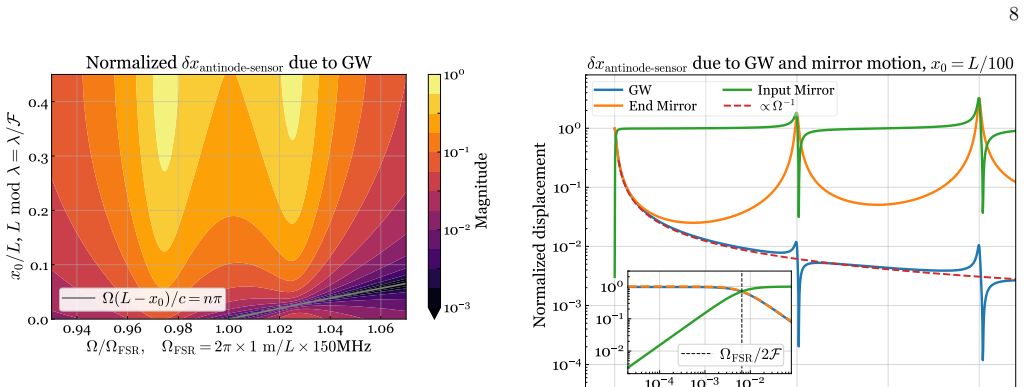
Effect of a gravitational wave In Fig. 4, we plot the magnitude of the relative sensor- antinode displacement due to a GW as a function of its frequency and the sensor rest position4 x0, normalized by the lowest-order cavity length change in the LL gauge, h0L/2. The cavity is held on resonance with respect to ω0. Immediately evident are bands of large rel...
-
[2]
Effect of mirror motion End mirror motion in the laboratory frameδx end(t) = δxm cos(Ωt) generates aj-th previous roundtrip time of T end j = 2L c + 2δxm c cos Ω(t− (2j−1)L c ) (j >0),(23) whereas identical motion of the input mirror leads to T input j = 2L c − δxm c h cos Ω(t− (2j−2)L c ) + cos Ω(t− 2jL c ) i (j >0).(24) We can then numerically compute t...
-
[3]
B. P. Abbottet al.(LIGO Scientific, Virgo), GWTC- 1: A Gravitational-Wave Transient Catalog of Compact Binary Mergers Observed by LIGO and Virgo during the First and Second Observing Runs, Phys. Rev. X9, 031040 (2019), arXiv:1811.12907 [astro-ph.HE]
work page internal anchor Pith review arXiv 2019
-
[4]
R. Abbottet al.(LIGO Scientific, Virgo), GWTC-2: Compact Binary Coalescences Observed by LIGO and Virgo During the First Half of the Third Observing Run, Phys. Rev. X11, 021053 (2021), arXiv:2010.14527
work page internal anchor Pith review arXiv 2021
-
[5]
R. Abbottet al.(KAGRA, VIRGO, LIGO Scien- tific), GWTC-3: Compact Binary Coalescences Observed by LIGO and Virgo during the Second Part of the Third Observing Run, Phys. Rev. X13, 041039 (2023), arXiv:2111.03606 [gr-qc]
work page internal anchor Pith review arXiv 2023
- [6]
-
[7]
The NANOGrav 15-year Data Set: Evidence for a Gravitational-Wave Background
G. Agazieet al.(NANOGrav), The NANOGrav 15 yr Data Set: Evidence for a Gravitational-wave Background, Astrophys. J. Lett.951, L8 (2023), arXiv:2306.16213 [astro-ph.HE]
work page internal anchor Pith review arXiv 2023
-
[8]
Antoniadiset al., The second data release from the European Pulsar Timing Array
J. Antoniadiset al.(EPTA, InPTA), The second data re- lease from the European Pulsar Timing Array - V. Search for continuous gravitational wave signals, Astron. Astro- phys.690, A118 (2024), arXiv:2306.16226 [astro-ph.HE]
-
[9]
The Science of the Einstein Telescope
A. Abacet al.(ET), The Science of the Einstein Tele- scope, (2025), arXiv:2503.12263 [gr-qc]
work page internal anchor Pith review Pith/arXiv arXiv 2025
-
[10]
E. D. Hall, Cosmic Explorer: A Next-Generation Ground-Based Gravitational-Wave Observatory, Galax- ies10, 90 (2022)
2022
-
[11]
Laser Interferometer Space Antenna
P. Amaro-Seoaneet al.(LISA), Laser Interferometer Space Antenna, (2017), arXiv:1702.00786 [astro-ph.IM]
work page internal anchor Pith review Pith/arXiv arXiv 2017
-
[12]
Kawamura et al., PTEP2021, 05A105 (2021), arXiv:2006.13545 [gr-qc]
S. Kawamuraet al., Current status of space gravitational wave antenna DECIGO and B-DECIGO, PTEP2021, 05A105 (2021), arXiv:2006.13545 [gr-qc]
-
[13]
M. Abeet al.(MAGIS-100), Matter-wave Atomic Gra- diometer Interferometric Sensor (MAGIS-100), Quantum Sci. Technol.6, 044003 (2021), arXiv:2104.02835
-
[14]
S. Takanoet al., TOrsion-Bar Antenna: A Ground-Based Detector for Low-Frequency Gravity Gradient Measure- ment, Galaxies12, 78 (2024), arXiv:2412.01323 [gr-qc]
-
[15]
Aggarwal, O
N. Aggarwal, O. D. Aguiar, A. Bauswein, G. Cella, S. Clesse, A. M. Cruise, V. Domcke, D. G. Figueroa, A. Geraci, M. Goryachev,et al., Challenges and oppor- tunities of gravitational-wave searches at mhz to ghz fre- quencies, Living reviews in relativity24, 4 (2021)
2021
-
[16]
Aggarwal, O
N. Aggarwal, O. D. Aguiar, D. Blas, A. Bauswein, G. Cella, S. Clesse, A. M. Cruise, V. Domcke, S. Ellis, D. G. Figueroa,et al., Challenges and opportunities of gravitational-wave searches above 10 khz: N. aggarwal et al., Living Reviews in Relativity28, 10 (2025)
2025
-
[17]
J. R. Sprague, S. L. Larson, Z. Wang, S. Klomp, A. Laeuger, G. Winstone, N. Aggarwal, A. A. Geraci, and V. Kalogera (LSD), Simulating the Galactic population of axion clouds around stellar-origin black holes: Gravi- tational wave signals in the 10–100 kHz band, Phys. Rev. D110, 123025 (2024), arXiv:2409.03714 [astro-ph.HE]
-
[18]
A. Arvanitaki and A. A. Geraci, Detecting high- frequency gravitational waves with optically-levitated sensors, Phys. Rev. Lett.110, 071105 (2013), arXiv:1207.5320 [gr-qc]
-
[19]
N. Aggarwal, G. P. Winstone, M. Teo, M. Baryakhtar, S. L. Larson, V. Kalogera, and A. A. Geraci, Search- ing for New Physics with a Levitated-Sensor-Based Gravitational-Wave Detector, Phys. Rev. Lett.128, 111101 (2022), arXiv:2010.13157 [gr-qc]
-
[20]
Weber, Detection and generation of gravitational 12 waves, Physical Review117, 306 (1960)
J. Weber, Detection and generation of gravitational 12 waves, Physical Review117, 306 (1960)
1960
-
[21]
Gerstenshtein and V
M. Gerstenshtein and V. Pustovoit, On the detection of low frequency gravitational waves, Soviet Physics-JETP 16, 433 (1963)
1963
-
[22]
V. B. Braginskii, Gravitational radiation and the prospect of its experimental discovery, Uspekhi Fizich- eskih Nauk86, 433 (1965)
1965
-
[23]
Cooperstock and V
F. Cooperstock and V. Faraoni, Laser-interferometric de- tectors of gravitational waves, Classical and Quantum Gravity10, 1189 (1993)
1993
-
[24]
Schilling, Angular and frequency response of LISA, Classical and Quantum Gravity14, 1513 (1997)
R. Schilling, Angular and frequency response of LISA, Classical and Quantum Gravity14, 1513 (1997)
1997
-
[25]
Rakhmanov, F
M. Rakhmanov, F. Bondu, O. Debieu, and R. Savage Jr, Characterization of the LIGO 4 km Fabry–Perot cavities via their high-frequency dynamic responses to length and laser frequency variations, Classical and Quantum Grav- ity21, S487 (2004)
2004
-
[26]
Rakhmanov, Response of test masses to gravitational waves in the local Lorentz gauge, Phys
M. Rakhmanov, Response of test masses to gravitational waves in the local Lorentz gauge, Phys. Rev. D71, 084003 (2005), arXiv:gr-qc/0406009
-
[27]
S. P. Tarabrin, Interaction of plane gravitational waves with a fabry-perot cavity in the local lorentz frame, Phys- ical Review D—Particles, Fields, Gravitation, and Cos- mology75, 102002 (2007)
2007
-
[28]
Melissinos and A
A. Melissinos and A. Das, The response of laser inter- ferometers to a gravitational wave, American Journal of Physics78, 1160 (2010)
2010
- [29]
- [30]
-
[31]
M. Rakhmanov, J. D. Romano, and J. T. Whelan, High- frequency corrections to the detector response and their effect on searches for gravitational waves, Class. Quant. Grav.25, 184017 (2008), arXiv:0808.3805 [gr-qc]
- [32]
- [33]
-
[34]
X. Deng and L. S. Finn, Pulsar timing array observations of gravitational wave source timing parallax, Mon. Not. Roy. Astron. Soc.414, 50 (2011), arXiv:1008.0320
-
[35]
McGrath,Gravitational Wave Timing Residual Mod- els for Pulsar Timing Experiments, Ph.D
C. McGrath,Gravitational Wave Timing Residual Mod- els for Pulsar Timing Experiments, Ph.D. thesis, Wis- consin U., Milwaukee, Wisconsin U., Milwaukee (2021), arXiv:2109.07603 [gr-qc]
-
[36]
A. Boˆ ıtier, S. Tiwari, L. Philippoz, and P. Jetzer, Pulse redshift of pulsar timing array signals for all possible gravitational wave polarizations in modified general relativity, Phys. Rev. D102, 064051 (2020), arXiv:2008.13520 [gr-qc]
-
[37]
S. Schaffrath, D. St¨ ork, F. Di Pumpo, and E. Giese, Uni- fied laboratory-frame analysis of atomic gravitational- wave sensors, AVS Quantum Sci.7, 044402 (2025), arXiv:2509.24993 [quant-ph]
-
[38]
Wang, X.-Y
Y.-J. Wang, X.-Y. Lu, C.-G. Qin, Y.-J. Tan, and C.-G. Shao, Modeling gravitational wave detection with atom interferometry, Class. Quant. Grav.38, 145025 (2021)
2021
- [39]
-
[40]
K. Nakamura and M. Ando, Torsion bar antenna in the proper reference frame with rotation, Phys. Rev. D90, 064008 (2014), arXiv:1405.4050 [gr-qc]
-
[41]
Ashkin, Trapping of Atoms by Resonance Radiation Pressure, Phys
A. Ashkin, Trapping of Atoms by Resonance Radiation Pressure, Phys. Rev. Lett.40, 729 (1978)
1978
-
[42]
Ashkin, J
A. Ashkin, J. M. Dziedzic, J. E. Bjorkholm, and S. Chu, Observation of a single-beam gradient force optical trap for dielectric particles, Opt. Lett.11, 288 (1986)
1986
- [43]
- [44]
-
[45]
Laeuger and N
A. Laeuger and N. Aggarwal, in prep., (2026)
2026
-
[46]
G. Winstoneet al.(LSD), Optical Trapping of High- Aspect-Ratio NaYF Hexagonal Prisms for kHz-MHz Gravitational Wave Detectors, Phys. Rev. Lett.129, 053604 (2022), arXiv:2204.10843 [physics.optics]
discussion (0)
Sign in with ORCID, Apple, or X to comment. Anyone can read and Pith papers without signing in.