Recognition: 2 theorem links
· Lean TheoremQuantum Simulation of Collective Neutrino Oscillations using Dicke States
Pith reviewed 2026-05-10 17:32 UTC · model grok-4.3
The pith
Dicke states enable qubit-efficient quantum simulations of collective neutrino oscillations.
A machine-rendered reading of the paper's core claim, the machinery that carries it, and where it could break.
Core claim
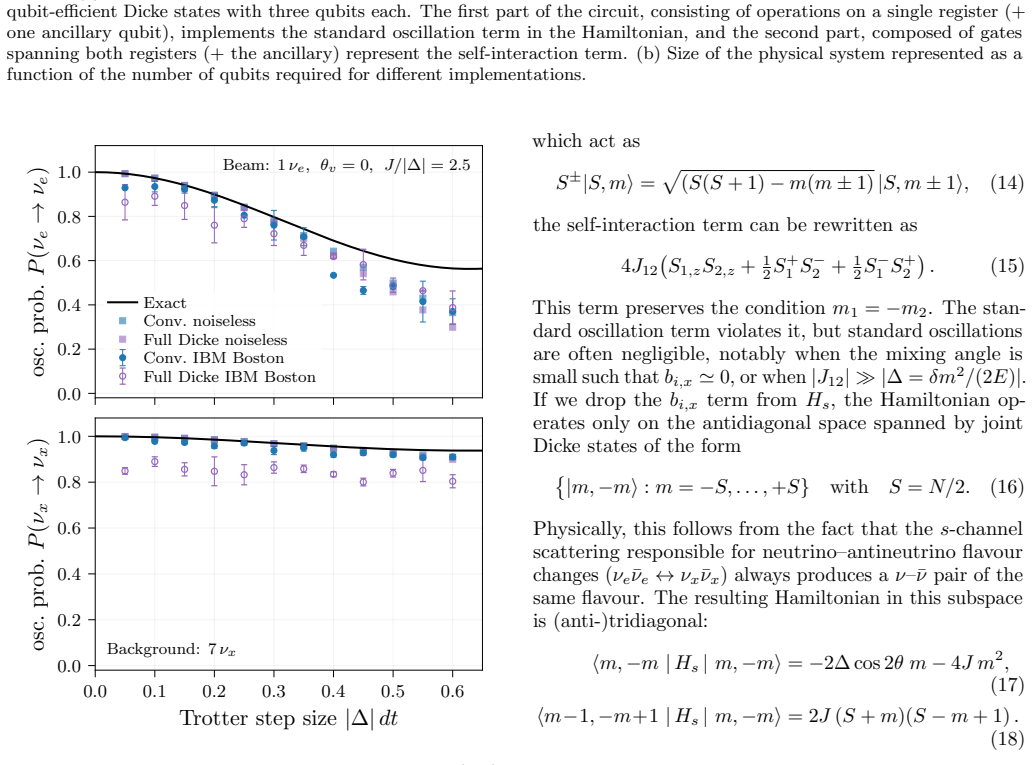
We propose a new class of qubit-efficient algorithms based on Dicke states and the su(2) spin algebra. We demonstrate the excellent performance of these algorithms both on classical and on quantum hardware.
What carries the argument
Dicke states, the fully symmetric multi-qubit states that respect the su(2) spin algebra of the collective neutrino system, which map the many-body flavor dynamics onto a much smaller effective Hilbert space.
If this is right
- Simulations of collective neutrino oscillations require far fewer qubits than naive product-state encodings.
- The algorithms run successfully on present-day quantum processors for the tested toy models.
- The su(2) structure allows direct incorporation of the dominant interaction terms in the neutrino Hamiltonian.
- Entanglement between neutrino flavors emerges naturally from the symmetric state evolution.
Where Pith is reading between the lines
- As quantum hardware scales, the same encoding could handle neutrino numbers large enough to model realistic supernova bursts.
- The approach may transfer to other many-body spin systems that share su(2) symmetry, such as certain atomic or condensed-matter ensembles.
- Improved neutrino-flux predictions from such simulations could tighten constraints on neutrino masses and mixing parameters extracted from supernova observations.
Load-bearing premise
The collective neutrino system possesses enough su(2) symmetry that Dicke states can capture its essential dynamics without significant loss for realistic supernova conditions.
What would settle it
Run the Dicke-state circuit on quantum hardware for a small number of neutrinos whose exact oscillation probabilities are known from classical diagonalization, and check whether the measured probabilities agree within device error bars.
Figures





read the original abstract
In dense neutrino gases, which exist for instance in supernovae, the flavour states of different neutrinos may become entangled with one another. The theoretical description of such systems may therefore call for simulations on a quantum computer. Existing quantum simulations of simple toy systems are not optimal in the sense that they do not fully exploit the symmetries of the system. Here, we propose a new class of qubit-efficient algorithms based on Dicke states and the $su(2)$ spin algebra. We demonstrate the excellent performance of these algorithms both on classical and on quantum hardware.
Editorial analysis
A structured set of objections, weighed in public.
Referee Report
Summary. The manuscript proposes a new class of qubit-efficient algorithms for quantum simulation of collective neutrino oscillations in dense gases (e.g., supernovae), based on encoding in Dicke states and exploiting the su(2) spin algebra symmetries of the collective Hamiltonian. It claims to demonstrate excellent performance of these algorithms on both classical simulators and quantum hardware.
Significance. If the central symmetry assumptions hold and the approach extends beyond toy models, the qubit reduction from O(N) to O(log N) via the Dicke manifold could enable simulations of larger neutrino systems than standard product-state encodings, providing a concrete algorithmic advance in quantum simulation of many-body neutrino dynamics.
major comments (2)
- [Abstract] Abstract: the claim of 'excellent performance' on classical and quantum hardware is asserted without any quantitative metrics, system sizes, error rates, baseline comparisons, or error bars, which is load-bearing for evaluating the demonstration of the proposed algorithms.
- [Theoretical framework] Theoretical framework section (on Hamiltonian symmetry): the qubit-efficient encoding and confinement to the (N+1)-dimensional Dicke subspace rely on the collective forward-scattering Hamiltonian exactly preserving total spin; however, the manuscript does not bound or quantify leakage out of this manifold when realistic supernova effects (matter potentials, non-uniform densities, multi-angle scattering) break the global su(2) symmetry, undermining the applicability claim beyond the tested toy models.
minor comments (2)
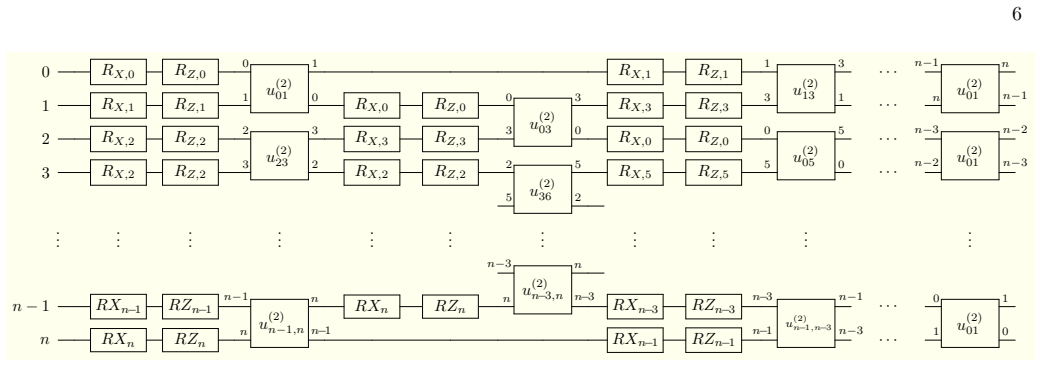
- [Methods] Methods section: clarify the precise mapping from neutrino flavor states to Dicke states and the implementation of the time-evolution operator under the su(2) algebra.
- [Results] Figure captions: add explicit labels for the toy-model parameters used in the classical and hardware demonstrations to improve reproducibility.
Simulated Author's Rebuttal
We thank the referee for their thorough review and valuable feedback on our manuscript. We address the major comments point by point below. We have made revisions to the manuscript to incorporate the referee's suggestions where possible.
read point-by-point responses
-
Referee: [Abstract] Abstract: the claim of 'excellent performance' on classical and quantum hardware is asserted without any quantitative metrics, system sizes, error rates, baseline comparisons, or error bars, which is load-bearing for evaluating the demonstration of the proposed algorithms.
Authors: We agree that the abstract's claim of 'excellent performance' would be more convincing with supporting quantitative details. The main text of the manuscript does include demonstrations on classical simulators and quantum hardware with specific system sizes and performance indicators. In the revised manuscript, we have updated the abstract to briefly include key metrics, such as the maximum number of neutrinos simulated and the observed fidelities, along with references to the relevant figures and tables for baselines and error bars. This addresses the concern without overstating the results. revision: yes
-
Referee: [Theoretical framework] Theoretical framework section (on Hamiltonian symmetry): the qubit-efficient encoding and confinement to the (N+1)-dimensional Dicke subspace rely on the collective forward-scattering Hamiltonian exactly preserving total spin; however, the manuscript does not bound or quantify leakage out of this manifold when realistic supernova effects (matter potentials, non-uniform densities, multi-angle scattering) break the global su(2) symmetry, undermining the applicability claim beyond the tested toy models.
Authors: The referee is correct that our qubit-efficient encoding assumes the preservation of total spin by the collective Hamiltonian. The manuscript primarily addresses the idealized case where this symmetry holds exactly, as is common in initial studies of collective neutrino oscillations. We have added a new paragraph in the Theoretical framework section discussing the potential for leakage when additional effects like matter potentials or multi-angle scattering are included. However, providing a quantitative bound on such leakage for full supernova models is beyond the current scope of this work, as it would require incorporating more complex Hamiltonians and performing extensive additional simulations. We clarify in the revision that the applicability to realistic scenarios is an approximation and subject to future investigation. revision: partial
- A quantitative bound or estimate of leakage from the Dicke subspace due to symmetry-breaking terms in realistic neutrino environments
Circularity Check
No circularity: algorithmic construction with external hardware validation
full rationale
The paper proposes qubit-efficient algorithms exploiting su(2) symmetry and Dicke states for collective neutrino oscillations, then demonstrates them on classical simulators and quantum hardware. No derivation step reduces to a fitted parameter renamed as prediction, no self-citation chain justifies the central premise, and the symmetry is an explicit modeling assumption tested in toy models rather than derived from the results. The work is self-contained against external benchmarks.
Axiom & Free-Parameter Ledger
axioms (1)
- domain assumption The collective neutrino system can be faithfully represented using the su(2) spin algebra and symmetric Dicke states.
Lean theorems connected to this paper
-
IndisputableMonolith/Foundation/AlexanderDuality.leanalexander_duality_circle_linking unclear?
unclearRelation between the paper passage and the cited Recognition theorem.
the Hamiltonian ... can be rewritten as Hs ≡ b·S_tot + 2J S²_tot ... S²_tot is a constant of motion. Therefore, if the system is initially in an eigenstate of S²_tot and S_z_tot, a so-called Dicke state...
-
IndisputableMonolith/Cost/FunctionalEquation.leanwashburn_uniqueness_aczel unclear?
unclearRelation between the paper passage and the cited Recognition theorem.
We propose a new class of qubit-efficient algorithms based on Dicke states and the su(2) spin algebra.
What do these tags mean?
- matches
- The paper's claim is directly supported by a theorem in the formal canon.
- supports
- The theorem supports part of the paper's argument, but the paper may add assumptions or extra steps.
- extends
- The paper goes beyond the formal theorem; the theorem is a base layer rather than the whole result.
- uses
- The paper appears to rely on the theorem as machinery.
- contradicts
- The paper's claim conflicts with a theorem or certificate in the canon.
- unclear
- Pith found a possible connection, but the passage is too broad, indirect, or ambiguous to say the theorem truly supports the claim.
Forward citations
Cited by 2 Pith papers
-
Tightening energy-based boson truncation bound using Monte Carlo-assisted methods
Monte Carlo-assisted tightening of the energy-based boson truncation bound substantially reduces volume dependence in (1+1)D scalar field theory and (2+1)D U(1) gauge theory.
-
Tightening energy-based boson truncation bound using Monte Carlo-assisted methods
A Monte Carlo-assisted analytic method tightens energy-based bounds on boson truncation errors, substantially reducing the volume dependence of the required cutoff in scalar and gauge theories.
Reference graph
Works this paper leans on
-
[1]
Quantum Simulation of Collective Neutrino Oscillations using Dicke States
may break down, and it may become necessary to consider full multiparticle evolution. This would entail a computational complexity that scales exponentially with the number of simulated neutrinos, N. Such systems a kbleau@uni-mainz.de b nikolina.ilic@cern.ch c jkopp@cern.ch d ushak.rahaman@cern.ch e xyz.yu@mail.utoronto.ca are therefore a prime applicatio...
work page internal anchor Pith review Pith/arXiv arXiv 2026
-
[2]
7 (a) for the specific example of a 3-qubit register
Single-qubit RZ gates: A rotation RZ(ϕj) is applied to each qubit, where the rotation angle for the j-th qubit is ϕj =−2 −2 j−1β+α c (1) j δt, where c(1) j ≡ −2 X l al X j aj .(A23) This is completely analogous to the circuit shown above in Fig. 7 (a) for the specific example of a 3-qubit register
-
[3]
We neglect global phases as they do not affect measurable quantities
Two-qubit RZZ gates: For each pair ( j, l) with j < l , a rotation RZZ (ϕjl)≡exp(−i ϕjl 2 ˆZj ⊗ ˆZl) is applied, withϕ jl =−2α c (2) jl δt, where c(2) jl ≡2 X j<l aj al .(A24) Each RZZ gate is implemented using two CNOT gates and a singleR Z rotation. We neglect global phases as they do not affect measurable quantities. 11 q0 RZ(φ0) RZZ (0, 1) RZZ (0, 2) ...
-
[4]
We use theX pXm sequence
mitigates this problem by applying dummy pulse sequences to idle qubits, which are designed such that the time-integrated interaction Hamiltonian between the qubit and its thermal environment averages to zero in the limit that the pulse sequence is much faster than the decoherence time [45]. We use theX pXm sequence. b Zero-Noise Extrapolation.The goal of...
-
[5]
M. Nakahata, History of solar neutrino observations, Progress of Theoretical and Experimental Physics2022, 12B103 (2022), https://academic.oup.com/ptep/article- pdf/2022/12/12B103/48422428/ptac039.pdf
2022
-
[6]
Y. Fukudaet al.(Super-Kamiokande), Evidence for os- cillation of atmospheric neutrinos, Phys. Rev. Lett.81, 1562 (1998), arXiv:hep-ex/9807003
-
[7]
First results from Kam- LAND: Evidence for reactor anti-neutrino disappear- ance,
K. Eguchiet al.(KamLAND), First results from Kam- LAND: Evidence for reactor anti-neutrino disappear- ance, Phys. Rev. Lett.90, 021802 (2003), arXiv:hep- ex/0212021
-
[8]
P. Adamsonet al.(MINOS), Improved search for muon- neutrino to electron-neutrino oscillations in MINOS, Phys. Rev. Lett.107, 181802 (2011), arXiv:1108.0015 [hep-ex]
-
[9]
S. P. Mikheyev and A. Y. Smirnov, Resonance Amplifica- tion of Oscillations in Matter and Spectroscopy of Solar Neutrinos, Sov. J. Nucl. Phys.42, 913 (1985)
1985
-
[10]
Wolfenstein, Neutrino Oscillations in Matter, Phys.Rev
L. Wolfenstein, Neutrino Oscillations in Matter, Phys.Rev. D17, 2369 (1978)
1978
-
[11]
J. T. Pantaleone, Neutrino oscillations at high densities, Phys. Lett. B287, 128 (1992)
1992
-
[12]
J. T. Pantaleone, Dirac neutrinos in dense matter, Phys. Rev. D46, 510 (1992)
1992
- [13]
-
[14]
Samuel, Bimodal coherence in dense selfinteracting neutrino gases, Phys
S. Samuel, Bimodal coherence in dense selfinteracting neutrino gases, Phys. Rev. D53, 5382 (1996), arXiv:hep- ph/9604341
-
[15]
S. Pastor and G. Raffelt, Flavor oscillations in the super- nova hot bubble region: Nonlinear effects of neutrino back- ground, Phys. Rev. Lett.89, 191101 (2002), arXiv:astro- ph/0207281
- [16]
-
[17]
A. Friedland and C. Lunardini, Neutrino flavor conversion in a neutrino background: Single particle versus multi- particle description, Phys. Rev. D68, 013007 (2003), arXiv:hep-ph/0304055
-
[18]
A. Friedland and C. Lunardini, Do many particle neutrino interactions cause a novel coherent effect?, JHEP10, 043, arXiv:hep-ph/0307140
-
[19]
S. Shalgar and I. Tamborra, Do we have enough evidence to invalidate the mean-field approximation adopted to model collective neutrino oscillations?, Phys. Rev. D107, 123004 (2023), arXiv:2304.13050 [astro-ph.HE]
-
[20]
L. Johns, Neutrino many-body correlations, Int. J. Mod. Phys. A39, 2450122 (2024), arXiv:2305.04916 [hep-ph]
- [21]
-
[22]
Sigl and G
G. Sigl and G. Raffelt, General kinetic description of rel- ativistic mixed neutrinos, Nucl. Phys. B406, 423 (1993)
1993
- [23]
-
[24]
K. Yeter-Aydeniz, S. Bangar, G. Siopsis, and R. C. Pooser, Collective neutrino oscillations on a quantum computer, Quant. Inf. Proc.21, 84 (2022), arXiv:2104.03273 [quant- ph]
-
[25]
A. K. Jha and A. Chatla, Quantum studies of neutrinos on IBMQ processors, Eur. Phys. J. ST231, 141 (2022)
2022
-
[26]
V. Amitrano, A. Roggero, P. Luchi, F. Turro, L. Vespucci, and F. Pederiva, Trapped-ion quantum simulation of col- lective neutrino oscillations, Phys. Rev. D107, 023007 (2023), arXiv:2207.03189 [quant-ph]
- [27]
- [28]
- [29]
-
[30]
I. Chernyshev, C. E. P. Robin, and M. J. Savage, Quantum magic and computational complexity in the neutrino sec- tor, Phys. Rev. Res.7, 023228 (2025), arXiv:2411.04203 [quant-ph]
-
[31]
G. Singh, Arvind, and K. Dorai, Simulating three-flavor neutrino oscillations on a nuclear magnetic resonance quantum processor, Phys. Scripta100, 085106 (2025), arXiv:2412.15617 [quant-ph]
-
[32]
L. Spagnoliet al., Collective neutrino oscillations in three flavors on qubit and qutrit processors, Phys. Rev. D111, 103054 (2025), arXiv:2503.00607 [quant-ph]. 13
-
[33]
S. Tripathi, S. Joshi, G. Rajpoot, and P. Shukla, Quantum Simulation of Collective Neutrino Oscillations in Dense Neutrino Environment, (2025), arXiv:2508.11610 [quant- ph]
-
[34]
Bleau, N
K. Bleau, N. Ilic, J. Kopp, U. Ramahan, and X. Y. Yu, Quantum entanglement in collective neutrino oscillations – the role of quantum computing, (2026), in preparation
2026
- [35]
-
[36]
H. Haeffneret al., Scalable multiparticle entanglement of trapped ions, Nature438, 643 (2005), arXiv:quant- ph/0603217
-
[37]
H. Haeffner, C. F. Roos, and R. Blatt, Quantum com- puting with trapped ions, Phys. Rept.469, 155 (2008), arXiv:0809.4368 [quant-ph]
-
[38]
Monroeet al., Programmable quantum simulations of spin systems with trapped ions, Rev
C. Monroeet al., Programmable quantum simulations of spin systems with trapped ions, Rev. Mod. Phys.93, 025001 (2021), arXiv:1912.07845 [quant-ph]
-
[39]
A. Browaeys and T. Lahaye, Many-body physics with individually controlled Rydberg atoms, Nature Phys.16, 132 (2020), arXiv:2002.07413 [cond-mat.quant-gas]
-
[40]
Saffman, Quantum computing with atomic qubits and Rydberg interactions: progress and challenges, J
M. Saffman, Quantum computing with atomic qubits and Rydberg interactions: progress and challenges, J. Phys. B49, 202001 (2016), arXiv:1605.05207 [quant-ph]
-
[41]
M. Mirrahimi, Z. Leghtas, V. V. Albert, S. Touzard, R. J. Schoelkopf, L. Jiang, and M. H. Devoret, Dynami- cally protected cat-qubits: a new paradigm for universal quantum computation, New J. Phys.16, 045014 (2014), arXiv:1312.2017 [quant-ph]
- [42]
-
[43]
Veldhorstet al., An addressable quantum dot qubit with fault-tolerant control-fidelity, Nature Nanotech.9, 981 (2014)
M. Veldhorstet al., An addressable quantum dot qubit with fault-tolerant control-fidelity, Nature Nanotech.9, 981 (2014)
2014
- [44]
-
[45]
Simon and Ady Stern and Das Sarma, Sankar , Date-Added =
C. Nayak, S. H. Simon, A. Stern, M. Freedman, and S. Das Sarma, Non-Abelian anyons and topological quantum computation, Reviews of Modern Physics80, 1083 (2008), arXiv:0707.1889 [cond-mat.str-el]
- [46]
- [47]
- [48]
-
[49]
A. Javadi-Abhari, M. Treinish, K. Krsulich, C. J. Wood, J. Lishman, J. Gacon, S. Martiel, P. D. Nation, L. S. Bishop, A. W. Cross, B. R. Johnson, and J. M. Gambetta, Quantum computing with qiskit (2024), arXiv:2405.08810 [quant-ph]
work page internal anchor Pith review arXiv 2024
-
[50]
Viola, E
L. Viola, E. Knill, and S. Lloyd, Dynamical decoupling of open quantum systems, Phys. Rev. Lett.82, 2417 (1999)
1999
-
[51]
Error mitigation for short-depth quantum circuits
K. Temme, S. Bravyi, and J. M. Gambetta, Error Mitiga- tion for Short-Depth Quantum Circuits, Phys. Rev. Lett. 119, 180509 (2017), arXiv:1612.02058 [quant-ph]
work page Pith review arXiv 2017
-
[52]
Giurgica-Tiron, Y
T. Giurgica-Tiron, Y. Hindy, R. LaRose, A. Mari, and W. J. Zeng, Digital zero noise extrapolation for quantum error mitigation, in2020 IEEE International Conference on Quantum Computing and Engineering (QCE)(2020) pp. 306–316
2020
- [53]
-
[54]
van den Berg, Z
E. van den Berg, Z. K. Minev, and K. Temme, Model-free readout-error mitigation for quantum expectation values, Phys. Rev. A105, 032620 (2022)
2022
discussion (0)
Sign in with ORCID, Apple, or X to comment. Anyone can read and Pith papers without signing in.