Recognition: unknown
Too Big to Quench? I. Constraining ISM Stripping of Dwarf Satellites in Milky Way-like Halos
Pith reviewed 2026-05-10 17:10 UTC · model grok-4.3
The pith
Ram pressure stripping efficiently quenches dwarf satellites only below about 10 million solar masses in Milky Way-like halos.
A machine-rendered reading of the paper's core claim, the machinery that carries it, and where it could break.
Core claim
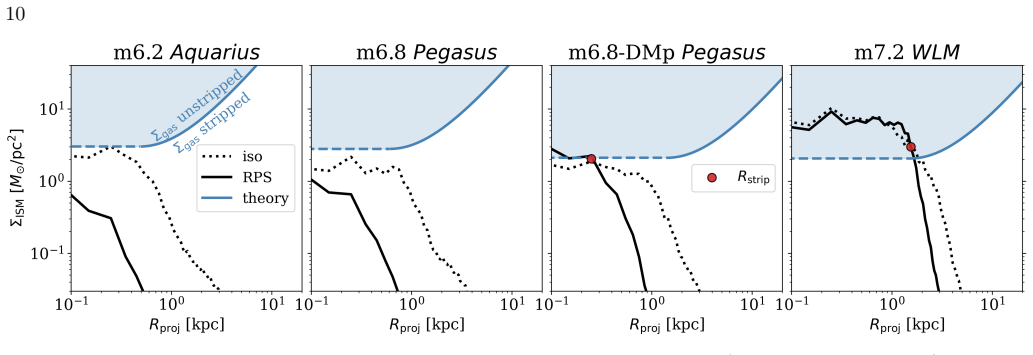
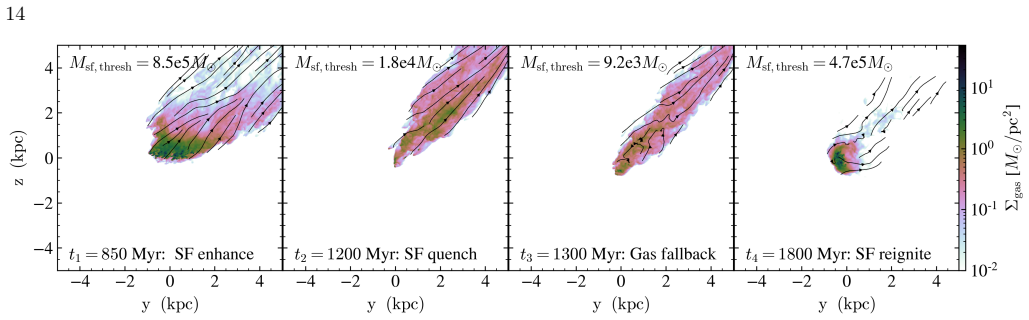
Using a suite of 20-pc resolution hydrodynamical wind tunnel simulations that include radiative cooling in a multiphase satellite ISM, star formation, and stellar feedback, and that vary both satellite masses and host halo gas densities along first-infall and post-pericentric orbits, the authors find that the degree of ISM stripping matches analytical predictions. Star formation quenches rapidly when ram pressure stripping is effective but can be mildly enhanced or temporarily quenched and then reignited when stripping is incomplete. ISM stripping is efficient for satellites with M⋆ ≲ 10^7 M⊙ (or M200 ≲ 10^10 M⊙) but highly inefficient above this scale, and this transitional mass is 0.5-1dex
What carries the argument
A suite of 20-pc resolution hydrodynamical wind-tunnel simulations modeling multiphase ISM, star formation, and stellar feedback while varying satellite masses and host gas densities along specified orbits.
If this is right
- Star formation is rapidly quenched when ram pressure stripping is effective.
- When ram pressure stripping is incomplete, star formation can be mildly enhanced or temporarily quenched and then reignited.
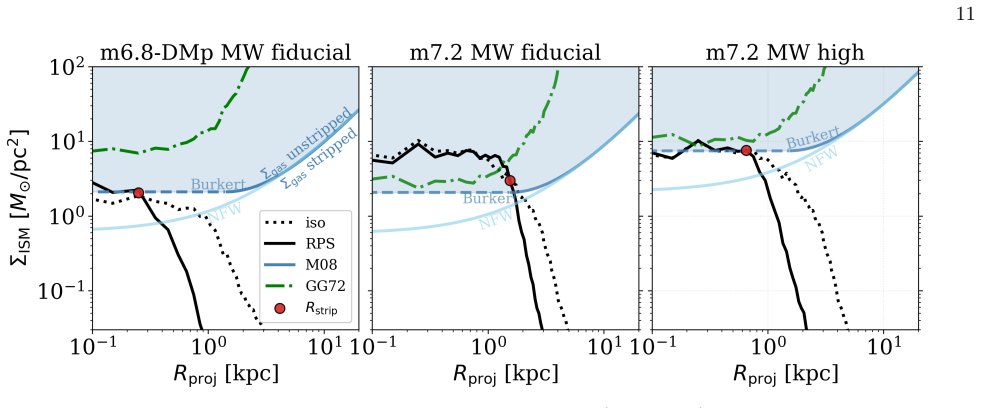
- The simulated degree of ISM stripping is consistent with the analytical prediction by McCarthy et al. (2008).
- Additional mechanisms such as tidal stripping of satellite dark matter or ram pressure from a clumpy gaseous halo are required to quench satellites above the 10^7 M⊙ scale.
Where Pith is reading between the lines
- Clumpy or inhomogeneous gas in real host halos could raise the effective mass threshold for efficient stripping compared with the smooth models used here.
- Adding full tidal interactions and dark matter stripping to the simulations might shift the transitional mass or change how quickly quenching occurs.
- Cosmological simulations that currently quench dwarfs at higher masses may need to incorporate these extra processes to match the observed satellite populations.
Load-bearing premise
The host halo gas is treated as smooth and uniform, with densities set only along chosen orbits and without tidal forces or dark matter stripping included in the setup.
What would settle it
Detection of a population of quenched dwarf satellites with stellar masses around 10^{7.5} M⊙ that show little evidence of tidal effects or clumpy halo gas would indicate that ram pressure can quench at higher masses than the smooth models allow.
Figures




read the original abstract
Galaxy environment plays a crucial role in quenching star formation in dwarf galaxies. In Milky Way (MW)-like environments, dwarf satellite quenching is primarily driven by ram pressure stripping (RPS), the direct removal of satellite gas by the host halo gas. Using a suite of 20-pc resolution hydrodynamical wind tunnel simulations, we constrain the satellite mass scale at which the stripping of a dwarf galaxy's interstellar medium (ISM) becomes inefficient in MW-like halos. The simulations include radiative cooling in a multiphase satellite ISM, star formation, and stellar feedback, and vary both satellite masses ($M_{\star}=10^{6.2}, 10^{6.8}, 10^{7.2}\ M_{\odot}$) and host halo gas densities along a first-infall and post-pericentric orbit. We find that the degree of ISM stripping in our dwarf galaxies is consistent with the analytical prediction by McCarthy et al. (2008). Star formation is rapidly quenched when RPS is effective, but can be mildly enhanced or temporarily quenched and subsequently reignited when RPS is incomplete. ISM stripping is efficient for satellites with $M_{\star} \lesssim 10^{7}\ M_{\odot}$ (or $M_{200} \lesssim 10^{10}\ M_{\odot}$) but highly inefficient above this scale. This transitional mass ($M_{\star} \approx 10^{7}\ M_{\odot}$) is 0.5-1 dex lower than that found in observations and cosmological simulations, suggesting that additional mechanisms are needed to quench more massive satellites, such as tidal stripping of the satellite dark matter or RPS from a clumpy gaseous halo.
Editorial analysis
A structured set of objections, weighed in public.
Referee Report
Summary. The manuscript presents results from a suite of high-resolution (20 pc) hydrodynamical wind-tunnel simulations investigating ram-pressure stripping (RPS) of the interstellar medium in dwarf satellite galaxies orbiting in Milky Way-like halos. Satellite stellar masses of 10^{6.2}, 10^{6.8}, and 10^{7.2} M_⊙ are considered, along with variations in host halo gas density corresponding to first-infall and post-pericentric orbits. The simulations incorporate radiative cooling in a multiphase ISM, star formation, and stellar feedback. The key finding is that ISM stripping is efficient below M⋆ ≈ 10^7 M_⊙ (M_{200} ≈ 10^{10} M_⊙) but highly inefficient above this transitional mass, in agreement with the analytical prediction of McCarthy et al. (2008). Star formation is rapidly quenched when stripping is effective but can be enhanced or temporarily affected when incomplete. The authors conclude that additional mechanisms, such as tidal stripping of dark matter or clumpy halo RPS, are required to explain quenching of more massive satellites, as the transitional mass is 0.5-1 dex lower than in observations and cosmological simulations.
Significance. This study offers a controlled, high-resolution numerical exploration of the mass dependence of RPS efficiency in dwarf galaxies, providing a clear benchmark for when this process alone becomes insufficient for quenching. The inclusion of multiphase gas physics, star formation, and feedback, combined with the direct comparison to the McCarthy et al. (2008) model, adds credibility to the results. If the transitional mass scale proves robust when tested against more complete physical setups, it would have significant implications for understanding environmental quenching in the Local Group and similar systems, motivating targeted investigations into tidal and substructure effects. The work is particularly valuable as the first in a series ('I.'), setting the stage for follow-up studies.
major comments (1)
- [Abstract and Methods description] The wind-tunnel simulations treat the host halo gas as smooth and uniform, without including tidal forces or the satellite dark matter halo. This assumption underpins the reported transitional mass of M⋆ ≈ 10^7 M⊙; as the skeptic highlights, tidal stripping could alter the satellite potential and stripping efficiency at higher masses, potentially shifting the scale and affecting the conclusion that additional mechanisms are necessary to match observations.
Simulated Author's Rebuttal
We thank the referee for their positive assessment of the work's significance and for the constructive major comment. We address the point below and have updated the manuscript with additional discussion of the setup limitations.
read point-by-point responses
-
Referee: The wind-tunnel simulations treat the host halo gas as smooth and uniform, without including tidal forces or the satellite dark matter halo. This assumption underpins the reported transitional mass of M⋆ ≈ 10^7 M⊙; as the skeptic highlights, tidal stripping could alter the satellite potential and stripping efficiency at higher masses, potentially shifting the scale and affecting the conclusion that additional mechanisms are necessary to match observations.
Authors: We agree that the wind-tunnel configuration isolates RPS by assuming a fixed satellite potential and a smooth, uniform host medium; this is a deliberate simplification to enable a clean comparison with the McCarthy et al. (2008) analytic model and to quantify the mass dependence of stripping efficiency alone. We acknowledge that adding the satellite dark-matter halo and tidal forces could shallow the potential at larger radii and thereby increase stripping efficiency at the upper end of our mass range, potentially moving the transitional mass upward by some amount. Our current results already show that RPS becomes inefficient above M⋆ ≈ 10^7 M⊙ and we explicitly list tidal stripping of the dark matter as one of the additional mechanisms required to match observations. Because this is Paper I, the follow-up work will incorporate tides and a live halo; we have expanded the discussion section to state this caveat more explicitly and to note that the reported transitional mass should be regarded as a lower limit for RPS-only quenching. revision: partial
Circularity Check
No circularity: transitional mass from direct hydro simulation outputs vs external analytic model
full rationale
The paper's central result (ISM stripping efficient below M⋆ ≈ 10^7 M⊙) is obtained from a suite of 20-pc resolution wind-tunnel hydro runs that explicitly evolve multiphase ISM, radiative cooling, star formation, and stellar feedback while varying satellite mass and host-gas density along specified orbits. These outputs are then compared for consistency against the independent analytic stripping criterion of McCarthy et al. (2008); the comparison is not used to derive the result. No equations reduce the reported mass scale to fitted parameters, no self-citations are load-bearing for the uniqueness or derivation, and the setup does not smuggle in an ansatz via prior work by the same authors. The chain is therefore self-contained and externally falsifiable.
Axiom & Free-Parameter Ledger
free parameters (2)
- satellite stellar masses
- host halo gas densities
axioms (2)
- domain assumption Radiative cooling operates in a multiphase satellite ISM
- domain assumption Star formation and stellar feedback follow standard prescriptions
Reference graph
Works this paper leans on
-
[1]
Abadi, M. G., Moore, B., & Bower, R. G. 1999, MNRAS, 308, 947, doi: 10.1046/j.1365-8711.1999.02715.x
-
[2]
2023, ApJ, 948, 18, doi: 10.3847/1538-4357/acbf4d
Marasco, A. 2023, ApJ, 948, 18, doi: 10.3847/1538-4357/acbf4d
-
[3]
Akerman, N., Tonnesen, S., Poggianti, B. M., et al. 2024, MNRAS, 527, 9505, doi: 10.1093/mnras/stad3842
-
[4]
Akins, H. B., Christensen, C. R., Brooks, A. M., et al. 2021, ApJ, 909, 139, doi: 10.3847/1538-4357/abe2ab Astropy Collaboration, Robitaille, T. P., Tollerud, E. J., et al. 2013, A&A, 558, A33, doi: 10.1051/0004-6361/201322068 Astropy Collaboration, Price-Whelan, A. M., Sip˝ ocz, B. M., et al. 2018, AJ, 156, 123, doi: 10.3847/1538-3881/aabc4f Astropy Coll...
-
[5]
Augustin, R., Tumlinson, J., Peeples, M. S., et al. 2025, ApJ, 993, 52, doi: 10.3847/1538-4357/ae0462
-
[6]
Battaglia, G., Taibi, S., Thomas, G. F., & Fritz, T. K. 2022, A&A, 657, A54, doi: 10.1051/0004-6361/202141528
-
[7]
Behroozi, P., Wechsler, R. H., Hearin, A. P., & Conroy, C. 2019, MNRAS, 488, 3143, doi: 10.1093/mnras/stz1182
-
[8]
2014, MNRAS, 438, 444, doi: 10.1093/mnras/stt2216
Bekki, K. 2014, MNRAS, 438, 444, doi: 10.1093/mnras/stt2216
-
[9]
M., Tumlinson, J., Geha, M., et al
Brown, T. M., Tumlinson, J., Geha, M., et al. 2014, ApJ, 796, 91, doi: 10.1088/0004-637X/796/2/91
-
[10]
Bryan, G. L., Norman, M. L., O’Shea, B. W., et al. 2014, ApJS, 211, 19, doi: 10.1088/0067-0049/211/2/19
-
[11]
Bullock, J. S., & Boylan-Kolchin, M. 2017, ARA&A, 55, 343, doi: 10.1146/annurev-astro-091916-055313
-
[12]
1995, ApJL, 447, L25, doi: 10.1086/309560
Burkert, A. 1995, ApJ, 447, L25, doi: 10.1086/309560 19
-
[13]
Danieli, S. 2026, ELVES-Field: Isolated Dwarf Galaxy Quenched Fractions Rise Below$M *\approx 10ˆ7$ $M \odot$, arXiv, doi: 10.48550/arXiv.2602.16778
-
[14]
Greco, J. P. 2022, ApJ, 933, 47, doi: 10.3847/1538-4357/ac6fd7
-
[15]
I., Guhathakurta, P., & Johnston, K
Choi, P. I., Guhathakurta, P., & Johnston, K. V. 2002, AJ, 124, 310, doi: 10.1086/341041
-
[16]
Christensen, C. R., Brooks, A. M., Munshi, F., et al. 2024, ApJ, 961, 236, doi: 10.3847/1538-4357/ad0c5a
-
[17]
Collins, M. L. M., & Read, J. I. 2022, Nature Astronomy, 6, 647, doi: 10.1038/s41550-022-01657-4 de Blok, W. J. G. 2010, Advances in Astronomy, 2010, 789293, doi: 10.1155/2010/789293 de Blok, W. J. G., Walter, F., Brinks, E., et al. 2008, AJ, 136, 2648, doi: 10.1088/0004-6256/136/6/2648
-
[18]
Emerick, A., Low, M.-M. M., Grcevich, J., & Gatto, A. 2016, ApJ, 826, 148, doi: 10.3847/0004-637X/826/2/148
-
[19]
Engler, C., Pillepich, A., Joshi, G. D., et al. 2023, MNRAS, 522, 5946, doi: 10.1093/mnras/stad1357
-
[20]
Faerman, Y., Pandya, V., Somerville, R. S., & Sternberg, A. 2022, ApJ, 928, 37, doi: 10.3847/1538-4357/ac4ca6
-
[21]
Faerman, Y., Sternberg, A., & McKee, C. F. 2020, ApJ, 893, 82, doi: 10.3847/1538-4357/ab7ffc
-
[22]
J., Ruszkowski, M., Tonnesen, S., & Holguin, F
Farber, R. J., Ruszkowski, M., Tonnesen, S., & Holguin, F. 2022, MNRAS, 512, 5927, doi: 10.1093/mnras/stac794
-
[23]
Fillingham, S. P., Cooper, M. C., Pace, A. B., et al. 2016, MNRAS, 463, 1916, doi: 10.1093/mnras/stw2131
-
[24]
Fillingham, S. P., Cooper, M. C., Wheeler, C., et al. 2015, MNRAS, 454, 2039, doi: 10.1093/mnras/stv2058
-
[25]
Garling, C. T., Peter, A. H. G., Spekkens, K., et al. 2024, MNRAS, 528, 365, doi: 10.1093/mnras/stae014
-
[26]
2017, MNRAS, 464, 3108, doi: 10.1093/mnras/stw2564
Bardwell, E. 2017, MNRAS, 464, 3108, doi: 10.1093/mnras/stw2564
-
[27]
Gatto, A., Fraternali, F., Read, J. I., et al. 2013, MNRAS, 433, 2749, doi: 10.1093/mnras/stt896
-
[28]
Geha, M., Blanton, M. R., Yan, R., & Tinker, J. L. 2012, ApJ, 757, 85, doi: 10.1088/0004-637X/757/1/85
-
[29]
Geha, M., Mao, Y.-Y., Wechsler, R. H., et al. 2024, ApJ, 976, 118, doi: 10.3847/1538-4357/ad61e7
-
[30]
Ram Pressure Stripping in Clusters: Gravity Can Bind the
Ghosh, R., Dutta, A., & Sharma, P. 2024, MNRAS, 531, 3445, doi: 10.1093/mnras/stae1345
-
[31]
Goldbaum, N. J., Krumholz, M. R., & Forbes, J. C. 2015, ApJ, 814, 131, doi: 10.1088/0004-637X/814/2/131
-
[32]
Goldbaum, N. J., Krumholz, M. R., & Forbes, J. C. 2016, ApJ, 827, 28, doi: 10.3847/0004-637X/827/1/28
-
[33]
Grcevich, J., & Putman, M. E. 2009, ApJ, 696, 385, doi: 10.1088/0004-637X/696/1/385 Grønnow, A., Fraternali, F., Marinacci, F., et al. 2024, MNRAS, 528, 3009, doi: 10.1093/mnras/stae073
-
[34]
, year = 1972, month = aug, volume =
Gunn, J. E., & Gott, III, J. R. 1972, ApJ, 176, 1, doi: 10.1086/151605
-
[35]
2012, ApJ, 746, 125, doi: 10.1088/0004-637X/746/2/125
Haardt, F., & Madau, P. 2012, ApJ, 746, 125, doi: 10.1088/0004-637X/746/2/125
-
[36]
Harris, C. R., Millman, K. J., van der Walt, S. J., et al. 2020, Nature, 585, 357, doi: 10.1038/s41586-020-2649-2
-
[37]
FIRE-2 Simulations: Physics versus Numerics in Galaxy Formation
Hopkins, P. F., Wetzel, A., Kereˇ s, D., et al. 2018, MNRAS, 480, 800, doi: 10.1093/mnras/sty1690
-
[38]
M., Geha, M., Guhathakurta, P., et al
Howley, K. M., Geha, M., Guhathakurta, P., et al. 2008, ApJ, 683, 722, doi: 10.1086/589632
-
[39]
Hu, C.-Y., Naab, T., Walch, S., Glover, S. C. O., & Clark, P. C. 2016, MNRAS, 458, 3528, doi: 10.1093/mnras/stw544
-
[40]
Hunter, D. A., & Elmegreen, B. G. 2004, AJ, 128, 2170, doi: 10.1086/424615
-
[41]
Hunter, D. A., Elmegreen, B. G., & Madden, S. C. 2024, ARA&A, 62, 113, doi: 10.1146/annurev-astro-052722-104109
-
[42]
A., Ficut-Vicas, D., Ashley, T., et al
Hunter, D. A., Ficut-Vicas, D., Ashley, T., et al. 2012, AJ, 144, 134, doi: 10.1088/0004-6256/144/5/134
-
[43]
Hunter, D. A., Elmegreen, B. G., Goldberger, E., et al. 2021, AJ, 161, 71, doi: 10.3847/1538-3881/abd089
-
[44]
Suntzeff, N. B. 1997, AJ, 113, 634, doi: 10.1086/118283
-
[45]
Kado-Fong, E., Greene, J. E., Huang, S., et al. 2020, ApJ, 900, 163, doi: 10.3847/1538-4357/abacc2
-
[46]
Kennicutt, R. C., & Evans, N. J. 2012, ARA&A, 50, 531, doi: 10.1146/annurev-astro-081811-125610
work page internal anchor Pith review doi:10.1146/annurev-astro-081811-125610 2012
-
[47]
The Astronomical Journal , author =
King, I. 1962, AJ, 67, 471, doi: 10.1086/108756 K¨ oppen, J., J´ achym, P., Taylor, R., & Palouˇ s, J. 2018, MNRAS, 479, 4367, doi: 10.1093/mnras/sty1610
-
[48]
2023, ApJ, 954, 177, doi: 10.3847/1538-4357/aceda3
Kulier, A., Poggianti, B., Tonnesen, S., et al. 2023, ApJ, 954, 177, doi: 10.3847/1538-4357/aceda3
-
[49]
Larson, R. B., Tinsley, B. M., & Caldwell, C. N. 1980, ApJ, 237, 692, doi: 10.1086/157917
-
[50]
2014, A&A, 563, A27, doi: 10.1051/0004-6361/201322658
Lelli, F., Fraternali, F., & Verheijen, M. 2014, A&A, 563, A27, doi: 10.1051/0004-6361/201322658
-
[51]
Li, J., Greene, J. E., Carlsten, S. G., & Danieli, S. 2024, ApJL, 975, L23, doi: 10.3847/2041-8213/ad5b59
-
[52]
Lucchini, S., D’Onghia, E., & Fox, A. J. 2021, ApJ, 921, L36, doi: 10.3847/2041-8213/ac3338
-
[53]
Manwadkar, V., & Kravtsov, A. V. 2022, MNRAS, 516, 3944, doi: 10.1093/mnras/stac2452
-
[54]
Mao, Y.-Y., Geha, M., Wechsler, R. H., et al. 2024, ApJ, 976, 117, doi: 10.3847/1538-4357/ad64c4
-
[55]
Mas-Ribas, L., McQuinn, M., & Prochaska, J. X. 2025, ApJ, 990, 179, doi: 10.3847/1538-4357/adf43b 20
-
[56]
Mayer, L., Governato, F., Colpi, M., et al. 2001, ApJ, 547, L123, doi: 10.1086/318898
-
[57]
Ram Pressure Stripping of Disc Galaxies: The Role of the Inclination Angle , shorttitle =
Moore, B. 2006, MNRAS, 369, 1021, doi: 10.1111/j.1365-2966.2006.10403.x
-
[58]
McCarthy, I. G., Frenk, C. S., Font, A. S., et al. 2008, MNRAS, 383, 593, doi: 10.1111/j.1365-2966.2007.12577.x
-
[59]
McConnachie, A. W. 2012, AJ, 144, 4, doi: 10.1088/0004-6256/144/1/4
-
[60]
McGaugh, S. S., Schombert, J. M., & Lelli, F. 2017, ApJ, 851, 22, doi: 10.3847/1538-4357/aa9790
-
[61]
Miller, M. J., & Bregman, J. N. 2015, ApJ, 800, 14, doi: 10.1088/0004-637X/800/1/14
-
[62]
Mishra, S., Fox, A. J., Krishnarao, D., et al. 2024, ApJL, 976, L28, doi: 10.3847/2041-8213/ad8b9d
-
[63]
1975, PASJ, 27, 533, doi: 10.1093/pasj/27.4.533
Miyamoto, M., & Nagai, R. 1975, PASJ, 27, 533, doi: 10.1093/pasj/27.4.533
-
[64]
2000, ApJ, 538, 559, doi: 10.1086/309140
Mori, M., & Burkert, A. 2000, ApJ, 538, 559, doi: 10.1086/309140
-
[65]
Munshi, F., Brooks, A. M., Applebaum, E., et al. 2021, ApJ, 923, 35, doi: 10.3847/1538-4357/ac0db6
-
[66]
Navarro, J. F., Frenk, C. S., & White, S. D. M. 1996, ApJ, 462, 563, doi: 10.1086/177173
-
[67]
Nulsen, P. E. J. 1982, MNRAS, 198, 1007, doi: 10.1093/mnras/198.4.1007
-
[68]
Oh, S.-H., Hunter, D. A., Brinks, E., et al. 2015, AJ, 149, 180, doi: 10.1088/0004-6256/149/6/180
-
[69]
Pace, A. B., Erkal, D., & Li, T. S. 2022, ApJ, 940, 136, doi: 10.3847/1538-4357/ac997b
-
[70]
2025, ApJ, 985, 121, doi: 10.3847/1538-4357/adc992 Pe˜ narrubia, J., Navarro, J
Patel, E., Garavito-Camargo, N., & Escala, I. 2025, ApJ, 985, 121, doi: 10.3847/1538-4357/adc992 Pe˜ narrubia, J., Navarro, J. F., & McConnachie, A. W. 2008, ApJ, 673, 226, doi: 10.1086/523686
-
[71]
Perez, F., & Granger, B. E. 2007, Computing in Science & Engineering, 9, 21, doi: 10.1109/MCSE.2007.53 Pietrzy´ nski, G., Graczyk, D., Gallenne, A., et al. 2019, Nature, 567, 200, doi: 10.1038/s41586-019-0999-4
-
[72]
Romanowsky, A. J. 2021, ApJL, 914, L23, doi: 10.3847/2041-8213/ac024f
-
[73]
2020, Adrn/Gala: V1.3,, Zenodo doi: 10.5281/zenodo.4159870
Price-Whelan, A., Sip˝ ocz, B., Lenz, D., et al. 2020, Adrn/Gala: V1.3,, Zenodo doi: 10.5281/zenodo.4159870
-
[74]
Putman, M. E., Peek, J. E. G., & Joung, M. R. 2012, ARA&A, 50, 491, doi: 10.1146/annurev-astro-081811-125612
-
[75]
E., Zheng, Y., Price-Whelan, A
Putman, M. E., Zheng, Y., Price-Whelan, A. M., et al. 2021, ApJ, 913, 53, doi: 10.3847/1538-4357/abe391
-
[76]
2024, MNRAS, 528, 3320, doi: 10.1093/mnras/stae237 Ramos-Mart´ ınez, M., G´ omez, G
Ramesh, R., & Nelson, D. 2024, MNRAS, 528, 3320, doi: 10.1093/mnras/stae237 Ramos-Mart´ ınez, M., G´ omez, G. C., & P´ erez-Villegas,´A. 2018, MNRAS, 476, 3781, doi: 10.1093/mnras/sty393
-
[77]
I., Iorio, G., Agertz, O., & Fraternali, F
Read, J. I., Iorio, G., Agertz, O., & Fraternali, F. 2016, MNRAS, 462, 3628, doi: 10.1093/mnras/stw1876
-
[78]
I., Iorio, G., Agertz, O., & Fraternali, F
Read, J. I., Iorio, G., Agertz, O., & Fraternali, F. 2017, MNRAS, 467, 2019, doi: 10.1093/mnras/stx147
-
[79]
Riley, A. H., Shipp, N., Simpson, C. M., et al. 2025, MNRAS, 542, 2443, doi: 10.1093/mnras/staf1350
-
[80]
A., van de Voort, F., Hannington, A
Rintoul, T. A., van de Voort, F., Hannington, A. T., et al. 2025, MNRAS, 543, 4321, doi: 10.1093/mnras/staf1718 Rodr´ ıguez-Cardoso, R., Roca-F` abrega, S., Jung, M., et al. 2025, A&A, 698, A303, doi: 10.1051/0004-6361/202453639
discussion (0)
Sign in with ORCID, Apple, or X to comment. Anyone can read and Pith papers without signing in.